International Journal of Research (IJR)
e-ISSN: 2348-6848, p- ISSN: 2348-795X Volume 2, Issue 05, May 2015 Available at http://internationaljournalofresearch.org
Introgression of
Sub1
QTL into a rainfed lowland rice variety
of Bangladesh using marker-assisted backcross approach
1
A. Ara; 2A. B. M. A. Uddin; 3K. M. Iftekharuddaula; 4M. M. H. Saikat & 1M. A. I. Khan
1Plant Pathology,2Entomology and 3Plant Breeding Division
Bangladesh Rice Research Institute, Gazipur, Bangladesh
4Department of Genetics and Plant Breeding
Bangabandhu Sheikh Mujibur Rahman Agricultural University,Gazipur, Bangladesh
Corresponding author:[email protected]
ABSTRACT
BRRI dhan49 is an early, rainfed lowland and popular rice variety in Bangladesh, but does not possess the flash flooding tolerant QTLSub-1. Molecular markers are tightly linked to submergence tolerant QTL (Sub-1) was utilized in a marker assisted selection program to develop elite breeding lines with broad-spectrum tolerance to flash flood. Sequence tagged site (STS) and simple sequence repeat (SSR) markers were used to detect the submergence tolerant genes. A cross was made between BRRI dhan49 and BRRI dhan52 (a high yielding monsoon rice containing submergence tolerant Sub-1 QTL). High-volume backcrossing techniques were followed to produce large numbers of backcross progeniesfrom the selected plants of different backcross generations. In foreground selection, markers closely linked to Sub-1 QTL were used to select plants possessing the
tolerant genes. At BC4F1 generation,
background selection was done to select plants that have maximum contribution from the recurrent parent genome through polymorphic microsatellite markers between donor and recurrent parents. Three best plants were selected and their recipient genome recovery percentages were 86.84%, 85.13% and 85.0%, respectively. This research work illustrates the successful application of marker-aided breeding to introgress the fla sh flood tolerant QTL into anearly, rainfed lowland, medium fine grain and popular rice variety of Bangladesh.This improved BRRI dhan49-Sub-1 line will be
more adaptable under the submergence prone domains of Bangladesh.
Key words:
Sub1 QTL; Marker-assisted backcross;
Rainfed lowland rice
INTRODUCTION
Rice productivity is severely affected by several biotic and abiotic stresses such as salinity, submergence, diseases, insects etc. Flash flood submergence is one of the important hazards to the agriculture of Bangladesh related to climate-change. Submergence stress regularly affects 15 million hectares or more of rainfed lowland rice (RLR) areas in South and Southeast Asia(Neerajaet al. 2007). To ensure the rice production by escaping submergence stress in the flash flood affected areas, flash flood tolerant genes or QTLs are necessary to introgress into more number of RLR modern varieties.
BRRI dhan49 is one of the most popular, early RLR variety with high yield potential (5.5 t/ha) possesses one week shorter growth duration compared to another RLR mega variety BR11 and shows lodging tolerance due to shorter plant height (100 cm). This variety is being widely cultivated by the RLR farmers mainly due to its medium fine grain and high value in the market.
International Journal of Research (IJR)
e-ISSN: 2348-6848, p- ISSN: 2348-795X Volume 2, Issue 05, May 2015 Available at http://internationaljournalofresearch.org
ricevarieties are susceptible to flooding if the plants are submerged under water for more than sevendays (Adkins et al.1990). A number of submergence tolerant improved breeding lines were developed at IRRI like SwarnaSub-1 was released in Indonesia and Bangladesh. Among 61 inbred varieties released by Bangladesh Rice Research Institute (BRRI), Bangladesh, BRRI dhan51 and BRRI dhan52 are only two flash flood tolerant those are developed by introgression of Sub-1 QTL but their growth duration is long. So, the places where more than one time flash flood occurs, the duration of these varieties are so long that flowering becomes affected by cold. That’s why BRRI dhan49, an early RLR variety with shorter growth duration (135 days) were selected as a recipient parent for introgression
of Sub-1 QTL through marker-assisted
backcrossing (MAB). MAB is used to transfer genes conferring favorable agronomic traits into the genetic background of a recipient parent (Hospital 2005).
This study was dealt with developing BRRI dhan49 into a submergence tolerant variety by incorporating Sub-1 QTL using marker assisted selection.Under the present investigation, marker assisted foreground selection was conducted for confirmation of
Sub-1 QTL. Recombinant and background
selection were used to minimize linkage drag and recover the recurrent parent genome, respectively.
MATERIALS AND METHODS
Plant materials and crossing scheme
BRRI dhan52, the rainfed lowland high yielding rice variety of Bangladesh, carrying the submergence tolerant Sub-1 QTLserved as the donorparent during the cross . This variety was derived from the cross BR11/IR40931-33-1-3-2 (Iftekharuddaulaet al. 2011). BRRI dhan49, an early ,popular RLR variety having 135 days growth duration, high yielding with moderately fine type grain was used as a recipient parent in the crossing scheme.BC4F1
population developed earlier as a part of varietal development processes of Plant
Breeding Division, BRRI, Gazipur,
Bangladesh was used for molecular studies. The initial work was started in Monsoon 2009with hybridization between BRRI dhan49 and BRRI dhan52 to introgresssubmergence toleranceSub-1 QTL into genetic background of BRRI dhan49.
Molecular marker analyses
DNA was extracted following modified Miniscale method (Zheng et al 1995). Miniscale is a standard method for DNA extraction which was followed in most cases. Spectrophotometer method was used and 25 ng/μl concentration of DNA samples was maintained for good amplification. PCR was performed in 10 μl reactions containing 3μl of DNA template, 1 μl 10X TB buffer, 1.35 μl 25 mM MgCl2, 0.2 μl of 10 mMdNTP, 0.5 μl
each of 10 μM forward and reverse primers and 0.1 μl of TaqDNA polymerase (5 U/μl) using GStorm thermal cycler (Chen et al. 1997, Neerajaet al. 2007). Ten micro liter of mineral oil was added in each well to prevent evaporation.In all cases template DNA was initially denatured for 4 min at 94°C, each cycle comprises 45 sec denatured at 94°C, 45 sec annealing at 55°C, and 1:30 min extension at 72°C with a final extension for 7 min at 72°C at the end of 35 cycles. The PCR products were mixed with bromophenol blue gel loading dye. The amplified products were
analyzed by electrophoresis on 8%
polyacrylamide gel using mini vertical gel tank for high throughput manual genotyping (CBS Scientific Co. Inc., CA, USA). The gels were stained in 0.5 mg/ml ethidium bromide and photos were taken under UV.
Genotyping was done using SSR marker RM8300 and gene-based marker Sub1C173 for foreground selection. Recombinant selection was done using four flanking markers SC41, RM23805, RM23901 and RM23915. Background selection was done using 40 SSR polymorphic markers. And finally three plantswere selected on the basis of phenotypic, foreground, recombinant and background selection. BC5F1 plants were
International Journal of Research (IJR)
e-ISSN: 2348-6848, p- ISSN: 2348-795X Volume 2, Issue 05, May 2015 Available at http://internationaljournalofresearch.org
Details of the used markers are presented in Table1.
Data analyses
The marker data was analyzed using computer software called Graphical Genotyper (GGT 2.0) developed by Dr. Ralph van Berloo, Laboratory of Plant Breeding,Wageningen Agricultural University, Netherlands (Van Berloo 2008). The software provided the high quality graphical illustration of the percentage of recurrent parent chromosomal segments in the selected segregants of the backcross population.
RESULTS AND DISCUSSION
This research work utilized the BC4F1 seeds
for molecular analyses. An intensive primer survey was carried out prior to MABC scheme for having evenly distributed polymorphic markers.
Foreground Selection
Foreground selection was performed among 62 BC4F1 plants in order to detect Sub-1QTL.
Foreground selection was carried out using a robust tightly linked marker RM8300. The size of the resistant allele of this tightly linked marker, which was obtained from the donor of Sub-1 QTL viz. BRRI dhan52, was 205 bp and that of susceptible allele obtained from BRRI dhan49 was 195 bp. This marker produced very conspicuous bands and it was possible to identify the genetic constitution of
the Sub-1 locus very easily using
polyacrylamide gel electrophoresis. Out of 62 plants, 29 plants were found showing the locus for the tightly linked marker as heterozygous state, 31 plants were found with the locus fixed for recipient allele (susceptible allele) i.e. homozygous state and only 2 plants were found with the locus fixed for donor allele (resistant allele). It was expected that those 29 individuals possessed the submergence resistant allele, so these segregants were selected for recombinant selection and promoted to further selection steps. Fig. 1 shows the gel picture of the
foreground selection with the tightly linked marker RM8300 in BC4F1 generation.
Recombinant Selection
The target of recombinant selection in BC4F1
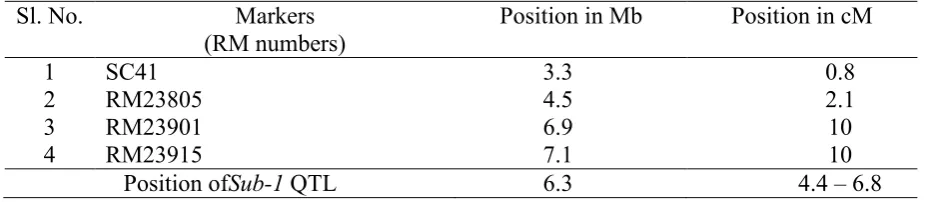
generation was to obtain single recombinant type segregant at one side of the Sub-1 QTL. Single recombinant type segregants were those types of segregants which minimized linkage drag at one side of the QTL. In other sense, single recombinant type segregants possessed the recipient allele for both the flanking markers used at any one side of the QTL. These types of segregants were very rare in frequency. Frisch et al.(1999) reported that relatively small population sizes could be used for recombinant selection. A total of four flanking markers (SC41, RM23805, RM23901 and RM23915) from the sub-telocentric Sub-1 region of chromosome 9 were used in BC4F1
generation. The description of these flanking markers is presented in Table 2.
SC41 and RM23805 were used as flanking marker for proximal end and RM23901 and RM23915 were used for distal end. The distance between the closest flanking marker
and Sub-1 QTL was 1.8 Mb (2.3 cM) at
proximal end and 0.6 Mb (2.4 cM) at distal end (Table 2). The scores for flanking markers viz. RM296, RM8300 & RM23915 were ‘B’ which indicated that the plants had fixed donor allele at the proximal and distal end of
Sub-1 QTL in BC4F1 generation. It was not
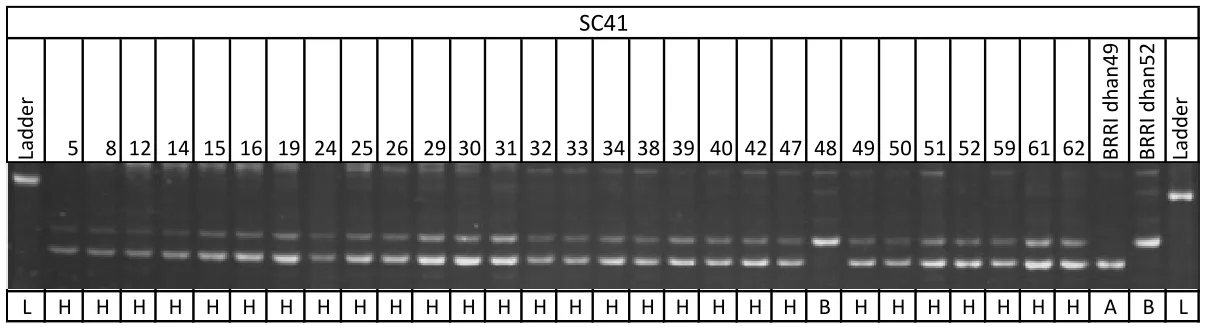
possible to minimize linkage drag at both sides of the QTL. As the chromosomal background of BRRI dhan52 near Sub-1 QTL did not affect phenotype of the BRRI dhan52. Hopefully, non-minimization of linkage drag in the genetic background BRRI dhan49-Sub-1 will not also affect its phenotype. The gel picture of recombinant selection SC41 is shown in Fig. 2.
Background Selection
A total of 40 microsatellite markers were used for background selection over 10 BC4F1 plants
International Journal of Research (IJR)
e-ISSN: 2348-6848, p- ISSN: 2348-795X Volume 2, Issue 05, May 2015 Available at http://internationaljournalofresearch.org
chromosome 9 and minimum number of background markers used was 1 for chromosome 3, 4 and 12. Hospital et al.(1992) and Visscher (1996) reported that, as a general rule, two to four markers per 100 cM could be efficiently used to accelerate the recovery of the recurrent parent genome in the early generations such as BC1F1 or BC2F1. The
reason for this was that in early generations, few recombinant events occurred so that
donor chromosome segments were
represented by a few long segments on each chromosome. Neerajaet al.(2007) used 56 SSR markers as initial background markers for the development of Swarna-Sub1. However, the average number of background markers over all the 12 chromosomes was 3.5. The percent markers homozygous for the recipient parent ranged from 51.35 to 82.75% in those 10 plants (Table 3).
In BC4F1 generation, plant no 42, 47 and 49
were considered as best plants on the basis of phenotype and recipient genome recovery. The percentage of recipient genome recovery in the best plants 42, 47 and 49 were 86.84%, 85.13 and 85.0%, respectively. Inplant number 42 (Table 3& Fig. 3) of BC4F1 generation, 28
markers out of 42 markers (73.68%) was like recipient parent type. But if the alleles of the homologous chromosomes were considered, the percentage of recipient alleles in plant number 42 was 86.84%. So, this plant had been considered as the best plant of that population. Fig. 3 shows the graphical genotype of the best plant 1. The red coloured regions on the chromosomes indicated homozygous region for the recipient genome while the yellow coloured regions indicated the heterozygous regions and the gray coloured regions indicated unknown region. The distances were represented in cM based on published map of Temnykhet al.(2001).
In BC5F1 generation, foreground and
background selection will again be applied to identifythe best plant which will be possible to self-pollinate in order to obtain homozygosity in BC5F2 generation, winter season (2012-13).
In this way, homozygous BRRI dhan49- Sub-1 line will be produced in Boro 2012-13.
Hopefully, newly developed BRRI dhan49-Sub-1 lines could be useful as a short duration submergence tolerant rice line for the flash flood affected greater Northern region of Bangladesh. The newly developed line will also be suitable in the environment affected by multiple flash floods due to shorter growth duration.
The best plant was identified possessed 86.84% recipient parent genetic background along with target Sub-1 QTL in the heterozygous state by using foreground, recombinant and background selection through marker assisted backcrossing. The rest of the genome was segregating for the remaining heterozygous background markers. The recovery of recipient parent genome in the best plant of BC4F1 generation indicated
that one more backcrossing and a final self-pollination in the BC5F1 generation would be
required in order to develop BRRI dhan49-Sub-1 homozygous line and it will be completed in BC5F2 generation. This research
work reflected that the approaches could be routinely used in order to introgress tolerant or resistant genes or QTLs, conferring tolerances or resistances to biotic and abiotic stresses, into the genetic background of high yielding varieties. The newly developed BRRI dhan49-Sub-1 lines could be useful as short duration submergence tolerant rice line for the flash flood affected area of Bangladesh.
REFERENCES
[1.] Adkins,S.W., Shiraishi,T.
andMcComb,J.A.1990.Submergence
tolerance of rice – A newglasshousemethod for the experimental submergence of plants. PhysiologiaPlantarum80: 642-646.
[2.] Chen,X., Temnykh,S., Xu,Y., Cho,Y. G. and McCouch,S. R.1997.Development of a microsatellite framework map providing genome-wide coverage in rice (Oryza sativa L.). TheorAppl Genet.95:553–567.
[3.] Frisch, M., Bohn, M. and
International Journal of Research (IJR)
e-ISSN: 2348-6848, p- ISSN: 2348-795X Volume 2, Issue 05, May 2015 Available at http://internationaljournalofresearch.org
transfer of a target gene. Crop Science39:
967-975.
[4.] Hospital,F.2005.Selection in backcross programmes. Philosophical Transactions of the Royal Society B.360:1503-1511.
[5.] Hospital. F., Chevalet, C. and Mulsant, P. 1992.Using markers in gene introgression breeding programs. Genetics132: 1199-1210.
[6.] Iftekharuddaula,K.M., Newaz,M.A.,
Salam, M.A., Ahmed,H.U.,
Mahbub,M.A.A., Septiningsih,E.M.,
Collard,B.C.Y., Sanchez,D.L., Pamplona, A.M. andMackill,D.J. 2011.Rapid and high-precision marker assisted backcrossing to introgress the SUB1 QTL into BR11, the rainfed lowland rice mega variety of Bangladesh. Euphytica178:83-97.
[7.] Neeraja,C.N.,
Maghirang-Rodriguez,R., Pamplona,A., Heuer,S.,
Collard,B.C.Y., Septiningsih,E.M.,
Vergara,G., Sanchez,D., Xu,K., Ismail,A.M. andMackill,D.J. 2007. A marker-assisted
backcross approach for developing
submergence-tolerant rice cultivars.
TheorAppl Genet.115:767-776.
[8.] Temnykh,S.,Clerck,G. D., Lukashova,
A.,Lipovich,L.,Carthinour, S. and
McCouch,S. R. 2001.Computational and experimental analysis of microsatellites in rice (O. sativa L.): frequency, length variation, transposon associations, and genetic marker potential. Genome
Research11:1441-1452.
[9.] Van Berloo, R. 2008. GGT 2.0: Versatile software for visualization and analysis of genetic data. Journal of
Heredity99:232-236.
[10.] Visscher,P. M. 1996. Proportion of the variation in genetic composition in backcrossing programs explained by genetic markers. Journal of Heredity87: 136-138. [11.] Zheng, K., Huang, N., Bennett, J. and
Khush,G.S.1995.PCR-based marker-assisted selection in rice breeding. International Rice Research Institute (IRRI), Los Baños,
International Journal of Research (IJR)
e-ISSN: 2348-6848, p- ISSN: 2348-795X Volume 2, Issue 05, May 2015 Available at http://internationaljournalofresearch.org
Table1. Details of polymorphic markers
Sl. No.
Chrom. No.
Primers Position (cM)
Position (Mb)
Band Size BRRI dhan49
BRRI
dhan52 Forward Reverse
Repeat motif
1 1 RM272 37.3 - 240.00-245.00 B A AATTGGTAGAGAGGGGAGAG ACATGCCATTAGAGTCAGGC (GA)9
2 1 RM583 58.9 - 193.00-199.00 B A AGATCCATCCCTGTGGAGAG GCGAACTCGCGTTGTAATC (CTT)20
3 1 RM104 186.6 - 221.44-230.72 A B GGAAGAGGAGAGAAAGATGTGTGTCG TCAACAGACACACCGCCACCGC (GA)9
4 1 RM414 191.4 - 230.00-235.00 B A ATTGCAGTCATGCAGCAGTC ATATCTCCAATGTGGCAGGG (ATGC)6
5 2 RM110 6.9 1.32 146.23-165.64 B A AAATTCGAAGCCATCCACCAACG GCCGACGAGGTCGAGTAGAAGG (GA)15
6 2 RM423 28.7 - 229.27-302.84 B A AGCACCCATGCCTTATGTTG CCTTTTTCAGTAGCCCTCCC (TTC)9
7 2 RM452 58.4 - 204.86-211.64 B A CTGATCGAGAGCGTTAAGGG GGGATCAAACCACGTTTCTG (ACG)9
8 2 RM525 143.7 - 108.52-112.33 A B GGCCCGTCCAAGAAATATTG CGGTGAGACAGAATCCTTACG (AAG)12
9 2 RM341 82.7 - 119.28-152.24 B A CAAGAAACCTCAATCCGAGC CTCCTCCCGATCCCAATC (CTT)20
10 2 RM208 186.4 35.13 175.07-145.60 A B AGTACCACCACCATTCTCTGCAAGC TCGATTGGCCATGAGTTCTCG (CT)12
11 3 RM231 15.7 - 179.88-195.20 B A CCAGATTATTTCCTGAGGTC CACTTGCATAGTTCTGCATTG (CT)16
12 4 RM119 76.1 - 178.00-180.48 A B CATCCCCCTGCTGCTGCTGCTG CGCCGGATGTGTGGGACTAGCG (GTC)6
13 5 RM153 0.0 0.167 197.77-204.35
A B GCCTCGAGCATCATCATCAG ATCAACCTGCACTTGCCTGG (GAA)9
14 5 RM574 41.0 3.42 160.17-167.51 A B AAACTAGCCACGGTTTGGTAGGG AGGGTGGCAGGGATGTAATTTCC (GA)11
15 5 RM598 68.3 - 184.38-203.46 A B GAATCGCACACGTGATGAAC ATGCGACTGATCGGTACTCC (AGC)9
16 5 RM334 141.8 - 182.28-195.46 A B GTTCAGTGTTCAGTGCCACC GACTTTGATCTTTGGTGGACG (CTT)20
17 6 RM589 3.2 - 189.54-227.13 A B ATCATGGTCGGTGGCTTAAC CAGGTTCCAACCAGACACTG (AC)24
18 6 RM136 51.2 - 98.32-104.32 B A GAGAGCTCAGCTGCTGCCTCTAGC GAGGAGCGCCACGGTGTACGCC (AGG)7
19 6 RM528 121.6 249.78-258.39 A B GGCATCCAATTTTACCCCTC AAATGGAGCATGGAGGTCAC (AGAT)9
20 6 RM340 133.5 - 119.0-157.86 A B GGTAAATGGACAATCCTATGGC GACAAATATAAGGGCAGTGTGC (CTT)8T3(CTT)14
21 7 RM481 3.2 - 146.00-157.62 A B TAGCTAGCCGATTGAATGGC CTCCACCTCCTATGTTGTTG (CAA)12
22 7 RM455 65.7 - 130.96-154.67 A B AACAACCCACCACCTGTCTC AGAAGGAAAAGGGCTCGATC (TTCT)5
23 8 RM256 101.5 24.14 105.20-110.50 A B GACAGGGAGTGATTGAAGGC GTTGATTTCGCCAAGGGC (CT)21
24 8 RM458 121.8 - 175.80-184.51 A B GGTGATCTGCATTGTCAACG TGCAATGGATCTAGCGACTG (TAG)8
25 9 RM296 0.0 - 122.49-129.60 A B CACATGGCACCAACCTCC GCCAAGTCATTCACTACTCTGG (GA)10
International Journal of Research (IJR)
e-ISSN: 2348-6848, p- ISSN: 2348-795X Volume 2, Issue 05, May 2015 Available at http://internationaljournalofresearch.org
Contd. Table1.
Sl. No.
Chrom.
No. Primers Position (cM) Position (Mb) Band Size dhan49 BRRI dhan52 BRRI Forward Reverse Repeat motif 27 9 RM23805 2.1 4.5 164.30-183.02 B A GAGACAGATGTGTACGGTTTGGTG TTGACAAGGGAATTGAAGGAGAAG (AC)13
28 9 RM23843 2.4-3.2 5.6 298.93-315.61 B A TCACAGACATAATTGTTTGGAGAAGG CCAAAAGCTTTCATCTTTTTGTCC (AT)40 29 9 Sub1C173 4.4 198.92-213.86 B A TGAGCACCATGCAATAACTGTCG CAGTGTTGGTGTGTGGGATTCG
30 9 RM8300 6.8-10.0 206.26-217.77 B A GCTAGTGCAGGGTTGACACA CTCTGGCCGTTTCATGGTAT
31 9 RM23901 6.8-10.0 6.9 252.20-256.78 B A CGATTTGTTGTCAGCGTGAATTAG CAAAAATCATCTATTTTCGCAGGC (AT)45 32 9 RM23915 10.0 7.2 260.26-273.44 B A CACATAGTTTCCATGCTCGTTCAC GGTAGAATCCATGACCGTCTCATC (AC)15
33 9 RM219 11.7 210.74-224.41 B A CGTCGGATGATGTAAAGCCT CATATCGGCATTCGCCTG CT
34 9 RM23958 20.7 7.9 109.40-117.02 B A CAACTAGCCCTACCGTGCAT CGTGTTAAAGCAGCGAAACA (AG)15
35 9 RM434 57.7 - 195.65-224.75 A B GCCTCATCCCTCTAACCCTC CAAGAAAGATCAGTGCGTGG (AG)12
36 9 RM245 112.3 - 148.97-154.22 A B ATGCCGCCAGTGAATAGC CTGAGAATCCAATTATCTGGGG CT
37 10
RM244 15.0 - 159.50-161.75 A B CCGACTGTTCGTCCTTATCA CTGCTCTCGGGTGAACGT (CT)4(CG)3
C(CT)6
38 10 RM216 17.6 - 135.94-149.75 A B GCATGGCCGATGGTAAAG TGTATAAAACCACACGGCCA (AG)12
39 10 RM536 55.1 242.98-248.44 A B CACTCACACGAACGACTGAC CGCAGGTTCTTGTGAAATGT (TC)11(CT)
5C3(CT)5
40 11 RM229 77.8 18.37 112.0-117.20 A B AGCCCCGAATAAATCCACCT CTGGAGGAGCATTTGGTAGC (TC)6ATT
(CT)11
41 11 RM254 110.0 - 210.36-247.97 A B
42 12 RM12 109.1 - 154.48-182.34 B A TGCCCTGTTATTTTCTTCTCTC GGTGATCCTTTCCCATTTCA AA
International Journal of Research (IJR)
e-ISSN: 2348-6848, p- ISSN: 2348-795X Volume 2, Issue 05, May 2015 Available at http://internationaljournalofresearch.org
Table 2. Flanking markers used in BC4F1 generation.
Sl. No. Markers
(RM numbers) Position in Mb Position in cM
1 SC41 3.3 0.8
2 RM23805 4.5 2.1
3 RM23901 6.9 10
4 RM23915 7.1 10
Position ofSub-1 QTL 6.3 4.4 – 6.8
Table 3. Results of background selection, BC4F1 generation.
Items Plant`s Number
12 15 16 26 31 40 42 47 49 61
Recipient parent (A) 19 22 26 26 27 25 28 26 21 24 Heterozygous (H) 18 16 12 13 10 13 10 11 9 5
Donor parent (B) 0 0 0 0 1 0 0 0 0 1
% A 51.35 57.89 68.42 66.66 72.97 65.78 73.68 70.27 70 82.75 %Recipient allele 77.8 78.94 84.21 83.33 86.48 82.89 86.84 85.13 85.0 91.37
Ranking for best
plant selection1 8 7 4 5 10 6 1 2 3 9
International Journal of Research (IJR)
e-ISSN: 2348-6848, p- ISSN: 2348-795X Volume 2, Issue 05, May 2015 Available at http://internationaljournalofresearch.org
Figure 1. Gel picture of the foreground selection with the tightly linked marker RM8300 in BC4F1 generation. (1-62 = BC4F1 generations
developed between the cross of BRRI dhan49 and BRRI dhan52, L=Ladder marker, A= Recipient parent, B= Donor parent and H= Heterozygous).
Lad
d
er
1 2 3 4 5 6 7 8 9 10 11 12 13 14 15 16 17 18 19 20 21 22 23 24 25 26 27 28 29 30 31 32 33 34 35 36 37 38 39 40 41 42 43 44 45 46 47 48 49 50 51 52 53 54 55 56 57 58 59 60 61 62 BRRI dh
an
4
9
BRRI dh
an
5
2
Lad
d
er
L A A A A H A A H B A A H A H H H A A H A A A A H H H B A H H H H H H A A A H H H A H A A A A H H H H H H A A A A A A H A H H A B L
International Journal of Research (IJR)
e-ISSN: 2348-6848, p- ISSN: 2348-795X Volume 2, Issue 05, May 2015 Available at http://internationaljournalofresearch.org
Figure 2. Gel picture shows the partial view of the recombinant selection with the flanking marker SC41. (5, 8, 12, 14, 15, 16, 19, 24, 25, 26, 29,
30, 31, 32, 33, 34, 38, 39, 40, 42, 47, 48, 49, 50, 51, 52, 59, 61 and 62 = recombinants selected by flanking marker, L=Ladder marker, A= Recipient parent, B= Donor parent and H= Heterozygous).
Lad
d
er
5 8 12 14 15 16 19 24 25 26 29 30 31 32 33 34 38 39 40 42 47 48 49 50 51 52 59 61 62 BRRI dh
an
4
9
BRRI dh
an
5
2
Lad
d
er
L H H H H H H H H H H H H H H H H H H H H H B H H H H H H H A B L
International Journal of Research (IJR)
International Journal of Research (IJR)
e-ISSN: 2348-6848, p- ISSN: 2348-795X Volume 2, Issue 05, May 2015 Available at http://internationaljournalofresearch.org
Figure 3. Graphical genotype of the selected best plant of BC4F1 generation. The red colored regions on the chromosomes indicated