Reactive Power Optimization in Grid using
Imperialist Competitive Algorithm
J.Karthikeyan
1, K.S.Chandragupta Mauryan
2, M. Pradeepkumar
3Assistant Professor, Sri Krishna College of Technology, Coimbatore, Tamilnadu, India 1 Assistant Professor, Sri Krishna College of Technology, Coimbatore, Tamilnadu, India 2
Student, EEE, Sri Krishna College of Technology, Coimbatore, Tamilnadu, India 3
ABSTRACT:The Imperialist Competitive Algorithm (ICA) is a heuristic technique for optimization procedure. This algorithm is based on socio-politically inspired optimization strategy. It has shown better convergence rate to achieve global optimum for different optimization problems. The IEEE 30-bus test system is used to demonstrate some aspects of the application of the ICA on the reactive power market problem. The outcomes are compared with those obtained by the Genetic Algorithm (GA) showing that the ICA convergence rate is more than GA.
KEYWORDS: Imperialist Competitive Algorithm, reactive power optimization.
I. INTRODUCTION
Reactive power optimization is a short-term planning activity carried out by system operators in order to ensure secure power system operation. Reactive power has a significant effect on the system security as it is directly associated with the power system voltage stability [1]. The reactive power can be controlled in order to improve the voltage profile and to minimize the system loss. Generally some load bus voltage may violate their upper or lower limits during system operation due to the disturbance or system configuration changes. The power system operator can alleviate this situation and voltages can be maintained within their permissible limits by reallocating reactive power generation in the system [2]. This means by adjusting the generator voltages, transformer taps and switchable VAR sources (capacitor or reactor).
In this paper, Imperialist Competitive Algorithm (ICA) is a population based algorithm, used to solve the reactive power optimization problem in a power grid. Conjointly, implementation of the ICA on reactive power optimization problem is compared with Genetic Algorithm.
This paper put forwards the efficient communication between CR nodes and spectrum utilization. Secondly, the security concerns of spectrum sensing are to ensure steadfastness. It uses two selection schemes called Node Selection Scheme (NSS) and Channel Selection Scheme (CSS). The aim of NSS is to allow each node to check its gain in copying a message to a relay while reconnoitring its transmission effort. Using NSS, each node decides which path should be used in order to provide minimum energy consumption without enduring end-to-end delay performance. Based on CSS, each node decides and switches to a licensed channel to maximize spectrum utilization while keeping the interference in a minimum level. This eventually enables CR-Network nodes to determine optimum path nodes and channels for an efficient communication in CR-Networks. The CR technology allows Secondary Users (SUs) to seek and utilize “spectrum holes” in a time and location-varying radio environment without causing harmful interference to Primary Users (PUs). This opportunistic use of the spectrum, leads to new challenges to the varying available spectrum. Using a Trust-Worthy algorithm, it improves the firmness of the Spectrum sensing in CR-Networks.
II.IMPERIALISTIC COMPETITIVE ALGORITHM
powerful and the weakest one will collapse. The ICA starts with an initial population called countries. Some of the best countries in the population are selected to be the imperialists and the rest form the colonies of these imperialists. Each imperialist with his colonies forms the empire. The more powerful imperialist, have the more colonies. In other words, the imperialist with a larger empire is more powerful. When the imperialist competition starts, their attempt to achieve more colonies starts. And the colonies start to move towards their imperialists. At the end, just one imperialist will remain.
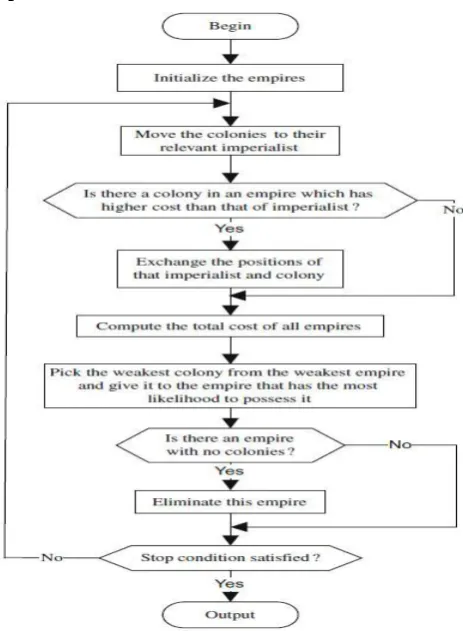
The steps used in the ICA are as follows:
1. Form the initial population of decision variables.
2. Select some random points on the function and initialize the empires. 3. Move the colonies toward their relevant imperialist (Assimilation). 4. Randomly change the position of some colonies (Revolution).
5. If there is a colony in an empire which has lower cost than the imperialist, exchange the positions of that colony and the imperialist.
6. Unite the similar empires.
7. Compute the total cost of all empires.
8. Pick the weakest colony (colonies) from the weakest empires and give it (them) to one of the empires (Imperialistic competition).
9. Eliminate the powerless empires.
10. It terminates if stop condition convinced, else go to step 2.
More details about the ICA can be obtained from [9]. The Imperialistic Competitive Algorithm is a newly introduced global search strategy that has recently been implemented for solving different optimization problems. This evolutionary optimization technique has shown great performance in both convergence rate and global optimum achievement. The initial population consists of individuals named country in the beginning of the algorithm and then the populations are separated to two different types as imperialist and colony based on their power (fitness value). Some of the best initial countries (the countries with the least fitness value) become Imperialists and start taking control over other countries (called Colonies) and form the initial Empires. The stage of this algorithm is conferred below.
Initial empires formation
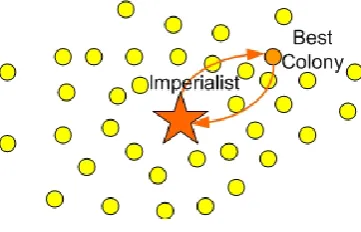
At the start of the algorithm, an initial population (countries) should be created. Each country consists of N variables to be optimized. The Fig. 1 shows the characteristic of empires formation.
Countryi = [x1,i x2,i x3,i ……..xNvar,i]
The cost function of countries is calculated by evaluating the function f at the variables. Costi = f (Countryi) = f(x1,i x2, ix3,I ….xNvar,i)
Fig.1 Empires formation
In the beginning, Ncountry is defined as the initial number of empire countries. The best countries of this empire are selected as imperialists (Nimp). Each of the remaining countries is under the control of one of those imperialists as colonies (Ncol). These colonies are divided between imperialists depending upon their power. In order to perform this work, first we should calculate the normalized cost of imperialists using equation below
Cn = max {ci}- cn
Where, Cn is the cost of nth imperialist, max{Ci} is maximum cost of imperialists and n C is the normalized cost of nth
Pn= Cn
Ci
Nimp i=1
Finally the initial number of colonies that belong to each imperialist is calculated: N .C.n = round { pn .(Ncol)}
Where, N .C.n is the initial number of colonies that belong to an imperialist, Ncol is the number of all colonies in initial
population and round is a function which returns the nearest integer to a floating point number.
Movement of colonies towards the imperialists
In this stage of algorithm, the colonies of each imperialist are moved towards them. If the problem has n variables, there would be an n dimensional space in which each country is a point on this space. The colony is moved by x units towards the imperialist. „x‟ is a random number in the interval (0,βd) which usually has uniform distribution. „d‟ is considered as the distance between the imperialist and the colony and β is a number larger than one and nearly two. β=2 is a good selection. Movement is not mandatory in the direction of the line towards the imperialist and it can deviate from this line (Figure 1). The deviation (θ) depends upon the problem and should be tuned. θ=π/4 is a optimum selection for many applications. Equation shows this process in two dimensions:
Newcolni = colni +β * rand * (impn – colni )
Where, coln i
is the position of the ith colony of the nth imperialist, rand is a random number in (0, 1) and impn is the
position of the nth imperialist. After the movement of the colonies towards the imperialist, if the colonies reach a better position than imperialist (with a lower fitness value) their position would be switched. The Fig. 2 shows the exchanging the positions of a colony and Imperialist
Fig. 2 Exchanging the positions of a colony and Imperialist
Imperialistic Competition and elimination of weak empires
In this stage, the weakest colony of the weakest imperialist is given to other imperialists depending on their power (probability). For calculating this probability, first we should calculate the total cost of the empires. The total cost of an empire equals to the sum of its own cost and a part of cost of its colonies:
T.C.n = Cost (imperialist) + ζ mean
{Cost(colonies of empires)}
Where, T.C.n is the total cost of nth empire and ζ is a positive number which is considered to be less than 1. This
number represents the effect of colonies in the total cost of empire. Then we can calculate the normalized total cost of empire:
N .T .C.n = max{T .C.i} – T .C .n
Where, N.T.Cn is the normalized total cost of nth empire. Finally we can calculate the probability (power) of each
empire for absorbing the weakest colony. Pp n =
𝑁.𝑇.𝐶.n
𝑁 .𝑇.𝐶.i
𝑁𝑖𝑚𝑝 𝑖=1
More powerful imperialists have more chance to absorb the weakest colony. For implementation of this issue, the following works should be done. First we should form Pp and R matrices:
Pp = [ Pp1 , Pp2 , ….,PpNimp ]
R = [r1,r2,…..,rNimp ]
D =Pp - R = [Pp1-r1, Pp2 -r2 ,..PpNimp -rNimp ]
The imperialist which has the maximum relevant index in D vector will absorb the mentioned colony. If an imperialist loses all of its colonies, it will collapse.
Imperial flow representation
Convergence
After a while, all empires will collapse except the most powerful one and all the other countries will be under the control of this empire. At this point, the algorithm stops. This condition cannot be ample enough for obtaining accurate results. Sometimes, it is required that the position of some or all the countries would be the same which is an ideal solution. And sometimes the maximum iteration number can be considered as a criterion for stopping the algorithm. The weakest colony in empire is shown in Fig.3. In this method weakest colony in empire is easily found.
III. PROBLEM FORMULATION
The problem of reactive power optimization is directly concerned not only with the service quality and reliability of supply but also with the economy and security of the power systems. Generally, some load bus voltage might violate their upper or lower limits during system operation due to disturbance and system configuration changes [3].
Objective Function
The primary objective of the Reactive Power Optimization (RPO) problem is to reduce the system‟s real power losses and to obtain the setting of various controls for the same. The real power loss is a non-linear function of bus voltage magnitudes and phase angles, which are implicitly a function of the control variables [4].
The objective function is
Min f(x) = nl P
k=1 kLoss = nlk=1GK[Vi2+ Vj2− 2ViVjcosθij]
Where,
PLoss Real power loss in the transmission
network
Gk Conductance of the line connecting i and
j bus
Vi Voltage magnitude on the bus i
Vj Voltage magnitude on the bus j
θij Phase angle of the voltage value between
i and j bus
Equality Constraints
Pgi− Pdi− Vi Vj(Gijcosθij+ Bijsinθij) nb
j=1 = 0
Qgi− Qdi− Vi Vj(Gijcosθij− Bijsinθij) nb
j=1
Where,
Pg Active power of the generation
Qg Reactive power of the generation
Pd Demand of the active power
Qd Demand of the reactive power
Gij Conductance of the line i th
and jth bus
Bij Susceptance of the line ith and jth bus
θij Voltage angle between bus i and bus j
nb Number of buses
Inequality Constraints
Qgimin < Qgi < Qgimaxi∈ng
Vimin < Vi< Vimaxi∈nb
Tkmin < Tk < Tkmaxk∈nt
Qcimin < Qci< Qcimaxi∈nc
Vi≥ Vi max → Vi= Vi max
Vi≤ Vi min → Vi = Vi min
Qi≥ Qi max → Qi= Qi max
Qi≤ Qi min → Qi= Qi min
Power flow equations are used as equality constraints, reactive power source installation restrictions, reactive power generation restrictions, transformer tap-setting and bus voltage restrictions are used as inequality constraints [5].
IV. OPTIMIZATION RESULTS
Fuzzy Logic
[3]
PSO
[8]
Bacterial
Foraging
[10]
Proposed
Method
Total kVAR
2400
2063
2550
2400
Real Power loss (KW)
165.07
168.80
161.86
160.92
Reactive Power Loss (KVA)
47.825
48.961
47.308
47.047
Min Voltage
0.9515
0.9496
0.9500
0.9507
The above table shows the result comparison of fuzzy logic, PSO, Bacterial foraging and proposed method of total kVAR, real power loss, reactive power loss and minimum voltage. It is evident that the proposed method has minimum losses and better voltage profile compared to methods listed above.
V. CONCLUSION
This technique is designed for the distributed grid network to reduce the real power loss by selecting the minimum loss path implementing the ICA at the network. These generated networks are compared with PSO, Fuzzy Logic, Bacterial Foraging and other obtained values with lesser iteration and has lesser time.
REFERENCES
1. Bae.Y.G. “Analytical method of capacitor allocation on distribution primary feeders,” IEEE Trans. Power Apparatus System, vol. 97, no. 4, pp.1232-1238, 1987.
2. Salama.M.M.A, Mansour.E.A.A, Chikhani, Hackam.A.Y.R, “Control of reactive power in distribution systems with an end-load and varying load conditions,” IEEE Trans. Power Apparatus System, vol.104, no. 4, pp. 941-947, 1985.
3. Abdul-rahman.KH, “Reactive power optimization using fuzzy load representation”, IEEE Transactions on Power Systems, vol. 9, no. 2, pp. 898-905, 1994.
4. K. Bhattacharya, J. Zhong, “Reactive power as an ancillary service,” IEEE Trans. Power Systems, vol. 16, no. 2, pp. 294-300, 2001.
5. J. Zhong, E. Nobile, A. Bose, K. Bhattacharya, “Localized reactive power markets using the concept of voltage control areas,” IEEE Trans. Power Systems, vol. 16, no. 2, pp. 294-300, 2001.
6. S. K. Parida, S. N. Singh, S. C. Srivastava, “Voltage security constrained localized reactive power market,” Power India Conference, 2006. 7. Ismael El-Samahy, Kankar Bhattacharya, Claudio Canizares, Miguel F. Anjos, Jiuping Pan, “A procurement market model for reactive power
service considering system security,” IEEE Trans. Power Systems, vol. 23, no. 1, 2008.
8. Mahadevan.K, Kannan.P.S, “Comprehensive learning Particle Swarm Optimization for Reactive Power Dispatch,” International Journal of Applied Soft Computing, vol. 10, no. 2, pp. 641-652, 2010.
9. Ghasemi M., Roosta A, “Imperialist Competitive Algorithm for Optimal Reactive Power Dispatch Problem: A Comparative Study,” Journal of World‟s Electrical Engineering and Technology, vol. 2, no. 2, pp. 22-29, 2013.