Single Document Keyphrase Extraction Using Label Information
Sumit Negi IBM Research
Delhi, India
Abstract
Keyphrases have found wide ranging application in NLP and IR tasks such as document sum-marization, indexing, labeling, clustering and classification. In this paper we pose the problem of extractinglabel specifickeyphrases from a document which has document level metadata as-sociated with it namelylabelsortags (i.e. multi-labeled document). Unlike other, supervised or unsupervised, methods for keyphrase extraction our proposed methods utilizes both the doc-ument’s text and label information for the task of extractinglabel specifickeyphrases. We pro-pose two models for this purpro-pose both of which model the problem of extracting label specific keyphrases as a random walk on the document’s text graph. We evaluate and report the quality of the extracted keyphrases on a popular multi-label text corpus.
1 Introduction
The use of graphs to model and solve various problems arising in Natural Language Processing have lately become very popular. Graph theoretical methods or graph based approaches have been success-fully applied for a varied set of NLP tasks such as Word Sense Disambiguation, Text Summarization, Topic detection etc. One of the earliest and most prominent work in this area has been the TextRank (Mi-halcea and Tarau, 2004) method - an unsupervised graph-based ranking model for extracting keyphrases and “key” sentences from natural language text. This unsupervised method extracts prominent terms, phrases and sentences from text. The TextRank models the text as a graph where, depending on the end application, text units of various sizes and characteristics can be added as vertices e.g. open class words, collocations, sentences etc. Similarly, based on the application, connections can be drawn between these vertices e.g. lexical or semantic relation, contextual overlap etc. To identify “central” or “key” text units in this text graph, TextRank runs thePageRankalgorithm on this constructed graph. The ranking over vertices (text units), which indicates their centrality and importance, is obtained by finding the stationary distribution of the random walk on the text graph.
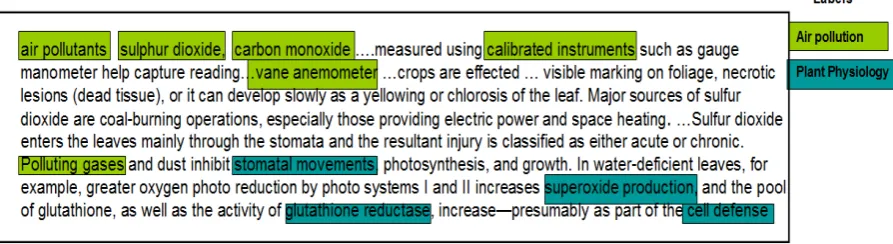
In this paper, we consider the problem of extractinglabel specifickeyphrases from a document which has document level metadata associated with it namelylabels(i.e. multi-labeled document). To elabo-rate, consider a document as shown in Figure 1. This document has been assigned to two categories as indicated by the labels “Air Pollution” and “Plant Physiology”. Running TextRank on this article yields top ranked key-phrases such as “calibrated instrument”, “polluting gases”, “industrial development” etc. These keyphrases, though central to the article, are not specific to any of thelabelsthat have been assigned to the article. For instance, one would associate keyphrases such as “carbon monoxide”, “air pollutants” to be more relevant to the “Air Pollution” label and keyphrases such as “stomatal movement”, “cell defense” to be more closely associated with the “Plant Physiology” label. The objective of this pa-per is to explore extensions to TextRank for extracting label-specific keyphrases from a multi-labeled document. Such label-specific keyphrases can be useful for a number of practical applications namely: highlighting such terms within the body of a document could provide a label-specific (topic-focussed) view of the document thus facilitating fast browsing and reading of the document, such key terms could also be useful for generating topic-driven or label-specific summaries and in multifaceted search.
This work is licenced under a Creative Commons Attribution 4.0 International License. Page numbers and proceedings footer are added by the organizers. License details:http://creativecommons.org/licenses/by/4.0/
Figure 1:Label specific keyphrases (best viewed in color). Note that there could be keyphrases that are common to both labels. Due to space restrictions only a snippet of the document is shown.
The rest of the paper is organized as following. We discuss related work and provide an overview of our approach in Section 2. Details of the proposed method is discussed in Section 3 followed by evaluation in Section 4. Future work and conclusion is presented in Section 5.
2 Related Work
The methods for keyphrase (or keyword) extraction can be roughly categorized into eitherunsupervised
orsupervised.Unsupervised methodsusually involve assigning a saliency score to each candidate phrase by considering various features. Popular work in this area include the use of point-wise KL-divergence between multiple language models for scoring bothphrase-nessandinformativenessof candidate phrases (Tomokiyo and Hurst, 2003), use of TF-IDF weighting (A. Hulth, 2003) etc.Supervised machine learn-ing algorithms have been proposed to classify a candidate phrase into either keyphrase or not using features such as the frequency of occurrence, POS information, and location of the phrase in the docu-ment. All the above methods only make use the document text for generating keyphrases and cannot be used (as-is) for generating label-specific keyphrases.
One possible method for extracting label-specific keyphrases from a document could be based on post-processing the output of the TextRank algorithm in the following way (1) Identify a set of label specific featuresfcand
l (unigram terms) that are strongly correlated with thelabel. This could be done by applying feature selection methods (Forman, 2003), (Forman, 2003) on a multi-label text corpus (we discuss this step in more detail in a later section). For instance,fcand
air_pollution={“pollutant”,“gases”,...} (2) Run the TextRank algorithm on the documentdto generate a list of keyphraseskeyphrased(3)Filter the resultant listkeyphrasedbased on lexical or semantic match with the label specific featuresflcandto generatekeyphrasel
dor label-lspecific keyphrase for documentd.
This approach suffers from the following limitations (a) The keyphrase list generated in Step (2) i.e. keyphrased might be dominated by keyphrases which have little to do with labell. Post processing this list (Step 3) usingfcand
l might result in only very few keyphrases inkeyphraseld. (b) The label specific featuresfcand
l , which are derived from corpus level statistics1, might not be the best indicator of thekeyphrase-nessof a term in the document. (c) Moreover, consider a scenario where a document is associated with more than one label. Consider the previous example where the document is associated with two labels “Air Pollution” and “Plant Physiology”. When extracting keyphrases specific to the label/category “Air Pollution” from document d one would expect that the extracted keyphrases are
closerto theAir Pollutionlabel/category anddistantfrom other labels associated with documentdi.e. “Plant Physiology”. It is not evident how this can be modeled in this approach. In this paper we propose an approach that models the problem of finding label-specific keyphrases in a document as a random walk on the document’s text-graph. Two approaches are proposed namelyPTR: Personalized TextRank
andTRDMS: TextRank using Ranking on Data Manifolds with Sinks.
PTR: Personalized TextRank : In this setting the PageRank algorithm, which is the underpinning of theTextRankkeyphrase extraction algorithm, is replaced with the personalized page rank (Haveliwala, 2002) algorithm. By using the label specific featuresfcand
l as thepersonalization vectorwe are able to bias the walk on the underlying text graph towards terms relevant to the label. We discuss this approach in more detail in Section 3.3. Even though using a label specific transport orpersonalization vector
helps bias the walk towards terms specific to that label, terms relevant to labels other thanlcontinue to influence the walk. ThePersonalized TextRankmethod offers no elegant solution which would penalize terms unrelated tolwhile simultaneously preferring terms relevant to labell.
To achieve both these goals in one model we propose theTRDMS: TextRank using Ranking on Data Manifolds with Sinksapproach. We model the problem of identifying label specific keyphrases in a given document as a random walk over the document’sweightedtext graph withsinkandquerynodes2.
Rank-ing on data manifolds was first proposed by (Zhou et al., 2004) and has been used for multi-document summarization (Wan et al., 2007), image retrieval (He et al., 2004) etc. An intuitive description of the ranking algorithm is described as follows. A weighted network is constructed first, where nodes rep-resent all the data and query points, and an edge is put between two nodes if they are “close”. Query
nodes are then initialized with a positive ranking score, while the nodes to be ranked are assigned a zero initial score. All the nodes, except thesinknodes, then propagate their ranking scores to their neighbor via the weighted network. The propagation process is repeated until a global state is achieved, and all the nodes except the query nodes are ranked according to their final scores. Manifold ranking gives high rank to nodes that are close to the query nodes on the manifold (relevance) and that have strong centrality (importance). Sink nodes, whose ranking is fixed to the minimum (zero) during the ranking process, do not spread any ranking score to their neighbors thus penalizing the nodes that are connected to them. To use this method for extracting label-(l) specific keyphrases , fcand
l are modeled asquery nodes while features associated with labels other thanl are modeled as sink nodes. This approach is inspired by the work done by (Cheng et al., 2011) for query recommendation and update summarization. Section 3.4 discusses this method in more detail. To summarize, to the best of our knowledge we are the first to propose the problem of extractinglabelspecific keyphrases from a multi-labeled document. Our modifications to TextRank for achieving this task are novel. Moreover, our idea of of usingRanking on Data Manifoldson the document-level text graphs for extracting label specific keyphrases is a new contribution.
3 Generating Label Specific Keyphrases
3.1 Notation
In this section we introduce notations which we use throughout the paper. LetDrepresent a multi-label document corpus and=be the set of all possible labels which could be associated with documents inD. A document from this corpus is denoted bydand the set of labels associated with documentdis denoted by`, whered∈Dand`⊆ =. The text graph for documentdis denoted byGdandMdenotes the number of vertices inGd. We describe how this text graph is constructed in Section 3.2. Features specific to label l, which are extracted from the corpusD, are represented asfcand
l , wherel∈ =. Section 3.5 describes how theselabel specific featuresare extracted from a multi-label document corpus.
3.2 Building the Text Graph
For a given documentdthe text graphGdis built in the following way. All open-class, unigram tokens occurring in dare treated as vertices. Two vertices are connected if their corresponding lexical units co-occur within a window of maximumN words, where N is set to 10 for all our experiments. As in-dicated by (Mihalcea and Tarau, 2004) co-occurrence links express relations between syntactic elements and represent cohesion indicators for a given text. Note that the methods described in Section 3.3 and Section 3.4 provide a score/rank for each vertex (unigram term) in the graph. To generate keyphrases (n-grams) from these candidate terms the following post-processing is performed on the top ranked terms. Vertices are sorted in reverse order of their score and the top K vertices in the ranking are retained
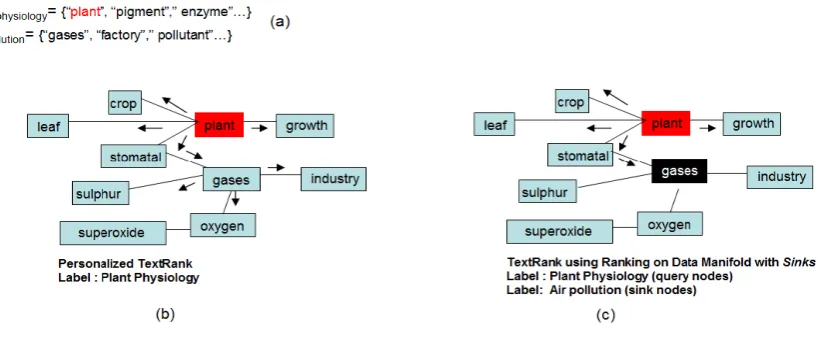
Figure 2:(a) Label specific featuresfcand
l (b)Personalized TextRank- walk biased towards terms related tofplant_physiologycand (shown in red color). (c)TextRank using Ranking on Data Manifold with Sinks: walk biased towards terms related tofcand
plant_physiology, while simultaneously penalizing terms that are related tofcand
air_pollution. The sink points, which are shown in black color, are vertices whose ranking scores are fixed at the minimum score (zero in our case) during the ranking process. Hence, the sink points will never spread any ranking score to their neighbors. Arrows indicate diffusion of ranking scores (Figure best viewed in color)
for post-processing. Let this ranked list be represented as <TK>. During post-processing, all terms se-lected as potential keywords are marked in the text, and sequence of adjacent keywords are collapsed into a multi-word keyphrase. For example, in the text calibrated instruments are used to measure, if the unigram termscalibrated andinstrumentsare selected as potential/candidate terms by the PTR or TRDMS method, since they are adjacent they are collapsed into one single keyphrase “calibrated in-struments”. This heuristic is implemented as a function which is referred askphrasegen(<TK>,d). This function takes as input the ranked term list <TK> and the document textdand returns the collapsed set of keyphrases. A similar approach was adopted in theTextRank(Mihalcea and Tarau, 2004) work.
3.3 PTR: Personalized TextRank
For extracting label-l specific keyphrases from document d we modify the TextRank (Mihalcea and Tarau, 2004) algorithm. We replace thePageRankalgorithm used in theTextRankmethod with the Per-sonalized Page Rank(Haveliwala, 2002) algorithm. PageRank gives a stationary distribution of a random walk which, at each step, with a certain probabilityjumps to a random node, and with probability 1- follows a randomly chosen outgoing edge from the current node. More formally, letGddenotes the text graph of documentdwithM vertices wheredidenotes the out degree of nodewi, thenp=Lp+ (1-)v. Wherepis the page rank vector,Lis aM ×M transition probability matrix withLji=d1i. In the page rank equationvis a stochastic normalized vector whose element values are all 1
M. This assigns equal probabilities to all nodes in the graph in case of random jumps. In thepersonalizedpage rank formulation the vectorvcan be non-uniform and can assign stronger probabilities to certain kind of nodes effectively biasing the PageRank vector. In thePTRapproachvis modeled to capture the evidence that is available for labellin documentd. Doing so biases the walk towards terms that are more specific to labellin the document. This is achieved by considering vertices (terms) that are common between the labellfeature vector i.e.fcand
l and the text graph for documentdi.e. Gd. More precisely, for a labellassociated with a documentd, letVl
d denote the intersection of the setVdwithflcand, i.e. Vdl=Vd∩flcand , whereVd denote the vertex set for the text graph Gd3 andl∈`. In this way Vdl indicates theevidence we have for labellin the text graphGd. To illustrate this point consider Figure 2. The label specific features for labelP lant P hysiology is shown in Figure 2 (a) denoted asfcand
plant−physiology. The term colored in red
3G
indicates the term that is common betweenfcand
plant−physiologyandGdi.e.Vdplant−physiology Having identified the nodes (Vl
d) which should be allocated stronger probabilities in v the next step is to devise a mechanism to determine these probabilities. We experiment with four approaches. In the first approach, referred to as seed_nodes_only, we allocate all the probability mass inv uniformly to the nodes inVl
d, all other nodes i.e. nodes6∈Vdlare assigned zero probability. In the second approach, re-ferred to as theseed_and_etaapproach, we keep aside a small fractionηof the probability mass, which is distributed uniformly to all the nodes6∈Vl
d, the rest of the probability mass i.e. 1-η4is uniformly dis-tributed to all nodes∈Vl
d. The third approach, referred to asnon_uniform_seed_only, is similar to the seed_nodes_onlyapproach except that in this case the probability mass invis not allocated uniformly to the nodes inVl
d. Probability mass is allocated to the nodes in proportion to their importance, as indi-cated by the weights alloindi-cated to the feature infcand
l by the feature selection method used. As we discuss in Section 3.5 the feature selection methods, which are used for generating label specific featurefcand
l ,
compute weights for individual features infcand
l . These weights (e.g mutual information score, t-score) indicate the strength of association between the feature and the label. In thenon_uniform_seed_only approach we allocate probability mass to nodes inVl
d in proportion to theirfeature weights. Finally, in thenon_uniform_etaapproach we distribute the probability mass i.e. 1-ηamongst theVl
d in propor-tion to theirfeature weights. The left probability mass ofηis distributed uniformly amongst other nodes 6∈Vl
d. Performance of these different configurations are evaluated in Section 4.1.
One shortcoming of the PTR approach is that it does not provides a clean mechanism to integrate features from labels other thanlwhich are associated with the documentd. The motivation of doing so is to on one hand bias the walk on the text graph towards terms infcand
l while simultaneously penal-izing terms which are inFcand =∪k6=l and k∈` fkcand5. As shown in Figure 2 (b) not incorporating this information results in a leakage of scores (indicated using arrows) to nodes not relevant to labell(e.g.
gases, sulphur etc) . In the next section we describe theTRDMSorTextRank using Ranking on Data Manifold with Sinksapproach which allows us to simultaneously consider both fcand
l andFcand in the same model.
3.4 TRDMS: TextRank using Ranking on Data Manifold with Sinks
Algorithm 1:Algorithm for generating label-lspecific keyphrases for documentd
Data: Documentd, label-lspecific unigram featuresfcand
l , unigram features for label categories other thanl represented asFcand=∪k6=land k∈`fkcand
Result: label-lspecific keyphrases from documentd
1. Build a Text GraphGdfor documentdas discussed in Section 3.2. Letwiindicate the vertices inGd; 2. Construct anaffinity matrix A, whereAij=sim(wi,wj) if there is an edge linkingwi,wjinGd.sim(wi,wj) indicates similarity between verticeswi,wj;
3. Symmetrically, normalizeAas S =D−1/2AD−1/2. D is a diagonal matrix matrix with its (i,i)-element equal
5. Sort the verticeswq∈Vqin descending order of their scoresp[q]. Let this ranked list be represented as <TK>;
6.kphrasel
d=kphrasegen(<TK>,d) , wherekphraseldis the label-lspecific keyphrase list for documentd; 7. returnkphrasel
d;
In this section we describe the TextRank using Ranking on Data Manifold with Sinksapproach that allows us to simultaneously consider bothfcand
l andFcand when extracting labellspecific keyphrases from document’sdtext graph. For ease of exposition we repeat a few notations and introduce some new ones. LetVddenote the vertex set for the text graphGd. Vertices for the text graphGdare represented bywi wherei∈[1..M], M is the number of vertices i.e. M=|Vd|. As introduce earlier,Vdldenotes the
intersection of the setVdwithflcand, i.e. Vdl=Vd∩flcand.Vdlindicates theevidencewe have for labell in the text graphGd, wherel∈`. These vertices are also referred to asquery nodesin the ranking on data manifold literature. LetV¬l
d denote the intersection of the setVdwithFcand, whereFcand=∪k6=l and k∈` fcand
k i.e. all the unigram features associated with label categories other thanl6. These vertices are also referred to assink nodesin the ranking on data manifold literature. All other vertices are indicated by Vdq, whereVdq=Vd\(Vd¬l∪Vdl) denote the set of points to be ranked. Letp:V → <denote the ranking function which assigns a ranking scorepi to each vertexwi inGd. One can viewpas a vector i.e. p= [p1,....,pM]. A binary vectory= [y1,....,yM] is defined in whichyi= 1 ifwi∈Vdlotherwiseyi = 0.
Algorithm 1 gives a detailed outline of theTRDMSmethod. This algorithm is based on the algorithm proposed by (Cheng et al., 2011) for ranking on data manifold with sink points. To generate label-l specific keyphrase for documentdthe algorithm considers documentd, label-lspecific unigram features fcand
l , and unigram features for labels other thanlrepresented asFcand. It begins by first building a text graphGd. After this an affinity matrixAis constructed. This is shown in Step 2. The affinity matrix A, which captures the similarity between vertices (terms in the text graph) wi and wj, is built using WordNet. We use the popular WordNet::Similarity (Pedersen et al., 2004) package which measures the semantic similarity and relatedness between a pairs of concepts. After symmetrically normalizing A (Step3) and initializing the queryandsink nodes the scores are propagated till convergence (Step 4). The routineconverge(p)checks for convergence by comparing the value ofpbetween two consecutive iterations. If there is little or no change inp the routine return true. To generate n-gram keyphrases we follow the approach described in Section 3.2. In Step6of Algorithm1thekphrasegen7routine is invoked. In order to choose top-k, label-lspecific keyphrases for documentdone can select the firstk elements of thekphrasel
dlist.
3.5 Generating label specific features from a multi-label corpus
As discussed in previous sections the label specific featuresfcand
l play an important role in the overall ranking process. When searching for label-lspecific keyphrases, the unigram featuresfcand
l helps bias the walk on the document’s text graph towards terms that are relevant and central to label l. We also saw that by consideringFcand i.e. unigram features belonging to label categories other thanl8 assink nodes prevents leakage of the ranking score to terms not relevant or central to l. We show through experiments in Section 4 that this improves the quality of label-l specific keyphrases extracted from document d. In order to generate label specific features from a multi-label corpus D we adopt the
problem transformation approach commonly used in label learning. In this approach the multi-label corpusDis transformed into| = | single-label data sets, where=is the set of labels associated with corpusD. Post this transformation any single-labelfeature selection method can be used to extract labell specific features from these single-label data sets. For our setup we experiment with unigram features selected using mutual information and chi-squared based feature selection methods.
4 Experiment
In order to assess the quality of the label-specific keyphrases generated by our system we conduct a manual evaluation of the generated output. Details of this evaluation are provided in Section 4.1. For our experiments we use a subset of the multi-label corpus EUR-Lex9. The EUR-Lex text collection is
a collection of documents about European Union law. It contains many different types of documents, including treaties, legislation, case-law and legislative proposals, which are labeled with EUROVOC descriptors. A document in this data-set could be associated with multiple EUROVOC descriptors10. The
data set that was downloaded contained 16k documents documents and 3,993 EUROVOC descriptors.
6We do not assume thatfcand
l ∩Fcand=∅
7Details of this routine are provided in Section 3.2
8In cases where the document is associated with more than one label or category 9http://www.ke.tu-darmstadt.de/resources/eurlex
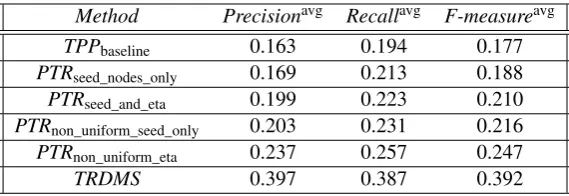
Method Precisionavg Recallavg F-measureavg
TPPbaseline 0.163 0.194 0.177
PTRseed_nodes_only 0.169 0.213 0.188 PTRseed_and_eta 0.199 0.223 0.210 PTRnon_uniform_seed_only 0.203 0.231 0.216 PTRnon_uniform_eta 0.237 0.257 0.247 TRDMS 0.397 0.387 0.392
Table 1:Keyphrase Extraction Results
We removed labels that were under represented11in this data set. We refer to this data set as theEUR− Lexfiltereddata set. We randomly selected 100 documents from theEUR−Lexfiltereddata set. Two criteria were considered when selecting these documents (a) Each document should be associated with at least 2 but not more than 3 labels (b) The size of theevidenceset i.e. |Vl
d|whereVdl =Vd∩fcandl is at least 10% of|Vd|, whereVdrepresents the vertex set of the text graph associated withd. The resulting data set is referred to as theEUR−Lexkeyphrasefiltered data set. The reason for enforcing these two criteria is the following. Ensuring that a document in EUR−Lexkeyphrasefiltered has at least2 labels allows us to experiment withsink nodes i.e. Fcand. As we discuss in Section 4.1 for each labelassociated with a document, a human evaluator was asked to generates a label specific list of keyphrases. For example, if a document is associated with 3 labels, three label specific keyphrase list had to be generated by the human evaluator. Allowing documents with more than3labels makes this process tedious. The reason for putting restriction (b) when building the EUR−Lexkeyphrasefiltered is explained in Section 4.1.1. For generating label-l specific features we use the approach described in Section 3.5. For our experiments mutual information based feature selection method was used with a feature size of 250 i.e. |fcand
l |=
250.
4.1 Label-specific Keyphrase Evaluation
Two graduate students were asked to manually extract label-specific keyphrases for each document in the EUR−Lexkeyphrasefiltered data set. At most 10 keyphrases could be assigned to each document-label pair. This results in a total of 1721 keyphrases. The Kappa statistics for measuring inter-agreement among the annotation was 0.81. Any annotation conflicts between the two subjects was resolved by a third graduate student. For evaluation, the automatically extracted label-specific keyphrases for a given document were compared with the manually extracted/annotated keyphrases. Before comparing the keyphrase, the words in the keyphrase were converted to their corresponding base form using word stemming. We calculate three evaluation metrics namely Precision, Recall and F-measure for each document-label pair. Precision (P) = countcorrect
countsystem, Recall (R) = countcountcorrecthuman and F-measure (F) =
2P R
P+R, where countcorrect is the total number of correct keyphrases extracted by our method,countsystemis the total number of automatically extracted keyphrases andcounthumanis the total number of keyphrases labeled by the human annotators. These metrics are calculated for each document-label pair in theEUR−Lexkeyphrasefiltered data set and then averaged to obtainP recisionavg,Recallavg andF−measureavg. These results are shown in Table 1
We compare the performance of our system against theTextRank with Post-Processing: T P Pbaseline baseline which was explained in Section 2. Briefly, in this setup to identify label-lspecific keyphrases in documentd, we runTextRankon documentdand filter the generated keyphrase list based onfcand
l i.e.
labellspecific features. In all setups the document text graph is built in the same fashion i.e. N=10 and co-occurrence relationship is used to draw edges between nodes in the text graph. For generating the affinity matrixA, which is used in theTRDMSmethod, theressemantic similarity method is used12. To
reiterate, when generating label-lspecific keyphrases for documentdthePTRmethod only usesfcand
l ,
whereas theTRDMSmethod uses bothfcand
l (asquerynodes) and Fcand = ∪k6=l and k∈` fkcand (where
11Any label which occurred less than 10% times in the data set was removed. The documents associated with these labels
were also removed from the data set
`is the set of labels associated with documentd) i.e. all the unigram features associated with label cat-egories other thanl(assinknodes). One can observe from Table 1 that forPTRthenon_uniform_eta
configuration gives the best result. Overall theTRDMSapproach significantly outperforms allPTR con-figurations and our baseline. This validates our belief that one can significantly improve the quality of extracted keyphrase by not only considering label-lspecific features i.e. fcand
l but also features associ-ated with label categories other thanl. When we analyzed the performance ofTRDMSat the document level we observed that the keyphrase extraction metrics for documents which hadstrongly correlated la-belse.g. “tariff_quota” and “import_license” was 9-11% lower than the reported average scores. On the contrary, keyphrase extraction metrics for documents which had labels that had no or weak correlation e.g. “aid_contract” and “import_license” was 3-5% higher than the reported average scores. One reason for this could be the substantial overlap betweenfcand
l andFcandfor highly correlated labels. This large overlap results in thequery nodes being considered assink nodes which negatively impacts the score propagation in the underlying text graph.
Figure 3:Impact of evidence set size on F-measure ( best viewed in color)
4.1.1 Impact of evidence set size (|Vl
d|) on keyphrase generation results To recap, elements in setVl
d indicate theevidencewe have for labellin the text graph of documentd i.e. Gd. In order to investigate how the size of the evidence set i.e. |Vdl|impacts the performance of our system the following simulation was carried out. In different setups we randomly drop out elements from Vl
dso that the size of the resulting evidence set ranges from 2% to 10% of|Vd|, where|Vd|represents the vertex set size of text graphGd. We plot the impact this has on the F-measure in Figure 3. One observes that when theevidenceset size is in the range 2-4% the gains over theT P Pbaselinebaseline (0.177) are low to modest. As the evidence set size increases the gains over the baseline increases substantially.
5 Conclusion and Future Work
References
Takashi Tomokiyo and Matthew Hurst. 2003. A language model approach to keyphrase extraction. Proceedings of the ACL 2003 workshop on Multiword expressions: analysis, acquisition and treatment.
A. Hulth. 2003. Improved Automatic Keyword Extraction Given More Linguistic Knowledge. Proceedings of the Conference on Empirical Methods in Natural Language Processing.
Yutaka Matsuo and Mitsuru Ishizuka. 2004. Keyword Extraction from a Single Document using Word Co-occurrence Statistical Information. International Journal on Artificial Intelligence Tools.
Peter D. Turney. 2000.Learning Algorithms for Keyphrase Extraction. Information Retrieval.
Eibe Frank and W. Gordon Paynter and Ian H. Witten and Carl Gutwin and Craig G. Nevill-Manning. 1999. Domain-Specific Keyphrase Extraction. IJCAI ’99: Proceedings of the Sixteenth International Joint Conference on Artificial Intelligence.
Peter D. Turney. 2003. Coherent Keyphrase Extraction via Web Mining. IJCAI ’03: Proceedings of the Sixteenth International Joint Conference on Artificial Intelligence.
Min Song and Il-Yeol Song and Xiaohua Hu. 2003. KPSpotter: a flexible information gain-based keyphrase extraction system. Fifth International Workshop on Web Information and Data Management.
Olena Medelyan and Ian H. Witten. 2006. Thesaurus based automatic keyphrase indexing. JCDL ’06: Proceed-ings of the 6th ACM/IEEE-CS joint conference on Digital libraries.
George Forman. 2003. An Extensive Empirical Study of Feature Selection Metrics for Text Classification. The Journal of Machine Learning Research.
George Forman. 2004. A pitfall and solution in multi-class feature selection for text classification. International Conference on Machine Learning.
Rada Mihalcea and Paul Tarau. 2004. TextRank: Bringing Order into Texts. Proceedings of EMNLP-04 and the 2004 Conference on Empirical Methods in Natural Language Processing.
Rada Mihalcea, Paul Tarau and Elizabeth Figa. 2004. PageRank on Semantic Networks, with Application to Word Sense Disambiguation. COLING.
Rada Mihalcea, Paul Tarau and Elizabeth Figa. 2004. PageRank on Semantic Networks, with Application to Word Sense Disambiguation. COLING.
Dengyong Zhou and Jason Weston and Arthur Gretton and Olivier Bousquet and Bernhard SchÃ˝ulkopf. 2004. Ranking on Data Manifolds. Advances in Neural Information Processing Systems.
Ted Pedersen and Siddharth Patwardhan and Jason Michelizzi. 2004. WordNet::Similarity: Measuring the Relat-edness of Concepts. Association for Computational Linguistics.
Rada Mihalcea and Paul Tarau. 2005. A language independent algorithm for single and multiple document summarization. In Proceedings of IJCNLPâ ˘A ´Z2005.
Xiaojun Wan. 2007.TimedTextRank: adding the temporal dimension to multi-document summarization. SIGIR. Taher H. Haveliwala. 2002. Topic-sensitive PageRank. Proceedings of the Eleventh International World Wide
Web Conference.
Xue-Qi Cheng and Pan Du and Jiafeng Guo and Xiaofei Zhu and Yixin Chen. 2011. Ranking on Data Manifold with Sink Points. IEEE Transactions on Knowledge and Data Engineering.
Jingrui He and Mingjing Li and Hong-Jiang Zhang and Hanghang Tong and Changshu Zhang. 2004. Manifold-ranking Based Image Retrieval. Proceedings of the 12th Annual ACM International Conference on Multimedia. Xiaojun Wan and Jianwu Yang and Jianguo Xiao. 2007. Manifold-Ranking Based Topic-Focused Multi-Document