387
Volume 63 44 Number 2, 2015
http://dx.doi.org/10.11118/actaun201563020387
SELECTED PLASTICS WEAR RESISTANCE TO
BONDED ABRASIVE PARTICLES COMPARED
TO SOME FERROUS MATERIALS
Milan Brožek
11 Department of Material Science and Manufacturing Technology, Faculty of Engineering, Czech University of Life
Sciences Prague, Kamýcká 129, 165 21 Praha 6-Suchdol, Czech Republic
Abstract
BROŽEK MILAN. 2015. Selected Plastics Wear Resistance to Bonded Abrasive Particles Compared to Some Ferrous Materials. Acta Universitatis Agriculturae et Silviculturae Mendelianae Brunensis, 63(2): 387– 393.
Plastics are macromolecular materials without we cannot imagine any branch of human activity with. Plastics have unique properties, o en very diff erent from metals. At the choice of the concrete plastic for the concrete application it is necessary to evaluate its mechanical, physical, chemical and technological properties. In last years producers off er also plastics for production of parts exposed to diff erent types of wear. In the contribution the results of wear resistance studying of 10 types of plastics (PTFE, PVC, POM-C, PC, PETP, PEEK, PA66, PP, PA6E and PE-UHMW) of one producer are published and compared with test results of four diff erent Fe alloys (grey iron, structural steel, cast steel wear resistant and high-speed steel). The laboratory tests were carried out using the pin-on-disk machine with abrasive cloth (according to ČSN 01 5084), when the abrasive clothes of three diff erent grits (240, 120 and 60) were used. It corresponds to the average abrasive grain sizes of 44.5 μm, 115.5 μm and 275 μm. During the test the test sample was pressed to the abrasive cloth by the pressure of 0.1 MPa. The wear intensity was assessed by the volume, weight and length losses of tested samples. The technical-economical evaluation was the part of the carried out tests. It was univocally proved that at the intensive abrasive wear using the abrasive cloth the best results shows the High-Speed Steel HSS Poldi Radeco 19 810 according to ČSN 41 9810, although its price is relatively high. Other tested Fe alloys, namely grey iron according to ČSN 42 2415, structural steel 11 373 according to ČSN 41 1373 and wear resistant cast steel VPH 6 showed also very favourable properties at the material low price. In comparison with Fe alloys the wear of all plastics was considerably higher and the plastics were considerably more expensive.
Keywords: plastics, abrasive wear, resistance to abrasion, pin-on-disk, laboratory tests
INTRODUCTION
Plastics are macromolecular materials without we cannot imagine any branch of human activity which. They are classifi ed according to diff erent criterions. Evidently the most o en plastics classifi cation is according to the heat eff ect (thermoplastics, thermosetting). The next classifi cation is according to their chemical composition (ČSN EN ISO 1043-1, 2012). According to additives we distinguish plastics with fi lling and without fi lling. According to the expected use in practice we distinguish standard plastics, structural plastics and high-tech plastics (Kinney, 1957; Pluhař et al., 1989).
replaced gradually until then used materials, namely wood, glass, steel or nonferrous metals. Since then the plastics production develops and increases very dynamical. From the available statistical data it follows that contemporary the year’s consumption of plastics is in the whole world almost 40 kg pro person, in Europe almost double.
Plastics have unique properties, mostly very diff erent from properties of metals. At the choice of the concrete plastic for the concrete application it is necessary to appraise its mechanical, physical, chemical and technological properties. In last years producers off er also plastics for parts exposed to diff erent types of wear (Brown, 1995; Budinski, 1997; Kutz, 2011; Lever and Rhys, 1968).
Contemporary plastics are processed using many diff erent technologies: moulding, calendring (sheeting), injection moulding, blow moulding, thermoforming, and cutting or welding, too. Products from plastics are fi nished by various surface fi nishing (Štěpek et al., 1989).
In the contribution the results of abrasive wear resistance study of 10 types of plastics are published. The results are compared with the test results of 4 diff erent Fe alloys. The laboratory tests were carried out using the pin-on-disk machine with abrasive cloth, when the abrasive clothes of 3 diff erent grits were used. The wear intensity of all test samples was assessed by volume, weight and length losses at diff erent conditions. The part of carried out tests was the technical-economical evaluation, too. The prices of plastics were taken over from invoices.
MATERIALS AND METHODS
For the materials wear resistance determination against single wear types (ČSN 01 5050, 1969) in principle fi eld tests (Brožek, 2007), pilot tests and laboratory tests (Brožek, Nováková and Mikuš, 2010) are used. Each of mentioned tests is of advantages, but also of disadvantages. Therefore each of test types is most suitable for other fi eld of application. The wear resistance test type is always necessary to
be chosen with regard to the wear process dominant conditions and to the demanded test results.
The wear intensity can be expressed by the directly measured values or by the relative values. The directly measured value can be abrasion specifi ed in length (cm), weight (g) or volume (cm3). The other possible way is the expression by the dimensionless quantity, when wear intensity of the tested sample is compared to the wear intensity of the standard (Vocel and Dufek et al., 1976; Brožek, 1995).
In literature a suffi cient number of wear resistance testers for various types of wear is mentioned (Blau, 1992; Friction and Wear Testing, 1987; Vocel, 1983). Testing equipment for abrasive wear resistance determination is usually classifi ed according to the contact mode of the sample with free or bonded abrasives. In practice the testing machines with abrasives bonded to cloth (Fig. 1) are used most o en. They are simple and reliable, with small variance in results. Their disadvantage is the variable quality of abrasive cloth. In Czech Republic this testing method is standardised according to ČSN 01 5084, 1974 (similar foreign standards: STN 01 5084, ASTM G 132).
The principle of an abrasive wear test using the pin-on-disk machine with abrasive cloth (ČSN 01 5084, 1974; Fig. 1) is to wear the specimen under pre-determined conditions. Using the apparatus with abrasive cloth the specimens were of 10 mm diameter and 70 mm length. The test specimen is pressed against an abrasive surface using the prescribed normal force. The wear path is a spiral on the disk, caused by a disk rotation and a radial feed of a specimen, so the specimen progressively moves over unused abrasive along the prescribed track length.
As abrasive cloth the corundum twill type A 99 – G, S 25, trade mark Globus, grit 120, was used. In addition tests using the grits 60 and 240 were carried out, too. It corresponds to the average abrasive grain sizes of 44.5 (grit 240), 115.5 (grit 120) and 275 μm (grit 60). During the test the test sample
was pressed to the abrasive cloth by the pressure of 0.1 MPa (Brožek, 2014; Nováková and Brožek, 2014).
The above mentioned pin-on-disk machine with abrasive cloth (bonded abrasive) is primarily destined for the determination of abrasive wear resistance of metallic materials (Brožek, 1995; Brožek, 2012; Brožek and Nováková, 2008). By the carried out tests it was proved that this machine is suitable and applicable for wear resistance tests of plastics, too.
In practice also machines of other design are used, e.g. machine with rubber cylinder. In this case the test sample is worn out by free abrasive, which is poured between the sample surface and the slowly rotating cylinder, which touches the sample surface. The rubber cylinder pushes the free abrasive grains against the tested sample surface. The used grains fall in a container (Budinski, 1997; Suchánek, Blaškovič and Brožek, 1999).
The summary of the used materials (plastics and metals) is in Tab. I. Chemical composition of tested Fe alloys is in Tab. II.
Before the abrasive wear test the density () of all tested materials was determined. Using a dial balance the sample weight (g) before (m1) and a er (m2) the test was determined with accuracy of 0.0001 g.
The weight loss Δm (g) is calculated using the equation
Δm = m1 − m2. (1)
The volume loss ΔV (cm3) is calculated from the weight loss Δm (g) and the density (g/cm3) (Tab. I) from the equation
Δm
ΔV = . (2)
The length loss Δl (cm) is calculated from the volume loss ΔV (cm3) and from the worn out sample front surface from the equation
4ΔV
Δl =
d2 . (3)
RESULTS AND DISCUSSION
Weight loss of tested materials is presented in Fig. 2, volume/length loss in Fig. 3.
From the test results shown in Fig. 2 (weight loss) and in Fig. 3 (volume loss/length loss) it follows that diff erent plastics have diff erent abrasive wear resistance. The order of tested plastics arranged
I: Summary of tested materials
Tested material Marking Density g/cm3 Price of sample
material CZK
Polytetrafl uorethylene PTFE 2.16 33.03
Polyvinyl Chloride PVC 1.38 9.32
Polyoxymethylene (Polyacetat) Copolymer POM-C 1.39 10.16
Polycarbonate PC 1.20 25.75
Polyethylene Terephthalatr Polyester PETP 1.40 10.16
Polyetheretherketone PEEK 1.32 94.86
Polyamide 6.6 PA66 1.14 11.01
Polypropylene PP 0.91 6.78
Polyamide 6 Extruded PA6E 1.14 7.62
1Polyethylene Ultra-high-molecular-weight PE-UHMW 0.93 13.55
Grey Iron according to ČSN 42 2415 GI 7.25 1.43
Structural steel 11 373 according to ČSN 41 1373 SS 7.68 1.30
Cast steel VPH 6 wear resistant CS 7.65 2.87
High-speed steel Poldi Radeco 19 810 according to ČSN 41 9810 HSS 8.25 56.00
Notes:
• Plastics are marked by abbreviations according to ČSN EN ISO 1043-1 (64 0002).
• The samples from all plastics and steels were cut off from bars of 10 mm diameter, the samples from grey iron and cast
iron from castings of a simple shape.
• For information: 1 EURO = 27.150 CZK (15 November 2013).
II: Chemical composition of tested Fe alloys (weight %)
Marking of tested material Tested material C Si Mn Cr B W V Mo
GI Grey iron 42 2415 3.93 3.76 0.38 x x x x x
SS Structural steel 11 373 0.17 0.19 0.47 0.04 x x 0.00 0.01
CS Cast steel VPH 6 0.51 0.40 1.21 0.95 0.02 x x x
according to the decreasing weight/volume loss is identical. It is logical owing to the same worn out front surface diameter of all tested samples.
At the arrangement of samples according to weight loss the samples from grey iron 42 2415, from steel 11 373 and from cast steel VPH 6 show the higher loss. It is caused by their considerably higher density compared to the density of tested plastics.
At the test using the pin-on-disk machine the highest wear was determined at the plastic PTFE. The wear intensity of next plastics decreased in order PVC, POM-C, PC, PETP, PEEK, PA66, PP and PA6E. The minimum wear was determined at the plastic PE-UHMW. At Fe alloys the highest wear was determined at the steel 11 373 and at the cast iron
VPH 6. The minimum wear of all tested materials was determined at the high-speed steel HSS Poldi Radeco (19 810) regardless of the measured quantity (volume, weight, length).
It was proved that with the increasing abrasive grain size the wear intensity increases at all tested materials. But at diff erent materials the increase of wear intensity depending on the abrasive grain size is diff erent. It is possible to state that from this point of view between tested plastics are relatively substantial diff erences. While at the plastic PTFE with the increasing abrasive grain size the wear increases very considerably, at plastics of types PA 66, PP and PA6E the wear increases only little. The trend of the wear increase with the increasing
PT F E PTFE PT F E PV C PVC PVC PO M -C PO M -C PO M -C PC PC PC PE T P PE T P PET P PEEK P EEK PE EK PA 6 6 PA 6 6 PA 6 6
PP PA6 PP PP
E PA 6E PA 6E PE-U HM W PE-U H M W PE-U H M W GI GI GI
SS CS SS CS SS CS
HS S HSS HS S 0,0 0,2 0,4 0,6 0,8 1,0
44,5 115,5 275
abrasive grain size / ȝm
w
eight
los
s /
g
2: Weight loss
PT F E PTFE PT F E PV C PV C PVC PO M -C PO M -C PO M -C PC PC PC PET P PET P PET P P EEK P EEK PEEK PA 6 6 PA 6 6 PA 6 6 PP PP PP PA6 E PA6 E PA6 E PE-U H M W P E -UHM W PE-U H M W
GI SS CS HSS GI SS CS HSS GI SS CS HSS
0,0 0,1 0,2 0,3 0,4 0,5
44,5 115,5 275
abrasive grain size / ȝm
vol um e lo ss / cm 3 0,0 0,1 0,2 0,3 0,4 0,5 0,6 le ng th lo ss / c m
abrasive grain size can be seen at the tested metals, too.
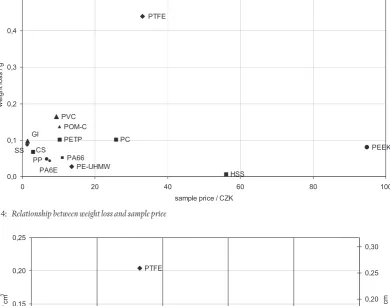
The graphical illustration of the technical-economical evaluation of the carried out tests is evident from Fig. 4 (according to weight loss) and Fig. 5 (according to volume/length loss).
In Figs. 4 (weight loss) and 5 (volume/length loss) the results of for practice most suitable materials from the technical-economical point of view are located le at the bottom. It is a case of keenly priced materials of relatively small wear. On the contrary the results of materials located right on the top are not suitable for use in conditions of abrasive wear. It is a case of material low wear and high price.
As it follows from above mentioned fi gures. the results of the major part of tested materials are located le at the bottom, but three samples considerably protrude from this location, namely
PTFE, PEEK and HSS Poldi Radeco 19 810. Using the abrasive cloth the plastic PTFE showed unequivocally the highest wear. The medium wear was determined at the most expensive plastic PEEK. On the contrary almost zero wear was determined at the sample made from the relatively expensive high-speed steel HSS 19 810.
At the technical-economical assessing of next samples results by volume (or length) wear the metallic materials, which means grey iron, structural steel and cast steel, have considerably higher wear resistance compared with all tested plastics and their price is low. But at the assessing using weight loss the metallic materials have higher losses that some plastics. It is caused by the considerably diff erent density of these materials.
From the results summarization it follows that at the diff erent materials wear resistance evaluation
PVC POM-C
PC PETP
PEEK PA66
PE-UHMW
HSS PTFE
PP PA6E GI
SS CS
0,0 0,1 0,2 0,3 0,4 0,5
0 20 40 60 80 100
sample price / CZK
w
e
ight
lo
ss
/ g
4: Relationship between weight loss and sample price
PTFE
PE-UHMW POM
PETP
PA 66 PP
PA6E GI
SS CS
HSS PVC
PC PEEK
0,00 0,05 0,10 0,15 0,20 0,25
0 20 40 60 80 100
sample price / CZK
vo
lu
m
e
lo
ss
/ c
m
3
0,00 0,05 0,10 0,15 0,20 0,25 0,30
le
n
g
th
lo
ss
/ c
m
it is necessary to give the parameter of loss. As it is showed in above mentioned fi gures, the results expressed by volume or length loss are at the same size of test samples identical, while results expressed by weight loss diff er.
In the end it is necessary to emphasize that at plastics usually other properties are appreciated than wear resistance. For their application e.g. mechanical, physical, chemical and technological properties are demanded.
The contribution contains the laboratory tests results of abrasive wear resistance of selected plastics and Fe alloys using the pin-on-disk machine with abrasive cloth carried out according to the standard
ČSN 01 5084. In total 10 types of plastics from one producer and 4 diff erent Fe alloys (grey iron, structural steel, wear resistant cast steel and high-speed steel) were tested.
All samples were of cylindrical shape of 10 mm diameter and 70 mm length. For the test samples wear three abrasive clothes of diff erent grit, namely 240 (mean abrasive grain size 44.5 μm), 120 (mean abrasive grain size 115.5 μm) and 60 (mean abrasive grain size 275 μm) were used. The wear intensity was evaluated by volume loss, weight loss and length loss at all tested samples. The technical-economical evaluation was the part of the carried out tests.
CONCLUSION
From the carried out test results it follows that all plastics were excessively worn out regardless of their price. By this reason they cannot be recommended for such working conditions. In accordance with the precondition the highest abrasive wear resistance was determined at the high-speed steel, but its price is relatively high. The results of the other Fe alloys were favourable, better than the results of plastics, even at a very low price. Contemporarily it was proved that with the increasing grain size the wear intensity increases, even when at diff erent materials diff erently.
Acknowledgement
Supported by the Internal Grant Agency of the Czech University of Life Sciences Prague, Prague, Czech Republic; Project No. 2014:31140/1312/3133.
REFERENCES
BLAU, P. J. 1992. ASM Handbook, Volume 18 – Friction, Lubrication, and Wear Technology. ASM International. [Online]. Available at: http://app. knovel.com/hotlink/toc/id:kpASMHVFL2/ asm-handbook-volume-18. [Acessed: 2013, November 12].
BROWN, R. (Ed.) 1995. Handbook of Polymer Testing: Physical Methods. New York: Dekker.
BROŽEK, M. 1995. Vybrané problémy navařování [Selected Problems of Sufracing]. Inaugural Dis-sertation. Prague: Czech Agricultural University. BROŽEK, M. 2007. Technicko-ekonomické
hodno-ceni aplikace návarů u plužních čepelí [Technical-economical evaluation of the overlays application on the plough shares]. Acta Univ. Agric. et Silvic. Mendelianae Brunensis, 55(4): 129–136.
BROŽEK, M. 2012. Wear resistance of multi-layer overlays. In: 11th International Scientifi c Conference Engineering for Rural Development. Latvia University of Agriculture. 24–25 May. Jelgava: Latvia University of Agriculture, 210–215.
BROŽEK, M. 2014. Abrasive wear resistance of wood. Manufacturing Technology, 14(2): 130–136. BROŽEK, M. and NOVÁKOVÁ, A. 2008. Evaluation
of sintered carbides wear resistance. In: 7th International Scientifi c Conference Engineering for Rural Development. Latvia University of Agriculture. 29– 30 May. Jelgava: Latvia University of Agriculture, 209–213.
BROŽEK, M., NOVÁKOVÁ, A. and MIKUŠ, R. 2010. Study of wear resistance of hard facings using welding powders on the NiCrBSi basis.
In: 4th International Conference Trends in Agricultural Engineering 2010. Czech University of Life Sciences Prague. 7–10 September. Prague: Czech University of Life Sciences Prague, 115–118.
BUDINSKI, K. G. 1997. Resistance to particle abrasion of selected plastics. Wear, 203–204: 302– 309.
KINNEY, G. F. 1957. Engineering properties and applications of plastics. New York: Wiley.
KUTZ, M. 2011. Applied plastics engineering handbook: processing and materials. Waltham: William Andrew. LEVER, A. E. and RHYS, J. A. 1968. The properties and
testing of plastic materials. 3rd Edition. Bristol: Wright Temple Press Books.
NOVÁKOVÁ, A. and BROŽEK, M. 2014. Selected plastics wear resistance. In: 13th International Scientifi c Conference Engineering for Rural Development. Latvia University of Agriculture. 29–30 May. Jelgava: Latvia University of Agriculture, 187–193. PLUHAŘ, J. et al. 1989. Nauka o materiálech [Material
Science]. Praha: SNTL.
[s.n.] Friction and Wear Testing. 1987. West Conshohocken, PA: American Society for Testing and Materials.
SUCHÁNEK, J., BLAŠKOVIČ, P. and BROŽEK, M. 1999. Abrasion Resistance of Selected Hardfacing Materials. In: Trends in Agricultural Engineering. Czech University of Agriculture. 15–17 September. Prague: Czech University of Agriculture, 606–610. ŠTĚPEK, J., ZELINGER, J. and KUTA, A. 1989.
VOCEL, M. 1983. Experimentální metody hodnocení tření a opotřebení [Experimental Methods of Friction and Wear Evaluation]. Kovové materiály, 21(6): 711–722.
VOCEL, M., DUFEK, V. et al. 1976. Tření a opotřebení strojních součástí [Friction and Wear of Machine Parts]. Praha: SNTL.
ÚNMZ. 2012. Plasty – Značky a zkratky – Část 1: Základní polymery a jejich zvláštní charakteristiky [Plastics – Symbols and abbreviated terms – Part 1: Basic polymers and their special characteristics]. ČSN EN
ISO 1043-1 (64 0002). Praha: Úřad pro technickou normalizaci, metrologii a státní zkušebnictví. ÚNMZ. 1969. Opotřebení materiálu. Názvosloví [Wear
of materials. Terminology]. ČSN 01 5050. Praha: Úřad pro technickou normalizaci, metrologii a státní zkušebnictví.
ÚNMZ. 1974. Stanovení odolnosti kovových materiálů proti abrazívnímu opotřebení na brusném plátně [Determination of metal material resistance against wear by abrasive cloth]. ČSN 01 5084. Praha: Úřad pro technickou normalizaci, metrologii a státní zkušebnictví.