Analysis And Scenario Of Navy Performance
Allowance Policy Using System Dynamic Model
Sukmo Hadi Nugroho, R. Madhakomala, Kazan Gunawan
Abstract : This study aims to conduct analysis and scenarios on performance benefit policies on the Professional, Welfare and Public Service aspects of the Indonesian Navy. This is because the current performance allowance given to Navy Personnel is not yet entirely based on achievement, workload, and risk of work performed. The policy evaluation method used is the development of a System Dynamic Concept-based model. The formulation is carried out by evaluating the main variables and aspects as a system that interacts. The output of this Dynamic System Model Analysis is Scenario and policy evaluation on the variable being assessed. Policy scenarios serve as indicators that show that variables need to be evaluated according to the strategic significance obtained. Then the policy scenario is simulated on the model. There are four scenarios: (a) Improvement of Professional Capability, (b) Increasing Professional Allowances and incorporating into the Performance Allowance structure, (c) Increasing Workload that impacts Assignment Risks and (d) Combined or Integrated Scenarios. Based on the analysis of all the scenarios, the best scenarios that can be applied in the implementation of the performance allowance policy are in the Navy.
Keywords: Policy Scenario, Navy Performance Allowances, System Dynamic.
————————————————————
1.
INTRODUCTION
Bureaucratic reform has become a national policy that continues to roll along with the development of a dynamic strategic environment. The focus of bureaucratic reform is directed at creating a clean government and good government. Within the Navy, as part of the Government, bureaucratic reform continues to be carried out gradually and continuously as a form of commitment for the Navy to position itself appropriately and optimize its role in the national life order of the Indonesian people. Bureaucratic reform is an important decision, not only for the Navy but also for the entire nation and state as well as national interests in general [16]. Performance allowance is expected to improve performance as measured by the agency's key performance indicators [10]. Performance allowances in implementing bureaucratic reforms use the following principles: (a) Efficiency and optimization of the budget ceiling of the Ministry of Institutions and Government, (b) Equal pay for equal work, namely the amount of performance allowance following position prices and performance achievements. Conceptually, the provision of performance allowances is one of the right steps to improve the performance of the state apparatus. The implementation of the policy for the provision of performance allowances in the apparatus environment has been implemented, but at the level of application in the field, some potential problems still appear [4]. Some of the problems that were identified in the implementation of the performance allowance within the Navy include:
a. The provision of performance allowances has not fully supported the achievement of relatively significant changes in the performance, productivity, and improvement of the welfare of members of the Navy, and even in public services. Moreover, in its implementation, the granting of performance allowances is only based on grade or rank level and does not look entirely at the burden of performance undertaken. This is indicated by the data in the field that there are still many violations of discipline committed by Navy personnel who are increasing every year. The number of Navy Navy disciplinary violations shows that the performance allowance has not significantly affected the performance and productivity improvement of the Navy. The phenomenon that should occur is that the remuneration is increasing, so the performance, discipline,
and productivity of the Indonesian Navy should increase as well, meaning that the number of disciplinary violations must also decrease. However, the facts show that the number of disciplinary violations in the performance of Indonesian Navy personnel has increased.
b. The application of performance allowances is also not entirely based on achievement, burdens and work risk levels which are the responsibility of each Navy personnel. The amount of performance allowance is only based on the class position of the stakeholders, regardless of achievement, workload and risk level of the work they carry. Though every profession has a very different level of competence, burden and work risk. The provision of performance allowances that are regulated based on Presidential Regulation 87 of 2015 does not accommodate existing theories about achievement, workload, and risk associated with satisfaction of performance, welfare, and principles of justice.
1141 not given adequate attention to the results and impact of
policies related to the provision of performance benefits.
2.
MATERIAL AND METHODS
The place or location of the study is focused on work units that represent the overall condition of the Navy in conducting the policy evaluation process. The research subjects were selected purposively according to the needs of the Indonesian Navy's Work Unit which is the site of this research and the people related to the Navy. The choice of work units within the Navy, as well as the community related to the Navy as a research locus, is because the work unit is very closely related to the evaluation model of performance benefit policies that have so far been applied at the work unit and can represent the overall conditions and situations of the work unit. within the Navy. Data collection in the form of open questionnaires and in-depth interviews conducted during this period. For variable data and policy criteria for the determination of performance allowances that are qualitative in nature and have preference values taken from 16 Expert Judgments from Expert Judgments. In the steps and procedures of the research, it can be explained that this research uses the Dynamic System approach in order to solve the problem of evaluating the policy of determining the performance allowances of the Navy personnel and their impact on professionalism of performance, discipline of soldiers, soldier welfare and public services by Navy personnel. Some of the underlying reasons for using and developing the System Dynamic method in this study are as follows [18]:
a. Analysis and study on the evaluation of performance allowance policies need to be done by considering the development of future system dynamics on all interacting variables, (professionalism of soldiers, soldier welfare and public/state services), to get results and real impact on determining the best policy.
b. The use of the Dynamic System method is very suitable to be applied and developed further, because the principle of this method in solving problems using systemic logic, so that each problem can be identified and solved holistically and integrated.
c. The Dynamic System Method Approach is a model for analyzing the behavior of a system that interacts, such as a performance allowance policy system that is dynamic and interacts among variables within it. The study process starts from the identification of symptoms to produce a structure of problems, then simulations, evaluations and policy analysis in decision making, both for evaluating the strategic steps that have been taken and for evaluating alternative steps to be taken, in determining the best policy of performance benefits in the TNI environment AL.
Data collection in this dissertation research activity is to obtain qualitative and quantitative data consisting of primary and secondary data. According to [19] The process of collecting main data and supplement data in this study was carried out through the following activities (a) Documentation, (b) Questionnaire, (c) Observation, (d) Interview.
2.1. Variable Identification
From the understanding of the evaluation of the performance allowance system of soldiers in the Navy
environment as well as the identification of all influential variables, the performance system of soldiers performance within the Navy can be categorized to include 3 (three) main aspects of the performance evaluation system, namely:
a. The Navy Professional aspects b. The Navy Welfare aspects c. The Navy Public service aspects.
Every major aspect of evaluating the performance allowance system has variables or criteria that are interconnected and interact in the system. Based on the results of the identification of variables on the performance of the Navy performance allowance system, the variables that have a significant effect on the professionalism, welfare, and public service aspects are found.
- The Navy Professional aspects a. The performance
b. Discipline c. Work target d. Motivation e. Violation
f. Warrior Capability g. Basic skills
h. Professional Capability i. Physical Condition j. Spiritual Conditions k. Assignment Risks l. Workload
- The Navy Welfare aspects a. Salary / Income
b. Education c. Health d. Housing e. Social status f. Public Confession. g. Institutional Recognition - The Navy Public Service aspect a. Basic Duty of the Navy b. War Military Operations
c. Military Operations Other Than War d. Maritime Regional Development e. Social Community
f. Assignment Risks g. Workload
2.2. System Dynamic Model Approach
The System Dynamics method uses causal relationships in constructing a complex system model. This is the basis for recognizing and understanding the dynamic behavior of the system. In other words, the use of the system dynamics methodology is more emphasized on the goals of increasing our understanding of how system behavior arises from its structure. Issues that can be properly modeled using a dynamic methodology are systems that have a dynamic nature (change with time); from the structure of the phenomenon contains at least one feedback structure [7]. According to [14, 18] the principles for creating dynamic models with the characteristics as described above are as follows:
a. Desired conditions and actual conditions must be distinguished in the model.
c. Conceptually different schools, within the model, must be distinguished.
d. Only information that is available to actors in the system must be used in modeling the decision.
e. The structure of the rules of decision making in the model must be compatible with managerial practices. f. System Dynamic Model is not made only to provide forecasting or prediction processes, but further, than that, System Dynamic is intended to understand the characteristics and behavior of internal and external process mechanisms that occur in a particular system [18]. System Dynamic is very effective to be used on systems that require a good level of data management [3]. With this flexibility, this helps in the process of model formulation, determination of model boundaries, model validation, policy analysis, and the application of the model. According to [14] The use of the System dynamic model is to simulate policy evaluations, to evaluate the strategic steps that have been taken (ex-post) in generating system performance, and for future evaluation (ex-ante), namely alternative steps taken in achieving the destination. This paper has many literatures to support the research, such as : System Dynamics Model of Sustainable Urban Development [2], A
System Dynamic Based DSS for Sustainable Coral Reef Management in Kenting Coastal Zone [1], Dynamics of Financial System: A System Dynamics Approach [11], Simulation of Dynamics Behaviors for Shipping Equipment Support with System Dynamics Analysis Approach [8], Influence of Compensation and Reward on Performance of Employees at Nakuru County Government [12], A System Dynamics Approach to Food Security through Smallholder Farming [15], Establishing the Location of Naval Base Using Fuzzy MCDM and Covering Technique Methods [13], Location Determination of Logistics Warehouse facility using Fuzzy Multi-Criteria Decision Making (FMCDM) Approach in Western Sea Sector of Indonesia [9].
III.
RESULT AND DISCUSSION
III.1. The Model
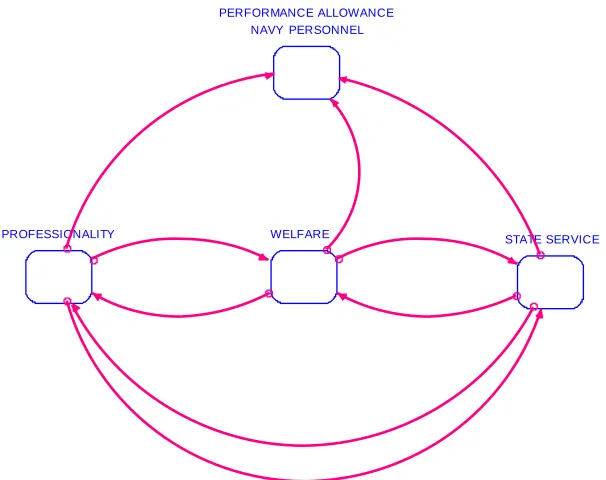
Each variable of the professional aspects of the Navy's soldiers has a value that is interconnected and forms interactions according to [5], in the Evaluation of the Performance Allowance System as shown in Figure 1.
Figure 1. The Model Interaction between aspects of the Performance Allowance System
In Figure 1 it can be explained that the performance allowance evaluation is a system that is directly affected by the aspects of soldier professionalism, soldier welfare, and public service aspects. These three aspects also influence one another. Professional aspects affect the welfare aspects and public/state services, then the welfare aspects of soldiers also affect the professional aspects and aspects
of public/state services. Likewise, aspects of public/state services also affect the Professional aspects and Welfare aspects. All aspects affect and are influenced by each other, thus forming a system that is an interaction between aspects, variables, and criteria, which can be shown in more detail in Figure 2. below:
WELFARE PERFORMANCE ALLOWANCE
NAVY PERSONNEL
1143
Figure 2. Causal Loop Diagram of the Main Aspects in the Performance Allowance System
Figure 2 explains the Performance Allowance as the main focus is strongly influenced by 3 (three) aspects of the system. The three aspects are aspects of professionalism of soldiers, the welfare of soldiers and aspects of public/state services. Each of these three aspects has unique variables or criteria and has a reciprocal relationship as a system that interacts with each other which is dynamic. The Professional Aspects of the Indonesian Navy include Performance, Discipline, Targeted Work, Motivation, Abuse, Warrior Capability, Basic Ability, Professional Capability,
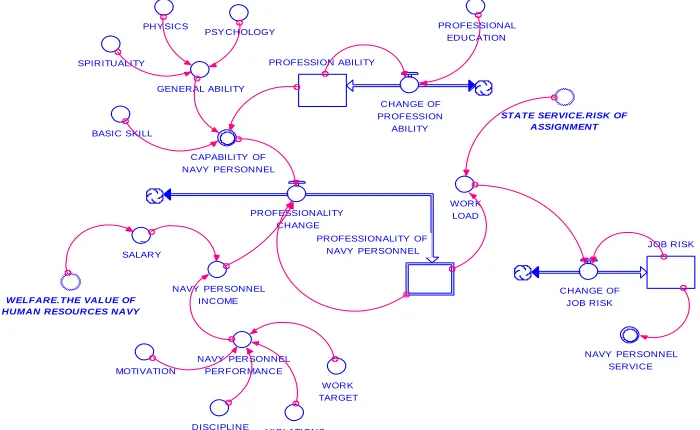
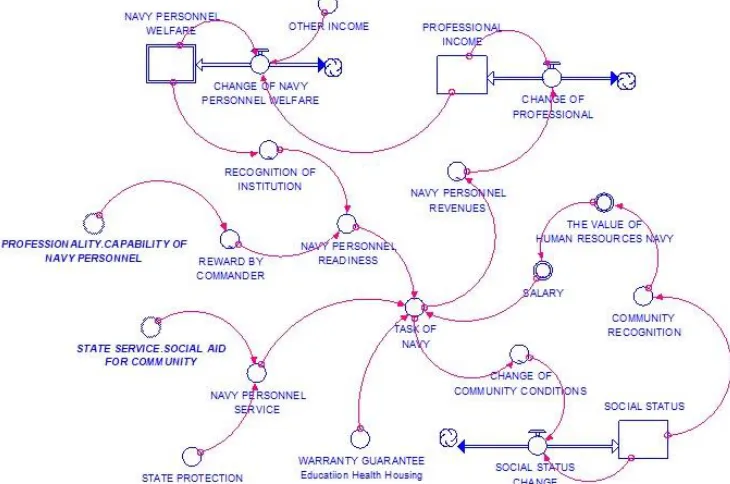
Physical Conditions, Spiritual Conditions, Risk of Assignment, Workload. Navy Soldier Welfare aspects include Salary / Income, Education, Health, Housing, Social Status, Community Recognition, and Institutional Recognition. The aspects of the Navy's public service include basic tasks of the navy, military operations of war, military operations other than war, fostering maritime areas, social, risk of assignment, workload. All sub-criteria interact with each other to form the Stock Flow Diagram as shown in Figure 3, 4 and 5 below:
Figure 3. Stock and Flow Diagram on Variable of Navy Professionality Aspect Model PROFESSIONALITY
CHANGE
PROFESSIONALITY OF NAVY PERSONNEL CAPABILITY OF
NAVY PERSONNEL BASIC SKILL
NAVY PERSONNEL SERVICE SPIRITUALITY
PHY SICS
PSY CHOLOGY
CHANGE OF JOB RISK
JOB RISK CHANGE OF
PROFESSION ABILITY PROFESSION ABILITY
WELFARE.THE VALUE OF HUMAN RESOURCES NAVY
PROFESSIONAL EDUCATION
SALARY ~
WORK TARGET NAVY PERSONNEL
PERFORMANCE
DISCIPLINE MOTIVATION
GENERAL ABILITY
VIOLATIONS
WORK LOAD
STATE SERVICE.RISK OF ASSIGNMENT
Figure 4. Stock and Flow Diagram on Variable of the Navy Welfare Aspects
Figure 5. Stock and Flow Diagram on the variable of the Navy Public Service Aspects
III.2. Variable Weighting
The next step is to weight the variable aspects and criteria that affect the Performance Allowance system. This weighting is done to get the value or level of importance of each aspect variable and criteria. The weighting assessment on the variable aspects and criteria in this research was carried out using Fuzzy Weighting, using research tools and instruments in the form of in-depth interviews and filling in the questionnaire with the experts. These data include data on aspects of variables and criteria that influence the performance benefit system. Efforts in
collecting interview and questionnaire data are intended only to obtain valid data so that it can be used following research objectives. The results of the assessment on the weighting of aspects, criteria, and variables will be included in the formulation or formulation of a dynamic system relationship in the performance evaluation system.
III.3. Influential Factors and Criteria.
1145 Navy, the Aspect of the Prosperity of the Navy and the
aspects of Soldier's Public Services. These aspects interact to form a system in evaluating performance allowances. The welfare aspect of soldiers occupies the highest weight in the performance allowance evaluation criteria with a weight of 0.353, Public / State Service Aspect with a weight of 0.342 and Professionality Aspect with a weight of 0.305. In the professionalism aspect criteria, of the many influential criteria variables, there are several variables which are significant variables that have a high weight value that is very influential on the system, namely: occupational risk variables (0.092), workload (0.091), professional ability (0.090) ), Performance targets (0.089) and soldier performance (0.088 While in the aspect of Warrior Welfare, which is a significant variable is the professional allowance/expertise of soldiers (0.159) and institutional rewards (0.157). Furthermore, in the aspect of Public Service, significant variables were found, namely: the risk of assignment (0.154), the workload of soldiers (0.153), basic duties of soldiers (0.151) and military operations of war (0.151),. All of these variables interact systemically to form a model in evaluating the performance allowances of the Navy personnel as depicted in the causal loop diagram of the performance allowances of soldiers, which are the findings or novelty in this dissertation research.
III.4. Development of a Policy Evaluation Model.
Dynamic system modeling is a model of policy evaluation that illustrates the interaction of all aspects and criteria that affect the evaluation of performance allowances, be it professional aspects, welfare aspects and aspects of public service for Navy soldiers, including the criteria or variables therein. This model produces an evaluation score of a policy scenario that is used as an indicator based on aspects, criteria and time dimensions. The score is an indicator of the level of importance of a policy, which represents a policy is implemented or not, and how the impact arising from the policy if implemented.
III.5. Sensitivity Analysis
Based on the sensitivity analysis conducted on each variable of the criterion aspects of the performance allowance system, we obtain key variables that are used as the basis for developing policy scenarios that are run on a dynamic system model, which includes four policy scenarios, including:
a. Scenario 1 "Professional Capability Enhancement / Special Skills of Navy Soldiers". Scenarios that focus on increasing the competency of special skills or advanced expertise of soldiers who have a professional and potential impact on a soldier's capability variables, which in turn can have an impact on the Professional Aspects of Soldiers. b. Scenario 2 "Increasing Professional Allowances for Navy Soldiers and incorporating them into the Performance Allowance Structure". This scenario is focused on increasing professional allowances for soldiers who have special expertise or advanced expertise for professional soldiers, such as the expertise of the Submarine brevet, Divers, Kopaska, Taifib, Denjaka, and Aviation Navy specialists. Has a direct impact on the Welfare Aspects of Soldiers.
c. Scenario 3. "Increased Workload of the Navy Soldiers which has an impact on increasing the Assignment
Risk". This scenario is focused on the work or task of soldiers who have a high risk. Increasing the workload of servicemen means taking structured and systematic actions to improve the performance and task of the soldier by taking into account the risks of assignment based on the corps and the profession. Has a significant impact on aspects of public services, in the form of carrying out the main tasks of the Navy and military operations.
d. Scenario 4 "Integrated Policy". This scenario is a combination or combination of scenarios 1 and 2, scenarios 1 and 3, scenarios 2 and 3 and a combined total of scenarios 1, 2 and 3. This scenario has an impact on evaluating the overall and holistic performance allowance as a system interaction between professional aspects, welfare, and public services.
Furthermore, all policy scenarios are simulated in modeling the dynamic system of the Navy Soldiers' Performance Benefits as a system that interacts with each of its variables which produces an output in the form of policy analysis and evaluation on each scenario that is run.
IV.
CONCLUSION
This dissertation research produces output in the form of models and policy analysis on the performance allowance determination system within the Navy with a dynamic system model approach. Dynamic system modeling is a model that illustrates the interaction of all aspects and criteria that affect the Evaluation of Performance Allowances, including aspects of Professionalism, Welfare aspects, and aspects of Public Services, including the criteria or variables in it as an interacting system. The next conclusion includes a comprehensive analysis and evaluation of the 4 (four) policy scenarios carried out in the evaluation model, namely:
a. Analysis of Scenario 1, "Enhancing Professional Capability / Special Skills of Soldiers" will have a significant impact on the capabilities of soldiers which further enhances the professional aspect of the soldier. This scenario which is also part of the main aspects of soldier professionalism has a significant impact on improving Performance Allowances. Furthermore, this scenario must be immediately programmed and implemented to achieve the desired professional majority condition as a necessity to increase the performance allowances of the Indonesian Navy personnel.
b. Analysis of Scenario 2, Scenario "Enhancing Professional Allowance for Soldiers and incorporating in the Performance Allowance structure" will have a significant impact on the income or social status of a soldier, which in turn can improve aspects of soldier welfare. This scenario which is also part of the main aspects of soldier professionalism has a significant impact on the Performance Allowance Evaluation. This scenario must be immediately programmed and implemented to achieve the desired welfare and professionalism of the soldier as a need to improve the Performance Allowances of the Navy's troops. The scenario "Improving Professional Allowances for Soldiers and incorporating in the Performance Allowance structure" can be done by revising Minister of Defense Decree, concerning Norms / Index of Program Planning and Budget of the Ministry of Defense.
Risk" will have a significant impact on the state and community defense and security conditions, which can further improve aspects of public service. This scenario which is also part of the main aspects of Public Services by soldiers has a significant impact on the Evaluation of Performance Allowances. This scenario must be immediately programmed and implemented to achieve the desired professionalism of the majority and public services as a need to improve the Performance Benefits of the Navy's troops. This scenario can be done by implementing in more detail and depth Law No. 34 regarding the Indonesian National Army and increasing the amount of performance allowance by revising Minister of Defense Regulation No. 32 of 2011 regarding Performance Allowances for TNI Soldiers based on the type and profession of soldiers, workload and risk of assignment. d. Analysis of Scenario 4, Integrated policy scenario between policy scenario 1: "Improvement of professional capabilities / special skills of Navy soldiers", and scenario 2: "Increased professional allowances for Navy soldiers" (incrementally in line with annual inflation increases and entering the performance allowance structure ), as well as scenario 3: "Increased workload of Navy personnel which results in an increased risk of assignment" (which is done in stages in an increase in workload). It must be done together as a basis or reasoning to increase and increase the value of the Navy Soldiers' Performance Allowances. The integrated scenario also produced findings in the form of the need to increase the allocation of special professional education for Indonesian Navy personnel. such as Submarine Brevetes, Kopaska Brevet, Taifib Brevet, Denjaka Brevet, Aviator Brevet, as a form of enhancing the real profession of soldiers. To follow up on this, it is necessary to revise the Decree of the Minister of Defense, concerning Norms / Index of Program Planning and Budget of the Ministry of Defense. Another finding is the need for an increase in the number of performance allowances for Navy, by revising Minister of Defense Regulation No. 32 of 2011 regarding Performance Allowances for Navy Personnel, adjusted to the type of soldier profession, workload, and assignment risk, in addition to the rank and position so far. implemented.
e. Best Scenario Analysis. Based on the analysis and evaluation carried out in an integrated and comprehensive manner, an integrated policy scenario is obtained, namely scenarios 1, 2 and 3 which are carried out together and integrated is the best policy in evaluating the performance allowance of the Indonesian Navy, because it gives a significant impact score on existing systems and models.
V.
FUTURE WORK
a. There needs to be a revision of the Decree of the Minister of Defense, concerning Norms / Index of Program Planning and Budget of the Ministry of Defense and the military. The revision carried out as input is an increase in the value of the TNI military professional allowance which is done every 1 (one) year automatically, with a minimum increase equal to annual inflation (based on data from the Central Bank of Indonesia), then the next revision is to include professional allowances mentioned in the structure of the Navy Performance Allowance which has not been done so far.
b. There needs to be a revision of the Minister of
Defense Regulation, concerning Performance Allowances for Navy Personnel. The recommended revision is an increase in the amount of Navy's performance allowance that is adjusted to the Professional Type of the Soldier, the Workload of the Soldier and the Risk of Assignment, as well as based on the rank and position that has been carried out so far.
c. Further Strategic Policy Formulation regarding Navy Professional Standardization is based on the classification of Professional Risks and Assignments in the Indonesian National Qualification Framework, also based on the National Professional Certification Board of the BNSP, and the establishment of a military Private Professional Certification Board as a basis and benchmark in the granting of the military Private Performance Allowance . This can be recommended as a revision to Regulation of the Minister of Defense concerning the Provision of Performance Benefits of Navy.
d. Follow-up on the recommendations for the formation of a Navy Professional Certification Body as a basis and benchmark for the granting of Performance Allowances, Identification on the professionalism, welfare and public service aspects of the Navy can be more detailed and in line with the dynamics of the strategic development of the Indonesian state. This can be continued in the next research.
e. As a material consideration in evaluating the determination of the performance of Navy soldiers, the professional aspect of soldiers must be improved. For this reason, it is necessary to increase the allocation of special professional education for the Navy personnel such as: Submarine Brevetes, Kopaska Brevet, Taifib Brevet, Denjaka Brevet, Aviator Brevet, as a form of enhancing the real profession of soldier with special expertise, both from in terms of increasing the number of education personnel as well as the education budget on increasing the profession of Navy.
f. Recommendations are the need for an Action Plan or a follow-up of the product of this dissertation research. The action plan is an innovative activity that aims to apply the model and implement it significantly in the Performance Allowance Evaluation System including the stages:
1. Publication and Socialization Stage 2. Stage of Leader Policy Installation 3. Implementation Phase
4. Monitoring and Evaluation Phase
g. The dynamic system model in evaluating the performance allowance can be developed according to the development of the dynamics of the existing situation system, assuming the model is dynamic with the data entered both variables, aspects, and criteria in the model can develop following the dynamics of the system that occur in the future.
ACKNOWLEDGMENT
1147
REFERENCES
[1] Chang, Y.C., F. W. Hong, and M. T. Lee, 2008, A System Dynamic Based DSS for Sustainable Coral Reef Management in Kenting Coastal Zone, Taiwan, Ecological Modelling, pp. 153–168. [2] Chen, M.C., T. P. Ho, and C. G. Jan 2006, A
System Dynamics Model of Sustainable Urban Development: Assessing Air Purification Policies at Taipei City, Asian Pacific Planning Review, Vol. 4, No. 1, pp. 29-52.
[3] Crosby, B.L. 1996, Policy implementation: The organizational challenge, World Development, Vol. 24, No. 9.
[4] Dye, T.R., 2001, Top-Down Policymaking. New York: Chatham House.
[5] Ibojo, B.O. and O.M. Asabi, 2014, Compensation Management and Employees Performance in the Manufacturing Sector, A Case Study of a Reputable Organization in the Food and Beverage Industry, International Journal of Managerial Studies and Research, Vol. 2, No. 9, pp. 108-117. [6] Janamanchi, B. and J.R. Burns, 2013, Control
Theory Concepts Applied to Retail Supply Chain: A System Dynamics Modeling Environment Study, Modelling and Simulation in Engineering, pp. 1-14. [7] Jay W. Forrester, 1997, Building a System
Dynamics Model. Massachusetts: Massachusetts Institute of Technology.
[8] Jian-Hua Yang Yang Song, 2015, Simulation of Dynamics Behaviors for Shipping Equipment Support with System Dynamics Analysis Approach, Journal of Industrial Engineering and Management, pp. 636-657.
[9] Kazan Gunawan, I Nengah Putra, Benny Sukandari, Okol S Suharyo, AK Susilo, 2018, Location Determination of Logistics Warehouse facility using Fuzzy Multi-Criteria Decision Making (FMCDM) Approach in Western Sea Sector of Indonesia, International Journal of Applied Engineering Research, Vol.13 Issue 3, pp. 1597-1604.
[10] Masango, R.S., 2007, Role of public opinion in the governance of a democratic state regarding South Africa, Journal of Public Administration, Vol. 42, No. 5.
[11] Nair, G.K. and L.L.R. Rodrigues, 2013, Dynamics of Financial System: A System Dynamics Approach, International Journal of Economics and Financial Issues, Vol. 3, No. 1, pp. 14-26.
[12] Njoroge, S.W., and J. Kwasira, 2015, Influence of Compensation and Reward on Performance of Employees at Nakuru County Government, Journal of Business and Management, Vol. 17, No. 11, pp. 87-93.
[13] Okol Sri Suharyo, Djauhar Manfaat, Haryo D Armono, 2017, Establishing the Location of Naval Base Using Fuzzy MCDM and Covering Technique Methods: A Case Study, International Journal of Operations and Quantitative Management, IJOQM, Vol. 23, Issue 1, pp 61-87.
[14] Sterman, J.D., 2000, Business Dynamics Systems Thinking and Modeling for a Complex World. London: Mc Graw Hill.
[15] Tsolakis, N. and J.S. Srai, 2017, A System Dynamics Approach to Food Security through Smallholder Farming in the UK, Chemical Engineering Transactions, vol. 57, pp. 2023-2028. [16] Wright, P.M., T.M. Gardner, and L.M. Moynihan,
2003, The impact of HR practices on the performance of business units, Human Resource Management Journal, Vol. 13, No. 3, pp. 21-36, [17] Yang Song, J.-h. Y. (2015). Simulation of
Dynamics Behaviors for Shipping Equipment Support with System Dynamics Analysis Approach. Journal of Industrial Engineering and Management, 636-657.
[18] Zagonel, A. A. (2002). Model Conceptualization in Group Model Building: A Review of The Literature Exploring the Tension Between Representing Reality and Negotiating A Social Orde. Proceedings of the 2002 International Conference of the System Dynamics Society, (p. 12). Palermo. [19] Zohrabi, M. (2013). Mixed-Method Research: