Volume 4, No. 3, March 2013 (Special Issue)
International Journal of Advanced Research in Computer Science
RESEARCH PAPER
Available Online at www.ijarcs.info
Impact of Traffic Pattern on Performance of Adhoc Routing Protocols in VANET
for Varying Mobility
Vijay Shankar Sharma
Department of Computer Science and Engineering MBM Engineering College
Jodhpur, India [email protected]
Nemi Chand Barwar
Department of Computer Science and Engineering MBM Engineering College
Jodhpur, India [email protected]
Abstract: This paper aims to study adhoc routing protocols namely AODV, AOMDV, DSR and DSDV under different traffic pattern like TCP and CBR in VANET environment for varying mobility. The performance of these routing protocols will be evaluated on the basis of considering the different parameters i.e. average end to end delay, packet delivery ratio, loss packet ratio and throughput. To achieve the behavior of VANET both pause time and speed parameters are variable. On the basis of number of nodes mobility is classified in three categories i.e. Low Mobility, Average mobility and High Mobility. On the basis of simulation results carried out using NS 2.35 simulator a relationship between the mobility pattern and traffic pattern is established.
Keywords: VANET, TCP, CBR, Mobility, E2E Delay, PDR, LPR, Throughput
I. INTRODAUCTION
Vehicular adhoc network (VANET) is a technology in which we can establish the communication intelligently between the vehicles. Mainly VANET can be classified into two categories that is vehicle to vehicle communication and vehicle to infrastructure communication.
The benefits of VANET include seamless internet connectivity resulting in improved road safety, essential alerts and accessing comforts and entertainments. To show the behavior of VANET [8], this paper considered three mobility pattern as low mobility, average mobility, and high mobility, in addition there is variation in the pause time and speed for both CBR and TCP connections. All the simulations carried out using the NS 2.35 simulator.
II. SETTINGSIMULATIONPARAMETERS
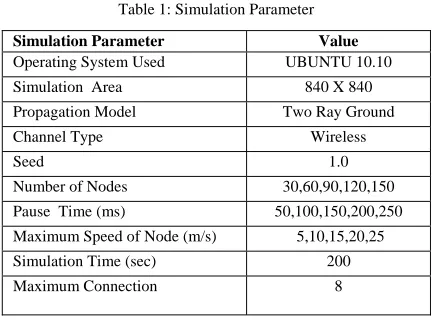
[image:1.612.333.551.318.485.2]To evaluate the adhoc routing protocols (AODV, AOMDV, DSR, DSDV) in the VANET Scenario this paper considered three mobility scenarios as low mobility, average mobility, and high mobility. In these scenarios number of nodes is increasing as for low mobility 30 nodes, for average mobility 90 nodes and for high mobility 150 nodes, means we are increasing number of nodes and evaluating the effect on the performance of the adhoc routing protocols by means of packet delivery ratio, average end to end delay, and loss packet ratio for CBR and TCP traffic pattern. Table I lists various simulation parameters [12].
Table 1: Simulation Parameter
Simulation Parameter Value Operating System Used UBUNTU 10.10 Simulation Area 840 X 840 Propagation Model Two Ray Ground Channel Type Wireless
Seed 1.0 Number of Nodes 30,60,90,120,150
Pause Time (ms) 50,100,150,200,250 Maximum Speed of Node (m/s) 5,10,15,20,25 Simulation Time (sec) 200 Maximum Connection 8
III. CLASSIFICATIONOFPERFORMANCE METRICS
Classification of the packet delivery ratio is considered <=95% as low, 96% to 97% as average and >=98% as high. Classification of the e2e delay is considered <=150 ms as low, 151 ms to 350 ms as average and >=351 ms as high. Classification of the loss packet ratio is considered < 1% as low, 1% to 2% as and > 2% as the high loss packet ratio. Classification of the throughput is considered <=100 kbps as the low throughput, 100 kbps to 200 kbps as the average throughput and >=200 kbps as the high throughput
IV. PATTERNANALYSISFORLOWMOBILITY ANDALLVARIANTSOFPAUSETIMEAND
SPEED
mobility and all the variation of the pause time and speed for both CBR and TCP traffic.
A. Low Mobility and Low Pause Time and Low speed:
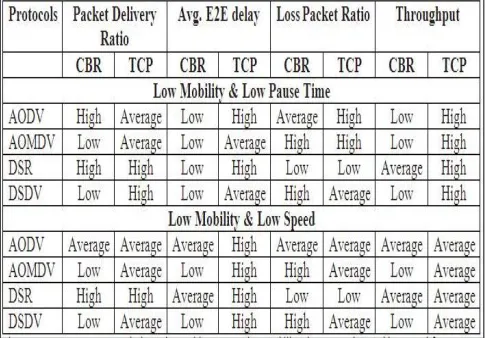
For CBR connection using pause time as a parameter in low mobility and low pause time PDR for the AODV and DSR is high and low for the AOMDV and DSDV. E2E Delay is low for all the protocols. LPR is high for the AOMDV and DSDV, average for the AODV and low for the DSR. Throughput is low for the AODV, AOMDV and DSDV, and average for the DSR. For CBR connection using speed as a parameter in low mobility and low speed PDR for the AOMDV and DSDV is low and average for the AODV and high for DSR. E2E Delay is low for AOMDV and DSDV, and average for AODV and DSR. LPR is high for the AOMDV and DSDV, average for the AODV and low for the DSR. Throughput is low for the AOMDV and DSDV, and average for the DSR and AODV. Finally for CBR connection DSR protocol is performing well.
For TCP connection using pause time as a parameter in low mobility and low pause time PDR for the AODV and AOMDV is average and high for the DSR and DSDV. E2E Delay is high for AODV and DSR, and average for the AOMDV and DSDV. LPR is high for the AOMDV and AODV, average for the DSDV and low for the DSR.
.Figure 1: PDR, E-2-E, LPR and Throughput with respect to low
mobility, low pause time and low speed for TCP & CBR Connections
Throughput is high for the all the protocols. For TCP connection using speed as a parameter in low mobility and low speed PDR for the AODV, AOMDV and DSDV is average and high for the DSR. E2E Delay is high for all the protocols. LPR is average for the AODV, AOMDV and DSDV, and low for DSR. Throughput is average for the all the protocols. Again for TCP connection in low mobility with low pause time and low speed DSR is performing well
B. Low Mobility and Avg Pause Time and Avg Speed:
For CBR connection using pause time as a parameter in low mobility and average pause time PDR for the AODV and DSR is high and low for the AOMDV and DSDV. E2E Delay is low for AODV, AOMDV and DSDV, and high for the DSR. LPR is high for the AOMDV, AODV
[image:2.612.54.297.352.521.2]and DSDV, average for the DSR. Throughput is low for the AODV, AOMDV and DSDV, and average for the DSR. For CBR connection using speed as a parameter in low mobility and average speed PDR is low for all the protocols. E2E Delay is low for DSR, AOMDV and DSDV, and high for the AODV. LPR is high for all the protocols. Throughput is low for all the protocols. For CBR connection in low mobility with average pause time and average speed all the protocols are showing average behavior.
Figure 2: PDR, E-2-E, LPR and Throughput with respect to low mobility, average pause time and average speed for TCP & CBR
Connections
For TCP connection using pause time as a parameter in low mobility and average pause time PDR is average for the AODV, AOMDV and DSR, and high for the DSDV. E2E Delay is high for AODV and DSR and low for the AOMDV and average for the DSDV. LPR is high for the AOMDV, AODV and DSR, and average for the DSDV. Throughput is high for the all the protocols. For TCP connection using speed as a parameter in low mobility and average speed PDR is average for the AODV, AOMDV and DSDV, and high for the DSR. E2E Delay is high for all the protocols. LPR is average for the AOMDV, AODV and DSDV, and low for the DSR. Throughput is high for the all the protocols. For TCP connection in low mobility with average pause time and average speed it can be concluded that DSR is performing well in comparison to the other protocols.
C. Low Mobility and High Pause Time and High Speed:
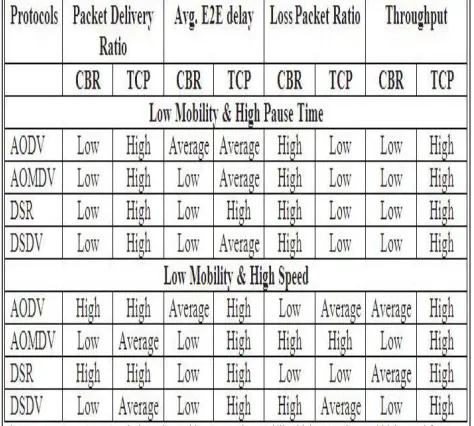
AOMDV and DSDV, low for AODV and DSR. Throughput is average for AODV and DSR, and low for AOMDV and DSDV. For CBR connection in low mobility with high pause time and high speed it can be concluded that on average basis all protocols are perfuming poor.
Figure 3: PDR, E-2-E, LPR and Throughput with respect to low mobility, high pause time and high speed for TCP & CBR Connections
For TCP connection using pause time as a parameter in low mobility and high pause time PDR is high for all the protocols. E2E Delay is average for AODV, AOMDV, DSDV and high for DSR. LPR is low for all the protocols. Throughput is high for the protocols. For TCP connection using speed as a parameter in low mobility and high speed PDR is high for AODV and DSR, and average for AOMDV and DSDV. E2E Delay is high for all the protocols. LPR is average for AODV and DSDV, low for DSR and high for AOMDV. Throughput is high for the protocols. For TCP connection in low mobility with high pause time and high speed it can be concluded that on the average basis all the protocols are performing well whereas in same scenario for CBR traffic all the protocols are performing poor.
V. PATTERNANALYSISFORAVERAGE MOBILITYANDALLVARIANTSOFPAUSETIME
ANDSPEED
This section present the various outcomes for the PDR, E2E Delay, LPR and Throughput, considering AODV, AOMDV, DSR and DSDV protocols for average mobility and all the variation of the pause time and speed (low, average, and high) for both CBR and TCP traffic
A. Avg Mobility and Low Pause Time and Low Speed:
For CBR connection using pause time as a parameter in average mobility and low pause time PDR for the AODV and DSR is high and low for the AOMDV and DSDV. E2E Delay is low for all the protocols. LPR is high for the AOMDV and DSDV, average for the AODV and DSR.
[image:3.612.324.557.186.392.2]Throughput is low for the AOMDV and DSDV, and average for the AODV and DSR. For CBR connection using speed as a parameter in average mobility and low speed PDR for the AOMDV and DSDV is low and high for the AODV and DSR. E2E Delay is low for all the protocols. LPR is high for the AOMDV and DSDV, low for the AODV and DSR. Throughput is low for the AOMDV and DSDV, and average for the DSR and AODV. For CBR connection in average mobility with low pause time and low speed it can be concluded that DSR and AODV are performing well in comparison to the AOMDV and DSDV.
Figure 4: PDR, E-2-E, LPR and Throughput with respect to average mobility, low pause time and low speed for TCP & CBR Connections
For TCP connection using pause time as a parameter in average mobility and low pause time PDR for the AODV and AOMDV is average and high for the DSR and DSDV. E2E Delay is high for AOMDV and DSR, and average for the AODV and DSDV. LPR is high for the AOMDV and AODV, average for the DSDV and DSR. Throughput is high for the all the protocols. For TCP connection using speed as a parameter in average mobility and low speed PDR for the AODV is low and average for the AOMDV and DSR, and high for DSDV. E2E Delay is high for all the protocols. LPR is average for the DSR, AOMDV and DSDV, and high for AODV. Throughput is high for the all the protocols. For TCP connection in average mobility with low pause time and low speed it can be concluded that DSDV is performing well in comparison to the other protocols.
B. Avg Mobility and Avg Pause Time and Avg Speed:
and high for AODV and DSR. E2E Delay is low for DSR, AOMDV and DSDV, and average for the AODV. LPR is high for AOMDV and DSDV, low for DSR and average for AODV. Throughput is low AOMDV and DSDV, and average for AODV and DSR. For CBR connection in average mobility with average pause time and average speed it can be concluded that DSR is performing well in comparison to other protocols.
Figure 5: PDR, E-2-E, LPR and Throughput with respect to average mobility, average pause time and average speed for TCP & CBR
Connections
For TCP connection using pause time as a parameter in average mobility and average pause time PDR is average for the AODV, AOMDV, and high for the DSR and DSDV. E2E Delay is high for DSR and average for the AOMDV, DSDV and AODV. LPR is high for the AOMDV and AODV, and average for the DSR and DSDV. Throughput is high for the all the protocols. For TCP connection using speed as a parameter in average mobility and average speed PDR is average for the AODV, AOMDV and high for the DSR and DSDV. E2E Delay is high for all the protocols. LPR is average for the AOMDV and DSDV, low for the DSR and high for AODV. Throughput is high for the all the protocols. For TCP connection in average mobility with average pause time and average speed it can be concluded that DSR is performing well in comparison to the other protocols.
C. Avg Mobility and High Pause Time and High Speed:
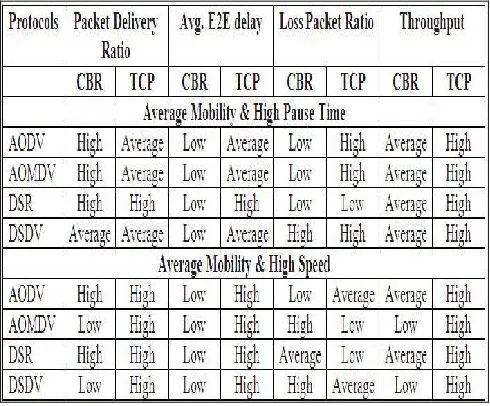
For CBR connection using pause time as a parameter in average mobility and high pause time PDR is high for AODV, AOMDV, DSR and average for DSDV. E2E Delay is low all the protocols. LPR is low for AODV, AOMDV and DSR, and high for DSDV. Throughput is average for all the protocols. For CBR connection in average mobility and high pause time it can be concluded that AODV, AOMDV and DSR are performing well whereas DSDV is performing poor in comparison to other protocols. For CBR connection using speed as a parameter in average mobility and high speed PDR is high for AODV and DSR, low for AOMDV and DSDV. E2E Delay is low for all the protocols. LPR is high for
AOMDV and DSDV, low for AODV and average for DSR. Throughput is average for AODV and DSR, and low for AOMDV and DSDV. For CBR connection in average mobility and high speed it can be concluded that both AODV and DSR protocols are performing well whereas AOMDV and DSDV are perfuming poor.
[image:4.612.324.569.185.388.2]For TCP connection using pause time as a parameter in average mobility and high pause time PDR is high for DSR and average for remaining protocols. E2E Delay is average for AODV, AOMDV, DSDV and high for DSR. LPR is high for AODV, AOMDV and DSDV, and low for DSR. Throughput is high for the protocols.
Figure 6: PDR, E-2-E, LPR and Throughput with respect to average mobility, high pause time and high speed for TCP & CBR Connections
For TCP connection in average mobility and high pause time it can be concluded that DSR is performing well in comparison to the other protocols.For TCP connection using speed as a parameter in average mobility and high speed PDR is high for all the protocols. E2E Delay is high for all the protocols. LPR is average for AODV and DSDV, low for DSR and AOMDV. Throughput is high for the protocols. For TCP connection in average mobility and high speed it can be concluded that AOMDV and DSR protocols are performing well whereas AODV and DSDV are perfuming.
VI. PATTERNANALYSISFORHIGHMOBILITY ANDALLVARIANTSOFPAUSETIMEAND
SPEED
This section present the various outcomes for the PDR, E2E Delay, LPR and Throughput, considering AODV, AOMDV, DSR and DSDV protocols for high mobility and all the variation of the pause time and speed (low, average, and high) for both CBR and TCP traffic.
A. High Mobility and Low Pause Time:
Throughput is low for the AOMDV and DSDV, and average for the AODV and DSR. For CBR connection using speed as a parameter in high mobility and low speed PDR for the AOMDV and DSDV is low and high for DSR and average for AODV. E2E Delay is average for AODV, DSR and DSDV, and low for AOMDV. LPR is high for the AOMDV, AODV and DSDV, and low for the DSR. Throughput is low for the AOMDV and DSDV, and average for the DSR and AODV. For CBR connection in high mobility with low pause time and low speed it can be concluded that DSR performing well in comparison to the other protocols
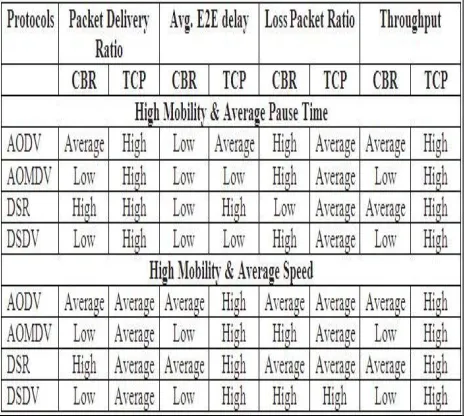
Figure 7: PDR, E-2-E, LPR and Throughput with respect to high mobility, low pause time and low speed for TCP & CBR Connections
For TCP connection using pause time as a parameter in high mobility and low pause time PDR for the AODV is average and high for the DSR, DSDV and AOMDV. E2E Delay is average for AODV, AOMDV and DSDV, and high for the DSR. LPR is average for the DSDV, DSR and AOMDV, and high for AODV. Throughput is high for the all the protocols. For TCP connection in high mobility and low pause time it can be concluded that DSDV and AOMDV is performing well in comparison to the other protocols. For TCP connection using speed as a parameter in high mobility and low speed PDR for the AODV, AOMDV and DSDV is average and high for DSR. E2E Delay is high for all the protocols. LPR is average for the DSR and high for AODV, AOMDV and DSDV. Throughput is high for AODV, AOMDV and DSDV, and average for DSR. For TCP connection in average mobility and low speed it can be concluded that DSR is performing well in comparison to the other protocols.
B. High Mobility and Avg Pause Time and Avg Speed:
For CBR connection using pause time as a parameter in high mobility and average pause time PDR for AOMDV and DSDV is low and average for AODV and high for DSR. E2E Delay is low for all the protocols. LPR is high for the AOMDV, DSDV and AODV, low for DSR. Throughput is low for the AOMDV and DSDV, and average for the DSR and AODV. For CBR connection in high mobility and average pause time it can be concluded
[image:5.612.54.288.187.366.2]that DSR is performing well in comparison to the other protocols. For CBR connection using speed as a parameter in high mobility and average speed PDR is low for AOMDV and DSDV, high for DSR and average for AODV. E2E Delay is low for DSDV, AOMDV, and average for AODV and DSR. LPR is high for AOMDV and DSDV, average for DSR and AODV. Throughput is low AOMDV and DSDV, and average for AODV and DSR. For CBR connection in high mobility and average speed it can be concluded that DSR and AODV are performing well in comparison to other protocols.
Figure 8: PDR, E-2-E, LPR and Throughput with respect to high mobility, average pause time and average speed for TCP & CBR
Connections
For TCP connection using pause time as a parameter in high mobility and average pause time PDR is high for all the protocols. E2E Delay is high for DSR and average for the AODV, and low for AOMDV and DSDV. LPR is average for all the protocols. Throughput is high for the all the protocols. For TCP connection in high mobility and average pause time it can be concluded that AOMDV and DSDV are performing well in comparison to the other protocols. For TCP connection using speed as a parameter in high mobility and average speed PDR is average for all the protocols. E2E Delay is high for all the protocols. LPR is average for the AOMDV, AODV and DSR, and high for DSDV. Throughput is high for the all the protocols. For TCP connection in high mobility and average speed it can be concluded that AODV and DSR is performing well in comparison to the other protocols.
C. High Mobility and High Pause Time and High Speed:
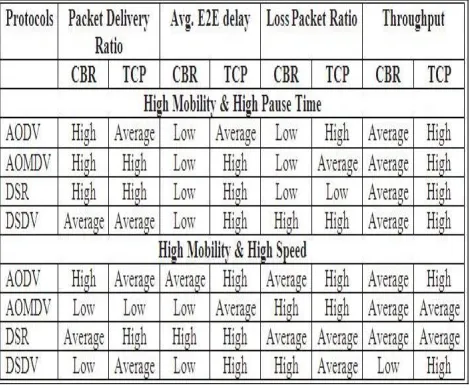
DSDV is performing poor in comparison to other protocols. For CBR connection using speed as a parameter in high mobility and high speed PDR is low for AOMDV and DSDV, average for DSR, and high for AODV. E2E Delay is low for AOMDV and DSDV, high for DSR and average for AODV. LPR is high for AOMDV and DSDV, average for AODV and DSR. Throughput is average for AODV, DSR and AOMDV, and low for DSDV. For CBR connection in high mobility and high speed it can be concluded that both AODV and DSR protocols are performing well whereas AOMDV and DSDV are perfuming poor.
[image:6.612.55.290.289.483.2]For TCP connection using pause time as a parameter in high mobility and high pause time PDR is high for DSR and AOMDV, and average for AODV and DSDV. E2E Delay is average for AODV and high for DSR, AOMDV and DSDV. LPR is high for AODV and DSDV, low for DSR and average for AOMDV. Throughput is high for the protocols. For TCP connection in high mobility and high pause time it can be concluded that AODV and DSR is performing well in comparison to the other protocols.
Figure 9: PDR, E-2-E, LPR and Throughput with respect to high mobility, high pause time and high speed for TCP & CBR Connections
For TCP connection using speed as a parameter in high mobility and high speed PDR is high for DSR, average for AODV and DSDV, and low for AOMDV. E2E Delay is high for AODV, DSDV and DSR, and average for AOMDV. LPR is average for DSR and DSDV, high for AODV and AOMDV. Throughput is high for AODV and DSDV, and average for AOMDV and DSR. For TCP connection in high mobility and high speed it can be concluded that DSR is performing well in comparison to other protocols.
VII. RESULTSANDDISCUSSION
In low mobility scenario DSR protocol is suitable for pause time variations there is only a single case in low mobility and high pause time scenario that all protocols are performing well under CBR traffic and none of the protocol are performing well under TCP traffic, means to say in low mobility, higher pause times are undesirable.
When we consider speed variations in low mobility it is clearly visible that again for the lower speeds DSR is the suitable candidate but as we proceeds to the higher speeds ( that is the usual phenomena of VANET) both DSR and AODV perform better in comparison to the other protocols. There is a single case for low mobility and average speed where all the protocols are showing the average behavior
Over all in average mobility scenario DSR protocol is suitable for both pause time and speed variations but it can also be not ignored that for CBR traffic AODV protocol is also performing well, there are few cases like for lower speed and lower pause time DSDV that table driven protocol is also performing well along with the DSR, one more important aspect is that AODV is suitable only in the CBR traffic and AOMDV will performs well in case of higher pause times.
In high mobility scenario, on the basis of average DSR protocol is performing well for both speed and pause time variations in CBR traffic. For higher and average pause time and speed AODV is equally perfuming with the DSR. When it comes to the TCP traffic in the same scenario results are different that for lower and average pause times DSDV along with AOMDV protocol are performing well. For higher pause time and all the variations of the speed again DSR is performing well.
VIII. CONCLUSIONANDFUTUREWORK
DSR protocol is suitable for lower speed and pause time irrespective of the mobility means to say that there is no effect of the mobility for lower pause time and speed. AODV protocol is suitable for higher pause time and speed. AOMDV and DSDV protocol are not significant in CBR traffic pattern they perform poor in comparison to the AODV and DSR. Both AODV and DSR protocol are suitable for VANETs, DSR is all rounder means it suitable in all the mobility patterns (high, average, low), whereas AODV is suitable for the average and high mobility pattern. AOMDV and DSDV protocol performs well in high mobility for TCP traffic pattern only. The suitability of protocols will depend on the traffic pattern means protocol behavior depend on the traffic pattern. There is tremendous scope for research in the area of VANET considering several other routing methods such as broadcast, geocast and cluster based routing methods can be explore for the evaluation of routing protocols in VANET, different position based routing protocols should be evaluated in real environment of VANET to check their efficiencies in real situation
IX. REFERENCES
[1] Vijay Shankar Sharma and N.C. Barwar
“Performance evaluation of DSR, AODV, AOMDV and DSDV Routing Protocols with varying pause time in VANET environment” 2nd international conference Beats-2012 , ISBN-13:978-81-925454-1-7, PP. 64
protocol under different traffic pattern” IJCA online, Jan 2012.
[3] D.B Johnson, D.A Maltz, and Yih-Chun Hu., “The Dynamic Source Routing Protocol for Mobile Ad Hoc Networks (DSR)”, Internet draft (draft-ietf-manet-dsr-10.txt), 19 July 2004
[4] C. Perkins E. Belding-Royer, and S.Das, “Ad hoc On- Demand Distance Vector (AODV) Routing”, RFC 3561, July2003.
[5] Perkins Charles E, Bhagwat Pravin, “Highly dynamic Destination-Sequenced Distance-Vector routing”, for mobile computers, Proc. of the SIGCOMM ’94
[6] Marc Gresis, “Tutorial for the network simulator
(ns-2)”, available http://www.isi.edu/nsnam/ns/tutorial/index.html
[7] Schnaufer, S., Effelsberg, W. (2008), "Position-based unicast routing for city scenarios," World of Wireless, Mobile and Multimedia Networks, 2008. [8] Kevin C. Lee, Uichin Lee, Mario Gerla, “Survey of Routing Protocols in Vehicular Ad Hoc Networks”, Advances in Vehicular Ad-Hoc Networks: Developments and Challenges, IGI Global, Oct, 2009
[9] Sven Jaap, Marc Bechler, and Lars Wolf, ”Evaluation of Routing Protocols for Vehicular Ad Hoc Networks in Typical Road Traffic Scenarios”, in Proc of the 11th EUNICE Open European Summer School on Networked Applications, Colmenarejo, Spain, July 2005.
[10] R.A. Santos et al., ”Performance Evaluation of Routing Protocols in Vehicular Ad Hoc Networks”, in International Journal of Ad Hoc and Ubiquitous Computing 2005, Vol. 1, No.1/2, pp. 80 - 91.
[11] SunilTaneja,AshwaniKush and Amandeep
Makkar,(International Journal of Innovation, Management and Technology, Vol. 1, No. 5, December 2010)“Experimental Analysis of DSR, AODV using Speed and Pause time”.
[12] Bijan Paul, Md. Ibrahim, Md. Abu Naser Bikas, “Experimental Analysis of AODV & DSR over TCP & CBR Connections with Varying Speed and Node Density in VANET”, IJCA, DOI:10.5120/2937-3897, Volume 24, Issue 4, June 2011, Pages 30-37
[13] Bijan Paul, Md. Ibrahim, Md. Abu Naser Bikas, “Performance Evaluation of Aodv & DSR with Varying Pause Time & Node Density Over TCP & CBR Connections in VANET”, IJCSNS, Volume 11, Issue 7, July 2011, Pages 119-127
[14] P. Johansson et al. , ”Scenario-based Performance Analysis of Routing Protocols for Mobile Ad-Hoc Networks”, In Proc. IEEE/ACM Mobicom’ 99, pp. 195-206, Seattle, WA, Aug. 1999.