© 2015, IRJET.NET- All Rights Reserved
Page 700
Performance Analysis of UDP/CBR &TCP/FTP Traffic Under Reactive and
Proactive Routing Protocols in VANET
Deepika Jaiswal , Dr. Sarita Singh Bhadauria
Department of Electronics, Madhav Institute of Technology and Science Gwalior(M.P.), India
---Abstract-
VANET is a growing technology which seeksthe interest of many researchers as it uses high speed vehicles as mobile nodes to implement mobile ad-hoc network .There are different traffic pattern to generate Random Traffic for wireless scenario. Reliability and Capability of transmission of information are the important characteristics that are determined by traffic scenario, which is necessary for the performance analysis of VANET .In this paper TCP/FTP (Transmission Control Protocol/File Transmission Protocol) and UDP/CBR (User Datagram Protocol/Constant Bit Rate) traffic are used. The purpose of this paper is to analyze different traffic under reactive and proactive routing protocols in city scenario with varying node densities on the basis of Performance metrics i.e. packet delivery ratio, end to end delay and throughput .It is found that TCP/FTP offers a far better performance than UDP/CBR in case of Packet Delivery Ratio and Throughput for all routing protocols while the performance of UDP/CBR traffic is better in case of end to end delay for all routing protocols. In this paper Simulation has been done using discrete event simulator NS-2.35.
Keywords-
Traffic pattern, TCP/FTP, UDP/CBR,
Proactive and Reactive routing protocols, NS-2.35 ,
PDR, End to End delay, Throughput.
INTRODUCTION
In a city area, traffic congestion becomes severe problem nowadays & every year due to traffic accidents a significant number of fatal injuries and major property losses are reported. According to the WHO report Reviewed on May 2015, every year, 1.24 million people
died as a result of crashes due to road traffic. Around 20 to 50 million people suffer non-fatal injuries, and as a result of their injury many meet with a disability. VANET (Vehicular ad-hoc Network) is an emerging technology, which helps to reduce road accident and congestion problem [1] . To provide safe and efficient routing of data in the network is one of the important challenges among several challenges in communication laid by VANET [5]. Hence, dynamic and efficient routing protocols need to be developed, which can guarantee efficient and secure routes of communication. Reliability and Capability of
transmission of information are the important
characteristics that are determined by traffic scenario, which is necessary for the performance analysis of VANET. The performance of routing protocols over different connections using Random Waypoint model is analyzed by researchers [3]. Main aim of this paper is to attain the performance evaluation of TCP/FTP and UDP/CBR traffic types under AODV ,DSR and DSDV Protocol, dealing with two variable parameters; simulation time and number or density of vehicles in city scenario. These scenarios are approved by simulations performed on Network Simulator-2 (NS-2.35) and the conclusions are drawn on the basis of performance metrics: packet delivery ratio, throughput, and average end to end delay.
© 2015, IRJET.NET- All Rights Reserved
Page 701
ROUTING PROTOCOLS
1.AODV
AODV is a reactive routing that uses routing tables, one entry per destination. To determine whether routing information is up-to-date and to avoid routing loops, sequence numbers are used. It helps in both multicasting and unicasting [4]. AODV employ RREQ & RREP message pair to discover the route. By broadcasting the RREQ message to its neighbors, the source node finds the route to destination [5]. The RREQ message contains fields; the source and destination address, lifespan of the message, a unique identification request ID and the source and destination sequence numbers. The Destination Sequence Number is the most recent sequence number received by the source from any route and the Source Sequence Number is the present sequence number to be used for route entry of the source node for the route request[4]. If from a list of neighbors any node recognizes the route to the destination then it can send RREP message to the source node.
2.DSR
DSR is also a reactive routing protocol. It discovers the route only on demand like AODV. Unlike AODV, DSR stores the complete path to the destination in its routing cache instead of the next hop node. The packet header field contains the address of all the intermediate nodes through which the packet moves to the destination node. This type of routing is known as source routing hence DSR name is so called. RREQ & RREP message pair is used to discover the route, like AODV. The Source node broadcasts the RREQ message and the node having a route to destination sends a RREP message [9]. An intermediate node rebroadcasts the RREQ message after adding its address to source address if it doesn’t have information regarding destination node
3.DSDV
The Destination-Sequenced Distance-Vector (DSDV)
Routing Protocol uses traditional Bellman-Ford Routing Algorithm in addition with some VANET related enhancements [6]. Every vehicular node manages a routing cache which lists the destinations with the number of vehicular nodes or no. of hops. To prevent the establishment of loops, sequence number is used to separate the old routes from new ones.
PERFORMANCE METRICS
VANET use a number of metrics for the evaluation of the performance of routing protocols in the network. In this paper the metrics considered to calculate the network performance are as follows:
1.Throughput:
It is the total number of packetssuccessfully delivered to destination during the simulation time. The unit used is kbps. The routing protocols with high throughput are more efficient.
(1)
2.Packet Delivery Ratio:
It is the number packets thatare delivered to the destination. The
higher is the packe delivery ratio, the better is the routing protocol.
(2)
3.End-To-End (E2E) Delay
: The total time fortransmitting a packet from source to the destination node is known as end to end delay. The delay performance metric includes the delays due to route discovery, packet propagation and sending time and the time of packet in queue.
(3)
DATA TRAFFIC /APPLICATION TRAFFIC TYPES
© 2015, IRJET.NET- All Rights Reserved
Page 702
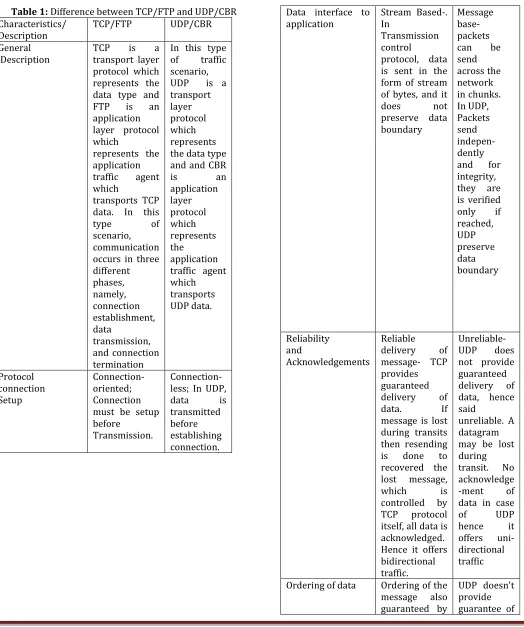
Table 1: Difference between TCP/FTP and UDP/CBR Characteristics/
Description
TCP/FTP UDP/CBR
General Description
TCP is a
transport layer protocol which represents the data type and
FTP is an
application layer protocol which
represents the application traffic agent which
transports TCP data. In this
type of
scenario, communication occurs in three different phases, namely, connection establishment, data
transmission, and connection termination
In this type
of traffic
scenario, UDP is a transport layer protocol which represents the data type and and CBR
is an
application layer protocol which represents the
application traffic agent which transports UDP data.
Protocol connection Setup
Connection-oriented; Connection must be setup before
Transmission.
Connection-less; In UDP,
data is
transmitted before establishing connection.
Data interface to application
Stream Based-. In
Transmission control
protocol, data is sent in the form of stream of bytes, and it
does not
preserve data boundary
Message base-packets
can be
send across the network in chunks. In UDP, Packets send indepen- dently
and for
integrity, they are is verified
only if
reached, UDP preserve data boundary
Reliability and
Acknowledgements
Reliable
delivery of
message- TCP provides guaranteed
delivery of
data. If
message is lost during transits then resending
is done to
recovered the lost message,
which is
controlled by
TCP protocol
itself, all data is acknowledged. Hence it offers bidirectional traffic.
Unreliable-
UDP does
not provide guaranteed delivery of data, hence said
unreliable. A datagram may be lost during transit. No acknowledge
-ment of
data in case
of UDP
hence it
offers uni-directional traffic
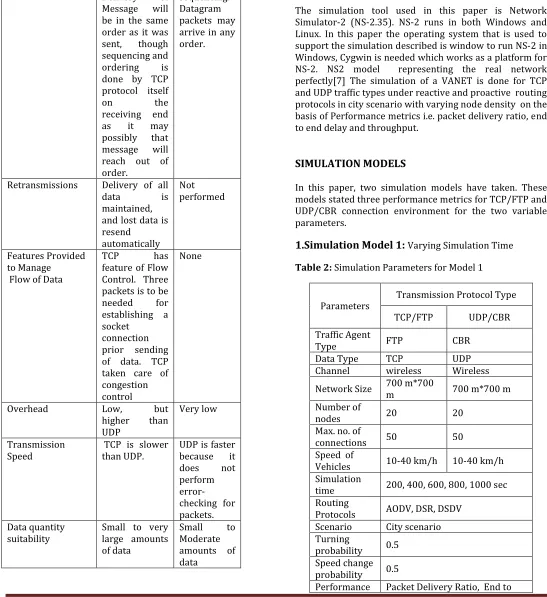
Ordering of data Ordering of the
message also guaranteed by
© 2015, IRJET.NET- All Rights Reserved
Page 703
TCP means
Delivery of
Message will
be in the same order as it was
sent, though
sequencing and
ordering is
done by TCP protocol itself
on the
receiving end
as it may
possibly that
message will
reach out of order.
ordering or sequencing. Datagram packets may arrive in any order.
Retransmissions Delivery of all
data is
maintained, and lost data is resend
automatically
Not performed
Features Provided to Manage
Flow of Data
TCP has
feature of Flow Control. Three packets is to be
needed for
establishing a socket
connection prior sending of data. TCP taken care of congestion control
None
Overhead Low, but
higher than
UDP
Very low
Transmission Speed
TCP is slower than UDP.
UDP is faster
because it
does not
perform error-checking for packets. Data quantity
suitability
Small to very large amounts of data
Small to
Moderate amounts of data
SIMULATION ENVIRONMENT
The simulation tool used in this paper is Network Simulator-2 (NS-2.35). NS-2 runs in both Windows and Linux. In this paper the operating system that is used to support the simulation described is window to run NS-2 in Windows, Cygwin is needed which works as a platform for NS-2. NS2 model representing the real network perfectly[7] The simulation of a VANET is done for TCP and UDP traffic types under reactive and proactive routing protocols in city scenario with varying node density on the basis of Performance metrics i.e. packet delivery ratio, end to end delay and throughput.
SIMULATION MODELS
In this paper, two simulation models have taken. These models stated three performance metrics for TCP/FTP and UDP/CBR connection environment for the two variable parameters.
[image:4.612.29.576.117.714.2]1.Simulation Model 1:
Varying Simulation TimeTable 2: Simulation Parameters for Model 1
Parameters
Transmission Protocol Type
TCP/FTP UDP/CBR
Traffic Agent
Type FTP CBR
Data Type TCP UDP
Channel wireless Wireless
Network Size 700 m*700
m 700 m*700 m
Number of
nodes 20 20
Max. no. of
connections 50 50
Speed of
Vehicles 10-40 km/h 10-40 km/h
Simulation
time 200, 400, 600, 800, 1000 sec
Routing
Protocols AODV, DSR, DSDV
Scenario City scenario
Turning
probability 0.5
Speed change
probability 0.5
© 2015, IRJET.NET- All Rights Reserved
Page 704
Metrics End Delay, Average Throughput
Interface
Queue Type Priority Queue (50 Packets)
Antenna
Model Omni-directional Antenna
Radio Propagation Model
Two-Ray Ground
MAC Type IEEE 802.11
Simulator NS-2.35
1.1 Result 1:
Packet delivery ratio vs. Simulation TimeConsidering all three protocols for Packet Delivery Ratio, it is found that TCP performs much better than UDP in case of AODV and DSDV while both performs almost same in case of DSR. This is shown in Figures 1, 2 & 3.
200 400 600 800 1000
0 10 20 30 40 50 60 70 80 90 100
ANALYSIS OF TCP/FTP & UDP/CBR TRAFFIC UNDER AODV PROTOCOL
SIMULATION TIME (sec)
P
A
C
K
E
T
D
E
L
IV
E
R
Y
R
A
T
IO
(
%
)
AODV (TCP) AODV (CBR)
Figure-1: Performance Analysis of TCP and UDP considering Packet Delivery Ratio in case of AODV Protocol
200 400 600 800 1000
0 10 20 30 40 50 60 70 80 90 100
ANALYSIS OF TCP/FTP & UDP/CBR TRAFFIC UNDER DSR PROTOCOL
SIMULATION TIME (sec)
P
A
C
K
E
T
D
E
L
IV
E
R
Y
R
A
T
IO
(
%
)
DSR (TCP) DSR (CBR)
Figure-2: Performance Analysis of TCP and UDP considering Packet Delivery Ratio in case of DSR Protocol
200 400 600 800 1000
0 10 20 30 40 50 60 70 80 90 100
ANALYSIS OF TCP/FTP & UDP/CBR TRAFFIC UNDER DSDV PROTOCOL
SIMULATION TIME (sec)
P
A
C
K
E
T
D
E
L
IV
E
R
Y
R
A
T
IO
(
%
)
DSDV (TCP) DSDV (CBR)
Fig ure-3: Performance Analysis of TCP and UDP considering Packet Delivery Ratio in case of DSDV Protocol
1.2 Result 2:
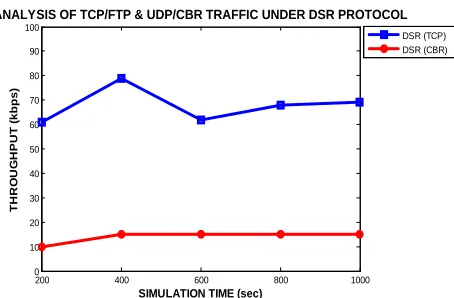
Throughput vs. Simulation TimeConsidering throughput as performance metrics, performance of TCP traffic is superior than UDP traffic under all three protocols. This is shown in Figures 4, 5 & 6.
200 400 600 800 1000
0 10 20 30 40 50 60 70 80 90 100
ANALYSIS OF TCP/FTP & UDP/CBR TRAFFIC UNDER AODV PROTOCOL
SIMULATION TIME (sec)
T
H
R
O
U
G
H
P
U
T
(
k
b
p
s
)
AODV (TCP) AODV (CBR)
© 2015, IRJET.NET- All Rights Reserved
Page 705
200 400 600 800 1000
0 10 20 30 40 50 60 70 80 90 100
ANALYSIS OF TCP/FTP & UDP/CBR TRAFFIC UNDER DSR PROTOCOL
SIMULATION TIME (sec)
T
H
R
O
U
G
H
P
U
T
(
k
b
p
s
)
DSR (TCP) DSR (CBR)
[image:6.612.51.278.93.242.2]Figure-5: Performance Analysis of TCP and UDP
considering Throughput in case of DSR Protocol
200 400 600 800 1000
0 10 20 30 40 50 60 70 80 90 100
ANALYSIS OF TCP/FTP & UDP/CBR TRAFFIC UNDER DSDV PROTOCOL
SIMULATION TIME (sec)
T
H
R
O
U
G
H
P
U
T
(
k
b
p
s
)
DSDV (TCP) DSDV (CBR)
F igure-6: Performance Analysis of TCP and UDP considering Throughput in case of DSDV Protocol
1.3 Result3:
End to End DelayvsSimulation TimeUDP is better in case of End to End Delay under all three protocols . This is shown in Figures 7, 8 & 9.
200 400 600 800 1000
0 100 200 300 400 500 600 700 800 900 1000
ANALYSIS OF TCP/FTP & UDP/CBR TRAFFIC UNDER AODV PROTOCOL
SIMULATION TIME (sec)
E
N
D
T
O
E
N
D
D
E
L
A
Y
(
m
s
)
AODV (TCP) AODV (CBR)
Figure-7: Performance Analysis of TCP and UDP considering End to End Delay in case of AODV Protocol
200 400 600 800 1000
0 100 200 300 400 500 600 700 800 900 1000
ANALYSIS OF TCP/FTP & UDP/CBR TRAFFIC UNDER DSR PROTOCOL
SIMULATION TIME (sec)
E
N
D
T
O
E
N
D
D
E
L
A
Y
(
m
s
)
DSR (TCP) DSR (CBR)
Fig ure-8: Performance Analysis of TCP and UDP
considering End to End Delay in case of DSR Protocol
200 400 600 800 1000
0 100 200 300 400 500 600 700 800 900 1000
ANALYSIS OF TCP/FTP & UDP/CBR TRAFFIC UNDER DSDV PROTOCOL
SIMULATION TIME (sec)
E
N
D
T
O
E
N
D
D
E
L
A
Y
(
m
s
)
[image:6.612.327.576.94.236.2]DSDV (TCP) DSDV (CBR)
Figure-9: Performance Analysis of TCP and UDP considering End to End Delay in case of DSDV Protocol
2.Simulation Model 2:
with Varying Number ofVehicles/Different Vehicle Density
[image:6.612.342.563.471.611.2]© 2015, IRJET.NET- All Rights Reserved
Page 706
Parameters Transmission Protocol Type
TCP/FTP UDP/CBR
Traffic Agent Type FTP CBR
Data Type TCP UDP
Channel wireless Wireless
Network Size 700
m*700 m 700 m*700 m
Number of nodes 20,40,60,
80,100
20,40,60,80,10 0
Max. no. of connections
50,100,15 0,200,250 respectiv ely
50,100,150,200 ,250
respectively
Speed of Vehicles 10-40
km/h 10-40 km/h
Simulation time 1000 sec
Routing Protocols AODV, DSR, DSDV
Scenario City scenario
Turning probability 0.5 Speed change
probability 0.5
Performance Metrics
Packet Delivery Ratio, End to End Delay, Average Throughput
Interface Queue
Type Priority Queue (50 Packets)
Antenna Model Omni-directional Antenna
Radio Propagation
Model Two-Ray Ground
MAC Type IEEE 802.11
Simulator NS-2.35
2.1 Result 1:
Packet Delivery Ratio vs. Number ofVehicles
Taking PDR as performance metrics for comparison of traffic types, it is found that TCP is better as well as stable under all three routing protocols. This is shown in Figures 10, 11 & 12.
20 40 60 80 100
0 10 20 30 40 50 60 70 80 90 100
ANALYSIS OF TCP/FTP & UDP/CBR TRAFFIC UNDER AODV PROTOCOL
NO. OF VEHICLES
P
A
C
K
E
T
D
E
L
IV
E
R
Y
R
A
T
IO
(
%
)
AODV (TCP) AODV (CBR)
Figure-10: Performance Analysis of TCP and UDP considering Packet Delivery Ratio in case of AODV Protocol
20 40 60 80 100
0 10 20 30 40 50 60 70 80 90 100
ANALYSIS OF TCP/FTP & UDP/CBR TRAFFIC UNDER DSR PROTOCOL
NO. OF VEHICLES
P
A
C
K
E
T
D
E
L
IV
E
R
Y
R
A
T
IO
(
%
)
DSR (TCP) DSR (CBR)
Figure-11: Performance Analysis of TCP and UDP considering Packet Delivery Ratio in case of DSR Protocol
20 40 60 80 100
0 10 20 30 40 50 60 70 80 90 100
ANALYSIS OF TCP/FTP & UDP/CBR TRAFFIC UNDER DSDV PROTOCOL
NO. OF VEHICLES
P
A
C
K
E
T
D
E
L
IV
E
R
Y
R
A
T
IO
(
%
)
© 2015, IRJET.NET- All Rights Reserved
Page 707
Figure-12: Performance Analysis of TCP and UDP considering Packet Delivery Ratio in case of DSDV Protocol
2.2 Result 2:
Throughput vs. No. of VehiclesConsidering Throughput as performance metrics for analysing traffic type,under AODV and DSDV Protocol performance of TCP is better than UDP while under DSR TCP performs better for less no. of vehicles and as no. vehicles increases the performance of TCP
decreases and becomes equal to UDP.
20 40 60 80 100
0 10 20 30 40 50 60 70 80 90 100
ANALYSIS OF TCP/FTP & UDP/CBR TRAFFIC UNDER AODV PROTOCOL
NO. OF VEHICLES
T
H
R
O
U
G
H
P
U
T
(
k
b
p
s
)
AODV (TCP) AODV (CBR)
Figure-13: Performance Analysis of TCP and UDP considering Throughput in case of AODV Protocol
20 40 60 80 100
0 10 20 30 40 50 60 70 80 90 100
ANALYSIS OF TCP/FTP & UDP/CBR TRAFFIC UNDER DSR PROTOCOL
NO. OF VEHICLES
T
H
R
O
U
G
H
P
U
T
(
k
b
p
s
)
DSR (TCP) DSR (CBR)
Figure-14: Performance Analysis of TCP and UDP considering Throughput in case of DSR Protocol
20 40 60 80 100
0 10 20 30 40 50 60 70 80 90 100
ANALYSIS OF TCP/FTP & UDP/CBR TRAFFIC UNDER DSDV PROTOCOL
NO. OF VEHICLES
T
H
R
O
U
G
H
P
U
T
(
k
b
p
s
)
DSDV (TCP) DSDV (CBR)
Figure-15: Performance Analysis of TCP and UDP considering Throughput in case of DSDV Protocol
2.3 Result 3:
End to End Delay vs. Number of VehiclesConsidering End to End Delay as performance metrics, under AODV and DSDV routing protocols UDP is better for less vehicle while as no. of vehicles increases in a network TCP performs better, and under DSR routing protocol UDP is superior even for increasing no. of vehicles.
20 40 60 80 100
0 100 200 300 400 500 600 700 800
ANALYSIS OF TCP/FTP & UDP/CBR TRAFFIC UNDER AODV PROTOCOL
NO. OF VEHICLES
E
N
D
T
O
E
N
D
D
E
L
A
Y
(
m
s
)
AODV (TCP) AODV (CBR)
© 2015, IRJET.NET- All Rights Reserved
Page 708
20 40 60 80 100
0 100 200 300 400 500 600 700 800
ANALYSIS OF TCP/FTP & UDP/CBR TRAFFIC UNDER DSR PROTOCOL
NO. OF VEHICLES
E
N
D
T
O
E
N
D
D
E
L
A
Y
(
m
s
)
DSR (TCP) DSR (CBR)
Figure-17: Performance Analysis of TCP and UDP considering End to End Delay in case of DSR Protocol
20 40 60 80 100
0 100 200 300 400 500 600 700 800
ANALYSIS OF TCP/FTP & UDP/CBR TRAFFIC UNDER DSDV PROTOCOL
NO. OF VEHICLES
E
N
D
T
O
E
N
D
D
E
L
A
Y
(
m
s
)
DSDV (TCP) DSDV (CBR)
Figure-18: Performance Analysis of TCP and UDP considering End to End Delay in case of DSDV Protocol
CONCLUSION
In this paper, the two traffic scenarios are compared i.e. TCP/FTP and UDP/CBR. To find the appropriate traffic type from these two available different traffics types in a network in city scenario, essential conclusions are prepared by examining the results and finally this paper is concluded by comparing two different traffic patterns via three performance metrics i.e. Throughput, Packet Delivery Ratio (PDR), End to End Delay. Number of conclusions drawn from number of experiments, observations, and analysis are as follows:
1.Packet Delivery Ratio (PDR):
For VaryingSimulation Time. of vehicles and no, out of the two traffic types i.e. TCP/FTP provides far better performance than the UDP/CBR. TCP/FTP is stable as well. This proves that the network working with routing protocols is more reliable.
2.Throughput:
For Varying Simulation Time, TCP/FTPprovides superior performance than the UDP/CBR but not stable While for varying no. vehicles TCP/FTP is better as well as stable. This proves that the network working with routing protocols provides improved efficiency with TCP/FTP than UDP/CBR.
3.End to End Delay:
For Varying Simulation Time,UDP/CBR offers lesser end to end delay than TCP/FTP, therefore speed of transmission is high in case of UDP, but for the scenario with Varying no. of vehicles , as the density of vehicles increases, the End to End delay of TCP/FTP decreases and becomes lesser than UDP/CBR under AODV and DSDV protocols but for DSR protocol UDP/CBR offers lesser end to end delay than TCP/FTP . For future extensions in this work, the concept can be used with various variations of TCP to give a extensive performance analysis for various routing protocols and performance metrics.
REFERENCES
[1] S. K. Singh , R. Duvuru , S. S. Thakur: Congestion Control Technique Using Intelligent Traffic and
Vanet: International Journal of Computer
Engineering & Applications, Vol. IV, Issue I/III, Jan , 2014.
[2] S. Singh and S. Agrawal, VANET Routing Protocols: Issues and Challenges: Proceedings of IEEE
International Conference on RAECS, Punjab
University Chandigarh, 06 – 08 March, 2014.
[3] B. Paul, A. Roy, S. Kumar Paul, Comparison of DSR, AODV and DSDV Routing Protocols with varying pause time & node density over TCP & CBR
Connections in VANET: Sixth International
Conference on Computational Intelligence and
© 2015, IRJET.NET- All Rights Reserved
Page 709
[4] C. Perkins, E. Belding, S. Das, Ad hoc On-DemandDistance Vector (AODV) Routing: RFC 3561, July 2003.
[5] Taleb T., Hashimoto K., A Stable Routing Protocol to Support ITS Services in VANET Networks: IEEE Transaction on Vehicular Technology, Vol. 56, No. 6, 2007
[6] C. Perkins, P. Bhagwat , Highly Dynamic
Destination Sequenced Distance Vector Routing (DSDV) for Mobile Computers: Comp. Commun. Rev., Oct. 1994, pp. 234–44.
[7] S. Abbas, S. Mohd. , Mohd. S, Boba, Generation of Real World Traffic Using NS-2 Traffic Agents:
Journal of Theoretical and Applied Information
Technology, Vol. 67 no.3, September 2014