Volume 8, No. 3, March – April 2017
International Journal of Advanced Research in Computer Science
REVIEW ARTICLE
Available Online at www.ijarcs.info
Cloud Computing and its issues
Kanika Sood
M .Tech. student, CSE Department, Chandigarh Engineering College,
Landran, Mohali, Punjab, India
Anurag Jain
Associate Professor, CSE Department, Chandigarh Engineering College,
Landran, Mohali, Punjab, India
Surabhi Kaul
M .Tech. student, CSE Department Chandigarh Engineering College,
Landran, Mohali, Punjab, India
Abstract: With the meaningful improvements in Information Technology, it is envisioned that computing facilities will be considered as a 5th utility of the life after the four main utilities i.e. Water, gas, electricity and telephony. This computing utility, will contribute the fundamental stages of computing jobs that is necessary to fulfil the day-to-day demands of the public. Various computing prototypes have been introduced and cloud computing is one of them. In this paper authors have described the cloud computing, various layers, models ,different cloud computing issues. Authors have also described load balancing and its techniques.
Keywords: cloud computing; characteristics; deployment models; service models; issues; load balancing
I. INTRODUCTION
Computing is being modified to a model that includes services delivered in way equivalent to conventional utilities such as water, electricity, gas and telephony. In October 2007, Google and IBM published collaboration in computing and it became more popular from then on. With the Amazon EC2, the web email, Google App Engine and Sales force’s CRM show a auspicious conceptual foundation of cloud services. In this model user can get resources according to their demand without noticing from where these services are managed and distributed. Several Computing paradigms include cluster computing, Grid computing and furthermore newly cloud computing. It is a paradigm that provides convenient , on-request access of network to serve computer recourses such as networks, servers, storage, applications and services that can be quickly supplied and release with least management work and service provider interaction [1,2].
II. CLOUDCOMPUTING
It is a technology in which we design computing systems, create applications, and leverage existing services for developing software. Mostly dynamic provisioning concept is used in this, which is applied to services, to compute capability, storage, networking, and Information Technology (IT) infrastructure in general. Resources can be accessed via web and a pay-per-use concept is offered via vendors. Anyone can easily register to Cloud services, and deploy and configure servers for creating an application in hours, and paying only for the time these resources have been accessed [1].
III. VIRTUALIZATION [11]
In cloud computing virtualization plays important role. In cloud computing system some of the features like reduced response time, elasticity are achieved through virtualization. Virtualization is not in actual but offers all the ability of a real.
It is a software performance of a device which will perform various programs like a real machine. It is of two types.
A. Para Virtualization
In Para virtualization the hardware provides various operating systems to run on single device. Para Virtualization also enables effective utilization of system resources such as Memory and processor. In this virtualization all the jobs are not completely accessible rather the jobs are granted in parts.
B. Full Virtualization
It means a proper installation of one device is done on another device. Thus a virtual machine is obtained which have all the software that is present in the actual server. It helps in sharing a system across multiple consumers. It also gives a mechanism for simulating hardware on another machine.
IV. TAXONOMY
Cloud computing has many advantages that are making it very useful day by day: it is cost effective because installation of most of the resources is not required; less maintenance charges because services are controlled by cloud vendors. Flexibility and scalability, resources are provisioned and released according to the user’s requirements.
A. Vision of cloud computing
Leonard et al. in [3] stated that “As of now, there is a beginning of computer networks, but as they grow up and become worldly wise. We will notice the disperse of computer utilities across the country”. It depends on the resources providing model performs the large change in the whole computing enterprise whereby resources will be willingly available on-demand like other utilities are available in today’s association. Similarly consumers need to pay only when they access services. By this heavy investments are no longer needed by consumer and find no difficulties in making and maintaining complicated infrastructure. There are four types of resources that can be allocated and consumed over the Internet. These recourses can be shared among users by influencing economy of scale. The first resource is Infrastructure resources which include storage, computing power and machine allocation. The second resource is software resources that include middleware and development resources. In Cloud Computing application resources are of third type and fourth type is business process [8]. Figure 1 describes cloud taxonomy which includes different deployment models, characteristics and delivery models.
Figure 1. Cloud Taxonomy [12]
B. Characteristics [3]
1) On-demand self service: It refers to the recourses
given by cloud providers that provide cloud resources on demand whenever they are required. User can access these recourses through internet from anywhere.
2) Broad network access: Resources are accessible on
the web and can be accessed via standard mechanism. It means user can access resources via handsets, laptops and workstation.
3) Resource pooling: Services are joined to help
multiple buyers by using multi-tenant model having various real and unreal resources that are dynamically allocated and dislocated according to the buyer’s demand.
4) Rapid elasticity: Services can be flexibly allocated and released automatically. For user recourses are unlimited and appropriated at any time.
5) Measured Service: Cloud provider measure or
monitor the provision of services for various reasons
including billing, effectiveness of resources, overall predicate planning.
C. Literature review
Zhang Q et al. in [6] have stated that cloud is a new model for offering and hosting resources to the users via web. In this enterprise landholders are getting benefits as it reduces the needs for consumers to plan ahead for provisioning, and allows enterprises to began from the small and increase resources only when there is a rise in service demand.
Ramachandran et al. in [23] has stated that cloud computing is a model that allows appropriate, effective bank of services such as applications, servers etc. These services are easily accessible by users via internet. These services can be applied and freed with minimum authority efforts. In this user does not need expertise and knowledge to maintain the infrastructure of clouds, so abstraction might be provided to utilize the services of an Internet with high scalability, high computing power, and quality of service and with high throughput.
Vaquero et al. in [7] provided up to 22 definitions of cloud computing and gives more comprehensive analysis of all its features. The clouds are a huge pool of resources which are easy to use and access. Major features are: scalability, user friendliness, Internet centric, virtualization, variety of resources, resource optimization, automatic adaptation, pay-per-usage, Service-Level Agreements (SLA).
Armbrust et al. in [31] have stated that there is a delusion of limitless computing services accessible according to users need. Cloud offers facility in which user can pay for the resources that he/she wants for a temporary basis and direct contracts are eliminated by the cloud users.
Plummer et al. in [32] have introduced that cloud computing is a paradigm where hugely extendable facilities are offered as a resource via net to various outside users.
Staten et al. in [33] have introduced a bank of hugely extendable and supervised infrastructure which offers applications to the outside users and bill depends on user’s usage.
Mell et al. in [2] have introduced a paradigm that offers suitable, payable access to a common bank of adaptive computing services (e.g. servers, applications, networks, storage, and services) via internet that can be quickly provided and freed with minimum management attempts.
D. Cloud Services [3]
1) IaaS: It is called as bottom layer of cloud computing system. It provides resources like computation, storage, communication according to the consumer’s demand. Amazon web services provide infrastructure as a service, In case of its EC2 service means provide virtual machines with bank of software that are almost similar to a normal physical service. Users have rights to perform various activities to the server such as start and stop, attachment of virtual disks and to adapt access permissions and firewall rules.
3) SaaS: It is called as First layer of cloud computing system. End users via the web portals can access all the services provided by this layer. Now a day’s Consumer using online software services rather than using locally installed computer programs. Conventional applications like word processing and spreadsheets are also provided as services in the web. Model that delivers these applications is called as software as a service. Salesforce.com is an example of software as a service that allows consumers to access applications on demand. Figure 2. Describes the cloud services. In this figure three cloud services have been shown. first one is providing software to the users, second one is offering platform to run the applications of the users and third one is providing infrastructure to the users. Facebook, YouTube etc. are the examples of SaaS. Google App Engine, Microsoft Azure etc. are the examples of PaaS and Go grid, flexiscale etc. are the examples of IaaS.
Figure 2. Service Models
E Deployment Models [3]
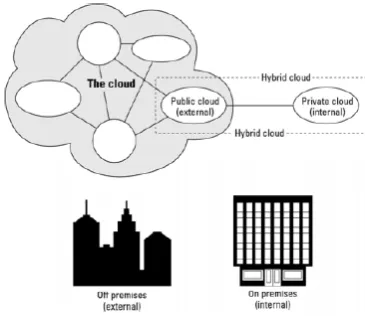
Even though cloud computing has came out mainly from the appearance of public utilities, other deployment models, with variations in physical location and distribution have been approved. In this sense, whatever of its service class, a cloud can be categorized as public, private, community, and hybrid.
1) Public Cloud: It is a cloud that is accessible by all the users anytime via internet. In this users have to pay for the services they are using rather than in advance.
Figure 3. Deployment locations for different cloud types [1].
2) Private Cloud: A private cloud is only accessible by enterprise holder or other organization. It is not open for ordinary public. In many cases, creating a cloud as a private depicts renovating a current framework by including virtualization and cloud-like interfaces. By this users can connect with the native data center although enduring the uniform profits of public clouds, especially self-service interface, privileged access to virtual servers, and pay per-use metering and billing.
3) Hybrid Cloud: It is created when computing
capacity of public clouds is added with a private cloud. The process of renting capacity to maintain burden is known as “cloud-bursting”.
4) Community cloud: It is used by various
associations and helps an individual community that includes mission, security requirements, strategy, and concurrence considerations.
V. CLOUDSERVICEPROVIDERS[3]
According to Merrill Lynch research, Cloud computing is approximately”$160 billion addressable market scope $95 billion in productivity and business applications and $65 billion in online purpose. Morgan Stanley has identified that cloud is a paradigm that is important and outstanding technology trend. Cloud computing provides services for consumers and take responsibility to access on demand services despite of time and location. For this various scholastic and technical associations are inquiring and evolving technologies for cloud computing.
A. Amazon EC2 [24]
It offers a virtual computing environment that allows a user to run Linux-based applications. The buyer can create a new Amazon paradigm named as Amazon machine image for holding the applications, libraries and connected configuration settings, or choose from a library of globally accessible AMIs. The user then requires to download the invented or accepted Amazon machine image to Amazon S3, starting stopping and monitoring the samples of the uploaded AMIs.
B. Google App Engine [25]
It enables a consumer to run applications using Python programming language. Google app engine support API’s for Google accounts, data stores, URL fetch, image manipulation and email services rather than supporting python standard library only. Web based administration console is also given by Google map engine so that users can easily manage their web applications. Currently Google map engine is an open source with 500 MB of storage and about 5 million page views per month.
C. Microsoft Azure [26]
[image:3.595.95.278.590.750.2]runtime script in local development environment. Then a packaged zip record is needed that contains scripts, executable binaries, input data and need to upload in Sun Grid. Now finally user’s file can be executed and monitor in Sun Grid web portal or API’s. After completion users need to download the results in local environment to view their results
D. Aneka [27]
It is a .Net –based service oriented resource management platform that is commercialized by Manjra soft. It is design to
handle multiple application models. To create a cloud in Aneka, provider requires installing a sample of Aneka container on the desktop computers. Main aim of this container is to start service and behaves like a single point to interact with other Aneka cloud. It provides SLA support so that user can specify deadline and budget that is Quos requirements. Aneka cloud can be accessed via Grid bus broker. It also allows user to specify the QOS requirement.
VI. ISSUESINCLOUDCOMPUTING[4]
• Our study shows that scaling an application in a cloud is more difficult, because a cloud is very different from a traditional enterprise framework.
• Application owners can select an optimal
infrastructure for their applications with various options from various vendors. In comparison, a cloud infrastructure is owned and maintained by the cloud providers. They only provide a restricted group of infrastructure components due to their commodity business model. Example, only five categories of virtual hosts is supplied by Amazon EC2 and owners are not able to customize their description. • Again due to its product enterprise pattern, a cloud
only provides commodity Virtual Machines (VM). The computation power and the network bandwidth is less than high-end servers. Example, only 800 Mbps is transmitted by all the virtual machines of Amazon, although, commercial web servers provide at most 1Gbps by using several Network Interface Cards (NIC).
• Unlike in an enterprise, application users have little or no control of the underlying cloud infrastructure. Example, for security reasons, Amazon EC2 does not disclose some of the networking features for security purpose. Application owners cannot change these infrastructure features. Almost every performance optimization technique relies on the infrastructure choice and control. Example, to expand a web based application, holders either request for the allotment of the similar IP address to all hosts to attain load balancing or ask for a load balancer. Unfavorably Amazon EC2 has no such choices. Probability of failure of product machines is usually high. Cloud architecture must be capable for handling these failure as soon as possible.. Because of these characteristics, cloud-hosted web applications are expected to run on a cluster with many standard commodity web servers, for this scalable and active load balancing result is required.
VII. LOAD BALANCING
Load balancing is a technique that distributes dynamic load across multiple systems to ensure no single system is overloaded. It helps in excellent utilization of resources and improves the execution of the system. Main goal of load balancing is to reduce the resource consumption that will further minimize carbon emission rate and energy consumption rate that is extreme need of cloud computing. It avoids a situation in a cloud where some systems are free or have no burden in work while others are heavily loaded. High consumer
ease and resource usage rate is achieved by using load balancing, hence overall performance and resource utililization of system is improved.
A. Need of Load Balancing [13]
It is a technique that provides the huge dynamic local workload across all the Nodes. By using load balancing a high consumer ease and resources usage rate can be achieved [15], be assure that all nodes are balanced, hence maintaining the total execution of the system. it can help in optimally utilizing the available resources, thus minimizing the resource consumption. Load balancing also helps in performing fail-over, allowing scalability, declining bottlenecks and over-provisioning, decreasing response time etc.
B. Load Balancing Approaches [29]
There are different load balancing environments that are discussed below.
1) Static Environment: This approach is appropriate for
similar and non dynamic environment. In a static approach, an algorithm is determined in design time and remains constant throughout. Thus there is no reconfiguration with the changing scenario. This algorithm gives the jobs to the nodes based only on the previous defined skill of the node to handle new demands [30].
2) Dynamic environment: This approach takes the
current parameters while giving job to a node. It is more appropriate for cloud environment. This algorithm is difficult to achieve as they have to continuously observe the nodes and task method and take the decision according to that [30].
3) Distributed Environment: It is liable for resource
allocating or task Scheduling decision. In distributed environment multiple domains monitor the network instead of single domain for monitoring the cloud network.
4) Centralized Environment: In centralized environment
all the allotments and scheduling conclusions are done by a single node. This node is liable for storing knowledge base of whole cloud network and can provide either static or dynamic approach.
5) Hierarchical Environment: This type of environment
involves various levels of e cloud and this technique mostly works in a master slave manner. Tree data structure is used to implement this where all branches in this are stabled below the direction of parent node.
C. Techniques of Load Balancing [13]
1) Load balancing based on Decentralized content: H.
superior appropriate node for processing the requests. In a decentralized manner this strategy is executed with low overhead. Content information is used to narrow down the search; this process enhances the searching performance and also total achievement of the system. It also helps in decreasing the free interval of the computing nodules thus enhancing their utilization.
2) Server-based load Balancing: A. M. Nakai et al. [15]
introduced a new server policy for web servers that are shared everywhere in the world. This technique helps in decreasing the service response times by using a policy that restricts the alteration of requests to the closest remote servers without overloading them. A middleware is defined to execute this policy. In this to help web servers to tolerate overloads, concept of heuristic is also used.
3) Join-Idle-Queue: Y. Lua et al. [16] introduced a load balancing algorithm for vigorously extendable web services. This algorithm is called as Join-Idle-Queue algorithm. This algorithm offers huge range load balancing with distributed dispatchers, first of all availability of free processors over dispatchers are found and then, jobs are assigned to processors to minimize common queue length of each processor.
4) A Lock-free multiprocessing technique: Liu et al. [17] introduced a solution that skips the usage of common storage however other solutions use common storage and lock to keep a user session. This solution is called as a lock free multiprocessing. It is obtained by adjusting Linux kernel. It helps in increasing the overall performance of load balancer in a multi-core environment. It can be done by running multiple load-balancing processes in one load balancer.
5) Scheduling strategy: J. Hu et al. [18] introduced a
strategy based on scheduling that utilizes authentic data and modern state of the system. This technique decreased dynamic migration by using a genetic algorithm. It helps in determining the issue of load-imbalance and high cost of migration thus achieving superior resource utilization.
6) Central policy: A. Bhadani et al. [19] introduced a
Central technique that maintains the load in a shared machine (virtual machine)/cloud computing environment. This policy increases the total performance of the system but it does not suppose the systems that are fault-tolerant.
7) Strategy for Virtual Storage: H. Liu et al. [20]
introduced a strategy that gives a huge scale net data storage prototype and Storage as a Service prototype founded on Cloud Storage. Storage virtualization is attained by using three-layered architecture and load balancing is attained by taking the support of two load balancing components. It helps in fixing the capability of simultaneous access by using replica adjusting moreover decreasing the response time and improving the potential of failure recovery. It also supports in achieving the use rate of storage resource, elasticity and strength of the system.
8) A Task Scheduling: Y. Fang et al. [21] introduced a
two-level task scheduling mechanism founded on load balancing to match active demands of users and
achieve a great resource usage. Load balancing is obtained in this by first designing jobs to virtual machines and to host resources thus achieving the job response time, resource usage and total achievement of the cloud computing environment.
9) Honeybee Foraging Behavior: M. Randles et al. [22]
discussed a redistributed honeybee-based load balancing method that is a nature-motivated algorithm. It obtains universal load balancing via native server steps. Performance of the system is improved with enhanced system variety but output is not enhanced with an increase in system size. It is better fitted for the situations where the different population of service types is needed.
D. Parameters of Load Balancing [13]
1) Overhead Associated: It defines the total amount of
workload when a load balancing algorithm is implemented. To perform load balancing approach effectively, this workload should be reduced.
2) Throughput: Throughput selects the number of jobs
whose performance has been finished. It should be maximize to enhance the achievement of the system.
3) Performance: Performance examines the
effectiveness of the system. It should be mended at a sensible cost.
4) Recourse Utilization: It checks the total usage of
resources. Resource utilization has to be perfect for an effective load balancing.
5) Scalability: Scalability should be optimized. It is a capability of an approach to achieve a load balancing with finite number of nodules.
6) Response Time: It is a total time taken by an
algorithm to compute a particular task. It should be minimized.
7) Migration Time: It is a time taken to move the jobs
from one nodule to other. Reduced migration time increases the performance of the system.
8) Fault Tolerance: It is a capability of an approach to achieve uniform load balancing despite of link failure. There should be good fault tolerance technique.
E. Load Balancing Challenges [28]
1) Automated service provisioning: Cloud computing is
known for elasticity; resources can be provisioned or released automatically. How then can a user use or release the resources of the cloud, by maintaining the same performance as traditional systems and using best resources?
2) Virtual Machines Migration: With virtualization,
whole machine can be observed as a list to unburden a heavily loaded physical machine and a virtual machine is shifted among the physical machines. The main aim is to allocate the load in a datacenter or set of datacenters. How then can a user actively allot the burden while shifting virtual machine to avoid bottlenecks in Cloud computing?
3) Energy Management: The benefit that supports the
portion of datacenter while making acceptable performance?
4) Stored data management: In the last time-interval
data stored over the network has an exponential enlarge even for companies by outsourcing their data storage or for individuals, the management and maintenance of data storage becomes a main challenge for cloud computing. How can a user distribute the data to the cloud for best storage of data while maintaining fast access?
5) Emergence of small data centers for cloud
computing: In cloud computing there is a probability to have small datacenters that are more profitable, inexpensive and lower power consumer than large datacenter [8]. Small providers can provide cloud computing services that are best to geo-diversity computing. Load balancing will become a problem on a global scale to assure an acceptable response time with a best distribution of resources.
VIII. CONCLUSION
In last few years existence of cloud computing has replaced the landscape of Information technology. It has been envisioned that cloud computing will be provided as 5th utility that will contribute the fundamental computing services. Cloud computing provides collection of resources that can accessed anywhere by using internet. Cloud Computing has Major Characteristics like elasticity, on-demand self service etc that play important role in provisioning and releasing the services. It offers numerous service models and deployment models. In this paper various Cloud Computing platforms are also discussed. Though some difficulties exist in Cloud computing and to handle load balancing is one of them. Technique that distributes the huge dynamic local workload across all the Nodes is called as load balancing. In this paper some current approaches and conflicts of load balancing are also discussed. In future work ACO algorithm for cloud computing tasks scheduling and simulator for cloud computing will be presented.
IX. REFERENCES
[1] B. Sosinsky, Cloud computing bible, John Wiley & Sons, Vol. 762, December 2010.
[2] P.Mell, and T. Grance, "The NIST definition of cloud computing," 2011.
[3] R. Buyya, C.S. Yeo, S. Venugopal, J. Broberg, and I.
Brandi,. "Cloud computing and emerging IT platforms: Vision, hype, and reality for delivering computing as the 5th utility," Future Generation computer systems , vol. 25, pp. 599-616 , June 2009.
[4] B.P. Rimal, C. Eunmi, and L. Ian, "A taxonomy and survey of cloud computing systems," INC, IMS and IDC, Augest 2009, pp. 44-51.D.C. Marinescu, Cloud computing: theory and practice. Newnes, May 2013.
[5] Q. Zhang, L. Cheng, and R. Boutaba, “Cloud computing:
state-of-the-art and research challenges,” vol. 1, May 2010, pp. 7-8..
[6] LM. Vaquero, L. Rodero-Merino, J. Caceres, and M. Lindner, "A break in the clouds: towards a cloud definition," ACM SIGCOMM Computer Communication Review, vol. 39, pp. 50-55,December 2008.
[7] A. Jain, and R. Kumar, "A Taxonomy of Cloud Computing," International Journal of Scientific and Research Publications, vol. 4, pp. 1-5, July 2014.
[8] M.A. Tawfeek, A. El-Sisi, AE. Keshk, and FA. Torkey,"Cloud task scheduling based on ant colony optimization," In Computer Engineering & Systems (ICCES), IEEE, 8th International Conference on, pp. 64-69, November 2013.
[9] R. Buyya, C. Vecchiola, and S.T. Selvi, Mastering cloud computing: foundations and applications programming, Newnes, 2013.
[10] Amandeep, V. Yadav, and F. Mohammad, "Different Strategies for Load Balancing in Cloud Computing Environment: a critical Study," vol. 3, April 2014.
[11] R. Kaur, and P. Luthra, "Load Balancing in Cloud Computing," In Proceedings of International Conference on Recent Trends in Information, Telecommunication and Computing, ITC, December 2012,
[12] A. Jain, and R. Kumar, "A multi stage load balancing technique for cloud environment," In Information Communication and Embedded Systems (ICICES), IEEE, International Conference on pp. 1-7, February 2016.
[13] H. Mehta, P. Kanungo, and M. Chandwani,
"Decentralized content aware load balancing algorithm for distributed computing environments," In Proceedings of the International Conference & Workshop on Emerging Trends in Technology, ACM, pp. 370-375, February 2011.
[14] Nakai, A. Massaru, E. Madeira, and L.E. Buzato, "Load balancing for internet distributed services using limited redirection rates," In Dependable Computing (LADC), IEEE, 5th Latin-American Symposium on, pp. 156-165, April 2011.
[15] Y. Lu, Q. Xie, G. Kliot, A. Geller, J.R.. Larus, and A. Greenberg, "Join-Idle-Queue: A novel load balancing algorithm for dynamically scalable web services," Performance Evaluation, vol. 68, pp. 1056-1071, November 2011.
[16] X. Liu, L. Pan, C.J. Wang, and J.Y Xie, "A lock-free solution for load balancing in multi-core environment," In Intelligent Systems and Applications (ISA), IEEE, 3rd International Workshop on, pp. 1-4, May 2011.
[17] J. Hu, J. Gu, G. Sun, and T. Zhao, "A scheduling strategy on load balancing of virtual machine resources in cloud computing environment," In Parallel Architectures, Algorithms and Programming (PAAP), IEEE, Third International Symposium on, pp. 89-96, December 2010.
[18] A. Bhadani, and S. Chaudhary, "Performance evaluation of web servers using central load balancing policy over virtual machines on cloud," In Proceedings of the Third Annual ACM Bangalore Conference, p. 16, January 2010.
[19] H. Liu, S. Liu, X. Meng, C. Yang, and Y. Zhang, "LBVS: A load balancing strategy for virtual storage," In Service Sciences (ICSS), IEEE, International Conference on, pp. 257-262, May 2010.
[20] A. Jain, and R. Kumar, "A comparative analysis of task scheduling approaches for cloud environment," In Computing for Sustainable Global Development (INDIACom), IEEE, 3rd International Conference on pp. 1787-1792, October 2016.
[21] M. Randles, D. Lamb, and A. Taleb-Bendiab, "A comparative study into distributed load balancing algorithms for cloud computing," In Advanced Information Networking and Applications Workshops (WAINA), IEEE 24th International Conference on, pp. 551-556, April 2010.
technology deployment model for an academic institute," Campus-Wide Information Systems, October 2014.
[23] Amazon, E.C.,"Amazon elastic compute cloud (Amazon EC2)," Amazon Elastic Compute Cloud (Amazon EC2) , March 2010.
[24] E. Ciurana, Developing with google app engine. Apress, January 2009.
[25] M. Copeland, J. Soh, A. Puca, M. Manning, and D. Gollob, "Overview of Microsoft Azure Services," In Microsoft Azure, Apress , pp. 27-69, 2015.
[26] C. Vecchiola, X. Chu, and R. Buyya, "Aneka: a software platform for .NET-based cloud computing," High Speed and Large Scale Scientific Computing, vol. 18, pp. 267-295, July 2009.
[27] N.J. Kansal, and I. Chana, "Existing load balancing techniques in cloud computing: a systematic review," Journal of Information Systems and Communication, vol. 3, p. 87, January 2012.
[28] M. Katyal, and A. Mishra, "A comparative study of load balancing algorithms in cloud computing environment," arXiv preprint arXiv. 1403.6918, March 2014.
[29] A. Jain, and R. Kumar, "A multi stage load balancing technique for cloud environment," In Information Communication and Embedded Systems (ICICES), IEEE, International Conference on pp. 1-7, February 2016.
[30] M. Armbrust, A. Fox, R. Griffith, A.D. Joseph, R. Katz, A. Konwinski, G. Lee, D. Patterson,A. Rabkin, I. Stoica, and M. Zaharia, M, "Above the clouds: a Berkeley view of cloud," Electrical Engineering and Computer Sciences, University of California at Berkeley, April 2009.
[31] D.C. Plummer, D.m. Smith, T.J. Bittman, D.W. Cearley, D.J. Cappuccio, D. Scott, R. Kumar, and B. Robertson, "Five refining attributes of public and private cloud computing," Gartner Research, vol. 167182, 2009.
[32] J. Staten, Y. Simon, F.E. Gillett, W. Saleh, and R.A. Dines, "Is cloud computing ready for the enterprise," Forrester Research , vol. 400 , March 2008.