R E S E A R C H
Open Access
Multiple-relay selection in amplify-and-forward
cooperative wireless networks with multiple
source nodes
Jinsong Wu
1*, Yimin D Zhang
2*, Moeness G Amin
2and Murat Uysal
3Abstract
In this article, we propose multiple-relay selection schemes for multiple source nodes in amplify-and-forward wireless relay networks based on the sum capacity maximization criterion. Both optimal and sub-optimal relay selection criteria are discussed, considering that sub-optimal approaches demonstrate advantages in reduced computational complexity. Using semi-definite programming convex optimization, we present computationally efficient algorithms for multiple-source multiple-relay selection (MSMRS) with both fixed number and varied number of relays. Finally, numerical results are provided to illustrate the comparisons between different relay selection criteria. It is
demonstrated that optimal varied number MSMRS outperforms optimal fixed number MSMRS under the same power constraints.
Introduction
Multihop relaying has emerged as a promising approach to achieve high-rate coverage in wireless communications [1,2]. Several amplify-and-forward (AF) and decode-and-forward (DF) relaying techniques have been introduced such as in [2,3]. Following those pioneer works, a num-ber of cooperative diversity schemes have been proposed, including, for example, distributed space-time coding [3-5], adaptive power control for relay networks or relay beamforming [6-9], and relay selection [10-19].
The objective of relay selection is to achieve higher throughput or lower error probability through choosing one or more relays for transmission according to chan-nel conditions. In comparison to relay beamforming, relay selection is attractive due to its deployment of simpler sig-naling scheme and energy saving. Most currently available relay selection approaches assume only a single source node [10-12,14-18], and can be classified into two cate-gories:
1. A majority of relay selection rules are restrictive in the sense that they either always use all the available
*Correspondence: [email protected]; [email protected] 1Bell Laboratories, Alcatel-Lucent, Shanghai 201206, P.R. China
2Center for Advanced Communications, Villanova University, Villanova, PA 19085, USA
Full list of author information is available at the end of the article
relays or always use just a single relay, such as in [10-18,20-29]. In [21], four simple relay selection criteria are described: Two criteria are based on the selection of a single relay according to mean channel gains, while the other two select all available relays. Selecting all available relays are the simplest
approach with multiple relays, and this approach may not be allowed when the sum power limit is less than the summation of the power values of all available relays. A single-relay node is selected based on average channel state information (CSI), e.g., distance or path loss [20,22,30], and on the instantaneous fading states of the various links such as in [23]. 2. Multiple-relay selection for a single source has
attracted attention as well [31-33]. Jing and Jafarkhani proposed sub-optimal two-step optimization
approaches for single-source multiple-relay selection in [31,33]: In the first step, phase rotation is
performed at each relay, and thus only power allocation is considered due to signal-to-noise ratio (SNR) consisting of a summation of purely real terms. In the second step, several sub-optimal methods were introduced [31,33]:
(a) By introducing the idea of relay ordering, several schemes with linear complexity were proposed;
(b) Based on recursion, a scheme with quadratic complexity was proposed.
Although both single- and multiple-relay selection approaches for a single source node network have been investigated, relay selection approaches for mul-tiple source nodes are rarely addressed in literature. Only the following three existing publications [34-36] have discussed multiple-source relay selection (MSRS) approaches. Elzbieta and Raviraj have proposed MSRS for DF relay networks [34]. Xu et al. have presented MSRS approaches in which only a single source is considered as the desired user over each selected relay per transmission while other sources or users are considered as interfer-ers during the transmission [35]. Guo et al. have analyzed MSRS for opportunistic relays, in other words, only a single source is transmitted over each selected relay per transmission [36]. Further, there have been several recent research works on two-way relay selections [37-40].
In this article, we consider AF relay-based cooperative communication systems for simultaneous multiple-source transmission over each selected relay, and more than one relay is allowed per multiple-source transmission. Each relay is assumed to satisfy practical individual short-term power constraints, that is, each relay has two power lev-els: zero and its maximum power. This assumption has been used for single-source multiple-relay selection in, for example, [31,33]. The main contributions of this article can be listed as:
1. Based on the sum capacity criteria, we derive and propose several multiple-relay selection techniques in AF relay networks with multiple source nodes. 2. Using semi-definite programming optimization, we
propose computationally efficient algorithms for multiple-source multiple-relay selection (MSMRS) in the presence of both fixed number and varied number of relays.
The following notations are used:(·)T denotes matrix transpose, (·)∗ conjugate, (·)H matrix conjugate trans-pose, Hardmard product operator, [A]a,b the (a,b)th entry (element) of matrixA, tr(·)matrix trace operation, Re(·) real part of the object (matrix or variable), Im(·) imaginary part of the object (matrix or variable), Eα(·)
expectation over random variable or random variable set α, diag(a)denotes a square matrix with all-zeros entries except the main diagonal filled with the entries of the vec-tora,φ denotes empty set, andX0 denotes thatXis a positive semi-definite matrix.
System model and problem formulation
Consider a wireless relay network with Msource nodes (transmitters),K relay nodes, and one destination node (receiver). Each node is equipped with a single antenna.
Assume no direct channel path between the source nodes and the destination node. The source nodes and the relay nodes are assumed to share the same transmission chan-nel.
Based on two-phase half-duplex AF relay assump-tion, we consider a multiple-source AF relay selection approach. The period of one two-phase AF relay proce-dure is defined as one time channel use. During thetth time channel use, the two-phase AF protocol is performed as follows:
1. In the first phase, themth source node (transmitter) sends source information symbolx(t)m using power
P(S)m to the relay nodes, wherem=1,. . .,M,
E
x(t)m
2
=1. the information symbolsx(t)m,
m=1,. . .,M, are selected randomly fromM independent codebooks. It is assumed thatM source nodes simultaneously send uncorrelated signal streamsx(t)m,m=1,. . .,M, and the corresponding channel symbols are received at relayk at the same time.
2. In the second phase,L relays with indices{k1,. . .,kL} are selected according to some criteria, which will be elaborated later. Here,L,1≤L≤K, is an integer, which is referred to as “relay selection order” in this article. Then, thekith relay,i=1,. . .,L, scales its received signal power to unity, and, using powerP(R)k
i , amplifies and forwards it to the receiver.
Note that, in this two-phase AF protocol, multiple source nodes share the same channels. The transmission and reception among the source nodes, the relay nodes and the destination node are assumed to be perfectly synchro-nized.
In thetth time channel use, the channel from themth source node (transmitter) to thekth relay is denoted as h(km,t) and the channel from thekth relay to the receiver
is denoted as gk(t). The channels are modeled as fre-quency non-selective Rayleigh fading, and are assumed to independently vary over different time channel uses. Denote v(t)k as the noise component at the kth relay, k = 1,. . .,K, and denotew(t)as the noise component at the destination node, wherev(t)k andw(t)are assumed to be independently and identically distributed (i.i.d.) com-plex Gaussian random variables with zero mean and unit variance.
During thetth time channel use, the received signal at thekth relay is
rk(t)=
M
m=1
P(S)m h(km,t)x(t)m
The corresponding scaling factor for thekth relay is given
During thetth time channel use, the received signal at destination is then obtained as
y(t)=
where αk(t) is the relay selection factor, whose value is equal to 0 or 1, depending upon different relay selection algorithms.
In this article, we choose sum capacity per time channel use as the performance measure for relay selection [41-43]. The system sum capacity is given by
C(t)= 1
where ρ(t) is the overall system effective SNR, and obtained in our case as
ρ(t)=E
Relay selection could be expressed using set parti-tion. Define relay index set = {1,. . ..,K}. There
L = 1. The optimization problem can be now for-mulated as arg
maxC(t). Since log
a(·), a > 1, is
a monotonous function, the problem is equivalent to arg
maxρ(t).
Relay selection can be implemented at the destina-tion node (receiver). In this case, the receiver is assumed to know all instantaneous channel state information for source-relay paths and relay-destination paths, which may be obtained through channel estimation. After one relay selection algorithm is performed at the destination node, αk(t)
1 = · · · = α (t)
kL are obtained, and then the destination node feedbacks one-digit relay selection information to each relay node. The superscripts(t)used in this section will be omitted in the rest of the article to simplify the notations whenever no ambiguity arises.
Fixed number multiple-source multiple-relay selection
When individual relay power constraints are equal or close, the number of relays may be used as a constraint to stand for sum relay power constraints. In this section, for simultaneous transmission of multiple source signals, the number of relays to be selected is assumed to be a fixed numberL, whereL > 1. This class of approaches are referred to as fixed number source multiple-relay selection (FN-MSMRS), and the corresponding set partition of relay indices for relay selection can be defined as
Lis a fixed positive integer
Optimal FN-MSMRS
Using (8) and the values of αkt, the output SNR of optimal FN-MSMRS (OFN-MSMRS) can be derived as
ρ=
Thus, the proposed selection criterion is
arg
(F)M
max{ρ}. (10)
Fixed number MSMRS based on semi-definite programming optimization
The complexity of OFN-MSMRS may be prohibitive par-ticularly when the dimension of the problem becomes larger. Closed-form optimization solutions are unfortu-nately not possible for (10) due to the involvement of multiple sources. Based on semi-definite programming [44], we propose an efficient approach for FN-MSMRS. First, note that (8) can be written in a matrix form as
ρ= p
real-valued matrix. It can be readily checked from (6) that
ImE{xm}|s|2
=ImpTP1/2AsP1/2p
=0.
Thus, (11) can be further simplified in a real-valued matrix form as
is an all-one column vector of lengthK. For an arbitrary
matrixMof sizeK×K, the following relationship always holds,
pTMp=cTMc, (14)
where
c=1,cT T , (15)
and matrixMis related toMby a functionf defined as
M=f(M)= 1
Now (11) can be re-written as
ρ= c
The optimization problem can be now formulated as
maximizeρ, (18a)
is quantified in (18c). Note that, it is necessary to include individual relay selection factor constraints, such as (18d), which are actually related to individual relay power con-straints, otherwise individual relay selection factors can be arbitrary in the optimization process. Only using vectorp, it is hard to quantify individual relay selection factor con-straints. However, based on the vector transformation in (13) and (15), individual relay selection factor constraints can be advantageously written as the form shown in (18d). Denote B = ccT. Note that cTXc = trXccT =
tr(GkB)=1,k=1,. . .,K, (19d)
rank(B)=1, (19e)
B0. (19f)
The optimization problem is not convex due to rank constraint (19e) and fractional constraint (19b). We can perform semi-definite relaxation through removing rank constraint (19e) [45]. Choosing a positive variable u, where trtr(NB(SB)+)1 ≥u, the above optimization problem can be written as
maximizeu, (20a)
subject to tr
1
u(S−uN)B
≥1, (20b)
trf(IK)B
=L, (20c)
tr(GkB)=1,k=1,. . .,K, (20d)
B0. (20e)
The optimization problem (20) is still non-convex. However, using the bisection Algorithm 1 as shown in Appendix, with the aids of convex programming tools, such asCVX [46,47] which we have used in the simula-tions, the problem (20) can be solved iteratively, since it is quasi-convex in each loop within the bisection Algo-rithm 1, whereuacts as a constant. This problem (20) can now be efficiently solved by standard interior point algo-rithms based on semi-definite programming (SDP) [48]. Denote the optimal estimation ofBthrough the proposed bisection Algorithm 1 as#B.
The above SDP procedure requires bisection Algo-rithm 1, which might introduce higher complexity when the number of iterative loops is high for convergence. Now we may consider another approach without the require-ment of an bisection algorithm. Denote
U=N+ 1
Lf(IK). (21)
Using (20c), we have
tr(UB)=tr(NB)+1. (22)
Denote
w=√λc, (23)
whereλ >0 is chosen to make sure
wTUw=1. (24)
DenoteW=wwT, and thus
ρ= tr(SB) tr(UB) =
tr(SW)
tr(UW). (25)
Through removing rank constraint (19e), the problem (19) is now relaxed to
maximize tr(SW), (26a)
subject to tr(UW)=1, (26b)
trf(IK)W
=Lλ, (26c)
tr(GkW)=λ,k=1,. . .,K, (26d)
D0, (26e)
λ≥0. (26f)
The problem (26) now could be solved using semi-definite programming without the requirement of a bisec-tion algorithm. Note that the above method could be considered as the extension of Charnes–Cooper algo-rithm [49] from linear fractional programming to linear quadratic programming.
Note that the above solutions are obtained through removing the rank-1 constraint (19e), which may lead to an increased problem dimension. Thus it is required to convert the semi-definite relaxation solution to some Boolean solution. In [45,50,51], a randomization method has been introduced to achieve this conversion. Note that in those works, the randomization approach is imple-mented without additional constraint. Here, we extend such randomization approach to support extra con-straints, such as (20c). Based on the randomization proce-dure as proposed in the Appendix, the decision ofc,#c, can be obtained, where#c=[#c]1,2,. . ., [#c]1,K+1 T and [#c]1,kis thekth entry of#c. It should be noted that Steps 9) and 10) of Algorithm 2 are introduced to satisfy constraint (20c). In [45,50,51], only c = signVTuis used in the ran-domization process. However, it has been further proved that±sign(c) = signVTuholds with probability 1 in Property 2 of [45]a. Thus it may be meaningful to perform both “+” and “−” of “sign” operations in the randomiza-tion process as we have proposed in Steps 9) and 10) of Algorithm 2.
The above proposed MSMRS based on semi-definite programming is termed as SDPFN-MSMRS:
1. In the case of solving Problem 20 and using randomization procedure Algorithm 2: SDPFN-MSMRS B1,
2. In the case of solving Problem 20 and using randomization procedure Algorithm 2 without step 10: SDPFN-MSMRS A1,
4. In the case of solving Problem 26 and using randomization procedure Algorithm 2 without step 10: SDPFN-MSMRS A2.
Note that both the solutions of SDPFN-MSMRS B1 and SDPFN-MSMRS A1 require bisection algorithms to solve SDP problems iteratively, while both the solu-tions of SDPFN-MSMRS B2 and SDPFN-MSMRS A2 do not.
Best worse FN-MSMRS and random FN-MSMRS
Note that (9) cannot be further simplified without addi-tional approximations. Intuitively, it can be questioned whether best-worse single source single-relay selection [33] can be extended to this case. To address this concern, calculate all and such a selection criterion is termed as best worse FN MSMRS (BWFN-MSMRS).
For comparison purpose, we also define random fixed number MSMRS (RANDFN-MSMRS), which randomly selects L relays, as a baseline benchmark FN-MSMRS scheme.
Varied number multiple-source multiple-relay selection (MSMRS)
When individual relay power constraints are diverse, sum power constraints can no longer be described using a fixed number of relays. Unlike the previous section, we assume in this section that the number of relays to be selected is not predetermined but rather a varied number which is optimized depending on both individual and sum relay power constraints. This class of proposed approaches are abbreviated as VN-MSMRS, and the corresponding set partition of relay indices for relay selection can be defined as
Lis a integer variable,
L
For comparison purpose, a baseline benchmark VN-MSMRS scheme using predetermined relay selection, PVN-MSMRS, is also defined. In this scheme, a feasible relay selection is chosen, assuming that this selection sat-isfies given relay power constraints, and no more relays can be added, otherwise the given sum power constraint is violated.
Optimal VN-MSMRS (OVN-MSMRS)
For VN-MSMRS, the overall effective system SNR is still given by (9). However, L is no longer a fixed number but a variable to be chosen from a set L ∈ {1,. . .,K}. The proposed optimal selection criterion, OVN-MSMRS, becomes
arg
(V)M
max{ρ}. (27)
Varied number MSMRS based on semi-definite programming optimization
For VN-MSMRS, the formulation of optimization prob-lem is the same as (18) except that (18c) is replaced by a sum power constraint
cTf(P)c≤P(Sum). (28)
The corresponding semi-definite relaxation formulation is written as
maximizeu, (29a)
subject to tr
The optimization problem (29) can be solved using the bisection procedure similar to the proposed Algorithm 1 as depicted in Appendix. The difference is that Step 4) of the bisection procedure for VN-MSMRS is changed into “solve the SDP optimization problem (29).” To obtain the estimation ofc,#c, the randomization procedure Algo-rithm 3 for VN-MSMRS is proposed in Appendix.
The above proposed MSMRS based on semi-definite programming is defined as MSMRS: the SDPVN-MSMRS using randomization procedure Algorithm 3 is termed as SDPVN-MSMRS B, while the SDPVN-MSMRS using randomization procedure Algorithm 3 without steps 9) and 10) is called as SDPVN-MSMRS A.
Numerical results
In this section, we present the performance of the sum capacity per time channel use for the relay selection approaches under considerations. In all figures, the hori-zontal axis indicates unit powerP, andPk(R),k=1,. . .,K, and P(S)m ,m=1. . .,M, are scaled values of P. In this
section, the number of sources is set toM=2. We further assume that channelsh(km,t)andgk(t),m=1,. . .,Mandk=
they change independently over different time channel uses.
FN-MSMRS results
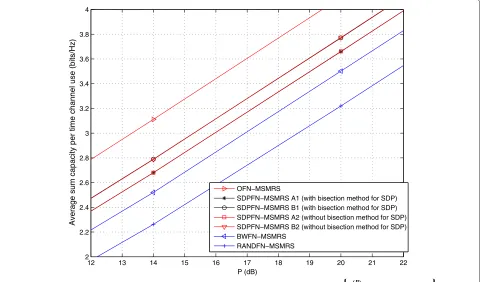
In Figures 1 and 2, we assume K=8, L=4,
Pk(R)=PM,k=1,. . .,K, and P(S)m =P,m=1,. . .,M.
The settings of randomization procedure in SDPFN-MSMRS A1, SDPFN-SDPFN-MSMRS A2, SDPFN-SDPFN-MSMRS B1, and SDPFN-MSMRS B2 areNc=2 andNl=14.
In Figure 1, we observe that, to achieve the same average sum capacity per time channel use,
1. SDPFN-MSMRS A1, SDPFN-MSMRS A2, SDPFN-MSMRS B1, and SDPFN-MSMRS B2 use less unit powerP than BWFN-MSMRS by 1.6 and 1.3 dB, respectively;
2. BWFN-MSMRS use less unit powerP than RANDFN-MSMRS by only 2.2 dB;
3. With the advantage of lower complexity, SDPFN-MSMRS A1, SDPFN-SDPFN-MSMRS A2, SDPFN-SDPFN-MSMRS B1, and SDPFN-MSMRS B2 require more unit power P than OFN-MSMRS by 2.2 and 2.5 dB, respectively.
It is observed that both SDPFN-MSMRS B1 and SDPFN-MSMRS B2 achieve notably higher average sum
capacity over both MSMRS A1 and SDPFN-MSMRS A2 for the same unit power P. This also ver-ifies the importance of step 10 of Algorithm 2. With very close performance to SDPFN-MSMRS A1 and SDPFN-MSMRS B1, respectively, SDPFN-MSMRS A2 and SDPFN-MSMRS B2 are quite computationally effec-tive due to avoiding the needs of additional bisection algorithms.
VN-MSMRS results
In this section, the settings of randomization procedure
in SDPVN-MSMRS B and SDPVNMSMRS A areNc =2
andNl=14.
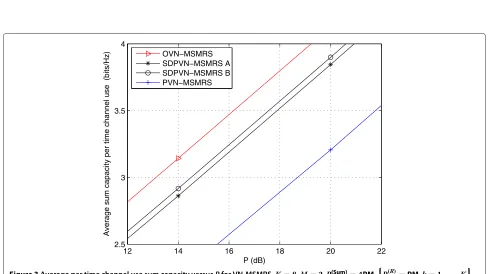
In Figures 3 and 4, we assumeK =8,M=2,P(Sum) = 4PM, P(R)k =PM,k=1,. . .,K, P(S)m =P,m=1,. . .,M.
From Figure 3, we observe that, to achieve the same average sum capacity per time channel use,
1. SDPVN-MSMRS B and SDPVN-MSMRS A use less unit powerP than PVN-MSMRS by 4.2 and 3.9 dB, respectively,
2. With the advantage of lower complexity,
SDPVN-MSMRS B and SDPVN-MSMRS A require more unit powerP than OVN-MSMRS by 1.4 and 1.7 dB, respectively.
12 13 14 15 16 17 18 19 20 21 22
2 2.2 2.4 2.6 2.8 3 3.2 3.4 3.6 3.8 4
P (dB)
Average sum capacity per time channel use (bits/Hz)
OFN−MSMRS
SDPFN−MSMRS A1 (with bisection method for SDP) SDPFN−MSMRS B1 (with bisection method for SDP) SDPFN−MSMRS A2 (without bisection method for SDP) SDPFN−MSMRS B2 (without bisection method for SDP) BWFN−MSMRS
RANDFN−MSMRS
Figure 1Average per time channel use sum capacity versusPfor FN-MSMRS,K=8,M=2,L=4,P(kR)=MP,k=1,. . .,K,
P(mS)=P,m=1,. . .,M
1.5 2 2.5 3 0.5
0.55 0.6 0.65 0.7 0.75 0.8 0.85 0.9 0.95 1
Sum capacity per time channel use (bits/Hertz)
Prob(C >C
0
)
OFN−MSMRS
SDPFN−MSMRS A1 (with bisection method for SDP) SDPFN−MSMRS B1 (with bisection method for SDP) SDPFN−MSMRS A2 (without bisection method for SDP) SDPFN−MSMRS B2 (without bisection method for SDP) BWFN−MSMRS
RANDFN−MSMRS
Figure 2Complementary cumulative distribution function of sum capacity per time channel use atP=14dB for FN-MSMRS, K=8,M=2,L=4,Pk(R)=MP,k=1,. . .,K,Pm(S)=P,m=1,. . .,M
.
12 14 16 18 20 22
2.5 3 3.5 4
P (dB)
Average sum capacity per time channel use (bits/Hz)
OVN−MSMRS SDPVN−MSMRS A SDPVN−MSMRS B PVN−MSMRS
Figure 3Average per time channel use sum capacity versusPfor VN-MSMRS,K=8,M=2,P(Sum)=4PM,P(R)
k =PM,k=1,. . .,K
,
P(mS)=P,m=1,. . .,M
1.5 2 2.5 3 0.7
0.75 0.8 0.85 0.9 0.95 1
Sum capacity per time channel use (bits/Hertz)
Prob(C > C
0
) OVN−MSMRS
SDPVN−MSMRS A SDPVN−MSMRS B PVN−MSMRS
Figure 4Complementary cumulative distribution function of capacity per time channel use atP=14dB for VN-MSMRS, K=8,M=2,P(Sum)=4PM,P(R)
k =PM,k=1,. . .,K
,P(mS)=P,m=1,. . .,M.
Unlike in Figures 3 and 4, relay powers in Figures 5 and 6 are not uniformly distributed, and we assumeK = 8, M = 2, P(Sum) = 3.62PM,
P(R)k =PM,k=1, 2
,
Pk(R)=0.65PM,k=3, 4, Pk(R)=0.4PM,k=5,. . ., 8,
Pm(S)=P,m=1,. . .,M
. In Figure 5, similar conclusions
can be drawn except for different gains as shown in Figure 3. For example, in Figure 5, SDPVN-MSMRS B uses 3.55 dB less unit powerP than PVN-MSMRS. The
12 14 16 18 20 22
2.5 3 3.5 4
P (dB)
Average sum capacity per time channel use (bits/Hz)
OVN−MSMRS SDPVN−MSMRS A SDPVN−MSMRS B PVN−MSMRS
Figure 5Average per time channel use sum capacity versusPfor VN-MSMRS,K=8,M=2,P(Sum)=3.62PM,P(R)
k =PM,k=1, 2
,
P(kR)=0.65PM,k=3, 4,Pk(R)=0.4PM,k=5,. . ., 8,Pm(S)=P,m=1,. . .,M
1.6 1.8 2 2.2 2.4 2.6 2.8 3 3.2 0.7
0.75 0.8 0.85 0.9 0.95 1
Sum capacity per time channel use (bits/Hertz)
Prob(C > C
0
) OVN−MSMRS
SDPVN−MSMRS A SDPVN−MSMRS B PVN−MSMRS
Figure 6Complementary cumulative distribution function of sum capacity per time channel use atP=14dB for VN-MSMRS, K=8,M=2,P(Sum)=3.62PM,P(R)
k =PM,k=1, 2
,P(kR)=0.65PM,k=3, 4,Pk(R)=0.4PM,k=5,. . ., 8,
P(mS)=P,m=1,. . .,M.
above results verify the importance of steps 9 and 10 of Algorithm 3.
Comparison between OFN-MSMRS and OVN-MSMRS
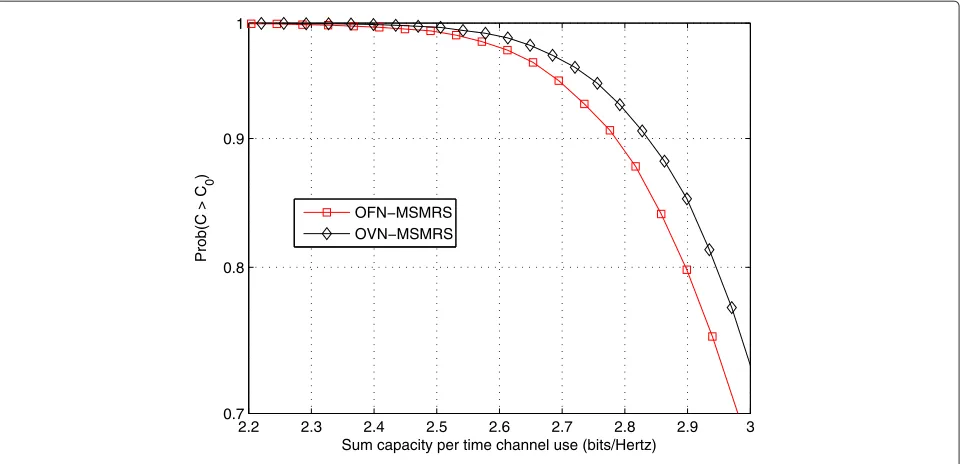
In Figures 7 and 8, we compare OFN-MSMRS with OVN-MSMRS under the same power constraints,
and we assume K = 8, M = 2, P(Sum) = 4PM,
P(R)k =PM,k=1,. . .,K
,
P(S)m =P,m=1,. . .,M
.
Note that, for OFN-MSMRS,P(Sum) =4PMis equivalent to setL=4. It is evident that OVN-MSMRS outperforms OFN-MSMRS under the same power constraints. This
12 12.5 13 13.5 14 14.5 15 15.5 16 2.8
2.9 3 3.1 3.2 3.3 3.4
P (dB)
Average sum capacity per time channel use (bits/Hz)
OFN−MSMRS OVN−MSMRS
Figure 7Average per time channel use sum capacity versusPfor OFN-MSMRS and OVN-MSMRS,K=8,M=2,P(Sum)=4PM,
P(kR)=PM,k=1,. . .,K,P(mS)=P,m=1,. . .,M
2.2 2.3 2.4 2.5 2.6 2.7 2.8 2.9 3 0.7
0.8 0.9 1
Sum capacity per time channel use (bits/Hertz)
Prob(C > C
0
)
OFN−MSMRS OVN−MSMRS
Figure 8Complementary cumulative distribution function of sum capacity per time channel use atP=14dB for OFN-MSMRS and OVN-MSMRS,K=8,M=2,P(Sum)=4PM,P(R)
k =PM,k=1,. . .,K
,P(mS)=P,m=1,. . .,M.
implies that the best selection solution for some channel realizations may not necessarily always reach full sum power constraints.
Note that the complexity of optimal MSMRS signifi-cantly increases whenK becomes larger. In simulations,
we choose a small number of K = 8, for reduced
simulation time. For such low K values, the complexity advantage for the proposed approaches may not be that significant. However, with the increase ofK, complexity advantage for proposed approaches in Sections ‘Fixed number multiple-source multiple-relay selection’ and ‘Varied number multiple-source multiple-relay selection’ will become more pronounced.
Conclusion
Based on the sum capacity maximization criterion, we have proposed a number of multiple-relay selec-tion approaches for simultaneously transmitting multiple source nodes with fixed power relays in an amplify-and-forward cooperative relay network. We propose computationally efficient algorithms based on semi-definite programming for MSMRS with both fixed num-ber and varied numnum-ber of relays. We have demon-strated that optimal varied number MSMRS outper-forms fixed number MSMRS under the same sum power constraints. Although we have discussed the convex relax-ation approaches in this article, as the future research directions, it may be deserved to investigate other non-convex-relaxation approaches with better performance, such as in [52-54].
Endnote
aIn [45], the authors express sign operation using notation “σ” instead of “sign”
Appendix Algorithms
Algorithm 1 Bisection procedure:
1. Initialize the upper and lower limits ofu,u(U)and
u(L);
2. Ifu(U)−u(L)< ε, go to step 7), otherwise go to step 3);
3. u:= 12u(U)+u(L);
4. Perform the SDP optimization procedure for problem (20);
5. If the optimization problem (20) is infeasible or unbounded,{u(U):=u;}
else{
u(L):=u;
# B=B;
}
6. Go to step 2);
7. The optimization procedure ends.
Algorithm 2 Randomization procedure for FN-MSMRS: 1. ComputeVsuch that#B=VTV, where
V=[v1,. . .,vK];
2. Setac=0,as=0, andρ(max)=0;
choose#cusing BWFN-MSMRS such thatL entries
6. Choose random vectorufrom the uniform distribution on the unit sphere;
7. Computec=signVTu, and thus obtaincas in
Computeρbased on (18b); Ifρ > ρ(max),ρ(max)=ρ,#c=c;
Computeρbased on (18b); Ifρ > ρ(max),ρ(max)=ρ,#c=c;
13. The randomization procedure ends.
Algorithm 3 Randomization procedure for VN-MSMRS: 1. ComputeVsuch that#B=VTV, where
V=[v1,. . .,vK],vkis thek th column vector ofV; 2. Setac=0,as=0, andρ(max)=0;
3. Ifas =0, go to step 13), otherwise go to step 4); 4. Ifac≥Nc,{
Choose#cusing optimal multiple-source single-relay selection such that the sum power constraint (28) is satisfied, then go to step 13);
}
else{go to step 5);} 5. Setal=0;
6. Choose random vectorufrom the uniform distribution on the unit sphere;
7. Computec=signVTu, and thus obtainc; 8. If the sum power constraint (28) is satisfied,{
Computeρbased on (18b); Ifρ > ρ(max),ρ(max)=ρ,#c=c;
as=1;
}
9. Computec= −c,[c]1,1=1, and thus obtainc;
10. If the sum power constraint (28) is satisfied,{ Usingc, computeρbased on (18b);
13. The randomization procedure ends.
Competing interest
The authors declare that they have no competing interests
Acknowledgements
The study was performed when J. Wu was with the Center for Advanced Communications, Villanova University, Villanova, PA 19085, USA
Author details
1Bell Laboratories, Alcatel-Lucent, Shanghai 201206, P.R. China.2Center for Advanced Communications, Villanova University, Villanova, PA 19085, USA. 3Faculty of Engineering, Ozyegin University, 34794, Istanbul, Turkey.
Received: 28 June 2011 Accepted: 3 July 2012 Published: 16 August 2012
References
1. A Sendonaris, E Erkip, B Aazhang, User cooperation diversity—part I: system description. IEEE Trans. Commun.51(11), 1927–1938 (2003) 2. JN Laneman, DNC Tse, GW Wornell, Cooperative diversity in wireless
networks: efficient protocols and outage behavior. IEEE Trans. Inf. Theory. 50(12), 3062–3080 (2004)
3. PA Anghel, M Kaveh, On the performance of distributed space-time coding systems with one and two non-regenerative relays. IEEE Trans. Wirel. Commun.5(3), 682–692 (2006)
4. J Laneman, G Wornell, Distributed space-time-coded protocols for exploiting cooperative diversity in wireless networks. IEEE Trans. Inf. Theory.49(10), 2415–2425 (2003)
5. Y Jing, B Hassibi, Distributed space-time coding in wireless relay networks. IEEE Trans. Wirel. Commun.5(12), 3524–3536 (2006)
6. A Reznik, SR Kulkarni, S Verdu, Degraded Gaussian multirelay channels: Capacity and optimal power allocation. IEEE Trans. Inf. Theory.50(12), 3037–3046 (2004)
7. X Tang, Y Hua, Optimal design of non-regenerative MIMO wireless relays. IEEE Trans. Wirel. Commun, 1398–1407 (2007)
8. N Khajehnouri, AH Sayed, Distributed MMSE relay strategies for wireless sensor networks. IEEE Trans. Signal Process.55, 3336–3348 (2007) 9. X Li, Y Zhang, M Amin, Joint optimization of source power allocation and
relay beamforming in multiuser cooperative wireless networks. Mobile Netw. Appl.16(5), 562–575 (2011)
10. V Sreng, H Yanikomeroglu, DD Falconer, Relayer selection strategies in cellular networks with peer-to-peer relaying. inProc. IEEE Vehicular Tech.
Conf.vol. 3 (2003), pp. 1949–1953
11. A Ribeiro, X Cai, GB Giannakis, Symbol error probabilities for general cooperative links. IEEE Trans. Wirel. Commun.4, 1264–1273 (2005) 12. AK Sadek, Z Han, KJR Liu, A distributed relay-assignment algorithm for
cooperative communications in wireless networks. inProc. IEEE Int. Conf.
Commun.(Istanbul, Turkey, 2006), pp. 1592–1597
13. Y Zhao, R Adve, TJ Lim, Symbol error rate of selection amplify-and-forward relay systems. IEEE Commun. Lett.10, 757–759 (2006)
15. DS Michalopoulos, GK Karagiannidis, TA Tsiftsis, RK Mallik, An optimized user selection method for cooperative diversity systems. inProc. IEEE
Globecom(San Francisco, CA, USA, 2006)
16. R Madan, NB Mehta, AF Molisch, J Zhang, Energy-efficient cooperative relaying over fading channels with simple relay selection. inProc. IEEE
Globecom(San Francisco, CA, USA, 2006)
17. CK Lo, RWH Jr, S Vishwanath, Hybrid-ARQ in multihop networks with opportunistic relay selection. inProc. IEEE Int. Conf. Acoustics, Speech, and
Signal Process,vol. 10 (Honolulu, Hawaii, USA, 2007), pp. 617–620
18. Y Zhao, R Adve, TJ Lim, Improving amplify-and-forward relay networks: optimal power allocation versus selection. IEEE Trans. Wirel. Commun.6, 3114–3122 (2007)
19. B Chalise, L Vandendorpe, Y Zhang, M Amin, Local CSI based selection beamforming for amplify-and-forward MIMO relay networks. IEEE Trans. Signal Process.60(5), 2433–2446 (2012)
20. A Stefanov, E Erkip, Cooperative coding for wireless networks. IEEE Trans. Commun.52, 1470–1476 (2004)
21. J Luo, RS Blum, LJ Cimini, LJ Greenstein, AM Haimovich, Link-failure probabilities for practical cooperative relay networks. inProc. IEEE Veh.
Tech. Conf. Spring,vol. 3 (Stockholm, Sweden, 2005), pp. 1489–1493
22. A Stefanov, E Erkip, Cooperative space-time coding for wireless networks. IEEE Trans. Commun.53(11), 1804–1809 (2005)
23. A Bletsas, DP Reed, A Lippman, A simple cooperative diversity method based on network path selection. IEEE J. Sel. Areas Commun.24, 659–672 (2006)
24. Y Li, B Vucetic, Z Chen, J Yuan, An improved relay selection scheme with hybrid relaying protocols. inProc. Global Telecommun. Conf.(Washington, D.C., USA, 2007), pp. 3704–3708
25. CK Lo, S Vishwanath, RW Heath, Relay subset selection in wireless networks using partial decode-and-forward transmission. inProc.
Vehicular Tech. Conf. Spring(Marina Bay, Singapore, 2008), pp. 2395–2399
26. R Madan, N Mehta, A Molisch, J Zhang, Energy-efficient cooperative relaying over fading channels with simple relay selection. IEEE Trans. Wirel. Commun.7(8), 3013–3025 (2008)
27. Y Zhang, Y Xu, Y Cai, Relay selection utilizing power control for decode-and-forward wireless relay networks. inProc. Int. Conf. on Sig. Proc.
Commun. Syst.(Gold Coast, Australia, 2008), pp. 1–5
28. DS Michalopoulos, HA Suraweera, GK Karagiannidis, R Schober, Amplify-and-forward relay selection with outdated channel estimates. IEEE Trans. Commun.60(5), 1278–1290 (2012)
29. I Krikidis, T Charalambous, JS Thompson, Buffer-aided relay selection for cooperative diversity systems without delay constraints. IEEE Trans. Wirel. Commun.11(5), 1957–1967 (2012)
30. Z Lin, E Erkip, Relay search algorithms for coded cooperative systems. in
Proc. IEEE Globecom,vol. 3 (St. Louis, Missouri, USA, 2005)
31. Y Jing, H Jafarkhani, Single and multiple relay selection schemes and their diversity orders. inProc. IEEE ICC 2008 Workshop on Cooperative Commun. &
Networking(Beijing, China, 2008), pp. 349–353
32. B Hegyi, J Levendovszky, Efficient, distributed, multiple-relay selection procedures for cooperative communications. inProc. Int. Symposium
Wireless Pervasive Computing(Santorini, Greece, 2008), pp. 170–174
33. Y Jing, H Jafarkhani, Single and multiple relay selection schemes and their diversity orders. IEEE Trans. Wirel. Commun.8(3), 1414–1423 (2009) 34. B Elzbieta, A Raviraj, Selection cooperation in multi-source cooperative
networks. IEEE Trans. Wirel. Commun.7, 118–127 (2008) 35. J Xu, S Zhou, Z Niu, Interference-aware relay selection for multiple
source-destination cooperative networks. inProc. 15th Asia-Pacific Conf.
on Commun.(Shanghai, China, 2009), pp. 338–341
36. W Guo, J Liu, L Zheng, Y Liu, G Zhang, Performance analysis of a selection cooperation scheme in multi-source multi-relay networks. inProc. Int.
Conf. on Wireless Commun. and Signal Processing(Nanjing, China, 2010),
pp. 1–6
37. L Ding, M Tao, F Yang, W Zhang, Joint scheduling and relay selection in one- and two-way relay networks with buffering. inProc. IEEE Int. Conf.
Commun.(Dresden, Germany, 2009)
38. I Krikidis, Relay selection for two-way relay channels with MABC DF: A diversity perspective. IEEE Trans. Veh. Technol.59(9), 4620–4628 (2010) 39. Y Li, RHY Louie, B Vucetic, Relay selection with network coding in
two-way relay channels. IEEE Trans. Veh. Technol.59(9), 4489–4499 (2010)
40. S Talwar, Y Jing, S Shahbazpanahi, Joint relay selection and power allocation for two-way relay networks. IEEE Signal Process. Lett.18(2), 91–94 (2011)
41. L Ozarow, The capacity of the white Gaussian multiple access channel with feedback. IEEE Trans. Inf. Theory.30(4), 623–629 (1984) 42. B Rimoldi, R Urbanke, A rate-splitting approach to the Gaussian
multiple-access channel. IEEE Trans. Inf. Theory.42(2), 364–375 (1996) 43. V Aggarwal, A Sabharwal, Slotted Gaussian multiple access channel:
Stable throughput region and role of side information. EURASIP J. Wirel. Commun. Network.2008, 1–11 (2008)
44. L Vandenberghe, S Boyd, Semidefinite programming. SIAM Rev.38, 49–95 (1996)
45. WK Ma, TN Davidson, KM Wong, ZQ Luo, PC Ching,
Quasi-maximum-likelihood multiuser detection using semi-definite relaxation with application to synchronous CDMA. IEEE Trans. Signal Process.50, 912–922 (2002)
46. M Grant, S Boyd, CVX: Matlab software for disciplined convex programming, version 1. 21 (2011), http://cvxr.com/cvx/ 47. M Grant, S Boyd, Graph implementations for nonsmooth convex
programs. inRecent Advances in Learning and Control,Lecture Notes in Control and Information Sciences (Springer-Verlag Limited, 2008), pp. 95–110. http://stanford.edu/∼boyd/graph dcp.html
48. C Helmberg, F Rendl, R Vanderbei, H Wolkowicz, An interior point method for semidefinite programming. SIAM J. Optimiz.6(2), 342–361 (1996) 49. A Charnes, WW Cooper, Programming with linear fractional functions.
Naval Res. Logist. Quaterly.9, 181–186 (1962)
50. MX Goemans, DP Williamson, Improved approximation algorithms for maximum cut and satisfiability problem using semi-definite programming. J. ACM.42(6), 1115–1145 (1995)
51. YE Nesterov, Quality of semidefinite relaxation for nonconvex quadratic optimization, Tech. Rep., CORE, Universite Catholique de Louvain, Brussels, Belgium, 1997
52. Y Zhang, G Zheng, C Ji, K Wong, Near-optimal joint antenna selection for amplify and forward relay networks. IEEE Trans. Wirel. Commun.9(8), 2401–2407 (2010)
53. J Chen, C Wen, Near-optimal relay subset selection for two-way amplify and forward MIMO relaying systems. IEEE Trans. Wirel. Commun.10, 37–42 (2011)
54. H Park, J Chun, A two-stage antenna subset selection scheme for amplify and forward MIMO relay systems. IEEE Signal Process. Lett.17(11), 953–956 (2010)
doi:10.1186/1687-1499-2012-256
Cite this article as:Wuet al.:Multiple-relay selection in amplify-and-forward
cooperative wireless networks with multiple source nodes.EURASIP Journal
on Wireless Communications and Networking20122012:256.
Submit your manuscript to a
journal and benefi t from:
7Convenient online submission
7 Rigorous peer review
7Immediate publication on acceptance
7 Open access: articles freely available online
7High visibility within the fi eld
7 Retaining the copyright to your article