Volume 2010, Article ID 627039,11pages doi:10.1155/2010/627039
Research Article
A Secure Localization Approach against Wormhole Attacks
Using Distance Consistency
Honglong Chen,
1, 2Wei Lou,
2Xice Sun,
1, 2and Zhi Wang
11State Key Laboratory of Industrial Control Technology, Zhejiang University, Hangzhou, Zhejiang 310027, China 2Department of Computing, The Hong Kong Polytechnic University, Kowloon, Hong Kong
Correspondence should be addressed to Zhi Wang,[email protected]
Received 1 September 2009; Accepted 21 September 2009
Academic Editor: Benyuan Liu
Copyright © 2010 Honglong Chen et al. This is an open access article distributed under the Creative Commons Attribution License, which permits unrestricted use, distribution, and reproduction in any medium, provided the original work is properly cited.
Wormhole attacks can negatively affect the localization in wireless sensor networks. A typical wormhole attack can be launched by two colluding attackers, one of which sniffs packets at one point in the network and tunnels them through a wired or wireless link to another point, and the other relays them within its vicinity. In this paper, we investigate the impact of the wormhole attack on the localization and propose a novel distance-consistency-based secure localization scheme against wormhole attacks, which includes three phases of wormhole attack detection, valid locators identification and self-localization. The theoretical model is further formulated to analyze the proposed secure localization scheme. The simulation results validate the theoretical results and also demonstrate the effectiveness of our proposed scheme.
1. Introduction
Wireless sensor networks (WSNs) [1] consist of a large amount of sensor nodes which cooperate among themselves by wireless communications to solve problems in fields such as emergency response systems, military field operations, and environment monitoring systems. Nodal localization is one of the key techniques in WSNs. Most of current localization algorithms estimate the positions of location-unknown nodes based on the position information of a set of nodes (locators) and the internode measurements such as distance measurements or hop counts. Localization in WSNs has drawn growing attention from the researchers, and com-prehensive approaches [2–6] are proposed. However, most of the localization systems are vulnerable under the hostile environment where malicious attacks, such as the replay attackorcompromise attack[7], can disturb the localization procedure. Security, therefore, becomes a significant concern of the localization process in hostile environment.
Thewormhole attackis a typical kind of secure attacks in WSNs. It is launched by two colludingexternal attackers[7] which do not authenticate themselves as legitimate nodes to the network. When starting a wormhole attack, one attacker
overhears packets at one point in the network, tunnels these packets through the wormhole link to another point in the network, and the other attacker broadcasts the packets among its neighborhood nodes. This can cause severe malfunctions on the routing and localization procedures in WSNs. Khabbazian et al. [8] point out how the wormhole attack impacts on building the shortest path in routing protocols. For the localization procedure under wormhole attacks, some range-free approaches [9, 10] have been proposed. We will propose a range-based secure localization scheme under wormhole attacks in this paper.
Simulation results show the effectiveness of our proposed scheme and validate the theoretical results.
As a summary, this paper makes the following contribu-tions:
(i) a novel wormhole attack detection scheme is pro-posed to detect the existence of a wormhole attack and to further determine the type of the wormhole attack;
(ii) a basic identification approach is designed to identify the valid locators for the sensor. Two independent algorithms are proposed to handle different worm-hole attacks;
(iii) an enhanced identification approach is developed which achieves better performances than the basic approach;
(iv) theoretical analysis on the probability of detecting wormhole attacks and the probability of successfully identifying all valid locators are conducted and verified by simulations.
(v) simulations are conducted to further demonstrate the effectiveness of the proposed secure localization schemes.
The remainder of this paper is organized as follows. In Section 2, we discuss the related work on the secure localization.Section 3describe the network model and the attack model of the system. The secure localization scheme is proposed inSection 4.Section 5gives the theoretical analysis and Section 6 presents the simulation results. Section 7
concludes the paper and outlines our future work.
2. Related Work
The secure localization in hostile environment has been investigated for several years and many secure localization systems have been proposed [11,12].
To resist the compromise attack, Liu et al. [13] propose the range-based and range-free secure localization schemes, respectively. For the range-based scheme, a Minimum Mean Square Estimation method is used to filter out inconsistent beacon signals. For the range-free scheme, the nodes adopt the voting-based location estimation which can ignore the minor votes imposed by the malicious nodes. SPINE [7] utilizes the verifiable multilateration and verification of positions of mobile devices into the secure localization in the hostile network. The mechanism in [14] introduces a set of covert base stations (CBS), whose positions are unknown to the attackers, to check the validity of the nodes. ROPE [15] is a robust positioning system with a location verification mechanism that verifies the location claims of the sensors before data collection. A suit of techniques in [16] are intro-duced to detect malicious beacons which can negatively affect the localization of nodes by providing incorrect information. TSCD [17] proposes a novel secure localization approach to defend against the distance-consistent spoofing attack using the consistency check on the distance measurements.
To detect the existence of wormhole attacks, researchers propose some wormhole attack detection approaches. In
[18],packet leashesbased on the notions of geographical and temporal leashes are proposed to detect the wormhole attack. Wang and Bhargava [19] detect the wormhole attack by means of visualizing the anomalies introduced by incorrect distance measurements between two nodes caused by the wormhole attack. Reference [20] further extends the method in [19] for large scale network by selecting some feature points to reduce the overlapping issue and preserving the major topology features. In [21], a detection scheme is elaborated by checking whether the maximum number of independent neighbors of two nonneighbor nodes is larger than the threshold.
To achieve secure localization in a WSN suffered from wormhole attacks, SeRLoc [9] first detects the wormhole attack based on thesector uniquenessproperty and commu-nication range violationproperty using directional antennas, then filters out the attacked locators. HiRLoc [10] further utilizes antenna rotations and multiple transmit power levels to improve the localization resolution. The schemes in [13] can also be applied into the localization against wormhole attacks. However, SeRLoc and HiRLoc need extra hardware such as directional antennae, and cannot obtain satisfied localization performance in that some attacked locators may still be undetected. Reference [13] requires a large amount of computation and possibly becomes incompetent when malicious locators are more than the legitimate ones. In [22], Chen et al. propose to make each locator build a conflicting-set and then the sensor can use all conflicting sets of its neighboring locators to filter out incorrect distance measurements of its neighboring locators. The limitation of the scheme is that it only works properly when the system has no packet loss. As the attackers may drop the packets purposely, the packet loss is inevitable when the system is under a wormhole attack. Compared to the scheme in [22], the distance-consistency-based secure localization scheme proposed in this paper can obtain high localization performance when the system has certain packet losses. Furthermore, it works well even when the malicious locators are more than the legitimate ones, which causes the malfunction of the scheme in [13].
3. Problem Formulation
In this section, we build the network model and the attack model, describe the related definitions, and analyze the effect of the wormhole attack on the range-based localization, after which we classify the locators into three categories.
range between two wormhole attackers can be larger than R, as they can communicate with each other using certain communication technique.
The sensors measure the distances to their neighboring locators using the Received Signal Strength Indicator (RSSI) method; the measurement error of the distance follows a normal distribution N(μ,σ), where the mean value μ =
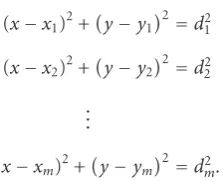
0 and the standard deviation σ is within a threshold. The sensors estimate their locations using the Maximum Likelihood Estimation (MLE) method [3]: Assume that the coordinates of themneighboring locators of the sensor are (x1,y1), (x2,y2), (x3,y3),. . ., (xm,ym), respectively, and the distance measurements from themlocators to the sensor are d1,d2,d3,. . .,dm, the location of the sensor (x,y) satisfies
By subtracting the last equation from each of the rest in (1), we can obtain the following equations represented as a linear equationAX=b, where
A=
Using the MLE method, the location of the sensor can be obtained asX=(ATA)−1ATb.
3.2. Attack Model. The network is assumed to be deployed in hostile environment where wormhole attacks exist to disrupt the localization of sensors. During the wormhole attack, one attacker sniffs packets at one point in the network and tunnels them through the wormhole link to another point. Being as external attackers that cannot compromise legitimate nodes or their cryptographic keys, the wormhole attackers cannot acquire the content, for example, the type of the sniffed packets. However, the attackers may drop off the received packets randomly which severely deteriorates the sensor’s localization process. We assume that the length of the wormhole link is larger thanRso that the endless packet transmission loop caused by both attackers is avoided.
The wormhole attack endured by a node can be classified into duplex wormhole attack and simplex wormhole attack according to the geometrical relation between the node and the attackers. A node is under a duplex wormhole attack when it lies in the common transmission area of these two attackers; a node is under a simplex wormhole attack when it lies in the transmission area of only one of these two attackers but not in the common transmission area of both.
Figure 1 shows the impact of the wormhole attack on the distance measurement of the sensor. When measuring the distance, the sensor broadcasts a request signal and waits for the responding beacon signals from the locators within its neighboring vicinity, based on which the sensor can use the RSSI method to estimate the distances to neighboring locators. For the duplex wormhole attack as shown in
Figure 1(a), whenL1 sends a beacon message to the sensor S, S will only get the distance measurement asd0 instead of the actual distance d1 because the RSSI received by S just reflects the propagational attenuation fromA1toS. For L2’s beacon message, as the packet will travel through two different paths to reachS,L2 → SandL2 → A2 →A1 → S, respectively,Swill obtain two distance measurementsd2and d0. For L4’s beacon message, it travels through three paths to reach S,L4 → S,L4 → A2 → A1 → S, and L4 →
A1 → A2 → S, respectively, thus Swill get three distance measurements asd4,d0, andd0. For the simplex wormhole attack as shown inFigure 1(b), whenSreceives the beacon message fromL5, it will measure the distance toL5asd0. For L3, two different distance measurementsd3 andd0 will be obtained. Thus, the locators which can communicate with the sensor via the wormhole link will introduce incorrect distance measurements.
All the locators that can exchange messages with the sensor, either via the wormhole link or not, are called neighboring locators(N-locators) of the sensor. Among these neighboring locators, the ones that can exchange messages with the sensor via the wormhole link are called dubious locators (D-locators), as their distance measurements may be incorrect and distort the localization; the locators that lie in the transmission range of the sensor are called valid locators(V-locators), as the sensor can obtain correct distance measurements with respect to them and assist the localization.
In this paper, we denote the set of N-locators, D-locators, and V-locators as LN,LD, and LV. For the scenario in Figure 1(a), LN = {L1,L2,L3,L4,L5,L6,L7},
LD = {L1,L2,L3,L4,L5,L7}, andLV = {L2,L3,L4,L6}. It is obvious thatLN =LV∪LD.
4. Secure Localization Scheme Against
Wormhole Attack
Wormhole link
L1 d
1A2
d72
d42
d0
d1
L2
d2
S L4
L7 L5
d4
d41
d71
d0
d3
L3
L6
d6
d2 d3
A1
d5
d5
Sensor Locator Attacker
(a)
Wormhole link
L6
d6
A2
d1
L1
d1
d2
L2
S d3
d4
L4
d42 d41
L3
d3
A1
d5
d5
L5
2R d0
Sensor Locator Attacker
(b)
Figure1: Illustrations of wormhole attack: (a) Duplex wormhole attack, (b) Simplex wormhole attack.
Messages from locators
Wormhole attack
detection Detected? Valid locatorsidentification Self-localization No
Yes
Figure2: Flow chart of the proposed secure localization scheme.
(i)Wormhole Attack Detection: The sensor detects the existence of a wormhole attack using the proposed detection schemes, and identifies whether it is under a duplex wormhole attack or a simplex wormhole attack.
(ii)Valid Locators Identification: Corresponding to the duplex wormhole attack and the simplex wormhole attack, the sensor identifies the V-locators using different identification approaches.
(iii)Self-localization: After identifying enoughV-locators, the sensor conducts the self-localization using the MLE method with correct distance measurements.
4.1. Wormhole Attack Detection. We assume that each locator periodically broadcasts a beacon message within its neigh-boring vicinity. The beacon message will contain the ID and location information of the source locator. When the network is threatened by a wormhole attack, some affected locators will detect the abnormality through beacon message exchanges. The following scenarios are considered abnormal for locators: (1) a locator receives the beacon message sent by itself; (2) a locator receives more than one copy of the same beacon message from another locator via different paths; (3) a locator receives a beacon message from another locator,
whose location calculated based on the received message is outside the transmission range of receiving locator. When the locator detects the message abnormality, it will consider itself under a wormhole attack. Moreover, if the locator detects the message abnormality under the first scenario, that is, the locator receives the beacon message sent by itself, it will further derive that it is under a duplex wormhole attack. The beacon message has two additional bits to indicate these two statuses for each locator:
(i) detection bit: this bit will be set to 1 if the locator detects the message abnormality through beacon message exchanges; otherwise, this bit will be 0; (ii) type bit: this bit will be 1 if the locator detects itself
under a duplex wormhole attack; otherwise, this bit will be 0.
of each N-locator based on the Loc ack message using the approach in [17] to countervail the random delay on the MAC layer of the locator: when broadcasting the Loc req packet, the sensor records the local timeT0. Every locator gets the local timeT1 by time-stamping the packet at the MAC layer (i.e., the time when the packet is received at the MAC layer) instead of time-stamping the packet at the application layer. Similarly, when responding to theLoc ackpacket, the locator puts the local timeT2at the MAC layer; bothT1and T2 are attached in the Loc ack packet. When receiving the Loc ackpacket, the sensor gets its local timeT3, and calculates the response time of the locator as (T3−T0)−(T2−T1). Note that this response time only eliminates the random delay at the MAC layer of the locators, but not the delay affected by attackers.
When conducting the localization, the sensor may also detect the message abnormality when it receives theLoc req message sent by itself. Moreover, the sensor can check the detection bit of theLoc ackmessage to decide if itsN-locator is under a wormhole attack or not.
We propose to use the following two detection schemes for the sensor to detect the wormhole attack.
Detection Scheme D1. If the sensorSdetects that it receives theLoc reqmessage sent from itself, it can determine that it is currently under a duplex wormhole attack. For example, when the sensor is under the duplex wormhole attack as shown in Figure 1(a), the Loc req message transmitted by the sensor can travel fromA1 via the wormhole link toA2 and then arrive atSafter being relayed byA2. Similarly, the Loc reqmessage can also travel fromA2through the worm-hole link toA1and then be received byS. Thus,Scan deter-mine that it is currently under a duplex wormhole attack.
Detection Scheme D2. If the sensor S detects that the detection bit of the receivedLoc ack message from any N-locator is set to 1,Scan determine that it is under a simplex wormhole attack. Note that when using detection scheme D2, the sensor may generate a false alarm if the sensor is outside the transmission areas of the attackers but any of its N-locators is inside the transmission areas of the attackers. However, this will only trigger the validate locators identification process but not affect the self-localization result.
The pseudocode of the wormhole attack detection is shown in Algorithm 1. The sensor broadcasts a Loc req message for self-localization. When receiving the Loc req message, eachN-locator replies aLoc ackmessage with the status bits indicating whether it has detected the abnormality. The sensor measures the distances to itsN-locators based on theLoc ackmessages using RSSI method and calculates the response time of eachN-locator. If the sensor receives the Loc req message sent by itself (detection scheme D1), it determines that it is under a duplex wormhole attack. Otherwise, if the sensor is informed by anyN-locator that the abnormality is detected (detection scheme D2), it declares that it is under a simplex wormhole attack. If no wormhole attack is detected, the sensor conducts the MLE localization.
1: Sensor broadcasts aLoc reqmessage.
2: EachN-locator sends aLoc ackmessage to the sensor, including the message abnormality detection result. 3: Sensor waits for theLoc ackmessages to measure the
distance to eachN-locator and to calculate the response time of eachN-locator.
4:ifsensor detects the attack using scheme D1then
5: A duplex wormhole attack is detected.
6:else ifsensor detects the attack using scheme D2 then
7: A simplex wormhole attack is detected. 8:else
9: No wormhole attack is detected. 10:end if
Algorithm1: Wormhole attack detection scheme.
4.2. Basic Valid Locators Identification Approach
4.2.1. Duplex Wormhole Attack. When detecting that it is currently under a duplex wormhole attack, the sensor tries to identify all itsV-locators before the self-localization. Take L2 in Figure 1(a) for example, when receiving the Loc req message from the sensor,L2will respond aLoc ackmessage to the sensor. As the sensor lies in the transmission range of L2, theLoc ackmessage can be received by the sensor directly. In addition, theLoc ackmessage can also travel fromA2via the wormhole link toA1then arrive at the sensor. Therefore, the sensor can receive theLoc ackmessage fromL2for more than once. However, there will be three different scenarios: (1) the locator lies in the transmission range of the sensor and its message is received by the sensor for three times (such as L4inFigure 1(a)); (2) the locator lies out of the transmission range of the sensor and its message is received by the sensor for twice (such asL7inFigure 1(a)); (3) the locator lies in the transmission range of the sensor and its message is received by the sensor for twice (such asL2inFigure 1(a)). We can see thatL2andL4areV-locators, but notV7. The sensor will use the following valid locator identification scheme to find the V-locators.
considered as a V-locator, and the distance measurement based on theLoc ackmessage with a shorter response time will be considered as correct (such asL2inFigure 1(a)).
Distance Consistency Property of Valid Locators. Assuming a set of locators L = {(x1,y1), (x2,y2),. . ., (xm,ym)} and corresponding measured distances D = {d1,d2,. . .,dm}, where (xi,yi) is the location of locator Li and di is the measured distance from the sensor to Li, i = 1, 2,. . .,m. Based on LandD, the estimated location of the sensor is (x0,y0). The mean square error of the location estimation isδ2=m
i=1[di−
(x0−xi)2+ (y0−yi)2]2/m. The distance consistency property of valid locators states that the mean square error of the location estimation based on the correct distance measurements is lower than a small threshold while the mean square error of the location estimation based on the distance measurements which contains some incorrect ones is not lower than the threshold.
We can further identify more V-locators using the distance consistency property of valid locators.
Identification Scheme I2. If the sensor has determined no less than two valid locators using identification scheme I1, it can identify other valid locators by checking whether the distance estimation is consistent. A predefined thresholdτ2 of the mean square error is determined, that is, a distance estimation with a mean square error smaller than τ2 is considered to be consistent. As shown in Figure 1(a), the sensor can identifyL2,L3, andL4 asV-locators and obtain the correct distance measurements to them. For other unde-termined locators, the sensor can identify them one by one. For example, to check whetherL1is aV-locator, the sensor can estimate its own location based on the distance mea-surements toL1,L2,L3, andL4. As the distance measurement to L1 is incorrect, the mean square error of the estimated distance measurements may exceed τ2, which means that L1 is not aV-locator. When the sensor checks the distance consistency of L2,L3,L4, and L6, it can get that the mean square error is lower thanτ2, thusL6is treated as aV-locator, and the distance measurement toL6is correct. After checking each of the undeterminedN-locators, the sensor can identify allV-locators with the correct distance measurements.
4.2.2. Simplex Wormhole Attack. If the sensor detects that it is under a simplex wormhole attack, it will adopt the following valid locators identification schemes.
Identification Scheme I3. When the sensor under a simplex wormhole attack as shown in Figure 1(b), if the sensor receives theLoc ackmessage of anN-locator twice, this N-locator will be considered as aV-locator. For example, when L3 in Figure 1(b) replies a Loc ack message to the sensor, this message will travel through two different paths to the sensor, one directly fromL3to the sensor and the other from L3 to A1 via the wormhole link to the sensor. Therefore, the sensor can conclude that L3 is a V-locator. To further obtain the correct distance measurement to L3, the sensor compares the response times of theLoc ackmessage fromL3
through different paths, and the distance measurement with a shorter response time is considered correct. Similarly, L4 can also be identified as aV-locator and its correct distance measurement can be obtained.
The following spatial property can also be used to identifyV-locators:
Spatial Property. The sensor cannot receive messages from twoN-locators simultaneously if the distance between these twoN-locators is larger than 2R.
Identification Scheme I4. When the sensor is under a simplex wormhole attack as shown in Figure 1(b), if the spatial property is violated by twoN-locators, it is obviously that one of them is aV-locator and the other is aD-locator. Take L2andL5inFigure 1(b)for example, the distance between them is larger than 2R, after receivingLoc ackmessages from them, the sensor can detect that the spatial property does not hold by these two N-locators. The response times of bothN-locators can be used to differentiate theV-locator from theD-locator. As theLoc ackmessage fromL5 travels via the wormhole link to the sensor, it will take a longer response time than that from L2. The sensor will regard L2 as a V-locator and L5 as a D-locator because L2 has a shorter response time. The distance measurement to L2 is also considered correct.
We can also use the distance consistency property of valid locators to identify moreV-locators when the sensor is under a simplex wormhole attack.
Identification Scheme I5. When the sensor is under a simplex wormhole attack, similar to identification scheme I2, if the sensor detects at least two V-locators using identification schemes I3 and I4, it can identify other V-locators based on the distance consistency property ofV-locators. Take the scenario inFigure 1(b)for example, the sensor can identify L2,L3, andL4 asV-locators and obtain the correct distance measurements to them. The sensor can further identify other V-locators by checking the distance consistency. A mean square error smaller thanτ2can be obtained when the sensor estimates its location based onL1,L2,L3, andL4because they are allV-locators. So the sensor can conclude thatL1is aV -locator and the distance measurement toL1is correct.
The procedure of basic valid locators identification approach is listed in Algorithm 2: If the sensor detects that it is under a duplex wormhole attack, it will conduct identification scheme I1 to detectV-locators. As the distance consistency check needs as least three locators, if the sensor identifies no less than two V-locators, it can use identification scheme I2 to identify otherV-locators. On the other hand, if the sensor detects that it is under a simplex wormhole attack, it adopts identification schemes I3 and I4 to identify theV-locators. After that, if at least twoV -locators are identified, the sensor conducts identification scheme I5 to detect otherV-locators.
1:if Sdetects a duplex wormhole attackthen
2: Conduct scheme I1 to identifyV-locators. 3: ifthe identified V-locators≥2then
4: Conduct scheme I2 to identify otherV-locators. 5: end if
6:else ifSdetects a simplex wormhole attackthen
7: Conduct schemes I3 and I4 to identifyV-locators. 8: ifthe identifiedV-locators≥2then
9: Conduct scheme I5 to identify otherV-locators. 10: end if
11:end if
Algorithm2: Basic Valid Locators Identification Approach.
identifies less than three V-locators, it will terminate the localization because the MLE method used in the self-localization needs at least three distance measurements. However, when using the identification schemes based on distance consistency property of V-locators, many V -locators may not be identified if the threshold of mean square error,τ2, is set inappropriately a small value.
To overcome the above problem, we propose an enhanced valid locators identification approach which can adaptively adjust the thresholdτ2to make the sensor easier to identify moreV-locators: If the sensor detects that it is under a duplex wormhole attack, it conducts identification scheme I1 to detectV-locators. If the sensor identifies no less than twoV-locators, it repeats to identify otherV-locators using identification scheme I2 and update theτ2with an increment ofΔτ2 until at least threeV-locators are identified orτ2 is larger thanτ2
max. On the other hand, if the sensor detects that it is under a simplex wormhole attack, it adopts schemes I3 and I4 to identify theV-locators. If at least twoV-locators are identified, the sensor repeats to conduct scheme I5 to detect other V-locators and update τ2 with an increment of Δτ2 until at least threeV-locators are identified or τ2 is larger than τ2
max. The procedure of the enhanced valid locators identification approach is listed inAlgorithm 3.
After the wormhole attack detection and valid locators identification, the sensor can identifyV-locators from its N-locators. Furthermore, the sensor can estimate the correct distance measurements to theV-locators. When the sensor obtains at least three correct distance measurements to its N-locators, it conducts the MLE localization based on these distance measurements and the locations of the correspondingN-locators.
5. Theoretical Analysis
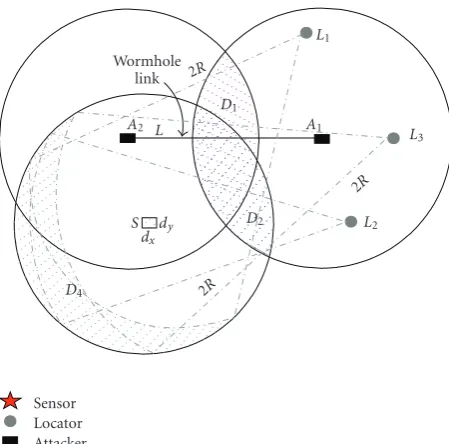
In this section, we formulate the mathematical models for the probability of wormhole attack detection and the probability of successfully identifying all theV-locators. To simplify our description, we denote the disk centered atUwith radiusR asDR(U). The overlapped region of the transmission areas of two attackers is denoted asD1and the overlapped region of the transmission areas of attackerA1and sensorSis denoted asD2, which are illustrated inFigure 3.
1:ifSdetects a duplex wormhole attackthen
2: Conduct scheme I1 to identifyV-locators. 3: ifthe identifiedV-locators≥2then
4: repeat
5: Conduct scheme I2 to identify otherV-locators. 6: τ2⇐τ2+Δτ2
7: untilthe identifiedV-locators≥3 orτ2> τ2 max
8: end if
9:else ifSdetects a simplex wormhole attackthen
10: Conduct schemes I3 and I4 to identifyV-locators. 11: ifthe identifiedV-locators≥2then
12: repeat
13: Conduct scheme I5 to identify otherV-locators. 14: τ2⇐τ2+Δτ2
15: untilthe identifiedV-locators≥3 orτ2> τ2 max
16: end if
17:end if
Algorithm3: Enhanced Valid Locators Identification Approach.
5.1. Probability of Wormhole Attack Detection. For the prob-ability of the wormhole attack detection, we denote it as Pdet, including the probability of the duplex wormhole attack detectionPDdetand the probability of the simplex wormhole attack detectionPSdet. Thus,
Pdet=PD
det+PdetS . (3)
ForPD
det, it equals to the probability that the sensor lies in the regionD1. Therefore,
PdetD = D1
πR2. (4)
Here,
D1=2R2arccos L 2R−L
R2−L2
4, (5)
whereLis the length of the wormhole link. For PS
det, the probability that the sensor lies in region
DR(A2)\D1inFigure 3equals to (πR2−D1)/πR2. When the sensor lies in this region, the sensor can detect the wormhole attack only if at least one locator lies in D1 or each of the regionsDR(A2)\D1andDR(A1)\D1inFigure 3has at least one locator, which means that theN-locators can detect the abnormality and inform the sensor. We define the event that at least one locator lies inD1asAand the event that each of the regionsDR(A2)\D1andDR(A1)\D1inFigure 3has at least one locator asB. Thus,
PSdet=
πR2−D1 πR2
P(A) +PAP(B). (6)
As the locators follow Poisson distribution, we get
P(A)=1−e−D1ρl
P(B)=1−e−(πR2−D 1)ρl
2 ,
Wormhole
Figure 3: Theoretical analysis of the mathematical model of a wormhole attack.
where ρl is the density of the locators. Therefore, the probability that the sensor can detect the simplex wormhole attack can be expressed as follows:
PS
Therefore, we can get
Pdet=PD
5.2. Probability of Successfully Identifying AllV-locators. For the probability that the sensor can successfully identify all the V-locators, we denote it asPide. Similarly,
Pide=PideD +PideS , (10)
wherePDideis the probability that the sensor can successfully identify all theV-locators when under a duplex wormhole attack, andPideS is for the simplex wormhole attack.
The probability that the sensor is under a duplex wormhole attack equals toD1/πR2as shown inFigure 3. The sensor is capable of successfully identifying all theV-locators under a duplex wormhole attack means that it can identify at least twoV-locators using identification scheme I1. That is,
the region (DR(A1)∪DR(A2))∩DR(S) inFigure 1(a)has at least two locators. Thus,
PDide=
Figure 1(a). We can approximateD3by
D3≈DDR(A2)∩DR(S)+D2, (13)
When the sensor is under a wormhole attack, the probability that it lies in thedxd ydomain inFigure 3equals todxd y/πR2. When lying in thedxd ydomain, if the sensor can identify at least two V-locators using identification schemes I3 and I4, it can successfully identify other V -locators. Assuming that the sensor can identifym V-locators using scheme I3 and identifyn V-locators using scheme I4, the probability that the sensor can identify at least twoV -locators using schemes I3 and I4 is calculated as
1−P(m=0)P(n=0)−P(m=0)P(n=1)
0.9
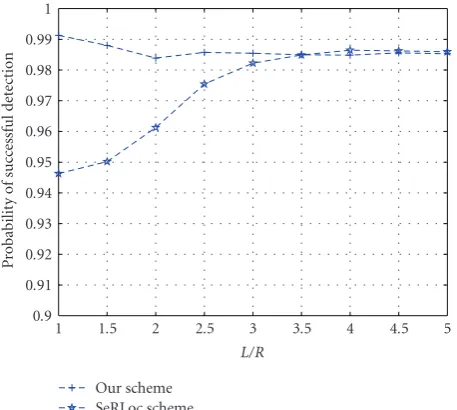
Figure4: Probability of wormhole attack detection: Our scheme versus SeRLoc scheme.
Therefore, we can obtain
Pide= D1
In this section, we present the simulation results to demon-strate the effectiveness of the proposed secure localization scheme and to validate our theoretical results. The network parameters are set as follows: the transmission rangeRof all types of nodes is identical and is set to 15 m; the density of locatorsρl =0.006/m2 (with the average degree around 4); the standard deviation of the distance measurementσ =0.5; the labelL/Rof thexaxis denotes the ratio of the length of the wormhole link (i.e., the distance between two attackers) to the transmission range. The threshold for the distance consistency τ2 = 1. For the enhanced secure localization scheme,Δτ2=1 andτ2
max=5.
Figure 4demonstrates the performance comparison of the probability of detecting the wormhole attack between our scheme and SeRLoc scheme. It can be observed that our scheme obtains a good performance with the probabilities higher than 98% for different values ofL/R. Although both schemes have the similar performance whenL/R >3.5, our scheme outperforms SeRLoc scheme, especially whenL/R < 2.
Figure 5: Probability of wormhole attack detection: Simulation versus Theoretical.
Figure6: Probability of successful localization.
Figure 5 demonstrates the validity of our theoretical analysis on the probability of the wormhole attack detection. We find that the maximum difference between the simula-tion and the theoretical result is smaller than 0.4%, which indicates that the theoretical result matches the simulation result very well.
0.8 0.82 0.84 0.86 0.88 0.9 0.92 0.94 0.96 0.98 1
P
robabilit
y
o
f
suc
ce
ssful
localization
1 1.5 2 2.5 3 3.5 4 4.5 5
L/R
Basic scheme Enhanced scheme
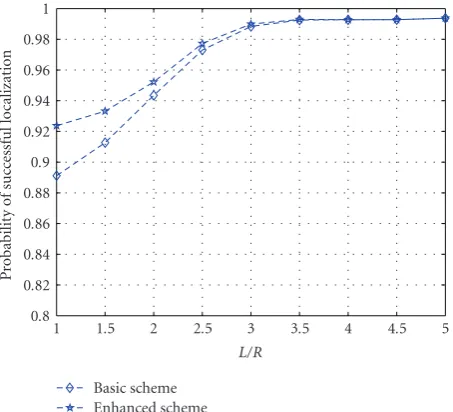
Figure7: Probability of successful localization: Basic scheme versus Enhanced scheme.
wormhole attack and simplex wormhole attack, and the communication range violation property may be invalid under the duplex wormhole attack. The consistency scheme identifies the D-locators based on the consistency check of the estimation result. The locator which is the most inconsistent one will be considered as a D-locator. In this simulation, the localization result is considered successful whenderr1 ≤derr2+ ftol∗R, wherederr1(andderr2) denotes the localization error with (and without) using the secure localization scheme, ftol is the factor of localization error tolerance (0.1 in our simulations). The performance of the scheme without any detection process shows the severe impact of the wormhole attack on the localization process, which makes the localization totally defunct when L/R is larger than 2. Figure 6 shows that our proposed scheme obtains much better performance than the other schemes.
Figure 7, we compare the basic secure localization scheme with the enhanced secure localization scheme. The enhanced scheme outperforms the basic scheme a bit higher (with the maximum improvement of about 3%) when L/R <3.
Figure 8shows the performance of successful localization of the enhanced scheme under different locator densities. It demonstrates that the increase of the locator density has a greater improvement whenL/R <3 than whenL/R >3.
Figure 9is to validate the correctness of the theoretical result of the probability of successfully identifying all V -locators. The maximum difference between the simulation and the theoretical result is about 4%, showing that the theoretical result matches the simulation result well.
7. Conclusion and Future Work
In this paper, we analyze the impact of the wormhole attack on the range-based localization. We propose a novel distance-consistency-based secure localization mechanism
0.9 0.91 0.92 0.93 0.94 0.95 0.96 0.97 0.98 0.99 1
P
robabilit
y
o
f
suc
ce
ssful
localization
1 1.5 2 2.5 3 3.5 4 4.5 5
L/R
pl=0.006
pl=0.009
pl=0.012
Figure 8: Probability of successful localization under different locator densities.
0.5 0.55 0.6 0.65 0.7 0.75 0.8 0.85 0.9 0.95 1
P
robabilit
y
o
f
suc
ce
ssful
det
ection
1 1.5 2 2.5 3 3.5 4 4.5 5
L/R
Simulation Theoretical
Figure 9: Probability of successfully identifying all V-locators: Simulation versus Theoretical.
In the future, our work will focus on the secure locali-zation when the sensor is under multiple wormholes’ attack simultaneously. We also intend to consider the secure locali-zation when different nodes have different transmission ranges.
Acknowledgments
This work is supported in part by Grants PolyU 5236/06E, PolyU 5243/08E, A-PJ16, NSFC 60873223, NSFC 90818010, and ZJU-SKL ICT0903.
References
[1] I. Akyildiz, W. Su, Y. Sankarasubramaniam, and E. Cayirci, “A survey on sensor networks,”IEEE Communications Magazine, vol. 40, no. 8, pp. 102–114, 2002.
[2] A. Savvides, C. Han, and M. Strivastava, “Dynamic fine-grained localization in ad-hoc networks of sensors,” in
Proceedings of the ACM Annual International Conference on Mobile Computing and Networking (MOBICOM ’01), pp. 166– 179, Rome, Italy, July 2001.
[3] M. Zhao and S. D. Servetto, “An analysis of the maximum likelihood estimator for localization problems,” inProceedings of the 2nd International Conference on Broadband Networks (ICBN ’05), pp. 59–67, Boston, Mass, USA, October 2005. [4] P. Bahl and V. N. Padmanabhan, “RADAR: an in-building
RF-based user location and tracking system,” inProceedings of the 9th Annual Joint Conference of the IEEE Computer and Communications Societies (INFOCOM ’00), vol. 2, pp. 775– 784, Tel Aviv, Israel, March 2000.
[5] Z. Li, W. Trappe, Y. Zhang, and B. Nath, “Robust statistical methods for securing wireless localization in sensor networks,” inProceedings of the 4th International Symposium on Informa-tion Processing in Sensor Networks (IPSN ’05), pp. 91–98, Los Angeles, Calif, USA, April 2005.
[6] G. Mao, B. Fidan, and B. D. O. Anderson, “Wireless sensor network localization techniques,”Computer and Telecommu-nications Networking, vol. 51, no. 10, pp. 2529–2553, 2007. [7] S. Capkun and J. P. Hubaux, “Secure positioning of wireless
devices with application to sensor networks,” inProceedings of the 24th Annual Joint Conference of the IEEE Computer and Communications Societies (INFOCOM ’05), vol. 2, pp. 1917– 1928, March 2005.
[8] M. Khabbazian, H. Mercier, and V. K. Bhargava, “Wormhole attack in wireless ad hoc networks: analysis and counter-measure,” in Proceedings of the Global Telecommunications Conference (GLOBECOM ’06), San Francisco, Calif, USA, December 2006.
[9] L. Lazos and R. Poovendran, “SeRLoc: robust localization for wireless sensor networks,” ACM Transactions on Sensor Networks, vol. 1, no. 1, pp. 73–100, 2005.
[10] L. Lazos and R. Poovendran, “HiRLoc: high-resolution robust localization for wireless sensor networks,” IEEE Journal on Selected Areas in Communications, vol. 24, no. 2, pp. 233–246, 2006.
[11] A. Boukerche, H. A. B. F. Oliveira, E. F. Nakamura, and A. A. F. Loureiro, “Secure localization algorithms for wireless sensor networks,”IEEE Communications Magazine, vol. 46, no. 4, pp. 96–101, 2008.
[12] A. Srinivasan and J. Wu, “A survey on secure localization in wireless sensor networks,” inEncyclopedia of Wireless and Mobile Communications, 2007.
[13] D. Liu, P. Ning, and W. Du, “Attack-resistant location estimation in sensor networks,” in Proceedings of the 4th International Symposium on Information Processing in Sensor Networks (IPSN ’05), pp. 99–106, Los Angeles, Calif, USA, April 2005.
[14] S. Capkun, M. Cagalj, and M. Srivastava, “Secure localization with hidden and mobile base stations,” inProceedings of the 25th IEEE International Conference on Computer Communica-tions Societies (INFOCOM ’06), Barcelona, Spain, April 2006. [15] L. Lazos, R. Poovendran, and S. Capkun, “ROPE: robust
posi-tion estimaposi-tion in wireless sensor networks,” inProceedings of the 4th International Symposium on Information Processing in Sensor Networks (IPSN ’05), pp. 324–331, Los Angeles, Calif, USA, April 2005.
[16] D. Liu, P. Ning, and W. Du, “Detecting malicious bea-con nodes for secure location discovery in wireless sensor networks,” in Proceedings of the 25th IEEE International Conference on Distributed Computing Systems (ICDCS ’05), June 2005.
[17] H. Chen, W. Lou, J. Ma, and Z. Wang, “TSCD: a novel secure localization approach for wireless sensor networks,” inProceedings of the 2nd International Conference on Sensor Technologies and Applications (SensorComm ’08), pp. 661–666, Cap Esterel, France, August 2008.
[18] Y. C. Hu, A. Perrig, and D. B. Johnson, “Packet leashes: a defense against wormhole attacks in wireless networks,” in Proceedings of the 22nd Annual Conference of the IEEE Computer and Communications Societies (INFOCOM ’03), vol. 3, pp. 1976–1986, San Franciso, Calif, USA, April 2003. [19] W. Wang and B. Bhargava, “Visualization of wormholes in
sensor networks,” in Proceedings of the ACM Workshop on Wireless Security (WiSec ’04), pp. 51–60, New York, NY, USA, 2004.
[20] W. Wang and A. Lu, “Interactive wormhole detection and evaluation,”Information Visualization, vol. 6, no. 1, pp. 3–17, 2007.
[21] R. Maheshwari, J. Gao, and S. R. Das, “Detecting wormhole attacks in wireless networks using connectivity information,” inProceedings of the 26th Annual IEEE Conference on Computer Communications (INFOCOM ’07), pp. 107–115, Anchorage, Alaska, USA, May 2007.