“
Design of Genetically Tuned Interval Type-2 Fuzzy PID
controller for Load Frequency Control (LFC) in the
Un-regulated Power System
”
1
Anita Singh, 2Manoj Jha, 3M.F. Qureshi
1,2
Department of Applied Mathematics, Rungta Engg. College, Raipur, India. 3
Department of Electrical Engg., Govt. Polytechnic, Narayanpur, India.
Abstract
This paper presents an Genetically Tuned interval type-2 fuzzy PID controller
(GT-IT2FPIDC) for the solution Load Frequency Control (LFC) problem in a deregulated power system that operate under deregulation based on the bilateral policy scheme. The interval type-2 fuzzy PID controller (GT-IT2FPIDC) is expected to compensate for the sudden load change, as the most effective countermeasure. In order to overcome difficulty of accuracy constructing the rule base in the IT2FPIDC, the parameters of the proposed controller is tuned by Genetic Algorithm (GA). The aim is to reduce interval type-2 fuzzy system effort, find a better fuzzy system control and take large parametric uncertainties into account. The proposed GA based IT2FPIDC controller is tested on a three-area deregulated power system. Analysis reveals that the proposed control strategy improves significantly the dynamical performances of system such as settling time and overshoot against parametric uncertainties for a wide range of area load demands and disturbances in either of the areas even in the presence of system nonlinearities. This newly developed strategy leads to a flexible controller with a simple structure that is easy to implement and therefore it can be useful for the real
world power system. The proposed method is tested on a three-area power system with different
contracted scenarios under various operating conditions. The results of the proposed controller are compared with the classical fuzzy PID type controller (CFPIDC).
Keywords
:LFC, Interval Type-2 Fuzzy PID Controller, Classical Fuzzy PID Controller Deregulated, GA Tuning.
1.
Introduction
Global analysis of the power system markets shows that the frequency control is one of the most profitable ancillary services at these systems. This service is related to the short-term balance of energy and frequency of the power systems. The most common methods used to accomplish frequency control are generator governor response (primary frequency regulation) and Load
Frequency Control (LFC). The goal of LFC is to re-establish primary frequency regulation capacity, return the frequency to its nominal value and minimize unscheduled tie-line power flows between neighboring control areas. From the mechanisms used to manage the provision this service in ancillary markets, the bilateral contracts or competitive offers stand out.
The dynamic behaviour of many industrial plants is heavily influenced by disturbances and,
in particular, by changes in the operating point. This is typically the case for the restructured power systems. Load Frequency Control (LFC) is a very important issue in power system operation and
control for supplying sufficient and reliable electric power with good quality. The main goal of the
LFC is to maintain zero steady state errors for frequency deviation and good tracking load demands
in a multi-area restructured power system. In addition, the power system should fulfil the requested
dispatch conditions. A lot of studies have been made in the last two decades about the LFC in
interconnected power systems. The real world power system contains different kinds of uncertainties
due to load variations, system modelling errors and change of the power system structure. As a result, a fixed controller based on the classical theories is certainly not suitable for the LFC problem. Consequently, it is required that a flexible controller be developed. The conventional control strategy for the LFC problem is to take the integral of the area control error as the control signal. An integral controller provides zero steady state deviation but it exhibits poor dynamic performance. To improve the transient response, various control strategy, such as linear feedback, optimal control and variable structure control have been proposed. However, these methods need some information for the system
states, which are very difficult to know completely. There have been continuing efforts in designing
LFC with better performance to cope with the plant parameter changes, using various adaptive neural networks and robust methods. The proposed methods show good dynamical responses, but robustness in the presence of model dynamical uncertainties and system nonlinearities were not considered. Also, some of them suggest complex state feedback or high order dynamical controllers, which are not practical for industry practices.
Recently, some authors proposed fuzzy PID methods to improve performance of the LFC problem. It should be pointed out that they require a three dimensional rule base. This problem makes the design process is more difficult. To overcome this drawback, an improved control strategy based on fuzzy theory and Genetic Algorithm (GA) technique has been proposed. In order for a fuzzy rule based control system to perform well, the fuzzy sets must be carefully designed.
Research on the LFC problem shows that, the fuzzy Proportional-Integral (PI) controller is simpler and more applicable to remove the steady state error. The fuzzy PI controller is known to give poor performance in the system transient response. In view of this, some authors proposed fuzzy Proportional-Integral-Derivative (PID) methods to improve the performance of the fuzzy PI controller. In order to overcome this drawback and focus on the separation PD part from the integral
part, this paper presents an Interval Type-2 Fuzzy PID (IT2FPID) controller with GA tuning. This is a form of behaviour based control where the PD controller becomes active when certain conditions are met. The resulting structure is a controller using two- dimensional inference engines (rule base) to reasonably perform the task of a three-dimensional controller. The proposed method requires fewer resources to operate and its role in the system response is more apparent, i.e. it is easier to
understand the effect of a two-dimensional controller than a three-dimensional one. This newly
developed control strategy combines interval type-2 fuzzy PD controller and GA tuning. The fuzzy PD stage is employed to penalize fast change and large overshoots in the control input due to corresponding practical constraints.
The proposed control has simple structure and does not require an accurate model of the plant. Thus, its construction and implementation are fairly easy and can be useful for the real world complex power system. The proposed method is applied to a three-area restructured power system as a test system. The results of the proposed IT2FPID controller are compared with the Classical Fuzzy PID controller (CFPIDC) in the presence of large parametric uncertainties and system nonlinearities under various area load changes. The performance indices have been chosen as the Integral of the Time multiplied Absolute value of the Error (ITAE), the Integral of the Time multiplied Square of the Error (ITSE), Integral of the Square of the Error (ISE) and Fig. of Demerit (FD). The simulation results show that not only the proposed controller can guarantee the robust performance for a wide range of load changes and parametric uncertainties even in the presence of Generation Rate Constraints (GRC), but also the system performance such as: ITAE, ITSE, ISE and FD indices are very better than the CFPID.
Assuming that parametric models are available, in this case, using soft computing methods would be helpful in order to adjust model parameters over full range of input–output operational data. Genetic Algorithms (GA) have outstanding advantages over the conventional optimization methods, which allow them to seek globally for the optimal solution. It causes that a complete system model is not required and it will be possible to find parameters of the model with nonlinearities and complicated structures. In the recent years, Genetic Algorithms are investigated as potential solutions to obtain good estimation of the model parameters and are widely used as an optimization method for training and adaptation approaches. In this paper, interval type-2 fuzzy PID controller (IT2PIDC) model is first developed for Load frequency control then, the related parameters are adjusted by applying Genetic Algorithms.
2.
Genetically Tuned Interval Type-2 Fuzzy PID controller
The most popular technique in evolutionary computation research has been the Genetic
Algorithm which can be applied to any problem that can be formulated as function optimization
problem [Sivanandam and Deepa (2008)]. By tuning the gains of the Interval Type-2 Fuzzy PID
Controller model using Genetic Algorithm better results are obtained [Sufian and Surendra (2008b)].
Interval Type-2 Fuzzy PID Controller model can be tuned by various methods, like changing the scaling factor, modifying the support and spread of membership functions, modifying the rules of the Rule base and changing the type of a membership function itself, doing so will result in change of the control surface and hence the output of the Interval Type-2 Fuzzy PID Controller model
[Drainkov et al (1993)]. The usefulness of Rule tuning is demonstrated by F. Herrera et al [Herrera
et al (1995)]. Membership function tuning using Genetic Algorithm is studied by Rafael Alcala et al
[Rafael et al (2005)], where it was seen how the performance would be improved by tuning the lateral position and support of the membership function. In addition to these the rule weights can also be changed to perform a local tuning of linguistic rules, which enables the linguistic fuzzy models to cope with inefficient and/or redundant rules thereby enhancing the robustness, flexibility
and system modeling capability [Rafael et al (2003a)]. By assigning a rule weight to each of the
fuzzy rules, complexity is increased while its accuracy is improved which suggests a trade-off relation between the accuracy and complexity [Hisao et al (2009)]. If a rule weight is applied to the consequent part of the rule, it modifies the size of the rule’s output value [Nauck (2000)]. Parameters like rules, membership functions and rule-weights play an important role in any fuzzy model, and optimizing them is a necessary task, since these parameters are always built by designers with trial and error along with their experience or experiments. After performing the tuning of individual parameters, an inference is drawn as to which procedure is better than the other with reference to ISE criterion.
Genetic Algorithm-based parameter
Learning GAs is optimization technique for the natural selection, which consists of three operations, namely, reproduction, crossover, and mutation [Fleming et al (2002)]. The most general considerations about GA can be stated as follows:
1. The searching procedure of the GA starts from multiple initial states simultaneously and
proceeds in all of the parameter subspaces simultaneously.
2. GA requires almost no prior knowledge of the concerned system, which enables it to deal
with the completely unknown systems that other optimization methods may fail.
3. GA cannot evaluate the performance of a system properly at one step. For this reason, it can
generally not be used as an on-line optimization strategy and is more suitable for fuzzy modeling.
Genetic Fuzzy Systems
The genetic fuzzy systems are primarily used to automate the knowledge acquisition step in fuzzy system design, a task that is usually accomplished through an interview or observation of a human expert controlling the system [Hoffmann (2001)]. An evolutionary algorithm adapts either part or all of the components of the fuzzy knowledge base. Fuzzy knowledge base is not a monolithic structure but is composed of the data base and the rule base where each plays a specific role in the fuzzy reasoning process. Genetic tuning processes are targeted at optimizing the performance of an already existing fuzzy system. Designing a fuzzy rule based system is equivalent to finding the optimal configuration of fuzzy sets and/or rules, and in that sense can be regarded as an optimization problem. The optimization criterion is the problem to be solved at hand and the search space is the set of parameters that code the membership functions, fuzzy rules and fuzzy rule-weights. The Fig.1 represents a genetic fuzzy system. The performance is aggregated into a scalar fitness value on which basis the evolutionary (Genetic) algorithm selects better adapted chromosomes. A chromosome either codes parameters of membership functions, fuzzy rules and fuzzy rule-weights or a combination thereof. By means of crossover and mutation, the evolutionary algorithm generates new parameters for the database and/or rule base whose usefulness is tested in the fuzzy system.
Fig.1. Genetic Fuzzy System
The objective functions considered here is based on the error criterion. In this paper performance of membership functions, rules and weight tuning are evaluated in terms of Integral square Error (ISE) error criteria. The error criterion is given as a measure of performance index. The ISEs of individual parameters are added together to obtain an overall ISE. This is done to simplify the task of Genetic Algorithm. The objective of Genetic Algorithm is to minimize this overall ISE. The overall ISE is given by Equation 6.
𝐼𝑆𝐸=∑6𝑖=1∫ 𝑒𝑖2(𝑡)𝑑𝑡 (6)
Where ei(t) is the error signal for the ithparameter. Here i can take values from 1 to 6 corresponding
to 6 parameters.
Interval Type-2 Fuzzy Logic Systems (IT2FLS)
In recent years, fuzzy logic has emerged as a powerful tool and is starting to be used in various power system applications. Fuzzy logic can be an alternative to classical control. It allows one to design a controller using linguistic rules without knowing the mathematical model of the plant. This makes fuzzy-logic controller very attractive systems with uncertain parameters. The linguistic rule necessary for designing a fuzzy-logic controller may be obtained directly from the operator who has enough knowledge of the response of the system under various operating conditions. The inference mechanism of the fuzzy-logic controller is represented by a decision table, which is consists of linguistic IF-THEN rule. It is assumed that an exact model of the plant is not available and it is difficult to extract the exact parameters of the power plant. Therefore, the design procedure cannot be based on an exact model. However the fuzzy logic approach makes the design of a controller possible, without knowing the mathematical (exact) model of the plant.
Interval Type-2 fuzzy sets, characterized by membership grades that are themselves fuzzy, were introduced by Zadeh in 1975 to better handle uncertainties. As illustrated in Fig.2, the membership function (MF) of a type-2 set has a footprint of uncertainty (FOU), which represents the uncertainties in the shape and position of the type-1 fuzzy set. The FOU is bounded by an upper MF and a lower MF, both of which are type-1 MFs. Fuzzy logic systems constructed using rule bases that utilize at least one interval type-2 fuzzy sets are called interval type-2 FLSs. Since the FOU of a type-2 fuzzy set provides an extra mathematical dimension, type-2 FLSs can better handle system uncertainties and have the potential to outperform their type-1 counterparts.
Fig.2. Interval type-2 fuzzy sets
Fuzzy Logic Systems (FLS) are known as the universal-approximators and have various applications in identification and control designs. A type-1 fuzzy system consists of four major parts: fuzzifier, rule base, inference engine and defuzzifier. A type-2 fuzzy system has a similar structure, but one of the major differences can be seen in the rule base part, where a type-2 rule base
has antecedents and consequents using Type-2 Fuzzy Sets (T2FS). In a T2FS, we consider a Gaussian function with a known standard deviation, while the mean (m) varies between m1 and m2. Because of using such a uniform weighting, we name the T2FS as an Interval Type-2 Fuzzy Set (IT2FS). Utilizing a rule base which consists of IT2FSs, the output of the inference engine will also be a T2FS and hence we need a type-reducer to convert it to a type-1 fuzzy set before defuzzification can be carried out. Fig.3 shows the main structure of type-2 FLS. By using singleton fuzzification, the singleton inputs are fed into the inference engine. Combining the fuzzy if-then rules, the inference engine maps the singleton input x = [x1, x2,…x3] into a type-2 fuzzy set as the output. A typical form of an if-then rule can be written as:
𝑅𝑖 =𝑖𝑓𝑥1 𝑖𝑠𝐹�1𝑖 𝑎𝑛𝑑𝑥2 𝑖𝑠𝐹�2𝑖 𝑎𝑛𝑑…𝑎𝑛𝑑𝑥𝑛 𝑖𝑠𝐹�𝑛𝑖 𝑡ℎ𝑒𝑛𝐺�𝑖 (1)
where Fks are the antecedents (k = 1,2,…,n) and Gi is the consequent of the ith rule. We use sup-star method as one of the various inference methods. The first step is to evaluate the firing set for ith rule as following:
𝐹𝑖�𝑥� =∏ 𝜇
𝐹�𝑖(𝑥1)
𝑛
𝑖=1 (2)
As all of the Fks are IT2FSs, so Fi(𝑥) can be written as 𝐹𝑖�𝑥�= �𝑓𝑖�𝑥�,𝑓𝑖�𝑥�� where:
𝑓𝑖�𝑥�=∏ 𝜇
𝐹�𝑖(𝑥1)
𝑛
𝑖=1
(3)
𝑓𝑖�𝑥�= ∏𝑛𝑖=1𝜇𝐹�𝑖(𝑥1) (4)
The terms 𝜇𝐹1 and 𝜇𝐹
1are the lower and upper membership functions, respectively (Fig.1). In the next step, the firing set Fi(x) is combined with the ith consequent using the product t-norm to produce the type-2 output fuzzy set. The type-2 output fuzzy sets are then fed into the type reduction part. The structure of type reducing part is combined with the defuzzification procedure, which uses Center of Sets (COS) method. First, the left and right centroids of each rule consequent are
computed using Karnik-Mendel (KM) algorithm. Let’s call them yl and yr respectively. The firing
sets 𝐹𝑖�𝑥�= �𝑓𝑖�𝑥�,𝑓𝑖�𝑥�� computed in the inference engine are combined with the left and right
centroid of consequents and then the defuzzified output is evaluated by finding the solutions of following optimization problems:
𝑦𝑙�𝑥�= min∀𝑓𝑘∈�𝑓𝑘,𝑓𝑘��∑𝑀𝑖=1𝑦𝑙𝑖𝑓𝑖�𝑥� /∑𝑀𝑖=1𝑓𝑖�𝑥�� (5)
𝑦𝑟�𝑥� = 𝑚𝑎𝑥∀𝑓𝑘∈�𝑓𝑘,𝑓𝑘��∑𝑀𝑖=1𝑦𝑟𝑖𝑓𝑖�𝑥� /∑𝑀𝑖=1𝑓𝑖�𝑥�� (6)
Define flk(𝑥) and frk (𝑥) as a functions which are used to solve (5) and (6) respectively and
let 𝜉1𝑖�𝑥�= 𝑓1𝑖�𝑥�/∑𝑀𝑖=1𝑓1𝑖�𝑥�
And 𝜉𝑟𝑖�𝑥�= 𝑓1𝑖�𝑥�/∑𝑀𝑖=1𝑓𝑟𝑖�𝑥�
Fig.3: Main structure of interval type-2 FLS
Then we can write (5) and (6) as:
𝑦𝑙�𝑥�= ∑ 𝑦1
𝑖 𝑀
𝑖=1 𝑓1𝑖�𝑥�
∑𝑀𝑖=1𝑓1𝑖�𝑥� = ∑𝑀𝑖=1𝑦1𝑖𝜉1𝑖�𝑥�= 𝜃1𝑇𝜉𝑙�𝑥� (7)
𝑦𝑟�𝑥� =∑ 𝑦𝑟
𝑖 𝑀
𝑖=1 𝑓𝑟𝑖�𝑥�
∑𝑀 𝑓𝑟𝑖
𝑖=1 �𝑥� =∑ 𝑦𝑟
𝑖 𝑀
𝑖=1 𝜉𝑟𝑖�𝑥� =𝜃𝑟𝑇𝜉𝑟�𝑥� (8)
Where
𝜉𝑙�𝑥�= �𝜉𝑙1�𝑥�𝜉𝑙2�𝑥�… . .𝜉𝑙𝑀�𝑥��
And 𝜉𝑟�𝑥�= �𝜉𝑟1�𝑥�𝜉𝑟2�𝑥�… . .𝜉𝑟𝑀�𝑥�� are the fuzzy basis functions and
𝜃𝑙�𝑥�= �𝑦𝑙1�𝑥�𝑦𝑙2�𝑥�… . .𝑦𝑙𝑀�𝑥��
And 𝜃𝑟�𝑥�= �𝑦𝑟1�𝑥�𝑦𝑟2�𝑥�… . .𝑦𝑟𝑀�𝑥��are the adjustable parameters.
Finally, the crisp value is obtained by the defuzzification procedure as follows:
𝑦�𝑥�= 12�𝑦𝑙�𝑥�+𝑦𝑟�𝑥��=12�𝜃𝑙𝑇𝜉𝑙�𝑥�+𝜃𝑟𝑇𝜉𝑟�𝑥��= 12𝜃𝑇𝜉�𝑥� (9)
Where
𝜃 = [𝜃𝑙𝑇𝜃𝑟𝑇]𝑇 and 𝜉 = [𝜉𝑙𝑇𝜉𝑟𝑇]𝑇
1. A typical LFC is constructed as a set of heuristic control rules, and the control signal is directly deduced from the knowledge base.
2. The gains of the conventional PID controller are tuned on-line in terms of the knowledge based and fuzzy inference, and then, the conventional PID controller generates the control signal.
The structure of the classical FPID controller is shown in Fig.4.which in the PID controller gains is tuned online for each of the control areas.Fig.5 a, b & c show membership for ACE, membership for ∆ACE and membership for KIi, KPi and Kdi respectively.
Fuzzifier Rule Base
Inference Defuzzier Type-reducer e 𝒆 Crisp inputs Type-2 fuzzy
inputs sets Type-2 fuzzy inputs sets
Type-1 fuzzy sets Crisp output 𝒖̇
Fuzzifier
Fuzzifier
Inference Engine Defuzzifier
Rule Base
PID Controller
Fig.4 Classical Fuzzy PID Controller (CFPIDC)
Fig.5. a) Membership for ACE b) Membership for ∆ACE c) Membership for KIi, KPi and Kdi
In the design of fuzzy logic controller, there are five parts of the fuzzy inference process: 1. Fuzzification of the input variables.
2. Application of the fuzzy operator (AND or OR) in the antecedent. 3. Implication from the antecedent to the consequent.
4. Aggregation of the consequents across the rules. 5. Defuzzification.
According to the control methodology a interval type-2 fuzzy PID controller (IT2FPIDC) for each of three areas is designed. The proposed controller is a two-level controller. The first level is fuzzy network and the second level is PID controller. The structure of the classical FPID controller is shown in Fig. 4, where the PID controller gains are tuned online for each of the control
areas. The controller block is formed by fuzzification of Area Control Error (ACE), the interface
mechanism and defuzzification. Therefore Ui is a control signal that applies to governor set point in each area. By taking ACEi as the system output, the control vector for a conventional PID controller is given by:
𝑢𝑖=KPiACEi(t)+KIi∫ 𝐴𝐶𝐸𝑖0𝑡 (𝑡)𝑑𝑡+KdiA ĊE(t)
In this strategy, the conventional controller for LFC scheme is replaced by Interval Type-2 fuzzy PID type controller (IT2FPIDC). The gains KPi , KIi and Kdi are tuned on-line in terms of the knowledge base and fuzzy inference, and then, the conventional PID controller generates the control signal. The motivation of using the fuzzy logic for tuning gains of PID controllers is to take
NB NS Z PS PB
-0.45 0 0.45 ACPi
S B
0 0.3 KIi, KPi, Kdi
NB NS PS PB
-0.65 0 0.65 ΔACPi
large parametric uncertainties, system nonlinearities and to minimize the area load disturbances. Fuzzy logic shows experience and preference through its membership functions. These functions
have different shapes depending on the system expert’s experience. The membership function sets
for ACE, ∆ACEi,KIi, Kdi and Kpi, are shown in Fig.5. The appropriate rules for the proposed control
strategy are given in Tables 1, 2 and 3.
This control methodology for the LFC problem shows good dynamical responses with robustness in the presence of dynamical uncertainties and system nonlinearities. From Fig.4, It should be pointed out that fuzzy PID controller normally requires a three-dimensional rule base.
This is difficult to obtain since three-dimensional information is usually beyond the sensing
capability of a human expert and it makes the design process more complex.
4. LFC Scheme in Deregulated Power System
In the deregulated power systems, the vertically integrated utility no longer exists. However, the common LFC objectives, i.e. restoring the frequency and the net interchanges to their desired values for each control area, still remain. The deregulated power system consists of Generator Groups (GGs), Transformer Groups (TGs) and Distribution Groups (DGs) with an open access policy. In the new structure, GGs may or may not participate in the LFC task and DGs have the liberty to contract with any available GGs in their own or other areas. Thus various combinations of possible contracted cases between DGs and GGs are possible. All the Transactions have to be cleared by the Independent System Operator (ISO) or other responsible organizations. In this new environment, it is desirable that a new model for LFC scheme be developed to account for the effects of possible load following contracts on system dynamics. Fig.5 shows the block diagram of fuzzy type controller to solve the LFC problem for each control area.
+ -
Fig.6 The proposed FPID controller design
Based on the idea presented, the concept of an ‘Augmented Generation Participation
Matrix’ (AGPM) to express the possible contracts following is presented here. The AGPM shows
the participation factor of a GG in the load following contract with a DG. The rows and columns of AGPM matrix equal the total number of GGs and DGs in the overall power system, respectively.
IT2 Fuzzy Network
PID Controller
Nominal Model of area i
Fuzzy PID Controller 𝑑𝑖𝜁𝑖𝜌𝑖
ACEi
Consider the number of GGs and DGs in area i be ni and mi in a large scale power system with N
control areas. The structure of AGPM is given by:
AGPM11...AGPM1N AGPM= . .
. .
AGPMN1...AGPMNN
gpf(Si+1)(zj+1)… . gpf(Si+1)(zj+mj)
AGPMij= . . . .
gpf(Si+ni)(zj+1)… . gpf(Si+ni)(zj+mj)
For i,j=1,...,N,
𝑠𝑖=∑𝑖−1𝑘=1𝑛𝑖 ,𝑧𝑗=∑𝑗−1𝑘=1𝑚𝑗 ,𝑠𝑖=𝑧𝑗=0
In the above, gpfij refers to ‘generation participation factor’ and shows the participation factor of GG i in total load following requirement of DG j based on the contracted case. Sum of all entries in each column of AGPM is unity. The diagonal sub-matrices of AGPM correspond to local demands and off-diagonal sub matrices correspond to demands of DGs in one area on GGs in another area. As there are many GGs in each area, ACE signal has to be distributed among them
due to their ACE participation factor in the LFC task and ∑𝑛𝑗=1𝑖 𝛼𝑗𝑖=1
The four input disturbance channels, di, η, ζ and ρi are considered for decentralized LFC
design. They are defined as bellow:
𝑑𝑖=𝛥𝑃𝐿𝑜𝑐𝑖+𝛥𝑃𝑑𝑖,𝛥𝑃𝐿𝑜𝑐𝑖=∑𝑚𝑖𝑗=1(𝛥𝑃𝐿𝑗+𝛥𝑃𝑈𝐿𝑗) 𝜂𝑖=∑𝑁𝑗=1,𝑗≠𝑖𝑛𝑇𝑖𝑗𝛥𝑓𝑗
ζ𝑖=Δ𝑃𝑡𝑖𝑒,𝑖,𝑠𝑐ℎ =∑𝑁𝑘=1,𝑘≠𝑖Δ𝑃𝑡𝑖𝑒,𝑖𝑘,𝑠𝑐ℎ
Δ𝑃𝑡𝑖𝑒,𝑖−𝑒𝑟𝑟𝑜𝑟= Δ𝑃𝑡𝑖𝑒,𝑖−𝑎𝑐𝑡𝑢𝑎𝑙-𝜁𝑖
𝜌𝑖=[𝜌1𝑖…𝜌𝑘𝑖…𝜌𝑛,𝑖]T
𝜌𝑘𝑖=∑𝑁𝑗=1[∑𝑚𝑗𝑡=1gpf(Si+k)(zj+t)𝛥𝑃𝐿𝑡−𝑗] 𝛥𝑃𝑚,𝑘−𝑖 = 𝜌𝑘𝑖+𝑎𝑝𝑓𝑘𝑖∑𝑚𝑖𝑗=1𝛥𝑃𝑈𝐿−𝑖 𝛥𝑃𝑚,𝑘−𝑖 = 𝜌𝑘𝑖+𝑎𝑝𝑓𝑘𝑖ΔPdi k=1,2,...ni
∆Pm,ki is the desired total power generation of a GG k in area i and must track the demand of
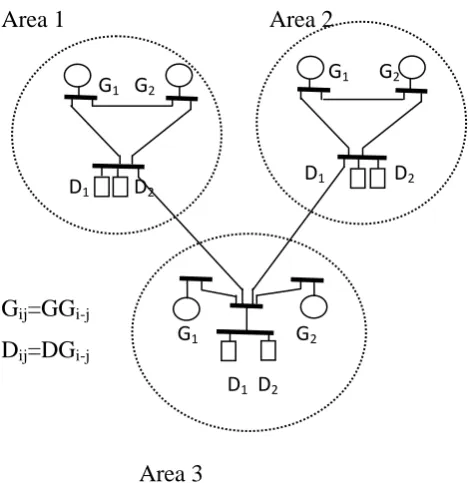
the DGs in contract with it in the steady state. A three area power system as shown in Fig.7 is considered as a test system to demonstrate the effectiveness of the proposed control strategy. It is assumed that each control area includes two GGs and DGs. The power system parameters are given in Tables 1-2.
Area 1 Area 2 Table 1. Control area parameters
Table 2. GGs Parameter
Gij=GGi-j Dij=DGi-j
Area 3
Fig.7 A three-area deregulated power system
5. Encoding for Fuzzy Rule Base
A major problem plaguing the effective use of this method is the difficulty of accurately
constructing the rule bases. Because, it is a computationally expensive combinatorial optimization
and also extraction of an appropriate set of rule bases from the expert may be tedious, time
consuming and process specific. Thus, to reduce fuzzy system effort cost, a GA has been proposed.
It was shown that, the global optimal point is guaranteed and the speed of algorithms convergence
is extremely improved, too. GA’s are search algorithms based on the mechanism of natural
selection and natural genetics. They can be considered as a general-purpose optimization method
and have been successfully appliedto search and optimization.
Rule1 Rule20 Rule1 Rule20
0
1 0
...
0 0 1 0 1 0...
0 1 0 1 0 0...
1 1 1Fig.8 Encoding for fuzzy rule base
In the GA just like natural genetics a chromosomes (a string) will contain some genes. These binary bits are suitably decoded to represent the character of the string. A population size is chosen consisting of several parent strings. The strings are then subjected to evaluation of fitness function. The strings with more fitness function will only survive for the next generation, in the process of the
Parameter Area 1 Area 2 Area 3
KP (Hz/pu) 125 80 100
TP (sec) 25 15 12
B (pu/Hz) 0.8877 0.85 0.9
Tij (pu/Hz) T12 =0.55 T13 =0.55 T23 =0.55
MVAbase
(1000 MW) Parameter
GGs (k in area i)
1-1 2-1 1-2 2-2 1-3 2-3
Rate (MW) 1100 900 1200 1000 1100 1150
TT (sec) 0.4 0.48 0..46 0..45 0.4 0..4
5
TH (sec) 0.08 0.09 0.07 0.09 0.08 0.09
R (Hz/pu) 2.5 3.5 3.0 2.8 2.8 3.5
α 0.45 0.45 0.45 0.45 0.45 0.45
G1 G2
D1 D2
G1 G2
D1 D2 G1 G2
D1 D2
selection and copying, the string with less fitness function will die. The former strings now produce new off-springs by crossover and some off-springs undergo mutation operation depending upend mutation probability to avoid premature convergence to suboptimal condition. In this way, a new population different from the old one is formed in each genetic iteration cycle. The whole process is repeated for several iteration cycles until the fitness function of an offspring is reach to the maximum value. Thus, that string is the required optimal solution. For our optimization problem, the new following fitness function is proposed:
f= 1
1+𝑀𝑆𝐸(𝑝𝑒𝑟𝑓𝑜𝑟𝑚𝑎𝑛𝑐𝑒𝐼𝑛𝑑𝑒𝑥)
MSE(performance Index)=�(∑3𝑖=1100∫ 𝑡0𝑡 |𝐴𝐶𝐸𝑖|𝑑𝑡/3
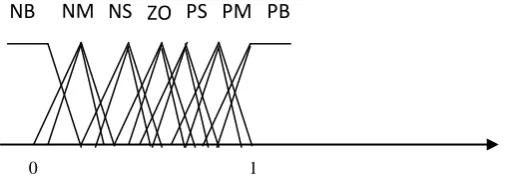
A string of 200 binary bits reprints gains of PID controller in three areas (Fig. 8), population size and maximum generation are 30 and 120, respectively. The least MSE is the better string. The better string survives in the next population. Based on the roulette wheel, some strings are selected to make the next population. After the selection and copying the usual mutual crossover of the string (crossover probability is chosen 98%) and mutation of some of the string (mutation probability is chosen 10%) are performed. In this way, new offspring of rule sets are produced in the total population then system performance characteristics and corresponding fitness value are recomputed for each string. Thus, the sequential process of fitness function, selection, crossover, mutation evaluation completes genetic iteration cycle. In the GAs rule base optimization we assume that the fuzzy sets Ci and Di are characterized by the membership functions shown in Fig.9.
The proposed method was applied to the LFC task in the deregulated power system. The plot of obtained fitness function value is shown in Fig.10. It can be seen that the fitness value increases monotonically from 0.16 to 0.28 in 98 generations. The fuzzy rule base is listed in Tables 3, 4 and 5.
0 1
NB NM NS ZO PS PM PB
Fig. 9 Membership function for KIi, KPiand
Fig.10 Convergence procedure of GA to obtain fuzzy rule table Solid (Max. value), Dashed (Mean Value) and Dated (Min. value)
Table 3. Rule Table for KIi Table 4. Rule Table for KPi
ΔACEi
NB NS PS PB
ACEi NB NM NB NB NB
NS NM NB NB NM
Z NB PB PB NM
PS PM PB PB PB
PB PS NM NM PM
Table 5. Rule Table for Kdi
ΔACEi
NB NS PS PB
ACEi NB NS PS NB NB
NS PB NM ZO NM
Z NB PB NS PM
PS PB PM NB PB
PB NB NS NB NM
6. Simulation Results
In the simulation study, the linear model of turbine ∆PVki /∆PTki is replaced by a nonlinear
model of Fig.11 (with ±0.05 limit). This is to take GRC into account, i.e. the practical limit on the rate of the change in the generating power of each GG. The results indicated that GRC would influence the dynamic responses of the system significantly and lead to larger overshot and longer settling time. Therefore, to illustrate the capability of the proposed strategy in this example, in the view point of uncertainty our focus will be concentrated on variation of these parameters.
Fig.11 Nonlinear turbine model with GRC
The designed GT-IT2FPIDC controller is applied for each control area of the deregulated power system as shown in Fig. 7. To illustrate robustness of the proposed control strategy against parametric uncertainties and contract variations, simulations are carried out for two Cases of
ΔACEi
NB NS PS PB
ACEi NB NS PS NB NB
NS PB NM ZO NM
Z NB PB NS PM
PS PB PM NB PB
PB NB NS NB NM
1
𝑇𝑇𝑘𝑖
1
𝑠 +d
-d
ΔPTki ΔPVki
possible contracts under various operating conditions and large load demands. Performance of the proposed GT-IT2FPIDC controller is compared with CFPIDC controller in power systems.
Case 1: Local Area Control
In this scenario, GGs participate only in the load following control of their areas. It is assumed that a large step load 0.15 pu is demanded by each DGs in areas 1 and 2. Assume that a case 1 of local area contracts between DGs and available GGs are simulated based on the following AGPM. It is noted that GGs of area 3 do not participate in the LFC task.
0.5 0.4 0 0 0 0 0.5 0.6 0 0 0 0 0 0 0.6 0.6 0 0
AGPM=
0 0 0.6 0.6 0 0
0 0 0 0 0 0
0 0 0 0 0 0
Also, assume, in addition to the specified contracted load demands 0.15 pu MW, a step load change as a large uncontracted demand is appears in control area 1 and 2, where, DGs of areas 1 and 2 demands 0.1 and 0.06 pu MW of excess power, respectively. This excess power is reflected as a local load of the area and taken up by GGs in the same area. Thus, the total local load in 1 and 2 areas is computed as:
∆P Loc,1=0.15+0.15+0.15=0.45 pu MW ∆P Loc,2=0.15+0.15+0.05=0.35 pu MW
The frequency deviation of two areas and tie-line power flow with 25% increase in all parameters Kpi,Tpi, Bi and Tij are depicted in Fig. 12. Using GT-IT2FPID controller, the frequency deviation of all areas and the tie-line power are quickly driven back to zero and has small overshoots. Since there are no contracts between areas, the scheduled steady state power flows over tie-line are zero.
0.5 Δf1 0
-0.5 -1
0 5 10 15 20 25 1.5
Δf2 0.75
0 -1
0 5 10 15 20 25 0.05
ΔPtie1-2 0
-0.1 -0.2
0 5 10 15 20 25
Fig.12 Deviation of frequency and tie-lines power flows using IT2FPIDC controller; Solid (GT-IT2FPIDC) and Dashed (CFPIDC)
Case 2: Global Area Control
In this scenario, DGs have the freedom to have a contract with any GG in their or another areas. Consider that all the DGs contract with the available GGs for power as per following AGPM. All GGs participate in the LFC task. It is assume that a large step load 0.15 pu MW is demanded by each DGs in all areas. Moreover, it is assumed that DGs of areas 1, 2 and 3 demands 0.15, 0.06 and 0.04 pu MW (un-contracted load) of excess power, respectively. The total local load in areas is computed as:
∆P Loc,1=0.15+0.15+0.15=0.45 pu MW
∆P Loc,2=0.15+0.15+0.06=0.36 pu MW
∆P Loc,3=0.15+0.15+0.04=0.34 pu MW
0.3 0 0.3 0 03 0 0.6 0.3 0 0.3 0 0 0 0.6 0.3 0 0 0
AGPM=
0.3 0 0.6 0.8 0 0
0 0.3 0 0 0.6 0
0 0 0 0 0 1
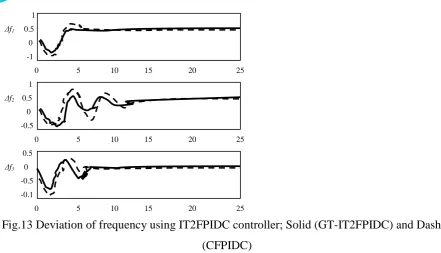
The purpose of this scenario is to test the effectiveness of the proposed controller against uncertainties and large load disturbances in the presence of GRC. Power systems responses with 25% decrease in uncertain parameters Kpi, Tpi, Bi and T ij are depicted are shown in Fig.13 and 14.
Using the GT-IT2FPID controller, the frequency deviation of the all areas is quickly driven back to zero and has small settling time. Also, the tie-line power flow properly converges to the specified value in the steady state case (Fig.14), i.e.; ∆Ptie12,sch=0.03 and ∆Ptie13sch,= 0.03 pu MW. The un-contracted Load of DGs in all areas is taken up by the GGs in these areas according to ACE participation factors in the steady state. The simulation results in the above case indicate that the proposed control strategy can ensure the robust performance such as frequency tracking and disturbance attenuation for possible contracted cases under modelling uncertainties and large area load demands in the presence of GRC.
1
Δf1 0.5 0
-1
0 5 10 15 20 25
1
Δf2 0.5 0
-0.5 0 5 10 15 20 25
0.5 Δf3 0
-0.5 -0.1 0 5 10 15 20 25
Fig.13 Deviation of frequency using IT2FPIDC controller; Solid (GT-IT2FPIDC) and Dashed (CFPIDC) 0.1 ΔPtie1 0.025 0
-0.4 0 5 10 15 20 25
0.05 ΔPtie1-3 0.025 0
-0.05 0 5 10 15 20 25
Fig.14 Deviation of tie lines power flows using IT2FPIDC controller; Solid (GT-IT2FPIDC) and Dashed (CFPIDC)
To demonstrate performance robustness of the proposed method, the ISE, ITAE and FD indices based on system performance characteristics are being used as:
ISE=1000∫ ∑020 3𝑖=1𝐴𝐶𝐸(𝑡)2dt
ITAE=100∫ 𝑡 ∑020 3𝑖=1|𝐴𝐶𝐸(𝑡)|dt
FD= (OSX14)2+(USX7)2+(TsX1)2
Where, Overshoot (OS), Undershoot (US) and settling time (Ts) (for 5% band of the total load demand in area 1) of frequency deviation area 1 is considered for evaluation of the FD. The value of ISE, ITAE and FD is calculated for cases 1 and 2 whereas the system parameters are varied from -25% to 25% of the nominal values and shown table 6.
Table 6 Performance indices values
Cases ISE ITAE FD
GT-IT2FPIDC
CFPIDC
GT-IT2FPIDC
CFPIDC
GT-IT2FPIDC
CFPIDC
1 Experiment 1 24.51 28.76 25.84 121.25 45.33 54.55
Experiment 2 25.19 26.43 25.08 109.48 45.26 48.93
Experiment 3 25.74 32.061 29.09 123.96 45.74 107.82
2 Experiment 1 29.47 33.43 26.32 125.78 45.09 117.36
Experiment 2 29.1 30.23 26.63 115.80 45.23 89.98
Experiment 3 29.87 37.63 27.59 133.79 45.22 128.87
It can be seen that the GT-IT2FPID controller has robust performance against system parametric uncertainties and possible contract scenarios even in the presence of GRC and the system dynamic performances is significantly improved.
7. Conclusions
In this paper a Genetically tuned interval type-2 fuzzy PID (GT-IT2FPIDC) type controller is proposed for solving the Load Frequency Control (LFC) problem in a deregulated power system that operate under deregulation based on the bilateral policy scheme. This control strategy was chosen because of increasing the complexity and changing structure of power systems. In order to reduce design effort and find better fuzzy system control, a GA with a strong ability to find the most optimistic results algorithm has been used to fuzzy controller rule bases. The aim is to reduce fuzzy system effort, find a better fuzzy system control and take large parametric uncertainties into account. The effectiveness of the proposed method is tested on a three-area deregulated power system for a wide range of load demands and disturbances under different operating conditions. The simulation results show that with the use of GT-IT2FPIDC the dynamic performance of system such as frequency regulation, tracking the load changes and disturbances attenuation is significantly improved for a wide range of plant parameter and area load changes. The system performance
characteristics in terms of ISE, ITAE and FD indices reveal that the designed GT-IT2FPID
controller is a promising control scheme for the solution of LFC problem and therefore it is recommended to generate good quality and reliable electric energy in the deregulated power systems.
References
1. H. Shayeghi, A. Ghasemi, (March 2011) “Market based LFC Design using Artificial Bee Colony”, International Journal on Technical and Physical Problems of Engineering (IJTPE), Issue 6, Vol., 3, No. 1, pp. 1-10.
2. R.D. Christie, A. Bose, (1996) “Load Frequency Control Issues in Power System Operations
after Deregulation”, IEEE Transactions Power Systems, Vol. 11, No. 3, pp. 1191-1200.
3. J. Kumar, N. G. Hoe, G. Sheble, (1997) “AGC Simulator for Price based Operation, Part I:
Modeling”, IEEE Transactions Power Systems, Vol. 12, No. 2, pp. 527-532.
4. V. Donde, A. Pai, I.A. Hiskens, (2001) “Simulation and Optimization in a AGC System
after Deregulation”, IEEE Transactions on Power Systems, Vol. 16, No. 3, pp. 481- 489.
5. H. Shayeghi, H.A. Shayanfar, A. Jalili, A. Ghasemi, (2010) “LFC Design using HBMO
Technique in Interconnected Power System”, International Journal on Technical and Physical Problems of Engineering (IJTPE), Issue 5, Vol. 2, No. 4, pp. 41-48.
6. H. Bevrani, Y. Mitani, K. Tsuji, (2004) “Robust Decentralized AGC in a Restructured
Power System”, Energy Conversion and Management, Vol. 45, Issue 15-16, pp. 2297- 2312.
7. K.Y. Lim, Y. Wang, R. Zhou, (1996) “Robust Decentralized Load Frequency Control of
Multi-Area Power System”, IEE Proceeding, Generation, Transmission and Distribution, Vol. 43, No. 5, pp. 377-386.
8. C. Chang, W. Fu, (1997) “Area Load Frequency Control Using Fuzzy Gain Scheduling of
PI Controllers”, Electric Power Systems Research, Vol. 42, Issue 2, pp. 145-152.
9. H. Shayeghi, H.A. Shayanfar, A. Jalili, M. Khazaraee, (2005) “Area Load Frequency
Control using Fuzzy PID Type Controller in a Restructured Power System”, Proceeding of the International Conference on Artificial Intelligence, Las Vegas, Nevada, USA, pp. 344-350, 27-30 June 2005
10.E. Yesil, M. Guzelkaya, I. Eksin, (2004) “Self Tuning Fuzzy PID Type Load and Frequency
Controller”, Energy Conversion and Management, Vol. 45, Issue 3, pp. 377- 390.
11.H. Shayeghi, A. Jalili, H.A. Shayanfar, (2007) “Robust Modified GA based Multi-Stage
Fuzzy AGC,” Journal of Energy Conversion and Management, Vol.48, No.5, pp. 1656-1670.
12.H. Shayeghi, H.A. Shayanfar, O.P. Malik, (2007) “Robust Decentralized Neural Networks
based AGC in a Deregulated Power System”, Electric Power System Research, Vol.77, No. 3, pp. 241-251.
13.K. Sebaa, M. Boudour, (2009) “Optimal Locations and Tuning of Robust Power System
Stabilizer Using Genetic Algorithms”, Electric Power Systems Research, Vol.79, Issue 2, pp. 406-416.
---