SHADOW AND SKY COLOR RENDERING TECHNIQUE IN AUGMENTED REALITY ENVIRONMENTS
HOSHANG KOLIVAND
iii
iv
ACKNOWLEDGEMENT
My appreciation first and foremost goes to the Almighty Allah, the creator of heavens and the Earth for giving me the breath of life and keeping me in good health all through the period of this study.
I would like to express my deep gratitude to my supervisor Assoc. Prof. Dr. Mohd Shahrizal Sunar for always being willing to discuss the different aspects of the research. He was always there for me.
My sincere appreciation also extends to my wife, Eng. Marzieh Moradi for her constant encouragement, and for not tolerating any procrastination and my son Shahin. They gave me the needed rest of mind to concentrate in this study.
Many thanks to Prof. Dr. Mark Billinghurst, Assoc. Prof. Dr. Mohd Shafry Mohd Rahim, Prof. Dr. Ghazali Sulong and for their functional suggestions. Last but not least to UTM ViCubeLab group members and my fellow postgraduate friends. I acknowledge the financial support received from the Universiti Teknologi Malaysia through the International Doctoral Fellowship awards 2011, 2012 and 2013, and through the RUG, FRGS and ERGS Grant for providing financial support of this research.
v
ABSTRACT
vi
ABSTRAK
vii
TABLE OF CONTENTS
CHAPTER TITLE PAGE
DECLARATION ii
DEDICATION iii
ACKNOWLEDGEMENT iv
ABSTRACT v
ABSTRAK vi
TABLE OF CONTENTS vii
LIST OF TABLES xiii
LIST OF FIGURES xiv
LIST OF ABBREVIATIONS xx
LIST OF APPENDICES xxi
1 INTRODUCTION 1
1.1 Introduction 1
1.2 Problem Background 6
1.3 Problem Statement 14
1.4 Research Aim 15
1.5 Research Objectives 15
1.6 Justification 16
1.7 Research Contributions 17
1.8 Research Scope and Limitations 18
1.9 Thesis Organisation 19
2 LITERATURE REVIEW 22
2.1 Introduction 22
2.2 The Sun Position and Sky Color 23
2.2.1 Sky Light 26
2.2.2 Longitude and Latitude 26
viii
2.3.1 Definition 27
2.3.2 Highlighted Literatures on Augmented
Reality 29
2.3.3 Issues in AR 30
2.4 Realistic Illumination Issues 32
2.5 Shadow Generation Techniques 37
2.6 Real Time Shadow Generation Techniques 38
2.6.1 Projection Shadows 39
2.6.2 Shadow Volumes 41
2.6.3 Shadow Maps 45
2.7 Improved Shadow Generation Algorithms 47
2.7.1 Geometry Based Algorithms 48
2.7.1.1 Alleviating Geometric Overhead 49 2.7.1.2 Soft Shadow Volume Algorithms 51
2.7.2 Image Based Algorithms 54
2.7.2.1 Percentage-Closer Filtering 54
2.7.2.2 Deep Shadow Maps 56
2.7.2.3 Adaptive Shadow Maps (ASMs) 57 2.7.2.4 Perspective Shadow Maps 58 2.7.2.5 Parallel Split Shadow Maps 60
2.7.2.6 Variance Shadow Maps 61
2.7.2.7 Layered Variance Shadow Maps 63
2.7.2.8 Cascaded Shadow Maps 64
2.7.2.9 Convolution Shadow Maps 67 2.7.2.10 Multi-View Soft Shadows 68 2.8 Critical Issues In Shadow Generation Algorithms 70
2.8.1 Image Based Issues 70
2.8.1.1 Anti-Aliasing 70
2.8.1.2 Partitioning 74
2.8.1.3 Culling 77
2.8.2 Geometrical Based Issues 79
2.9 None Real-Time Shadow Generation Techniques 80
2.9.1 Ray Casting 80
2.9.2 Ray Tracing 81
2.9.3 Radiosity 83
2.10 Realistic Shadows in Augmented Reality 84
2.10.1 Hard Shadows in AR 85
2.10.1.1 Hard shadows Geometrical
ix
2.10.1.2 Hard shadows Imaged Based 88
2.10.2 Soft Shadow in AR 89
2.10.2.1 Soft Shadows Geometrical
Based 90
2.10.2.2 Soft Shadows Image Based 91 2.10.3 Realistic Shadows Issues in AR 94
2.11 Summary 96
3 RESEARCH METHODOLOGY 99
3.1 Introduction 99
3.2 Research Framework 100
3.3 Phase 1: Sky Investigation 102
3.3.1 Investigating about the Sun Position 103 3.3.2 Investigating about Sky Color 104
3.3.3 Implementing Sky Color 105
3.4 Phase 2: Shadows Investigation 105
3.4.1 Image-Based Shadows Investigation 108 3.4.2 Investigating about Geometrical Based
Shadows 108
3.4.3 Improving Silhouette Detection 110
3.4.4 Shadows Implementation 110
3.4.5 Proposing Hybrid Shadow Maps 111 3.5 Phase 3: The Coherent Formula and Prototype 111
3.5.1 Introducing a Coherent Mathematical
For-mula for the Sun Position and Shadows 112 3.5.2 Constructing a Prototype by Integrating
Sky Color and Shadows with Respect to
the Sun Position 112
3.5.3 Implementing the Interaction Between Sky
Color and Objects 113
3.6 Phase 4: Augmented Reality, Interaction and
Evaluation 114
3.6.1 Investigating about Augmented Reality 115 3.6.2 Integrating and Implementing the
Interac-tion and Shadows in AR 115
3.6.3 Testing, Evaluation and Validation 116 3.6.3.1 Shadows Generation Testing 118 3.6.3.2 Sky Color Generation Testing 118
x
3.7 Resources of Data and Required Equipments 119
3.7.1 Resources of 3D Objects 119
3.7.2 Resources of Video Data 120
3.8 Required Environments 120
3.9 Summary 121
4 SHADOW AND SKY COLOR RENDERING
TECH-NIQUES 122
4.1 Introduction 122
4.2 The Sun Position and Sky Color 124
4.2.1 Detecting Longitude and Latitude 124
4.2.2 Dome modelling 124
4.2.3 Calculating the Sun Position 125
4.2.4 Color Spaces 127
4.2.4.1 RGB Space 127
4.2.4.2 CIE XYZ Space 128
4.2.4.3 CIE Yxy Space 128
4.2.5 Perez Sky Model 130
4.2.6 Skylight Distribution Coefficients and
Zenith Value 131
4.3 Shadow Rendering Algorithms 133
4.3.1 Projection Shadow Algorithm 133
4.3.1.1 Soft Projection Shadows 135 4.3.1.2 An Improvement on Soft
Projec-tion Shadows 135
4.3.2 Geometrical Based Techniques 138 4.3.2.1 Silhouette Definition 139 4.3.2.2 Silhouette Detection Algorithms 141
4.3.3 Image Based Techniques 147
4.3.3.1 Hybrid Shadow Maps 148
4.4 The Coherent Formula of the Sun Position and
Shadows in Specific Location, Date and Time 152
4.5 Summary 156
5 IMPLEMENTATION OF OUTDOOR COMPONENTS
IN AUGMENTED REALITY 158
5.1 Introduction 158
5.2 Sky Illumination in Augmented Reality Systems 160
xi
5.2.2 Real Sky Modelling (RSM) 161
5.3 Global illumination and Radiosity Computation 162
5.4 Radiosity Caster Culling 164
5.4.1 Bounding Volume Mask 166
5.4.2 Geometry Mask 166
5.4.3 Fragment Mask 166
5.4.4 CAFRAG Mask 167
5.5 Augmented Reality Setup 168
5.5.1 Conventional AR Systems 169
5.5.2 AR Systems Equipped with Shadows 169 5.5.3 Virtual Shadows on Real Objects 169 5.5.4 Integrating the Realistic Outdoor AR
System 170
5.6 Conclusion 172
6 TESTING AND EVALUATION 173
6.1 Introduction 173
6.2 The Sun Position and Sky Color Evaluation 174 6.3 Evaluation on Improved Projection Shadow 178
6.4 EESD in Shadow Volumes 180
6.5 Hybrid Shadow Mapping Evaluation 183
6.6 Integration of Real-Time Sky Color and Shadows 185 6.6.1 Integration of Shadow Volumes and Sky
Color 185
6.6.2 Integration of Hybrid Shadow Maps and
Sky Color 186
6.7 Software Evaluation 187
6.8 Interaction Between Sky Color and Objects in
Augmented Reality 191
6.9 Integrating AR Systems 193
6.9.1 Simple AR Environments 193
6.9.2 AR Systems Including Soft Shadows 194 6.9.3 Virtual Shadows on Real Objects 195 6.9.4 Interaction Between Sky Color and Object
in Outdoor AR Environments 198
6.10 Summary 204
7 CONCLUSION 206
xii
7.2 Research Achievements and Limitation 210
7.2.1 Research Achievements 211
7.2.2 Research limitation 213
7.3 Future Works 214
7.3.1 Algorithm Extensions 215
7.3.2 Technique Extensions 216
REFERENCES 218
xiii
LIST OF TABLES
TABLE NO. TITLE PAGE
2.1 Summary of improved projection shadow techniques 68 2.2 Summary of improved geometrical based shadow
techniques 69
2.3 Summary of improved image based shadow techniques 69
3.1 Julian day conversion 104
3.2 Research requirements and specification 121
5.1 Comparison between different kinds of masks 167 6.1 Real and software generated data sets for both sunrise and
sunset at UTM on 14 May, 2011 176
6.2 Complexity with n=10 and m=5 181
6.3 Complexity with n=100 and m=10 181
6.4 Frame rendering time for a large scene 185
6.5 A comparison between the sky color interaction and objects in both virtual environment and augmented
xiv
LIST OF FIGURES
FIGURE NO. TITLE PAGE
1.1 Research focus area 2
1.2 Left: Study of shadows by Leonardo da Vinci (1490),
Right: Shadow construction by Lambert (1774) 4 1.3 Comparison between a scene without shadows and with
shadows to realise distance and size of objects 5 1.4 Comparison between a scene without shadows and with
shadows to realise the geometry of complex object 5 2.1 Taxonomy of Mixed Reality Environments (Milgram
et al., 1995) 28
2.2 (left) A scene with simple illumination, (right) the scene
with indirect illumination (Lensing and Broll, 2012) 35 2.3 Interaction between environments and augmented objects
in life video (Liuet al., 2010) 36
2.4 Shadow generation techniques 38
2.5 Projection shadows 40
2.6 Left: Theory of shadow volume. Right: result of shadow
volume using stencil buffer 43
2.7 A volume of shadow volumes constructed using
silhouette detection 44
2.8 Left: theory of shadow mapping. Right: standard shadow
mapping 46
2.9 (a) Normal, PSC and PSR are in the scene. (b)Culling: PSC = O1, O5 and PSR = O1, O2, O3, O5. (c) Clamping: CSC: Shadow volumes SVi are clamped. (d) Clamping:
DSC 51
2.10 Wedge construction steps 52
2.11 Computing the occluded area for an occluder at a receiver point. Assuming each silhouette edge treats are not the
xv
2.12 Comparison between ordinary texture map filtering (A)
and percentage closer filtering (B) 55
2.13 Left: The compression algorithm, (a) piecewise linear curve and error bound. (b) Extent of output segment to the current z-value to have deep shadow maps. Right:
Deep shadow maps with 50,000 hairs 56
2.14 Self-shadowing smoke and hair together 57
2.15 Left: simple shadow mapping. Right: perspective shadow
maps 58
2.16 Split schemes, Left: Uniform splitting, Center:
Logarith-mic splitting. Right: Practical splitting 60 2.17 View frustum and light frustum mix to create Parallel
Split Shadow Maps 61
2.18 Shadow reconstruction curve VSM 62
2.19 Left: Theory of Layered Variance Shadow Maps. Right:
result of LVSM 63
2.20 Left: theory of CSM when light and view direction are perpendicular. Right: result of CSM with 3 partitions in
1024*1024 resolution 65
2.21 (a): CSM redundant rendering when the angle between the light and view directions α = 120 degrees. (b): the worst case of redundant rendering when α = 180
degrees (Lianget al., 2011) 66
2.22 (a) has redundant rendering, inversely (b) has no redundant rendering because there is no intersection
between layers (Lianget al., 2011) 66
2.23 a) Left: reveals conventional shadow mapping where point x1 is lit, point x2 is in shadow. (a) Right illustrates convolution shadow mapping. (b) Depicts result of convolution shadow mapping without any light
bleeding (Annenet al., 2007) 67
2.24 Left: Projection aliasing due to different size project areas. Right: Perspective aliasing happens when a
shadow map ignores perspective foreshortening 71
2.25 Aliasing theory in shadow mapping 72
2.26 Notation used in the accurate aliasing description (image
xvi
2.27 Left: z-partitioning by capturing four different shadow maps for each partition. Right: result of cascade shadow
mapping with four partitions 75
2.28 Comparison of z-partition schemes between Basic Logarithmic and SDSM logarithmic distribution with four
partitions 76
2.29 Total error of different schemes for varying shadow map numbers. FP is frustum face partitioning, ZP is z-partitioning, W is warping (figure courtesy of Brandon
Lloyd) 77
2.30 Left: brief overview of masking techniques and their attributes (L: low, M: medium, H: high). Right: 2D
illustration of the masking techniques 79 2.31 Left: Theory of Ray Tracing, Right: Result of Ray
Tracing 82
2.32 Left: simple scene. Center: direct illumination. Right:
Radiosity 84
2.33 History of AR - a brief timeline 85
2.34 (a) and (b) Real and virtual (avatar and box) shadow with overlapping, (c) Removing the overlapping using the
protection step 86
2.35 Haller’s method for casting virtual shadows on real
objects 87
2.36 Generating cast shadows without explicit 3-D
reconstruc-tion 89
2.37 The approximation of illumination of the real world 90 2.38 Supan’s method with different number of light sources.
(a):8 light sources, (b) 48 light sources, (c) 64 light
sources 92
3.1 Framework of research 102
3.2 The sun position in different month at same time 103
3.3 Process of Sky Color Generation 106
3.4 Shadow casters and shadow receivers 107
3.5 Silhouette detection 109
3.6 Shadow volumes 109
3.7 Different prepared GUI for controlling longitude, latitude,
xvii
3.8 (a) at 7:37 am, (b) at 10:16 am, (c) at 1132: am on May
10th and (d) at 7:37 am on May 14th2012 at Universiti
Teknologi Malaysia 113
3.9 System Architecture in AR environment 117
4.1 The sky dome modelling 125
4.2 The zenithal and azimuthal angles on the hemisphere 127
4.3 The RGB color space 128
4.4 CIE color space for xy chromaticity’s 129
4.5 Color Gamut for two devices expressed Yxy 130
4.6 Umbra and penumbra regions in soft shadows 134
4.7 Original projection shadow 135
4.8 Left: Geometric progression for choosing the color,
Right: Soft shadow parameters 137
4.9 Left: FPS for simple sampling and sampling using proposed algorithm, Right: Relation between size of
samples andΩ 138
4.10 Contribution of silhouette detection in shadow volumes 140 4.11 Left: Triangular mesh,Right:Extended edge for silhouette
detection 142
4.12 Layer Separating in Hybrid Shadow Mapping 149
4.13 Hybrid Shadow Mapping 149
4.14 Construction of Hybrid Shadow Mapping 151
4.15 Construction of light bleeding 152
4.16 Shadow generation theory 153
5.1 Different type of mask, (a): Receivers, (b): BVOL, (c):
GEOM, (d): FRAG, (e): CAFRAG 165
5.2 Structure of interaction between sky color and virtual
objects in augmented reality environment 171 6.1 Left: Real sky color in Universiti Teknologi Malaysia 15
June 2011. Right: Result of the Sky Color application
(UTM, 15 June, 2011) 175
6.2 Real sky color and virtual sky color, May 10th 2012 at Universiti Teknologi Malaysia at a latitude of 1.28 and longitude of 103.45 at different times of day at 7:43 am
and 11:43 am 177
6.3 Different real sunrise and sunset and results of our
application 178
6.4 Left: Simple Sampling using 360 samples, Right:
xviii
6.5 Left: Simple sampling using 360 samples. Right:GP
Sampling using 255 samples 179
6.6 The illustration of stencil buffer in shadow volumes take
silhouette detection into account 180
6.7 Complexity with n=10,m=5 181
6.8 Complexity with n=100,m=10 182
6.9 Final comparison between three algorithms 182
6.10 Shadow volumes using EESD 183
6.11 Left: CSMs using store of mean and variance, Center: HSMs using medium bounding, Right: HSMs using layer
overlapping 184
6.12 (a): SSMs, (b): CSMs, (c): PCF, (d): LVSMs using
Gaussian blurring, (e): HSMs using Gaussian blurring 184 6.13 Combination of sky color and shadows, January 1st at
Universiti Teknologi Malaysia at different times of the
day 186
6.14 Hybrid shadow maps (1024*1024), January 1st at
Universiti Teknologi Malaysia at different times of day 187 6.15 HSA and VSA in different times of day (May 14, 2011) 188
6.16 HSA and VSA in different Julian day 189
6.17 Left: Eiffel Tower, captured on 6 October at 16:03, Right: The Software generated result for Eiffel Tower position
on 6 October at 16:03 190
6.18 Left: Eiffel Tower, captured on 24 October at 16:23, Right: The Software generated result for Eiffel Tower
position on 24 October at 16:23 190
6.19 Left: Eiffel Tower, captured on 5 September at 17:19, Right: The Software generated result for Eiffel Tower
position on 6 September at 17:19 191
6.20 Left: Eiffel Tower, capture on 6 November at 9:54 am, Right: The Software generated result for Eiffel Tower
position on 6 November at 9:54 am 191
6.21 Left: Tokyo, captured on 16 November at 16:15, Right: The Software generated result for Eiffel Tower on 16
November at 16:15 192
6.22 Left: Tokyo, captured on 10 November at 16:35, Right: The Software generated result for Eiffel Tower position
xix
6.23 Left: University of Missouri - St. Louis captured on 26 July 2012 at 6:02 , Right: The Software generated result for University of Missouri - St. Louis capture on 26 July
2012 at 6:02 193
6.24 Left: Poipu Beach, Kauai, Hawaii on 29 October 2012 at 6:33 am, Right software generation result for Poipu
Beach, Kauai, Hawaii on 29 October 2012 at 6:33 am 193 6.25 Left: Imagine Peace Tower on 15 October 2012 at 11:30
am, Right software generation result for Imagine Peace
Tower on 15 October 2012 at 11:30 am 194
6.26 Interaction between sky color and objects in virtual
environment 194
6.27 Left: A conventional AR system, Right: Simple AR
system including hard shadows 195
6.28 An AR system equipped with soft shadows 195
6.29 Virtual shadows on real objects 196
6.30 (a) Simple Shadow Maps on virtual and real objects, (b)
PCF shadows on virtual and real objects 197
6.31 Virtual shadows on real objects 198
6.32 (a) Castro results, (b) Our results 198
6.33 Convergence rate controlling for interaction between sky color and objects at a time of a day, http://www.youtube.com/watch?v=RHbb0fgpw8Y &
feature=plcp 201
6.34 Interaction between sky color and objects in augmented environment at different times of day on May 10th and
May14th2012 at Universiti Teknologi Malaysia 202 6.35 A scene with and without augmented objects, at 9:55 on
January11th 2013 at Universiti Teknologi Malaysia 202 6.36 Interaction between sky color and objects in augmented
environment at different times of January 11th 2013 at
Universiti Teknologi Malaysia 203
6.37 Interaction between sky color and objects in augmented environment at 15:28 on January11th 2013 at Universiti
xx
LIST OF ABBREVIATIONS
PC – Personal Computer
GUI – Graphic User Interface
FPS – Frame Per Second
PCF – Percentage-Closer Filtering VSSM – Variance Soft Shadow Mapping GIS – Geographic Information System LVSM – layered Variance Shadow Maps
VSM – Variance Shadow Mapping
CSM – Cascaded Shadow Maps
EESD – Extended Edge Silhouette Detection
HSM – Hybrid Shadow Maps
SH – Spherical Harmonics
PRT – Precomputed Radiance Transfer
3D – Three Dimension
GMT – Greenwich Mean Time
VE – Virtual Environment
AR – Augmented Reality
MR – Mixed Reality
xxi
LIST OF APPENDICES
APPENDIX TITLE PAGE
A PORTION CODES 238
CHAPTER 1
INTRODUCTION
1.1 Introduction
Rendering atmospheric phenomena are known to have had their base in the fields of atmospheric optics and meteorology. Nevertheless, practical computer graphics applications have been limited by the complexity of the associated rendering problems. The techniques for rendering outdoor scenes are different from those of their indoor counterparts as the sun and the sky color are the main resources for consistent illumination of outdoor rendering environments (Klassen, 1987; Kaneda et al., 1991; Sunaret al., 2003; Dobashiet al., 2002).
Over the last two decades, Augmented Reality (AR) or in general, Mixed Reality (MR) has been one of the most attractive topics in computer graphics making researchers interested in achieving good results in this field (Azuma, 1997; Jacobset al., 2005; Madsen and Nielsen, 2008). In AR, realism can be achieved through entering shadows as well as inducing interaction between objects (Jensenet al., 2009; Liuet al., 2010; Xinget al., 2012; Madsen and Lal, 2013).
2
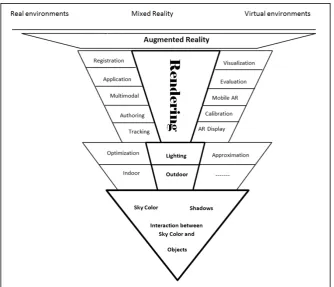
1.1 represents the research area. The final focus area is shown as well as all open issues in AR.
Figure 1.1: Research focus area
Studies about sky color and shadows are the main resources for outdoor components using grammars with sets of rules. Rendering outdoor components is studied for visualization of natural scenes in different contexts: animators, ecosystem simulations, video games, design architectures and flight simulators (Klassen, 1987; Sunaret al., 2003).
3
The principle of calculating the sun position has long been known. The ancient Egyptians were able to calculate the sun position many years ago by digging a large hole inside a pyramid; just once a year, on the king’s birthday, the sun would shine on the grave of their king (Perl and Weihs, 1990; Nawar et al., 2007). The practical use of the sun position in computer graphics applications is one of the outdoor rendering concerns.
Daylight is combination of all direct and indirect light from the sun, sky color and diffusion of other object especially the earth. In other words, daylight includes direct sunlight, diffused sky radiation, and both of these reflected from the earth and terrestrial objects. Intensity of skylight or sky luminance are not uniform and depend on the clarity of the sky (Nishita and Nakamaei, 1986).
The sun and the sky are the main resources of natural illumination. The sun is a light source simulating the effect of sunlight and can be used to show how the shadows cast by a structure affect the surrounding area. The angle of the light from the sun is controlled by location, date and time. The skylight is the most important outdoor illumination to render the scene realistic (Dobashiet al., 1996).
Most real-time rendering has focused on indoor rendering but the real ability of computer graphics can be demonstrated in outdoor rendering taking the sky illumination into account (Preetham et al., 1999; R¨onnberg, 2004). It is because, the sky usually illuminates a point from almost all directions. A realistic sky scene will greatly improve the reality of the outdoor virtual environment (Wang, 2007). Generating sky color as a background for each outdoor scene is essential factor to make it realistic. Displaying the sky has become critical, as many buildings are designed, so that the sky or a surrounding scene is reflected in the building windows (Dobashiet al., 1997).
4
long time to render. This also requires a substantial amount of memory. Overcoming this problem has been an attractive topic and challenging many researchers since later in the previous century.
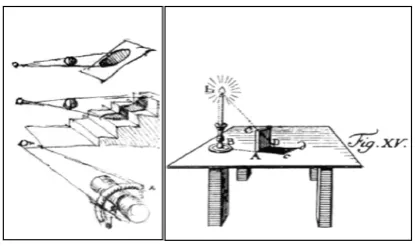
Figure 1.2: Left: Study of shadows by Leonardo da Vinci (1490), Right: Shadow construction by Lambert (1774)
In computer games, shadows make gamers feel a sense of playing in the real world resulting in maximum pleasure. Games without shadows are not pleasurable to gamers. Nowadays, gamers taste virtuality and their imaginations constantly demand more and more realism. To create realistic environments, shadows are very important as they reveal information about the distances between objects in the entire scene. It is a major factor of 3D graphics, but unfortunately it is expensive in the case of rendering time in virtual, let alone in augmented reality environments. Shadows are one of the most significant aspects in virtual and augmented reality environments both for the spectator to detect distance relationships between objects, and to reveal the complexity of objects resulting in more realistic environments. Leonardo Da Vinci (Figure 1.2 (left)) was the first to focus on painting and static images take shadows into account (Vinci, 1490). There are some materials by Lambert who worked on shadows, specifically the geometry underlying the shadow receiver (Figure 1.2(right)) (Lambert, 1774).
5
Figure 1.3: Comparison between a scene without shadows and with shadows to realise distance and size of objects
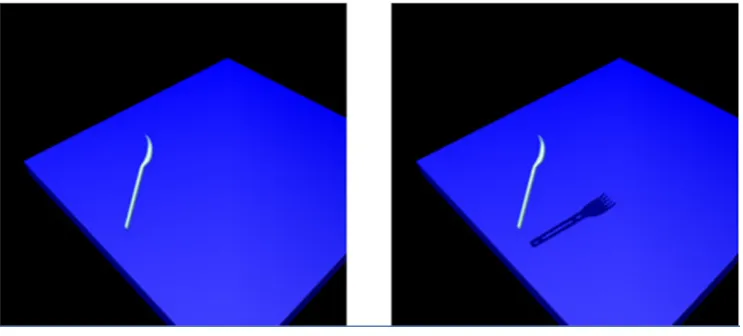
compared with other objects which are located far away. For example, in Figure1.3, on the left, the distance and size of the objects are not clear but on the right of the Figure 1.3, it is obvious that scissors are above the plane, and torus is on the plane. Another advantage is that shadows help the viewer realise the geometry of a complex object which includes huge number of polygon. In Figure 1.4 (left), it is not clear what the curve is. However, the number of tines in the fork is clear on the right of the picture.
Figure 1.4: Comparison between a scene without shadows and with shadows to realise the geometry of complex object
6
interaction between sky color and objects. The method is followed through exerting sky color energy on virtual objects. The interaction between sky color and virtual objects in AR systems could be the latest state-of-the-art to make the AR system more realistic at the time of writing the present thesis (Liuet al., 2009, 2010; Xinget al., 2011, 2012, 2013).
To sum up, the significant factors in realistic outdoor AR rendering include the sun position, sky color, shadows and interaction between objects. Sky color and shadow generation are expensive for rendering individual cases let alone their integration. Thus, they require more improvements not only in the case of rendering time but also in the case of realism. In this research, an attempt is made to reduce the rendering time through some improvements on shadow generation algorithms and radiosity technique, and enhance realism by applying shadows and the effect of sky color on virtual objects in augmented reality environments.
1.2 Problem Background
More than 30 years has passed since the first computer game was invented (3D Monster Maze 1981); many prominent researchers have spent much time to improve the quality of virtual environments and make the virtual scenes realistic similar to what meets the eyes. Nowadays, large companies, e.g. NVIDIA, Maya and 3D Studio Max spend exorbitant amounts on improving the quality of various fields of computer games. Although speed is crucial in real-time applications, visual quality is also a very significant factor (Boulanger, 2008; Feng, 2008; Kim, 2010; Xinget al., 2011, 2012).
7
hours which are too long, a real-time technique will be in order to reduce the CPU render time. Real-time rendering is the best technique to avoid long CPU rendering hours not only in the case of virtual environments but also augmented reality systems.
In general, poverty and unfair division of revenue are highly interconnected. In computer graphics also, for a desirable result, an enhancement in quality will produce a lower reduction in Frame Per Second (FPS). Therefore, any enhancement in quality is considered undesirable for rapid reduction in FPS and vice versa. However, in some development techniques there is a trade-off between FPS and quality. Introducing a compromise technique to enhance the quality which remains FPS could be a desirable achievement for the current research.
In real-time rendering, realism can be achieved only by combination of sophisticated modellings such as daylight, reflection, absorption and shadows (Jansen and Chalmers, 1993). Most real-time rendering has focused on indoor rendering due to the complexity of outdoor rendering especially in augmented reality environments (Preethamet al., 1999; R¨onnberg, 2004). All these motivate us to focus on sky color and shadows in outdoor AR rendering systems to enhance the realism and reduce rendering time. Outdoor rendering components such as the sun position, sky color, shadows and interaction between sky color and objects in augmented reality environments, implementation of related objects, and their relationship form some of the topics in the approach adopted in the present research.
8
Many algorithms are proposed for shadow generation. Shadow volumes and shadow maps are classical real-time shadow techniques. Shadow volumes are accurate enough but they are geometrically-based and require extensive calculations. Although shadow volumes are established in the gaming industry, they have two expensive phases; updating volume rendering passes, and silhouette detection to recognize the outline of occluders (Raskar and Cohen, 1999; Assarsson and Akenine-Moller, 2003; Junget al., 2004; Billeteret al., 2010). Silhouette detection requires a novel algorithm or an improvement on existing algorithm to reduce the rendering time in shadow volumes.
In the case of shadow volumes, recognizing the outline of objects can be effective in rendering speed of the algorithm. Silhouette detection is essential in determining the outline of the object as it reduces the cost of rendering. Silhouette detection is an important phase in all visual effects. To generate shadows, silhouette detection plays a crucial step in detecting occluder boundaries (Raskar and Cohen, 1999; Assarsson and Akenine-Moller, 2003; Chenet al., 2011).
Richards et al. (1987) was the first researcher who focused on silhouette detection interpreting the silhouette of objects. Saito and Takahashi (1990) improved the silhouette detection using G-buffer. Hertzmann (1999) proposed a technique for recognizing silhouette of irregular objects using Z-buffer. Simultaneously, Raskar and Cohen (1999) by changing the front faces and back faces of a polygon object presented a new technique for silhouette detection. Jung et al. (2004) improved the algorithm by proposing a technique using spatial coherence and frame coherence. Fawad et al. (2009) combined Canny (1986) method, Markosianet al.(1997) method and method of Markosian and Adviser-Hughes (2000) to introduce a fast silhouette detection for shadow volume generation but still extensive calculations were needed.
9
is a crucial problem of shadow maps (Williams, 1978; Reeveset al., 1987; Wooet al., 1990; Lokovic and Veach, 2000; Lauritzen and McCool, 2008; Eisemann et al., 2009, 2011; Scherzer et al., 2011). Improvement of these categories of shadow generation algorithms is another contribution of the present research.
Reeves et al. (1987) proposed a new technique to reduce aliasing by filtering the algorithm which they called percentage-closer filtering (PCF). This algorithm, by filtering the depth map with interpolation of binary data, attempts to produce monotonic data in the outline of shadows. This method involves binary data. Lokovic and Veach (2000) proposed a technique entitled deep shadow maps to reduce aliasing. Unlike traditional shadow maps which store one depth for each pixel, deep shadow maps store fractional visibility functions that represent the visibility through a given pixel at all different depth levels. Fernando et al. (2001) tried to resolve shadow maps aliasing using the technique of synchronizing the pixel size in two viewpoints. This is accomplished by storing the shadow maps in a hierarchical structure instead of the normal flat two-dimensional view.
Stammingeret al.(2002) proposed Perspective Shadow Maps (PSMs) to reduce aliasing. They implemented PSMs in normalized device coordinate space. PSMs reduce aliasing and create almost sharp outlines. This idea provides almost good resolution for near objects and decreases resolution as the viewer moves away from the viewpoint. Donnelly and Lauritzen (2006) proposed an algorithm entitled Variance Shadow Maps (VSMs) based on traditional shadow mapping to reduce aliasing. In this algorithm, instead of storing a single depth value (z-value), they store mean and squared values for depths distribution. Dimitrov (2007) proposed a technique to create semi-soft shadows, based on shadow mapping entitled Cascaded Shadow Maps (CSMs). Cascaded shadow maps try to reduce aliasing by z-partitioning. Lauritzen and McCool (2008) proposed an algorithm which could solve both VSMs problems. They called the algorithm Layered Variance Shadow Maps (LVSMs). LVSMs divide depth shadow into layers but reduce the texture precise.
10
entitled Variance Soft Shadow Mapping(VSSM). VSSM is based on PCF and exploits recent advances in VSMs. VSSM could render high quality soft shadow faster than PCSS. They presented some other ideas on variance soft shadow mapping for rendering plausible soft shadow in real-time. Variance soft shadow mapping is based on the theoretical framework of percentage-closer soft shadows. Their new formulation allowed efficient computation of blocker distances, a common bottleneck of percentage-closer soft shadows.
Bittneret al. (2011) proposed a technique to cull parts of shadow caster which do not contribute to shadows. The method uses a mask to cull the shadow casters using a hierarchical occlusion culling. They proposed different masks to cull the shadow casters and calculated the cost for each. They claimed the technique achieves 3x-10x speedup for rendering a wide scene like a city and 1.5x-2x speedup for rendering an actual game scene.
In the case of augmented reality, realistic virtual objects in outdoor rendering environments require state-of-the-art effects such as consideration of shadows, daylight, reflection and absorption (Jansen and Chalmers, 1993; Madsen and Lal, 2011). Shadows are one of the significant factors enhancing the realism of augmented reality outdoor rendering which have been examined for more than fifteen years (Azuma, 1997; Naemura et al., 2002; Debevec, 2004). Many researchers studied how the shadows in augmented reality environments can be applied and improved (Madsen et al., 2003; Haller et al., 2003; Gibson et al., 2003; Jacobs et al., 2005; Madsen and
Nielsen, 2008; Madsen and Lal, 2013). Enhancement of shadows while considering light is another aspect making objects more realistic in outdoor AR rendering but they are still distinguishable with the real ones (Yan, 2008; Nowrouzezahrai et al., 2011; Aittala, 2010; Madsen and Lal, 2011; Figueiredoet al., 2012; Knechtet al., 2012). An interaction between sky color and virtual objects during daytime is the last contribution of current research to enhance the quality of outdoor augmented reality environments.
12
2011). Low FPS is due to more complexity of outdoor environments. Most complexity comes from geometry, lighting and shadows (Boulanger, 2008; Bittner et al., 2011). The geometry is because of too much detail in outdoor environments. Lighting computation is caused by higher levels of light reflection over all visible objects in the scene. Complexity of shadow generation is caused by projection of all visible objects from light point of view to the shadow receivers. To overcome this complexity, much research has been conducted on this challenging problem (Reeves et al., 1987; Assarsson and Akenine-Moller, 2003; Junget al., 2004; Boulanger, 2008; Billeteret al., 2010; Lianget al., 2011). Rendering a scene with full ecosystems or large environment is a difficult task because of the level of geometry and complexity that was mentioned before. The lowest frame per second happens when the scene is wide as is the case in outdoor environments. This requires more improvement to render a large scene realistic. Thus, approximations giving the most visually convincing results at the lowest possible cost are required (Wyman, 2004; Zhang et al., 2007; Boulanger, 2008; Nguyenet al., 2010; Lianget al., 2011).
In the case of shadow generation, shadow volumes need to be improved in the silhouette detection phase which is the most expensive part of the algorithms (Crow, 1977; Assarsson and Akenine-Moller, 2003; Jung et al., 2004; Billeter et al., 2010). Shadow maps require an improvement in aliasing which is their critical problem (Williams, 1978; Reeves et al., 1987; Woo et al., 1990; Lokovic and Veach, 2000; Lauritzen and McCool, 2008; Eisemannet al., 2009; Scherzeret al., 2011).
Shadows play an important role and are an essential factor for a 3D impression of a scene to achieve a realistic augmented reality result, (Naemura et al., 2002; Debevec, 2004). Simulating shadows in augmented reality for a virtual object in real scenes is difficult especially when the approximate geometric details about the real scene and the light source are known (Jacobset al., 2005).
13
for virtual objects but there is no interaction between sky color and objects.
Direct and indirect illumination on virtual objects in augmented reality systems is an open question in current augmented reality environments due to researchers’ focus on consistent illumination (Gibson et al., 2003; Hughes et al., 2004; Steinicke et al., 2005; Feng, 2008; Jensen et al., 2009; Xinget al., 2011, 2012; Madsen and Lal,
2013). In addition to shadowing, interaction between real and virtual objects is a more important aspect to enhance the realism of virtual objects in augmented reality (Feng, 2008; Yeoh and Zhou, 2009; Aittala, 2010; Kim, 2010; Xinget al., 2012), and the main outdoor objects is the sky. Outdoor rendering in augmented reality is more complicated due to the unpredictable illumination changes with respect to sky color (Luet al., 2010).
Increasing the rendering speed is still the challenging problem facing augmented reality as important as realistic (Liu et al., 2009; Xing et al., 2012). To have an interaction between sky color and objects taking shadows into account, a fast shadow technique is required as much as an improvement on radiosity technique to share the energy between outdoor objects.
14
1.3 Problem Statement
The most sophisticated components in outdoor rendering are shadows and lighting (Jansen and Chalmers, 1993; Preetham et al., 1999; R¨onnberg, 2004; Boulanger, 2008). In general, lighting refers to global illumination and interaction between objects where the main object in the outdoor environment is the sky (Kaneda et al., 1991; Tadamuraet al., 1993; Nishitaet al., 1996; Tamuraet al., 2005; Boulanger,
2008; Arief et al., 2012; Madsen and Lal, 2013; Xinget al., 2013). Shadows refer to the dark portions and halftones which include all different categories such as hard, soft or even soft outline shadows and self shadowing.
However, registration and tracking are two of the main issues in building effective AR systems (Madsen and Laursen, 2007), generating realistic virtual objects in augmented reality environments that are indistinguishable from real ones is still an open issue (Yan, 2008; Liu et al., 2009; Sheng et al., 2010; Krevelen and Poelman, 2010; Xing et al., 2012; Madsen and Lal, 2013). An interaction between objects in augmented reality can be used to improve realism (R¨onnberg, 2004; Liu et al., 2010; Xinget al., 2012; Madsen and Lal, 2013; Xinget al., 2013; Zhanget al., 2013).
Realistic rendering of virtual objects in outdoor environments which makes the objects indistinguishable from real ones is the most difficult task in augmented reality environments (Madsen and Laursen, 2007). For outdoor rendering, sky effect is the first and most important factor to be taken into account for generating a realistic environment (Kanedaet al., 1991; Tadamuraet al., 1993). Therefore, realistic outdoor rendering augmented reality could be achieved by applying the effect of sky color on virtual objects as well as real objects.
15
address.
Lack of time outdoor rendering environments in sufficient real-ism (Boulanger, 2008), encouraged the researcher to apply a convenient technique to integrate the main outdoor AR components by considering sky color and shadows with respect to sun position in any specific location, date and time.
1.4 Research Aim
The aim of this research is to propose a technique to achieve realistic real-time outdoor rendering taking into account the interaction between sky color and objects in augmented reality environments with respect to shadows and the interaction in any specific location, date and time.
1.5 Research Objectives
To achieve this aim, the following objectives need to be followed:
1. To propose a new shadow algorithm for increasing the realism and reducing the rendering time
2. To introduce a new mathematical formula to calculate the shadows with respect to the sun position in any specific location, date and time
16
systems
1.6 Justification
This research has prepared three improved algorithms and a new technique to integrate outdoor components in AR systems. Two algorithms are related to shadow generation and the other one is in radiosity. The algorithms address some problems facing game makers. Animators are the main audience who can use the algorithms to create outdoor environments in virtual and augmented reality. The new algorithm in shadow generation can be used for game makers to construct shadows in both virtual and augmented reality environments with high frame per second and high enough quality in realism. In the case of shadow generation, the results obtained from this research are poised to become a basis for the much needed industrial standard in computer graphics. They address the issue of image and geometry-based shadow generation. It is also believed to have a significant effect and impact on the rendering time and realism.
In the case of the final integrating technique, three groups form the audience. The first group are animators and game developers. The second group is the physics and arts teachers. Building designers and architectures form the third group who can use the final prototype.
Virtual Heritage is a relevant subject which can benefit largely from the results of interaction between sky color and objects with respect to the sun position in any specific location, date and time to reveal realistic heritage in real environments (Noh et al., 2009). Interaction between the sky and objects in virtual and augmented reality
17
Physics teachers, also, can use the application in some cases. The effect of sun position on shadows and measurement of direction and length of shadows are from among the low-level uses of this integration. At an intermediate level, investigation of Perez model and the effect of sun position on sky color in different locations, dates and times can be useful for students to reveal God’s miraculous creation, the solar system. Observation of the interaction between the sky color and objects in virtual and augmented reality environments could form a professional discussion topic for physics and arts students.
Finally, to recognize the best direction of building in cold or warm areas and to save the energy, building design industry can use the final software. Specification of the best building direction in any specific location is an important factor. In cold places, a building needs to be situated where shadows lie in the back of the building; in warm places, building should be located in the position where shadows lie in front of the building. This is a simple way to save the free blessing which God presented to us. It is hoped that this will be of enormous help to all groups.
1.7 Research Contributions
• The shadow generation algorithms is one of the contributions to keep maintain the trade-off between FPS and quality of results. An algorithm for silhouette detection based on geometrical techniques for shadow volume generation and a hybrid shadow maps algorithm based on shadow mapping are the first contributions of this research. In the case of shadow volumes an improvement on silhouette detection increases the FPS. The hybrid shadow mapping not only enhances the quality of shadows but also increases the FPS.
18
present research. This coherent formula could make outdoor rendering as easy as indoor rendering. Outdoor rendering using a coherent formula eliminated the need for shadow positioning during daytime.
• The main contribution of this research is to propose a new technique for rendering the shadows and sky color to reveal the interaction between sky color and objects in the AR system. The prototype takes into account the outdoor components such as sky color and shadows with respect to the sun position in augmented reality environments to make the interaction between sky color and objects appear. The improved algorithm for radiosity technique to share the sky color energy and to improve the trade-off also needs to be mentioned in this regard.
1.8 Research Scope and Limitations
The shadow generation algorithms can be used for opaque objects as well as previous algorithms which are a requirement for outdoor AR systems. The occluders are opaque, thus light penetrable objects such as semi-transparent are excluded. In the case of shadow volumes, the algorithm is newly-designed for silhouette detection. In the case of hybrid shadow maps, the algorithm could improve both FPS and the quality of shadows. The algorithm is implemented with OBJ, PLY and RAW data. The shadow generation techniques exclude complicate objects such as hair, fur and smoke. However, hybrid shadow maps could be implemented for complex objects such as grass and trees in augmented reality systems.
19
The interaction is applied for both virtual environments and augmented reality environments. Two classes of sky color generation are employed to reveal the outdoor-element interaction; virtual sky model and real sky model. The software does not take into account other atmospheric phenomena such as rainbows, halos, glories and coronas.
The AR system considered multimarker and markerless as well as single marker. In some parts of the research multimarker is used to show different virtual objects in real scenes when the distance between camera and virtual objects is not so long. In the case of wide outdoor environments markerless AR is applied because detecting the far marker is not rebuts and capturing a far scene including near marker does not lead to more realism. In the case of markerless AR, the location and direction of virtual objects could be handled using keyboard and mouse or a configuration INIfile.
1.9 Thesis Organisation
Chapter 1, includes the statement of the thesis. It starts with the introduction
and then problem background. Next comes problem statement, aim and objectives followed by the scope and limitation which are described clearly. The structure of thesis is outlined at the end of the chapter.
Chapter 2, provides an in-depth literature review of all the three major areas;
the sun position and sky color generation in computer graphics, shadow generation and augmented reality systems. Emphasis is laid on the various contributions and limitations of the proposed algorithms and techniques in all three relevant areas.
20
respect to the sun position, viewer’s location, date and time using Perez model. Phase 2 examines shadows and the implementation of different types of shadow algorithms. The proposed coherent formula for sun position and shadows will be implemented in phase 3. The last part of phase 3 takes up construction of an outdoor virtual environment and implementation of the interaction in virtual environments(VE). Phase 4 is allocated to augmented reality and applying the interaction in AR; then testing and evaluating of the results.
Chapter 4, discusses the realisation of the first and second objectives of
this research. It starts with implementing the sun position and sky color. Then redefinition of shadow parameters and implementation of the improved and proposed shadow algorithms are employed in this chapter. Shadow volumes and shadow maps are implemented separately. Two new algorithms are proposed. EESD (Extended Edge Silhouette Detection)improves the shadow volume algorithms and HSM (Hybrid Shadow Maps) reduces rendering time and enhances the realism of shadows. Integrating sky color and shadows, an outdoor rendering environment is provided in the third section. The environment is produced in two different cases; geometrical and image-based. The chapter ends with the introduction of the coherent formula which meets the second objective.
Chapter 5, presents the interaction between sky color and objects in both
VE and AR. This chapter introduces an improved algorithm on radiosity which is required for meeting the last objective. The final technique to integrate the outdoor AR environments is presented in the last part of this chapter.
Chapter 6, presents results emanating from the application of the three
21
and augmented reality environments, the final goal is tested and evaluated.
218
REFERENCES
Agrawala, M., Ramamoorthi, R., Heirich, A. and Moll, L. (2000). Efficient Image-Based Methods for Rendering Soft Shadows. Proceeding of the 27th Annual Conference on Computer Graphics and Interactive Techniques, 23–28,ACM Press. 375–384.
Agusanto, K., Li, L., Chuangui, Z. and Sing, N. (2003). Photorealistic Rendering for Augmented Reality Using Environment Illumination.In Proceedings of the 2nd IEEE and ACM International Symposium on Mixed and Augmented Reality, 208–216.
Aittala, M. (2010). Inverse lighting and photorealistic rendering for augmented reality. The Visual Computer. 26(6-8), 669–678.
Akenine-M¨oller, T. and Assarsson, U. (2002). Approximate soft shadows on arbitrary surfaces using penumbra wedges. Proceedings of the 13th Eurographics workshop on Rendering, 297–306. Eurographics Association.
Annen, T., Dong, Z., Mertens, T., Bekaert, H.-P., Philippe andSeidel and Kautz, J. (2008). Real-time, all-frequency shadows in dynamic scenes.ACM Transactions on Graphics (Proceedings of ACM SIGGRAPH 2008). 27(3), 1–34.
Annen, T., Mertens, T., Bekaert, P., Seidel, H.-P. and Kautz, J. (2007). Convolution shadow maps.Proceedings of the 18th Eurographics conference on Rendering Techniques, 51–60. Eurographics Association.
Arief, I., McCallum, S. and Hardeberg, J. (2012). Realtime estimation of illumination direction for augmented reality on mobile devices. Final Program and Proceedings - IS and T/SID Color Imaging Conference, 111–116.
Arvo, J. (2004). Tiled shadow maps. Computer Graphics International, 2004. Proceedings, 240–246. IEEE.
219
Azuma, R. (1997). A Survey of Augmented Reality. Presence: Teleoperators and Virtual Environments. 6(6), 355–385.
Azuma, R., Baillot, Y., Behringer, R., Feiner, S., Julier, S. and MacIntyre, B. (2001). Recent advances in augmented reality.IEEE Computer Graphics Applications. 21(6), 34–47.
Baran, I., Chen, J., Ragan-Kelley, J., Durand, F. and Lehtinen, J. (2010). A hierarchical volumetric shadow algorithm for single scattering. ACM Transactions on Graphics (TOG). 29(6), 178. ACM.
Batagelo, H. and Junior, I. (1999). Real-Time Shadow Generation using BSP Trees and Stencil Buffers.In SIBGRAPI. 12, 93–102.
Bavoil, L. (2011). Multi-View Soft Shadows. Http://developer. nvidia. com.
Benichou, F. and Elber, G. (1999). Output sensitive extraction of silhouettes from polygonal geometry.In Proc. of Pacific Graphics 1999, 60–69.
Billeter, M., Sintorn, E. and Assarsson, U. (2010). Real time volumetric shadows using polygonal light volumes.Proceedings of the Conference on High Performance Graphics, 39–45.
Bittner, J., Mattausch, O., Silvennoinen, A. and Wimmer, M. (2011). Shadow caster culling for efficient shadow mapping.In Symposium on Interactive 3D Graphics and Games, ACM, New York, NY, USA, I3D 11, 81–88.
Blinn, J. (1982). Light Refection Functions for Simulation of Clouds and Dusty Surfaces.ACM Transactions on Graphics. 16, 21–29.
Blinn, J. and Newel, M. (1976). Texture and refection in computer generated images. Communications of the ACM. 19, 542–546.
Boulanger, K. (2008). Real-time realistic rendering of nature scenes with dynamic lighting.Ph.D Thesis. ProQuest.
Bouville, C., Dubois, J., Marchal, I. and Viaud, M. (1988). Monte-Carlo Integration Applied to an Illumination Model.EuroGraphics 88, 483–498.
Brabec, S. and Seidel, H.-P. (2003). Shadow volumes on programmable graphics hardware.Computer Graphics Forum. 22(3), 433–440. Wiley Online Library. Braun, H. and Cohen, M. (2010). A Simple Model for Real Time Sky Rendering.
NVIDIA, Technical Report.
220
Bucholtz, A. (1995). Rayleigh-scattering calculations for the terrestrial atmosphere. Applied Optics. 34(15), 2765–2773. Optical Society of America.
Canny, J. (1986). A computational approach to edge detection. Pattern Analysis and Machine Intelligence, IEEE Transactions on. (6), 679–698. IEEE.
Chan, E. (2004). Efficient shadow algorithms on graphics hardware. Master Thesis. Massachusetts Institute of Technology.
Chen, J., Baran, I., Durand, F. and Jarosz, W. (2011). Real-time volumetric shadows using 1D min-max mipmaps. Symposium on Interactive 3D Graphics and Games, PAGE–7. ACM.
Chong, H. Y. and Gortler, S. J. (2004). A lixel for every pixel. Proceedings of the Fifteenth Eurographics Conference on Rendering Techniques, 167–172. Eurographics Association.
Chong, H. Y. and Gortler, S. J. (2007). Scene Optimized Shadow Mapping. Harvard Computer Science Technical Report. Harvard University, Cambridge.
Chong, H. Y.-I. (2003). Real-time perspective optimal shadow maps.Technical Report. Harvard University.
CIE (2012). Online: http://www.cie.co.at/cie/home.html. Cited 1st June, 2012.
Cohen, M. and Wallace, J. R. (1993). Radiosity and Realistic Image Synthesis.Morgan Kaufmann., 213–222.
Cook, R. L. (1986). Stochastic sampling in computer graphics. ACM Trans. Graph. 5(1), 51–72.
Crow, F. (1977). Shadow Algorithms for Computer Graphics. Computer Graphics. 11(2), 242–247.
Dai Shuling, R. C. Q. T. (2009). Real-time Simulation of Sky and Sun in Clear Day. Journal of Computer-Aided Design & Computer Graphics. 3, 005.
Debevec, P. (2004). Image-based lighting.IEEE Computer Graphics and Applications. 22, 26–34.
Debevec, P. (2006). A Median Cut Algorithm for Light Probe Sampling. ACM SIGGRAPH 2006 Courses, 6. ACM.
Debevec, P., Tchou, C., Gardner, A., Hawkins, T., Poullis, C., Stumpfel, J., Jones, A., Yun, N., Einarsson, P., Lundgren, T.et al.(2004). Estimating surface reflectance properties of a complex scene under captured natural illumination.Conditionally Accepted to ACM Transactions on Graphics, 19.
221
Detection and Person Silhouette Extraction Enhanced by Body Parts Tracking. Society of Photo-Optical Instrumentation Engineers (SPIE) Conference Series. 8301, 24.
Dimitrov, R. (2007). Cascaded Shadow Maps.NVIDIA, Technical Report.
Dippe, M. and Wold, E. (1985). Antialiasing Through Stochastic Sampling.Computer Graphics. 19(3), 69–78.
Dobashi, Y., Iwasaki, W., Ono, A., Yamamoto, T., Yue, Y. and Nishita, T. (2012). An inverse problem approach for automatically adjusting the parameters for rendering clouds using photographs. ACM Transactions on Graphics (TOG). 31(6), 145. ACM.
Dobashi, Y., Kaneda, K., Yamashita, H. and Nishita, T. (1996). Method for Calculation of Sky Light Luminance Aiming at an Interactive Architectural Design.Computer Graphics Forum (Proc. EUROGRAPHICS’96). 15(3), 112– 118.
Dobashi, Y., Kaneda, K., Yamashita, H., Okita, T. and Nishita, T. (2000). A simple, efficient method for realistic animation of clouds. Proceedings of the 27th annual conference on Computer Graphics and Interactive Techniques, 19–28. ACM Press/Addison-Wesley Publishing Co.
Dobashi, Y., Kusumoto, K., Nishita, T. and Yamamoto, T. (2008). Feedback control of cumuliform cloud formation based on computational fluid dynamics. ACM Transactions on Graphics (TOG). 27(3), 94. ACM.
Dobashi, Y., Nishita, T., Kaneda, K. and Yamashita, H. (1997). A Fast Display Method of Sky Colour using Basis Functions.The Journal of Visualization and Computer Animation. (8), 115–127.
Dobashi, Y., Yamamoto, T. and Nishita, T. (2002). Interactive rendering of atmospheric scattering effects using graphics hardware. In Proceedings of the ACM SIGGRAPH/EUROGRAPHICS Conference on Graphics Hardware, 99– 107.
Donnelly, W. and Lauritzen, A. (2006). Variance Shadow Maps. In Proceedings of the 2006 ACM SIGGRAPH Symposium on Interactive 3D Graphics and Games, 161–165.
Duan, X. and Liu, H. (2009). Detection of hand-raising gestures based on body silhouette analysis.Proceedings of the 2008 IEEE International Conference on Robotics and Biomimetics, 1756–1761. Thailand.
222
Eisemann, E., Assarsson, U., Schwarz, M. and Wimmer, M. (2009). Casting Shadows in Real Time.
Eisemann, E., Wimmer, M., Assarsson, U. and Schwarz, M. (2011).Real-time shadows. AK Peters Limited.
Emmanuel, R. (2012). An urban approach to climate sensitive design: strategies for the tropics. Taylor & Francis.
Everitt, C. and Kilgard, M. J. (2003). Practical and robust stenciled shadow volumes for hardware-accelerated rendering.arXiv preprint cs/0301002.
Fauerby, K. and Kjaer, C. (2003). Real-time Soft Shadows in a Game Engine.Master Thesis. University of Aarhus.
Fawad, M., Wencheng, W. and Enhua, W. (2009). LOD Exploitation and Fast Silhouette Detection for Shadow Volumes.International Journal of Electrical and Computer Engineering. 1(2), 92–98.
Feldmann, T., Dießelberg, L. and W¨orner, A. (2009). Adaptive foreground/background segmentation using multiview silhouette fusion.Pattern Recognition, 522–531. Springer.
Feng, Y. (2008). Estimation of light source environment for illumination consistency of augmented reality.Image and Signal Processing, 2008. CISP’08. Congress on. 3, 771–775. IEEE.
Fernando, R., Fernadez, S., Bala, K. and Greenberh, D. (2001). Adaptive Shadow Maps. In Proceedings of ACM SIGGRAPH ACM Press / ACM SIGGRAPH, 387–390.
Figueiredo, L. H. d., Velho, L.et al.(2012). Realistic Shadows for Mobile Augmented Reality. Virtual and Augmented Reality (SVR), 2012 14th Symposium, 36–45. IEEE.
Forest, V., Barthe, L. and Paulin, M. (2006). Realistic soft shadows by penumbra-wedges blending.In Proceedings of Graphics Hardware 2006, 39–47.
Forest, V., Barthe, L. and Paulin, M. (2008). Accurate shadows by depth complexity sampling. Computer Graphics Forum (Proceedings of Eurographics 2008). 27(2), 663–674.
Fritz, F., Susperregui, A. and Linaza, M. (2005). Enhancing cultural tourism experiences with augmented reality technologies.6th International Symposium on Virtual Reality, Archaeology and Cultural Heritage (VAST).
Fusion, D. (2012). Online: http://www.developerfusion.com/thread/27321/how-to-convert-bitmap-to-raw-image. 25 June.
223
Gibson, S., Cook, J., Howard, T. and Hubbold, R. (2003). Rapid Shadow Generation in Real-World Lighting Environments.In Proceedings of Eurographics Symposium on Rendering 2003, 219–229.
Gibson, S. and Murta, A. (2000). Interactive rendering with real world illumination.In Proceedings of Eurographics Symposium on Rendering 00, 365–376.
Giegl, M. and Wimmer, M. (2007a). Fitted virtual shadow maps. In Proceedings of GI (Graphics Interface) C. G. Healey and E. Lank (Eds.). Canadian Human-Computer Communications Society, Montreal, Canada, (2007), 159–168.
Giegl, M. and Wimmer, M. (2007b). Queried virtual shadow maps. In Proceedings of I3D (ACM SIGGRAPH Symposium on Interactive 3D Graphics and Games) ACM Press, 65–72.
Glover, J. and McCulloch, J. (1958). The empirical relation between solar radiation and hours of sunshine.Quarterly Journal of the Royal Meteorological Society. 84(360), 172–175.
Goral, C., Torrance, K., Greenberg, D. and Battaile, B. (1984). Modeling the interaction of light between diffuse surfaces.Computer Graphics. 18(3), 213–222.
Gormans, C. (2012). Lonline page. Online: http://www.linkedin.com/in/clgorman. 17 June.
Green, P., Kautz, J. and Durand, F. (2007). Efficient Reflectance and Visibility Approximations for Environment Map Rendering. Computer Graphics Forum (Proc. EUROGRAPHICS). 26(3), 495–502.
Green, S., Billinghurst, M., Chen, X. and Chase, G. (2008). Human-robot collaboration: A literature review and augmented reality approach in design. International Journal of Advanced Robotic Systems. 5(1), 1–18.
Greene, N. (1986). Environment mapping and other applications of world projections. Computer Graphics and Applications, IEEE. 6(11), 21–29. IEEE.
Haber, J., Magnor, M. and Seidel, H.-P. (2005). Physically-based simulation of twilight phenomena.ACM Transactions on Graphics (TOG). 24(4), 1353–1373. ACM. Haeberli, P. and Akeley, K. (1990). The accumulation buffer: hardware support for
high-quality rendering.ACM SIGGRAPH Computer Graphics. 24(4), 309–318. ACM.
224
Haller, M. (2004). Photorealism or/and non-photorealism in augmented reality. Proceedings of the 2004 ACM SIGGRAPH international conference on Virtual Reality continuum and its applications in industry, 189–196. ACM.
Haller, M., Drab, S. and Hartmann, W. (2003). A Real-Time Shadow Approach for an Augmented Reality Application Using Shadow Volumes. In Proceedings of VRST 03, 56–65.
Hartmann, W., Zauner, J., Haller, M., Luckeneder, T. and Woess, W. (2003). Shadow Catcher: a vision based illumination condition sensor using ARtoolkit. In 2003 IEEE Internation Augmented Reality Toolkit Workshop (IEEE Cat. No.03EX780), 44 –55.
Hasenfratz, J., Lapierre, M., Holzschuch, N. and Sillion, F. (2003). A Survey of Real-time Soft Shadows Algorithms.Computer Graphics Forum. 22(4), 753–774. Heidmann, T. (1991). Real shadows real time.IRIS Universe. 11, 28–31.
Hensley, J., Scheuermann, T., Coombe, G., Singh, M. and Lastra, A. (2005). Fast summed-area table generation and its applications. Comput. Graph. Forum. 24(3), 547–555.
Hertzmann, A. (1999). Introduction to 3D Non-Photorealistic Rendering: Silhouettes and Outlines, In Stuart Green, editor, Non-Photorealistic Rendering. SIGGRAPH Course Notes.
Horn, B. K. P. (1986). Robot vision. The MIT Press.
Hosek, L. and Wilkie, A. (2012). An analytic model for full spectral sky-dome radiance. ACM Transactions on Graphics (TOG). 31(4), 95. ACM.
Hostetler, D. (2002). Silhouette Edge Detection Algorithms for use with 3D Models. Graphics Algorithms and 3D Technologies (G3D) Intel Architecture Labs (IAL).
Hu, B. and Brown, C. (2005). Cast shadows in augmented reality systems.Ph.D Thesis. University of Rochester. Department of Computer Science.
Hughes, C. E., Konttinen, J. and Pattanaik, S. N. (2004). The future of mixed reality: Issues in illumination and shadows.The Interservice/Industry Training, Simulation & Education Conference (I/ITSEC). 2004(1). NTSA.
Ikeda, T., Oyamada, Y., Sugimoto, M. and Saito, H. (2013). Illumination estimation from object shadow and incomplete object shape information captured by an RGB-D camera. Kyokai Joho Imeji Zasshi/Journal of the Institute of Image Information and Television Engineers. 67(4), J124–J133.
225
A developer’s guide to silhouette algorithms for polygonal models. Computer Graphics and applications, IEEE. 23(4), 28–37. IEEE.
Ismail, A. W. (2011). User Interaction Technique With 3D Object Manipulation in Augmented Reality Environment.Master Thesis. UTM Malaysia.
Jacobs, K. and Loscos, C. (2004). Classification of illumination methods for mixed reality.In Eurographics. State-of-the-Art Report.
Jacobs, K., Nahmias, J.-D., Angus, C., Reche, A., Loscos, C. and Steed, A. (2005). Automatic generation of consistent shadows for augmented reality. Proceedings of Graphics Interface 2005, 113–120. Canadian Human-Computer Communications Society.
Jacquemin, C., Gagner, G. and Lahoz, B. (2011). Shedding light on shadow: Real-time interactive artworks based on cast shadows or silhouettes.MM’11 - Proceedings of the 2011 ACM Multimedia Conference and Co-Located Workshops, 173–182.
Jansen, F. W. and Chalmers, A. (1993). Casting Shadows in Real Time. In Michael F. Cohen, Claude Puech, and Francois Sillion, editors, Fourth Eurographics Workshop on Rendering, 27–46.
Jensen, B., Laursen, J., Madsen, J. and Pedersen, T. (2009). Simplifying Real Time Light Source Tracking and Credible Shadow Generation for Augmented Reality. Institute for Media Technology, Aalborg University.
Jensen, H. W., Durand, F., Dorsey, J., Stark, M. M., Shirley, P. and Premoˇze, S. (2001). A Physically-Based Sight Sky Model.Proceedings of the 28th annual conference on Computer Graphics and Interactive Techniques, 399–408. ACM.
Jiang, K., Li, A.-H. and Su, Y.-Z. (2012). Adaptive shadow detection based on global texture and sampling deduction. Guangdianzi Jiguang/Journal of Optoelectronics Laser. 23(11), 2174–2179.
Johnson, G. S., Hunt, W. A., Hux, W. R., Allen andMark and Burns, S., Christopher A.and Junkins (2009). Soft irregular shadow mapping: Fast, high-quality, and robust soft shadows. In Proceedings of ACM SIGGRAPH Symposium on Interactive 3D Graphics and Games 2009, 57–66.
Jung, S. K., Kwon, S. I. and Kim, K.-J. (2004). Real-time Silhouette Extraction Using Hierarchical Face Clusters.Dept. of Computer Engineering, 1–8.
Kajiya, J. T. (1986). The rendering equation.Computer Graphics (Proceedings of ACM SIGGRAPH 86). 20(4), 143–150.
226
mixed reality. Proceedings of the 2008 ACM symposium on Virtual Reality Software and Technology, 219–222. ACM.
Kambezidis, H., Asimakopoulos, D. and Helmis, C. (1990). Wake Measurements Behind A Horizontal-Axis 50 Kw Wind Turbine.Solar Wind Tech. 7, 177–184. K´an, P. and Kaufmann, H. (2012). High-quality reflections, refractions, and caustics in augmented reality and their contribution to visual coherence. Mixed and Augmented Reality (ISMAR), 2012 IEEE International Symposium, 99–108. IEEE.
Kanbara, M. and Yokoya, N. (2004). Real-Time Estimation of Light Source Environment for Photorealistic Augmented Reality. In Proceedings of the 17th International Conference on Pattern Recognition, 911–914. Cambridge, United Kingdom.
Kaneda, K., Okamoto, T., Nakamae, E. and Nishita, T. (1991). Photorealistic Image Synthesis for Outdoor Scenery Under Various Atmospheric Conditions. The Visual Computer. 7, 247–258.
Karlsson, J. and Selegard, M. (2005). Rendering realistic augmented objects using an image based lighting approach. Master Thesis. Linkpings Universitet, Department of Science and Technology, Swede.
Kautz, J., Lehtinen, J. and Aila, T. (2004). Hemispherical rasterization for self-shadowing of dynamic objects.In Proc. Eurographics Symposium on Rendering 2004, 179–184.
Kim, H., Sakamoto, R., Kitahara, I., Toriyama, T. and Kogure, K. (2007). Robust silhouette extraction technique using background subtraction. 10th Meeting on Image Recognition and Understand, MIRU.
Kim, H., Sakamoto, R., Kitahara, I., Toriyama, T. and Kogure, K. (2008). Background Subtraction using Generalized Gaussian Family Model.IET Electronics Letters. 44(3), 189–190.
Kim, Y. (2010). Augmented Reality of Flexible Surface with Realistic Lighting.Ubiquitous Information Technologies and Applications (CUTE), 2010 Proceedings of the 5th International Conference, 1–5. IEEE.
Klassen, R. (1987). Modeling the Effect of the Atmosphere on Light.ACM Transactions on Graphics. 6, 215–237.
227
Knecht, M., Traxler, C., Mattausch, O. and Wimmer, M. (2012). Reciprocal shading for mixed reality.Computers & Graphics. Elsevier.
Krevelen, D. and Poelman, R. (2010). A Survey of Augmented Reality Technologies, Applications and Limitations.The International Journal of Virtual Reality. 9(2), 1–20.
Krisciunas, K. (1997). Optical night-sky brightness at mauna kea over the course of a complete sunspot cycle.Publications of the Astronomical Society of the Pacific, 1181–1188.
Lambert, J. H. (1774). Die freye Perspektive.
Lauritzen, A. and McCool, M. (2008). Layered variance shadow maps. In GI ’08: Proceedings of Graphics Interface 2008 Toronto, Ontario, Canada), Canadian Information Processing Society, 139–146.
Lauritzen, A., Salviy, M. and Lefohnz, A. (2010). Sample distribution shadow maps. In Advances in Real-Time Rendering in 3D Graphics and Games.
Lee, D.-Y., Ahn, J.-K. and Kim, C.-S. (2009). Fast background subtraction algorithm using two-level sampling and silhouette detection. Image Processing (ICIP), 2009 16th IEEE International Conference, 3177–3180. IEEE.
Lee, K. W. (2006). Real-time shadow casting using fake soft shadow volume with stencil buffer. Master Thesis. Universiti Teknologi Malaysia, Faculty of Computer Science and Information System.
Lee, M. E., Redner, R. A. and Uselton, S. P. (1985). Statistically optimized sampling for distributed ray tracing.ACM SIGGRAPH Computer Graphics. 19(3), 61–68. ACM.
Lee, S. and Jung, S. (2011). Estimation of illuminants for plausible lighting in augmented reality.Proceedings - 2011 International Symposium on Ubiquitous Virtual Reality, ISUVR 2011, 17–20.
Lefohn, A. E., Sengupta, S. and Owens, J. (2007). Resolution-matched shadow maps. ACM Trans. Graph. 26(4), 1–17.
Lehtinen, J. and Kautz, J. (2003). Matrix radiance transfer. In Proc. Symposium on Interactive 3D Graphics 2003, 59–64.
Lengyel, E. (2002). Mathematics for 3D Game Programming and Computer Graphics. Lensing, P. and Broll, W. (2012). Instant indirect illumination for dynamic mixed reality scenes.Mixed and Augmented Reality (ISMAR), 2012 IEEE International Symposium, 109–118. IEEE.