DEVELOPMENT OF LIVE LEARNING SYSTEM USING MULTI INTEGRATED APPROACH
AHMED A. AHMED KHALF
A project report submitted in partial fulfillment of the requirements for the award of the degree of
Master of Science (Information Technology – Management)
Faculty of Computer Science and Information Systems Universiti Teknologi Malaysia
“To my beloved my father Mr. Abdallah Al-Sabawi and my mother Mrs. Basima Ahmed, to my two elder brothers Muhanned and Omar, as well as to all my sisters.
I would say to them, I am very proud of you, thanks for your encouragement, supportive situations. Conversely, to all my best friends Mohammed Al-Ali,
Mohammed Hasson, Omar Ismail, Omer Ahmed and Yahya Qusay, thank you for being faithful and helpful. It is also nice to mention our sweet memories”
To my supervisor, Dr. Othman Ibrahim your good deeds will always be remembered.
lastly, To all my fellow friends,
iv
ACKNOWLEDGEMENT
In the name of Allah, Most Merciful, Most Compassionate. It is by God’s willing, I was able to complete this project within the time given. I would like to use this opportunity to thank my supervisor, Dr. Othman Ibrahim for his insights, patience, and helpful suggestion in guiding me through all the way from the very beginning to the accomplishment of this project.
My special thanks to my family for being supportive, motivate and also understanding me through hard times and difficulties.
My fellow postgraduate students should also be recognized for their support. My sincere appreciation extends to my colleagues, friends and others who have provided assistance at various angles. Their views and tips are useful indeed. Unfortunately, it is not possible to list all of them in this limited space
ABSTRACT
vi
ABSTRAK
TABLE OF CONTENTS
CHAPTER TITLE PAGE
TITLE i
DECLARATION ii
DEDICATION iii
AKNOWLEDGEMENT iv
ABSTRACT v
ABSTRAK vi
TABLE OF CONTENTS vii
LIST OF TABLES xii
LIST OF FIGURES xiii
LIST OF APPENDICES xv
1 PROJECT OVERVIEW 1
1.1 Introduction 1
1.2 Background of the problem 3
1.3 Project Objectives 5
1.4 Scope of the Project 6
1.5 Problem Statement 7
1.6 The importance of the project 7
1.7 Uniqueness of the project 9
1.7 Organization of the Project 9
viii
2 LITERATURE REVIEW 11
2.1 Introduction 11
2.2 E-Learning Concept 12
2.2.1 E-learning 13
2.2.2 Online Live Learning and Teaching 15 2.3 Advantages and disadvantages of using E-learning 16
2.4 Framework of E-Learning 18
2.4.1 Khan’s E-Learning Framework 19 2.4.2 Wilson’s Framework of E-Learning
Approach
22
2.5 Live Learning (Synchronous learning) 25 25.1 Advantages of online synchronous
learning
28
2.5.2 Disadvantages of online synchronous learning
29
2.6 Structure of Live Learning 30
2.7 Comparison between E-Learning and Live Learning
31
2.8 The comparison between Live Learning approaches in several case studies
34
2.8.1 Implementation of E-Learning in UNU-IIST (United Nation
University-International Institute of Software Technology)
35
2.8.2 Implementation of E-Learning in CINECA (Consortium of Italian Universities)
39
2.8.3 The Summary of Two Case Studies in E-learning Implementation
42
2.9 Tools and Technologies for Live Learning 43
2.9.1 Wimba Live Classroom 46
2.9.2 Wimba Voice Direct 47
Classroom Systems
2.9.4 eLeap 50
2.9.5 WebEx 51
2.10 E-Learning in FSKSM-Universiti Teknologi Malaysia (UTM)
53
2.11 Chapter Summary 55
3 RESEARCH METHODOLOGY 56
3.1 Introduction 56
3.2 Project Methodology 57
3.2.1 Planning Phase 62
3.2.2 Analysis Phase 63
3.2.3 Design Phase 63
3.2.4 Implementation Phase 64
3.2.5 Testing Phase 65
3.3 Systems Requirements 67
3.3.1 Software Requirement 68
3.3.2 Hardware Requirements 69
3.4 Project Plan 69
3.5 Chapter Summary 70
4 ANALYSIS AND SYSTEM DESIGN 71
4.1 Introduction 71
4.2 Organizational Analysis 72
4.2.1 Organizational Structure 72
4.2.1 Vision and Mission of Current System 74
4.3 As-Is Process 75
4.4 To Be Process 76
4.4.1 User Validation Survey for Proposed Model
80
x
4.4.3 Use Case Diagram 84
4.4.4 Use Case Description 85
4.4.5 Class Diagram 86
4.4.6 Sequence Diagram 87
4.4.7 CRC Card 87
4.4.8 System Architecture 87
4.4.9 Windows Navigation Diagram 88
4.4.10 Graphic User Interface (GUI) Desig 89
4.4.11 Database Design 90
4.5 Findings on Preliminary Requirement 91
4.6 Chapter Summary 98
5 THE IMPLEMENTATION OF LIVE LEARNING
SYSTEM
99
5.1 Introduction 99
5.2 Data Collection : Questionnaire and Case Study 100
5.3 Overview of the system 106
5.3.1 Login Form 106
5.3.2 Student- Register Subject 107
5.3.3 Admin-Edit admin profile 108
5.3.4 Lecturer-Add Class 109
5.3.5 Student-Lecturer-Join Class 110 5.3.6 Download Subject Resources 111 5.3.7 Lecturer- Input Student Mark 112
5.4 Testing and validation 113
5.5 User manual 116
5.6 Chapter summary 116
6 ORGANIZATIONAL STRATEGIES 117
6.1 Introduction 117
6.2 Implementation Strategies 118
6.3 Change Management 121
6.5 Expected Organization Benefit 124
6.6 Chapter Summary 124
7 DISCUSSION AND CONCLUSION 125
7.1 Introduction 125
7.2 Achievements 126
7.3 Constraints and Challenges 126
7.4 Aspirations and Future Enhancement for the System
127
7.5 Chapter summary 128
REFERENCE 129
xii
LIST OF TABLES
TABLE NO. TITLE PAGE
2.1 Synchronous vs. Asynchronous eLearning 34
2.2 Software and Tools for online live learning and teaching 45
3.1 Methodology Framework 60
4.1 Result for survey 82
4.2 List of tables in livelearning database 90
4.3 The Proposed Element of Infrastructure Framework of Live
92
4.4 Description of the task in Live learning structure 97
5.1 Result Analysis for UAT Section A 102
5.2 Result Analysis for Questionnaire: UAT-Section B 103 5.3 Result Analysis for Questionnaire: UAT-Section C 105
5.4 Black Box Testing Scenario and Result 114
6.1 Methodology to ensure the successfulness of implementation strategies
119
6.2 Parallel implementation in Live Learning 120
6.3 Actor Change Management 121
LIST OF FIGURES
TABLE NO. TITLE PAGE
1.1 Problem domain of the study 5
2.1 Structure of chapter 2 and mapping of the sections and subsections.
12
2.2 The E-Learning Framework 20
2.3 The E-Learning Structural Frame Work 24
2.4 Online Synchronous Distance Learning 26
2.5 The Structure Of Live Learning 31
2.6 Architecture of Student Module 36
2.7 Architecture of Lecturer Module 37
2.8 Architecture of Learning Module 38
2.9 E-learning Project Steps 40
2.10 CINECA E-learning Solution 41
2.11 The Snapshot of Wimba Live Classroom 46
2.12 The snapshot of Wimba Voice Direct 47
2.13 Ellumination live web interface professional 49
2.14 Integrated Web, Video and Voice 49
2.15 Integrated Lectures with Web Conference 50
2.16 eLeap Learning Management System 51
2.17 WebEx live learning 53
2.18 E-Learning at FSKSM-UTM 54
3.1 Research Methodology 59
xiv
3.3 White-box testing 67
4.1 Organizational Structure of FSKSM-UTM 73
4.2 The framework of E-Learning in UTM 75
4.3 Activity diagram of As-Is Process in FSKSM-UTM 76
4.4 Proposed Model for Live Learning System 78
4.5 SMS for class reminder 79
4.6 Survey Result in Graphical Representation 81
4.7 Use Case Diagram 85
4.8 Class Diagram 86
4.9 System Architecture 88
4.10 Windows Navigation Diagram 89
4.11 Suggestion of Infrastructure Framework of Live Learning in UTM
94
4.11 The Proposed Live Learning Structure in educational environment
96
5.1 Demographical information for respondent gender 100 5.2 Demographical information for range of respondent’s age 101 5.3 Demographical information for year experience in using
internet
102
5.4 Graphical Analysis Result for UAT Section A 103
5.5 Login Form 107
5.6 Register Subject 108
5.7 Edit Admin Profile Form 109
5.8 Add Class Form 110
5.9 Live Class Form 111
5.10 Download Subject Resources 112
LIST OF APPENDICES
TABLE NO. TITLE PAGE
A Gantt Chart For Project 133
B Use Case Description 136
C Sequence Diagram 141
D CRC card 144
E Graphics User Interface 153
F Design Database 158
CHAPTER I
PROJECT OVERVIEW
1.1 Introduction
The rapid development of technology, especially in educational technology area which significantly changes each minutes and time, has strongly connection with the involvement from its community itself. The development of education network, including distance education and distance learning, has been dominated by the utilization of information technology recently.
With the growing popularity of distance education and online programs the education is becoming easy and easy for the people anywhere in the world. As one of the important component of higher learning , e learning is a type of open or flexible learning, introduces the new method of teaching and learning, and an imperative strategy in the educational reform creates new borderless learning environment, opportunities and bring dramatic changes in the global educational landscape. E learning facilitates the access of greater numbers of people and improves student learning outcomes and has the potential to contribute to their lifelong development and their well-being which is the ultimate purpose of education. E learning has been implemented in every field and all forms of education. Malaysia implemented the first computer system in 1966. Since then, the Government has introduced a variety of initiatives to facilitate the greater approval and diffusion of online learning to improve capacities in every field of business, manufacturing, and education in general life. These measures include the enhancement of education and training programs, provision of an environment favorable to the development of online learning, provision of incentives for mechanization and computerization, and the creation of venture capital funds.
Information technology aims to improve performance and flexibility in education by the intelligent application of technology and hopes to increase the effectiveness and efficiency of teaching and learning process. The live learning and teaching is one of the aspects of e-learning which has entered a golden age of rapid development.
3
Rapid advancement in Technology makes the web conference accessible to abroad participation; it reduces the cost of travel for the lecturers and enables the faculty to invite a much bigger group to participate in the event including administrative assistants and technical staff.
Another type of e-learning is the WEB-based seminar; it is a workshop or lecture delivered over the web, such as webinars, webcast, or other methods where there will be interaction between the audience and participation.
The term Web castused:
i. To send live audio or video programming over the Web, It is the Internet counterpart to traditional radio and TV broadcasting.
ii. To send selected Web-based information (text, graphics, audio, video, etc.) to Internet users based on individual requirements.
This project will discuss about Live learning and teaching (web conferencing) and its usage in learning in the case of FSKSM the project will focus on the multi integration of live learning system.
1.2 Background of the problem
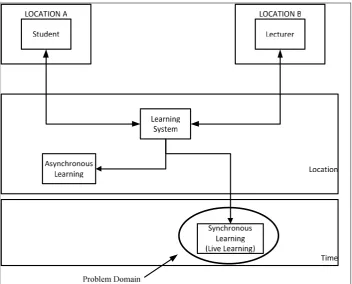
instruction to their employees or learners. Typically they provide needed training by sending people to school, holding in-house training classes, or providing manuals and self-study guides. In some situations it is advantageous for them to use e-learning or other forms of e-e-learning instead of the traditional training. Other times it is disadvantageous. As with anything else, there are benefits and limitations, as well as pros and cons. There are many advantages to online and computer-based learning when compared to traditional face-to-face courses and lectures. Our focus here on UTM campuses generally and particularly FSKSM major, both in KL campus and Skudai campus. Many of the lecturers are located in KL campus and have to teach their students in Skudai campus.To handle this distance and time problem between the lecturer and student, the integrated system which can be Communication Bridge between lecturer and student needs to be developed.
5
Figure 1.1: Problem domain of the study
1.3 Project Objectives
The objectives of this project are as follows:
i. To analyze the requirement of learning process between lecturers and students.
iii. To develop web based live learning system for FSKSM learning activities.
1.4 Scope of the Project
The Scope of the project will focus on developing web-based live learning for University Technology of Malaysia in FSKSM. The scope of this project also describes the features of Live learning itself as listed below:
i. The system is developed by analyzing the requirement of learning process in the context of Lecturer and UTM student (Especially in FSKSM).
ii. Research finding will presents the designation of prototype system by using UML and GUIs design.
iii. The prototype system will be developed as real time web based application. iv. The management of current learning process (UTM e-Learning) should be
integrated in the live learning system.
v. The prototype system has functioned as synchronous portal which allowed students and lecture to communicate visually in a classroom (created in the live learning system).
7
1.5 Problem Statement
This project is conducted as an attempt to find the answers to some problems, relating to education such as Electronic Learning, particularly "Live Learning and Teaching". The main question of this project is “How to develop web based live learning system to meet the requirement of UTM students and lecturers?"
i. How to analyze the requirement pattern of learning process between student and lecturer in FSKSM-UTM
ii. How to design integrated system for learning process which contains of time and distance factors
iii. How to develop web based live learning system to meet the requirement of UTM students and lecturers.
1.6 The importance of the project
1.6.1 University
i. It will increase the university reputation in using ICT (Information Communication and Technology).
ii. It will decrease the expenses that come from lecturers’ transportation among the campuses.
1.6.2 Lecturer
i. The system will improve the involvement students for visiting their virtual classroom and webinar.
ii. It will give motivation and enhances of awareness in using live learning for their teaching and learning.
1.6.3 Students
i. Alto of benefits can be for the student himself such as makes the student more practical to use live teaching system,
ii. make the student able to share the knowledge with other students on the other campus as long as it is input and output speech
9
1.7 Uniqueness of the project
i. The system accommodates the needs of real time learning process between students and lecturers.
ii. The system contains management of subject, student, assignment and virtual class.
iii. The virtual class contains 3 main frames which are: Camera frame, Board frame and Chat class frame.
iv. The system contains Three main components based on its usage which are : x AJAX (Asynchronous JavaScript and XML)
x Sound Streaming. x Video Streaming.
1.8 Organization of the Project
This project comprises of five chapters and is organized as follows:
subject in Chapter 4 which introduces the initial finding of the system design based on SDLC (Software Development Life Cycle) and containing UML design along with GUI design. Chapter 5 has discussed about the system development and explained the part about the system developed which is containing live aspect to support learning process between student and lecturer. In class module, there are several modules which are supporting the interaction such as live chat, webcam streaming and then slide streaming. The management of lecturer, student, administrator and subject has been shown in the system. This chapter is ended with testing phase. In this study, testing phase is using blackbox methodology which is allows user to test the system architecture without code knowledge. User can test the system by verifying its functional module. In the chapter 6, an organizational strategy has been proposed to assist the institution how to adjust the system and its environment. Finally in chapter 7, this study has been summarized and come out with future works.
1.9 Chapter Summary
REFERENCES
Allen E. and Seaman J., Making the Grade: Online Education in the United States, Babson Survey Research GroupBabson College, 2006
Bannan-Ritland, B., Computer-mediated communication, eLearning, and interactivity: A review of the research. Quarterly Review of Distance Education, 3(2), 161-179., 2008
Bernard, R. M., Abrami, P. C., Borokhovski, E., Wage, A., Wozney, L., Wallet, P. A., Fiset, M., & Huang B., How does distance education compare with classroom instruction? A meta-analysis of the empirical literature. Review of Educational Research, 74(3), 379-439., 2004
Biggs, J. B., Teaching for Learning:The view from cognitive psychology. Hawthorn, Vic: Australian Council for Educational Research., 1991
Blocher, J. M., Increasing learner interaction: Using jigsaw online. Educational Media International, 42(3), 269–278., 2005
Brennan, R., One Size Doesn’t FitAll – Pedagogy in the online environment: Vol. 1. Adelaide: National Centre for Vocational Education Research. Retrieved October 17, 2003 from: http://www.ncver.edu.au/publications/965.html
Brodsky, M., E-learning Trends, Today and Beyond. Learning and Training Innovations, May. Retrieved October 17, 2003 from: http://www.elearningmag.com/ltimagazine/article/articleDetail.jsp?id=56219 Brown R., Bradley D., Voltz Elements of Effective e-Learning Design,
http://www.irrodl.org/content/v6.1/brown_voltz.html, retrieve at 14 march 2009
Collis B., Tele-learning in a digital world: The future of distance learning. London. International Thompson Computer Press, 1996
De Vries J., Bersin J., Rapid e-learning: What works., 2004, Retrieved February 2006 from http://www.macromedia.com/software/breeze/ whitepapers/bersin _elearning_study.pdf
Duckworth, C.L., ISD for live e-learning, 2001, retrieved on September 25, 2004 from http://www.learningcircuits.com/2001/apr2001/duckworth.html
Edvardsson I. R., Oskarsson G. K., Distance Education and Academic Achievement in Business Administration: The case of the University of Akureyri, The International Review of Research in Open and Distance Learning, Vol 9 No 3, 2008, ISSN: 1492-3831
Ehn, P., Scandinavian Design: On participation and skill. In P. S. Adler and T. A. Winograd (Eds.) Usability: Turning technologies into tools (p. 96-132). New York: Oxford University Press., 1992
Fozar, B. and Kumar, L. S., Mobile learning and student retention. International Review of Research in Open and Distance Learning, 8(2), 1-16., 2007, http://www.irrodl.org/index.php/irrodl/article/view/345/927
Ge W. and Chao Y. (2005), Implementation of E-learning System for UNU-IIST, UNU-IIST Report No. 320
Gee, J. P., What video games have to teach us about learning and literacy. New York: Palgrave Macmillan., 2003
Green, L., How Popular Musicians Learn: A way ahead for music education. Aldershot, UK and Burlington, VT.: Ashgate., 2002
Gunasekaran A., McNeil R.D., Shaul D., E-learning: research and applications, Industrial and Commercial Training, Volume 34, Number 2, 2002 , pp. 44-53(10)
Howell, S. L., Laws, R. D., & Lindsay, N. K., Revaluating course completion in distance education. Avoiding the comparison between apples and oranges. The Quarterly Review of Distance Education, 5(4), 243-252., 2004
131
Khan, B., Managing e-learning strategies: Design, delivery, implementation and evaluation. Hershey, PA: Information Science Publishing., 2001
Laudon, K.C. and Traver C.G. (2007). E-commerce Business Technology Society Third Edition. Prentice Hall, Pearson Education.
Levy Y., Assesing the value of E-Learning System, Idea groups Inc, 2006
Meyer, K. A.,Putting the distance learning comparison study in perspective: Its role as personal journey research. Online Journal of Distance Learning
Administration, 7(1)., 2004,
http://www.westga.edu/~distance/ojdla/spring71/meyer71.html
Morrison D., E-learning Strategies How to get implementation and delivery right first time, John Wiley & Sons Ltd, 2003
Muirhead, B., and Haughey, M., An assessment of the learning objects, models and frameworks developed by the Learning Federation Schools Online Curriculum
Content Initiative. Retrieved February 11, 2004 from: http://www.thelearningfederation.edu.au/tlf/newcms/view_page.asp?page_id=8 620&Men_Id=4
Natarajan R., Convocation Address,Indira Gandhi National Open University
New Zealand Council for Educational Research, Critical Success Factors and Effective Pedagogy for e-learning in Tertiary Education, 2004
Ng, K. C., Replacing face-to-face tutorials by synchronous online technologies: Challenges and pedagogical implications.International Review of Research in Open and Distance Learning 8(1)., 2007
Pacey, A., Meaning in Technology. Cambridge, MA.: The MIT Press, 1999
Pan, C. C., & Sullivan, M. Promoting Synchronous Interaction in an E-Learning Environment.Technical Horizons in Educational Journal, 33(2), 27-30.
Perspectives and challenges in e-learning: towards natural interaction paradigms, Journal of Visual Languages and Computing, pp. 333-345, 2004
Raskin, J., The Humane Interface: New directions in designing interactive systems. Reading, MA.: Addison Wesley, 2000
Roffe I., E-learning : Enhancement, Engagement and Execution, Quality Assurance in Education, vol. 10 no. 1, pp. 40-50, 2002
Scott Wilson, www.jisc.ac.uk/media/documents/programmes/elearning/ programme_structure.doc, JISC Executive, Bristol, August 2007
Shelly, Cashman & Rosenblatt. (2006). Systems Analysis and Design. Boston, MA: Thompson Course Technology.
Silverman, S. L., and Casazza, M. E., Learning and Development: Making connections to enhance teaching. San Francisco: Jossey-Bass., 2000
Sims, R., Promises of interactivity: Aligning learner perceptions and expectations with strategies for flexible and online learning, Distance Education, 24(1), 87-103., 2003
Sommerville, Ian. (2001) Software engineering, 6th ed. Delhi: Pearson Education Asia.
Talavera N., Álvarez E., Mondelo P., Terrés F., Capturing requirements for e-learning systems design, Proceedings of International Conference on Computer-Aided Ergonomics and Safety, 2001
Trace A. Urdan, Cornelia C. Weggen, CORPORATEE-LEARNING: EXPLORING A NEW FRONTIER, March 2000
Urdan. T., Weggen, C., Corporate E-Learning: Exploring a New Frontier: http:// www.spectrainteractive.com/pdfs/CorporateELearingHamrecht.pdf, Retrieved at 3 April 2006
WebEx (2005), Approaches to Learning Management System Integration, Developer Technical Note
William Horton Consulting, Inc., William Horton Consulting Specializes In E-Learning and Information Design., 2003, Retrieved April 25, 2003 from: http://www.horton.com/
Willis, B., Distance education: A practical guide. Englewood Cliffs, NJ:Educational Technology Publications. Retrieved November 11, 2007, from http://www.uidaho.edu/eo/dist9.html, 2005
Woodley, A.,Conceptualizing student dropout in part-time distance education: pathologizing the normal. Open Learning, 19(1), 47-63., 2004