ASSESSMENT OF SEISMIC RISK IN SWEDEN – PILOT STUDY
Sture Andersson1), Roland Roberts2), Jan Lundwall3) 1) SA Ingenjörsbyrå AB, Sweden
2) University of Uppsala, Sweden 3) Ringhals AB, Sweden
ABSTRACT
This pilot study investigates a number of methods and criteria with regard to their potential in assessing the
seismic risk for Swedish nuclear power plants.
It is shown that a "Swedish" earthquake according to SKI TR 92:3 with a frequency of exceedance of <
10-5/yr (E5) satisfies the criteria of NRC Reg. Guide 1.166 indicating that its effects do not exceed intensity VI
according to the modified Mercalli scale. MMI VI is the intensity at which slight damage begins to appear in poorly
built buildings implying that the risk of damage to a nuclear plant from an E5-earthquake can be considered very
low even if the plant has been built without any consideration given to seismic loads.
As part of this pilot study an integrated ground motion measure, CAV, damage potentials have been
compared for a "Swedish" and a "Western United States" earthquake according to SKI TR 92:3 and Reg. Guide 1.60
respectively, which are very different in frequency content. It is found that the "Swedish" earthquake needs to be
scaled by a factor of 2 - 4 to get the same damage potential (= equal CAV-value) as a "Western United States" event.
The result indicates that the Swedish E5-earthquake with a PGA-value of 0.11g is comparable to a Reg. Guide
1.60-earthquake with a PGA-value of about 0.03g-0.05g, which is considered to be low/non-damaging by most seismic
experts. (PGA = Peak Ground Acceleration.) The significant parameter controlling this relation is the expected
longer time of duration for the American loadings.
In conclusion, the results of the pilot study can motivate significant changes of presently applied
requirements and criteria with regard to seismic risk in Sweden.
INTRODUCTION
Swedish earthquake risk is dominated by near-field earthquake events and is characterized by high
acceleration responses at high frequencies. This fact causes problems when applying standard methods (including
SQUG and SMA) for seismic re-evaluation. The current study aims at investigating the seismic risk for Swedish
nuclear plants and to find out whether there are reasons to revise today's view of seismic risk.
THE “SWEDISH” EARTHQUAKE
Sweden's bedrock mainly consists of ”the Baltic Shield”. These rocks are very old and because of the
recurring ice ages, sedimentary sequences are relatively rare and thin. As crystalline rocks often extend almost to the
surface, surface seismic velocities are high. The damping of seismic signals is low in these rocks, which means that
the observable effects of earthquake vibrations can travel longer distances than in other geological environments,
especially at higher frequencies. At the same time there are no strong focusing- and amplification effects such as
those that can be created in e.g. sedimentary basins, with large vibrations as a consequence. The fact that Sweden is
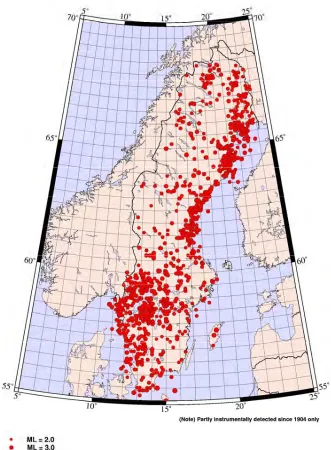
a country of low seismicity further reduces the risk. Figure 1 shows all known historical earthquakes in Sweden of
magnitude over 2.
As a result of the work carried out in the late 80’s with the probabilistic characterisation of seismic ground
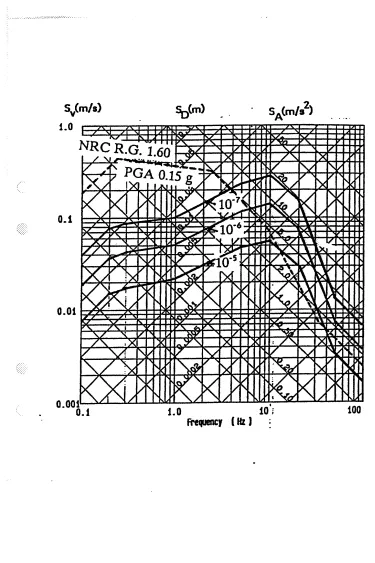
motions, uniform hazard ground response spectra for various exceedance frequencies (E-5, E-6. E-7) were outlined
[1]. The intention was to provide a basis for a systematic risk analysis covering various combinations of load
probabilities and conditional probabilities of failure and damage, if required.
It was found that the seismic risk was mainly governed by earthquakes with hypocentral distances less than
30 km.
In Figure 2 the response spectrum according to Reg. Guide 1.60 is compared to ref. [1] envelope ground
response spectra.
THE CAV-CONCEPT, OBE-EXCEEDANCE
The criteria of NRC Reg. Guide 1.166 [2] aim at defining an earthquake which empirically is not dangerous
to industrial plants. MMI VI was chosen as a measure of such an earthquake and it was found that the so called
CAV-value (Cumulative Absolute Velocity) was best suited in correlating observed damage and measured ground
motion.
CAV is calculated by:
CAV
=
∫
a(t)dt
where a(t) = time history of ground acceleration.
NRC have issued a Regulatory Guide, 1.166; “Pre-Earthquake Planning and Immediate Nuclear Power
Plant Operator Post-earthquake Actions“, March 1997. To characterize a certain earthquake it requires both a
response spectrum check and a check of the CAV-value.
The spectrum check involves a check of maximum spectral acceleration in the frequency range 2-10 Hz,
and a check of maximum spectral velocity in the frequency range 1-2 Hz; in both cases a damping value of 5% is
assumed.
If the spectral acceleration exceeds the OBE-spectrum values, 1/3 of the SSE-spectrum values or 0.2 g,
whichever is greater or if the spectral velocity exceeds the OBE-spectrum values, 1/3 of the SSE-spectrum values or
6 inches per second (0.15 m/s), whichever is greater and at the same time the calculated CAV-value exceeds 0.16
gsec, it shall be assumed that OBE was exceeded and act accordingly.
CAV BASED ON SKI 92:3 E-5 ENVELOPE SPECTRUM
The criteria are simple to apply and to get a perspective on the Swedish earthquake, spectra and time
histories according to SKI TR 92:3 [1] have been studied. The spectra which specify the 10-5/yr-level do exceed 0.2
g at frequencies above 7 Hz. However, the spectral velocity at frequencies < 2 Hz is only about 0.03 m/s and
furthermore the calculated CAV-value falls below 0.16 gsec. According to these criteria an E5-earthquake
consequently has a damage potential corresponding to MMI ≤ VI. MMI VI is the intensity at which slight damage
begins to appear in poorly built buildings implying that the risk of damage to a nuclear plant from an E5-earthquake
can be considered very low even if the plant has been built without any consideration given to seismic loads. An
earthquake of this intensity would not require reactor shutdown.
CAV FOR WESTERN UNITED STATES SEISMIC LOADINGS VERSUS SWEDISH LOADING
As part of this pilot study an integrated ground motion measure, CAV, damage potentials have been
compared for a "Swedish" and a "Western United States" earthquake according to SKI TR 92:3 and Reg. Guide 1.60
respectively, see ref. [3]. These earthquakes are very different in frequency content. It is found that the "Swedish"
earthquake needs to be increased by a factor of 2 - 4 to get the same damage potential (= equal CAV-value) as the
"Western United States" event. The result indicates that the Swedish E5-earthquake with a PGA-value of 0.11g is
comparable to a Reg. Guide 1.60-earthquake with a PGA-value of about 0.03g-0.05g, which is considered to be
low/non-damaging by most seismic experts. (PGA = Peak Ground Acceleration.) The significant parameter
controlling this relation is the expected longer time of duration for the American loadings.
THE RELATION BETWEEN CAV AND PGA FOR "TYPICAL" SWEDISH BEDROCK
Theoretical studies of the relation between CAV and PGA for "typical" Swedish bedrock have been carried
out. For a given earthquake PGA increases faster than CAV the closer the epicenter we get. This is natural since
PGA is a measure of a single maximum while CAV is a more integrated measure of the ground motion and the
energy distribution in time increases with distance during the travel of the seismic wave through the inhomogeneous
Earth. Since risk estimates, especially those based on PGA, are dominated by near-field events and since it seems
obvious that CAV is a better measure of damage risk, it follows that risk estimates based on PGA will exaggerate
the seismic risk for Swedish nuclear plants.
The numerical simulations are relatively few and the study should be regarded as preliminary. A number of
parameters can be changed in the model including depth, size and orientation of the earthquake and the structure of
the Earth. Adjustments of these parameters would of course change the calculated PGA- and CAV-values. Using
reasonable parameter values for Swedish conditions the model shows that at a distance of 20 km a PGA-value of 0.1
PGA-value of 0.11 g corresponds to a CAV-value of 0.13 gsec. Compared to published data from USA this implies
a risk picture with a relatively low CAV in relation to PGA, a conclusion fully in compliance with the judgement
that larger, more distant earthquakes are more important for risk in USA than in Sweden.
CONCLUSIONS
Using the parameter CAV it is found that the damage potential of the Swedish E5-earthquake corresponds
to intensity VI of the modified Mercalli scale. Thus the risk of damage to well-built a nuclear plant from an
E5-earthquake can consequently be considered very low even if it has been built without any consideration given to
seismic loads. The only known components where uncertainty remains are some relays of older type which have
proved to be relatively acceleration sensitive when tested, especially in "undrawn" condition, and if they are
important to safety they need a closer study (or need to be exchanged).
Summing up we arrive at a picture indicating that earthquake events do not constitute any significant risk
for Swedish nuclear plants. The benefit of resources spent on reducing seismic risk will therefore be very ineffective
from a cost point of view, which should be taken into account when formulating seismic requirements. Similar
observations evidently have been made in other countries, the following quotation from [4] is one example: "In
general, concerning the re-evaluation methodologies, when mean probabilities of exceedance at the 10-4/a level are less than 0.1g peak ground acceleration, considerations should be given to developing reduced scope Seismic
Margin Assessment procedures. The existing procedures which were developed on a site specific basis for moderate
— 0.12–0.33g peak ground acceleration sites may not be appropriate or cost benefit effective for such low seismicity
sites and new approaches should be developed for a realistic, but safe, analysis of the protection against external
events."
In conclusion, the results of the pilot study can motivate significant changes of presently applied
requirements and criteria with regard to seismic risk in Sweden.
REFERENCES
[1] SKi Technical Report 92:3, Characterization of seismic ground motions for probabilistic safety
analyses of nuclear facilities in Sweden. April 1992
[2] U.S. Nuclear Regulatory Commission, Regulatory Guide 1.166, Pre-earthquake planning and
immediate nuclear power plant operator post-earthquake actions. March 1997
[3] DNV, Report No.15297300-1 Rev. 2, Estimation of CAV for the Swedish seismic loading E-5,
2004-10-07, Olof Björndahl
[4] IAEA-TECDOC 1341, Extreme external events in the design and assessment of nuclear power plants.
March 2003