Performance Analysisof Random Interleaver
for OFDM-IDMA Systemusing AWGN and
Rayleigh Fading Channel
Kapil Dev
1, S. K. Sriwas
2, J. P. Saini
3and M. Shukla
4P. G. Student, Department of Electronics and Communication Engineering, B.I.E.T. Jhansi, UP, India1 Assistant Professor, Department of Electronics and Communication Engineering, B. I. E. T. Jhansi, UP, India2
Professor, Department of Electronics and Communication Engineering, B. I. E. T. Jhansi, UP, India3 Professor,Department of Electronics and Communication Engineering, H. B. T. I. Kanpur, UP, India4
ABSTRACT: This paper provides a review on the orthogonal frequency division multiplexing (OFDM) and interleave division multiple access (IDMA) by using AWGN and Rayleigh fading channel. OFDM-IDMA is a composite communication system. This system has been receiving significant research attention due to their capability to address the problem like inter symbol interference (ISI) and multiple access interference (MAI). In various fourth generation wireless communication system this method most widely used. An efficient random based interleaver is present which is simple and could produce orthogonal interleavers for generating user specific chip level inteleaver for different user.
KEYWORDS: IDMA, OFDM-IDMA, Random Interleaver, ISI, MAI
I. INTRODUCTION
Multiple access technique is one of the key techniques which are used in the wireless communication system, mostly in the mobile communication system. Generally multiple access techniques such as FDMA/TDMA/CDMA are suitable for voice communication only and unsuitable for high data rate transmission which is used in 1G/2G/3G systems. Performance of CDMA system is limited by multiple access interference and inters symbol interference (ISI). [1] Interleave division multiple access(IDMA) most widely used in recent year which can be treated as a special case of code division multiple access (CDMA)[2] Which has much consideration for multiple access communication. It is distinct from CDMA, where Orthogonal or Quasi-Orthogonal signature sequences are used in code domain for user separation. IDMA used for different interlever to obtain the exact function. Since, user specific interleavers can be generated in simple way for a larger number. The limited number of user specific signal sequence can be bypass which is limitation of CDMA and this exhibit the advantage of IDMA over CDMA.
Orthogonal frequency division multiplexing (OFDM)-interleave division multiple access IDMA is a multicarrier system which is used in new and developing broadband wireless communication systems. The word orthogonal implies that there is a literal relationship between frequencies of the carrier in the system. The idea of composite communication scheme combining OFDM-IDMA has many profits like the analysis of inter symbol interference (ISI) and sufficient reduction of multiple access interference.
High peak to average power ration (PAPR) is drawback with OFDM-IDMA system. The high PAPR of OFDM-IDMA indicates that if the signal is not to be distorted most of the element in the transmitter and receiver must have a greatest dynamic range. In individual the output amplifier of the transmitter must be very linear over a large range of signals. OFDM-IDMA is precise to frequency offset. Local oscillation and carrier of the received signal can reduced the system performance.
Section II outlines the OFDM-IDMA system model. In section III describe the different communication channel.Section IV indicate that the comparison of bit error rateof AWGN channel and Rayleigh fading channel and Section V gives the final conclusion.
II. OFDM-IDMA SYSTEM MODEL
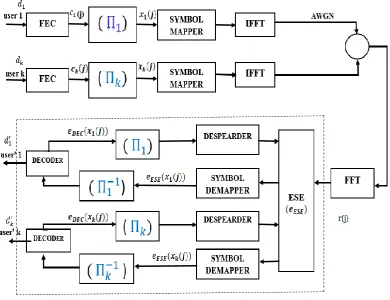
Users are analzed by distinct chip-level interleaving in the OFDM-IDMA system and CDMA is analzed by distinct signatures. In place of distinct signatures it is used distinct chip-level interleaving in OFDM-IDMA system. Chip-by-chip iterative multiuser detection technique is the main advantage of the OFDM-IDMA system [4]. Multi User Detection (MUD) in IDMA systems become very simple because the complexity of MUD become linear function of the number of users. Compared with the CDMA system, IDMA have very simple MUD algorithm [5]. IDMA can be used to reducing MAI and lSI at lesser complexity. Each user has data in either coded or spreaded form thencoded and spreader data are interleaved. All the data are add up because all the data of every user is transmitted at the same time. In the transmission channel an Additive White Gaussian Noise (AWGN) and other multipath channel coefficients added in transmitted data. After this data is reached at mobile station (MS) or every user.
Figure (1) OFDM-IDMA System Model
The upper parts of Figure (1) indicate the transmitter section of an OFDM-IDMA system with k simultaneous users. User k has input data sequence dk which is encoded with the help of a low-rate code Ck. There are different types of
FEC (Forward Error Correction) codes given as binary symmetric codes, convolutional codes, block codes, turbo codes, and so on. In this paper we usedconvolutional codes. The function of convolutional encoder(k/n) is encodes thek input bits into n coded output bits. Chip-levelinterleaver𝜋𝑘is used for interleaved the coded sequence. We get X (k) = [X1(j), X2(j), X3(j) ... Xk(j)] asper the meeting, we call the elements in Xk "chips". The basic principle of IDMA
system is interleaverthat requiredto bedistinct for distinct users. It is consider that the interleavers [6] are generated independentlyand randomly. Interleavers are used for circulate the coded sequences so that the neighbouring chips are approximatelyuncorrelated andan N point IFFTis used to modulate the sequence on to sub carriers. After filtering the chip, the signal received from k users can be expressed as
𝑟 𝑗 = 𝑘𝑘=1ℎ𝑘𝑥𝑘 𝑗 + 𝑛 𝑗 𝑗 = 1,2,3, … … . . 𝐽 (1)
The channel coefficient (hk) for user-k related withn (j).Wheren (j) are samples of anAWGN(Additive White Gaussian
Noise) with variance(𝜎2=𝑁0
2 ).We consider that thehk (channelcoefficient) is known a priori at the receiver section. The received signal is goes through orthogonal frequency division multiplexing (OFDM) demodulation system. Demodulationsystem consists of removal of cyclic prefix and FFT.
Both noise and interference associated with the received signal. The receivers are used to detach the user's data from noise andinterference [5]. It is used to divides the work into two section. In First section weisolate the user’s data from others data with the help of ESE block. Another section is used to decode the data nose will be reduced with the help of convolutional decoder block. Both these blocks are used to exchange extrinsicinformation. The summed data is decoded by ESE using the CBCalgorithm [5] proposed by Li ping et al.
III. COMMUNICATION CHANNEL
To transmit the information signal, from transmitter to receiver a channel is used. In wireless communication to transmit the signal a channel is required. Channel can be divided into fast and slow fading channel. In fast fading channel the impulse response is changed while in slow fading channel impulse response is unchanged for several symbols. This paper focus on the BER analysis of AWGN and Rayleigh fading channel.
A. AWGN
Channel play important role for any type of communication system. Noise is one of the factors which affect the performance of communication channel. There are so many factors whichcause the AWGN like fluctuation of atom in conductor, emission from earth, shot noise and other sunny object and from ethereal sources such as sun. There are different types of communication channel. One of the simplest models of channel is AWGN channel and it is convenient for wired communication. It is LTI(linear time invariant). White Gaussian noise compute to the signal when signal goes through it. Characteristic of this channel is amplitude frequency response and phase response is flat and linear for all frequency [7] respectively. It does not exist fading but only distortions occur when modulated signal passes through it.
Received signal can be written as,
r (t) = x(t) + n(t) (2)
Where, n (t) indicate the noise which has variance as the noise power and Gaussian distribution with zero mean.
x (t) indicate the transmitted signal
B. Rayleigh fading channel
The received signal R (n) can be expressed as
𝑅 𝑛 = ℎ 𝑛, 𝜏 𝑠 𝑛 − 𝑚 + 𝑤(𝑛) (3)
Where w (n) represent AWGN noise with zero mean and unit variance and h (n) indicate channel impulse response.
Channel response can be written as
ℎ 𝑛 = 𝛼(𝑛)𝑒−𝑗𝜃 (𝑛) (4)
Whereθ(n) and α(n) are phase shift and attenuation for nth path.
Magnitude of sum of two identical independent orthogonal Gaussian random variable is Rayleigh distribution and PDF (probability density function) given by
𝑃 𝑧 = 𝑧
𝜎2𝑒 𝑧2
2𝜎 2 z≥0 (5)
Where 𝜎2 represent the time average power of the received signal and equation (5) represents the Rayleigh random variable.
IV. BIT ERROR RATE
It is the ratio ofnumber of bits with error to the total number of bits that have been transmitted over a given time period that is
𝐵𝐸𝑅 =𝑛𝑢𝑚𝑏𝑒𝑟 𝑜𝑓 𝑏𝑖𝑡𝑠 𝑤𝑖𝑡 ℎ 𝑒𝑟𝑟𝑜𝑟
𝑡𝑜𝑡𝑎𝑙 𝑛𝑢𝑚𝑏𝑒𝑟 𝑜𝑓 𝑏𝑖𝑡𝑠 𝑠𝑒𝑛𝑡 (6)
It is a key parameter which is estimate the performance of a system along with transmitter, receiver and channel.
BER for BPSK in AWGN channel is given as
𝑃𝑏 = 1
2𝑒𝑟𝑓𝑐(
𝐸𝑏
𝑁0 ) (7)
Where Eb/N0 = bit energy to noise ratio
BER for BPSK in Rayleigh fading channel [9] is given as
𝑃𝑏 = 1 2[1 −
𝐸𝑏 𝑁 0 𝐸𝑏 𝑁 0+1
] (8)
Where Eb/N0 = bit energy to noise ratio
Figure (2). BER performance of random interleaver with OFDM-IDMA for user 16, 32, 48 and 64.
Figure (3) indicate the BER performance of OFDM-IDMA system in Rayleigh fading channel and AWGN channel with TBI. At the time of simulation, the bit energy to noise (Eb/N0) is taken in dB, for simulation we consider the data
length is 128 bits with 15 iteration count along with 16 spread length. Simulation indicates the AWGN channel give the better BER than Rayleigh fading channel.
V. CONCLUSION
In this paper comparison between AWGN channel and Rayleigh fading channel of random interleaver have been done on the basis of parameter like bit error rate(BER). It is conclude that bit error rate of AWGN channel and Rayleigh fading channel distressed by so many aspect like high PAPR, sensitivity of CFO and number of user. In this paper, we consider OFDM-IDMA with random interleaver and conclude that it give the better performance when number of user is less.
REFERENCES
[1]Ramjee Prasad and Tero O Janepera, “A survey on CDMA: A Evolution towards Wideband CDMA” in proc. of IEEE, 1998
[2] T. S. Rappaport Et AL., Wireless Communication: Principalesand Practice. Prentice Hall Ptr New Jersey, Vol. 2.
[3] Muyiwa B. Balogun, Olutayo O. Oyerinde and Stanley H. Mneny, “Performance analysis of the OFDM- IDMA system with carrier Frequency Offeset in a Fast Fading Multipath Channel,” in proc. 3rd Int. Conf. of wireless Commun., Vechicular Technology, Information Theory and Aerospace and Electronics systems, pp. 1-5, Jun.2013.
[4] L. Liu, W. Leung, and L. Ping, “Simple Itertive Chip-By-Chip Multiuser Detection for CDMA System,” In Vehicular Technology Conference, 2003. Vtc 2003-Spring. The 57th IEEE Semiannual, Vol. 3. IEEE 2003,pp. 2157-2161.
[5] L. Ping, L. Liu, K. Wu, And W. K. Leung, “Interleave division multiple access,” Wireless Communications, IEEE Transaction on, Vol. 5, No.4,pp. 938-947, 2006.
[6] I. Pupeza, A. Kavcic, and L. Ping, “Efficient Generation Of Interleavers For Idma,” In Communications, 2006. Icc 06. IEEE International Conference On, Vol. 4. IEEE, 2006, pp. 1508-1513
[7] Van de Beek, J. Edfors, O. Sandell, M. Wilson, SK. Borjeson and P.O., “On channel estimation in OFDM systems”, In proceedings of 45th IEEE Vehicular Technology Conference, vol.-2, Issue 7, pp. 815-819, 1995.
[8] NavjotKaur and Lavish Kansal, “Performance Comparison of MIMO Systems over AWGN and Rician Channels using OSTBC4 with Zero Forcing Receivers,” International Journal of Engineering & Computer Science IJECS-IJENS Vol:13, No: 02.