Determination of Adsorption Isotherms and
Kinetic Parameters for Biosorption of Cu (II)
on Raw Pine Needles: An Experimental Study
D.S. Malik1, C.K. Jain2, Anuj K. Yadav1* Richa Kothari3 Vinayak V. Pathak1,3
Department of Zoology and Environmental Sciences, Gurukula Kangri Vishwavidyalaya, Haridwar (U.K.), India1
Environmental Hydrology Division, National Institute of Hydrology, Roorkee (U.K.), India2
School of Environmental Sciences, Babasaheb Bhimrao Ambedkar University, Lucknow, (U.P.), India3
ABSTRACT: An experimental study was performed to investigate the potential of raw Chir pine needles (Pinus roxburghii) for biosorption of Cu(II) from its aqueous solutions. Biosorption was carried out under varying pH, contact time, biosorbent doses, and initial metal concentrations to achieve optimal condition for metal uptake. Biosorption of metal at equilibrium was tested by Langmuir and Freundlich adsorption isotherms. Both isotherms showed significant R2 value, though Langmuir isotherm was found most significant (R2=0.96). The maximum biosorption capacity (qmax)
of P. roxburghii was 4.03 mg/g at pH 6.5, while the constant b at the same pH was 0.298 Lmg-1. The value of separation coefficient also favours the adsorption process which ranges between 0.869-0.250 with initial metal ion range of 0.5 to 10 mg/L. The constants obtained with Friendluich isotherm, Kf (0.88) and n (1.10) also favours the
biosorption process. Parameters of kinetic studies suggest pseudo second order kinetic as a most favourable model for present biosorption process with R2=0.99. Functional groups such as hydroxyl (OH), amine (NH), carboxylic (COO), aromatic (CH), amide (NH) and carbonyl (CO), obtained in FTIR confirm the presence of potential ligands in raw pine needles, FTIR studies indicated the presence of functional groups like on the surface of biosorbent.
KEYWORDS: Biosorbent; isotherm; kinetic study; FTIR; ligands I. INTRODUCTION
Elevated concentration of metallic substance in aquatic environment poses threat to the life of aquatic organisms. Higher concentrations of all metals are toxic for living organisms. Due to their higher solubility nature, these are considered toxic for living forms. Metals persist in living organisms’ body at low concentrations. Toxic metals (Cu, Cr, Pb, Cd, Hg, As, Ni) are used by humans for quite long times in industries like electroplating, battery manufacturing, plastic, paint, textile and tannery industries [1]. The respective concentration of metal depends on the industrial operation and nature of wastewater treatment processes, such as most of the industries discharge effluents only after conventional treatment, which produces effluent congaing metal concentration beyond the discharge limits. WHO, the permissible level of Cu(II) in drinking water is 2 mg/L and for wastewater and industrial effluents is 3 mg/L [2]. Hence, the removal of metal bearing effluents is necessary before the discharge into environment. Copper is essential element for human life but its excessive concentration can cause irritation, organ dysfunction (kidney and liver) and gastrointestinal disturbance. Many conventional methods have been developed for the removal of heavy metals from water and wastewater like osmosis, membrane process, ion-exchange, chemical precipitation, flotation and adsorption. Despite of high removal efficiency, most of these processes are economically unviable and energy intensive. Therefore a low cost and efficient method to remove Cu (II) has been always become the focus of researchers.
,leaf powder corn cobs [6], tree fern [7], Wheat shell [8], papaya wood [9-10], coffee waste [11], mushroom biomass [12], cactus fibers [13], okra biomass [14], ground nut husk [15].
Despite of detailed exploration of plant derived biosorbent only few researchers have focused Chir Pine needles as a biosorbent for metal removal. Chir pine (Pinus roxburghii) are found abundantly in Himalayan range from 500-2500 m which extends from countries India, Pakistan, Nepal, Bhutan and Afghanistan. Pine needles are high susceptible for forest fire which damages forest flora and fauna. As forest waste, pine needles can be used as adsorbent for heavy metal removal from water and wastewater. Thus, the present study deals with the application of pine needle for Cu(II) metal ion removal from aqueous solutions. We studied adsorption of Cu(II) onto pine needle by varying pH, initial concentration, adsorbent dosage and contact time on uptake of metal were also studied . The study also involves isotherm and kinetic study to understand the mechanism and nature of bisorption. On the other hand surface feature of pine needle responsible for metal uptake is observed through FTIR analysis.
II. RELATED WORK
Pine cone biomass tested for the uptake of methylene blue dye in aqueous solutions [16]. The maximum monolayer adsorption capacity of pine cone biomass was 109.89 mg/g at 30 oC. Dod et al. [17] used green pea peels (Pisum sativum) for methylene blue dye removal from wastewater. They studied the adsorption affecting parameter like initial dye concentration, pH, contact time, adsorption dosage, agitation speed, particle size and temperature. The maximum adsorption capacity was found upto 163.94 mg in 7h contact time at 30 oC. Imperata cylindrical (cogon grass), common weed, was utilized ad adsorbent for the removal of methylene blue [18]. They found that adsorption dosage and ph affected the adsorption process. The maximum colour removal was found to be 99.09 % at shaking speed of 100 rpm, pH 9, 40 min contact time and adsorption dosage of 1.0 g. Ghosh et al. [19] assessed the potential of tobacco stem ash as an adsorbent for uptake of methylene blue dye from aqueous media. The maximum adsorption was 35.7 mg/g. The dimensionless separation factor (RL) was found to be 0.137, which supported the MB dye removal from
wastewater.
III. MATERIAL AND METHODS Preparation of Adsorbent
Pine needles were collected from Garhi Cantt, Dehradun, India and then washed with several times with double distilled water. After that material grinded into powder and sieved 75-150 mesh size. The sieved material again washed with double distilled water to remove dirt and colour. Then, material again dried in oven (105oC) and packed in air tight plastic container.
Adsorbent solution
The chemicals used in experiment were analytical grade. The stock solution of Copper (II) was prepared by dissolving 3.929 g of copper sulphate (CuSO4.7H2O) in 1 litre triple distilled water. The required concentrations (1-10 mg/L) were
prepared by further dilutions.
Instrumentation
A ELICO SL 160 model atomic spectrophotometer was used to determine the copper concentrations in solution. Fourier transform infrared spectroscopy (FTIR) spectra of before and after adsorption were recorded using KBr pellets on Shimadzu-8400S model over 400-4000 cm-1.The surface structural modification of adsorbent was visualized by SEM (JSM- JEOL, Japan).
Adsorption studies
Adsorption of Cu(II) metal ions on raw pine needles was performed in batch mode sorption equilibrium experiments with series of Erlenmeyer flasks of 250 mL capacity. 0.1 g of pine needle adsorbent was placed in 250 mL conical flasks containing 100 mL of Cu(II) solution of desired concentration. The flasks were shaken in digital shaken at 110 rpm. After the equilibrium time flasks were taken out and samples were analyzed by AAS.
The percentage of Cu(II) removal was calculated by formula as:
Where, Co and Ce are the liquid-phase dye concentration at initial stage and equilibrium stage respectively.
The amount of Cu(II) adsorbed per unit mass was computed by using equation as:
q = × ……….(2)
Where, qe (mg/g) is the equilibrium amount of copper metal ions adsorbed per unit mass of pine needle, V(L) is the
volume of solution and W(g) is the mass of adsorbent.
Study of isotherms
Isotherms describes the interaction between the biosorbent and biosorbate and determine the maximum biosorption capacity. The Langmuir and Freundlich models are commonly used to describe biosorption process. The Langmuir [20] isotherm describes monolayer coverage of the biosorbate on the surface of biosorbent. The Langmuir isotherm, non-linear form is shown as:
qe=QobCe/1+beCe ……….(3)
The linear form of Langmuir isotherm equation can be represented as:
1/qe=1/Qo+1/bQoCe ………(4)
Where qe is the amount of adsorbent on the fiber at equilibrium (mg/g), Ce (mg/L) and b (L/mg) are the monolayer
biosorption capacity, respectively. The values of Qo and b were calculated from the slope and intercept of the plot. The dimentionless equilibrium parameter (RL) is used to describe whether the Langmuir biosorption process is favourable
or not, which can be represented as:
RL=1/1+bCo ……….(5)
Where Co is the initial concentration of the biosorbate (mg/L). For favourable condition RL value should be (0< RL<1),
unfavourable (RL>1), linear (RL=1) and irreversible (RL=0). On the other hand, Freundlich model describes
hetrogenous surfaces, general form of Freundlich can be expressed as:
qe=KFCe1/n ………..(6)
The logarithmic (linear) form of the Fruendlich equation can be written as:
ln qe=lnKF+1/n lnCe ……….(7)
Where qe is the amount of metal biosorbed per unit weight of biosorbate (mg/g), Ce is the equilibrium liquid phase
concentration (mg/L, KF is the Freundlich constant (mg/g) and 1/n is the hetrogenicity factor. The values of KF and n
(Table 1.) were obtained from the slope and intercept of a plot of log qe vs log Ce.
Biosorption kinetics
Biosorption kinetic models are used to describe the biosorption mechanism and affecting parameters in the biosorption process [21]. Pseudo first order and pseudo second order kinetic model were used to test the experimental data. The Lagergren pseudo-first order equation can be represented as:
Log qe(qe-qt)=log qe- . ………(8)
Where k1 is the rate constant of pseudo-first order biosorption and qe and qt express the amount metal biosorbed at time
= + ………(9)
Where qe and qt are amount of metal ion biosorbed (mg/g) at equilibrium at time t respectively. K2 (g/mg min) is the
rate constant of pseudo-second order biosorption.
IV. RESULT AND DISCUSSION FTIR analysis before and after biosorption of Cu(II)
The functional groups that are found on the surface of pine needle biosorbent are responsible for chemical reactivity at the surface. FTIR spectra analyzed on biosorbent raw and Cu(II) loaded biomass by use of KBr and pine needle adsorbent (Fig 1 and 2). There were displacements of IR bands found between raw and treated samples for Cu biosorption. A characteristic peak at 576.68 cm-1 was due to C-Cl stretching, and peak at 651 cm-1 indicates the stretching of NH group and CH bending. The peak present at 754.12 cm-1 indicates aromatic CH bending. The peaks at 1350.08 cm-1 and 1330.79 cm-1 were due to –CH and –CN stretching. The peaks at 1542.95 cm-1 and 1591.16 cm-1 were attributed to stretching vibration of –NO2 and C=C groups. The bands observed at 3205.47 cm-1 was assigned to
aliphatic NO2 stretching. The peaks at 3072.39 cm-1 corresponds to –CH stretching, and peaks at 3419.95 cm-1
and3265.25 cm-1 indicating presence of -OH group. The results indicated that the functional groups OH, NH, COO and CO were mainly involved in the biosorption of Cu(II).
Fig.1 FTIR spectra of Pine needles adsorbent before adsorption
Effect of pH
The biosorption process was influenced by pH of the system; it affects the functional group properties on the adsorbate surface [22]. Fig. 3 shows the influence of pH on Cu(II) sorption by pine needles. It was evident from the figure that sorption was ph dependent and maximum sorption occurs at ph 6.5. The percentage of Cu(II) ion removal increased from 80% to 99% with an increase of pH from 4.0 to 6.5 and thereafter removal decreased from 99% to 73.05% with an increase of pH from 7 to 10. Cellulose, hemicelluloses and lignin are common materials in plant cell wall. Cellulose hemicelluloses and lignin have hydrophobic and aromatic properties which are binding sites for metal uptake [23-24]. The adsorption capacity decreased at lower pH value was due to the higher concentration of H3O
+
ions present in the aqueous solution, which compete with the Cu(II) ions for the adsorption sites of pine needles [25]. At higher pH value, H3O+ ions are become available in solution resulting in a higher sequestration of metal
ions.
Fig. 3 Effect of pH on adsorption of Cu(II) ions onto Pine needle adsorbent (Conditions: Concentration =5 ppm, Doses= 1.0 g/L, Temperature 25oC, pH =6.5, volume= 100 mL, contact time 350 min)
Effect of initial metal concentration
The effect of Cu(II) concentration on the sorption by pine needle sorbent was investigated by varying the Cu(II) from 1-10 mg/L at pH 6.5 (Fig.4). Copper metal uptake increases rapidly as concentration increase from 1 to 2.5 mg/L but become slow in the later stage until equilibrium condition obtained. The equilibrium time for copper adsorption on pine needle at different adsorbent concentration was found to be 30 min.
Fig.4 Effect of adsorbent dosage and contact time (Conditions:, Doses= 1.0 g/L, Temperature 25oC, pH =6.5, volume= 100 mL, contact time 350 min)
2.5 6.86 20.7 80.7 88.6493.54 98.83 89.25 85.76 73.05 0 10 20 30 40 50 60 70 80 90 100
0 1 2 3 4 5 6 7 8 9 10 11
% R e m o va l pH % Removal
Dose - 1.0 g/L Conc.- 5 ppm
51.16 62.53
85.43 87.23 89.01 92.34
0 10 20 30 40 50 60 70 80 90 100
0 1 2 3 4 5 6 7 8 9 10
% R e m o va l
Metal Concentration (mg/l)
Dose - 1.0 g/L Conc.- 5
Effect of adsorbent doses
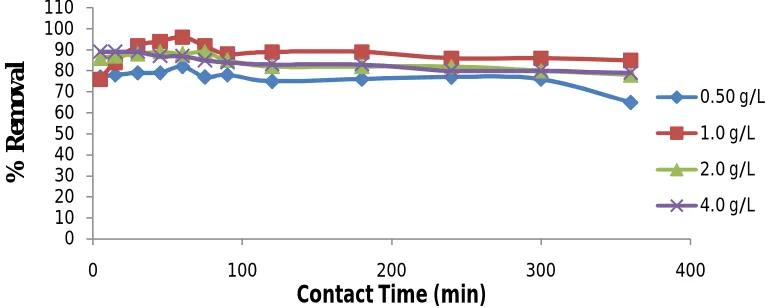
Effect of adsorbent dosage on adsorption of copper was studied by changing the biosorbent dosage from 0.50 to 4 g/L using 5 mg/L of the Cu(II) ion solutions (Fig. 5). The maximum removal was found at 1 mg/L.
Fig. 5 Effect of adsorbent dosage on adsorption of Cu(II) ions onto Pine needle adsorbent (Conditions: Concentration =5 ppm, Temperature 25oC, pH =6.5, volume= 100 mL, contact time 350 min) Biosorption mechanism
We used two biosorption isotherm to describe the biosorption mechanism, which were fitted in the present study by the widely used Langmuir and Freundlich isotherms. Fig. 6 shows the Langmuir isotherm and Fig 7 shows the Freundlich isotherm for Cu(II) uptake on pine needle sorbents. Table 1 shows the maximum biosorption capacity (qmax), bonding
energy constant (b) and correlation coefficient (R2) were 4.03 mg/g, 0.298 L/mg and 0.9 for Langmuir isotherm. The Freundlich constant (KF), n and correlation coefficient (R2) were found to be 0.88, 1.10 and 0.95. The value of n found
between 0 to 10 indicates a favourable biosorption by the pine needle biosorbent for Cu(II) uptake. Langmuir isotherm(R2=0.96) describes the Cu(II) uptake better than Freundlich isotherm (R2=0.95). The parameter, RL,
dimensionless parameter or separation factor, represent the shape of isotherm and nature of sorption process [21]. The values of RL for Cu(II) were calculated and plotted on the bases of different initial metal concentrations. In this work,
the calculated RL values ranged from 0.869-0.250 with initial metal ion range of 0.5 to 10 mg/L (Table 2), which
suggests that favourable adsorption of Cu(II) onto the pine needle adsorbent, under the test conditions.
Fig.6 &7 Langmiur plot of Ce/qe vs Ce and Freundlich plot for Cu metal uptake by pine needle
0 10 20 30 40 50 60 70 80 90 100 110
0 100 200 300 400
%
R
em
oval
Contact Time (min)
0.50 g/L
1.0 g/L
2.0 g/L
4.0 g/L
y = 0.834x + 0.248 R² = 0.966
0 0.5 1 1.5 2 2.5 3 3.5 4 4.5
0 2 4 6
1
/C
e
1/qe
y = 0.908x - 0.053 R² = 0.955
-0.8 -0.6 -0.4 -0.2 0 0.2 0.4 0.6 0.8
-1 -0.5 0 0.5 1
Lo
g
Ce
Table 1 Equilibrium model parameters for the removal of Cu(II) onto pine needle
Langmuir constant Freundlich constant
qmax(mg/g) B (L/mg) R2 n KF(mg/g) R2
4.03 0.298 0.96 1.10 0.88 0.95
Table 2 Value of separation parameter (RL), based on the Langmuir isotherm equation
Initial Cu(II) concentration (mg/L) RL value
0.5 0.869
1.0 0.769
2.5 0.571
5.0 0.400
7.5 0.307
10 0.250
Biosorption kinetics
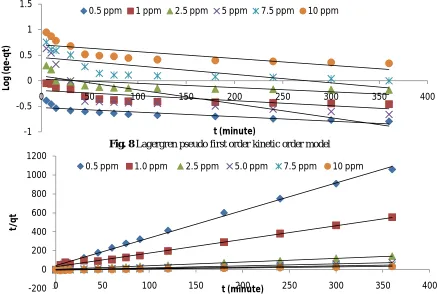
The study of biosorption kinetics reveals the solute uptake rate, mechanism of biosorption that controls the biosorption process. For this, Pseudo-first order and pseudo-second order kinetic models were tested with the experimental data. The plot of Log (qe-qt) vs t and t/qt vs t were shown in Fig. 8 and 9. A plot of Pseudo first-order and pseudo second-order (eq. 8 and eq. 9) gave straight lines with good correlation values. Pseudo second second-order correlation was found higher (R2=0.99) than Pseudo second order (R2=0.75).Table 3 shows the pseudo first order and pseudo second order kinetic parameters. The values of qe obtained in pseudo second order model were in better agreement with the
adsorption data than those obtained in pseudo-first order model.
Fig. 8 Lagergren pseudo first order kinetic order model
Fig. 9. Ho’s pseudo second order kinetic model
-1 -0.5 0 0.5 1 1.5
0 50 100 150 200 250 300 350 400
Lo
g
(q
e
-q
t)
t (minute)
0.5 ppm 1 ppm 2.5 ppm 5 ppm 7.5 ppm 10 ppm
-200 0 200 400 600 800 1000 1200
0 50 100 150 200 250 300 350 400
t/
q
t
t (minute)
Table 3 Pseudo-first order and pseudo-second order kinetic parameter for adsorption of Cu(II) metal ion
Concentration (mg/L)
qe exp
(mg/g)
Pseudo first order kinetics Pseudo-second order kinetic
qe(cal)
mg/g
K1(/
minute)
R2 qe (cal) mg/g K2(g/mg/
min
R2
0.5 0.34 0.298745 0.002073 0.75 0.343773 8.459081 0.99 1.0 0.96 0.645803 0.002303 0.58 0.692617 2.084558 0.99 2.5 1.84 1.085176 0.018424 0.4 2.581978 0.150001 0.99 5.0 4.978 1.251699 0.003685 0.52 4.86618 0.04223 0.99 7.5 6.1 2.856933 0.003685 0.55 7.147963 0.019572 0.99 10.0 7.8 5.066406 0.002994 0.58 9.149131 0.011946 0.97
Comparison of Pine needles with other adsorbents
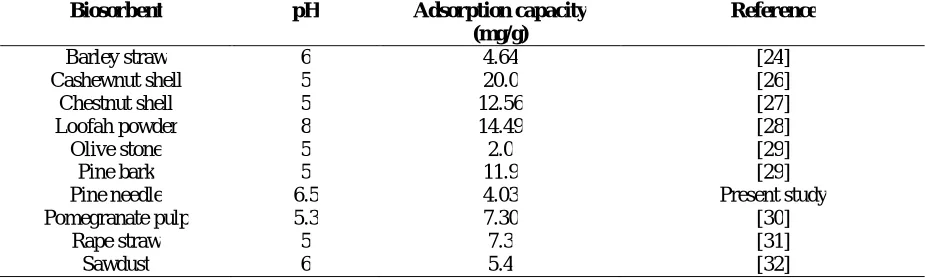
In the present study, the Cu(II) metal ion efficiencies were obtained from Langmuir isotherm (qe) of different adsorbents were represented in Table 4. It was found from Table that pine needle adsorbent capacity was higher with some other adsorbents.
Table 4 Comparison of biosorption capacities of various biosorbents for removal of Cu(II) metal ion Biosorbent pH Adsorption capacity
(mg/g)
Reference
Barley straw 6 4.64 [24]
Cashewnut shell 5 20.0 [26]
Chestnut shell 5 12.56 [27]
Loofah powder 8 14.49 [28]
Olive stone 5 2.0 [29]
Pine bark 5 11.9 [29]
Pine needle 6.5 4.03 Present study
Pomegranate pulp 5.3 7.30 [30]
Rape straw 5 7.3 [31]
Sawdust 6 5.4 [32]
V. CONCLUSION
The leaves of Pinus roxburghii, a forest waste, can be used as effective biosorbent for the removal of Cu(II) metal ions from aqueous solutions. The biosorption of metal was found to be dependent on contact time, pH, biosorbent doses and initial metal concentrations. It was observed that an increase in the amount sorbed Cu(II) as increase in initial metal concentrations, and the equilibrium conditions were almost achieved after 30-60 min contact time. The highest metal uptake was found to be 4.03 mg/g at 6.5 pH. The equilibrium data of Cu(II) sorption was fitted well with both Langmuir and Freundlich isotherms. Pseudo second order kinetic model was fitted well than pseudo first order kinetic model. Infra-red spectroscopy revealed that various functional groups present on surface of biosorbent interact with Cu(II) binding on pine needle such as hydroxyl (OH), amine (NH), carboxylic (COO) aromatic (CH), amide (NH) and carbonyl (CO). Thus, it can be concluded that the forest waste biomass can be used as biosorbent to remove metals from water and wastewater.
ACKNOWLEDGEMENTS
REFERENCES
[1] Ang XW, Sethu VS, Andresen JM, Sivakumar M “Copper(II) ion removal from aqueous solutions using biosorption technology:thermodynamic and SEM-EDX studies”. Clean Techn Environ Policy 15:401-407
[2] Rao RAK, Khan U “Adsorption studies of Cu(II) on boston fern (Nephrolepis exaltata) Schtt. CV. Bostoniensis) leaves”. Appl Water Sci DOI. 10.1007/s13201-016-0386-3 (2016)
[3] Zare H, Heydarzade H, Rahimnejad M, Tardast A, Seeffi M, Peghambarzadeh SM Dried activated sludge as an appropriate biosorbent for removal of copper(II) ions”. Arabian Journal of Chemistry Vol. 8, pp 858-864 (2015)
[4] Zouboulis AI, Matis KA, Loukidou M, Šebesta F “Metal biosorption by PAN-immobilized fungal biomass in simulated wastewater”. Colloids Suf. Vol. A 212, pp 185-195 (2003) DOI: 10.1016/S0927-7757(02)00304-7
[5] Sun G, Shi W “Sunflower stalks as adsorbents for the removal of metal ions from wastewater”. Ind Eng Chem Res Vol. 37, pp 1324-1328 (1998) [6] Vaughan T, Seo CW, Marshall WE “Removal of selected metal ions from aqueous solution using modified corn cobs”. Bioresour Technol Vol. 78, pp
133-139 (2011)
[7] Ho YS, Chiv WT, Hsu CS, Huang CT “Sorption of lead ions from aqueous solution using tree fern as a sorbent”. Hydrometallurgy Vol. 73, pp 55-61 (2004)
[8] Basci N, Kocadagistan E, Kocadagistan B “Biosorption of copper(II) from aqueous solutions by wheat shell”. Desalination Vol. 165, pp 135 (2004) [9] Saeed A, Akhter MW, Iqbal M “Removal and recovery of heavy metals from aqueous solution using papaya seed as a raw biosorbent” . Sep Purif Technol
Vol. 45, pp 25-31 (2005)
[10] Hanafiah MAK, Ngah WSW, Zakaria H, Ibrahim SC “Batch study of liquid phase adsorption of lead ions using Lalang (Imperata cylindrical) leaf powder” . J Biol Sci Vol 7, pp 222-230 (2007)
[11] Oliveira WE, Franca AS, Oliveira LS, Rocha SD “Untreated coffee husks as biosorbents for the removal of heavy metals from aqueous solution”. J Hazard Mater Vol. 152, pp 1073 (2008)
[12] Ertugay N, Bayhan YK “The removal of copper(II) ions by using mushroom biomass (Agaricus bisporus) and kinetic modelling”. Desalination Vol 255, pp 137-142 (2010)
[13] Hadjittofi L, Prodromou M, Pashalidis I “Activated biochar derived from cactus fibers-Preparation, characterization and application on Cu(II) removal from aqueous solutions” . Bioresour Technol Vol. 159, pp 460-464 (2014)
[14] Singha AS, Guleria A “Utility of chemically modified agricultural waste okra biomass for removal of toxic heavy metal ions from aqueous solution”. Engineering in Agriculture, Environment and Food Vol. 8, No. 1, pp 52-60 (2015)
[15] Ahmad R, Haseeb S “Adsorptive removal of Pb2+, Cu2+ and Ni2+ from aqueous solution by using groundnut husk modified with Guar Gum (GG), kinetic and thermodynamic studies”. Groundwater for Sustainable Development Vol. 1 No. 1-2. Pp 41-49 (2015)
[16] Sen TK, Afroze S, Ang HM “Equilibrium, kinetics and mechanism of removal of methylene blue from aqueous solution by adsorption onto pine cone biomass of Pinus radiate. Water Air Soil Pollut Vol No. 218, pp- 499-515 (2011)
[17] Dod R, Banerjee G, Saini S “Adsorption of methylene blue using green pea peels (Pisum sativum): A cost –effective option for dye based wastewater treatment. Biotechnology and Bioprocesses Engineering Vol No. 17, pp-862-874 (2012)
[18] Su X-H C, Teng TT, Alkarkhi AFM, Low LW “Imperata cylindrical (cogon grass) as an adsorbent for methylene blue dye removal: Process optimization . Water Air Soil Pollut, Volume No. 225, pp- 1941
[19] Gosh RK, Reddy DD “Tobacco stem as an adsorbent for removal of methylene blue from aqueous solution: Equilibrium, kinetics and mechanism of adsorption. Water Air soil Pollut, Vol No. 224, pp- 1582
[20] Langmuir, I. “The constitution and fundamental properties of solids and liquids”. , J. Am. Chem. Soc., Vol. 38, No 11,pp 2221-2295 (1916) [21] Jain CK, Malik DS, Yadav AK “Applicability of plant based biosorbents in the removal of heavy metal: a review”. Environ Process. (2016)
[22] Li H, Guo Q, Dai P, Zhang J, Zhang C, Bao N “Preparation and characterization of activated carbon from stalk with guanidine phosphate activation:Sorption of Cd(II)”. Journal of Applied Pyrolysis Vol No, 102, pp 7-15 (2013)
[23] Pehlivan E, Altun T, Cetin S, Bhanger MI “Lead sorption by waste biomass of hazelnut and almond shell” . J Hazard Mater Vol 169, pp 1203-1208 (2009)
[24] Pehlivan E, Altun T, Parlayici S “Utilization of barley straws as biosorbents for Cu2+ and Pb2+ ions”. J Hazard Mater Vol. 164, pp 982–986 (2009) [25] Kipcak I, Isryel TG “Magnesite tailing as low cost adsorbent for the removal of copper(II) ions from aqueous solution:. Korean J Chem Eng Vol 32, No 8,
pp 1634-1641 (2015)
[25] Jayaram K, Prasad MNV “Removal of Pb(II) from aqueous solution by seed powder of Prosopis juliflora DC”. J Hazard Mater Vol 169, pp 991-997 (2009)
[26] Senthilkumar P, Ramalingam S, Sathyaselvabola V, Kirupa SD, Sivanesan S “Removal of copper(II) ions from aqueous solution by adsorption using cashew nut shell”. Desalination Vol. 266, No 1-3, pp 63-71 (2011)
[27] Yao ZY, Qi JH, Wand LH “Equilibrium, kinetic and thermodynamic studies on the biosorption of Cu(II) onto chestnut shell”. J Hazard Mater Vol. 174 , No 1-3, pp 137-143 (2010)
[28] Tang X, Zhang Q, Liu Z, Pan K, Dong Y and Li Y (2014) Removal of Cu(II) by loofah fibers as a natural and low-cost adsorbent from aqueous solutions. Journal of Molecular Liquids 191:73-78
[29] Blazquez G, Martin-Lara MA, Dionisio-Ruiz E, Tenaria G, Calero M “Evaluation and comparison of the biosorption process of copper ions onto olive stone and pine bark”. J Indi Eng Chem Vol 17, pp 824-833 (2011)
[30] Güzel F, Aksoy Ӧ, Akkaya G “Evaluation of pomegranate (Punica granatum L) pulp for the removal of copper(II) ions: Kinetic, equilibrioum, and desorption studies”. Journal of Dispersion Science and Technology Vol. 35, No 4, pp 482-493 (2014)
[31] Wang J, Chen T, Li S, Yue Z, Jin J, He G, Zhang H “Biosorption of copper(II) from aqueous solutions with rape straw”. Geomicrobiology Journal Vol. 29, pp 250-254 (2012)