Volume 2007, Article ID 56382,17pages doi:10.1155/2007/56382
Research Article
A New Method to Represent Speech Signals Via Predefined
Signature and Envelope Sequences
¨
Umit G ¨uz,1, 2Hakan G ¨urkan,1and Binboga Sıddık Yarman3, 4
1Department of Electronics Engineering, Engineering Faculty, Is¸ık University, Kumbaba Mevkii, S¸ile, 34980 Istanbul, Turkey 2SRI-International, Speech Technology and Research (STAR) Laboratory, 333 Ravenswood Avenue, Menlo Park, CA 94025, USA 3Department of Electrical-Electronics Engineering, College of Engineering, Istanbul University, Avcılar, 34230 Istanbul, Turkey 4Department of Physical Electronics, Graduate School of Science and Technology, Tokyo Institute of Technology,
(Ookayama Campus) 2-12-1 Ookayama, Meguro-ku, Tokyo 152-8552, Japan Received 3 June 2005; Revised 28 March 2006; Accepted 30 April 2006
Recommended by Kostas Berberidis
A novel systematic procedure referred to as “SYMPES” to model speech signals is introduced. The structure of SYMPES is based on the creation of the so-called predefined “signatureS= {SR(n)}and envelopeE= {EK(n)}” sets. These sets are speaker and language independent. Once the speech signals are divided into frames with selected lengths, then each frame sequenceXi(n) is reconstructed by means of the mathematical formXi(n)=CiEK(n)SR(n). In this representation,Ciis called the gain factor,SR(n) andEK(n) are properly assigned from the predefined signature and envelope sets, respectively. Examples are given to exhibit the implementation of SYMPES. It is shown that for the same compression ratio or better, SYMPES yields considerably better speech quality over the commercially available coders such as G.726 (ADPCM) at 16 kbps and voice excited LPC-10E (FS1015) at 2.4 kbps.
Copyright © 2007 ¨Umit G¨uz et al. This is an open access article distributed under the Creative Commons Attribution License, which permits unrestricted use, distribution, and reproduction in any medium, provided the original work is properly cited.
1. INTRODUCTION
Transmission and storage of speech signals are widespread in modern communications systems. The field of speech rep-resentation or compression is dedicated to finding new and more efficient ways to reduce transmission bandwidth or storage area while maintaining high quality of hearing [1].
In the past, a number of new algorithms based on the use of numerical, mathematical, statistical, and heuristic methodologies were proposed in order to represent, code, or compress the speech signals. For example, in the con-struction of speech signals, linear predictive coding (LPC) techniques such as LPC-10E (FS1015) utilize low bit rates at 2.4 kbps with acceptable hearing quality. Pulse code modula-tion (PCM) techniques such as G.726 (ADPCM) yield much better hearing quality over LPC-10E but demand higher bit rates of 32 or 16 kbps [1–3].
In our previous work [4–7], efficient methods to model
speech signals with low bit rates and acceptable hearing qual-ity were introduced. In these methods, one would first exam-ine the signals in terms of their physical features, and then find some specific waveforms to best describe the signals, called signature functions. Signature functions of speech
introduced in [15–17]. In this paper however, results of [15–
17] are considerably enhanced by creating almost complete PSS and PES for different languages utilizing the Phonetics Handbookprepared by the International Phonetics Associa-tion (IPA) [18].
2. THE PROPOSED METHOD
It would be appropriate to extract the statistical features of the speech signals over a reasonable length of time. For the sake of practicality, we present the new technique on the dis-crete time domain since all the recordings are made with dig-ital equipment. LetX(n) be the discrete time domain repre-sentation of a recorded speech piece withNsamples.
Let this piece be analyzed frame by frame. In this rep-resentation, Xi(n) denotes a selected frame as shown in
Figure 1. Then, the following main statement and the re-lated definitions are proposed which constitute the basis of the new modeling technique.
2.1. Main statement
Referring to Figure 1, for any time frame i, the sampled speech signal which is given by the vectorXiof lengthLFcan be approximated as
Xi∼=CiEKSR, (1)
where
(i) Ciis a real constant and it is called the gain factor, (ii)K, R, NE, and NS are integers such that K ∈
{1, 2,. . .,NE},R∈ {1, 2,. . .,NS},
(iii) the signature vectorSTR =[sR1 sR2 . . . sRLF] is
gener-ated utilizing the statistical behavior of the speech sig-nals and the termCiSRcontains almost full energy ofXi in the LMS sense,
(iv)EKis (LFbyLF) diagonal matrix such that
EK=
⎡ ⎢ ⎢ ⎢ ⎢ ⎢ ⎢ ⎣
eK1 0 0 . . . 0
0 eK2 0 . . . 0
0 0 eK3 . . . 0
..
. ... ... . .. ...
0 0 0 . . . eKLF
⎤ ⎥ ⎥ ⎥ ⎥ ⎥ ⎥ ⎦ (2)
and acts as an envelope term on the quantity CiSR which also reflects the statistical properties of the speech signal under consideration,
(v) the integerLFdesignates the total number of samples in theith frame.
Now, let us verify the main statement.
2.2. Verification of the main statement
The sampled speech signal sequencex(n) can be written as
x(n)=
N
i=1
xiδi(n−i). (3)
In (3), δi(n) represents the unit sample; xi designates the measured value of the sequencex(n) at theith sample.x(n) can also be expressed in vector form as
XT = x(1) x(2) . . . x(N)= x
1 x2 . . . xN
. (4)
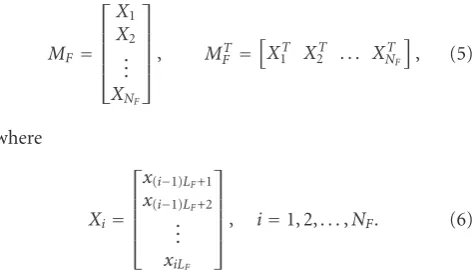
In this representation, X is called the main frame vector (MFV) and it may be divided into frames with equal lengths, having, for example, 16, 24, 32, 64, or 128 samples and so forth. In this case, MFV which is also designated byMF is obtained by means of the frame vectors{X1,X2,. . .,XNF}
MF=
⎡ ⎢ ⎢ ⎢ ⎢ ⎣ X1 X2 .. .
XNF
⎤ ⎥ ⎥ ⎥ ⎥
⎦, M T
F = X1T X2T . . . XNTF
, (5)
where
Xi=
⎡ ⎢ ⎢ ⎢ ⎢ ⎣
x(i−1)LF+1
x(i−1)LF+2
.. .
xiLF
⎤ ⎥ ⎥ ⎥ ⎥
⎦, i=1, 2,. . .,NF. (6)
NF =N/LFdenotes the total number of frames inX. Obvi-ously, integersNandLFmust be selected in such a way that NFalso becomes an integer.
As it is given by [7], each frame sequence or vectorXi can be spanned in a vector space formed by the orthonormal vectors1{φ
ik}such that
Xi=
LF
k=1
ckφik, k=1, 2,. . .,LF, (7)
where the frame coefficientsckare obtained as
ck=φTikXi, k=1, 2,. . .,LF (8)
and{φik}are generated as the eigenvectors of the frame cor-relation matrixRi
Ri=E
XiXiT = ⎡ ⎢ ⎢ ⎢ ⎢ ⎢ ⎢ ⎣
ri(1) ri(2) ri(3) . . . ri
LF
ri(2) ri(1) ri(2) . . . ri
LF−1
ri(3) ri(2) ri(1) . . . ri(LF−2)
.. . ... ... . .. ... ri LF ri
LF−1
ri
LF−2
. . . ri(1) ⎤ ⎥ ⎥ ⎥ ⎥ ⎥ ⎥ ⎦ (9)
constructed with the entries;
ri(d+ 1)= 1
LF
[i·LF−d]
j=[(i−1)·LF+1]
xjxj+d, d=0, 1, 2,. . .,LF−1.
(10)
1It is noted that orthonormal vectorφ
X
(
n
)
Frame 1 Frame 2 Frame 3 Framei FrameNF
1 2 3 LF12 3 LF123 LF 12 3 LF
n
Xi
Figure1: Segmentation of speech signals frame by frame.
In (9)E[·] designates the expected value of a random vari-able. Obviously,Riis real, symmetric, positive semidefinite, and Toeplitz which in turn yields real, distinct, and nonneg-ative eigenvalues λik satisfying the relationRiφik = λikφik. Let the eigenvalues be sorted in descending order such that (λi1≥λi2≥λi3≥ · · · ≥λiLF) with corresponding
eigenvec-tors{φik}. Then, the total energy of the frameiis given by
XT
i Xi:
XiTXi= LF
k=1 x2
ik= LF
k=1 c2
ik. (11a)
In the mean time, the expected value of this energy is ex-pressed as
E
L
F
k=1
c2 ik
=
LF
k=1 φT
ikE
XiXiT
φik= LF
k=1 φT
ikRiφik= LF
k=1 λik.
(11b)
In (11), contributions of the higher order terms become negligible, perhaps after p terms. In this case, (7) may be truncated. The simplest form of (7) is obtained by setting
p=1.
As an example, let us consider a randomly selected 16 se-quential voice frames formed withLF =16 samples. In this case, one would end up with 16 distinct positive-real eigen-values in descending order for each frame. If one plots all the eigenvalues on a frame basis then,Figure 2follows. This figure shows that the eigenvalues become drastically smaller after the first one. Moreover, if one varies the frame length
LFas a parameter to further reduce the effect of the second-and higher-order terms then, almost full energy of the signal frame is captured within the first term of (7). Hence,
Xi∼=c1φi1. (12)
That is whyφi1is called the signature vector since it contains most of the useful information of the original speech frame under consideration. Once (12) is obtained, it can be con-verted to an equality by means of an envelope termEiwhich is a diagonal matrix for each frame. Thus,Xiis computed as
Xi=CiEiφi1. (13)
10 8 6 4 2 0 2
4 6
8 10
12 14
16 1 3 5 7
9 11 13 15
E
igen
value
amplitude
Eigen values
(desc ending
order) i. fram e
Figure2: Plot of the 16 distinct eigenvalues in a descending order for 16 adjacent speech frames.
In (13), diagonal entrieseirof the matrixEiare determined in terms of the entries ofφT
i1 =[φi11 · · · φi1r · · · φi1LF]
andXT
i =[xi1 · · · xir · · · xiLF] by simple division.
eir= xir
Ciφi1r
, r=1, 2,. . .,LF
. (14)
In essence, the quantities eir of (14) somewhat absorb the remaining energy of the terms eliminated by truncation pro-cess of (7). This approach constitutes the basis of the new speech modeling technique as follows.
In this research, several tens of thousands of speech pieces were investigated frame by frame and several thousands of “signature and envelope sequences” were generated. It was observed that patterns obtained by plotting the envelope
0.4 0.3 0.2 0.1 0 0.1 0.2 0.3 0.4
1 2 3 4 5 6 7 8 9 10 11 12 13 14 15 16 Sample [n]
A
m
plitude
(a)
0.4 0.3 0.2 0.1 0 0.1 0.2 0.3 0.4
1 2 3 4 5 6 7 8 9 10 11 12 13 14 15 16 Sample [n]
A
m
plitude
(b) 0.4
0.3 0.2 0.1 0 0.1 0.2 0.3 0.4
1 2 3 4 5 6 7 8 9 10 11 12 13 14 15 16 Sample [n]
A
m
plitude
(c)
0.4 0.3 0.2 0.1 0 0.1 0.2 0.3 0.4
1 2 3 4 5 6 7 8 9 10 11 12 13 14 15 16 Sample [n]
A
m
plitude
(d)
Figure3: Some selected eigenvectors which exhibit similar patterns (LF=16).
constructed with one of a kind, or unique patterns. All the above groundwork leads one to propose “a novel systematic procedure to model speech signals by means of PSS and PES.” In short, the new numerical procedure is called “SYMPES” and it is outlined in the following section.
2.3. A novel systematic procedure to model speech signals via predefined envelope and signature sets: SYMPES
SYMPES is a systematic procedure to model speech signals in four major steps described as follows.
Step 1. Selection of speech pieces to create signature and en-velope sequences.
(i) For a selected frame lengthLF, investigate variety of speech pieces frame by frame which describe the ma-jor characteristics of speakers and languages to
deter-mine signature and envelope sequences. This step may result in hundreds of thousand of signature and enve-lope sequences for different languages. However, these sequences exhibit too many similar patterns subject to elimination.
Step 2. Elimination of similar patterns.
(i) Eliminate the similar patterns of signature and en-velope sequences to end up with unique shapes. Then, form the PSS and PES utilizing the unique patterns.
Step 3. Reconstruction of speech frame by frame.
(i) Once PSS and PES are formed, one is ready to syn-thesize a given speech pieceX(n) of lengthNframe by frame. In this case, divideX(n) into frames of length
25 20 15 10 5 0 5 10 15 20 25
1 2 3 4 5 6 7 8 9 10 11 12 13 14 15 16 Sample [n]
A
m
plitude
(a)
25 20 15 10 5 0 5 10 15 20 25
1 2 3 4 5 6 7 8 9 10 11 12 13 14 15 16 Sample [n]
A
m
plitude
(b)
25 20 15 10 5 0 5 10 15 20 25
1 2 3 4 5 6 7 8 9 10 11 12 13 14 15 16 Sample [n]
A
m
plitude
(c)
25 20 15 10 5 0 5 10 15 20 25
1 2 3 4 5 6 7 8 9 10 11 12 13 14 15 16 Sample [n]
A
m
plitude
(d)
Figure4: Some selected envelope vectors which exhibit similar patterns (LF=16).
pullingEKfrom PES andSRfrom PSS to minimize the frame error defined byεi(n)=Xi(n)−CiEKSR, in the LMS sense.
(ii) Eventually, sequencesXAi are collected under the approximated main frame vector
MAF=
⎡ ⎢ ⎢ ⎢ ⎢ ⎣
XA1 XA2 .. .
XANF
⎤ ⎥ ⎥ ⎥ ⎥
⎦ to reconstruct the speech as
XA(n)=
XA1,XA2,. . .,XANF;NF=N/NLF
≈X(n).
(15)
Step 4. Elimination of the background noise due to the re-construction process by using a moving average post-filter.
(i) At the end of the third step, the reconstructed sig-nal may contain unexpected spikes in merging process
of the speech frames in sequential order. These spikes may cause unexpected background noise which may be classified as the musical noise. It was experienced that the musical noise can significantly be reduced by means of a moving average post-filter. In this regard, one may utilize a simple moving average finite impulse response filter. Nevertheless, an optimum filter can be selected by trial and error depending on the environ-mental noise, and the operational conditions.
sample selection to generate PSS and PES are introduced in
Section 4. Computational details to construct PSS and PES are presented by Algorithm 1. The numerical aspects of the speech reconstruction process are given by Algorithm 2.
2.4. Elimination of similar patterns
One of the useful tools to measure the similarities between two sequences is known as the Pearson correlation coefficient (PCC). PCC is designated byρYZand given as [19]
ρYZ
=
L i=1
yizi
− L i=1yi
L i=1zi
L
L i=1y2i−
L i=1yi
2
L Li=1z2i− L
i=1zi 2
L
.
(16)
In the above formula Y = [y1 y2 . . . yL] and Z =
[z1 z2 . . . zL] are two sequences subject to comparison.
Clearly, (16) indicates thatρYZis always between−1 and +1. ρYZ=1 indicates that two vectors are identical.ρYZ=0 cor-responds to completely uncorrelated vectors. On the other hand,ρYZ = −1 refers to perfectly opposite pair of vectors (i.e.,Y = −Z). For the sake of practicality, it is assumed that the two sequences are almost identical if 0.9≤ρYZ≤1. Hence, similar patterns of signature and envelope sequences are eliminated accordingly. Thus, the signature vectors which have unique patterns are combined under the set called pre-defined signature set PSS= {Sns(n); ns=1, 2,. . .,NS}. The
integerNSdesignates the total number of elements in this set. Similarly, reduced envelope sequences are combined under the set called predefined envelope set PES= {Ene(n); ne =
1, 2,. . .,NE}. The integerNEdesignates the total number of unique envelope sequences in PES. At this point, it should be noted that members of PSS are not orthogonal. They are just the unique patterns of the first eigenvectors of various speech frames obtained from thousands of different experiments. In Figures5and6, some selected one of a kind signature and velope sequences are plotted point by point against their en-try indices resulting in the signature and envelope patterns, respectively.
All of the above explanations endorse the phrasing of the main statement that any speech frameXican be modeled in terms of the gain factorCi, predefined signatureSR, and en-velopeEK terms asXi ≈ CiEKSR. In the following section, algorithms are summarized to generate PSS and PES.
3. GENERATION OF PSS AND PES AND THE RECONSTRUCTION PROCESS OF SPEECH
The heart of the newly proposed method to model speech signals is based on the generation of the PSS and PES. There-fore, in this section first an algorithm is outlined to construct PSS and PES (Algorithm 1) then, synthesis or reconstruction process of speech signals is detailed (Algorithm 2).
3.1. Algorithm 1: generation of the predefined signature and envelope sets
Inputs
(i) Main frame sequence of the speech piece{X(n),n =
1, 2,. . .,N}.
Herewith, sample speech pieces given by the IPA Handbook were utilized [18]. This handbook in-cludes phonetics properties (vowels, consonants, tones, stress, conventions, etc.) of many different lan-guages used by both genders.
(ii) LF: total number of samples in each frame under con-sideration.
In this work, different values of LF (such as LF = 8, 16, 32, 64, 128) were selected to investigate the effect of the frame length to the quality of the reconstructed speech by means of the absolute category rating-mean opinion score (ACR-MOS) and the segmental signal-to-noise ratio (SNRseg). Details of this effort are given in the subsequent section.
Computational steps
Step 1. Compute the total number of framesNF=N/LF. Step 2. Divide the speech pieceXinto framesXi. In this case, the original speech is represented by the main frame vector
MT
F = X1T X2T · · · XNTFof (5).
Step 3. For each frameXi, compute the correlation matrixRi.
Step 4. For eachRi, compute the eigenvaluesλikin descend-ing order with the corresponddescend-ing eigenvectors.
Step 5a.Store the eigenvector which is associated with the maximum eigenvalue λir = max{λi1,λi2,λi3,. . .,λiLF} and
simply refer to this signature vector with the frame index, asSi1.
Step 5b.Compute the gain factorCi1in the LMS sense to ap-proximateXi≈Ci1Si1.
Step 6. Repeat Step 5 for all the frames (i = 1, 2,. . .,NF). At the end of this loop, eigenvectors, which have maximum energy for each frame, will be collected.
Step 7. Compare all the collected eigenvectors obtained in Step 6 with an efficient algorithm. In this regard, Pear-son correlation formula may be employed as described in
Section 2.4. Then, eliminate the ones which exhibit similar patterns. Thus, generate the predefined signature set PSS =
{Sns(n); ns = 1, 2,. . .,NS}with reduced number of
eigen-vectorsSi1. Here,NS designates the total number of one of a kind signature patterns after the elimination. Remark: the above steps can be repeated for many different speech pieces to augment PSS.
0.4
0.2
0
0 10 20
(a)
0.5
0
0.5
0 10 20
(b)
0.5
0
0.5
0 10 20
(c)
0.5
0
0.5
0 10 20
(d)
0.4
0.3
0.2
0 10 20
(e)
0.5
0
0.5
0 10 20
(f)
0.5
0
0.5
0 10 20
(g)
0.5
0
0.5
0 10 20
(h)
0.4
0.3
0.2
0 10 20
(i)
0.5
0
0.5
0 10 20
(j)
0.5
0
0.5
0 10 20
(k)
0.5
0
0.5
0 10 20
(l)
0.4
0.3
0.2
0 10 20
(m)
0.4
0.2
0
0 10 20
(n)
0.4
0.3
0.2
0 10 20
(o)
0.5
0
0.5
0 10 20
(p)
Figure5: Unique patterns of some selected signature sequences (LF=16).
Step 9. Eliminate the envelope sequences which exhibit sim-ilar patterns with an efficient algorithm as in Step 7, and construct the predefined envelope set PES = {Ene(n); ne =
1, 2,. . .,NE}; Here,NEdenotes the total number of one of a kind unique envelope patterns.
Once PSS and PES are generated, then any speech sig-nal can be reconstructed frame by frame (XAi=CiEKSR) as implied by the main statement. It can be clearly seen that in this approach, the frame iis reconstructed with three ma-jor quantities, namely, the gain factorCi, the indexRof the predefined signature vectorSRpulled from PSS, and the in-dexK of the predefined envelope sequenceEK pulled from PES.SRandEK are determined to minimize the LMS error which is described by means of the difference between the original frame pieceXiand its modelXAi=CiEKSR. Details of the reconstruction process are given in the following algo-rithm.
3.2. Algorithm 2: reconstruction of speech signals
Inputs
(i) Speech signal{X(n),n=1, 2,. . .,N}to be modeled. (ii) LF: number of samples in each frame.
(iii) NSandNE; total number of the elements in PSS and in PES, respectively. These integers are determined by Step 7 and Step 9 of Algorithm 1, respectively. (iv) The predefined signature set PSS= {SR;R =1, 2,. . .,
NS}created utilizing Algorithm 1.
(v) The predefined envelope set PES= {EK;K=1, 2,. . ., NE}created utilizing Algorithm 1.
Computational steps
Step 1. DivideXinto framesXiof lengthLFas in Algorithm 1. In this case, the original speech is represented by the main frame vectorMT
5
0
5
0 10 20
(a)
1.5
1
0.5
0 10 20
(b)
2
1
0
0 10 20
(c)
2
1
0
0 10 20
(d)
2
1
0
0 10 20
(e)
2
1
0
0 10 20
(f)
2
1
0
0 10 20
(g)
1.5
1
0.5
0 10 20
(h)
4
2
0
0 10 20
(i)
5
0
5
0 10 20
(j)
4
2
0
0 10 20
(k)
2
1
0
0 10 20
(l)
2
1
0
0 10 20
(m)
1.5
1
0.5
0 10 20
(n)
1.5
1
0.5
0 10 20
(o)
5
0
5
0 10 20
(p)
Figure6: Unique patterns of some selected envelope sequences (LF=16).
Step 2a.For each frameipull an appropriate signature vector
SR from PSS such that the distance or the total errorδR = Xi−CRSR 2 is minimum for all R = 1, 2,. . .,R,. . .,NS. This step yields the index R of the SR. In this case,δR = min{ Xi−CRSR 2} = Xi−CRSR 2.
Step 2b.Store the index numberRthat refers toSR, in this case,Xi≈CRSR.
Step 3a.Pull an appropriate envelope sequence (or diagonal envelope matrix) EK from PES such that the error is fur-ther minimized for allK =1, 2,. . .,K,. . .,NE. Thus,δK = min{ Xi−CREKSR 2} = Xi−CREKSR 2. This step yields the indexKof theEK.
Step 3b.Store the index numberKthat refers toEK. It should be noted that at the end of this step, the best signature vector
SRand the best envelope sequenceEKare found by appropri-ate selections. Hence, the frameXiis best described in terms of the patterns ofEKandSR. That is,Xi≈CREKSR.
Step 4. Having fixedEKandSR, one can replaceCRby com-puting a new gain factorCi =(EKSR)TXi/(EKSR)T(EKSR) to further minimize the distance between the vectors Xi and CREKSR in the LMS sense. In this case, the global mini-mum of the error is obtained and it is given by δGlobal = Xi−CiEKSR 2. At this step, the frame sequence is approxi-mated byXAi=CiEKSR.
Step 5. Repeat the above steps for each frame to reconstruct speech asMT
AF = XA1T XA2T . . . XANT F ≈M
T F.
to exhibit the usage of Algorithms 1 and 2 and the resulting speech quality are compared with the results of commercially available speech coding techniques G.726, LPC-10E, and also with our previous work [7].
4. INITIAL RESULTS ON THE IMPLEMENTATION OF THE NEW METHOD OF SPEECH
REPRESENTATION
In this section, the speech reconstruction quality of the new method is compared with those of G.726 at 16 kbps and LPC-10E at 2.4 kbps providing (1 to 4) and (1 to 26.67) compres-sion ratio, respectively. In this regard, the comprescompres-sion ratio (CR) is defined as CR =borg/brec; whereborgdesignates the total number of bits in representing the original signal and
brecis the total number of bits which refers to the compressed version of the original. Finally, SYMPES is compared with the speech modeling technique presented in [7].
4.1. Comparison with G.726 (ADPCM) at 16 kbps
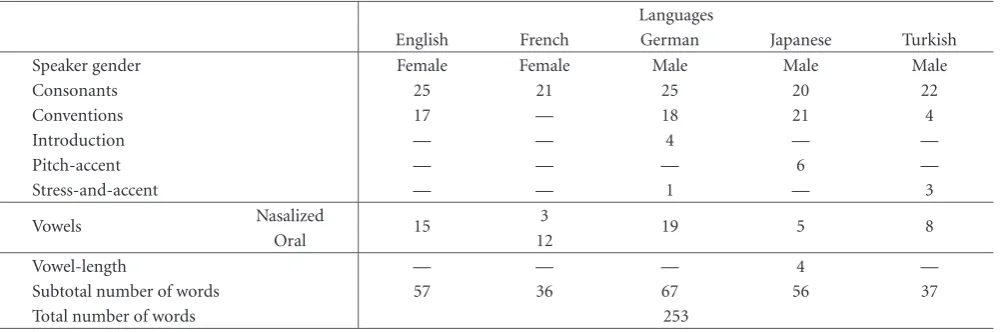
In order to make a fair comparison between G.726 at 16 kbps and the newly proposed technique, the input parameters of Algorithm 1 are arranged in such a way that Algorithm 2 of the reconstruction process yields CR = 4. In this case, one only needs to measure the speech quality of the reconstructed signals as described below. In this regard, the speech pieces, which were given by the IPA Handbook and sampled with 8 KHz sampling rate were utilized to generate PSS and PES withLF=16 samples. In the generation process, all the avail-able characteristic sentences (total of 253) from five different languages (English, French, German, Japanese, and Turkish) were employed. These sentences include consonants, conven-tions, introduction, pitch-accent, stress and accent, vowels (nasalized and oral), and vowel-length. Details are given in
Table 1.
In this case, employing Algorithm 1, PSS was constructed with NS = 2048 unique signature patterns. Similarly, PES was generated withNE = 57422 unique envelopes. As de-scribed in Section 2.4and step 7 of Algorithm 1, Pearson’s similarity measure of (16) with 0.9 ≤ ρYZ ≤ 1 was used in the elimination process. As a result of the above compu-tations, NS andNEare represented with 11 and 16 bits, re-spectively. It was experienced that 5 bits were good enough to code theCi. In conclusion, one ends up with a total num-ber of NBF = 5 + 11 + 16 = 32 bits to reconstruct the speech signals for each frame employing the newly proposed method. On the other hand, the original signal, coded with standard PCM (8 bits, 8 KHz sampling rate) is represented by
NB(PCM)=8×16=128 bits. Hence, both G.726 at 16 kbps and the new method provide CR =4 as desired. Under the given conditions, it is meaningful to compare the average ACR-MOS and the SNRseg, obtained for both G.726 and the new method. In the following section, ACR-MOS and SNRseg test results are presented.
It should be remarked that ideally one would expect to construct the universal predefined signature and envelope sets which are capable of producing all the existing sounds of languages. In this case, one may question the speech
reproduction capability of PSS and PES derived using 253 different sound phrases mentioned above. Actually, we tried to enhance PSS and PES employing the other languages avail-able in IPA. However, under the same elimination process implemented in Algorithm 1, we were not able to further in-crease the number of signature and the envelope patterns. Therefore, 253 sound phrases are good enough for the speech reproduction process of SYMPES. As a matter of fact, as it is shown by the following examples, the hearing quality of the new method (MOS ≈ 4.1) is much better than G.726 MOS≤3.5). Hence, we confidently state that PSS and PES obtained forLF =16 provide good quality of speech repro-duction.
4.1.1. MOS and SNR assessment results:
new method SYMPES versus G.726
In this section, mean opinion score and segmental signal-to-noise ratio results of SYMPES are presented and they are compared with those of G.726.
Mean opinion score tests: once PSS and PES are gener-ated, the subjective test process contains three stages; collec-tion of original speech samples, speech modeling or struction, and the hearing quality evaluation of the recon-structed speech.
The original speech samples were collected from OGI, TIMIT, and IPA corpus databases [18,21–23]. In this regard, we had the freedom to work with five languages namely; En-glish, French, German, Japanese, and Turkish. Furthermore, for each language, we picked 24 different sentences or phrases which were uttered by 12 male and 12 female speakers. At this point, it is important to mention that PSS and PES should be universal (speaker and language independent) for any sound to be synthesized. Therefore, for the sake of fairness, we were careful not to use the same speech samples which were uti-lized in the construction PSS and PES. In the second stage of the tests, one has to model the selected speech samples us-ing Algorithm 2. In the last stage, reconstructed speech pieces for both the new method and G.726 are evaluated by means of the subjective (ACR-MOS) and the objective (SNRseg) speech quality assessment techniques [24,25].
Table1: Language-based speech property distribution of the complete sample set provided by IPA utilized to form PSS and PES forLF=16.
Languages
English French German Japanese Turkish
Speaker gender Female Female Male Male Male
Consonants 25 21 25 20 22
Conventions 17 — 18 21 4
Introduction — — 4 — —
Pitch-accent — — — 6 —
Stress-and-accent — — 1 — 3
Vowels Nasalized 15 3 19 5 8
Oral 12
Vowel-length — — — 4 —
Subtotal number of words 57 36 67 56 37
Total number of words 253
In order to assess the objective quality of the recon-structed speech signals, the SNRseg is utilized. Here, in this work, each segment is described over 10 frames of length
LF =16 or equivalently each segment consists ofKF =160 samples. Then, SNRseg is given by
SNRseg= 1 TF
TF−1
j=0 10 log10
mj
n=mj−KF+1
x(n)2 mj
n=mj−KF+1
x(n)−x(n)2
.
(17)
LetN be the total number of samples in the speech piece to be reconstructed. Then, in (17) TF = N/KF; j desig-nates the frame index; nis the sample number in frame j;
m0 = KF;mj = jKF. It should be noted that the indices m0,m1,. . .,mTF−1refer to the “end points” of each segment
placed in the speech piece to be reconstructed.
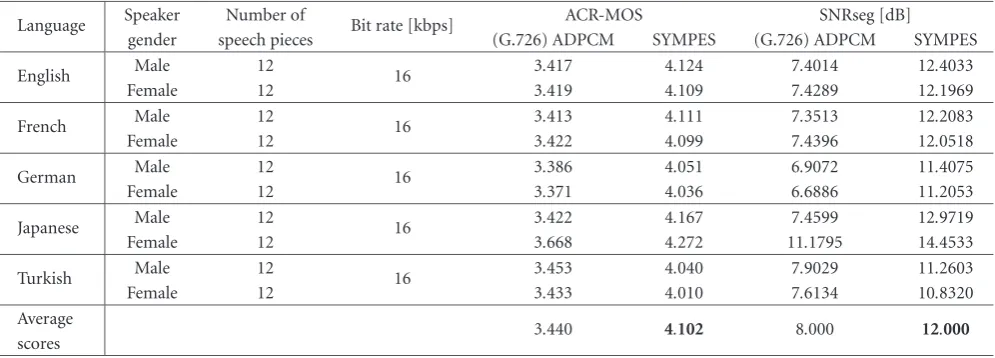
The ACR-MOS test results and computed values of SNRseg for the reconstructed speech pieces are summarized inTable 2.
If we compute the average ACR-MOS and SNRseg values over the languages, one can clearly see that the new method provides much better speech quality over G.726. In this case, we can say that the proposed method yields almost toll qual-ity (MOS≈4.1) whereas G.726 is considered to yield com-munication quality (MOS≈3.5). To provide visual compre-hension, the original and the reconstructed waveforms of the five speech waveforms corresponding to five different sen-tences in five languages uttered by male speakers are depicted inFigure 7. Similarly, inFigure 8, speech waveforms uttered by female speakers are shown.
As it can be deduced fromFigure 7, the visual difference
between the original and the reconstructed waveforms are negligible, which verifies the superior results presented in
Table 2for the newly proposed speech modeling technique. This completes the comparison at the low compression rate (CR=4).
It should be mentioned that similar comparisons were also made with G.726 at 24, 32, and 48 kbps. For these cases
proposed method yields slightly better results over G.726. For example, the new method withLF=8 corresponds to G.726 at 32 kbps. In this case, while G.726 results in SNRG.726−32≈ 25 dB, the new method gives SNR≈26 dB. Since the differ-ence is negligible, details are omitted here.
Let us now comment on the noise robustness of SYMPES.
4.1.2. Comments on the noise robustness of SYMPES
SYMPES directly builds a mathematical model for the speech signal regardless it is noisy or not. Therefore, one expects to end up with a similar noise level in the reconstructed speech as in the original. In fact, a subjective noise test was run to observe the effect of the noisy environment to the robustness of SYMPES. In this regard, a noise free speech piece was mixed with 1.2 dB white noise; then it was reconstructed using SYMPES of LF = 16. The test was run among 5 male and 5 female untrained listen-ers. They were asked to rate the noise level of the recon-structed speech relative to the original, under three cate-gories namely “no change in the noise level,” “reduced noise level,” and “increased noise level”. Seven of the listeners confirmed that the noise level of the reconstructed speech was not changed. Two of the female subjects said that the noise level was slightly reduced, and one of the male lis-tener asserted that noise level was slightly increased. In this case, we can safely state that “SYMPES is not susceptible to the noise level of the environment.” Furthermore, any noise level which is built on the original signal can be re-duced by post-filtering the reconstructed signal. As a mat-ter of fact it was experienced that both the background noise due to reconstruction process and the environmental noise were reduced significantly by using a moving average post-filter.
Table2: Subjective and objective speech quality scores for G726 and the new method.
Language Speaker Number of Bit rate [kbps] ACR-MOS SNRseg [dB] gender speech pieces (G.726) ADPCM SYMPES (G.726) ADPCM SYMPES
English Male 12 16 3.417 4.124 7.4014 12.4033
Female 12 3.419 4.109 7.4289 12.1969
French Male 12 16 3.413 4.111 7.3513 12.2083
Female 12 3.422 4.099 7.4396 12.0518
German Male 12 16 3.386 4.051 6.9072 11.4075
Female 12 3.371 4.036 6.6886 11.2053
Japanese Male 12 16 3.422 4.167 7.4599 12.9719 Female 12 3.668 4.272 11.1795 14.4533
Turkish Male 12 16 3.453 4.040 7.9029 11.2603
Female 12 3.433 4.010 7.6134 10.8320
Average
3.440 4.102 8.000 12.000
scores
4.2. Comparison with voice excited LPC-10E (2.4 kbps)
Standard voice excited LPC-10E employs 20 msec speech frames coded with 48 bits which corresponds to 2.4 kbps. On the other hand, using standard PCM, these time frames contain 160 samples represented by 1280 bits. Thus, the compression rate of LPC-10E is CRLPC=1280/48.=26.67. In order to make a fair comparison, parameters of the new method have to match to that of LPC-10E. First of all, PSS and PES must be regenerated accordingly. In this regard, we can say that one needs to deal with a multitudinous vari-ety of many “signature and envelope” sets to enhance the language & speaker independency for the long speech frame lengths such asLF = 128. However, it should be recalled that this was not the case forLF = 16. So, as described in
Section 4.1, we utilized the rich speech samples collection of IPA [18] with 890 different characteristic sentences in 17 dif-ferent languages (English, French, German, Japanese, Turk-ish, Amharic, Arabic, IrTurk-ish, Sindhi, Cantonese, Czech, Bul-garian, Dutch, Hebrew, Catalan, Galician, and Croatian) (see
Table 3). ChoosingLF=128 and 0.9≤ρYZ ≤1, Algorithm 1 returns withNS =32768 signature andNE =131072 en-velope patterns of one kind. Clearly, it is sufficient to repre-sentNSandNEwith 15 and 17 bits, respectively. As was the case before, the gain factorCiis also represented with 5 bits. In this case, each frame of 128 samples is represented by total number ofNBF=5+15+17=37 bits. Thus, the compression ratio of the new method becomes CR=128×8/37=27.68 which is even higher than CRLPC = 26.67. In the follow-ing section it is shown that the new method yields superior speech quality over voice excited LPC-10E.
4.2.1. MOS test results: SYMPES versus voice
excited LPC-10E
As described inSection 4.1.1, after the formation of PSS and PES withLF=128 samples, we run the ACR-MOS test with the same speech set given byTable 2. The test results are sum-marized inTable 4.
A close examination ofTable 4reveals that SYMPES re-sults in superior speech quality over voice excited LPC-10E for all the languages under consideration.
Just for the sake of visual inspection an original and a re-constructed speech signals are depicted inFigure 9for com-parison. A close examination of Figure 9validates the su-perior reconstruction ability of SYMPES over voice excited LPC-10E.
4.2.2. Comparison of SYMPES with CS-ACELP
It is important to mention that one may conceptually link SYMPES with the other code excited linear predictive (CELP) methods such as conjugate structure-algebraic CELP (CS-ACELP) at 8 kbps (or G.729 at 8 kbps).
CS-ACELP utilizes two stage LBG vector quantization with fixed2 and adaptive3 codebooks [30]. In this regard, each speech frame of 10 msec is described in terms of the indices of the fixed and adaptive codes and the gain factor and they are represented with a total of 80 bits which cor-responds to a compression ratio of CRCS-ACELP = 8. This process may resemble the procedure described by SYMPES. Fixed and adaptive codes of CS-ACELP may be related to the signature and the envelope sequences of SYMPES respec-tively; but it should be kept in mind that SYMPES does not include any adaptive quantity beyond the gain factor. Fur-thermore, CS-ACELP is an LPC technique which takes the error or the residual into account in an additive manner whereas SMYPES literally produces a simple but a nonlin-ear frame model by multiplying three major quantities so thatXAi = f(Ci,EK,SR) = CiEKSR. In this representation, the envelope matrix EK works on the signature vector SR as a multiplier to reduce the modeling error in a nonlin-ear manner. Clnonlin-early, it is not possible to find a one-to-one correspondence between the SYMPES and the CS-ACELP,
2Voice excitations.
1 0.5 0 0.5 1
0 2 4 6 8 10 12 14 16 18
10 3
Original speech signal
A
m
plitude
English-male
1 0.5 0 0.5 1
0 2 4 6 8 10
10 3
Original speech signal
A
m
plitude
French-male
1 0.5 0 0.5 1
0 2 4 6 8 10 12 14 16 18
10 3
Reconstructed speech signal
A
m
plitude
English-male
1 0.5 0 0.5 1
0 2 4 6 8 10
10 3
Reconstructed speech signal
A
m
plitude
French-male
1 0.5 0 0.5 1
0 2 4 6 8 10 12 14 16
10 3
Original speech signal
A
m
plitude
German-male
1 0.5 0 0.5 1
0 2 4 6 8 10 12 14 16
10 3
Original speech signal
A
m
plitude
Japanese-male
1 0.5 0 0.5 1
0 2 4 6 8 10 12 14 16
10 3
Reconstructed speech signal
A
m
plitude
German-male 1
0.5 0 0.5 1
0 2 4 6 8 10 12 14 16
10 3
Reconstructed speech signal
A
m
plitude
Japanese-male
1 0.5 0 0.5 1
0 2 4 6 8 10
10 3
Original speech signal
A
m
plitude
Turkish-male
1 0.5 0 0.5 1
0 2 4 6 8 10
10 3
Reconstructed speech signal
A
m
plitude
Turkish-male
Figure7: Original and reconstructed speech waveforms using the new method for English, French, German, Japanese, and Turkish sentences uttered by male speakers.
since they differ in nature with respect to both model4 and domain5. On the other hand, the gain factor C
i of SYM-PES plays the same role as in CS-ACELP to further reduce
4Linear model of CS-ACELP versus nonlinear model of SYMPES. 5Transform domain of CS-ACELP versus discrete time domain of
SYM-PES.
the error between the original and the approximated speech frames in the LMS sense. Similar MOS tests ofSection 4.2.1
were also run to compare SYMPES at LF = 326 with CS-ACELP at 8 kbps. It was found that SYMPES yields the
6SYMPESL
1 0.5 0 0.5 1
0 1 2 3 4 5 6 7 8 9
10 3
Original speech signal
A
m
plitude
English-female
1 0.5 0 0.5 1
0 2 4 6 8 10 12 14
10 3
Original speech signal
A
m
plitude
French-female
1 0.5 0 0.5 1
0 1 2 3 4 5 6 7 8 9
10 3
Reconstructed speech signal
A
m
plitude
English-female
1 0.5 0 0.5 1
0 2 4 6 8 10 12 14
10 3
Reconstructed speech signal
A
m
plitude
French-female
1 0.5 0 0.5 1
0 0.5 1 1.5 2
10 4
Original speech signal
A
m
plitude
German-female
1 0.5 0 0.5 1
0 2 4 6 8 10
10 3
Original speech signal
A
m
plitude
Japanese-female
1 0.5 0 0.5 1
0 0.5 1 1.5 2
10 4
Reconstructed speech signal
A
m
plitude
German-female
1 0.5 0 0.5 1
0 2 4 6 8 10
10 3
Reconstructed speech signal
A
m
plitude
Japanese-female
1 0.5 0 0.5 1
0 0.2 0.4 0.6 0.8 1 1.2 1.4 1.6 1.8 2
10 4
Original speech signal
A
m
plitude
Turkish-female
1 0.5 0 0.5 1
0 0.2 0.4 0.6 0.8 1 1.2 1.4 1.6 1.8 2
10 4
Reconstructed speech signal
A
m
plitude
Turkish-female
Figure8: Original and reconstructed speech waveforms using the new method for English, French, German, Japanese, and Turkish sentences uttered by female speakers.
average MOSSYMPES =3.72 in contrast with CS-ACELP giv-ing the average MOSCS-ACELP=3.70. Details are omitted here since the hearing quality difference between the two methods is negligible.
Table3: Language-based speech property distribution of the complete sample set provided by IPA utilized to form PSS and PES forLF=128.
Language Speaker
gender Consonant Convention Vowels
Stress and
accent Introduction
Pitch-accent
Vowel-length Assimilation Geminatives
English Female 25 17 15 — — — — — —
French Female 21 — Nasalized 3 — — — — — —
Oral 12
German Male 25 18 19 1 4 — — — —
Japanese Male 20 21 5 — — 6 4 — —
Turkish Male 22 4 8 3 — — — — —
Amharic Male 35 — 11 — — — — — —
Arabic Male 29 — 8 — — — — — —
Irish Female 44 — 14 — — — — — —
Sindhi Male 46 — 10 — — — — — —
Cantonese Male 19 — Diphthongs 11 — — — — — 9
Monophthongs 32
Czech Female 25 — 13 5 — — 3 —
Bulgarian Female 22 — 8 2 — — — — —
Dutch Female 23 — 22 4 — — — — —
Hebrew Male 22 — 5 2 — — — — —
Catalan Male 23 21
Diphthongs 8
7 — — — — —
Stressed 7
Unstressed 3
Galician Male 21 22 7 23 — — — — —
Croatian Female 25 10
1
20 3 — — — —
Long 7
Short 5
Subtotal
number of
words
447 113 234 62 12 6 4 3 9
Total number
of words 890
Table4: Subjective speech quality scores for LPC-10E and the new method.
Language Speaker gender Number of speech pieces
ACR-MOS
LPC-10E 2.4 kbps SYMPES 2.3125 kbps
English Male 12 2.490 3.384
Female 12 2.395 3.455
French Male 12 2.520 3.374
Female 12 2.409 3.435
German Male 12 2.540 3.363
Female 12 2.410 3.411
Japanese Male 12 2.460 3.359
Female 12 2.427 3.603
Turkish Male 12 2.610 3.396
Female 12 2.452 3.418
1 0.5 0 0.5 1
0 1 2 3 4 5 6
Original speech signal 10 4
(a) 1
0.5 0 0.5 1
0 1 2 3 4 5 6
10 4
Reconstructed speech signal obtained by using SYMPES CR=27.68
(b) 1
0.5 0 0.5 1
0 1 2 3 4 5 6
10 4
Reconstructed speech signal obtained by using voice excited LPC-10E CR=26.67
(c)
Figure9: Original and the reconstructed speech signals for visual inspection and comparison of the new method of speech modeling SYMPES with LPC-10E.
compression rates (CR≤8) however, SYMPES yields either slightly better or almost the same speech quality like the oth-ers.
4.3. Comparison of SYMPES with our previous results given by [7]
First of all in [7], the results were given on the predefined sig-nature set which was generated based on selected 500 words from Turkish Language, which in turn makes the speech model very restricted; whereas in this work, complete speech pieces of OGI, TIMIT, and IPA Handbook were utilized to generate predefined signature and envelope sets which are supposed to yield rather universal results and make SYMPES speaker and language independent.
Moreover, in [7], envelope sequences which improve the hearing quality tremendously were not used at all. Hence, here in this work, results of [7] were pretty much general-ized and hearing quality of the reconstructed speech signals is significantly enhanced. As a matter of fact, no matter what the frame length and the compression ratio is, in the recon-struction process, mean opinion scores presented in [7] were below 2.8 out of 5, whereas in this work, in all the examples, they are well above 3.4. Therefore, we can simply state that SYMPES is the generalized and the improved version of the speech model method presented in [7].
5. CONCLUSIONS
In this paper, a novel systematic procedure referred to as “SYMPES” is presented to model speech signals frame by frame by means of the so-called predefined “signature and envelope” patterns. In this procedure, the reconstructed speech frame XAi is described by multiplying three major quantities, namely, the gain factor Ci, the frame signature vectorSR, and the diagonal envelope matrixEK or in short as XAi = CiEKSR. Signature and envelope patterns are se-lected from the corresponding PSS and PES that are formed through the use of a variety of speech samples included in the IPA Handbook. These sets are almost universal. That is to say, they are speaker and language independent. In the synthesis process, each speech frame is fully identified with the gain factorCiand the indicesRandKof the predefined signature and the envelope patterns, respectively.
The subjective and objective test assessments reveal that the hearing quality of SYMPES is slightly better at low com-pression rates (CR ≤ 8) than that of G.726 (16, 24, 32, and 48 kbps) and CS-ACELP (8 kbps). At higher compres-sion rates (CR 8), SYMPES results in superior hearing quality over G.726 and LPC techniques. One should note that this high rate of compression is purchased at the expense of the computational efforts to determine the gain factors as well as to identify the proper signature and envelope patterns in the search process. In this regard, computational lag may be disregarded by an appropriate buffering operation.
As far as digital communication systems are concerned, SYMPES may be considered as a coding scheme. In this case, once the PSS and PES are created and stored, one only needs to transmit theCiwith the relevant indicesRandK. For ex-ample, if SYMPES withLF = 128 is used, then a substan-tial saving in the transmission-bandwidth (CR=27.68) with good quality of speech is achieved.
It is interesting to note that the new method of speech modeling presented in this paper may be employed for speech recognition purposes as described in [31]. It may be used to model biomedical signals such as electrocardiograms and electromyograms as well. Initial results of these works are given in [32,33]. In future research, we hope to improve the results of [31–33] and the computational efficiency of SYM-PES.
ACKNOWLEDGMENT
This work is sponsored by the research unit of Istanbul University, Istanbul, Turkey under the Contracts No. UDP-440/10032005 and 400/03062005.
REFERENCES
[1] A. S. Spanias, “Speech coding: a tutorial review,”Proceedings of the IEEE, vol. 82, no. 10, pp. 1541–1582, 1994.
[3] G. Varile and A. Zampolli,Survey of the State of the Art in Human Language Technology, chapter 10.2: Transmission and Storage (B. S. Atal and N. S. Jayant), Cambridge University Press, Cambridge, UK, 1998.
[4] A. M. Karas¸ and B. S. Yarman, “A new approach for repre-senting discrete signal waveforms via private signature base sequences,” inProceedings of the IEEE European Conference on Circuit Theory and Design, pp. 875–878, Istanbul, Turkey, Au-gust 1995.
[5] A. M. Karas¸,Characterization of electrical signals by using sig-nature base functions, Ph.D. thesis, Department of Electrical and Computer Engineering, Institute of Science, Istanbul Uni-versity, Istanbul, Turkey, January 1997, Advisor: Professor B. S. Yarman.
[6] R. Akdeniz and B. S. Yarman, “Turkish speech coding by sig-nature base sequences,” inProceedings of the International Con-ference on Signal Processing Applications & Technology (ICSPAT ’98), pp. 1291–1294, Toronto, Canada, September 1998. [7] R. Akdeniz and B. S. Yarman, “A novel method to represent
speech signals,”Signal Processing, vol. 85, no. 1, pp. 37–50, 2005.
[8] H. Hotelling, “Analysis of a complex of statistical variables into principal components,”Journal of Educational Psychology, vol. 24, no. 6, pp. 417–498, 1933.
[9] E. Oja, “A simplified neuron model as a principal component analyzer,”Journal of Mathematical Biology, vol. 15, no. 3, pp. 267–273, 1982.
[10] I. T. Jolliffe,Principal Component Analysis, Springer Series in Statistics, Springer, New York, NY, USA, 1933.
[11] A. N. Akansu and R. A. Haddad,Multiresolution Signal De-composition, Academic Press, San Diego, Calif, USA, 1992. [12] K. Fukunaga,Introduction to Statistical Pattern Recognition,
Academic Press, London, UK, 1990.
[13] A. J. Newman, “Model reduction via the Karhunen Loeve ex-pansion part I: an exposition,” Tech. Rep. ISR T.R.96-32, Insti-tute of Systems Research, College Park, Md, USA, April 1996. [14] G. Strang,Linear Algebra and Its Applications, Academic Press,
New York, NY, USA, 1980.
[15] ¨U. G¨uz,A new approach in the determination of optimum signa-ture base functions for Turkish speech, Ph.D. thesis, Department of Electrical and Computer Engineering, Institute of Science, Istanbul University, Istanbul, Turkey, 2002, Advisor: Professor B. S. Yarman.
[16] ¨U. G¨uz, B. S. Yarman, and H. G¨urkan, “A new method to rep-resent speech signals via predefined functional bases,” in Pro-ceedings of the IEEE European Conference on Circuit Theory and Design, vol. 2, pp. 5–8, Espoo, Finland, August 2001.
[17] ¨U. G¨uz, H. G¨urkan, and B. S. Yarman, “A novel method to rep-resent the speech signals by using language and speaker inde-pendent predefined functions sets,” inProceedings of the IEEE International Symposium on Circuits and Systems, vol. 3, pp. 457–460, Vancouver, BC, Canada, May 2004.
[18] IPA,Handbook of the International Phonetics Association: A Guide to the Use of the International Phonetic Alphabet, Cam-bridge University Press, CamCam-bridge, UK, 1999.
[19] K. Pearson, “On lines and planes of closest fit to systems of points in space,”Philosophical Magazine, vol. 2, no. 11, pp. 559–572, 1901.
[20] Y. Linde, A. Buzo, and R. M. Gray, “An algorithm for vec-tor quantizer design,”IEEE Transactions on Communications, vol. 28, no. 1, pp. 84–95, 1980.
[21] OGI Multi-Language Telephone Speech Corpus, CD-ROM, Linguistic Data Consortium.
[22] S. R. Quackenbush, T. P. Barnwell, and M. A. Clements, Ob-jective Measures of Speech Quality, Prentice Hall, Englewood Cliffs, NJ, USA, 1988.
[23] J. S. Garofolo, L. F. Lamel, W. M. Fisher, J. G. Fiscus, D. S. Pal-lett, and N. L. Dahlgren, “DARPA TIMIT acoustic phonetic speech corpus,” Tech. Rep. NISTIR 4930, U.S. Department of Commerce, NIST, Computer Systems Laboratory, Washing-ton, DC, USA, 1993.
[24] ITU-T Recommendation G.726; 40, 32, 24, 16 kbit/s ADPCM, Geneva, (12/90).
[25] ITU-T Appendix III to ITU-T Recommendation G.726; Gen-eral aspects of digital transmission systems-comparison of ADPCM algorithms, Geneva, (05/94).
[26] ITU-T Recommendation P.861; Series P: Telephone transmis-sion quality methods for objective and subjective assessment of quality-objective quality measurement of telephone band (300-3400 Hz) speech codecs, Geneva, (08/96).
[27] ITU-T Recommendation P.830; Telephone transmission qual-ity methods for objective and subjective assessment of qualqual-ity- quality-subjective performance assessment of telephone-band and wideband digital codecs, Geneva, (02/96).
[28] W. D. Voiers, “Methods of predicting user acceptance of voice communication systems,” Final Report DCA100-74-C-0056, July 1976.
[29] ITU-T Recommendation P.800; Series P: Telephone transmis-sion quality methods for objective and subjective assessment of quality-methods for subjective determination of transmis-sion quality, Geneva, (08/96).
[30] ITU-T Recommendation G.729; Coding of speech at 8 kbit/s using CS-ACELP.
[31] ¨U. G¨uz, H. G¨urkan, and B. S. Yarman, “A new speech signal modeling and word recognition method by using signature and envelope feature spaces,” inProceedings of the IEEE Euro-pean Conference on Circuit Theory and Design, vol. 3, pp. 161– 164, Cracow, Poland, September 2003.
[32] B. S. Yarman, H. G¨urkan, ¨U. G¨uz, and B. Ayg¨un, “A new mod-eling method of the ECG signals based on the use of an opti-mized predefined functional database,”Acta Cardiologica - An International Journal of Cardiology, vol. 58, no. 3, pp. 59–61, 2003.
[33] H. G¨urkan, ¨U. G¨uz, and B. S. Yarman, “A novel representa-tion method for electromyogram (EMG) signal with prede-fined signature and envelope functional bank,” inProceedings of the IEEE International Symposium on Circuits and Systems, vol. 4, pp. 69–72, Vancouver, BC, Canada, May 2004.
¨
Umit G¨uzgraduated from Istanbul
Pertev-niyal High School in 1988 and Department of Computer Programming, Yıldız Techni-cal University, Istanbul, Turkey in 1990. He received the B.S. degree with high honors from the Department of Electronics Engi-neering, College of EngiEngi-neering, Istanbul University, Istanbul, Turkey in 1994. He re-ceived M.S. and Ph.D. degrees in electron-ics engineering from the Institute of
(T ¨UB˙ITAK) in 2006. He is accepted as an International Fellow by the SRI (Stanford Research Institute)-International Speech Tech-nology and Research (STAR) Laboratory in 2006. He is awarded with the J. William Fulbright Post-Doctoral Research Fellowship in 2007. He is accepted as an International Fellow by the Interna-tional Computer Science Institute (ICSI) Speech Group at the Uni-versity of California, Berkeley in 2007. His research interest covers speech modeling, speech coding, speech compression, automatic speech recognition, natural language processing, and biomedical signal processing.
Hakan G¨urkanreceived the B.S., M.S., and
Ph.D. degrees in electronics and communi-cation engineering from the Istanbul Tech-nical University, Istanbul, Turkey, in 1994, 1998, and 2005, respectively. He was a Re-search Assistant in the Department of Elec-tronics Engineering, Engineering Faculty, Is¸ık University, Istanbul, Turkey. He has been an instructor in the Department of Electronics Engineering, Engineering
Fac-ulty, Is¸ık University, Istanbul, Turkey, since 2005. His current in-terests are in digital signal processing, mainly with biomedical and speech signals modeling, representation, and compression.
Binboga Sıddık Yarman received the B.S.
degree in electrical engineering from Is-tanbul Technical University, Turkey (1974); M.E.E.E. degree from Electro-Math Stevens Institute of Technology Hoboken, NJ, 1977; Ph.D. degree in EE-Math from Cornell Uni-versity, Ithaca, NY, 1981. He was a Mem-ber of the Technical Staff, Microwave Tech-nology Centre, RCA David SarnoffResearch Center, Princeton, NJ (1982–1984);