
THERMOCHEMISTRY MODELLING IN AN OPEN-SOURCE DSMC CODE
T J Scanlon1, C White, M Schuebler, R E Brown and J M Reese
Department of Mechanical and Aerospace Engineering University of Strathclyde
Glasgow G1 1XJ UK
Abstract
This paper describes the implementation and validation of a Direct Simulation Monte Carlo (DSMC) thermochemistry model using the open-source C++ DSMC code, dsmcFoam. An approach, known as the quantum kinetic (QK) method, has been adopted to describe chemical reactions using DSMC procedures based solely on microscopic gas information. Results for vibrational relaxation and dissociation reaction rates for a single cell, adiabatic bath demonstrate the successful implementation of the QK model when compared with analytical solutions and numerical results from other contemporary DSMC codes.
1. Introduction
Hypersonic vehicles which typically operate in rarefied gas environments and are subject to extremes of velocity and altitude, so it is important that the aerodynamic and thermal loads on the vehicle are properly characterised if the feasibility of the vehicle design is to be accurately assessed. The vehicle may also encounter gas-side chemical reactions that can have a significant influence on aerodynamic performance and vehicle surface heat flux [1]. Numerical models which fail to incorporate such reacting flows miss out on an essential part of the flow physics surrounding the vehicle.
1.1 Limitations of the standard Navier-Stokes-Fourier model
The planetary atmospheres through which hypersonic vehicles may pass consist of a number of chemical species, the relative proportion of which varies with altitude. Although it is known that the gas in the atmosphere is composed, at microscopic level, of discrete atoms and molecules, a useful approximation arises if the atmosphere is treated as a continuum. The flow over a vehicle moving through the atmosphere can then be modelled by appealing to the fundamental principles of momentum interchange and mass and energy conservation. This continuum approach is at the root of conventional computational fluid dynamics (CFD) methods for the solution of the Navier-Stokes-Fourier (NSF) equations. Indeed, continuum CFD has been applied successfully in many simulations of gas flow around air-and spacecraft, air-and yields good agreement with measured data over a wide range of practically-relevant operational conditions [2].
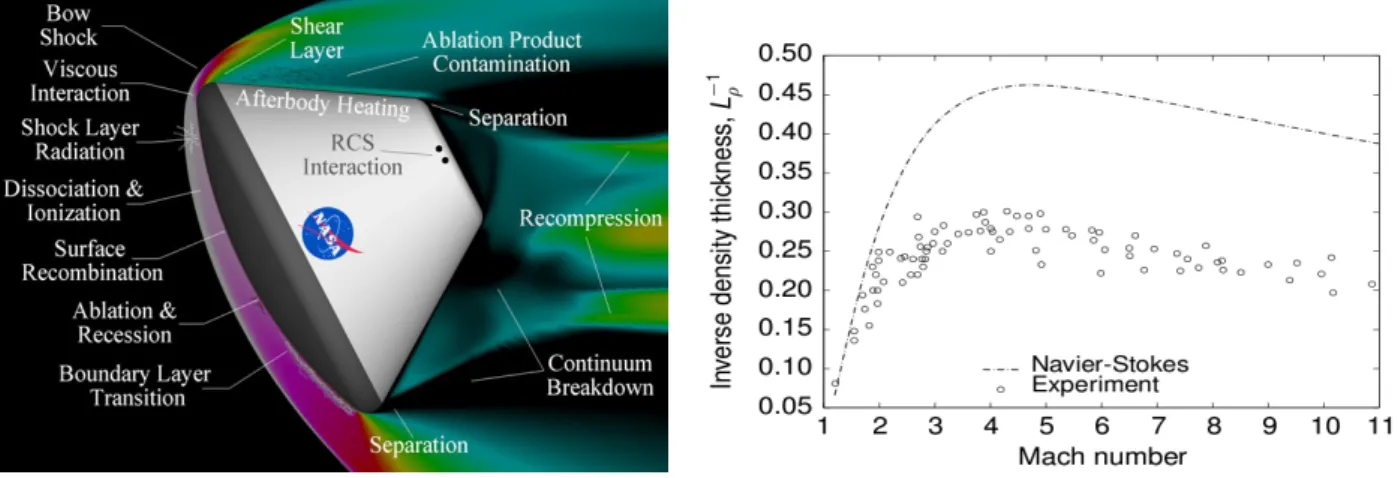
However, continuum-based models have limitations in dilute gas conditions. The extent of gas rarefaction is traditionally gauged by a parameter known as the Knudsen number, Kn, defined as the ratio of the mean free path of the gas molecules to a characteristic length scale of the vehicle. As the Knudsen number increases, the non-continuum, particulate-like behaviour of the gas becomes more important. Numerical models hoping to simulate such rarefied conditions must be able capture the complex physics shown in figure 1 for high-speed vehicle re-entry. The flow environment is characterised by a distinct bow-shock upstream of the body followed by a high temperature region immediately downstream of the shock. In this searingly hot region, chemical reactions may take place involving dissociation and ionization while surface chemistry is also possible. In the lee of the craft there is a highly rarefied zone within which thermochemical non-equilibrium conditions may exist. The paucity of molecules in this zone may necessitate the region being described using a non-continuum, particle-based formulation.
It is possible to describe such complex flow conditions using the Boltzmann equation, which is appropriate for the entire range of Knudsen numbers likely to be encountered by hypersonic vehicles. However, the Boltzmann equation is extremely difficult to solve numerically due to its high degree of dimensionality and the complexity of the collision term. Simplification of the collision term in the equation through the Bhatnagar–Gross–Krook (BGK) approximation [3] has given rise to a number of new numerical algorithms, such as the model Boltzmann equation (MBE) solver
developed by Yang and Huang [4]; however these nascent techniques have yet to establish themselves as practical simulation tools.
The problem that the Navier-Stokes-Fourier equations have in capturing rarefaction is highlighted in figure 2 [5]. The normal shock wave is a fundamental component of many high-speed aerodynamic flows, e.g. in the leading part of the bow shock. Rarefaction causes the shock to be relatively thick (of the order of a few gas mean-free-paths, of the same order as the standoff distance of the bow shock from the vehicle leading edge). This figure shows that the NSF equations consistently predict shocks in argon gas that are some 50% thinner than observed experimentally. That the fluid dynamic equations have such difficulty in predicting the behaviour in such a simple flow case, calls their appropriateness for more complex rarefied flowfields into question.
Certain non-equilibrium behaviour can be accommodated to some extent in conventional CFD NSF approaches to modelling the gas dynamics around aero-space vehicles, for instance by incorporation of a finite slip velocity between the gas and any solid surfaces that are immersed within the flow. A computationally-efficient gas flow method, but one which has had only modest success to date, is to establish either a Kn-series or a Hermite polynomial approximation to the distribution function in the Boltzmann equation. To first order (i.e. for near-equilibrium flows) this approach yields the NSF set, but the solution methods can be continued to second and higher orders to incorporate more and more of the salient characteristics of a rarefied flow. This family of so-called extended hydrodynamic equations has various different members, includes the Burnett, Grad 13-moment, R13, R26 equations, and others. Generally, they all have great difficulty in achieving stable physical solutions of high-Mach-number flows. Their non-linearity also makes them difficult to solve numerically, and as they are higher-order in the gradients of flow properties their solution requires additional boundary conditions that are not easy to define. For these reasons, extended hydrodynamics has not established a firm place in the armoury of tools a high-speed aerodynamicist can deploy.
1.2 Alternative numerical approaches; the Direct Simulation Monte Carlo (DSMC) method
In highly rarefied environments (Kn > 0.1) accommodation of the thermochemical non-equilibrium effects that occur in the flow away from surfaces remains a challenging problem. For this reason, analysis of gas flows in the non-continuum regime is most naturally conducted using specialised computational techniques that are derived from a statistical mechanical representation of the behaviour of the individual particles comprising the flow. The most successful of these techniques is undoubtedly the Direct Simulation Monte Carlo (DSMC) approach, originally proposed by Bird [6].
The DSMC technique composes particles to moving and colliding using kinetic-theory considerations that can capture the non-equilibrium gas behaviour accurately. DSMC considers molecular collisions using stochastic rather than deterministic procedures over a time step which is a small fraction of the mean collision time, and each DSMC particle represents a large number of real gas molecules. The decoupling of particle ballistic motion and particle collisions improves the computational efficiency of DSMC greatly in comparison with other particle methods such as molecular dynamics (MD). The computational domain is divided into either a structured or unstructured grid of cells,
Figure 1 Complex physics in planetary vehicle re-entry (image credit NASA)
with each cell of a dimension that is a small fraction of the local mean free path size. The cells are then utilised to select particles for collisions on a probabilistic basis, and also are used for sampling the macroscopic flow properties. Intermolecular collisions are handled probabilistically using phenomenological models which are designed to reproduce real fluid behaviour when the flow is examined at the macroscopic level. The DSMC technique has been shown to provide a solution to the Boltzmann equation as the number of simulated particles tends toward the true value within the flow field [7]. The DSMC approach is currently the dominant numerical method for rarefied gas flow applications.
1.3 Thermochemistry effects
For engineering purposes, the gas in the Earth’s atmosphere may be assumed to be a binary mixture composed of oxygen (O2) and nitrogen (N2). In the DSMC methodology, particle clusters must be endowed with the correct
properties to capture kinetic and rotational modes of energy storage. Vibrational excitation of the gas molecules as well as dissociation of both oxygen and nitrogen are likely to be important features of the flow around any hypersonic vehicle at the highest altitudes (80-120 km) and speeds, while even at lower speeds and altitudes vibrational excitation and limited dissociation of oxygen are still likely to be important [8]. Such real-gas effects need to be properly accounted for. The DSMC technique normally models air as either a 5-species mixture
(
N
2,O
2,N , O ,NO
)
using dissociation, recombination and exchange reactions or as a mixture of 11 species(
N
2, N
2+, O
2,O
+2, NO, NO
+,N , N
+,O , O
+,e
−)
including ionization. In conventional CFD, reaction rates arecalculated according to the Arrhenius law [8]. However, this assumes local thermochemical equilibrium, which is inappropriate for rarefied hypersonic flows. In contrast, the DSMC method, with its particulate approach, is able to capture successfully the thermochemical non-equilibrium effects encountered in high speed rarefied gas environments [1].
2. Chemistry modelling in dsmcFoam
The DSMC code used for this paper is dsmcFoam. The code has been written within the framework of the open-source C++ CFD toolbox OpenFOAM [9]. The main features of the dsmcFoam code include the capability to perform both steady and transient DSMC simulations for multi-species conditions, to model arbitrary 2D/3D geometries using unstructured polyhedral meshes, and unlimited parallel processing. The original version of dsmcFoam determines intermolecular collisions for polyatomic species using the variable hard sphere (VHS) model [6] and applies the phenomenological Larsen-Borgnakke model to distribute post-collision energy between the translational and rotational modes [6]. A series of successful benchmark trials have been carried out which have validated the dsmcFoam code for non-reacting flows [10].
2.1 The quantum-kinetic (QK) model
We have implemented and validated a chemistry model into dsmcFoam for reacting flows. Recently, Bird [11] has proposed a new model for DSMC chemical reactions which makes no reference to macroscopic gas properties. All reaction probabilities are based on the vibrational state of the colliding molecules. The new model is called the “quantum-kinetic” or QK model. This section describes the principal features of the QK chemistry model.
Consider the binary collision of two polyatomic DSMC simulator particles, P and Q. Each particle in the collision pair is considered in turn and the following steps are undertaken:
1. Calculate the pre-collision energy of particle P,
E
c ,P , which is the sum of the relative translational energy between P and Q and the vibrational energy of particle P:
E
c , P=
E
tr, PQ+
E
v , P , (1)
i
max,P=
⌊
E
c , Pkθ
v ,P⌋
, (2)
where k is the Boltzmann constant and
θ
v ,P is the characteristic vibration temperature. The brackets⌊⌋
indicate thati
max,P is “quantized” by truncating its value to an integer.3. Chemical dissociation (e.g.
N
2+
N
→
N
+
N
+
N
) occurs when the energy of the diatomic molecule reaches the value that corresponds to the dissociation energy. Dissociation may be processed when:
i
max>
θ
dθ
v ,(3)
4. A desired feature in the DSMC methodology is that the numerical process should not depend on any macroscopic information. The two molecules in a collision have no knowledge of the overall macroscopic temperature and, if highly nonequilibrium flows are to be resolved sufficiently, the procedures for energy redistribution in a collision should be based entirely on the energies and impact parameters associated with
that collision. In order to adhere to this microscopic principle, a “quantized collision temperature”,
T
coll,Pis defined which is based on
E
c ,P :
T
coll, P=
i
max,Pθ
v , P/
(
7
/
2
−
ω
P)
, (4)5. Next, the vibrational collision number, Zv , is evaluated from:
Z
v=
(
θ
dT
coll ,P)
ω
[
Z
ref(
θ
dT
ref)
−ω
]
[
(
θd Tcoll,P
)
1 3−1
]
/[
(
θd Tref)
1 3−1
]
, (5)
where
θ
d is the characteristic dissociation temperature, ω is the temperature exponent of viscosity, Zref is a reference vibrational collision number, evaluated at an arbitrary reference temperature Tref. Thevalue of Tref should be representative of the range of temperatures expected in the application.
6. The probability of particle P being accepted for vibrational exchange is determined by comparing the probability value, 1/Zv, with a uniformly distributed, normalised random number.
7. For vibrational exchange without chemical reactions, it is important to verify that the correct vibrational relaxation rate is achieved. The QK model necessitates the use of not only discrete integer values for the
collision temperature,
T
coll,P , but also a quantized version of the Larsen-Borgnakke (LB) method [13] to simulate the transfer between translational, rotational and vibrational energy modes in particle collisions. Inthis method, an integer value of the post-collision quantum level, i' , is selected randomly from the range
f
(
i
')
=
(
1
−
i
'
kθ
v ,PE
c ,P)
3 2−ω
, (6)
and the post-collision quantum number, i' , is determined using the acceptance-rejection approach [6].
8. The post-collision vibrational energy of particle P is then evaluated as
E
v ,P'
=
i
'kθ
v, P . This vibrationalenergy is subtracted from the pre-collision energy,
E
c ,P , and the remaining energy is then divided between the translational and rotational modes using the standard LB method [2].9. The process is then repeated for particle Q.
3. Results
3.1 Vibrational relaxation in nitrogen
dsmcFoam has used to evaluate the vibrational relaxation rate of N2 in an adiabatic, single cell box. 1.2 million DSMC
particles have been used and the gas is initially at a temperature of 20,000 K, as far as the translational and rotational modes are concerned, but with no energy for vibration. The results of the dsmcFoam vibrational relaxation are compared with those of Bird [14] in figure 3.
The results show that equipartition of energy has been achieved between the energy modes as the gas reaches an equilibrium temperature of approximately 14,720 K. The results also show the relaxation curves for all three modes are in excellent agreement with those of Bird [14].
Figure 3 Vibrational relaxation in nitrogen; symbols - Bird[14], lines – dsmcFoam Translational ; Rotational ; Vibrational
3.2 Chemical reactions – dissociation of N2 and O2
When two simulators are selected for collision, the dissociation process is activated when the conditions described in item 3 above are met. If dissociation occurs then the number of reactions is augmented by one. However, unlike the
the conditions found in a real gas, the chemical reaction does not actually occur: our interest lies in predicting the rate of dissociation, so the simulators are left unchanged and no molecular splitting takes place.
The principal dissociation reactions in hypersonic applications involve N2 and O2. So dsmcFoam has been tested for
the following four dissociation cases:
N2 + N → N + N + N ,
N2 + N2 → N2 + N + N ,
O2 + O → O + O + O ,
O2 + O2 → O2+ O + O .
For an equilibrium variable hard sphere gas at temperature T, the dissociation rate coefficient may be written as [1]:
k
(
T
)=
2
σ
ref(
1
+
δ
PQ) √
π
(
T
T
ref)
1−ω
(
2
kT
refm
r)
1/2×
∑
i=0
id
Q
[
5
2
−
ω ,
θ
d−
iθ
vT
]
1
Z
v(
T
)
exp
[
−
iθ
vT
]
(7)
where
Q
(
a,x
)=
Γ
(
a,x
)/
Γ
(
a
)
is a form of the incomplete Gamma function,Zv
(
T)
={
1−exp(
−θv/T)
}
−1is the vibrational partition function in the harmonic oscillator model,
i
d is thevibrational level immediately below the dissociation limit, σ and
m
r are the collision pair cross section andreduced mass, and
δ
PQ is the Kronecker delta.Figures 4 to 7 show the dsmcFoam-predicted dissociation reaction rates, compared with the analytical model in equation 7. The ability to reproduce equilibrium reaction rates is essential for any chemistry model, and figures 4 to 7 show an excellent agreement between the dsmcFoam dissociation rates and the analytical values from equation 7.
Figure 4 Nitrogen dissociation N2 + N → N + N + N Figure 5 Nitrogen dissociation N2 + N2 → N2 + N
Figure 6 Oxygen dissociation O2 + O → O + O + O Figure 7 Oxygen dissociation O2 + O2 → O2 + O +
O
4. Conclusions
The first stages in the development and validation of an open source chemistry model in DSMC have been successfully completed. The vibrational mode has been incorporated into the dsmcFoam code and the quantum-kinetic (QK) methodology has been applied to model chemical reactions. The dsmcFoam-predicted vibrational relaxation and equilibrium dissociation reaction rates are in excellent agreement with analytical results. Further development work on dsmcFoam will be to test the code in non-equilibrium reaction conditions, and implement a set of chemical reactions appropriate for hypersonic rarefied thermochemistry applications. This will involve either a 5- or 11- species air mixture with models to describe recombination, exchange reactions and ionization.
References:
[1] Gallis, M. A.,Bond, R. B. and Torczynski, J.R.(2009) A kinetic-theory approach for computing chemical-reaction rates in upper-atmosphere hypersonic flows, J. Chem. Phys. 131, 124311.
[2] Bertin, J. J. and Cummings, R. M. (2006) Annu. Rev. Fluid Mech.38:129-157.
[3] Bhatnagar P. L., Gross E. P. and Krook M. (1954) A model collision process in gases. I. Small amplitude processes in charge and neutral one-component system. Phys. Rev. 94:511–25.
[4] Yang J. Y. and Huang J. C. (1995) Rarefied flow computations using nonlinear model Boltzmann equations. J. Comput. Phys., 120(2):323–39.
[5] Greenshields, C. J. and Reese, J. M. (2007) The structure of shock waves as a test of Brenner’s modifications to the Navier-Stokes equations. Journal of Fluid Mechanics, 580:407-429.
[6] Bird, G.A. (1994) Molecular gas dynamics and the direct simulation of gas flows (Clarendon, Oxford).
[7] Wagner W. (1992) A convergence proof for Bird’s direct simulation Monte Carlo method for the Boltzmann equation. J. Stat. Phys. 66:1011–44.
[8] Anderson, J.D. Jr. (2006), Hypersonic and High Temperature Gas Dynamics (second edition), McGraw-Hill. [9] http://www.opencfd.com
[10] Scanlon, T. J. Roohi, E., White, C., Darbandi, M. and Reese, J. M. (2010) An open-source, parallel, DSMC code for rarefied gas flows in arbitrary geometries, Computers and Fluids, 39, 2078-2089.
[11] http://gab.com.au/RGD27Bird.pdf, (2010).
[12] Bird, G. A. (2009) A comparison of collision energy-based and temperature-based procedures in DSMC, Rarefied Gas Dynamics (Ed. T. Abe), American Institute of Physics, 245-250.
![Figure 3 Vibrational relaxation in nitrogen; symbols - Bird[14], lines – dsmcFoam Translational ; Rotational ; Vibrational](https://thumb-us.123doks.com/thumbv2/123dok_us/1687595.122139/5.892.277.592.656.985/figure-vibrational-relaxation-nitrogen-dsmcfoam-translational-rotational-vibrational.webp)
