Co-reference via Pointing and Haptics in Multi-Modal Dialogues
Lin Chen, Barbara Di Eugenio Department of Computer Science
University of Illinois at Chicago 851 S Morgan ST, Chicago, IL 60607, USA
{lchen43,bdieugen}@uic.edu
Abstract
This paper describes our ongoing work on resolving third person pronouns and deictic words in a multi-modal corpus. We show that about two thirds of these referring expressions have antecedents that are introduced by point-ing gestures or by haptic-ostensive actions (actions that involve manipulating an object). After describing our annotation scheme, we discuss the co-reference models we learn from multi-modal features. The usage of haptic-ostensive actions in a co-reference model is a novel contribution of our work.
1 Introduction
Co-reference resolution has received a lot of atten-tion. However, as Eisenstein and Davis (2006) noted, most research on co-reference resolution has focused on written text. This task is much more difficult in dialogue, especially in multi-modal di-alogue contexts. First, utterances are informal, un-grammatical and disfluent. Second, people sponta-neously use gestures and other body language. As noticed by Kehler (2000), Goldin-Meadow (2003), and Chen et al. (2011), in a multi-modal corpus, the antecedents of referring expressions are often in-troduced via gestures. Whereas the role played by pointing gestures in referring has been studied, the same is not true for other types of gestures. In this paper, alongside pointing gestures, we will discuss the role played byHaptic-Ostensive (H-O)actions, i.e., referring to an object by manipulating it in the world (Landragin et al., 2002; Foster et al., 2008).
As far as we know, no computational models of co-reference have been developed that include H-O ac-tions: (Landragin et al., 2002) focused on percep-tual salience and (Foster et al., 2008) on generation rather than interpretation. We should point out that at the time of writing we only focus on resolving third person pronouns and deictics.
The rest of this paper is organized as follows. In Section 2 we describe our multi-modal annotation scheme. In Section 3 we present the pronoun/deictic resolution system. In Section 4, we discuss experi-ments and results.
2 The Data Set
The dataset we use in this paper is a subset of the ELDERLY-AT-HOME corpus (Di Eugenio et al., 2010), a multi-modal corpus in the domain of elderly care. It contains 20 human-human dialogues. In each dialogue, a helper (HEL) and an elderly person (ELD) performedActivities of Daily Living(Krapp, 2002), such as getting up from chairs, finding pots, cooking pastas, in a realistic setting, a studio apart-ment used for teaching and research. The corpus contains videos and voice data in avi format, haptics data collected via instrumented gloves in csv format, and the transcribed utterances in xml format.
We focused on specific subdialogues in this cor-pus, that we call Find tasks: a Find task is a con-tinuous time span during which the two subjects were collaborating on finding objects. Find tasks arise naturally while helping perform ADLs such as preparing dinner. An excerpt from a Find task is shown below, including annotations for pointing gestures and for H-O actions (annotations are
formed via the Anvil tool (Kipp, 2001)).
ELD : Can you get me a pot?
HEL: (opens cabinet, takes out pot, without saying a word)
[Open(HEL,Cabinet1),Take-Out(HEL,Pot1)]
ELD: Not that one, try over there.
[Point(ELD,Cabinet5)]
Because the targets of pointing gestures and H-O actions are real life objects, we designed a refer-ring index system to annotate them. The referrefer-ring index system consists of compile time indices and run time indices. We give pre-defined indices to tar-gets which cannot be moved, like cabinets, draw-ers, fridge. We assign run time indices to targets which can be moved, and exist in multiple copies, like cups, glasses. A referring index consists of a type and an index; the index increases according to the order of appearance in the dialogue. For exam-ple, “Pot#1” means the first pot referred to in the dialogue. If a pointing gesture or H-O action in-volved multiple objects, we used JSON (JavaScript Object Notation)1 Array to mark it. For example, [C#1, C#2] means Cabinet#1 and Cabinet#2.
We define a pointing gesture as a hand gesture without physical contact with the target, whereas gestures that involve physical contact with an ob-ject are haptic-obstensive (H-O).2We use four tracks in Anvil to mark these gestures, two for pointing gestures, and two for H-O actions. In each pair of tracks, one track is used for HEL, one for ELD. For both types of gestures, we mark the start time, end time and the target(s) of the gesture using the re-ferring index system we introduced above. Addi-tionally we mark the type of an H-O action: Touch, Hold, Take-Out (as in taking out an object from a cabinet or the fridge), Close, Open.3
Our co-reference annotation follows an approach similar to (Eisenstein and Davis, 2006). We mark the pronouns and deictics which need to be resolved, their antecedents, and the co-reference links be-tween them. To mark pronouns, deictics and tex-tual antecedents, we use the shallow parser from
1
http://www.json.org/
2
Whereas not all haptic actions are ostensive, in our dia-logues they all potentially perform an ostensive function.
3
Our subjects occasionally hold objects together, e.g. to fill a pot with water: these actions are not included among the H-O actions, and are annotated separately.
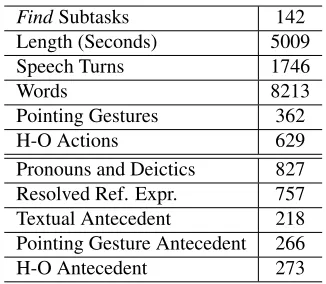
FindSubtasks 142 Length (Seconds) 5009 Speech Turns 1746
Words 8213
[image:2.612.345.508.55.197.2]Pointing Gestures 362 H-O Actions 629 Pronouns and Deictics 827 Resolved Ref. Expr. 757 Textual Antecedent 218 Pointing Gesture Antecedent 266 H-O Antecedent 273
Table 1: Annotation Statistics
Apache OpenNLP Tools4to chunk the utterances in each turn. We use heuristics rules to automatically mark potential textual antecedents and the phrases we need to resolve. Afterwards we use Anvil to edit the results of automatic processing. To annotate co-reference links, we first assign each of the textual antecedents, the pointing gestures and H-O actions a unique markable index. Finally, we link referring expressions to their closest antecedent (if applicable) using the markable indices.
Table 1 shows corpus and annotation statistics. We annotated 142Findsubtasks, whose total length is about 1 hour and 24 minutes. This sub-corpus comprises 1746 spoken turns, which include 8213 words. 10% of the 8213 words (827 words) are pro-nouns or deictics. Note that for only 757/827 (92%) were the annotators able to determine an antecedent. Interestingly, 71% of those 757 pronouns or deictics refer to specific antecedents that are introduced ex-clusivelyby gestures, either pointing or H-O actions. In the earlier example, only the type for the referent ofthatinNo, not that onehad been introduced textu-ally, but not its specific antecedentpot1. Clearly, to be effective on such data any model of co-reference must include the targets of pointing gestures and H-O actions. H-Our current model does not take into ac-count the type provided by thede dictointerpretation of indefinites such asa potabove, but we intend to address this issue in future work.
In order to verify the reliability of our annotations, we double coded 15% of the data for pointing ges-tures and H-O actions, namely the dialogues from 3 pairs of subjects, or 22 Find subtasks. We
ob-4
tained reasonable κ values: for pointing gestures, κ=0.751, for H-O actions, κ=0.703, and for co-reference,κ=0.70.
3 The Co-reference Model
In this paper we focus on how to use gesture infor-mation (pointing or H-O) to solve the referring ex-pressions of interest. Given a pronoun or deictic, we build co-reference pairs by pairing it with the targets of pointing gestures and H-O actions in a given time window. We mark the correct pairs as “True” and then we train a classification model to judge if a co-reference pair is a true pair. The main component of the resolution system is the co-reference classifi-cation model. Since our antecedents are not textual, most of the traditional features for co-reference res-olution do not apply. Rather, we use the following multi-modal features -Uis the utterance containing the pronoun / deictic to be solved:
• Time distance between the spans of U and of the pointing/H-O action. If the two spans over-lap, the distance is 0.
• Speaker agreement:If the speaker ofUand the actor of the pointing/H-O action are the same.
• Markable type agreement:If the markable type of the pronoun/deictic and of the targets of pointing gesture/H-O action are compatible.
• Number agreement: If the number of the pro-noun/deictic is the same as that of the targets of the pointing gesture/H-O action.
• Object agreement: If the deictic is contained in a phrase, such as “this big blue bowl”, we will check if the additional object descrip-tion “bowl” matches the targets of pointing gesture/H-O action.
• H-O Action type: for co-reference pairs with antecedents from H-O actions.
For markable type agreement, we defined two types of markables: PLC (place) and OBJ (object). PLC includes all the targets which cannot easily be moved, OBJ includes all the targets like cups, pots. We use heuristics rules to assign markable
types to pronouns/deictics and the targets of point-ing gestures/H-O actions. To determine the number of the targets, we extract information from the an-notations; if the target is a JSON array, it means it is plural. To extract additional object description for the object agreement feature, we use the Stanford Typed Dependency parser (De Marneffe and Man-ning., 2008). We check if the pronoun/deictic is in-volved in “det” and “nsubj” relations, if so, we ex-tract the “gov” element of that relation as the object to compare with the target of gestures/H-O actions.
4 Experiments and Discussions
We have experimented with 3 types of classification models: Maximum Entropy (MaxEnt), Decision Tree and Support Vector Machine (SVM), respec-tively implemented via the following three pack-ages: MaxEnt, J48 from Weka (Hall et al., 2009), and LibSVM (Chang and Lin, 2011). All of the results reported below are calculated using 10 fold cross validation.
We have run a series of experiments changing the history length from 0 to 10 seconds for generating co-reference pairs (history changes in increments of 1 second, hence, there are 11 sets of experiments). For each history length, we build the 3 models men-tioned above. An additional baseline model treats a co-reference pair as “True” if speaker agreement is true for the pair, and the time distance is 0. Beside the specified baseline, J48 can be seen as a more so-phisticated baseline as well. When we ran the 10 fold experiment with J48 algorithm, 5 out of 10 gen-erated decision trees only used 3 attributes.
We use two metrics to measure the performance of the models. One are the standard precision, re-call and F-Score with respect to the generated co-reference pairs; the other is the number of pro-nouns and deictics that are correctly resolved. Given a pronoun/deictic pi, if the classifier returns more
than one positive co-reference pair forpi, we use a
heuristic resolver to choose the target. We divide those positive pairs into two subsets, those where the speaker ofpiis the same as the performer of the
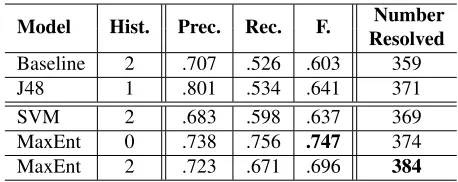
Model Hist. Prec. Rec. F. Number Resolved
[image:4.612.70.299.56.147.2]Baseline 2 .707 .526 .603 359 J48 1 .801 .534 .641 371 SVM 2 .683 .598 .637 369 MaxEnt 0 .738 .756 .747 374 MaxEnt 2 .723 .671 .696 384
Table 2: Gesture&Haptics Co-reference Model Results
of the gesture/H-O action in the most recent pair. Given the space limit, Table 2 only shows the results for each model which resolved most pro-nouns/deictics, and the model which produced the best F-score. In Table 2, with the change ofHistory
window setting, the gold standard of co-reference pairs change. When the history window is larger, there are more co-reference candidate pairs, which help resolve more pronouns and deictics.
Given we work on a new corpus, it is hard to compare our results to previous work, additionally our models currently do not deal with textual an-tecedents. For example Strube and M¨uller (2003) reports their best F-Measure as .4742, while ours is .747. As concerns accuracy, whereas 384/827 (46%) may appear low, note the task we are per-forming is harder since we are trying to solve all pro-nouns/deictics via gestures, not only the ones which have an antecedent introduced by a pointing or H-O action (see Table 1). Even if our feature set is lim-ited, all the classification models perform better than baseline in all the experiments; the biggest improve-ment is 14.4% in F-score, and solving 25 more pro-nouns and deictics. There are no significant differ-ences in the performances of the 3 different classifi-cation models. Table 2 shows that the history length of the best models is less than or equal to 2 seconds, which is within the standard error range of annota-tions when we marked the time spans for events.
5 Conclusions
This paper introduced our multi-modal co-reference annotation scheme that includes pointing gestures and H-O actions in the corpus ELDERLY-AT-HOME. Our data shows that 2/3 of antecedents of pronouns/deictics are introduced by pointing ges-tures or H-O actions, and not in speech. A co-reference resolution system has been built to resolve
pronouns and deictics to the antecedents introduced by pointing gestures and H-O actions. The classi-fication models show better performance than the baseline model. In the near future, we will integrate a module which can resolve pronouns and deictics to textual antecedents, including type information pro-vided by indefinite descriptions. This will make the system fully multi-modal. Additionally we intend to study issues of timing. Preliminary studies of our corpus show that the average distance between a pro-noun/deictic and its antecedent is 8.26” for textual antecedents, but only 0.66” for gesture antecedents, consistent with our results that show the best models include very short histories, at most 2” long.
Acknowledgments
This work is supported by award IIS 0905593 from the National Science Foundation. Thanks to the other members of the RoboHelper project, espe-cially to Anruo Wang, for their many contributions, especially to the data collection effort. Additionally, we thank the anonymous reviewers for their valuable comments.
References
Chih-Chung Chang and Chih-Jen Lin. 2011. LIBSVM: A library for support vector machines. ACM Transac-tions on Intelligent Systems and Technology, 2:27:1– 27:27.
Lin Chen, Anruo Wang, and Barbara Di Eugenio. 2011. Improving pronominal and deictic co-reference resolu-tion with multi-modal features. InProceedings of the SIGDIAL 2011 Conference, pages 307–311, Portland, Oregon, June. Association for Computational Linguis-tics.
Marie-Catherine De Marneffe and Christopher D. Man-ning. 2008. The stanford typed dependencies repre-sentation. InColing 2008: Proceedings of the work-shop on Cross-Framework and Cross-Domain Parser Evaluation, pages 1–8. Association for Computational Linguistics.
Jacob Eisenstein and Randall Davis. 2006. Gesture Improves Coreference Resolution. InProceedings of the Human Language Technology Conference of the NAACL, Companion Volume: Short Papers, pages 37– 40.
Mary Ellen Foster, Ellen Gurman Bard, Markus Guhe, Robin L. Hill, Jon Oberlander, and Alois Knoll. 2008. The roles of haptic-ostensive referring expressions in cooperative, task-based human-robot dialogue. In
Proceedings of the 3rd ACM/IEEE international con-ference on Human Robot Interaction, HRI ’08, pages 295–302. ACM.
S. Goldin-Meadow. 2003. Hearing gesture: How our hands help us think. Harvard University Press. Mark Hall, Eibe Frank, Geoffrey Holmes, Bernhard
Pfahringer, Peter Reutemann, and Ian H. Witten. 2009. The WEKA data mining software: An update.
SIGKDD Explorations, 11(1).
Andrew Kehler. 2000. Cognitive Status and Form of Reference in Multimodal Human-Computer Interac-tion. InAAAI 00, The 15th Annual Conference of the American Association for Artificial Intelligence, pages 685–689.
Michael Kipp. 2001. Anvil-a generic annotation tool for multimodal dialogue. In Proceedings of the 7th European Conference on Speech Communication and Technology, pages 1367–1370.
Kristine M. Krapp. 2002. The Gale Encyclopedia of Nursing & Allied Health. Gale Group, Inc. Chapter Activities of Daily Living Evaluation.
F. Landragin, N. Bellalem, and L. Romary. 2002. Refer-ring to objects with spoken and haptic modalities. In
Proceedings of the Fourth IEEE International Confer-ence on Multimodal Interfaces (ICMI’02), pages 99– 104, Pittsburgh, PA.