Deep Unsupervised Feature Learning for Natural Language Processing
Stephan Gouws
MIH Media Lab, Stellenbosch University
Stellenbosch, South Africa
[email protected]
Abstract
Statistical natural language processing (NLP) builds models of language based on statistical features ex-tracted from the input text. We investigate deep learning methods for unsupervised feature learning for NLP tasks. Recent results indicate that features learned using deep learning methods are not a sil-ver bullet and do not always lead to improved re-sults. In this work we hypothesise that this is the result of a disjoint training protocol which results in mismatched word representations and classifiers. We also hypothesise that modelling long-range de-pendencies in the input and (separately) in the out-put layers would further improve performance. We suggest methods for overcoming these limitations, which will form part of our final thesis work.
1
Introduction
Natural language processing (NLP) can be seen as build-ing modelsh: X → Y for mapping an input encoding x∈ Xrepresenting a natural language (NL) fragment, to an output encodingy∈ Yrepresenting some construct or formalism used in the particular NLP task of interest, e.g. part-of-speech (POS) tags, begin-, inside-, outside (BIO) tags for information extraction, semantic role labels, etc. Since the 90s, the predominant approach has been sta-tistical NLP, where one models the problem as learning a predictive functionhfor mapping fromh:X → Yusing machine learning techniques. Machine learning consists of a hypothesis function which learns this mapping based on latent or explicit features extracted from the input data. In this framework,his usually trained in a supervised setting from labelled training pairs (xi, yi) ∈ X × Y. Additionally, the discriminant functionhtypically oper-ates on a transformed representation of the data to a com-mon feature space encoded as afeature vectorφ(x), and then learns a mapping from feature space to the output space,h : φ(x) → y. In supervised learning, the idea
~
x∈ X the cat sits on the mat
φ(~x) φ(x1) φ(x2) φ(x3) φ(x4) φ(x5) φ(x6) ~
y∈ Y B-NP I-NP B-VP O B-NP I-NP
[image:1.612.314.545.242.278.2]NE Tags [the cat]NP [sits]VP [on]O [the mat]NP
Table 1: Example NLP syntactic chunking task for the sentence “the cat sits on the mat”. X represents the words in the input space,Yrepresents labels in the output space.φ(~x)is a feature representation for the input text~xand the bottom row represents the output named entity tags in a more standard form.
is generally that features represent strong discriminating characteristics of the problem gained through manual en-gineering and domain-specific insight.
As a concrete example, consider the task of syntactic chunking, also called “shallow parsing”, (Gildea and Ju-rafsky, 2002): Given an input string, e.g.
“the cat sits on the mat”,
the chunking problem consists of labelling segments of a sentence with syntactic constituents such as noun or verb phrases (NPs or VPs). Each word is assigned one unique tag often encoded using the BIO encoding1. We repre-sent the input text as a vector of wordsxi ∈~x, and each word’s corresponding label is represented byyi ∈~y(see Table 1). Given a feature generating functionφ(xi)and a set of labelled training pairs(xi, yi)∈ X × Y, the task then reduces to learning a suitable mappingh:φ(X)→ Y.
Most previous works have focused on manually en-gineered features and simpler, linear models, includ-ing “shallow” model architectures, like the percep-tron (Rosenblatt, 1957), linear SVM (Cortes and Vap-nik, 1995) and linear-chain conditional random fields (CRFs) (Lafferty, 2001). However, a shallow learning ar-chitecture is only as good as its input features. Due to the complex nature of NL, deeper architectures may be
re-1E.g.B-NPmeans “begin NP”,I-NPmeans “inside NP”, andO
means other/outside.
quired to learn data representations which contain the ap-propriate level of information for the task at hand. Prior to 2006, it was computationally infeasible to perform infer-ence in hierarchical (“deep”), non-linear models such as multi-layer perceptrons with more than one hidden layer. However, Hinton (2006) proposed an efficient, layer-wise greedy method for learning the model parameters in these architectures, which spurred a renewed interest in deep learning research.
Still, creating annotated training data is labour-intensive and costly, and manually designing and extract-ing discriminatextract-ing features from the data to be used in the learning process is a costly procedure requiring sig-nificant levels of domain expertise. Over the last two decades, the growth of available unlabeled datax ∈ X
and the ubiquity of scalable computing power has shifted research focus to unsupervised approaches for automat-ically learningappropriate feature representationsφ(x)
from large collections of unlabeled text.
Several methods have been proposed for unsuper-vised feature learning, including simplek-means cluster-ing (Lloyd, 1982), Brown clustercluster-ing (Brown et al., 1992), mutual information (Shannon and Weaver, 1962), princi-pal components analysis (PCA) (Jolliffe, 2002), and in-dependent component analysis (ICA) (Hyv¨arinen et al., 2001).
However, natural language has complex mappings from text to meaning, arguably involving higher-order correlations between words which these simpler meth-ods struggle to model adequately. Advances in the “deep learning” community allow us to perform efficient unsu-pervised feature learning in highly complex and high-dimensional input feature spaces, making it an attrac-tive method for learning features in e.g. vision or lan-guage (Bengio, 2009).
The standard deep learning approach is to learn lower-dimensional embeddings from the raw high-dimensional2 input spaceX to lower dimensional (e.g.
50-dimensional) feature spaces in an unsupervised man-ner, via repeated, layer-wise, non-linear transformation of the input features, e.g.
ˆ
y=f(k)(· · ·f(2)(f(1)(~x))· · ·),
where f(i)(x) is some non-linear function (typically
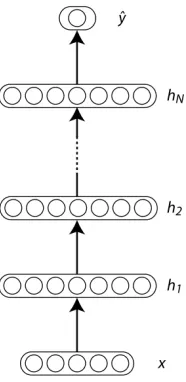
tanh) for which the parameters are learned by back prop-agating error gradients. This configuration is referred to as a “deep” architecture withklayers (see Figure 1 for an example).
For feature generation, we present a trained network with a new vector ~xrepresenting the input data on its
2E.g. a “one-hot” 50,000-dimensional vector of input words, with a
[image:2.612.385.478.65.256.2]‘1’ indicating the presence of the word at that index, and a ‘0’ every-where else.
Figure 1: Example of a deep model. The input vectorxis trans-formed into the hidden representation, here denoted ash1, using
an affine transformationW and a non-linearity. Each subse-quent hidden layerhktakes as input the output of its preceding
layerh(k−1)(Bengio, 2009).
input layer. After performing one iteration of forward-propagation through the network, we can then view the activation values in the hidden layers as dense, so-called “distributed representations” (features) of the input data. These features can in turn be passed to an output clas-sifier layer to produce some tagging task of interest. Re-cent work in deep learning show state-of-the-art results in part-of-speech parsing, chunking and named-entity tag-ging (Collobert, 2011), however performance in more complex NLP tasks like entity and event disambiguation and semantic role labelling are still trailing behind.
In this work we focus specifically on extending current state of the art deep neural models to improve their per-formance on these more difficult tasks. In the following section we briefly review and discuss the merits and lim-itations of three of the current state of the art deep learn-ing models for NLP. We then identify our primary re-search questions and introduce our proposed future work roadmap.
2
Current State-of-the-Art and
Limitations
Historically, training and testing these models were slow, scaling linearly in the vocabulary size. However, several recent approaches have been proposed which overcome these limitations (Morin and Bengio, 2005), including the work by Collobert and Weston (2008) and Mnih and Hinton (2009) discussed next.
2.1 Collobert & Weston (2008)
Collobert and Weston (2008) present a discriminative, non-probabilistic, non-linear neural language model that can be scaled to train over billions of words since each training iteration only computes a loss gradient over a small stochastic sample of the training data.
AllK-dimensional word embeddings are initially set to a random state. During each training iteration, an n-gram is read from the training data and each word is mapped to its respective embedding. All embeddings are then concatenated to form anK-length positive training vector. A corrupted n-gram is also created by replac-ing then’th (last) word by some word uniformly chosen from the vocabulary. The training criterion is that the net-work must predict positive training vectors with a score at least some margin higher than the score predicted for corruptedn-grams. Model parameters are trained simul-taneouslywith word embeddings via gradient descent.
2.2 The Hierarchical Log Bilinear (HLBL) Model
Mnih and Hinton (2007) proposed a simple probabilis-tic linear neural language model called the log bilin-ear (LBL) model. For ann-gram context window, the LBL model concatenates the first(n−1)K-dimensional word embeddings and then learns a linear mapping from
R(n−1)K toRK for predicting the embedding of thenth word. For predicting the next word, the model outputs a probability distribution over the entire vocabulary by computing the dot product between the predicted embed-ding and the embedembed-ding for each word in the vocabulary in an output softmax layer. This softmax computation is linear in the length of the vocabulary for each prediction, and is therefore the performance bottleneck.
In follow-up work, Mnih and Hinton (2009) speed up training and testing time by extending the LBL model to predict the next word by hierarchically decomposing the search through the vocabulary by traversing a binary tree constructed over the vocabulary. This speeds up train-ing and testtrain-ing exponentially, but initially reduces model performance as the construction of the binary partition-ing has a strong effect on the model’s performance. They introduce a method for bootstrapping the construction of the tree by initially using a random binary tree to learn word embeddings, and then rebuilding the tree based on a clustering of the learned embeddings. Their final results are superior to the standard LBL in both model perplexity and model testing time.
2.3 Recursive Neural Networks (RNNs)
Socher (2010; 2011) introduces a recursive neural net-work (RNN) framenet-work for parsing natural language. Previous approaches dealt with variable-length sentences by either
i using a window approach (shifting a window of n words over the input, processing each fixed-size win-dow at a time), or
ii by using a convolutional layer where each word is convolved with its neighbours within some sentence-or window-boundary.
RNNs operate by recursively applying the same neural network to segments of its input, thereby allowing RNNs to naturally operate on variable-length inputs. Each pair of neighbouring words is scored by the network to reflect how likely these two words are considered to form part of a phrase. Each such operation takes twoK-dimensional word vectors and outputs anotherK-dimensional vector and a score. Socher (2010) proposes several strategies (ranging from local and greedy to global and optimal) for choosing which pairs of words to collapse into a new K-dimensional vector representing the phrase comprised of the two words. By viewing these collapsing operations as branch merging decisions, one can construct a binary parse tree over the words in a bottom-up fashion.
2.4 Discussion of Limitations
Neural language models are appealing since they can more easily deal with missing data (unknown word com-binations) due to their inherent continuous-space repre-sentation, whereasn-gram language models (Manning et al., 1999) need to employ (sometimes ad hoc) methods for smoothing unseen and hence zero probability word combinations.
The original NPLM performs well in terms of model perplexity on held-out data; however, its training and test-ing time is very slow. Furthermore, it provides no support for handling multiple word senses, the property that any word can have more than one meaning, since each word is assigned an embedding based on its literal string repre-sentation (i.e. from a lookup table).
The Collobert & Weston model still provides no mech-anism for handling word senses, but improves on the NPLM by adding several non-linear layers which in-crease its modelling capacity, and a convolutional layer for modelling longer range dependencies between words. Recursive neural nets (RNNs) directly address the prob-lem of longer-range dependencies by allowing neighbour words to be combined into their phrasal equivalents in a bottom-up process.
perplexity, but shares the problem of slow training and testing times and the inability to handle word senses or dependencies between words (outside its n-gram con-text).
In the HLBL model, Mnih and Hinton address the slow testing performance of the LBL model by using a hierar-chical search tree over the vocabulary to exponentially speed up testing time, analogous to the concept of class-based language models (Brown et al., 1992). The HLBL model can also handle multiple word senses, but in their evaluation they show that in practice the model learns multiple senses (codes) for infrequently observed words instead of words with more than one meaning (Mnih and Hinton, 2009). The performance is strongly dependent on the initialisation of the tree, for which they present an iterative but non-optimal bootstrap-and-train procedure. Despite being non-optimal, it is shown to outperform the standard LBL model in terms of perplexity.
3
Mismatched Word Representations and
Classifiers
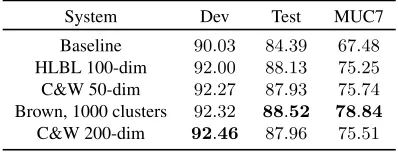
The deep learning ideal is to train deep, non-linear mod-els over large collections of unlabeled data, and then use these models to automatically extract information-rich, higher-level features3 to integrate into standard NLP or image processing systems as added features to improve performance. However, several recent papers report sur-prising and seemingly contradicting results for this ideal. In the most direct comparison for NLP, Turian (2010) compares features extracted using Brown clustering (a hierarchical clustering technique for clustering words based on their observed co-occurrence patterns), the hi-erarchical log-bilinear (HLBL) embeddings (Mnih and Hinton, 2007) and Collobert and Weston (C+W) em-beddings (Collobert and Weston, 2008), by integrating these as additional features in standard supervised condi-tional random field (CRF) classification systems for NLP. Somewhat surprisingly, they find that using the more complex C+W and HLBL features do not improve signif-icantly over Brown features. Indeed, under several con-ditions the Brown features give the best results.
These results are important for several reasons (we highlight these results in Table 2). The goal was to im-prove classification performance in structured prediction tasks in natural language by integrating features learned in a deep, unsupervised approach within a standard lin-ear classification framework. Yet these complex, deep methods are outperformed by simpler unsupervised fea-ture extraction methods.
3“Higher-level” features simply mean combining simpler features
extracted from a text to produce conceptually more abstract indicators, e.g. combining word-indicators for “attack”, “soldier”, etc. to form an indicator forWAR, even though “war” is not mentioned anywhere in the text.
System Dev Test MUC7
Baseline 90.03 84.39 67.48 HLBL 100-dim 92.00 88.13 75.25 C&W 50-dim 92.27 87.93 75.74 Brown, 1000 clusters 92.32 88.52 78.84
[image:4.612.327.526.58.134.2]C&W 200-dim 92.46 87.96 75.51
Table 2: Final NER F1 results reported by Turian (2010).
In a sense, these seem to be negative results for the utility of deep learning in NLP. However, in this work we argue that these seemingly anomalous results stem from a mismatch between the feature learning function and the classifier that was used in the classification (and hence evaluation) process.
We consider the learning problem h : X → Y to decompose intoh = h0(φ(X)), whereφis the feature learning function andh0 is a standard supervised classi-fier. φreads input fromX and outputs encodings in fea-ture spaceφ(x).hreads input in feature spaceφ(x)and outputs encodings in the output label spaceY.
Note that this easily extends to deep feature learning models by simply replacing φ(X) with φ(k)(· · ·φ(2)(φ(1)(X))· · ·), for a k-layer architecture,
where the first layer reads input inXand each subsequent layer reads the output of the previous layer.
Within this view of the deep learning process, we can see that unsupervised feature learning does not happen in isolation. Instead, the learned features only make sense within some learning framework, since the output of the feature learning functionφ(and each deep layerφ(k−1))
maps to a region in feature code space which becomes in turn the input to the output classifierh0(or subsequent layerφ(k)) . We therefore argue that in a semi-supervised or unsupervised classification problem, the feature learn-ing functionφshould be strongly dependent on the clas-sifierh0that interprets those features, and vice versa.
This notion ties in with the standard deep-learning training protocol of unsupervised pre-training followed byjointsupervised fine-tuning (Hinton et al., 2006) of the top classification layer and the deeper feature extraction layers. We conjecture that jointly training a deep feature extraction model with a linear output classifier leads to better linearly separable feature vectorsφ(x)than train-ing both independently. Note that this is in contrast to how Turian (2010) integrated the unsupervised features into existing NLP systems via disjoint training.
4
Proposed Work and Research Questions
modelling capacity of deep neural models, and to suc-cessfully model more complex semantic tasks such as anaphora resolution and semantic role labelling,we hy-pothesise that the model needs to avoid modelling purely local lexical semantics and needs to efficiently handle multiple word senses and long-range dependencies be-tween input words (or phrases) and output labels. We propose to overcome the limitations of previous models with regard to these design goals, by focusing on the fol-lowing key areas:
Input language representation: Neural models rely on vector representations of their input (as opposed to discrete representations as in, for instance, HMMs). In NLP, sentences are therefore encoded as real-valued em-bedding vectors. These vectors are learned in either a task-specific setting (as in the C+W model) or as part of a language model (as in the LBL model), where the goal is to predict the next word given the learned representa-tions of the previous words. In order to maximise the information available to the model, we need to provide information-rich representations to the model. Current approaches represent each word in a sentence using a dis-tinct word vector based on its literal string representation. However, as noted earlier, in NL the same words can have different senses based on the context in which it appears (polysemy). We propose to extend the hierarchical log-bilinear (HLBL) language model (see Section 2.2) in two important ways. We choose the HLBL model for its sim-plicity and good performance compared to more complex models.
Firstly, we propose to replace the iterative bootstrap-and-train process for learning the hierarchical tree struc-ture over the vocabulary with a modified self-balancing binary tree. The tree rebalances itself from an initial random tree to leave most frequently accessed words near the root (for shorter codes and faster access times), while moving words between clusters to maximise over-all model perplexity.
Secondly, we propose to add a word sense disambigua-tion layer capable of modelling long-range dependencies between input words. For this layer we will compare a modified RNN layer to a convolutional layer. The modi-fied RNN will embed each focus word with itsnmost dis-criminative neighbour words (in a sentence context win-dow) into a new K-dimensional, sense-disambiguated embedding vector for the focus word. We will evaluate and optimise the final model’s learned representations by evaluating language model perplexity on held out data.
Model architecture and internal representation: Deep models derive their modelling power from their hi-erarchical structure. Each layer transforms the output representation of its previous layer, allowing the model to learn more general and abstract feature combinations in the higher layers which are relevant for the current
task. The representations on the hidden layers serve as transformed feature representations of the input data for the output classifier. Enforcing sparsity on the hid-den layers has been shown to produce stronger features for certain tasks in vision (Coates et al., 2010). Ad-ditionally, individual nodes might be highly correlated, which can also reduce the performance of certain clas-sifiers which make strong independence assumptions (for instance naive Bayes). We propose to study the effect that enforcing sparsity in the learned feature representations has on task performance in NLP. Additionally, we pro-pose to evaluate the effect that an even stronger training objective – one that encourages statistical independence between hidden nodes by learning factorial code repre-sentations (Hochreiter and Schmidhuber, 1999) – has on model performance.
Modelling structure in the output space: Tasks in NLP mostly involve predicting labels which exhibit highly regular structure. For instance, in part-of-speech tagging, two determiners have a very low likelihood of following directly on one another, e.g. “the the”. In or-der to successfully model this phenomenon, a model must take into account previous (and potentially future) predic-tions when making the current prediction, e.g. as in hid-den Markov models and conditional random fields. We propose to include sequential dependencies in the output labels and to compare this with including a convolutional layer below the output layer, for predicting output labels in complex NLP tasks such as coreference resolution and event structure detection.
5
Conclusion
Deep learning methods offer an attractive unsupervised approach for extracting higher-level features from large quantities of text data to be used for NLP tasks. However current attempts at integrating these features into existing NLP systems do not produce the desired performance im-provements. We conjecture that this is due to a mismatch between the learned word representations and the classi-fiers used as a result of disjoint training schemes, and our thesis roadmap suggests three key areas for overcoming these limitations.
References
Y. Bengio, R. Ducharme, P. Vincent, and C. Janvin. 2003. A neural probabilistic language model. Journal of Machine Learning Research, 3:1137–1155, March.
Y. Bengio. 2009. Learning deep architectures for ai. Founda-tions and TrendsR in Machine Learning, 2(1):1–127. P.F. Brown, P.V. Desouza, R.L. Mercer, V.J.D. Pietra, and J.C.
A. Coates, H. Lee, and A.Y. Ng. 2010. An analysis of single-layer networks in unsupervised feature learning.Ann Arbor, 1001:48109.
R. Collobert and J. Weston. 2008. A unified architecture for natural language processing: Deep neural networks with multitask learning. InProceedings of the 25th International Conference on Machine Learning, pages 160–167. ACM. R. Collobert. 2011. Deep learning for efficient
discrimina-tive parsing. InInternational Conference on Artificial In-telligence and Statistics (AISTATS).
C. Cortes and V. Vapnik. 1995. Support-vector networks. Ma-chine learning, 20(3):273–297.
D. Gildea and D. Jurafsky. 2002. Automatic labeling of seman-tic roles.Computational Linguistics, 28(3):245–288. G.E. Hinton, S. Osindero, and Y.W. Teh. 2006. A fast
learn-ing algorithm for deep belief nets. Neural computation, 18(7):1527–1554.
S. Hochreiter and J. Schmidhuber. 1999. Feature extraction through lococode.Neural Computation, 11(3):679–714. A. Hyv¨arinen, J. Karhunen, and E. Oja. 2001. Independent
component analysis, volume 26. Wiley Interscience. I.T. Jolliffe. 2002. Principal component analysis, volume 2.
Wiley Online Library.
J. Lafferty. 2001. Conditional random fields: Probabilistic models for segmenting and labeling sequence data. In Pro-ceedings of ICML, 2001.
S. Lloyd. 1982. Least squares quantization in pcm. IEEE Transactions on Information Theory, 28(2):129–137. C.D. Manning, H. Sch¨utze, and MITCogNet. 1999.
Founda-tions of statistical natural language processing, volume 999. MIT Press.
A. Mnih and G. Hinton. 2007. Three new graphical models for statistical language modelling. InProceedings of the 24th international conference on Machine learning, pages 641– 648. ACM.
A. Mnih and G.E. Hinton. 2009. A scalable hierarchical dis-tributed language model. Advances in neural information processing systems, 21:1081–1088.
F. Morin and Y. Bengio. 2005. Hierarchical probabilistic neural network language model. InAISTATS05, pages 246–252. F. Rosenblatt. 1957. The Perceptron, a Perceiving and
Recog-nizing Automaton Project Para. Cornell Aeronautical Labo-ratory.
C.E. Shannon and W. Weaver. 1962. The mathematical theory of communication, volume 19. University of Illinois Press Urbana.
R. Socher, C.D. Manning, and A.Y. Ng. 2010. Learning contin-uous phrase representations and syntactic parsing with recur-sive neural networks. InProceedings of the NIPS-2010 Deep Learning and Unsupervised Feature Learning Workshop. R. Socher, C.C. Lin, A.Y. Ng, and C.D. Manning. 2011.
Pars-ing natural scenes and natural language with recursive neural networks. InProceedings of the 26th International Confer-ence on Machine Learning (ICML), volume 2, page 7. J. Turian, L. Ratinov, and Y. Bengio. 2010. Word