Long-term Security and Universal Composability
∗J¨orn M¨uller-Quade IKS, Universit¨at Karlsruhe
m e l r @ r . k . eu l e q i a u a d
Dominique Unruh Saarland University u r h m c . n - a r a d dn u @ m i u i s a l n . e
April 28, 2010
Abstract
Algorithmic progress and future technological advances threaten today’s cryptographic protocols. This may allow adversaries to break a protocol retrospectively by breaking the underlying complexity assumptions long after the execution of the protocol. Long-term secure protocols, protocols that after the end of the execution do not reveal any information to a then possibly unlimited adversary, could meet this threat. On the other hand, in many applications, it is necessary that a protocol is secure not only when executed alone, but within arbitrary contexts. The established notion of universal composability (UC) captures this requirement.
This is the first paper to study protocols which are simultaneously long-term secure and universally composable. We show that the usual set-up assumptions used for UC protocols (e.g., a common reference string) are not sufficient to achieve long-term secureand composable protocols for commitments or zero-knowledge protocols.
We give practical alternatives (e.g., signature cards) to these usual setup-assumptions and show that these enable the implementation of the important primi-tives commitment and zero-knowledge protocols.
Keywords: Universal Composability, long-term security, zero-knowledge, commit-ment schemes.
Contents
1 Introduction 3
1.1 The notion of long-term UC security . . . 3
1.2 Impossibility results . . . 5
1.3 Possibility results. . . 9
1.4 Related work . . . 10
1.5 Organisation . . . 12
2 Preliminaries 12 2.1 Notation . . . 12
2.2 Cryptographic tools . . . 13
3 Modelling composable long-term security 13 3.1 UC framework . . . 13
3.2 Long-term UC . . . 17
3.3 Conventions . . . 21
3.4 Functionalities . . . 22
4 Commitments 23 4.1 Impossibility results . . . 23
4.2 Commitments from zero-knowledge protocols . . . 27
4.3 Commitment protocols from a PKI . . . 29
4.4 Statistically hiding UC commitments are not always long-term UC . . . 32
5 Zero-knowledge protocols 36 5.1 Impossibility when using LTR functionalities . . . 36
5.2 Impossibility when using offline functionalities . . . 47
5.3 Generalising LTR . . . 52
6 Possibility results from non-standard setup assumptions 55 6.1 Trusted devices implementing a random oracle . . . 55
6.2 Signature cards . . . 59
7 Conclusions 68
A Technical lemmas 69
References 77
1
Introduction
Computers and algorithms improve over time and so does the ability of an adversary to break cryptographic protocols. The VENONA project is an example where the NSA (USA) and the GCHQ (U.K.) stored Russian ciphertexts over years until these ciphertexts could eventually be cryptanalysed. Official key length recommendations, e.g., by the Federal Office for Information Security (BSI) in Germany, are valid for no more than six years, and future technology like quantum computers could render even paranoid choices for the key length obsolete. This threatens in particular data that is required to remain confiden-tial for many years (e.g., medical data or government secrets). In other words, while we can be reasonably confident that cryptographic assumptions are indeed valid for today’s adversaries, it is very uncertain what computational problems will still be considered hard a decade from now. This leads to the requirement oflong-term security (a.k.a.everlasting security). A long-term secure protocol is based on temporary assumptions, assumptions that only have to hold during the execution of the protocol. These protocols should be secure even if the adversary becomes computationally unlimited after the protocol execu-tion. However, in contrast to unconditional security, which is not based on computational assumptions at all, for long-term security, computational assumptions need to holdduring the execution of the protocol. This reflects the fact that we can judge more or less precisely what the current state of the art is. A long-term secure protocol will be robust against future technological advances on the part of the adversary.
However, when considering protocol executions in complex environments (the Internet being the foremost example), long-term security alone will not be enough to guarantee the integrity and confidentiality of one’s data. It may happen that a protocol is long-term secure when executed in isolation, but becomes insecure when executed in larger contexts, e.g., as a subprotocol of some other protocol or concurrently with instances of the same or other protocols. This is also bothersome if one tries to modularly build up a protocol from smaller ones and wants to prove the security of the separate building blocks individually. Therefore a strong notion of long-term security should also have strong composability properties that guarantee the (long-term) security of the protocol even if this protocol is executed in a larger context.
While long-term security has been (explicitly or implicitly) considered in a number of works (see Section 1.4), to the best of our knowledge, so far there have been no gen-eral definitions of long-term security (i.e., not specific to a particular protocol task like commitment or key-exchange) and no positive composability results. In this paper, we investigate the requirements resulting from such a strong notion and give both positive and negative results for two important cryptographic building blocks, commitments and zero-knowledge protocols.
1.1 The notion of long-term UC security
(usually) performs the desired protocol task directly, without involving any cryptography. For example, a functionality FCOM for commitments would take a value m from the
sender in the commit-phase and notify the recipient that some value has been committed to (without revealing m). In the unveil-phase, the functionality FCOM would send m
to the recipient (without allowing the sender to change m). Obviously,FCOM is a secure
commitment by definition. We sayπcomputationally UC emulates Fif for any polynomial-time adversary A (attacking the real protocol π) there is a polynomial-time simulatorS (attacking the ideal functionalityF) such that for any polynomial-time machineZ (called the environment) the outputs of Z in an execution of the network π +A+Z (the real model) and in an execution of the networkF+S+Z(the ideal model) arecomputationally indistinguishable. Ifπcomputationally UC emulatesF, any attack performed byAcan be mimicked byS, hence intuitively π is as secure asF which in turn is secure by definition (as it is the specification of the protocol task at hand).
The notion of computational UC security has the advantage of giving strong compo-sitionality guarantees: If π computationally UC emulates F, then a protocol σπ using π as a subprotocol computationally UC emulates the protocol σF which invokesF instead of π (this is the so-called universal composition theorem [Can01]). Hence it is enough to analyse the (partially idealised) protocol σF (which in most cases will be much simpler). Then, the security properties of σF carry over to the more complex protocol σπ.
However, computational UC security does not guarantee long-term security: Since all machines (the adversary, the simulator, and the environment) are polynomially bounded, it is not excluded that the real protocol π can be broken by investing a superpolynomial amount of work after the protocol execution. This threat can be covered by requiring statistical UC security: The real protocolπstatistically UC emulatesthe ideal functionality
F if for any possibly unbounded adversary A there is a simulator S (whose running time is polynomially bounded in that of A) such that for anypossibly unbounded environment
Z the outputs of Z in an execution of the networkπ+A+Z and in an execution of the network F+S+Z are statistically indistinguishable. This definition is certainly strong enough to give long-term security guarantees. Yet, as this definition does not allow us to use any computational assumptions, it is too strong for most applications. For example, a commitment scheme satisfying this definition would have to be both statistically hiding and statistically binding; this is well-known to be impossible.
In order to extend the UC definition to encompass long-term security, we need to allow adversary, simulator, and environment to be computationally unlimitedafter the protocol execution (but not during the protocol execution). This could be modelled by explicitly introducing two execution phases, one in which the protocol runs and adversary, simulator, and environment are polynomially-bounded, and a second phase in which no protocol machine is allowed to run and adversary, simulator, and environment are unbounded.1
Furthermore, the output of the environment should bestatistically indistinguishable in the real and the ideal model. Yet, introducing these two phases unnecessarily complicates the details of the model. Instead, we can make use of a simple observation: It is a well-known fact that without loss of generality, we can assume that the adversary only passes messages
1One might, as in the case of statistical UC, restrict the simulator to be polynomially bounded in the
between the protocol and the environment, but does not perform any computations on its own (a so-called dummy-adversary [Can01]). Hence, when the protocol stops, we may assume that the dummy-adversary stops execution, too. If the dummy-adversary does not send any messages anymore, the simulator may also stop execution (since there is nothing to simulate). Thus, we may assume that after protocol execution, neither adversary nor simulator runs, and the environment only applies a (possibly inefficient) function to its output, but is polynomially bounded otherwise. Yet, applying such a function to the output of the environment cannot increase the statistical distance between the output in the real and in the ideal model, so we can even omit this post-protocol computation and get the following definition of long-term UC security:
Definition 1.1 (Long-term UC security – informal). A real protocol π long-term UC emulates the ideal functionality F if for any polynomial-time adversary A there is a polynomial-time simulator S such that for any polynomial-time environment Z the outputs of Z in an execution of the networkπ+A+Z and in an execution of the network
F+S+Z are statistically indistinguishable.
Summarising, the definition of long-term UC security captures the intuitive requirement of being secure against attacks of unbounded computational power after the protocol execution. It is not hard to see that long-term UC security is strictly stronger than com-putational UC security and strictly weaker than statistical UC security (see Section 3.2). Yet, the universal composition theorem also holds for long-term UC security (with an almost unmodified proof, see Section 3.2).
1.2 Impossibility results
1.2.1 Impossibility results for commitments.
We investigate whether it is possible to give long-term UC secure implementations of commitments; more precisely, whether there are protocols that long-term UC emulate the functionality FCOM for commitments. (Note that long-term UC secure commitments are
something stronger than statistically hiding, computationally UC secure commitments; cf. Section 1.2.3 below.) It is well-known that even with respect to computational UC, it is impossible to implement commitments without using any special setup assumptions [CF01, CKL03]. Instead, one has to assume that the real protocol has access to an ideal functionality like a common reference string (CRS) or a public key infrastructure (PKI).
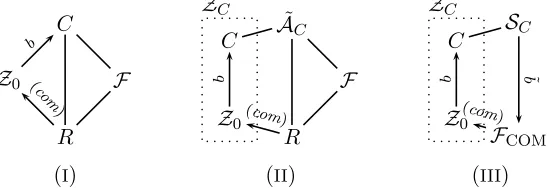
extractable (this holds even for computational UC). That is, when interacting with the sender, the simulator needs to be able to extract bfrom the messages sent by the sender. However, since the view of the sender is independent of b, this is impossible.
The only property of the CRS functionality that we actually used was that the com-munication from the functionality to the sender could be computed from the interaction from the functionality to the recipient. Furthermore, although in the case of the CRS, this computation is efficient, we did not use this fact. Hence, the above argument can be generalised to cover a large class of setup assumptions, which we call long-term revealing (LTR).
Definition 1.2 (Long-term revealing – informal). Let P be a party identifier. A functionality F is called long-term revealing (LTR) for P if the following holds: In any protocol (where the protocol includes F, and specifies some implementation of the party P, and possibly other machines), the communication2 between P and F can be derived (possibly by applying a inefficient function) from the communication between F and all parties except P.
If a functionalityF is LTR for P, any secrets thatP and F have established during the protocol run will eventually be learned by a adversary that is unbounded after the protocol execution. (Note that the definition does not imply that any such secrets between P andF are established. If no such secrets are established, the definition holds vacuously.) Thus, using a similar argument as in the case of the CRS, we get the following theorem:
Theorem 1.3 (Impossibility of commitments using LTR functionalities – infor-mal). No long-term UC secure protocol for commitments with sender C can be imple-mented using a functionality that is LTR for C.
Many commonly used setup assumptions are LTR functionalities. Indeed:
• The CRS is LTR for all parties because all parties get the same value.
• For the same reason, a coin-toss is LTR for all parties.
• A PKI is LTR for all parties assuming that the public key uniquely determines the corresponding secret key.
• The commitment functionality is LTR for the recipient.
As a corollary we get that, with respect to long-term UC security, commitments cannot be “turned around”: Since a commitment from Rto C is LTR forC, it cannot be used to implement a long-term UC secure commitment from C to R.
2We stress that this refers to the bi-directional communication between P andF. In the case of the
1.2.2 Impossibility results for zero-knowledge protocols.
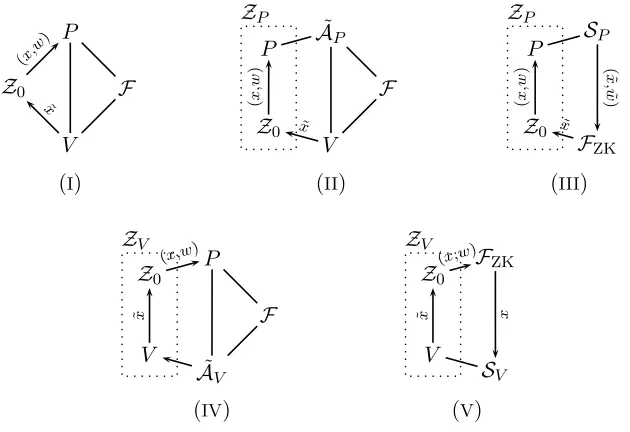
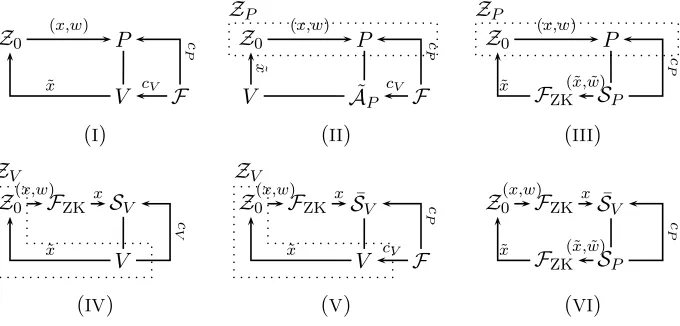
We then show that, in general, it is impossible to implement long-term UC secure zero-knowledge protocols3 using LTR functionalities. In order to describe the impossibility
result, we first need to define a certain class of relations:
Definition 1.4 (Essentially unique witnesses – informal). A relation R has essen-tially unique witnesses if there is a polynomial-time algorithm UR (the witness unifier)
with the following two properties: On input (x, w) ∈ R, UR outputs a witness w′ with
(x, w′) ∈ R. For (x, w1),(x, w2) ∈ R, the distributions of UR(x, w1) and UR(x, w2) are
statistically indistinguishable.
In other words, for a relation with essentially unique witnesses it is possible to efficiently produce a “normal form”w′ =UR(x, w) of a witnesswin such a way that it is
information-theoretically impossible to find out from which ofx’s witnesses the witnessw′ was derived.
A special case are relations where each statement has at most one witness (relations with unique witnesses). In this case, ifUR(x, w) just outputsw,UR fulfils Definition 1.4.
Hence relations with unique witnesses are a special case of relations with essentially unique witnesses.
For relations that do not have essentially unique witnesses, we get the following im-possibility result:
Theorem 1.5 (Impossibility of zero-knowledge protocols using LTR function-alities – informal). If R does not have essentially unique witnesses, no long-term UC secure zero-knowledge protocol for the relation R with prover P can be implemented using a functionality that is LTR for P.
The reader might wonder whether Theorem 1.5 can be strengthened to show that for any nontrivial relation R, long-term UC secure zero-knowledge protocols using LTR function-alities are impossible. However, this is not the case: We present a long-term UC secure zero-knowledge protocol for showing the knowledge of the factorisation of a Blum-integer using an LTR functionality. Assuming that the factorisation of Blum-integers is a hard problem, this constitutes a long-term UC secure zero-knowledge protocol for a nontrivial relation. Thus, although it is not clear whether this protocol has practical applications, it at least shows that the condition on R in Theorem 1.5 is necessary.
Yet, we can weaken the condition on R if we strengthen the conditions on the func-tionality: We call a functionality offline if it distributes some values to all parties at the very start of the protocol and then stops. Examples for offline functionalities are the CRS (which sends the same random value to all parties and then stops) and the PKI (which sends the secret key to a single party and the public key to all parties and then stops). We have the following theorem:
Theorem 1.6 (Impossibility of zero-knowledge protocols using offline LTR func-tionalities – informal). Let R be a nontrivial relation.4 Then no long-term UC secure
3By a long-term UC secure zero-knowledge protocol we mean a protocol that long-term UC securely
implements the zero-knowledge functionalityFZK. This functionality takes a pair (x, w) from the prover, and ifwis a witness forx, then the functionality givesxto the verifier.
zero-knowledge protocol for the relation R with prover P can be implemented using an offline functionality that is LTR for P.
This rules out any useful long-term UC secure zero-knowledge protocol that uses only a CRS or a PKI.
1.2.3 Statistically hiding, computationally UC secure commitments.
Intuitively, a long-term UC secure commitment scheme gives the following two guaran-tees: First, it guarantees that the committed value stays secret even in the presence of adversaries that are computationally unbounded after the protocol execution; this would also be guaranteed if the protocol was statistically hiding. Second, long-term UC security guarantees composability within arbitrary protocols; this would also be guaranteed by computational UC security. This observation may lead to the following conjecture:
Conjecture (false): If a commitment scheme is statistically hiding, and also computationally UC secure,5 then it is long-term UC secure.
Indeed, commitment schemes that are both statistically hiding and computationally UC secure are known [DN02] (based on a CRS). So if this conjecture was true, it would imme-diately give us long-term UC secure commitment schemes based on a CRS. Unfortunately, from our impossibility results it follows that such schemes do not exist, hence the conjec-ture must be false.
In order to give a better intuition about why a statistically hiding, computationally UC secure commitment scheme may fail to be long-term UC secure, we roughly sketch why the scheme from [DN02] (called the DN-commitment hereafter) fails to be long-term UC secure:
The basic idea behind the DN-commitment is very roughly the following: The set of possible values of the CRS is partitioned into two computationally indistinguishable sets E and E∁. The DN-commitment scheme is designed in such a way that if the CRS is in E, then the commitment is statistically hiding. However, if the CRS is in E∁, then the commitment is extractable (given a certain trapdoor, the committed message can be extracted) and equivocable (given a certain trapdoor, the committed message can be changed after the commit phase). In particular, if the CRS is in E∁, the DN-commitment scheme is only computationally hiding. In a normal execution, the CRS will always be chosen from E, hence the scheme is statistically hiding. To show the computational UC property, however, one constructs a simulator that chooses the CRS fromE∁. In this case, the simulator is able to use the extractability and equivocability to perform its simulation. Since the simulator chooses the CRS from a different set E∁ than the CRS in the real execution, the simulated protocol execution is not statistically indistinguishable from
5To avoid confusion, note that this is a different notion than requiring that the commitment scheme is
the real execution. Hence the DN-commitment is not long-term UC secure in the sense of Definition 1.1 although it is both computationally UC secure and statistically hiding individually. The intuitive reason is that the DN-commitment is not simultaneously sta-tistically hiding and computationally UC secure within a single execution.
This shows that the above conjecture is false in general. One might still argue that this is a problem of our definition (i.e., that long-term UC security is too strong a notion), and that statistically hiding, computationally UC secure commitment schemes are good enough for all purposes. To show that this is not the case, we present a simple (though contrived) protocol π with the following property: When π uses ideal commitments, Alice’s inputm is kept secret even in the presence of unbounded adversaries. Yet, when we instantiate the ideal commitments inπwith the DN-commitment scheme, thenmcan be extracted by an adversary that is computationally bounded during the protocol execution, but unbounded afterwards. In other words, the DN-commitment scheme looses its long-term security when composed.
1.3 Possibility results.
As the commonly used setup assumptions do not allow us to construct long-term UC secure commitments and zero-knowledge protocols, we present two practically motivated setup assumptions (based on [HUMQ07]) which do allow us to construct such protocols.
The first of these setup assumptions is a trusted pseudorandom function (TPF). A TPF represents a piece of trusted hardware that computes a pseudorandom function [GGM86] but does not (explicitly) reveal the seed of that function. Of course, the seed may be implicitly determined by the answers to sufficiently many queries to the TPF, but finding the seed based on these answers is infeasible. We assume that all parties have access to TPFs implementing the same function.
The second setup assumption is a signature card. A signature card represents a piece of trusted hardware that computes signatures on arbitrary messages for its owner, but never (explicitly) reveals its signing key (as in the case of TPFs). The corresponding verification key, however, is publicly known. The practical advantage of assuming signature cards is that such signature cards are commercially available.
In the following exposition, we concentrate on signature cards, but analogous reasoning and results hold for TPFs.
At the first glance, it seems that signature cards are LTR for all parties and thus cannot be used to construct long-term UC secure commitments or zero-knowledge protocols: A computationally unbounded machine can compute the the signature card’s signing key from the verification key, and thus compute the answers to any query made by the owner of the signature card. However, upon closer inspection, it turns out that signature cards are not LTR for their owner: Although an unbounded machine could compute the answers to all queries made to the signature card, it cannot determinewhich queries were actually made.
(a) The prover knows strings σ and w such that σ is a valid signature on w, and w is a witness forx, or
(b) the prover knows the secret signing key of the signature card.
We can show that this protocol is long-term UC secure even if polynomially many instances of the protocol are run concurrently, sharing a single signature card.6 This is
very important for practical applications as it would be impractical to expect the user to use a fresh signature card for each and every zero-knowledge protocol he executes.
Given long-term UC secure zero-knowledge protocols, we can construct long-term UC secure commitments using standard techniques.
Combining these results, we get the following theorem:
Theorem 1.7 (Long-term UC secure protocols from signature cards – informal).
Using a single signature card (and assuming the existence of one-way functions), we can ex-ecute an arbitrary (polynomially-bounded) number of long-term UC secure zero-knowledge protocols and commitments.
The protocol is also guaranteed to stay secure if the adversary retrieves the signing key from the signature card after the protocol execution (e.g., by opening it).
Similar ideas are used to construct long-term UC secure zero-knowledge protocols and commitments schemes from TPFs. However, the resulting protocol is somewhat more complicated than in the case of signature cards.
1.4 Related work
1.4.1 Related to long-term security
Memory bounded adversaries. The idea of long-term or everlasting security has been considered with respect to memory bounded adversaries. Key exchange protocols and protocols for oblivious transfer have been developed in the bounded storage model [CM97, CCM02]. These protocols can be broken by an adversary with more memory than assumed, however they cannot be broken in retrospect even by an unlimited adversary. [Rab03] presents a scheme using distributed servers of randomness (virtual satellites) to achieve everlasting security; in this scheme the access of the adversary to the communication between the parties and the distributed servers is limited during the key exchange. It was shown by [DM04] protocols in the bounded storage model do not necessarily stay secure when composed with other protocols.
Quantum cryptography. Long-term security has been investigated in quantum cryptog-raphy. It is generally accepted (even though not formally proven) that a computationally secure authentication of a quantum key exchange yields a long-term secure key. Quan-tum protocols for bit commitment and oblivious transfer which become unconditionally
6This is not automatically guaranteed by the universal composition theorem since that theorem requires
secure, but rely on temporary computational assumptions were investigated and found to be impossible7 (see, e.g. [BCMS99]).
Zero-knowledge, commitments, function evaluation. Statistical zero-knowledge arguments [BCC88] are in fact long-term secure zero-knowledge protocols (but not nec-essarily UC secure, of course). As soon as the protocol terminates, an adversary cannot profit from additional computational power; an unbounded verifier cannot learn anything because the argument system is statistical zero-knowledge, and an unbounded prover can-not cheat because the proof is already finished.
Similarly, statistically hiding commitments [NOVY98] are actually long-term secure commitments since after the end of the protocol, even with unlimited computational power, no party can learn the committed value (unless an unveil is performed) and no party can change the committed value (since the protocol has already ended).
[MQ05] stated protocols for secure function evaluation achieving long-term security; however, they only considered secure function evaluation with constant input size. Their protocols do not allow for universal composition (they do, however, compose sequentially).
Forward security. Another related topic is that of forward security, which was intro-duced in the context of key exchange in [DvOW92, G¨un90]. Forward security requires that past session keys remain computationally secure even if some long-term secret is revealed to the adversary. This notion is related to and seems to be implied by long-term UC because in most protocols the session keys can be computed by unlimited adversaries and can therefore be considered to be known after the protocol execution.
1.4.2 Related to composition
Composition of general (not long-term secure) protocols as well as particular classes of protocols like zero-knowledge has been extensively studied. For example, [FS90] presented a zero knowledge scheme that does not compose in parallel and introduced the notion of witness indistinguishable proofs. This security property is weaker than zero-knowledge but closed under parallel composition. More general impossibility results regarding the both sequential and parallel composability of zero-knowledge protocols were independently shown in [GK96].
The work [CK01] provides a security definition for key exchange which allows us to build secure channels from key exchange, which was not guaranteed by earlier definitions. The security requirement of non-malleability of cryptographic protocols [DDN91] becomes necessary when the protocols are to be used in certain larger applications.
Composition theorems which are independent of the surrounding application were given in [Can00] for sequential composition and in [BPW07, Can01] for universal composition (UC).
To the best of our knowledge, with exception of the negative result [DM04], previous work on long-term security did not take the problem of composability into account.8
7Unless additional assumptions are made, such as bounded quantum storage [DFSS05] or the availability
of a piece of trusted hardware.
8[WW08] investigates sequential composition in the quantum bounded storage model. Their
1.5 Organisation
Section 2 (Preliminaries). We present elementary notation and nomenclature (Sec-tion 2.1) and list the cryptographic tools used throughout this work (Sec(Sec-tion 2.2).
Section 3 (Modelling composable long-term security). We develop the definition of long-term UC. First, we review the UC framework on which our definition is based (Sec-tion 3.1). In Sec(Sec-tion 3.1, we introduce and motivate our defini(Sec-tion of long-term UC security. Further, we state a few implicit conventions used in the rest of the paper (Section 3.3) and define the functionalities used in the rest of this work (Section 3.4).
Section 4 (Commitments). In this section, we discuss long-term UC secure commit-ments. We introduce long-term revealing setup assumptions and show the impossibility of realising long-term UC secure commitments from these (Section 4.1). Then we show that given a long-term UC zero-knowledge scheme, long-term UC commitments can be realised (Section 4.2). In Section 4.4 we explain why statistically hiding, computationally UC secure commitment schemes are not necessarily long-term UC secure.
Section 5 (Zero-knowledge protocols). We discuss long-term UC secure zero-knowledge protocols. In Section 5.1 we introduce the class of relations with essentially unique witnesses and show that using long-term revealing setup assumptions, relations without essentially unique witnesses cannot have long-term UC secure zero-knowledge protocols. In Section 5.2 we extend our impossibility result by showing that if a long-term revealing setup assumption is used offline, we can only construct long-long-term UC zero-knowledge protocols for (almost) trivial relations. In Section 4.3 we investigate in more detail whether a PKI can be used for constructing long-term UC zero-knowledge protocols.
Section 6 (Possibility results from non-standard setup assumptions). We inves-tigate non-standard (but practically motivated) setup assumptions that enables the imple-mentation of long-term UC secure commitments and zero-knowledge schemes. Namely, in Section 6.1 we show how to do this using trusted hardware that evaluates pseudorandom functions, and in Section 6.2 we show how to use signature cards.
Section 7 (Conclusions). We conclude the paper and propose directions for further research.
2
Preliminaries
2.1 Notation
We call a function f negligible, if for any positive polynomial p and sufficiently large k, f(k)≤1/p(k). We call f overwhelming, when 1−f is negligible. We callf non-negligible if it is not negligible. We call f noticeable if there is a positive polynomial such that for sufficiently large k we havef(k)≥1/p(k).
A PPT-algorithm (probabilistic polynomial time) is a uniform probabilistic algorithm that runs in polynomial-time in the length of its inputs.
We call a relationR on {0,1}∗× {0,1}∗ poly-balanced if there is a polynomial p, such that |w| ≤ p(|x|) for all x, w with xRw. We call R an NP-relation if it is poly-balanced and deciding (x, w)∈R is in P. The languageLRassociated withRisLR:={x∈ {0,1}∗ :
∃w:xRw}. We usually call x thestatement and w with xRwthe witness forx. We call an NP-relation R(uniformly) trivial if there is a PPT-algorithm that upon inputx∈LR
outputs a witness for x with overwhelming probability. We call R nonuniformly trivial there is a nonuniform deterministic polynomial-time algorithm that upon input x ∈ LR
outputs a witness forx.
An integern > 0 is called a Blum-integer, ifn=pq for two primesp, q with p≡q ≡ 3 mod 4. An integerp≥3 is called asafe prime if bothp and p−12 are prime.
An EF-CMA secure signature scheme is a scheme that has existential unforgeability under chosen message attacks [GMR88]. We do not require perfect completeness (i.e., when choosing a key pair, signing and then verifying, the probability of a successful verification is overwhelming but not necessarily 1).
Unless otherwise stated, all security assumptions are against nonuniform adversaries (e.g., EF-CMA security means EF-CMA security with respect to nonuniform adversaries).
2.2 Cryptographic tools
In [HR07], it is shown that assuming the existence of a one-way function, a statistically hiding commitment scheme exists. This scheme has the additional properties that the unveil-phase consists of only one message, and that given the message, the committed valuev, and the transcript of the interaction in the commit phase, there is a deterministic polynomial-time algorithm that checks whether the verifier accepts the value v. If both parties are honest, the verification succeeds with probability 1 (perfect correctness).
Using that commitment-scheme in the zero-knowledge argument-system for graph-3-colourability from [GMW91], we get a statistically witness indistinguishable argument of knowledgestatistically witness indistinguishable argument of knowledgefor any NP-relation given any one-way function.9
For some results, we will need the existence of EF-CMA secure signature schemes. These also exist under the assumption that one-way functions exist [Rom90].
3
Modelling composable long-term security
3.1 UC framework
Since our work builds on the UC framework [Can01], in this section we revisit the main points of that model. The reader familiar with the UC framework can safely skip this section and proceed to Section 3.2 on page 17.
In general, the fact that a protocol is secure with respect to some security notion does not necessarily imply that the protocol stays secure with respect to that notion when
com-9The resulting scheme is of course even zero-knowledge, not only witness-indistinguishable, but we do
posed with other (secure) protocols. Therefore, an important property of security notions is the ability to guarantee secure composition. One security notion that gives very strong composability guarantees is the Universal Composability framework (UC) from [Can01]. (As well as the independently proposed and essentially identical Reactive Simulatability framework [BPW07].)
Overview. Security in the UC framework is defined by comparison of a real protocol π with some ideal protocol ρ. In most cases, this ideal protocol ρ will consist of a single machine, a so-called ideal functionality. Such a functionality can been seen as a trusted machine that implements the intended behaviour of the protocol. For example, a func-tionalityF for commitment would expect a valuemfrom a party C. Upon receipt of that value, the recipientR would be notified by F that C has committed to some value (but
F would not reveal that value). WhenC sends an unveil request to F, the value m will be sent to R (but F will not allow C to unveil a different value). For more examples of functionalities, see Section 3.4 or [Can01].
Given a real protocol π and an ideal protocol ρ, we say that π realises ρ (also called “implements”, “emulates”, or “is as secure as”) if for any adversary A attacking the
pro-tocol π there is a simulator S performing an attack on the ideal protocol ρ such that no environmentZ can distinguish betweenπ running withA andρ running withZ. HereZ may choose the protocol inputs and read the protocol outputs and may communicate with the adversary or simulator (but Z is, of course, not informed whether it communicates with the adversary or the simulator). There are two important differences between the UC model and the so-called stand-alone model for secure multiparty computation (see, e.g., [Gol04, Chapter 7]). First, the environment may communicate with the adversary during the protocol execution, and second, the environment does not need to choose the inputs at the beginning of the protocol execution; it may adaptively send inputs to the protocol parties at any time, and it may choose these inputs depending upon the outputs and the communication with the adversary. These modifications are the reason for the very strong composability properties of the UC model.
Definitions. In order to formulate these properties, let us first give more detail on the above intuition. In the UC framework, all protocol machines and functionalities, as well as the adversary, the simulator and the environment are modelled as interactive Turing machines (ITM). Throughout a protocol execution, an integerkcalled the security parameter is accessible to all parties. At the beginning of the execution of a network consisting ofπ,A, andZ, the environmentZis invoked with an initial inputz. From then on, every machineM that is activated can send a messagemto a single other machineM′. Then that machineM′ is activated and given the message m and the id of the originator
M′. If in some activation a machine does not send a message, the environment Z is activated again. Additionally the environment may issue corruption requests for some party P. From then on, the machines corresponding to the party P are controlled by the adversary (i.e., it can send and receive messages in the name of that machine, and it can read the internal state of that machine). Finally, at some point the environment Z gives some outputmwhich can be an arbitrary string. By EXECπ,A,Z(k, z) we denote the
the environment Z.
We distinguish two different flavours of corruption. We speak of static corruption if the environment Z may only send corruption requests before the begin of the protocol, and of adaptive corruption ifZ may send corruption requests at any time in the protocol, even depending on messages learned during the execution. In this paper, we will restrict our attention to the less strict security model using static corruption.
If the ideal protocol ρ consists of an ideal functionality F, for technical reasons we assume the presence of so-called dummy parties that forward messages between the en-vironment Z and the functionality F. For example, assume that F is a commitment functionality. In an ideal execution, Z would send a value m to the party C (since it does not know of F and therefore will not send to F directly). Then C would forward m to F. Then F notifies R that a commitment has been performed. This notification is then forwarded to Z. With these dummy parties we have, at least syntactically, the same messages as in the real execution: Z sends m to C and receives a commit notification from R. Second, the dummy-parties allow a meaningful corruption in the ideal model. If
Z corrupts some partyP, in the ideal model the effect would be that the simulator controls the corresponding dummy party P and thus can read and modify messages to and from the functionalityF in the name of P. Thus if we write EXECF,S,Z, this is essentially an
abbreviation for EXECρ,S,Z where the ideal protocolρ consists of the functionalityF and
the dummy-parties.
For full details see [Can01].
Having defined the families of random variables EXECπ,A,Z(k, z) and EXECρ,S,Z(k, z)
we can now define security via indistinguishability.
Definition 3.1 (Universal Composability [Can01]). A protocol π UC realises a pro-tocol ρ, if for any polynomial-time adversary A there exists a polynomial-time simula-tor S, such that for any polynomial-time environment Z the families of random vari-ables {EXECπ,A,Z(k, z)}k∈N,z∈{0,1}
poly(k) and {EXECρ,S,Z(k, z)}k∈N,z∈{0,1}
poly(k) are com-putationally indistinguishable.
Note that in this definition, it is also possible to only consider environmentsZ that give a single bit of output. As demonstrated in [Can01], this gives rise to an equivalent definition. However, in the case of long-term UC below, this will not be the case, so we stress the fact that we allow Z to output arbitrary strings. In particular an environment machine can output its complete view.
Natural variants of this definition are statistical UC, where all machines (environment, adversary, simulator) are computationally unbounded and the families of random variables are required to be statistically indistinguishable, and perfect UC, where all machines are computationally unbounded and the families of random variables are required to have the same distribution. In these cases one often additionally requires that if the adversary is polynomial-time, so is the simulator.
Composition. For some protocolσ, and some protocol π, byσπ we denote the protocol whereσ invokes (up to polynomially many) instances ofπ.10 That is, in σπ the machines
10For simplicity, we assume throughout this work that the session ids assigned to these instances are
fromσand fromπ run together in one network, and the machines fromσ access the inputs and outputs of π. (In particular, Z then talks only to σ and not to the subprotocol π directly.) See [Can01] for details. A typical situation would be that σF is some protocol that makes use of some ideal functionality F (say, a commitment) and then σπ would be
the protocol resulting from implementing that functionality by some protocol π (say, a commitment protocol). One would hope that such an implementation results in a secure protocol σπ. That is, if π realises F and σF realises G, then σπ realises G. Fortunately,
this is the case:
Theorem 3.2 (Universal Composition Theorem [Can01]). Let π, ρ, and σ be polynomial-time protocols. Assume that π UC realises ρ. Then σπ UC realisesσρ.
For a proof see [Can01] or our proof sketch of Theorem 3.4 below. The intuitive reason for this theorem is that σ can be considered as an environment for π or ρ, respectively. Since Definition 3.1 guarantees that π and ρ are indistinguishable by any environment, security follows.
In a typical application of this theorem one would first show that π realises F and that σF realises G. Then using the composition theorem one gets that σπ realises σF
which in turn realisesG. Since the realises-relation is transitive (as can be easily seen from Definition 3.1), it follows that σπ realises G.
This composition theorem is the main feature of the UC framework. It allows us to build up protocols from elementary building blocks. This greatly increases the manage-ability of security proofs for large protocols. Furthermore it guarantees that the protocol can be used in arbitrary contexts.
Analogous theorems also hold for statistical and perfect UC.
Dummy-adversary. When proving the security of a given protocol in the UC setting, a useful tool is the so-called dummy-adversary. The dummy-adversary ˜A is the adversary that simply forwards messages between the environment Z and the protocol (i.e., it is a puppet of the environment that does whateverZinstructs it to do). In [Can01] it is shown that UC security with respect to the dummy-adversary implies UC security. The intuitive reason is that since ˜Adoes whateverZ instructs it to do, it can perform arbitrary attacks and is therefore the worst-case adversary given the right environment (remember that we quantify over all environments).
We very roughly sketch the proof idea. Let protocolsπ and ρ and some adversaryA be given. Assume thatπ UC realisesρwith respect to the dummy-adversary ˜A. We want to show that π UC realises ρ with respect to A. Given an environmentZ, we construct an environment ZA which simulates Z and A. Note that an execution of EXECπ,A˜,ZA is essentially the same as EXECπ,A,Z (up to a regrouping of machines). Then there is
a simulator ˜S such that EXECπ,A˜,ZA and EXECρ,S˜,ZA are indistinguishable. Let S be
the simulator that internally simulates the machines A and ˜S and forwards all actions performed by A as instructions to ˜S (remember that ˜S simulates ˜A, so it expects such instructions). Then EXECρ,S˜,ZA is again the same as EXECρ,S,Z up to a regrouping of
machines. Summarising, we have that EXECπ,A,Z and EXECρ,S,Z are indistinguishable.
For details, see, e.g., [Can01].
perfect UC security, as well as with respect to our notion of long-term UC that is defined below (in all cases the proof is virtually unmodified).
3.2 Long-term UC
We now present our model of universally composable long-term security (long-term UC). We build on the Universal Composability framework [Can01] described in the preceding section. In that modelling, a computationally limited entity called the environment has to distinguish between an execution of the protocol (with some adversary) and an execution of an ideal functionality (with some simulator). To define long-term security, we have to add the requirement that even if some entity gets unlimited computational power after the execution of the protocol, security is maintained.
The most immediate solution would be to introduce two phases in the execution of the network. In the first phase, all machines are computationally limited, and the protocol runs normally. In the second phase, the environment, the adversary, and the simulator are allowed to be computationally unlimited, but the protocol machines are not allowed to send any more messages. Thus the first phase models the protocol execution, and the second phase models the time after the protocol execution during which the data retrieved in the protocol may be analysed and computational assumptions may be broken. Finally, the output of the environment is required to be statistically indistinguishable in the real and the ideal model. (The choice of statistical instead of computational indistinguishability is because the distinction also happens after the protocol execution.)
Although this approach would probably work and give a reasonable model of long-term UC security, the introduction of different phases introduces major changes to the technical parts of the UC framework. For example, a machine model must be defined that allows us to switch the computational power from polynomial to unlimited, it must be specified who decides when the first phase ends (does the protocol have an output that it has finished execution, does the environment decide?), scheduling issues must be solved (when the second phase begins, how are the machines notified of this fact, in which order are they activated by the notification?), etc. We believe that all these issues can be solved. However, changes in scheduling or the definition of running-time have shown to interact nontrivially with other parts of the definition of UC and with the composition theorem (see, e.g., [BHMQU05, HMQU05]). And many of the design decisions might be quite arbitrary or hard to motivate. Therefore, instead of using this two-phase model, we strive for a simpler definition of long-term UC security that introduces minimal changes with respect to the original UC framework and that in particular does not need to change the network, machine or running-time model.
assume without loss of generality that the dummy-adversary stops communicating after the first phase, too. Since the simulator has to mimic the behaviour of the adversary, the simulator will also stop communicating after the first phase. So we have arrived at a model, where in the second phase the only machine that actually performs any computations is the environment, and no communication takes place. Then any post-protocol computation of the environment would be nothing more than the application of a function to the view, so the statistical distance between the environment’s output in the real and the ideal model will be maximal for the environment that just outputs its unmodified view. Thus we can even get rid of the environment’s internal computation in the second phase by allowing the environment to output its complete view.
By this argument, we have found a very simple way of adding the long-term security requirement to the UC framework: We simply require that after the execution of the protocol (which is still performed against computationally limited adversaries and envi-ronments) even an unlimited entity could not distinguish between an execution of the real protocol or of the functionality, i.e., we require that the output of the environment is statistically indistinguishable in the real and ideal model.11 Note that this is the only modification with respect to the original UC framework and the modification is actually smaller than that between computational and statistical UC. In particular, we can ex-pect many properties derived for the original UC framework to easily carry over to the long-term UC framework.
In the following definition, let EXECπ,A,Z(k, z) denote the output ofZin an execution
of the protocol π with adversaryAand environmentZ, wherekis the security parameter and z the auxiliary input of the environmentZ. EXECF,A,Z(k, z) is defined analogously.
See Section 3.1 for details.
Definition 3.3 (Long-term UC). A protocol π long-term UC realises an ideal pro-tocol ρ, if for any polynomial-time adversary A there exists a polynomial-time simula-torS, such that for any polynomial-time environment12Z the families of random variables
{EXECπ,A,Z(k, z)}k∈N,z∈{0,1}
poly(k) and{EXECρ,S,Z(k, z)}k∈N,z∈{0,1}
poly(k) are statistically indistinguishable.
Relation to other UC variants. Obviously, this definition is stronger than computa-tional UC as in Definition 3.1 because we replaced computacomputa-tional by statistical indistin-guishability. Furthermore, statistical security (following [Can01] we assume the variant that requires the simulator to be polynomial-time if the adversary is, see page 15) implies long-term UC security: In the case of statistical security, statistical indistinguishability holds for all environments and simulators, thus in particular for polynomial-time ones. And for polynomial-time adversaries, the simulator is guaranteed to be polynomial-time, too. Thus the conditions for long-term UC security are fulfilled.
Thus long-term UC lies between computational and statistical UC. Indeed, these im-plications are strict (assuming, e.g., the existence of one-way functions) as shown by the following examples: Let π be a protocol that expects a messagem from the environment
11Here it is important that we are using the formulation of the UC framework where the environment is
not restricted to outputting a single bit.
(I)
Z
A
σ π1
.. . πn
(II)
Z
A
σ S˜1 ρ1
.. . ... ˜
Sn ρn
S
(III)
Z
A
σ
π1
.. . πi−1
˜
A πi
˜
Si+1 ρi+1
.. . ... ˜
Sn ρn
Zσ,i
Figure 1: Networks occurring in the proof sketch of Theorem 3.4. Network (I) represents the real model, (II) the ideal model, and (III) the hybrid case. For simplicity, not all connections between machines are depicted. E.g., Aalso has connections to the instances of π, and σ also has direct connections to the instances ofρ.
and passes that message to the adversary if and only if the adversary solves some com-putationally hard puzzle (e.g., inverting a one-way function). Let ρ be a protocol that expectsm from the environment but does not givem to the adversary. Thenπlong-term UC realises ρ but does not statistically UC realise ρ.
Furthermore, letπ′ be a protocol that outputs a pseudorandom string, and letρ′ be a
protocol that outputs a truly random string. Then π′ computationally UC realises ρ′ but does not long-term UC realise ρ′.
The fact that statistical UC implies long-term UC is useful since one can use statistical UC results and combine them with long-term UC results using the composition theorem (see Theorem 3.4 below) to construct a larger long-term UC secure protocol. For example, from a commitment functionality, it is easy to construct a statistically secure coin toss.13
Combined with a long-term UC secure protocol for commitment, we get a long-term UC secure coin toss protocol.
Composition. Due to the minimal change in the security definition, the composition theorem from [Can01] (Theorem 3.2 above) carries over to our Definition 3.3:
Theorem 3.4 (Universal Composition Theorem).Letπ,ρ, andσbe polynomial-time protocols. Assume that π long-term UC realisesρ. Then σπ long-term UC realises σρ.
For the full proof, we refer to [Can01], the only modification that needs to be made to their proof of the composition theorem is to replace all occurrences of terms of the form
|Pr[EXEC... = 1]−Pr[EXEC... = 1]| (comparing the probability of the environment
outputting 1) by ∆(EXEC...,EXEC...) where ∆ denotes the statistical distance (comparing
the actual distributions of environment’s output). Except for this modification, the proof from [Can01] is unchanged. However, for completeness we give a short proof sketch of Theorem 3.4.
Proof sketch. Our goal is to prove that under the assumptions of Theorem 3.4, σπ
long-term UC realises σρ. Assume that σ invokes at most n instances of the respective
sub-13Alice commits to a random stringr
protocol π orρ. Sinceπ long-term UC realises ρ, there is a polynomial-time simulator ˜S such that for any environmentZ we have that EXECπ,A˜,Z and EXECρ,S˜,Z are statistically
indistinguishable. Here ˜A is the dummy-adversary that just forwards messages between the environment and the protocol (see Section 3.1, page 16). In the following, we will call this simulator ˜S the dummy-simulator.
Let a polynomial-time adversary A be given (that is supposed to attack σπ). We
construct a simulator S that simulates the adversaryAand ninstances ˜S1, . . . ,S˜n of the
dummy-simulator ˜S. The simulated adversary A is connected to the environment and to the protocol σ, but all messages between A and the i-th instance πi of π are routed
through the corresponding dummy-simulator Si (which is then supposed to transform
these messages into a form suitable for instances of ρ). The simulatorS is depicted by the dashed box in network (II) in Figure 1.
We have to show that for any environment Z we have that EXECσπ,A,Z and
EXECσρ,S,Z are statistically indistinguishable, i.e., that the output ofZ in the networks
(I) and (II) in Figure 1 is statistically indistinguishable.
For this, we construct a hybrid environmentZσ,i. (It is depicted as the dashed box in
network (III) in Figure 1.) This environment simulates the machinesZ,A, the protocolσ, instancesπ1, . . . , πi−1 of the real protocolπ, and instances ˜Si+1, . . . ,S˜nandρi+1, . . . , ρnof
the dummy-simulator and the ideal protocol ρ, respectively. The communication between
Z, A, and σ is forwarded. Communication between one of these and the j-th protocol instance is forwarded as follows: If j < i, the communication is simply forwarded to πj.
If j > i, the communication is routed through the corresponding dummy-simulator ˜Sj
(which is then supposed to transform these messages into a form suitable for ρi). And
finally, if j =i, the communication is passed to the outside of Zσ,i (where it then will be
passed to some adversary/simulator or to a protocol instance, depending on whether it was a message fromA orσ).
We will now show that there is a negligible function µ such that the statistical dis-tance between EXECZ
σ,i,A˜,π(k, z) and EXECZσ,i,S˜,ρ(k, z) is bounded by µ(k) for any
security parameter k and any i = 1, . . . , n. For this, construct an environment Zσ
which expects as its initial input a pair (i, z) with i ∈ {1, . . . , n}, and then runs
Zσ,i with input z. Since the dummy-simulator ˜S is a good simulator for the
dummy-adversary A, we have that EXECZσ,A˜,π(k,(i, z)) and EXECZσ,S˜,ρ(k,(i, z)) are
statisti-cally indistinguishable, so there exists a negligible function µ such that the statistical distance between EXECZ
σ,A˜,π(k,(i, z)) = EXECZσ,i,A˜,π(k, z) and EXECZσ,A˜,π(k,(i, z)) =
EXECZ
σ,i,S˜,ρ(k, z) is bounded byµ(k) for all i.
14
The game EXECZ
σ,i,A˜,π(k, z) is depicted as network (III) in Figure 1 (except that
we denoted the external copy of π with πi). Observe that EXECZσ,i+1,S˜,ρ(k, z) (note
the changed index i+ 1) contains the same machines (when unfolding the simulation performed by Zσ,i into individual machines) up to the fact that the communication with
thei-th instance ofπ is routed through the dummy-adversary ˜A. However, the latter just forwards messages, so EXECZ
σ,i,A˜,π(k, z) = EXECZσ,i+1,S˜,ρ(k, z).
14Here we explicitly used the auxiliary input of Z. The composition theorem, however, also holds if
no auxiliary input is used. In this case, we let Zσ choose the valueirandomly. See, e.g., [HMQS06] for
Since the triangle inequality holds for the statistical distance, it follows that the statis-tical distance between EXECZ
σ,n,A˜,π(k, z) and EXECZσ,1,S˜,σ(k, z) is bounded by n·µ(k) which is negligible. Thus these two families of distributions are statistically indistinguish-able. Moreover, EXECZ
σ,n,A˜,π(k, z) and EXECZ,A,σπ describe the same game (up to
unfolding of simulated submachines and up to one instance of the dummy-adversary). Similarly, EXECZ
σ,1,S˜,σ(k, z) and EXECZ,S,σρ describe the same game (up to unfolding of simulated submachines). Thus EXECZ,A,σπ and EXECZ,S,σρ are statistically
indistin-guishable. Since the construction of S does not depend on Z, we have that σπ long-term
UC realises σρ.
On the minimality of the security notion. At this point one might wonder whether this definition is possibly stricter than necessary, especially in view of the various impos-sibility results presented below. However, if one is willing to accept stand-alone security (i.e., simulation-based securitywithout an environment, see e.g. [Gol04]), with the extra requirement that the outputs of the parties and of the adversary/simulator arestatistically indistinguishable in real and ideal model (long-term stand-alone security), as a minimal security requirement, we can argue as follows: If we want to fulfil this minimal security re-quirementand simultaneously get universal composability, the proof from [Lin03] states15 that the minimal security notion satisfying these two requirements is a security notion similar to Definition 3.3, with the only difference that the simulator is allowed to depend on the environment (specialised-simulator long-term UC). Since all our impossibility re-sults also apply for this weaker notion (we never use the fact that the simulator does not depend on the environment), we see that we cannot find an essentially more lenient secu-rity notion than Definition 3.3 if we accept long-term stand-alone secusecu-rity as a minimal security notion.
3.3 Conventions
In all our results we assume thatsecure channels are given for free (i.e., we are in the secure-channel network-model).16 Further, security always denotes security with respect tostatic adversaries, i.e. parties are not corrupted during the protocol execution. Obviously, our negative results also apply to the stricter setting with adaptive adversaries. However, we believe that even our positive results can be adapted to that setting.
We consider the case without an honest majority, since given an honest majority we could use information-theoretically secure protocols.
15With minor modifications: simply replace computational indistinguishability by statistical
indistin-guishability.
16This much simplifies the presentation. Since all our results concern the two-party case, it is easy to
3.4 Functionalities
In this section, we define some commonly used functionalities that we will investigate in the course of this paper.
We assume the following conventions in specifying functionalities:
We always assume that the adversary is informed of every invocation of the function-ality, and the functionality only delivers its output when the adversary has triggered that delivery. So a phrase like “upon inputxfromP1,FsendsytoP2” should be understood as
“upon inputxfromP1,F sends (i-th input fromP1) to the adversary, and upon a message
(deliver i) from the adversary,F sendsyto P2”. For better readability, we use the shorter
formulation.
Most of the functionalities defined here are parametrised by a function m giving the length of their input and outputs. We will often omit explicitly stating thismif it is clear from the context.
When a functionality receives an invalid input from some party, it simply forwards that input to the adversary.
The first functionality used in this paper is the common reference string (CRS). Intu-itively, the CRS denotes a random string that has been chosen by some trusted party or by some natural process, and that is known to all parties prior to the start of the protocol.
Definition 3.5 (Common reference string (CRS)). Let Dk (k∈N) be an efficiently
samplable distribution on {0,1}∗. At the beginning of the protocol, the functionalityFD CRS
chooses a value r according to the distribution Dk (k being the security parameter) and
sends r to the adversary and all parties Pi.17
If Dk is the uniform distribution on{0,1}m(k) for any k, we speak of a uniform CRS
of length m. We then write Fm
CRS instead of F Dk
CRS.
The second functionality is the coin toss. At a first glance, the coin toss looks very similar to the CRS, since also the coin toss consists of a random string that is given to both parties involved (and to the adversary). However, the coin toss guarantees that no party can learn the coin toss before both parties agree to toss the coin.18 As we will see below, a coin toss is more powerful than a CRS in the context of long-term UC.19
Definition 3.6 (Coin Toss (CT)). When both P1 and P2 have given some input, the
functionality Fm
CT chooses a uniformly distributed r∈ {0,1}m(k) and sendsr to the
adver-sary, to P1, and to P2.
Note that here we differ in notation from [Can01]. [Can01] defines the coin-toss to be a one-bit CRS (i.e., asFCRSU whereU is the uniform distribution on{0,1}). In particular, all
17Here, we are slightly inexact: Strictly speaking, in the UC framework, a functionality cannot generate
output without being explicitly activated. Instead, the functionality would choose and send rwhen first activated by some party. For simplicity, however, we use the slightly more inexact formulation here and in Definitions 3.7 and 5.8.
18This can be illustrated by the following example: Alice and Bob want to know which of them pays the
bill. So Alice and Bob agree: “We toss a coin, if the outcome is 1, Bob pays, otherwise Alice pays.” Of course, if they were to use a CRS instead of a coin toss they could not use this simple protocol, because the outcome of the CRS is known before the start of the protocol.
19Although, in contrast, a UC secure (without long-term) coin toss can be realised using a CRS under
parties learn the result of the coin-toss at the beginning of the protocol. In contrast, with our functionalityFCTthe result of the coin-toss stays secret until bothP1 andP2 explicitly
allow it to be released. This make the coin-toss functionality much more powerful than the CRS, see, e.g., [HMQU06].
The next functionality models the setup assumption that there is a trusted (predis-tributed) public key infrastructure, which provides each party with a secret key and attests the corresponding public key to any interested party.
Definition 3.7 (Public Key Infrastructure (PKI)). Let G be a PPT-algorithm that upon input1k outputs two string sk and pk .20 WhenFG
PKI runs with parties P1, . . . , Pn, at
the beginning of the protocol, FG
PKI chooses independent key pairs (ski,pki) ← G(1k) for
i= 1, . . . , n and sends (pk1, . . . ,pkn) to the adversary, and it sends (ski,pk1, . . . ,pkn) to
the party Pi for i= 1, . . . , n.
The next two functionalities are well-known cryptographic building blocks that find application in the construction of many protocols.
Definition 3.8 (Commitment (COM)). Let CandRbe two parties. The functionality
FCOMC→R,m behaves as follows: Upon (the first) inputx∈ {0,1}m(k)fromCsend(committed)
to R. Upon input (unveil) from C send x to R. We call C the sender and R the recipient.
Definition 3.9 (Zero-Knowledge (ZK)). LetR be an NP-relation, and letP andV be two parties. The functionality FZKR,P→V,m behaves as follows: Upon the first input of(x, w) from P satisfyingxRw and |x| ≤m(k), send x to V.
We call P the prover and V the verifier.
4
Commitments
4.1 Impossibility results
In this section we will examine the possibility of long-term UC realising commitments. It will turn out that commitments cannot be long-term UC realised using CRS or coin-toss, nor with an arbitrary PKI. Note that the incompleteness of the CRS stands in stark contrast to the situation of (non-long-term) UC. In [CLOS02] it was shown that given a CRS, any functionality has a UC secure realisation. Furthermore, in [BCNP04] it was shown that the same holds for a PKI.21 However, given a ZK functionality, commitments can be realised even with respect to long-term UC.
To state the impossibility results in a more general fashion, we first need the following definition:
Definition 4.1 (Long-term revealing). LetP be a party identifier. For a given network S, let transS denote the transcript of all communication between a functionalityF and all
20I.e.,Gis a key generation algorithm.
21Their definitionF
krk of a PKI is somewhat different to ours. However, their proof directly carries over