Topology,Connectedness,Pages 1–38
Theory of g-Tg-Connectedness
Khodabocus m. i. and Sookia n. u. h.
Department of Mathematics, Faculty of Science, University of Mauritius
Abstract. Several specific types of ordinary and generalized connectedness in a generalized topological space have been defined and investigated for var-ious purposes from time to time in the literature of topological spaces. Our recent research in the field of a new type of generalized connectedness in a generalized topological space is reported herein as a starting point for more generalized types.
Key words and phrases. Generalized topological space, generalized local connectedness, generalized pathwise connectedness, generalized local pathwise connectedness, generalized simple connectedness, generalized components
1. Introduction
Among the most important topological properties (briefly, T-properties rela-tive to ordinary topology, and Tg-properties relative to generalized topology), the T-properties1calledT-connectedness andg-T-connectedness inT-spaces (ordinary and generalized connectedness in ordinary topological spaces) and theTg-properties
called Tg-connectedness and g-Tg-connectedness in Tg-spaces (ordinary and
gen-eralized connectedness in gengen-eralized topological spaces) are no doubt the most important invariant properties [3, 7, 27]. Indeed, T-connectedness is an absolute property of aT-set [3, 13, 31], andg-T-connectedness,Tg-connectedness andg-Tg
-connectedness, respectively, are absolute properties of a g-T-set, a Tg-set, and a g-Tg-set [15, 27]. Typical examples ofg-T-connectedness in T-spaces are α,β,γ
-connectedness [10, 16, 24]; examples ofTg-connectedness inTg-spaces are semi∗α, s,
gb-connectedness [7, 14, 26], whereas examples ofg-Tg-connectedness inTg-spaces
are bTµ,µ-rgb,πp-connectedness [4, 21, 30], among others.
In the literature ofTg-spaces, the study ofg-Tg-sets by various authors has
pro-duced some new classes ofg-Tg-connectedness inTg-spaces, similar in descriptions
to g-T-connectedness inT-spaces [5, 4, 17]. By using theθ-modification general-ized topology and γθ-operator introduced by [23], [28] have extended the notion
Email Address for Correspondence:. [email protected]. 1Notes to the reader: T= (Ω,T), Tg = (Ω,T
g) are topological spaces (briefly,T-space and
Tg-space) with ordinary and generalized topologiesT andTg(briefly, topology andg-topology).
Subsets ofT,Tg, respectively, are calledT,Tg-sets; subsets ofT,Tg, respectively, are calledT,Tg
-open sets, and their complements are calledT,Tg-closed sets. Generalizations ofT-sets,T-open
andT-closed sets, respectively, are calledg-T-sets,g-T-open andg-T-closed sets; generalizations of Tg-sets, Tg-open and Tg-closed sets, respectively, are called g-Tg-sets, g-Tg-open and g-Tg
-closed sets. Connectedness inT withT,g-T-sets are called T,g-T-connectedness, respectively; connectedness inTgwithTg,g-Tg-sets are calledTg,g-Tg-connectedness, respectively.
1
ofθ-connectedness [1] to the setting ofTg-spaces and studied itsTg-properties
ac-cordingly. Based on the work of [10], [5] have introduced a new type of g-Tg
-connectedness in Tg-spaces called hyperconnected and studied the Tg-properties
associated with it and its analogue in the generalized sense. In the same year, [29] have introduced, studied and exemplified the notion of extremally µ-disconnected
Tg-spaces, just to name a few.
In view of the above references, it would appear that, from every new type of g-Tg-set introduced in a Tg-space, there can be introduced a new type of g-Tg
-connectedness in the Tg-space. Having introduced a new class of g-Tg-sets and
studied from it someTg-properties in aTg-space (seeTheories ofg-Tg-Sets,g-Tg
-Maps, andg-Tg-Separation Axioms), it seems, therefore, reasonable to introduce a
new type ofg-Tg-connectedness in theTg-space and discuss itsTg-properties. In this
chapter, we attempt to make a contribution to such a development by introducing a new theory, calledTheory of g-Tg-Connectedness, in which it is presented a new
generalized version ofTg-connectedness in terms of the notion ofg-T-set, discussing
the fundamental properties and giving its characterizations on this ground. The chapter is organised as follows: In Sect. 2, preliminary notions are de-scribed inSect. 2.1 and the main results ofg-Tg-connectedness in aTg-space are
reported in Sect. 3. In Sect. 4, the establishment of the relationships among various types of g-Tg-connectedness are discussed in Sect. 4.1. To support the work, a nice application of the concept ofg-Tg-connectedness in aTg-space is
pre-sented in Sect. 4.2. Finally, Sect. 4.3 provides concluding remarks and future directions of the notion ofg-Tg-connectedness in aTg-space.
2. Theory
2.1. Preliminaries. Though foreign terms presented themselves here are neatly defined in our previous works (see Theories of g-Tg-Sets, g-Tg-Maps, and g-Tg -Separation Axioms), we thought it necessary to recall some of the most essential concepts presented in those works.
Throughout, the universe of discours is themaster set U; it is fixed within the framework of the theory of g-Tg-connectedness and contains as elements all sets
(Λ-sets: Λ∈{Ω,Σ}and Γ-subset: Γ⊆Ω or Γ⊆Σ;TΛ,g-TΛ,TΛ,g-TΛ-sets; Tg,Λ, g-Tg,Λ,Tg,Λ,g-Tg,Λ-sets) considered in this theory, andIn0
def
= {ν ∈N0: ν ≤n}; the
construction of the index setsI0
∞,In∗,I∞∗ follows analogously. Let Λ∈ {
Ω,Σ}⊂U be a given set and letP(Λ)def= {Og,ν⊆Λ : ν ∈I∞∗
}
be the collection of all subsets
Og,1, Og,2, . . ., of Λ. Then every one-valued mapTg,Λ : P(Λ)→ P(Λ) satisfying Tg,Λ(∅) =∅, Tg,Λ(Og)⊆ Og, andTg,Λ
(∪
ν∈I∞∗ Og,ν )
=∪ν∈I∗
∞Tg,Λ(Og,ν) is called an absoluteg-topology on Λ, andTg,Λ
def
= (Λ,Tg,Λ) is called aTg,Λ-space, on which
no separation axioms are assumed unless otherwise mentioned [12, 11, 25]. For
any subset Γ ⊆Λ of Λ, every one-valued restriction map Tg,Γ :P(Γ)7−→ Tg,Γ def
= {
Og∩Γ : Og∈ Tg,Λ }
, then, defines a relativeg-topology on Γ, andTg,Γ def
= (Γ,Tg,Γ)
is called aTg-subspace.
The operator clg,Λ : P(Λ) → P(Λ) carrying eachTg,Λ-set Sg ⊂ Tg,Λ into its
closure clg,Λ(Sg) =Tg,Λ−intg,Λ(Tg,Λ\ Sg)⊂Tg,Λ is called a g-closure operator
and the operator intg,Λ :P(Λ)→ P(Λ) carrying eachTg,Λ-set Sg ⊂Tg,Λ into its
g
for clarity clg(·), intg(·), respectively, are employed instead of clg,Λ(·), intg,Λ(·).
Let {Λ : P(Λ) → P(Λ) denotes the absolute complement relative to Λ⊂U, and
letSg⊂Tg,Λ be anyTg,Λ-set. Then, the classes
Tg,Λ def
= {Og⊂Tg,Λ: Og∈ Tg,Λ }
, ¬Tg,Λ
def
= {Kg⊂Tg,Λ: {Λ(Kg)∈ Tg,Λ }
,
(2.1)
respectively, denote the classes of allTg,Λ-open andTg,Λ-closed sets relative toTg,Λ,
and the classes
CsubTg,Λ[Sg] def
= {Og ∈ Tg,Λ: Og⊆ Sg }
,
Csup¬T
g,Λ[Sg] def
= {Kg∈ ¬Tg,Λ: Kg⊇ Sg }
,
(2.2)
respectively, denote the classes ofTg,Λ-open subsets andTg,Λ-closed supersets
(com-plements of theTg,Λ-open subsets) of the Tg,Λ-set Sg ⊂Tg,Λ relative toTg,Λ. To
this end, the g-closure and the g-interior of a Tg-set Sg ⊂Tg in a Tg,Λ-space [6]
define themselves as
intg,Λ(Sg) def
= ∪
Og∈CsubTg,Λ[Sg]
Og, clg,Λ(Sg) def
= ∩
Kg∈Csup¬T g,Λ[Sg]
Kg.
(2.3)
The notations clg◦intg(·), intg◦clg(·), and clg◦intg◦clg(·), respectively, mean
clg(intg(·)), intg(clg(·)), and clg(intg(clg(·))); other composition operators are
defined in a similar way. Also, the backslash Tg\ Sg refers to the set-theoretic
differenceTg− Sg. Ag-operation onP(Λ) is a map opg:P(Λ)→ P(Λ) satisfying
the following statements:
∀Sg∈ P(Λ)\ {
∅}, ∃(Og,Kg)∈ Tg,Λ\ {
∅}× ¬Tg,Λ\ {
∅}: (
opg(∅) =∅)∨(¬opg(∅) =∅), (Sg⊆opg(Og) )
∨(Sg⊇ ¬opg(Kg) )
,
(2.4)
where ¬opg :P(Λ)→ P(Λ) is called the ”complementary g-operation” onP(Λ) and, for allTg-setsSg,Sg,ν,Sg,µ∈ P(Λ)\
{
∅}, the following axioms:
• Ax. i. (Sg ⊆opg(Og) )
∨(Sg⊇ ¬opg(Kg) )
,
• Ax. ii. (opg(Sg)⊆opg◦opg(Og) )
∨(¬opg(Sg)⊇ ¬opg◦¬opg(Kg) )
,
• Ax. iii. (Sg,ν ⊆ Sg,µ → opg(Og,ν) ⊆ opg(Og,µ) )
∨(Sg,µ ⊆ Sg,ν ←
¬opg(Kg,µ)⊇ ¬opg(Kg,ν) )
,
• Ax. iv. (opg (∪
σ=ν,µSg,σ )
⊆∪σ=ν,µopg(Og,σ) )
∨(¬opg(∪σ=ν,µSg,σ )
⊇
∪
σ=ν,µ¬opg(Kg,σ) )
,
for someTg,Λ-open sets Og,Og,ν,Og,µ∈ Tg,Λ\ {
∅}andTg,Λ-closed sets Kg,Kg,ν,
Kg,µ∈ ¬Tg,Λ [8, 22]. The class Lg[Ω] =Lωg[Λ]× Lκg[Ω], where
Lg[Λ] def
= {opg,νµ(·) =(opg,ν(·),¬opg,µ(·)): (ν, µ)∈I30×I30}
in theTg,Λ-spaceTg,Λ, denotes the class of all possibleg-operators and their
com-plementaryg-operators in theTg,Λ-spaceTg,Λ. Its elements are defined as:
opg(·) ∈ Lωg[Λ]def= {opg,0(·), opg,1(·), opg,2(·), opg,3(·)} = {intg(·), clg◦intg(·), intg◦clg(·), clg◦intg◦clg(·)
} ;
¬opg(·) ∈ Lκg[Λ]def= {¬opg,0(·), ¬opg,1(·), ¬opg,2(·), ¬opg,3(·)} = {clg(·), intg◦clg(·), clg◦intg(·), intg◦clg◦intg(·)
}
.
(2.6)
ATg,Λ-setSg,Λ⊂Tgin aTg,Λ-space is called ag-Tg,Λ-set if and only if there exist
a pair (Og,Kg)∈ Tg,Λ× ¬Tg,Λ ofTg,Λ-open andTg,Λ-closed sets, and ag-operator
opg(·)∈ Lg[Λ] such that the following statement holds:
(∃ξ)[(ξ∈ Sg)∧ ((
Sg ⊆opg(Og) )
∨(Sg⊇ ¬opg(Kg) ))]
.
(2.7)
Theg-Tg,Λ-setSg⊂Tg,Λis said to be of categoryν if and only if it belongs to the
following class ofg-ν-Tg,Λ-sets: g-ν-S[Tg,Λ
]def
= {Sg⊂Tg,Λ: (
∃Og,Kg,opg,ν(·) ) [(
Sg⊆opg,ν(Og) )
∨(Sg⊇ ¬opg,ν(Kg) )]}
.
(2.8)
Accordingly, the classes ofg-ν-Tg,Λ-open andg-ν-Tg,Λ-closed sets, respectively, are
defined by
g-ν-O[Tg,Λ ] def
= {Sg ⊂Tg,Λ: (
∃Og,opg,ν(·) ) [
Sg⊆opg,ν(Og) ]}
,
g-ν-K[Tg,Λ ] def
= {Sg ⊂Tg,Λ: (
∃Kg,opg,ν(·) ) [
Sg⊇ ¬opg,ν(Kg) ]}
.
(2.9)
From these classes, the following relation holds:
g-S[Tg,Λ ]
= ∪ν∈I0 3g-ν-S
[ Tg,Λ
]
= ∪ν∈I0 3 (
g-ν-O[Tg ]
∪g-ν-K[Tg ])
= (∪ν∈I0 3g-ν-O
[ Tg,Λ
])
∪(∪ν∈I0 3g-ν-K
[ Tg,Λ
])
= g-O[Tg,Λ ]
∪g-K[Tg,Λ ]
.
(2.10)
By omitting the subscript gin almost all symbols of the above definitions, very similar definitions are obtained but in aTΛ-space. Thus,
(∃ξ)[(ξ∈ S)∧((S ⊆op (O))∨(S ⊇ ¬op (K)))].
(2.11)
is the condition which characterises a TΛ-set S ⊂TΛ in aTΛ-space as a g-TΛ-set;
it is called ag-TΛ-setS ⊂TΛ of categoryνif and only if it belongs to the following
class ofg-ν-TΛ-sets:
g-ν-S[TΛ ]def
= {S ⊂TΛ: (∃O,K,opν(·)) [
(S ⊆opν(O))∨(S ⊇ ¬opν(K))]}.
(2.12)
Evidently, the classes ofg-ν-TΛ-open andg-ν-TΛ-closed sets, respectively, are
de-fined by
g-ν-O[TΛ ] def
= {S ⊂TΛ: (∃O,opν(·)) [
S ⊆opν(O) ]}
,
g-ν-K[TΛ ] def
= {S ⊂TΛ: (∃K,opν(·)) [
S ⊇ ¬opν(K)]}.
g
The classes O [Tg,Λ] and K [Tg,Λ] denote the families of Tg,Λ-open and Tg,Λ
-closed sets, respectively, in Tg,Λ, with S [Tg,Λ] = O [Tg,Λ]∪K [Tg,Λ]; the classes
O [TΛ] and K [TΛ] denote the families ofT-open andTΛ-closed sets, respectively, in TΛ, with S [TΛ] = O [TΛ]∪K [TΛ]. (Whenever we feel that the subscript Λ∈
{ Ω,Σ} is understood from the context, it will be omitted for clarity.)
A (TΩ,TΣ)-map and a (Tg,Ω,Tg,Σ)-map, respectively, are mappings in the usual
sense between T-spaces and Tg-spaces. Thus, π : TΩ → TΣ is a (TΩ,TΣ)-map
between T-spaces TΩ = (Ω,TΩ) and TΣ = (Σ,TΣ), and π : Tg,Ω → Tg,Σ is a
(Tg,Ω,Tg,Σ)-map betweenTg-spacesTg,Ω= (Ω,Tg,Ω) andTg,Σ= (Σ,Tg,Σ).
A map πg : TΩ → TΣ is called a g- (TΩ,TΣ)-map if and only if, for every
(Oω,Kω) ∈ TΩ× ¬TΩ, there exists (Oσ,Kσ)∈ TΣ× ¬TΣ such that the following
statement holds: [
πg(Oω)⊆op (Oσ) ]
∨[πg(Kω)⊇ ¬op (Kσ) ]
.
(2.14)
It is said to be of categoryν if and only ifπg∈g-ν-M [TΩ;TΣ] where, g-ν-M [TΩ;TΣ]
def
= {πg: (
∀Oω,Kω )(
∃Oσ,Kσ,opν(·) ) [(
πg(Oω)⊆opν(Oσ) )
∨(πg(Kω)⊇ ¬opν(Kσ) )]}
.
(2.15)
Writeg-ν-M [TΩ;TΣ] =g-ν-MO[TΩ;TΣ]∪g-ν-MK[TΩ;TΣ] where, g-ν-MO[TΩ;TΣ]
def
= {πg: (
∀Oω )(
∃Oσ,opν(·) )[
πg(Oω)⊆opν(Oσ) ]}
,
g-ν-MK[TΩ;TΣ] def
= {πg: (
∀Kω )(
∃Kσ,opν(·) )[
πg(Kω)⊇opν(Kσ) ]}
.
(2.16)
Then, if πg ∈g-ν-MO[TΩ;TΣ], it is said to be a g-ν- (TΩ,TΣ)-open map; if πg ∈ g-ν-MK[TΩ;TΣ], it is said to be a g-ν- (TΩ,TΣ)-closed map. As in the foregoing
discussion, the establishment of g-M [TΩ;TΣ] = g-MO[TΩ;TΣ]∪g-MK[TΩ;TΣ] is
immediate.
A mapπg :Tg,Ω→Tg,Σ is called a g- (Tg,Ω,Tg,Σ)-map if and only if, for every
(Og,ω,Kg,ω)∈ Tg,Ω× ¬Tg,Ω, there exists (Og,σ,Kg,σ)∈ Tg,Σ× ¬Tg,Σsuch that the
following statement holds: [
πg(Og,ω)⊆opg(Og,σ) ]
∨[πg(Kg,ω)⊇ ¬opg(Kg,σ) ]
.
(2.17)
It is said to be of categoryν if and only ifπg∈g-ν-M [Tg,Ω;Tg,Σ] where, g-ν-M [Tg,Ω;Tg,Σ]
def
= {πg: (
∀Og,ω,Kg,ω )(
∃Og,σ,Kg,σ,opg,ν(·) ) [(
πg(Og,ω)⊆opg,ν(Og,σ) )
∨(πg(Kg,ω)⊇ ¬opg,ν(Kg,σ) )]}
.
(2.18)
Letg-ν-M [Tg,Ω;Tg,Σ] =g-ν-MO[Tg,Ω;Tg,Σ]∪g-ν-MK[Tg,Ω;Tg,Σ] where, g-ν-MO[Tg,Ω;Tg,Σ]
def
= {πg: (
∀Og,ω )(
∃Og,σ,opg,ν(·) ) [
πg(Og,ω)⊆opg,ν(Og,σ) ]}
,
g-ν-MK[Tg,Ω;Tg,Σ] def
= {πg : (
∀Kω )(
∃Kg,σ,opg,ν(·) ) [
πg(Kg,ω)⊇opg,ν(Kg,σ) ]}
.
(2.19)
Then, if πg ∈ g-ν-MO[Tg,Ω;Tg,Σ], it is called a g-ν- (Tg,Ω,Tg,Σ)-open map; if πg∈g-ν-MK[Tg,Ω;Tg,Σ], it is called ag-ν- (Tg,Ω,Tg,Σ)-closed map. The
A map πg :Tg,Ω→ Tg,Σ is said to be g- (Tg,Ω,Tg,Σ)-continuous if and only if,
for every (Og,σ,Kg,σ)∈ Tg,Σ× ¬Tg,Σ, there exists (Og,ω,Kg,ω)∈ Tg,Ω× ¬Tg,Ωsuch
that the following statement holds: [
π−g1(Og,σ)⊆opg(Og,ω) ]
∨[πg−1(Kg,σ)⊇ ¬opg(Kg,ω) ]
.
(2.20)
It is said to be of categoryν if and only ifπg∈g-ν-C [Tg,Ω;Tg,Σ] where,
g-ν-C [Tg,Ω;Tg,Σ] def
= {πg : (
∀Og,σ,Kg,σ )(
∃Og,ω,Kg,ω,opg,ν(·) ) [(
π−g1(Og,σ)⊆opg,ν(Og,ω) )
∨(πg−1(Kg,σ)⊇ ¬opg,ν(Kg,ω) )]}
.
(2.21)
Obviously,g-C [Tg,Ω;Tg,Σ] = ∪
ν∈I0
3g-ν-C [Tg,Ω;Tg,Σ].
A map πg : Tg,Ω → Tg,Σ is said to be g- (Tg,Ω,Tg,Σ)-irresolute if and only if,
for every (Og,σ,Kg,σ)∈ Tg,Σ× ¬Tg,Σ, there exists (Og,ω,Kg,ω)∈ Tg,Ω× ¬Tg,Ωsuch
that the following statement holds: [
π−g1(opg(Og,σ) )
⊆opg(Og,ω) ]
∨[πg−1(¬opg(Kg,σ) )
⊇ ¬opg(Kg,ω) ]
.
(2.22)
It is said to be a g- (Tg,Ω,Tg,Σ)-irresolute map of category ν if and only if πg ∈ g-ν-I [Tg,Ω;Tg,Σ] where,
g-ν-I [Tg,Ω;Tg,Σ] def
= {πg: (
∀Og,σ,Kg,σ )(
∃Og,ω,Kg,ω,opg,ν(·) ) [(
πg−1(opg,ν(Og,σ) )
⊆opg,ν(Og,ω) )
∨(πg−1(¬opg,ν(Kg,σ) )
⊇ ¬opg,ν(Kg,ω)
)]}
.
(2.23)
Evidently, g-I [Tg,Ω;Tg,Σ] = ∪
ν∈I0
3g-ν-I [Tg,Ω;Tg,Σ]. The classes MO[TΩ;TΣ] and MK[TΩ;TΣ] denote the families ofT-open andT-closed maps, respectively, fromTΩ
intoTΣ, with M [TΩ;TΣ] = MO[TΩ;TΣ]∪MK[TΩ;TΣ]. The classes MO[Tg,Ω;Tg,Σ]
and MK[Tg,Ω;Tg,Σ] denote the families of Tg-open and Tg-closed maps,
respec-tively, fromTg,ΩintoTg,Σ, with M [Tg,Ω;Tg,Σ] = MO[Tg,Ω;Tg,Σ]∪MK[Tg,Ω;Tg,Σ].
Definition2.1 (g-Tg-Separation,g-Tg-Connected). Ag-Tg-separation of category ν of two nonemptyTg-setsRg,Sg⊆Tgof aTg-spaceTg= (Ω,Tg) is realised if and
only if there exists either a pair (Ug,ξ,Ug,ζ)∈g-ν-O [
Tg ]
×g-ν-O[Tg ]
of nonempty g-Tg-open sets or a pair (Vg,ξ,Vg,ζ) ∈g-ν-K
[ Tg
]
×g-ν-K[Tg ]
of nonemptyg-Tg -closed sets such that:
( ⊔
λ=ξ,ζ
Ug,λ=Rg⊔ Sg
) ∨( ⊔
λ=ξ,ζ
Vg,λ=Rg⊔ Sg )
.
(2.24)
Two nonempty Tg-sets Rg, Sg ⊆ Tg of a Tg-space Tg = (Ω,Tg) which are not g-Tg-separated of categoryν are said to be g-Tg-connected of categoryν.
The definitions of classes ofg-Tg-connected andg-Tg-separated sets of category ν follow.
g
• i. The Tg-set Sg ⊂ Tg is said to beg-Tg-connected of category ν if and
only if it belongs to the following class ofg-ν-Tg-connected sets: g-ν-Q [Tg]
def
= {
Sg⊂Tg: (
∀(Ug,λ,Vg,λ )
λ=ξ,ζ ∈g-ν-O [
Tg ]
×g-ν-K[Tg ])
[
¬( ⊔
λ=ξ,ζ
Ug,λ=Sg ) ∧
¬( ⊔
λ=ξ,ζ
Vg,λ=Sg )]}
.
(2.25)
• ii. The Tg-set Sg ⊂Tg is said to be g-Tg-separated of category ν if and
only if it belongs to the following class ofg-ν-Tg-separated sets: g-ν-D [Tg]
def
= {
Sg⊂Tg: (
∃(Ug,λ,Vg,λ )
λ=ξ,ζ ∈g-ν-O [
Tg ]
×g-ν-K[Tg ])
[( ⊔
λ=ξ,ζ
Ug,λ=Sg
) ∨( ⊔
λ=ξ,ζ
Vg,λ=Sg )]}
.
(2.26)
The dependence ofg-ν-Q[Tg ]
andg-ν-D[Tg ]
on bothg-ν-O[Tg ]
andg-ν-K[Tg ]
is immediate. Thus, to define the pairs(ν-Q[Tg ]
, ν-D[Tg ])
,(g-ν-Q[T],g-ν-D[T]), and (ν-Q[T], ν-D[T]), respectively, it suffices to let them be dependent on the pairs(ν-O[Tg
]
, ν-K[Tg ])
, (g-ν-O[T],g-ν-K[T]), and(ν-O[T], ν-K[T]); the char-acters of these classes are found in earlier chapters (seeTheories ofg-Tg-Sets,g-Tg
-Maps, andg-Tg-Separation Axioms). The notationsg-Q [Tg] andg-D [Tg] stand for g-Q [Tg] =
∪ ν∈I0
3g-ν-Q [Tg] and g-D [Tg] = ∪
ν∈I0
3g-ν-Q [Tg], respectively.
Remark2.3. In defining the classesg-ν-Q [Tg] andg-ν-D [Tg], it is clear that by the
statement (Ug,λ,Vg,λ )
λ=ξ,ζ ∈g-ν-O [
Tg ]
×g-ν-K[Tg ]
is meant a pair of nonempty g-Tg-open andg-Tg-closed sets. Furthermore, by Ω∈g-ν-Q [Tg] or Ω∈g-ν-D [Tg]
is meant ag-Tg-connection of categoryν or ag-Tg-separation of categoryν of the Tg-spaceTg= (Ω,Tg) is realised.
Definition 2.4. LetTg= (Ω,Tg) be aTg-space. Then: • i. Tg is called a g-ν-Tg⟨C⟩-spaceg-ν-T⟨
C⟩ g
def
= (Ω,g-ν-T⟨gC⟩) if and only if it isg-Tg-connected of categoryν.
• ii. Tg is called ag-ν-Tg⟨D⟩-spaceg-ν-T⟨ D⟩ g
def
= (Ω,g-ν-T⟨gD⟩)if and only if it isg-Tg-separated of categoryν.
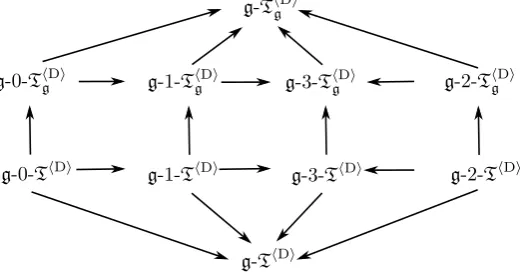
In the sequel, by g-ν-T⟨gLC⟩ def= (Ω,g-ν-T⟨gLC⟩), g-ν-T⟨gPC⟩ def= (Ω,g-ν-T⟨gPC⟩), g-ν-T⟨gLPC⟩def= (Ω,g-ν-T⟨gLPC⟩), and g-ν-T⟨gSC⟩ def= (Ω,g-ν-T⟨gSC⟩), respectively, are meant locally, pathwise, locally pathwise, and simply g-ν-T⟨gC⟩-spaces. Finally, by a g-ν-T⟨gA⟩-space g-T⟨gA⟩ = (Ω,g-T⟨gA⟩) is meant g-T⟨gA⟩ = ∨ν∈I0
3g-ν-T ⟨A⟩
g =
(
Ω,∨ν∈I0 3g-ν-T
⟨A⟩ g
)
= (Ω,g-T⟨gA⟩), where A ∈ {C,LC,PC,LPC,SC,D}. In the following sections, the main results of the theory of g-Tg-connectedness are
pre-sented.
3. Main Results
If for all (Ug,λ,Vg,λ )
λ=ξ,ζ ∈ g-O [
Tg ]
×g-K[Tg ]
neither Ug,ξ ⊔ Vg,ζ = Ω nor
Ug,ζ⊔Vg,ξ= Ω is satisfied, then aTg-spaceTg = (Ω,Tg) is said to beg-Tg-separated.
Theorem 3.1. If g-T⟨gD⟩=(Ω,g-T⟨gD⟩)be a g-T⟨gD⟩-space, then there exists a pair
(
Ug,ξ,Vg,ζ )
∈g-O[Tg ]
×g-K[Tg ]
or a pair (Ug,ζ,Vg,ξ )
∈g-O[Tg ]
×g-K[Tg ]
such that
[
Ug,ξ⊔ Vg,ζ = Ω ]
∨[Ug,ζ⊔ Vg,ξ= Ω ]
.
(3.1)
Proof. Let g-T⟨gD⟩ = (
Ω,g-T⟨gD⟩) be a g-T⟨gD⟩-space. Then, there exists a pair (
Ug,λ,Vg,λ )
λ=ξ,ζ∈g-O [
Tg ]
×g-K[Tg ]
such that ( ⊔
λ=ξ,ζ
Ug,λ= Ω
) ∨( ⊔
λ=ξ,ζ
Vg,λ= Ω )
.
IfUg,ξ∈g-O [
Tg ]
thenUg,ζ={(Ug,ξ)∈g-O [
Tg ]
∩g-K[Tg ]
, and ifVg,ξ∈g-K [
Tg ]
then Vg,ζ ={(Vg,ξ)∈g-O [
Tg ]
∩g-K[Tg ]
. Thus, if Ug,ξ ∈ g-O [
Tg ]
, it suffices to set Vg,ζ = {(Ug,ξ), and if Vg,ξ ∈ g-K
[ Tg
]
, it suffices to set Ug,ζ = {(Vg,ξ). By substitutions, it follows, then, that
[
Ug,ξ⊔ Vg,ζ = Ω ]
∨[Ug,ζ⊔ Vg,ξ= Ω ]
,
which was to be proved. Q.e.d.
Remark 3.2. Given (Rg,Sg) ⊆Tg and ¬opg,ν : P(Ω) → P(Ω), the statement (
Rg∩ ¬opg,ν(Sg) )
∪(¬opg,ν(Rg)∩ Sg )
= ∅, when ν = 0, may be called the Hausdorff-Lennes Separation Condition in theTg-spaceTg = (Ω,Tg).
If a Tg-space Tg = (Ω,Tg) is g-Tg-connected, then either {(Ug,λ) = Ug,η, so that Ug,λ ∈ g-K
[ Tg
]
or, {(Vg,λ) = Vg,η, so that Vg,λ ∈ g-O [
Tg ]
, where (λ, η) ∈
{(ξ, ζ),(ζ, ξ)}. Therefore,Tgisg-Tg-connected if it has no nonempty properg-Tg
-setSg ∈g-O [
Tg ]
∩g-K[Tg ]
. Hence, these theorems follow:
Theorem3.3. If aTg-spaceTg = (Ω,Tg)has a nonempty properg-Tg-open-closed
setSg ∈g-O [
Tg ]
∩g-K[Tg ]
, then it is ag-T⟨gD⟩-space g-Tg⟨D⟩=(Ω,g-T⟨gD⟩):
∃Sg∈g-O [
Tg ]
∩g-K[Tg ]
⇒ g-T⟨gD⟩=(Ω,g-T⟨gD⟩).
(3.2)
Proof. LetSg ∈g-O [
Tg ]
∩g-K[Tg ]
be a nonempty properg-Tg-open-closed set
inTg. Then, there exists (
Ug,λ,Vg,λ )
λ=ξ,ζ ∈g-O [
Tg ]
×g-K[Tg ]
such that [
Ug,ξ⊇ Sg⊇{(Ug,ζ) ]
∨[{(Vg,ξ)⊇ Sg⊇ Vg,ζ ]
.
Consequently, the following relation holds: ( ⊔
λ=ξ,ζ
Ug,λ⊇ Sg∪ Ug,ζ⊇{(Ug,ζ)∪ Ug,ζ )
∨(
{(Vg,ξ)∪ Vg,ξ⊇ Sg∪ Vg,ξ ⊇ ⊔
λ=ξ,ζ
Vg,λ )
.
Since{(Ug,ζ)∪Ug,ζ = Ω,Sg∪Ug,ζ= Ω and, consequently, ⊔
λ=ξ,ζUg,λ= Ω; observe that,Ug,ξ =Sg ={(Ug,ζ) becauseSg ∈g-O
[ Tg
]
∩g-K[Tg ]
is a nonempty proper g-Tg-open-closed set inTg. Since{(Vg,ξ)⊔ Vg,ξ= Ω andSg∈g-O
[ Tg
]
∩g-K[Tg ]
g
{(Vg,ξ) = Sg = Vg,ζ. Therefore, {(Vg,ξ)∪ Vg,ξ = Sg∪ Vg,ξ = ⊔
λ=ξ,ζVg,λ. By substitutions, it consequently follows that
( ⊔
λ=ξ,ζ
Ug,λ= Ω
) ∨( ⊔
λ=ξ,ζ
Vg,λ= Ω )
,
which was to be proved. Q.e.d.
The converse of the above theorem also holds as demonstrated below.
Theorem 3.4. If g-T⟨gD⟩= (
Ω,g-T⟨gD⟩)be a g-T⟨gD⟩-space, then it has a nonempty properg-Tg-open-closed setSg∈g-O
[ Tg
]
∩g-K[Tg ]
:
∃Sg∈g-O [
Tg ]
∩g-K[Tg ]
⇐ g-T⟨gD⟩=(Ω,g-T⟨gD⟩).
(3.3)
Proof. Let g-T⟨gD⟩ = (Ω,g-T⟨gD⟩) be a g-T⟨gD⟩-space. Then, there exists a pair (
Ug,λ,Vg,λ )
λ=ξ,ζ∈g-O [
Tg ]
×g-K[Tg ]
such that ( ⊔
λ=ξ,ζ
Ug,λ= Ω
) ∨( ⊔
λ=ξ,ζ
Vg,λ= Ω )
.
But ⊔λ=ξ,ζUg,λ = Ω implies either Ug,ξ = {(Ug,ζ) or Ug,ζ = {(Ug,ξ), and on the other hand, ⊔λ=ξ,ζVg,λ = Ω implies eitherVg,ξ ={(Vg,ζ) or Vg,ζ ={(Vg,ξ). Consequently, there exists aTg-setSg⊂Tg such that
[
Ug,ξ⊇ Sg⊇{(Ug,ζ) ]
∨[{(Vg,ξ)⊇ Sg⊇ Vg,ζ ]
.
Hence,g-T⟨gD⟩has a nonempty properg-Tg-open-closed setSg∈g-O [
Tg ]
∩g-K[Tg ]
;
this completes the proof of the theorem. Q.e.d.
Combined together, the above theorems establish the necessary and sufficient conditions for a Tg-space Tg = (Ω,Tg) to be g-Tg-separated and g-Tg-connected,
and hence the following corollary.
Corollary 3.5. Let Tg = (Ω,Tg) be a Tg-space. Then it is a g-T⟨gD⟩-space g-T⟨gD⟩ =
(
Ω,g-T⟨gD⟩) if and only if Tg has a nonempty proper g-Tg-open-closed
setSg ∈g-O [
Tg ]
∩g-K[Tg ]
:
g-T⟨gD⟩=(Ω,g-T⟨gD⟩) ⇔ ∃Sg ∈g-O [
Tg ]
∩g-K[Tg ]
.
(3.4)
A g-Tg-separation is realised if the only g-Tg-sets in Tg which are both g-Tg
-open-closed sets are the improperTg-sets∅, Ω⊆Tg. The theorem follows.
Theorem 3.6. A Tg-space Tg = (Ω,Tg) is said to be a g-T⟨gD⟩-space g-T⟨ D⟩
g =
(
Ω,g-T⟨gD⟩)if the onlyg-Tg-sets inTg which are bothg-Tg-open-closed sets are the
improperTg-sets ∅,Ω⊆Tg.
Proof. Let Sg ∈ g-O [
Tg ]
∩g-K[Tg ]
be a g-Tg-set in Tg. Then, there exists (
Ug,Vg )
∈ g-O[Tg ]
×g-K[Tg ]
such that Ug ⊇ Sg ⊇ Vg. Consequently,{(Ug)⊆ {(Sg)⊆{(Vg). Since
(
{(Vg),{(Ug) )
∈g-O[Tg ]
×g-K[Tg ]
, it follows that,{(Sg)∈ g-O[Tg
]
∩g-K[Tg ]
. SinceSg ∩{(Sg) =∅, implying Sg∪{(Sg) = Ω, it results,
obviously, that, [(
Sg,{(Sg) )
∈(∅,Ω)]∨[(Sg,{(Sg) )
∈(Ω,∅)].
The logical relationship between Tg-connectedness and g-Tg-connectedness is
contained in the following theorem.
Theorem 3.7. If Tg = (Ω,Tg) be a g-T⟨gC⟩-space g-T⟨ C⟩
g =
(
Ω,g-T⟨gC⟩), then it is also a Tg⟨C⟩-space T⟨
C⟩
g =
( Ω,Tg⟨C⟩
)
:
g-T⟨gC⟩=(Ω,g-T⟨gC⟩) ⇒ T⟨gC⟩= (
Ω,Tg⟨C⟩ )
.
(3.5)
Proof. Let Tg = (Ω,Tg) be a T⟨ D⟩
g -space T⟨ D⟩
g =
( Ω,Tg⟨D⟩
)
. Then it has a
nonempty proper Tg-open-closed set Sg ∈ O [Tg]∩K [Tg] in T⟨ D⟩
g . Since O [Tg]∩
K [Tg]⊆g-O [Tg]∩g-K [Tg], it follows that,Sg ∈g-O [Tg]∩g-K [Tg] inT⟨ D⟩ g . This
proves thatT⟨gD⟩is also ag-T⟨gD⟩-spaceg-T⟨ D⟩
g =
(
Ω,g-T⟨gD⟩). In other words, ifTgis
ag-T⟨gC⟩-spaceg-T⟨gC⟩= (
Ω,g-T⟨gC⟩), then it is also aTg⟨C⟩-spaceT⟨ C⟩
g =
( Ω,Tg⟨C⟩
) ,
and the proof is complete. Q.e.d.
By virtue of the above theorem, the following corollary follows.
Corollary 3.8. If Tg= (Ω,Tg)be a T⟨ D⟩
g -spaceT⟨ D⟩
g =
( Ω,Tg⟨D⟩
)
, then it is also ag-T⟨gD⟩-spaceg-T⟨gD⟩=
(
Ω,g-T⟨gD⟩):
g-T⟨gD⟩= (
Ω,g-Tg⟨D⟩) ⇐ T⟨gD⟩= (
Ω,Tg⟨D⟩ )
.
(3.6)
ATg-set Sg ⊂Tg of aTg-spaceTg = (Ω,Tg) is g-Tg-connected if and only if it
isg-Tg-connected as aTg-subspace. The theorem follows.
Theorem 3.9. If Sg ⊂ Tg,Γ is a Tg-set of a Tg-subspace Tg,Γ = (Γ,Tg,Γ) of a Tg-space Tg,Ω = (Ω,Tg,Ω), then Sg isg-Tg,Γ-connected if and only if it is g-Tg,Ω
-connected:
Sg∈g-Q [
Tg,Γ ]
⇔ Sg ∈g-Q [
Tg,Ω ]
.
(3.7)
Proof. Necessity. LetSg⊂Tg,Γbe aTg-set of aTg-subspaceTg,Γ = (Γ,Tg,Γ) of a Tg-spaceTg,Ω= (Ω,Tg,Ω) and suppose thatSg∈g-Q
[ Tg,Γ
]
. Then,Sg ∈/ g-D [
Tg,Γ ]
and, hence, for all(Ug,λ,Vg,λ )
λ=ξ,ζ∈g-O [
Tg,Γ ]
×g-K[Tg,Γ ]
,
¬( ⊔
λ=ξ,ζ
Ug,λ=Sg ) ∧
¬( ⊔
λ=ξ,ζ
Vg,λ=Sg )
,
But, Tg,Γ× ¬Tg,Γ ⊆ Tg,Ω× ¬Tg,Ω, and on the other hand, opg,Γ(·) ∈ Lg [
Γ] im-plies opg,Γ(Og,λ) = Γ ∩opg,Ω(Og,λ) = opg,Ω(Og,λ) and ¬opg,Γ(Kg,λ) = Γ∩
¬opg,Ω(Kg,λ) =¬opg,Ω(Kg,λ) for any (Og,Kg)∈ Tg,Γ× ¬Tg,Γ, whereopg,Ω(·)∈ Lg
[
Ω]. Thus, for all(Ug,λ,Vg,λ )
λ=ξ,ζ∈g-O [
Tg,Ω ]
×g-K[Tg,Ω ]
,
¬( ⊔
λ=ξ,ζ
Ug,λ=Sg ) ∧
¬( ⊔
λ=ξ,ζ
Vg,λ=Sg )
.
Consequently,Sg∈/ g-D [
Tg,Ω ]
and, hence,Sg ∈g-Q [
Tg,Ω ]
. Sufficiency. Conversely, suppose thatSg ∈g-Q
[ Tg,Ω
]
. This implies that Sg ∈/ g-D[Tg,Ω
]
. Therefore, for all(Ug,λ,Vg,λ )
λ=ξ,ζ ∈g-O [
Tg,Ω ]
×g-K[Tg,Ω ]
,
¬( ⊔
λ=ξ,ζ
Ug,λ=Sg ) ∧
¬( ⊔
λ=ξ,ζ
Vg,λ=Sg )
g
But,(Ug,λ,Vg,λ )
λ=ξ,ζ⊆ (
Sg,Sg )
⊆Tg,Γ×Tg,Γimplies, evidently, (
Ug,λ,Vg,λ )
λ=ξ,ζ∈ g-O[Tg,Γ
]
×g-K[Tg,Γ ]
, since opg,Γ(·) ∈ Lg [
Γ] is equivalent to opg,Γ(·) = Γ∩
opg,Ω(·)∈ Lg [
Ω]. Consequently, for all(Ug,λ,Vg,λ )
λ=ξ,ζ∈g-O [
Tg,Γ ]
×g-K[Tg,Γ ]
,
¬( ⊔
λ=ξ,ζ
Ug,λ=Sg ) ∧
¬( ⊔
λ=ξ,ζ
Vg,λ=Sg )
,
Therefore,Sg∈/g-D [
Tg,Γ ]
and, thus,Sg∈g-Q [
Tg,Γ ]
. Q.e.d.
There are some very fundamental Tg-properties of g-Tg-connected sets which
follow from the next theorem.
Theorem3.10. IfSg∈g-Q [
Tg ]
be ag-Tg-connected set of ag-Tg⟨D⟩-spaceg-T⟨ D⟩
g =
(
Ω,g-T⟨gD⟩), then there exists(Ug,λ,Vg,λ )
λ=ξ,ζ∈g-O [
Tg ]
×g-K[Tg ]
such that
( ∨
λ=ξ,ζ (
Sg⊆ Ug,λ
)) ∨( ∨
λ=ξ,ζ (
Sg⊆ Vg,λ ))
.
(3.8)
Proof. Let Sg ∈ g-Q [
Tg ]
be a g-Tg-connected set in a g-Tg⟨D⟩-space g-T⟨ D⟩
g =
(
Ω,g-T⟨gD⟩). Then, for all(Ug,λ,Vg,λ )
λ=ξσ,ζσ ∈g-O
[ Tg
]
×g-K[Tg ]
,
¬( ⊔
λ=ξσ,ζσ
Ug,λ=Sg ) ∧
¬( ⊔
λ=ξσ,ζσ
Vg,λ=Sg )
⇒ ¬( ∩
λ=ξσ,ζσ
Ug,λ=∅ ) ∧
¬( ∩
λ=ξσ,ζσ
Vg,λ=∅ )
⇒ ( ∩
λ=ξσ,ζσ
Ug,λ̸=∅
) ∧( ∩
λ=ξσ,ζσ
Vg,λ̸=∅ )
.
Since Tg is a g-T⟨gD⟩-space g-T⟨ D⟩
g =
(
Ω,g-T⟨gD⟩), there exists, therefore, pairs (
Ug,λ,Vg,λ )
λ=ξ,ζ∈g-O [
Tg ]
×g-K[Tg ]
such that ( ⊔
λ=ξ,ζ
Ug,λ= Ω
) ∨( ⊔
λ=ξ,ζ
Vg,λ= Ω )
⇒ ( ⊔
λ=ξ,ζ (
Sg∩ Ug,λ )
=Sg
) ∨( ⊔
λ=ξ,ζ (
Sg∩ Vg,λ )
=Sg )
⇒ ( ∨
λ=ξ,ζ (
Sg ⊆ Ug,λ
)) ∨( ∨
λ=ξ,ζ (
Sg⊆ Vg,λ ))
.
Since ∩λ=ξ
σ,ζσUg,λ,
∩
λ=ξσ,ζσVg,λ̸=∅ hold, and, moreover,Tg is a g-T ⟨D⟩ g -space g-T⟨gD⟩=(Ω,g-T⟨gD⟩), the proof at once follows. Q.e.d. Equivalently stated, the following proposition states that, any Tg-set which is
contained in ag-Tg-connected set is also ag-Tg-connected.
Proposition 3.11. Let Rg, Sg ⊂ Tg be Tg-sets in a Tg-space Tg = (Ω,Tg). If Sg∈g-Q
[ Tg
]
andRg satisfies [
Rg⊆opg(Sg) ]
∨[Rg⊆ ¬opg(Sg) ]
,
thenRg∈g-Q [
Tg ]
.
Proof. Let Rg, Sg ⊂ Tg be Tg-sets in a Tg-space Tg = (Ω,Tg), where Sg ∈ g-Q[Tg
]
, and, by hypothesis, Rg ∈ g-D [
Tg ]
. Since Rg ∈ g-D [
Tg ]
, there exists, then,(Ug,λ,Vg,λ
)
λ=ξρ,ζρ ∈g-O
[ Tg
]
×g-K[Tg ]
such that, ( ⊔
λ=ξρ,ζρ
Ug,λ=Rg
) ∨( ⊔
λ=ξρ,ζρ
Vg,λ=Rg )
.
Since Sg ∈ g-Q [
Tg ]
, it must be contained in either of Ug,ξρ, Ug,ζρ, or in either of
Vg,ξρ, Vg,ζρ. Consequently,
( ∨
λ=ξρ,ζρ
(
Sg⊆ Ug,λ
)) ∨( ∨
η=ξρ,ζρ
(
Sg⊆ Vg,η ))
⇒( ∨
λ=ξρ,ζρ
(
opg(Sg)⊆ Ug,(ρ,λ)
)) ∨( ∨
η=ξρ,ζρ
(
¬opg(Sg)⊆ Vg,(ρ,η) ))
,
where Ug,(ρ,λ) = opg(Ug,λ) and Vg,(ρ,η) = ¬opg(Vg,η) for every pair (λ, η) ∈
{(ξρ, ζρ),(ζρ, ξρ)}. With no loss of generality, let it be supposed that [
opg(Sg)⊆ Ug,(ρ,λ) ]
∨[¬opg(Sg)⊆ Vg,(ρ,η) ]
holds for a (λ, η)∈ {(ξρ, ζρ),(ζρ, ξρ)}. Then, since the relationsRg= ⊔
σ=λ,ηUg,σ ⊆ ⊔
σ=λ,ηUg,(ρ,σ) and∅= ∩
σ=λ,ηVg,σ ⊇ ∩
σ=λ,ηVg,(ρ,σ)hold, it follows that,
opg(Sg)∩ Ug,η ⊆ Ug,(ρ,λ)∩ Ug,η⊆ ∩
σ=λ,η
Ug,(ρ,σ)=∅;
¬opg(Sg)∩ Vg,λ ⊆ Vg,(ρ,η)∩ Vg,λ⊆ ∩
σ=λ,η
Vg,σ =∅.
Therefore, opg(Sg)∩Ug,η,¬opg(Sg)∩Vg,λ=∅. On the other hand, sinceRg⊂Tg
satisfies[Rg⊆opg(Sg) ]
∨[Rg⊆ ¬opg(Sg) ]
, it results that,
Ug,η = Rg∩ Ug,η= opg(Sg)∩ Ug,η,
Vg,λ = Rg∩ Vg,λ=¬opg(Sg)∩ Ug,λ.
From these and opg(Sg)∩Ug,η,¬opg(Sg)∩Vg,λ=∅, it follows that,Ug,η,Vg,λ=∅, which contradict the hypothesis thatRg∈g-D
[ Tg
]
. Q.e.d.
The following proposition states that, if it be given a collection ofg-Tg-connected
sets with non-void intersection, then g-Tg-connectedness is preserved under the
operation of union.
Proposition 3.12. Let {Sg,ν: ν ∈In∗} ⊆g-Q [
Tg ]
be a collection of n≥1 g-Tg
-connected sets in a Tg-space Tg = (Ω,Tg). If ∩
ν∈In∗Sg,ν ̸=∅, then ∪
ν∈In∗Sg,ν ∈ g-Q[Tg
]
inTg: ∩
ν∈I∗n (
Sg,ν∈g-Q [
Tg ])
̸
=∅ ⇒ ∪
ν∈In∗
Sg,ν ∈g-Q [
Tg ]
.
g
Proof. Let {Sg,ν: ν ∈In∗} ⊆ g-Q [
Tg ]
be a collection of n ≥ 1 g-Tg-connected
sets in a Tg-space Tg = (Ω,Tg), and suppose, by hypothesis, that ∪
ν∈In∗Sg,ν ∈ g-D[Tg
]
, where ∩ν∈I∗
nSg,ν ̸=∅. Since
∪
ν∈In∗Sg,ν ∈ g-D [
Tg ]
, there exists, then, (
Ug,λ,Vg,λ )
λ=ξ,ζ∈g-O [
Tg ]
×g-K[Tg ]
such that ( ⊔
λ=ξ,ζ
Ug,λ= ∪
ν∈In∗Sg,ν
) ∨( ⊔
λ=ξ,ζ
Vg,λ= ∪
ν∈In∗Sg,ν )
.
Since ∩ν∈I∗
nSg,ν ̸= ∅, there exists a unit Tg-set {η} ⊂ Tg satisfying {η} ⊆
∩
ν∈In∗Sg,ν ̸=∅. But, by hypothesis, ∪
ν∈In∗Sg,ν ∈g-D [
Tg ]
. Consequently, ( ∨
λ=ξ,ζ (
{η} ⊆ Ug,λ∩ ( ∩
ν∈I∗n
Sg,ν )))
∨( ∨
λ=ξ,ζ (
{η} ⊆ Vg,λ∩ ( ∩
ν∈In∗
Sg,ν )))
.
Clearly, for everyν ∈In∗, ( ∨
λ=ξ,ζ (
Sg,ν∩ Ug,λ̸=∅
)) ∨( ∨
λ=ξ,ζ (
Sg,ν∩ Vg,λ̸=∅ ))
⇒( ∨
λ=ξ,ζ (
Sg,ν⊆ Ug,λ
)) ∨( ∨
λ=ξ,ζ (
Sg,ν⊆ Vg,λ ))
.
Therefore, ( ∨
λ=ξ,ζ ( ∪
ν∈In∗
Sg,ν⊆ Ug,λ
)) ∨( ∨
λ=ξ,ζ ( ∪
ν∈In∗
Sg,ν⊆ Vg,λ ))
,
which contradicts the hypothesis that∪ν∈I∗
nSg,ν∈g-D
[ Tg
]
. Q.e.d.
Stated differently, the following proposition states that, if every two-pointTg-set
of a Tg-set is a Tg-subset of some g-Tg-connected subset of the Tg-set, then the Tg-set is also ag-Tg-connected set.
Proposition 3.13. Let Sg ⊂ Tg be a Tg-set in a Tg-space Tg = (Ω,Tg). If
every two-point Tg-set Qg ⊆ Sg satisfies the relation Qg ⊆ Rg ⊆ Sg, where Rg∈g-Q
[ Tg
]
, thenSg∈g-Q [
Tg ]
:
Qg∩ Sg⊇ Qg∩ Rg∈g-Q [
Tg ]
⇒ Sg∈g-Q [
Tg ]
.
(3.11)
Proof. Let Sg ⊂ Tg be a Tg-set in a Tg-space Tg = (Ω,Tg) and suppose that
every two-point Tg-setQg⊆ Sg satisfies the relation Qg⊆ Rg ⊆ Sg, whereRg ∈ g-Q[Tg
]
, and by hypothesis,Sg ∈g-D [
Tg ]
. Then, there exists(Ug,λ,Vg,λ )
λ=ξσ,ζσ ∈
g-O[Tg ]
×g-K[Tg ]
such that ( ⊔
λ=ξσ,ζσ
Ug,λ=Sg
) ∨( ⊔
λ=ξσ,ζσ
Vg,λ=Sg )
.
SinceUg,λ,Vg,λ̸=∅for every λ∈ {ξσ, ζσ}, assume that
{ξ} = Qg∩ Ug,ξσ =Qg∩ Vg,ξσ,
In other words, Qg ⊂
×
λ=ξσ,ζσUg,λ or Qg ⊂×
λ=ξσ,ζσVg,λ. SinceRg ∈g-Q[ Tg
] , for all(Ug,λ,Vg,λ
)
λ=ξρ,ζρ ∈g-O
[ Tg
]
×g-K[Tg ]
,
¬( ⊔
λ=ξρ,ζρ
Ug,λ=Rg ) ∧
¬( ⊔
λ=ξρ,ζρ
Vg,λ=Rg )
⇒ ¬( ⊔
λ=ξρ,ζρ
(
Qg∩ Ug,λ )
=Qg ) ∧
¬( ⊔
λ=ξρ,ζρ
(
Qg∩ Vg,λ )
=Qg )
⇒ ¬(Qg=Qg )
∧ ¬(Qg=Qg )
,
which contradicts the hypothesis thatSg ∈g-D [
Tg ]
. Q.e.d.
A Tg-space is g-Tg-connected if any two-point Tg-set can be enclosed in some g-Tg-connected set, and hence the following proposition.
Proposition 3.14. If any two-point Tg-set Qg ⊂ Tg can be enclosed in some g-Tg-connected setSg∈g-Q [Tg], then theTg-spaceTg= (Ω,Tg) is ag-T⟨gC⟩-space g-T⟨gC⟩=(Ω,g-T⟨gC⟩):
(
∀Qg⊂Tg )(
∃Sg=Sg∪ Qg∈g-Q [Tg] )
⇒ g-T⟨gC⟩=(Ω,g-T⟨gC⟩).
(3.12)
Proof. Let ξ ∈ Tg be fixed and, for every ζ ∈ Tg, let Qg(ξ,ζ) ⊂ Tg be a
two-point g-Tg-connected set in a Tg-space Tg = (Ω,Tg) containing ξ, ζ ∈ Tg. Then, ∪
ζ∈TgQg(ξ,ζ)∈g-Q [Tg] and, by hypothesis, it is the entireTg-spaceTg. HenceTg
is ag-T⟨gC⟩-spaceg-T⟨ C⟩
g =
(
Ω,g-T⟨gC⟩ )
. Q.e.d.
The theorem given below states that, any pair of nonempty g-Tg-sets which is
contained in some pair ofg-Tg-separated sets is alsog-Tg-connected.
Theorem3.15. LetTg = (Ω,Tg)be aTg-space. If(Sg,α,Sg,β)∈g-D [Tg]×g-D [Tg]
be a pair of g-Tg-separated sets and (Rg,α,Rg,β) ∈ g-S [Tg]×g-S [Tg] be a pair
of nonempty g-Tg-sets satisfying (Rg,α,Rg,β) ⊆(Sg,α,Sg,β), then (Rg,α,Rg,β) ∈ g-D [Tg]×g-D [Tg]:
(Sg,λ=Rg,λ∪ Sg,λ)λ=α,β ∈g-D [Tg] ⇒ (Rg,λ)λ=α,β∈g-D [Tg].
(3.13)
Proof. Let (Sg,α,Sg,β) ∈ g-D [Tg]×g-D [Tg] be a pair of g-Tg-separated sets
and let (Rg,α,Rg,β) ∈ g-S [Tg]×g-S [Tg] be a pair of nonempty g-Tg-sets
satis-fying (Rg,α,Rg,β) ⊆ (Sg,α,Sg,β) in a Tg-space Tg = (Ω,Tg). Then, there exists (
Ug,λ,Vg,λ )
λ=ξσ,ζσ ∈g-O
[ Tg
]
×g-K[Tg ]
such that ( ⊔
λ=ξσ,ζσ
Ug,λ= ⊔
η=α,β
Sg,η
) ∨( ⊔
λ=ξσ,ζσ
Vg,λ= ⊔
η=α,β
Sg,η )
⇔( ∩
λ=ξσ,ζσ
Ug,λ=∅
) ∨( ∩
λ=ξσ,ζσ
Vg,λ=∅ )
.
Since (Rg,α,Rg,β) ⊆ (Sg,α,Sg,β), ∩
η=α,βRg,η ⊆ ∩
η=α,βSg,η. If the relation ⊔
η=α,βSg,η = ⊔
λ=ξσ,ζσUg,λis satisfied, then
∩
η=α,βRg,η ⊆ ∩
g
⊔
η=α,βSg,η = ⊔
λ=ξσ,ζσVg,λ, then
∩
η=α,βRg,η⊆ ∩
λ=ξσ,ζσVg,λ=∅ holds. Hence, there exists(Ug,λ,Vg,λ
)
λ=ξρ,ζρ ∈g-O
[ Tg
]
×g-K[Tg ]
such that ( ⊔
λ=ξρ,ζρ
Ug,λ= ⊔
η=α,β
Rg,η
) ∨( ⊔
λ=ξρ,ζρ
Vg,λ= ⊔
η=α,β
Rg,η )
.
This proves the theorem. Q.e.d.
The basic relation betweeng-Tg-connectedness andg-Tg-separateness follows:
Theorem 3.16. In order that a Tg-set Sg ⊂ Tg of a Tg-space Tg = (Ω,Tg) be g-Tg-connected it is necessary and sufficient that there exists no (Rg,α,Rg,β) ∈ g-O[Tg
]
×g-O[Tg ]
or(Sg,α,Sg,β)∈g-K [
Tg ]
×g-K[Tg ]
such that it be expressible as
( ⊔
σ=α,β
Rg,σ=Sg
) ∨( ⊔
σ=α,β
Sg,σ =Sg )
.
(3.14)
Proof. Necessity. LetSg ⊂Tg be a Tg-set in theTg-spaceTg = (Ω,Tg) and let
there exists (Rg,λ,Sg,λ)λ=α,β ∈g-O [
Tg ]
×g-K[Tg ]
such that ( ⊔
σ=α,β
Rg,σ=Sg
) ∨( ⊔
σ=α,β
Sg,σ =Sg )
.
Since (Rg,λ,Sg,λ)λ=α,β ∈ g-O [
Tg ]
×g-K[Tg ]
, there exists (Ug,λ,Vg,λ )
λ=α,β ∈ g-O[Tg
]
×g-K[Tg ]
such that(Rg,λ,Sg,λ )
λ=α,β= (
Ug,λ,Vg,λ )
λ=α,β. Consequently, ( ⊔
λ=α,β
Ug,λ=Sg
) ∨( ⊔
λ=α,β
Vg,λ=Sg )
.
This shows that (Rg,λ,Sg,λ)λ=α,β ∈ g-D [
Tg ]
×g-D[Tg ]
. Hence, Sg ∈ g-D [
Tg ]
. The condition of the theorem is, therefore, necessary.
Sufficiency. Conversely, suppose that Sg ∈ g-D [
Tg ]
, there exists, then, a pair (
Ug,λ,Vg,λ )
λ=α,β∈g-O [
Tg ]
×g-K[Tg ]
such that ( ⊔
λ=α,β
Ug,λ=Sg
) ∨( ⊔
λ=α,β
Vg,λ=Sg )
.
But, (Ug,λ,Vg,λ )
λ=α,β ∈g-O [
Tg ]
×g-K[Tg ]
. Therefore, it follows that there
ex-ists(Rg,λ,Sg,λ )
λ=α,β ∈g-O [
Tg ]
×g-K[Tg ]
such that the relations expressible by (
Rg,λ,Sg,λ )
λ=α,β = (
Ug,λ,Vg,λ )
λ=α,β hold. Hence, theTg-set Sg ⊂Tg is express-ible as
( ⊔
σ=α,β
Rg,σ=Sg
) ∨( ⊔
σ=α,β
Sg,σ =Sg )
.
The condition of the theorem is, therefore, sufficient. Q.e.d.
If Sg ∈ g-O [
Tg ]
, then g-Tg-open sets in Sg are clearly also in g-O [
Tg ]
, and conversely. Likewise, ifSg ∈g-K
[ Tg
]
, theng-Tg-closed sets inSgare clearly also in ∈g-K[Tg
]
Corollary 3.17. Let Sg ∈ g-S [
Tg ]
be a g-Tg-set in a Tg-space Tg = (Ω,Tg).
Then:
• i. If Sg ∈g-O [
Tg ]
, then in order that Sg ∈g-Q [
Tg ]
, it is necessary and sufficient that there exists no (Rg,α,Rg,β)∈g-O
[ Tg
]
×g-O[Tg ]
such that it be expressible asSg=
⊔
λ=α,βRg,λ.
• ii. If Sg ∈g-K [
Tg ]
, then in order that Sg ∈g-Q [
Tg ]
, it is necessary and sufficient that there exists no (Rg,α,Rg,β)∈g-K
[ Tg
]
×g-K[Tg ]
such that it be expressible asSg=
⊔
λ=α,βRg,λ.
The following remark contains classifications ofg-Tg-connectedness with respect
to openness and closedness.
Remark 3.18. Suppose ⊔σ=α,βRg,σ = Sg hold, then it is no error to call Sg a g-Tg-connected open set if (Rg,α,Rg,β)∈g-O
[ Tg
]
×g-O[Tg ]
, and ag-Tg-connected
closed set if (Rg,α,Rg,β)∈g-K [
Tg ]
×g-K[Tg ]
.
From the above corollary, it would appear thatg-Tg-connectedness depends on
the existence of certain g-Tg-separated sets or, equivalently, on the existence of
certain disjoint g-Tg-open, closed sets. As another simple ways of characterizing g-Tg-connectedness, the proposition follows.
Proposition3.19. ATg-spaceTg= (Ω,Tg)is ag-T⟨gD⟩-spaceg-T⟨ D⟩
g =
(
Ω,g-T⟨gD⟩) if and only if any one of the following statements holds:
• i. ∃(Sg,α,Sg,β)∈ (
g-D[Tg ]
\ {∅})2
: ⊔λ=α,βSg,λ= Ω;
• ii. ∃(Sg,α,Sg,β)∈ (
g-O[Tg ]
\ {∅})2
: ⊔λ=α,βSg,λ= Ω;
• iii. ∃(Sg,α,Sg,β)∈ (
g-K[Tg ]
\ {∅})2
: ⊔λ=α,βSg,λ= Ω.
Proof. Necessity. Let g-T⟨gD⟩ = (
Ω,g-T⟨gD⟩) be a g-T⟨gD⟩-space. Then, there exists Sg ∈
( g-O[Tg
]
∩g-K[Tg ])
\ {∅,Ω}. Consequently, there exists (Ug,Vg )
∈
g-O[Tg ]
×g-K[Tg ]
such that
Ug⊇ Sg⊇ Vg ⇒ {(Ug)⊆{(Sg)⊆{(Vg).
Therefore,{(Sg)∈ (
g-O[Tg ]
∩g-K[Tg ])
\ {∅,Ω}. Hence, (
Sg,{(Sg) )
∈(g-D[Tg ]
\ {∅})2
∪(g-O[Tg ]
\ {∅})2
∪(g-K[Tg ]
\ {∅})2 .
Sufficiency. Conversely, suppose that
∃(Sg,α,Sg,β)∈ (
g-D[Tg ]
\ {∅})2
∪(g-O[Tg ]
\ {∅})2
∪(g-K[Tg ]
\ {∅})2 ,
such that Ω = ⊔λ=α,βSg,λ. Then if (Sg,α,Sg,β)∈ (
g-D[Tg ]
\ {∅})2
, there exists (
Ug,λ,Vg,λ )
λ=α,β∈g-O [
Tg ]
×g-K[Tg ]
such that, ( ⊔
λ=α,β
Ug,λ= ⊔
λ=α,β
Sg,λ
) ∨( ⊔
λ=α,β
Vg,λ= ⊔
λ=α,β
Sg,λ )
⇒ ( ⊔
λ=α,β
Ug,λ= Ω
) ∨( ⊔
λ=α,β
Vg,λ= Ω )
.
If (Sg,α,Sg,β)∈ (
g-O[Tg ]
\{∅})2
, there exists(Ug,α,Ug,β )
∈g-O[Tg ]
×g-O[Tg ]
such that (Sg,α,Sg,β
)
⊆(Ug,α,Ug,β )
. Consequently, it follows that Ω =⊔λ=α,βSg,λ⊆ ⊔
λ=α,βUg,λ. Hence, ⊔