University of South Carolina
Scholar Commons
Theses and Dissertations
2017
The Eccentric Compositional Style of Mark
Applebaum: An Analysis of his Acoustic Percussion
Works
Richard Shane Reeves University of South Carolina
Follow this and additional works at:https://scholarcommons.sc.edu/etd Part of theMusic Performance Commons
This Open Access Dissertation is brought to you by Scholar Commons. It has been accepted for inclusion in Theses and Dissertations by an authorized administrator of Scholar Commons. For more information, please [email protected].
Recommended Citation
THE ECCENTRIC COMPOSITIONAL STYLE OF MARK APPLEBAUM: AN ANALYSIS OF HIS ACOUSTIC PERCUSSION WORKS
by
Richard Shane Reeves
Bachelor of Science
University of Alabama at Birmingham, 2003
Master of Music University of Florida, 2008
____________________________________________________
Submitted in Partial Fulfillment of the Requirements
for the Degree of Doctor of Musical Arts in
Music Performance
School of Music
University of South Carolina
2017
Accepted by:
David S. Herring, Major Professor
Michael Harley, Committee Member
Daniel Jenkins, Committee Member
Greg Stuart, Committee Member
ii
iii ABSTRACT
Mark Applebaum is an American composer and Professor of Composition at
Stanford University who has made significant contributions to contemporary music. His
music has been performed all over the world and his popularity as a composer continues
to increase. The experimental nature of his music and his continual innovation and
creativity makes his music worthy of study. However, there has been no scholarly
research done on his music. Because of this void, a study of his music is needed and
would be valuable to both performers and scholars alike.
The oeuvre of Mark Applebaum is vast and includes music written in traditional
mediums as well as those that are unorthodox. The author has chosen to limit the focus of
this document to nine acoustic percussion works. Using these selected works, this
document will provide an analysis of certain compositional traits that illustrate the
composer’s eccentric compositional style. Applebaum has written many other pieces for
chamber ensembles and, large ensembles, as well as electro-acoustic compositions that
contain similar compositional traits, as well as exceptional percussion writing. While in
general these works are beyond the scope of this document, some will be referenced
briefly if they are pertinent to the concepts being discussed.
As of the date of completion of this paper, there is no existing research on these
works and it is intended that the document may be used in further research of the music
iv
acoustic percussion works, it is the writer’s hope that it will be a valuable source of
information in the percussion community.
The document is divided into five chapters. Chapter one contains a biography of
Mark Applebaum as well as an introduction to his music. Chapter two focuses on specific
compositional ideas that illustrate Mark Applebaum’s unorthodox method of composition.
This involves an analysis of four major percussion works, each of which were
constructed using compositional ideas that involve a complex process of generating
musical material. Chapter three focuses on ways that rhythm and meter are used with
examples taken from several works. Chapter four focuses on the use of indeterminacy
and improvisation. Finally, chapter five will take a detailed look at the visual and
v
TABLE OF CONTENTS
Abstract ... iii
List of Figures ... vi
List of Musical Examples ... vii
Foreword ...1
CHAPTER 1. BIOGRAPHY OF MARK APPLEBAUM ...2
CHAPTER 2. INNOVATIVE COMPOSITIONAL PROCESSES ...7
CHAPTER 3. TREATMENT OF RHYTHM AND METER ...45
CHAPTER 4. INDETERMINACY AND IMPROVISATION ...56
CHAPTER 5. VISUAL AND THEATRICAL ELEMENTS ...67
BIBLIOGRAPHY ...87
vi
LIST OF FIGURES
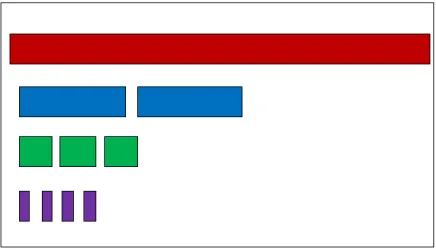
Figure 2.1 Comparison of all four kaleidoscopes ...10
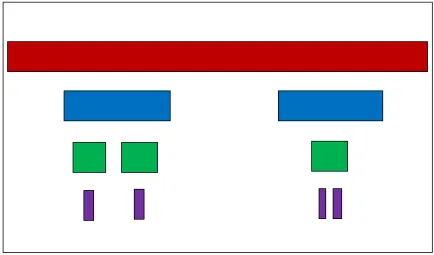
Figure 2.2 After kaleidoscopes 2-4 have been cut into pieces ...10
Figure 2.3 Strips put in position ...11
Figure 2.4 Final configuration ...11
Figure 2.5 P.D. Eastman, Go, Dog. Go!, pp. 6-7 ...13
Figure 2.6 Numbers assigned to the dogs ...15
Figure 2.7 Straitjacket, palindrome number sequence...31
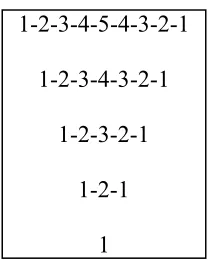
Figure 2.8 Censorship number sequence ...31
Figure 2.9 Second view of censorship sequence compared with the first ...32
Figure 2.10 Both halves of the palindrome after censorship ...34
Figure 2.11 Second half of palindrome inverted ...34
Figure 2.12 Final configuration of measures ...35
Figure 3.1 Go, Dog. Go! improvisation designations ...51
Figure 3.2 Gone, Dog. Gone! instrument setup ...52
Figure 3.3 Gone, Dog. Gone! instrument notation key ...53
Figure 3.4 Gone, Dog. Gone! cycle chart ...54
Figure 4.1 Legend for Theme in Search of Variations...65
Figure 5.1 Final form of composite drawing ...78
Figure 5.2 Composition Machine #1 instrumentation and legend ...80
vii
LIST OF MUSICAL EXAMPLES
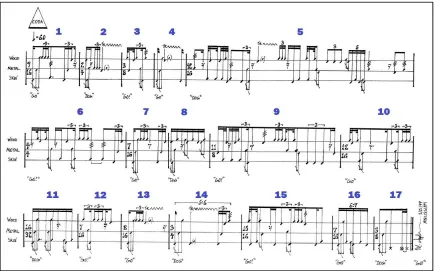
1. Go, Dog. Go!, mm. 1-17 (coda) ...15
2. Go, Dog. Go!, m. 6, m. 10 and m. 15 (rhythmic figure A) ...18
3. Go, Dog. Go!, m. 6, m. 10, m. 15 (rhythmic figure B) ...18
4. Go, Dog. Go!, mm. 3 and 10 (dogs with one wheel) ...19
5. Go, Dog. Go!, mm. 5 and 9 (rhythmic figures A and B marked) ...19
6. Go, Dog. Go!, mm. 8, 11, and 16 (black dog) ...21
7. Go, Dog. Go!, mm. 14 and 16...22
8. Go, Dog. Go!, mm. 1-17, (white and spotted dogs with triplet) ...23
9. Go, Dog. Go!, mm. 2, 4, 5, 13, and 14 (dogs with red or yellow collars) ...24
10. Go, Dog. Go!, mm. 1, 6, and 7 (dogs with green collars) ...25
11. Go, Dog. Go!, mm. 9, 12, and 15 (dogs with white collars) ...26
12. Go, Dog. Go!, mm. 5 and 9, (dogs subjected to the “not in a hurry” modification)....27
13. Straitjacket, mvt. 1, (reconstruction of first 4 mm. of original material) ...36
14. 30: The First Decade, mm. 89-113 ...39
15. 30, mm. 81-88 ...41
16. 30: The Third Decade, episode VII ...42
17. Catfish, mm. 33-35 ...47
18. Catfish, mm. 64-66 ...47
19. Catfish, mm. 71-74 ...47
viii
21. Gone, Dog. Gone!, page one ...55
22. Entre Funérailles II, page one ...60
23. Catfish, mm. 45-54 ...61
24. 30: The Second Decade, mm. 256-263 ...63
25. Theme in Search of Variations, mm. 23-29 ...65
26. The Metaphysics of Notation, excerpt ...68
27. Straitjacket, mvt. II, mm.1-3 ...70
28. Straitjacket, mvt II, mm 1-4 ...72
29. Gone, Dog. Gone!, mm. 1-6 ...74
30. 30: The First and Second Decades, mm. 318-323...76
31. Straitjacket, mvt. IV, Taquinoid, mm. 1-5 ...77
1 FOREWORD
This document is part of the dissertation requirement for the Doctor of Musical Arts
degree in Performance. The major portion of the degree consists of four public recitals.
Copies of the recital programs are bound at the end of this paper, and recordings of the
2 CHAPTER 1
BIOGRAPHY OF MARK APPLEBAUM
Mark Stephen Applebaum was born on Friday, October 13, 1967 in Chicago,
Illinois to Robert and Rosalie Applebaum.1 He began studying piano at the age of seven
due in part to the influence of his father who was also a pianist and composer.2 In high
school, Applebaum continued to play piano as well as perform with a rock band. It was
also in his high school days that he began composing music, most notably musicals for
his theater program.3 After graduating high school in 1985, Applebaum attended Carleton
College where he studied composition with Philip Rhodes and completed a senior thesis
involving a trip to Mexico City to interview Conlon Nancarrow.4 He graduated in 1989
receiving his baccalaureate, magna cum laude. He received both his Masters in 1992 and
his Ph.D. in 1996 in composition from the University of California at San Diego where
he studied with Brian Ferneyhough, Joji Yuasa, Rand Steiger, and Roger Reynolds.5 In
the fall of 1996, Applebaum taught at Carleton College where he served as
Dayton-Hudson Visiting Artist. Shortly afterwards he began his first tenure track position at
1 Juli, Hodgson. “Mark Applebaum: A Biography.” Mississippi Writers and Musicians. Accessed April 2, 2016. http://www.mswritersandmusicians.com/mississippi-musicians/mark-applebaum#bio
2 Ibid.
3 Ibid.
4Mark Applebaum. “Biography.” Accessed April 20, 2013. http://www.markapplebaum.com/
bio.html
3
Mississippi State University in 1997.6 In 2000, he left to accept a position at Stanford
University, where he currently serves as Associate Professor of Composition and Theory
as well as founder and director of the Stanford Improvisation Collective.7
In addition to his work at Stanford, Applebaum has given lectures and
masterclasses at many renowned institutions including Harvard, Princeton, Columbia,
Oberlin, Duke, the University of Chicago, Northwestern University, the Eastman School
of Music, the New England Conservatory of Music, Hong Kong University, the
JML/Irino Foundation in Tokyo, the Bruckner Conservatory in Linz, Austria, and the
Janáček Academy of Music and Performing Arts in the Czech Republic.8
Applebaum’s works have been performed throughout the United States, Europe,
Africa, and Asia with notable performances at the Darmstadt summer sessions, ICMC in
Beijing and Singapore, the TRANSIT Festival in Belgium, Stockholm New Music, the
American Composers Orchestra’s OrchestraTech, the Unyazi Festival in Johannesburg,
South Africa, Sonorities in Belfast, Sonic Circuits in Hong Kong, SIGGRAPH in Los
Angeles, the Essl Museum in Vienna, and the Kennedy Center. He was a 2002 visiting
artist at Electronic Music Midwest, featured composer at the 2004 University of
Michigan Eclectronica Microfestival, and a featured composer at the 61st Festival of
Contemporary Music at Louisiana State University.9
Over the course of his career, Applebaum has received many commissions,
including those from Betty Freeman, the Merce Cunningham Dance Company, the
6 Mark Applebaum, “Progress Report — The State of the Art after Sixteen Years of Designing and
Playing Electroacoustic Sound-Sculptures: A Detailed Examination of Original Instruments and Reflections on Their Cultural Context,” eContact 12.3 (2010): accessed May, 16, 2016,
http://econtact.ca/12_3/applebaum_soundsculpture.html 7 Bash.
8 Ibid.
4
Fromm Foundation, the Paul Dresher Ensemble, the Vienna Modern Festival, Antwerp’s
Champ D’Action, Festival ADEvantgarde in Munich, Zeitgeist, MANUFACTURE
(Tokyo), the St. Lawrence String Quartet, the Jerome Foundation, and the American
Composers Forum. In 1997, Applebaum received the American Music Center’s Stephen
Albert Award and an artist residency fellowship at the Villa Montalvo artist colony in
Northern California.10
In addition to being a composer, Applebaum is also an accomplished jazz pianist.
He has performed concerts all over the world, including a solo recital in Ouagadougou,
Burkina Faso which was sponsored by the American Embassy. He received the jazz prize
of the Southern California Jazz Society in 1994, and in 1999 the Mark Applebaum Trio
performed in the first Mississippi arts event broadcast live over the World Wide Web.
Currently, he performs with his father, Bob Applebaum, in the Applebaum Jazz Piano
Duo. They made their Tunisian debut at the Municipal Theater in Tunis and have recently
performed a concert in Singapore. The Apple Doesn’t Fall Far from the Tree, their first
studio recording, is available on Innova Records.11
Applebaum has also been interested in the invention of new instruments, most of
which he constructs himself. Part of this inspiration comes from Conlon Nancarrow and
Harry Partch, composers who also found it necessary to invent unusual instruments to
realize their musical visions.12 He has designed and built many electro-acoustic
instruments out of junk, hardware, and found objects for use as both compositional and
improvisational tools. One such instrument is the Mouseketier, a musical Frankenstein
consisting of small objects such as threaded rods, nails, combs, doorstops, springs,
10 Ibid.
11 Ibid.
5
squeaky wheels, ratchets, a toilet tank flotation bulb, and other unlikely objects which are
struck, plucked, scratched, and bowed.13 It can also be connected to an interface of live
electronics which enables the instrument to produce an even wider array of sounds.
Applebaum jokingly says that because he is the only person who plays this instrument, he
is simultaneously the world’s greatest and worst Mouseketier player.14 Nonetheless, he
enjoys playing the role of inventor in addition to the more traditional roles of performer,
interpreter, composer, and teacher.15 Applebaum frequently performs live concerts using
his homemade instruments and has recorded a full length album entitled, Mousetrap
Music, which consists of improvisations on these instruments.16
Applebaum’s eccentric personality, as well as his interest in exploring new ideas
and methods, gives his music a unique (and oftentimes bizarre) quality. Some of his
ideas are rather absurd, such as his Concerto for Florist and Orchestra, in which an
orchestra accompanies a florist creating a large bouquet of flowers. Others stem from
random observances outside of the world of music. For example, Tiӧn, a soundless work
written for three simultaneous conductors conducting invisible ensembles, was inspired
by Applebaum witnessing an argument in sign language between two deaf people.17 This
observation caused Applebaum to realize that loudness is very much an emotional and
psychological phenomenon and not just an aural one.18 Along similar lines, many of
Applebaum’s compositions explore the areas of visual arts. Most notably, his interest in
the visual aspects of performing music has led him to the creation of a complex sign
13 Ibid.
14 TEDxStanford. “Mark Applebaum: The Mad Scientist of Music.” Filmed May 2012. Duration:
16:50. http://www.ted.com/talks/mark_applebaum_the_mad_scientist_of_music?language=en 15 Ibid.
16 http://www.markapplebaum.com/bio.html
17 “Mark Applebaum: Radical Notation.” YouTube video, 4:28. Posted by “CCA Fresno State,”
6
language system complete with a unique notational system. This system is made up of
hundreds of gestures that are choreographed to music and notated in the score using a
series of pictographs created by the composer, himself. These gestures will be discussed
in detail in this document. Mark Applebaum is always searching for new ideas and
methods in the creation of his music. Many of his works cause one to question the very
definition of what music is. Applebaum’s response is that it is the wrong question. The
question should not be “is it music?”, but rather, “is it interesting”?19 Furthermore,
Applebaum states that if a metric is needed by which to evaluate his music, it would be
that his works should always cause the listener to ask two questions—“What the hell was
that?” and “Can I hear more?”20
19 TEDxStanford.
7 CHAPTER 2
INNOVATIVE COMPOSITIONAL PROCESSES
This chapter will demonstrate some of the innovative compositional processes
that Mark Applebaum has used in specific works. Four pieces will be discussed, each of
which make use of a compositional technique that has been crafted specifically for each
work. The mechanics of each technique as well as the ideas that inspired them will be
discussed in detail.
2.1 NARCISSUS: STRATA/PANACEA
Narcissus: Strata/Panacea is a piece for solo marimba premiered in 1994 by
Tatiana Kóleva at the Darmstadt summer courses in Germany.21 This work makes use of
a compositional technique that involves cutting fragments of previously composed sheet
music and then redistributing these fragments in such a way that they form stacked layers.
The result is that certain sections of music are obscured whenever a fragment is placed on
top of it. The music written on the fragment cancels out and replaces the music that it
obscures. Once the layers are put in place, the score is rewritten and this new score
becomes the final draft of the work. This process will be discussed in detail after some
brief background information about the work.
Narcissus: Strata/Panacea is part of a larger collection of works referred to by
Applebaum as the Janus Cycle. This collection of works was composed between 1992
21 Mark Applebaum. “Acoustic Works.” Accessed July 11, 2013.
8
and 1996 and includes orchestral, choral, chamber, and solo compositions.22 There are a
total of eleven works in the Janus cycle, with Narcissus being the sixth one. Each of these
eleven works is in a binary form made up of two contrasting sections that Applebaum
calls kaleidoscope and monolith. The kaleidoscope has a dense and complex texture
made up of short rapidly juxtaposed materials. This contrasts heavily with the monolith,
which is very sparse and simplistic. In Narcissus, the two sections of the kaleidoscope
and monolith are subtitled; Strata and Panacea, respectively. It is this kaleidoscope
section or Strata, which makes use of the previously mentioned cutting and layering
technique and will be the focus of the remainder of this section.
The kaleidoscope section of every work in the Janus cycle is constructed using a
complex algorithm that is a total of six minutes in duration. This algorithm consists of a
configuration of formal designations, durational values, and transformation procedures
rather than specific musical material.23 As a result, it may be used many times but still
produce distinct works. Each piece in the Janus cycle has unique musical material which
is then subjected to the algorithm. Narcissus: Strata/Panacea is special among the works
of the Janus cycle in that it uses the algorithm in a different way. Instead of having the
composition constructed as one six-minute kaleidoscope according to the pattern of the
algorithm, Applebaum created the kaleidoscope of this work out of fragments of four
different kaleidoscopes.24 In other words, Applebaum composed four separate
kaleidoscopes for this work instead of one as he did for the other pieces in the Janus cycle.
22 Ibid.
23 Private telephone conversation with composer, July 14, 2013. The writer was shown the
9
However, due to a detailed process involving layering of the fragments, the total duration
of this new kaleidoscope still comes out to be the normal length of six minutes.
The compositional process begins with the creation of each of the four original
kaleidoscopes. These kaleidoscopes are four separate musical works that are composed
independently but all make use of the same algorithm. The first kaleidoscope is six
minutes in duration, which is the standard duration for all kaleidoscopes in the Janus
cycle. The second kaleidoscope is half the duration as the first, or three minutes. The
same algorithm is used to construct the piece but the durations have been shortened by
half (i.e., a three second section is now 1.5 seconds in length). The third kaleidoscope is
half the length of the second kaleidoscope, totaling one and a half minutes with the
durations of the algorithm shortened by half again. Likewise, the fourth kaleidoscope is
shortened to half the length of the third kaleidoscope and clocks in at forty five seconds
in duration with the algorithm adjusted accordingly. The scores for each kaleidoscope are
written as one long, horizontal line of music rather than the traditional method of having
multiple lines on a single page. After all four kaleidoscopes have been completed, the
four scores are laid out and positioned according to size, as shown in Figure 2.1. The
kaleidoscopes are in order from top to bottom and are color-coordinated (Red =
Kaleidoscope 1, Blue = 2, Green = 3, Purple = 4).
After the scores are placed in order of size, the second, third, and fourth
kaleidoscopes are cut into a certain number of strips that correspond to the number of its
order. The second one is cut into two halves, the third one is cut into three thirds and the
fourth one is cut into four fourths. Figure 2.2shows the pieces after they have been cut
10
Figure 2.1: Comparison of all four kaleidoscopes.
11
Next, the two strips of kaleidoscope two are laid on top of kaleidoscope one.
Similarly, the three strips of kaleidoscope three are laid on top of the two strips of
kaleidoscope two; one strip on one half and two strips on the other. Finally, the four strips
of kaleidoscope four are laid on top of the three strips of kaleidoscope three; two strips on
one piece and the other two each placed on one strip of kaleidoscope three. Figure 2.3
and Figure 2.4 shows what this looks like.
Figure 2.3: Strips put in position.
12
Once these strips are put in place, then the entire piece is rewritten as one score
which now becomes the final form of the work. The total duration of this new
kaleidoscope is still the same as that of the other works in the Janus cycle which is six
minutes. However, there are now interruptions throughout in which one piece interrupts
the other and in turn is interrupted by another. As a result of this layering and interruption,
the first, second, and third kaleidoscopes have measures that are written but never heard
because they have become replaced by the interruption of a different one. The only
kaleidoscope that is heard in its entirety is the fourth one, albeit in four non-consecutive
segments. The subtitle Strata is a fitting description for the kaleidoscope section of
Narcissus because of the various layers that are built on top of each other at different
points. The composer said that the idea for this type of layering structure came from
interruptions one experiences in channel surfing on a television.25 In this case, the four
kaleidoscopes represent four different television channels that are changed back and forth.
2.2 GO, DOG. GO! CODA SECTION: TRANSLATING IMAGES TO MUSIC
Another innovative compositional idea used by Mark Applebaum is found in the
percussion duet Go, Dog. Go!, specifically in the work’s coda (The main body of the
work is constructed in a different manner and will be discussed later in the document).
Applebaum created musical material for this coda based off a double spread page in the
1961 children’s book Go, Dog. Go! by P.D. Eastman. The title of this work is also taken
from the title of the book. Applebaum’s motivation for using this picture as a starting
point was his desire to take something seemingly trivial and construct something complex
with it.26 The picture is shown in Figure 2.5.
25 Ibid.
13
Figure 2.5: P.D. Eastman, Go, Dog. Go!, pp. 6-7.27
Each player has a setup of six instruments consisting of a high and low wood,
high and low metal, and high and low skin instrument. All six instruments are chosen by
the performers with no stipulations other than each pair must have two distinct sounds
and all instruments between both players have similar sustain rates when struck. Both
players read from the same score and play in unison throughout the entire coda.
There are seventeen dogs that appear on these two pages and there are seventeen
measures in the coda, each one corresponding to a single dog. As stated in the program
notes of the piece, musical materials were created according to distinct visual features of
the dogs. The main features mentioned are the color of the dog (white, black or spotted),
method of movement (on foot, unicycle, bicycle, buggy or roller skates), and the color of
14
the collar that the dog is wearing. Additionally, special characteristics of certain dogs
result in modifications to the principal musical materials. These include dogs with the
tongue hanging out, having extremely effeminate mannerisms, and having the appearance
of not being in a hurry.28 These three characteristics are given in the program notes, but it
is implied that these are only examples and that there may be other noticeable
characteristics that result in additional modifications.
Example 1shows the seventeen measures of the coda. (Measure numbers were
not included in the original manuscript, so they have been added in order to facilitate ease
of analysis). Vocalizations are sounded with the syllables Go, Dog, and Go repeated in
several cycles at the rate of one syllable per measure. Each syllable occurs on the
downbeat, with one final syllable sounding after the conclusion of the last measure.
Applebaum does not state which measure corresponds to each dog, nor does he
reveal the exact order in which they occur. However, a careful analysis reveals that the
images are translated into music in the order shown in Figure 2.6. Numbers have been
added to the original pages indicating the order of the dogs. The number given for each
dog indicates the number of the measure that corresponds to it (i.e. dog number one =
measure one, dog number two = measure two, etc).
When placed in this order, all of the dogs that are on foot have a reverse grace
note figure on the downbeat of their respective measures. This figure is made up of a
sixteenth note followed by two grace notes. There are a total of ten dogs moving on foot:
dogs 1, 2, 4, 7, 8, 11, 13, 14, 16 and 17. The instrumentation for the grace note figure is
low skin, low metal, and high wood and is the same for all dogs except for dogs two and
eight;. Dogs two and eight have a different instrumentation because they are the only two
15
Example 1. Mark Applebaum, Go, Dog. Go!, mm. 1-17 (coda).
16
dogs on foot that are pushing another dog and are thus subjected to this modification.
Dog two is pushing another dog on a device with one wheel, while dog eight is pushing
another dog in a buggy. The rhythmic character of the grace note figure is retained but
the instrumentation has been changed to low wood, low skin, and high metal (cf. mm. 1
and 2).
Two of the dogs on foot have other distinct features. The first is dog number
eleven, which is doing a handstand. This dog is grouped into the category of dogs on foot
even though he is technically being transported by another dog on a unicycle. It appears
that the modification for a dog doing a handstand is to have the grace note figure played
twice, as shown in measure eleven. The second is dog number seventeen, which is cut off
in the picture with only the hind leg revealed. It is impossible to know anything about this
dog except that it is moving on foot. Neither its color nor the color of its collar can be
determined. Therefore, it receives only the musical marker that all dogs on foot receive,
which is the three-note grace figure on the downbeat of the measure. Applebaum chooses
to finish the measure for this special dog on the hi-hat which is the only measure of the
coda in which it is used. The sounding of the hi-hat, followed by the sudden silencing of
it by the foot, can be interpreted as a musical depiction of the page abruptly cutting off
the image of the dog.
Applebaum states that the number of wheels signify thematic duration.29
Therefore dogs with more wheels will have longer measures than those with fewer. Dog
five, who is on roller skates, has the largest number of wheels (eight wheels total). Being
that it is the only dog that is moving on roller skates, it is logical to assume that the
corresponding measure for this dog will be the longest measure in the coda, which is
17
measure five ( the 42/16 measure). This places the roller skate dog as dog five in the
order of occurrence. The dog with the second largest amount of wheels is dog nine, who
is riding in a buggy which has four wheels. Since this is the only dog that has a vehicle
with four wheels, the corresponding measure will be the second longest measure in the
coda which is measure nine (the 11/8 measure). Knowing that the roller skate dog is
number five and the buggy dog is number nine helps to determine the order of the rest of
them.
There are five more dogs that are using a wheeled device; three on bicycles or
scooters, and two on a one-wheeled device. It is a little more difficult to pinpoint the
musical translation of each of these dogs, since the duration of their respective measures
are similar in length and there is more than one of each. The three dogs using bicycles are
dogs six, ten, and fifteen. The measures for all three of these dogs have similar musical
material, although each one is distinct, possibly due to other unknown modifications.
They begin with a 32nd-16th-32nd note figure followed by an eighth note reverse flam
(rhythmic motive A) as shown in example 2. Measures ten and fifteen have this figure on
the downbeat, whereas measure six has the pattern displaced by starting with a sixteenth
note rest. The figure still totals one full beat because the reverse flam has been changed to
a sixteenth note. This displacement is most likely a modification of some sort, possibly
because dog six is on what looks to be a self-propelled bike rather than a scooter (dog 10)
or standard bicycle (dog 15). The next full beat for measures six and fifteen have an
identical pattern except for the choice of skin instrument. This rhythmic motive (rhythmic
motive B) consists of a sixteenth rest, a sixteenth note, and a broken sixteenth note, as
18
Example 2. Mark Applebaum, Go, Dog. Go!, m. 6, m. 10 and m. 15 (rhythmic motive A).
Example 3. Mark Applebaum, Go, Dog. Go!, m. 6, m. 10, m. 15 (rhythmic motive B)
Rhythmic motive B is identical in instrumentation in both measure six and
measure ten. However, measure ten has an extra eighth note rest placed just before it.
This eighth rest as well as the sixteenth rest at the beginning of rhythmic motive B has
been renotated as a dotted eighth rest. The remainder of material in these measures is
derived from other features of the dogs not related to wheels. In summary, although there
are slight differences between these measures, the musical material is similar enough to
suggest that they are indeed linked to the three two-wheeled dogs.
There are two dogs that utilize a single wheel, dogs three and twelve. These two
measures contain fragments of the material found in the measures of the two wheeled
dogs. Measure three has the 32nd-16th-32nd note figure (first half of rhythmic motive A)
followed by the broken 16th note triplet (second half of rhythmic motive B). Measure
twelve has the 16th note broken triplet (second half of rhythmic motive B). Example 4
19
As mentioned, these fragments are pieces from rhythmic motives A and B which
are all found in the measures of the two-wheeled dogs. Looking back at measures five
and nine (roller skates and buggy dog respectively), the second half of rhythmic motive B
and a complete rhythmic motive A can be found somewhere in the measure. However,
they are not in the same order and there is other material interspersed between these
fragments. Example 5 shows these two measures with rhythmic motive A and fragments
from rhythmic motive B marked.
Example 4. Mark Applebaum, Go, Dog. Go!, mm. 3 and 10 (dogs with one wheel).
Example 5. Mark Applebaum, Go, Dog. Go!, mm. 5 and 9 ( rhythmic motives A and B marked).
Rhythmic motives A and B are not found in the measures of the dogs on foot,
which makes them an identifiable musical marker for dogs with wheels. It seems that the
principal material for all dogs with wheels was made up of a series of fragments that were
20
would have more fragments than all other dogs and the buggy dog would have more
fragments than all the others minus the roller skate dog. This would explain why the
roller skate dog has fragments that no other dog has, such as the quintuplet. Likewise, the
eighth note triplet after rhythmic motive A occurs only with the roller skate and buggy
dogs but not with the bicycle or unicycle dogs. It is difficult to recreate the original
material because both the roller skate dog and the buggy dog also appear to have been
subjected to further modifications. Both have their eyes closed and appear relaxed so they
are most likely the dogs subjected to the “not in a hurry” modification that is mentioned
in the program notes. However, there is enough information known to recognize general
similarities of musical material for all dogs using wheeled devices.
Another major feature that dictates musical material and was mentioned by
Applebaum in the program notes is the color of the dogs’ fur. There are a total of three
black dogs, all of which are on foot, and as a result their measures include the grace note
figure associated with those on foot. Since special characteristics of certain dogs denote
modifications of the original materials, it is likely that dog eleven (which is doing a
handstand) and dog sixteen (who seems to be the “extremely effeminate” dog mentioned
in the program notes) have material in their respective measures modified from the
original. Because of this, dog eight is most likely closer to the principal material. Dog
eight is pushing another dog, so it has the altered grace note figure instrumentation
mentioned previously. A comparison of the three measures for these dogs demonstrates
similarities in musical material as shown in example 6. The principal material appears to
have been made up of a sixteenth note figure with flams on the third and sixth notes that
21
eleven is the only measure that has the “on foot” grace note figure played twice in the
measure. This is most likely a modification connected to this dog being the only one
doing a handstand. Since it is played twice, the actual beginning of the original pattern
begins on the second grace note figure and is cut short slightly. Ignoring the rests, the
original pattern can still be seen but there are only four notes before the measure is cut off.
Dog sixteen, as mentioned before, is most likely the dog mentioned in the program notes
as “extremely effeminate”. Thus the modification is that the principal material has been
rearranged to fit into a five over seven rhythmic grouping. There seems to be a similar
modification to that of another dog mentioned in the program notes, dog fourteen, who is
the only dog with his tongue out. In this measure there is a five over six grouping
covering the entire measure. Therefore it is clear that these two modifications are related
to transforming an entire measure into a grouping of five. Both measures are shown in
example 7.
Example 6. Mark Applebaum, Go, Dog. Go!, mm. 8, 11, and 16 (black dog measures).
As far as the choice of instrumentation, dogs eleven and sixteen have their
respective notes on the low and high skin instruments (other than the on foot grace note
22
dogs eight and eleven have the same instrumentation because they are both wearing bows
as opposed to collars while dog eight has no bow but rather a sweater. The other
difference between the three black dog measures is rests that have been inserted between
notes. These rests may have something to do with the color of the bows or sweater but
because two of the three dogs have modifications; it is difficult to know for certain
without knowing the principal material before it was modified.
Example 7. Mark Applebaum, Go, Dog. Go!, mm. 14 and 16.
With the exception of two dogs that may have been subjected to modifications,
the measures of all solid white and spotted dogs contain a sixteenth note triplet voiced on
a single instrument. None of the three black dogs (dogs 8, 11 and 16) or the yellow dog
(dog 3) have this triplet. Of all of the dogs that have this triplet, dog two is the only one
that has it voiced on the high wood. This dog has the triplet voiced on the high metal
most likely so that the triplet matches the voicing of the grace note that precedes it. For
all dogs that have the triplet and are on foot, the triplet and final grace note are played on
the same instrument. Example 8 shows this triplet marked along with green arrows that
23
Dogs four and fourteen are both spotted but do not have the triplet (indicated by
black box in fig. 2.14) which is most likely due to a modification in which the triplet is
removed. Dog four is the only dog that has a large barrel on his collar and this could be a
modification in which the triplet is removed. Dog fourteen has no discernible feature that
would signal modification except for the tongue sticking out which seems to be linked to
the quintuplet as mentioned previously.
Example 8. Mark Applebaum, Go, Dog. Go!, mm. 1-17, (white and spotted dogs with triplet).
The color of the collar of each dog is another feature that is realized musically.
Each of the dogs that have a red or yellow collar (four and one respectively) has a trill
between both the high and low instruments of the same instrument category. Dog
24
All of the dogs with red collars except for dog two have the trill placed on the two wood
instruments. Dogs that have a 16th note triplet before or after the trill have the 16th note
triplet matching the instrumentation of the trill. Dogs five and thirteen have the triplet on
high wood with the trill on high and low wood. Likewise, dog two has the triplet on high
metal with the trill placed on the high and low metal. As for the sixteenth rest placement,
in measure two, this is probably another modification for some unknown reason.
Example 9 shows the measures of all dogs with red or yellow collars with the trills
marked.
25
Dogs that have a green collar (dogs 1, 6, and 7) have a sixteenth note triplet at the
end of the measure voiced as low skin, low metal, and low wood as shown in example 10.
Dogs one and six have a roll on the high skin which precedes the sixteenth note triplet but
dog seven has an eighth rest instead. It is possible that the roll has been removed due to a
modification but it is difficult to be certain. All three of these dogs are spotted but dogs
one and six have a single large black spot on their bodies whereas dog seven has a bunch
of small black spots on his body. This could possibly be connected with a modification in
which the roll is removed.
Example 10. Mark Applebaum, Go, Dog. Go!, mm. 1, 6, and 7 (dogs with green collars).
The other collar colors, blue and white, are somewhat more difficult to decipher.
The only dog with a blue collar (notwithstanding dog 16 who is wearing a blue bow and
dog nine wearing a blue sweater) is dog ten, which is riding a bicycle. However, there is
no new material added after the sixteenth note triplet. Furthermore, all of the material in
this dog’s measure is also in the measures of the other two bike dogs with the exception
of the eighth note rest. The eighth note rest may be associated with the blue collar, but
26
Three dogs have white collars (dogs 9, 12, and 15). The measures for these three
dogs are shown in example 11. All three of these dogs are either spotted or on foot, so
they have the 16th note triplet on the high wood. Dogs nine and fifteen have a roll on the
low wood either before or after the triplet, but this roll is absent in dog twelve due to a
modification. Dog twelve has many small black spots just like dog seven, who also has
the associated roll removed from its measure. As mentioned previously concerning green
collar dogs, this may indicate that dogs having multiple small black spots have been
subjected to a modification in which rolls are removed. Example 11 shows the measures
for the three dogs with white collars.
Example 11. Mark Applebaum, Go, Dog. Go!, mm. 9, 12, and 15 (dogs with white collars).
Dog nine has the roll placed before the triplet whereas dog fifteen has the roll
after the triplet. This is because dog nine has most likely been subjected to the “not in a
hurry” modification which appears to be a retrograde of the roll/trill and triplet. Dog five
also is subjected to this modification and thus has its trill placed in front of the triplet. As
mentioned previously, these are the only two dogs that have their eyes closed and appear
27
retrograde figures marked. All other dogs with this triplet roll/trill figure have the triplet
played before the roll or trill which is probably how the original material was written.
The original material for white collar dogs appears to be a roll that occurs after the 16th
note triplet followed by a rhythmic figure consisting of the values of a sixteenth note and
an eighth (see ex. 11). Dog twelve has a sixteenth rest followed by an eighth note and dog
fifteen has a sixteenth note followed by an eighth note. Dog twelve has the roll removed
so the triplet is followed immediately by the rhythmic figure. The choice of rests or notes
was probably determined by an unknown modification. Furthermore, dog nine does not
have this figure, which could also be the result of another unknown modification.
Example 12. Mark Applebaum, Go, Dog. Go!, mm. 5 and 9, (dogs subjected to the “not in a hurry” modification).
2.3 STRAITJACKET, MOVEMENT I, PALINDROME FORM AND SEQUENTIAL
METAMORPHOSIS CENSORSHIP
Another distinctive compositional technique is found in the first movement of
Straitjacket, a piece for percussion soloist and percussion quartet. This work consists of
four independent movements, each having a different instrumentation and compositional
method. Thus, they can be perceived as four separate works. The composer states in the
28
percussion and percussion quartet”.30 The four movements were modeled on four types of
linguistic constraints found in the writings of the French literary collective known as
Oulipo. Although there are many others, the specific constraints employed by Applebaum
are the palindrome, the isopangram, the lipogram, and the taquinoid.31 In this chapter,
the focus will be on the palindrome, which is the first movement of Straitjacket.
A palindrome in literature is a word, sentence, or phrase that reads the same
forward as well as backward. Words such as civic, kayak, and racecar are all examples of
single word palindromes. Whole sentences can be worded to form a palindrome such as
“Never odd or even” and “Was it a cat I saw?” Applebaum uses the palindrome as the
overarching form of the movement. However, the genius does not lie in Applebaum’s use
of a palindrome, a form that has been used by many composers before him, but in the
way that he modifies the material after composing it. Applebaum does this by way of an
invented compositional technique that transforms the palindrome into something new.
This process will be discussed momentarily.
The palindrome of Straitjacket is scored for five players on drum sets that play in
unison for the duration of the entire movement. The members of the quartet play
matching kits consisting of kick drum, snare, and hi-hat. The soloist plays two separate
kits (both consisting of kick drum, snare and hi-hat) that can have two separate timbres if
the soloist so chooses. Both drum sets of the soloist are positioned on the center of the
stage facing away from each other; one towards stage right and the other towards stage
left. The ideal setup is to have a single shared throne positioned between the two drum
kits. The soloist performs the first half of the piece, which is also the first half of the
30 Applebaum. Program Notes.
29
palindrome, on one of the drum sets. When the first half of the palindrome is completed,
the soloist spins around on the same throne and performs the retrograde of the palindrome
on the second drum set which is facing the opposite direction. As a result, the two halves
of the palindrome are reinforced visually by the position of the soloist.
The compositional process of this piece involved two phases: the initial
composition of primary material, and the manipulation of that material. During the first
phase, the primary material, which consists of 88 measures, was composed. These 88
measures are generated according to a pattern in which each measure is a transformation
of the previous measure. The first measure is made up of what could be interpreted as a
standard rock drum set groove. This measure is transformed slightly and repeated in
measure two. Then the second measure is transformed and this becomes measure three.
Similarly, this process of transformation continues until 88 measures have been
completed. The type of transformation of each measure varies throughout the piece. The
completion of these 88 measures marks the end of the first phase of the compositional
process.
For the second phase, this 88 measure composition is now subjected to a process
that involves the removal of certain measures found in the primary material. When a
measure is removed, the next measure that remains takes its place. For example, if
measure three is removed and measure four is not, measure four becomes the third
measure in the final draft. Applebaum refers to this entire process as sequential
metamorphosis censorship.32 The terms, sequential metamorphosis, refers to how each
sequential measure of the primary material is a transformation of the previous measure.
The term, censorship, refers to certain measures being removed or censored after the
30
original 88 measures have been composed. The measures are not removed randomly but
rather follow a clear pattern based off of a specific number sequence. Applebaum
describes the entire process in his program notes about the piece:
“The scheme is mind-numbingly elaborate, but the gist is that the musical
narrative gradually increases and decreases the degree to which adjacent musical materials are transformed. For example, the second measure is a clear
modification of the first measure; however, the third measure is a bit more distant from the second, as if an intermediary transformative step were missing; and so on. The conceptual gap widens and narrows, producing moments of logical consequence as well as profoundly incongruous ones.
But when this sequence folds back on itself, only some of the prior measures are sounded. New measures appear instead (algorithmically selected among those unsounded, intermediary bits that conceptually bridged the earlier gaps). At the same time there exist other composed intermediary bits that are never sounded on either side of the mirror. Perhaps it is clearer to imagine that my task is to first compose a number series and its retrograde: 12345 – 54321. But then the palindrome is distilled: 125 – 541. As such, certain bits (1, 5) are heard in both directions; certain bits (2) are heard only forward; certain bits (4) are heard only in reverse; and certain bits (3) exist conceptually, but are never sounded. Consequently, discursive gaps of varying size abound, from the most gently evolving discourse to the most fractured and surreal.”33
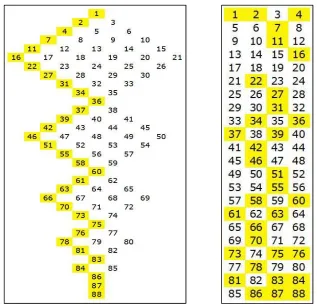
Figure 2.7 shows a number sequence that represents all 88 measures. The shaded areas
are the measures that remain after the censorship process (the measures in the final draft).
The unshaded numbers are the measures that have been removed. These shaded measures
that remain make up the first half of the final work or the forward progression of the
palindrome. The backward progression of the palindrome will go through the same
process but will have slightly different results.
In the final form of the work, measure one and two are played followed
immediately by measure four, which has now become measure three in the final draft. As
figure 2.7 illustrates, the rate of censorship follows a linear pattern of 1, 2, 3, 4, and 5
before going in reverse 4, 3, 2, and 1. The first two measures are played, then one
31
Figure 2.7: Straitjacket, palindrome number sequence. 34
measure is censored; the next measure played, two measures censored; the next measure
played, three measures censored, etc. After the completion of this sequence, it repeats,
but only going up to 4 before reversing, then up to 3, then 2; etc. Figure 2.8 shows the
complete censorship number sequence.
1-2-3-4-5-4-3-2-1
1-2-3-4-3-2-1
1-2-3-2-1
1-2-1
1
Figure 2.8: Censorship number sequence.
32
It should be noted here that each row of the number sequence above forms its own
palindrome, each one shorter than the previous one. Thus the overall work is made of two
halves of a palindrome as well as the various rows of the censorship number sequence.
The natural consequence of such a censorship pattern is that the rate of transformation of
the principal material gradually widens and narrows. As a result, this produces moments
in the piece where adjacent measures are similar, and other moments where they are so
different that they seem almost unrelated. Figure 2.9shows another view of the number
sequence that emphasizes the rate of censorship. The original figure is shown beside it for
reference.
Figure 2.9: Second view of censorship sequence compared with the first.35
33
This diagram shows that there are five cycles of expansion and contraction, each
forming the shape of a diamond. The least amount of sequential change occurs at the top
point of each diamond as it moves diagonally to the right and downward. This direction
of movement gradually increases the amount of change between consecutive measures.
The greatest point of difference in each diamond occurs when the diagonal changes to a
left, downward direction. From here, the rate of change begins drastic and gradually
lessens in the amount of change occurring. Furthermore, with each diamond, the farthest
point of change decreases each time, with the last diamond producing almost no change.
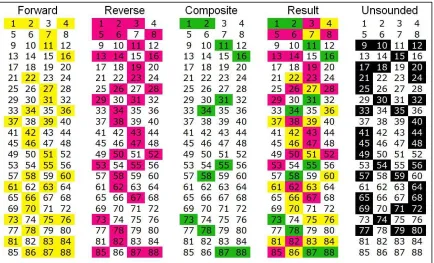
Once censorship has been applied, the original 88 measures are reduced to the 33
that are articulated in the final work. These 33 measures constitute the first half of the
palindrome. The second half of the palindrome makes use of the same process of
censorship but naturally begins on measure 88 and proceeds backwards. As a result, the
specific measures that are removed will not be exactly the same as those removed in the
first half. Figure 2.10 shows the two halves of the palindrome with an arrow indicating
the direction in which it proceeds.
The first half of the palindrome concludes with measure 88, which is then
repeated as the first measure of the second half. Figure 2.11 shows the second half
inverted in order to show how different measures from the original material are removed.
The natural consequence in following this censorship technique is that some
measures will sound only in the front half of the palindrome while others will only sound
in the back half. Additionally, some measures will end up sounding in both halves while
some that were originally part of the initial composition, will never sound. Figure 2.12
34
Figure 2.10: Both halves of the palindrome after censorship. 36
Figure 2.11: Second half of palindrome inverted. 37
35
Figure 2.12: Final configuration of measures.38
An analysis of these charts enables a reconstruction of sections of the original
material before censorship was applied. For example, the first eight measures of the piece
can be reconstructed and the details of transformation more clearly analyzed. The
measures that are censored in the first half are played in the second half. Example 13
shows the first four measures as they would have appeared before censorship was applied.
Here, it can be seen more clearly how each measure was a transformation of the previous
measure. Unfortunately, the original 88-measure composition can never be reconstructed
in full due to the fact that some measures did not sound in either half. Measure one
contains eight beats. Measure two transforms this measure by rearranging the beats into a
different order. The new order proceeds from outside to inside, beginning with beat eight
37 Ibid.
36
and followed by beats one, seven, two, six, three, five and four. Measure three uses a
slightly different transformation pattern. Beginning on beat one of measure two, it skips
every other beat so it is made up of beats one, three, five and seven of measure two. The
nature of this transformation type automatically changes it into a 4/4 measure. Measure
four removes all notes in the hi-hat and snare except for the one ghost note on the fourth
partial of beat three. In addition, the bass drum note on beat two is removed and beat four
is a repeat of beat one. The modifications do not necessarily follow a specific pattern and,
as mentioned previously, a full reconstruction is not possible due to a great portion of the
original material never having been used in the final draft.
Example 13. Mark Applebaum, Straitjacket, mvt. 1, (reconstruction of first 4 mm. of original material).
37
2.4 30 AND FORMAL SYNCHRONICITY
30, for percussion ensemble of 12 players, is a monumental work that is actually
made up of three independent pieces, each of which is ten minutes in duration. The
interesting concept behind this work is that its three smaller pieces were written so that
they could be performed individually as self-contained works, consecutively as a trilogy,
or played simultaneously. The performer’s choice will, of course, alter the total duration.
If any of the three works are performed individually or in any combination
simultaneously, then the total duration will be ten minutes. If two of the three are
performed consecutively, the duration will be 20 minutes. Finally, if all three pieces are
played consecutively, the total duration becomes 30 minutes. In addition to the work’s
harmonious synchronicity between the three pieces, each piece has a distinctive feature
specific to itself.
The title refers to the 30th anniversary of Mark Applebaum’s marriage. Each of
the three pieces corresponds to one decade of the 30 year period. The title of the work
varies according to the performance option chosen. The first piece played alone is entitled
30: The First Decade, the second piece, 30: The Second Decade, and the third, 30: The
Third Decade. In addition, any two of these may be performed simultaneously and this
choice should be reflected in the title: for example, 30: The First and Second Decades. If
all three pieces are performed, whether consecutively or simultaneously, the title can be
either 30: The First, Second, and Third Decades, or simply 30.39
30: The First Decade, for percussion soloist, uses two identical setups, one for the
right hand and one for the left hand. The instrumentation for each set consists of a high
and low cowbell, a high and low woodblock, and a high and low glass bottle. The pitches
38
and timbres of the set on the left must be an exact match to those on the right. The
performer places music stands between the two percussion setups. . The music is notated
using two staves of three lines each. One stave is for the right hand set and the other stave
for the left. The three lines represent the three pairs of cowbells, blocks and bottles.
The soloist uses two pairs of rubber mallets, one hard pair and one soft pair that
all have two stage fiberglass shafts. The hard mallets are designated in the notation with a
black circle above the corresponding notes while the soft mallets are designated in the
notation with a white circle. The two-step fiberglass shafts are necessary because during
certain sections of the piece, the performer must produce multiple bounce strokes by
striking the glass bottles with the mallet shaft. This type of bounce is virtually impossible
with a wooden handle mallet. In addition, other sections require that the performer use
the butt end of the mallets to trill between two bottles, something which would be
difficult using thick shafts or drum sticks.
In this work, Applebaum makes use of a striking spatial effect. Both percussion
setups are amplified with a separate microphone unique to each setup. It is than played
through a PA system with one microphone panned 100 percent to the right side of the
sound system and the other microphone panned 100 percent to the left side. This
produces a spatial effect in which identical sounds seem to move from one side of the hall
to the other, making identically pitched instruments a necessity for this work. The piece is
written with this spatial effect in mind, and the composer stresses its importance in the
program notes.40 Example 14 illustrates this idea. To emphasize the spatial nature of the
piece, note heads have been marked in red for the left side and blue for the right side.
Beginning in measure 93, there is a trill written for the high and low cowbell which is
39
played with the mallets inside the bells. Here, both bells are played on the right
percussion table and thus will be heard by the audience on the right side of the
performance hall. Likewise, in measure 102, a similar figure is played on both cowbells
on the left table and thus heard only on the left side. The pattern from measure 97 to
measure 100 makes use of the high wood block on both the right and left tables. However,
since they have the same pitch, an aural illusion is created in which the same sound
jumps left to right in the concert hall. Beginning in measure 105, an extended version of
this same pattern is played only on the high woodblock of the right table.
Example 14. Mark Applebaum, 30: The First Decade, mm. 89-113.
30: The Second Decade is written for percussion quartet. All four players have
nearly identical setups that consist of a suspended cymbal, log drum, snare drum, two
40
different tunings and dimensions, with player one having the highest pitched instruments
and player 4 having the lowest pitched instruments. Players 1 and 3 have a pair of bongos
and players 2 and 4 have a pair of congas. The instrumentation for the quartet uses
instruments not found in the solo part, which is one way that both pieces are given a
distinct character when they are performed individually. At the same time, this creates
contrast with the solo part and quartet when two or three of the pieces are performed
simultaneously.
In addition to playing instruments, all four players must perform various
vocalizations as well as hand gestures. There are three vocalizations employed in the
piece: “sh” as in the word hush, “s” as in silence, and “ch” as in cheese.41 All of these
whispered sounds are notated using the International Phonetic Alphabet. Example 15
shows an excerpt of this piece using a full score that includes all three works together. In
this example, the vocalizations have been marked with a square. The capital S is the
symbol for the “sh” sound and the dotted lines indicate that it is held. This vocal sound
pairs well with the two cowbell rolls in the solo part that are panned first to the left and
then to the right. In some places, these vocalizations are mandatory, but during the hand
gesture section there are vocalizations that are optional. Applebaum wanted to include
something audible for audio recordings of the work since the hand gestures would not be
seen.42 The hand gestures make up a substantial portion of the piece and will be discussed
in detail in chapter five of this document.
41 Ibid.
41
Example 15. Mark Applebaum, 30, mm. 81-88.
30: The Third Decade is written for percussion septet. This work is quite different
in form, style, and instrumentation than the other two works. It is made up of ten
consecutive episodes that each consists of a single line passage for each player and
notated spatially. Each episode lasts approximately one minute and is measured in real
time. All players have a stopwatch that is synchronized with one another. At the
beginning of the piece, the conductor gives a cue to start the watches which run for the
remainder of the piece. Each episode is repeated a specific number of times before
moving on to the next. However, each of the seven players move to the next episode at
different times as notated in the score. For example, player one moves from episode one
42
a complete episode. The players are labeled one through seven on the left side of the
score along with their entrance time written above and the time that they move on to the
next episode written below. In addition, there are two number values notated inside
hexagonal boxes. The first box indicates the number of seconds that should elapse for the
first repetition of the episode. The second hexagonal box indicates the duration of the
second repetition of the episode. As the players continue repeating each episode, they
alternate between these two values until it is time to move to the next episode. In example
16, player one takes eleven seconds to complete the first repetition and 19 seconds to
repeat the second.
Example 16. Mark Applebaum, 30: The Third Decade, episode VII.
The instrumentation is quite large for this work and makes use of both traditional
43
instrument (or small group of instruments) for each episode. In general, most of the
instruments in a given episode are similar in character or tone color. For example,
episodes one and ten contain a pitched sound tapestry made up of vibraphone,
almglocken, glockenspiel, chimes, crotales, handbells and grand piano. Non-traditional
instruments are present in several episodes. In episode five, all players use a roll of duct
tape as an instrument and in episode nine; all players perform on clickable ballpoint pens.
Episode seven (example 16) features traditional instruments such as bamboo wind chimes
and clave, along with a typewriter, bubble wrap that is popped, twigs that are snapped,
and stones that are poured onto a ceramic jug. The effect of this piece is a soft, calm and
tranquil soundscape that slowly and gradually changes timbre in a similar way to how a
multi-colored light slowly moves from blue to green to purple.
All three works that make up 30 have distinct characteristics and make use of
different instruments and timbres. The solo piece is unique in that it is written to
emphasize the panning spatial effect of the two identical percussion setups. Also, the
instrumentation of the solo part consists of bottles, woodblocks, and cowbells —
instruments not found in either the quartet or the septet. As a result, the soloist adds a
distinct layer to the ensemble when all three pieces are performed together. The quartet
contrasts with the solo part in that it uses drums, cymbals and log drums and is written
without the spatial aspect found in the solo part. It also contains hand gestures that are not
present in the solo or septet parts. The septet contains many different timbres including
pitched instruments and unusual instruments which are not found in the solo or quartet
44
discernible meter. Therefore, it lacks the strong rhythmic elements found in the other
pieces.
When all three pieces performed simultaneously, each of the individual works
takes on a new identity when heard in context with the others. For example, when the
quartet performs alone, the last section of the piece will have no sound at all because all
four players are performing hand gestures. However, when performed with the soloist,
these gestures are now choreographed with the sounds played by the soloist. If the quartet
performs with the septet but not the soloist, rather than having someone play the exact
45 CHAPTER 3
TREATMENT OF RHYTHM AND METER
In this chapter, several works that contain notable uses of rhythm and meter will
be discussed. This will include a brief discussion of Applebaum’s use of metric
modulations using his percussion trio Catfish as an example. In addition, there will be a
detailed analysis of two of Applebaum’s works that make use of a fascinating mechanism
to generate rhythmic material that, to this writer’s knowledge, no other composer has
used. This process and the purpose behind it will be discussed in detail.
3.1 METRIC MODULATIONS OF CATFISH
Catfish is a work written for percussion trio with each player performing on three
instruments that are made of the same material. Player one uses three metal instruments,
player two, wood and player three, skin. Each of the three instruments in each family is
specified to be high, middle, and low in sound. In addition, the instruments must be three
of a kind, or three different instruments entirely.43 For example, two cowbells and a metal
plate would be forbidden but three cowbells (assuming they are high, middle, and low) or
a cowbell, a metal plate and a cymbal would be permissible. While staying within these
parameters, the players choose their specific instruments for performance. The piece was
originally written to be the overture to what Applebaum refers to as a “secular oratorio”