COMPARISON OF LOW ENERGY CONSUMPTION
PROTOCOLS IN WIRELESS SENSOR NETWORK
Anil Kumar Gupta
1, Govind Verma
2 1M.Tech,
2Assistant Professor, Department of Computer Science & Engineering,
SRM University Ghaziabad (India)
ABSTRACT
Wireless Sensor Network is an emanating field for research in several aspects of human beings. WSN is a network composed
of nodes without any central controller. Sensor network protocols have high ability to be used in each and every field of life.
The working of sensor networks depends entirely on the battery power of sensors which cannot be replaced. In this work,
cluster based routing protocol is studied precisely. Further leach protocol is modified as MCHAEEC protocolby introducing
two schemes efficient cluster head replacement scheme and dual transmitting power level scheme for amplification of
signals. The performance of MCHAEEC protocol is shown in terms of network life time and throughput. The cluster head
selection in MCHAEEC is more efficient than other protocols because energy is not wasted to select the new cluster head for
new round and in other scheme two levels of power are used for amplification of signals either low or high power. Thus
using different energy for different types of communication. MCHAEEC is compared with LEACH and MOD-LEACH
protocol in the end. MCHAEEC gives better performance than LEACH and MOD-LEACH in terms of network lifetime.
Keywords: Clusters, MCHAEEC, LEACH, MOD-LEACH, Power level, Threshold etc.
I. INTRODUCTION
WSN is a large network of nodes which are interconnected by a communication network. These nodes are autonomous
objects which are randomly deployed in any region according to the requirement. The number of sensor nodes in a network
can vary from some hundreds of nodes to thousands depending on the requirement of the region. A sensor network consists
of low power nodes and low cost multifunctional nodes. These sensor nodes communicate via wireless medium over certain
distances. The sensor nodes consist of sensing, processing, power and communication component. Each and every
component is having its own functions to perform. The arrangement of these sensor nodes is defined in two ways one in
deterministic way and other self-organizing capability. It means that in deterministic way the routes for data transmission is
already defined and sensors are placed manually. Whereas in self-organizing way the nodes are scattered randomly in an ad
hoc manner .As the energy consideration is also important for setting up the routes. They can provide high quality and fault
tolerant network capability [1] [2], however there battery lifetime is limited. Ranging from medical applications to military
applications WSN is used. The numbers of nodes in network are potentially large. One of the main important applications of
the WSN is to monitor the data of the environment and then further transmit that data to the central point called sink node. In
order to initiate some specific action the data is analyzed .That data is analyzed by the sink node or by the network. The most
important criteria in wireless sensor network are that large number of sensors should be used and the energy consumption of
these sensors should be low so that energy is not wasted.
The most prominent limitation in Wireless Sensor Networks is energy limitation constraint. The number of nodes deployed
in any region are high so the monitoring of such nodes becomes very difficult. Once the network is established the node
energy keeps on dissipating whenever the information is received or send to other node in network. As the sensor nodes are
such small sized batteries .So sensors need efficient mechanism for energy utilization. As sensor networks have dynamic
nature so nodes can lose its connection in any network. So each node is tightly power constrained. Therefore the entire
network has limited lifetime. In order to enhance the network lifetime of network many routing protocol approaches are
used. Thus routing protocol is an important factor affecting the energy consumption of the sensor nodes. One of techniques
to enhance network lifetime is clustering. Clustering divides the nodes into separate clusters .In this large data coming from
different nodes is compresses by using the techniques of aggregation. Therefore, only those packets are transmitted which
consist meaningful information; this approach leads to an efficient solution for energy. Data aggregation can be executed
with the help of clustering technique [3] [4]. In any wireless network for efficient performance, the protocols should be
efficient. Many protocols have been designed which address the power problem. One of the most prominent algorithms
which are designed to address power issue is direct transmission algorithms, cluster based algorithms and hop to hop
transmission algorithms. In further sections, the work done on cluster based routing in wireless sensor network is discussed
and some modifications are made in existing protocol to increase efficiency. Finally, experiments are made to show the
network lifetime and throughput.
II. RELATED WORK
In a survey on routing protocols in WSN, it classifies the routing techniques based on network structure into three categories
flat based, location based and hierarchical based. Further also these protocols are classified into QoS based, data centric
based, mobility based, query based, negotiation based and multipath based protocols. Manufacturing of small nodes capable
of transmitting and processing are available nowadays, but hundreds of nodes are deployed for any application in any region.
These nodes deployed have limited power so the power capability of the nodes should not be wasted. It means the power
capability should be used in a précised manner so that it is not wasted and the network lifetime is enhanced. Although
efficient circuit is also an essential requirement for energy efficiency but protocols also play an important role in energy
consideration and power management.
To deal with such energy problems direct transmission approach was discussed [5].In direct transmission the node senses
data from the environment and directly transmits it to the base station. This method is very much efficient for the security
measures because there is direct transmission but one drawback of this approach is the excessive power consumption of the
nodes. As the nodes which are far away from the base station die out quickly because they require extra power consumption.
To solve this problem further protocols are classified in two classes taken into consideration the energy aware
broadcast/multicast problems. The algorithm is classified in the MEB/MEM (minimum energy broadcast/multicast) problem
and MLB/MLM (maximum lifetime broadcast) problem in wireless networks. Two main energy metrics that are considered
in this approach are minimizing the total power consumption of all the nodes involved in multicast session and maximize the
operation time until the power of the one node battery is depleted in multicast session.
In order to solve the issues in direct transmission another approach least transmission energy came into existence. In this the
transmission of the data takes place along the network through multi hop. Both direct transmission and least transmission
energy lead to same energy problem but the only difference between two was that in least transmission the nodes which are
far away from the base station live longer as compare to the nodes which are closer to the base station. The reason for the
nearer nodes to die is because all data is routed to base station. However the transmitting most of the data from each node
uses much energy. To address this problem Direct Diffusion method is used which involves the data processing and data
dissemination[6] .This concept is used in hierarchical clustering mechanism and thus presented clustering based routing
protocol[7].Clustering is one of the efficient mechanisms in energy conservation of wireless sensor network. Clustering is
useful in data query and broadcast of message [8][9]. In sensor network nodes establish clusters and each node nominates
one node as cluster head. The node which is chosen as a cluster head is having maximum energy. It is the cluster head which
collects the data from each cluster, aggregates the received data and then transmits it to the base station. In this way lifetime
be elected as a cluster head. Considering clustering mechanism various protocols are developed and each of the protocol has
its own functions [10]. Stable Election Protocol (SEP) gives each node a weighted probability of becoming a cluster
head[11].The sensor network architecture of Threshold sensitive Energy Efficient
sensor network protocol (TEEN) is based on hierarchical grouping where the nodes which are closer to each other form
clusters and process goes on until second level is reached. The Adaptive Threshold Energy Efficient sensor network protocol
(APTEEN) architecture is same as TEEN. In APTEEN first the previous data is analyzed, then snapshot view of the network
is taken and for a specific period of time event is monitored. Power efficient Gathering in Sensor Information Systems
(PEGASIS) a chain is formed among the nodes and so that each node can receive and transmit the data, then the collected
data moves from node to node and destination node transmits it to the base station. LEACH is among the most popular
protocols for the sensor network. Leach [12] protocol proposes that each node should elect itself a cluster head; therefore
first CH selection process is initiated. In Leach protocol each node is assumed to have powerful energy to reach the nearest
cluster head. In this nodes transmit to cluster head and cluster head aggregate the data and transmit it to the base station. But
using powerful energy for transmission waste energy of the network. Based on LEACH and SEP several numerous protocols
are proposed Q-Leach optimize the network life time of homogenous network [13].
III. LEACH PROTOCOL
Leach is one of the prominent proactive sensor network protocols. In leach once the cluster head is chosen , it is responsible
for broadcasting message in assigned time schedule .As the cluster head broadcasts a TDMA schedule for the transmission
of the data in given order. Each and every node is having its own time slot in the frame during which the transmission takes
place. When the last node completes its transmission then the schedule is repeated. Leach is a cluster based protocol in
which cluster head rotates randomly to evenly distribute the energy among the nodes in the network [14]. Leach protocol
works in various rounds. Each round consists of two phases, set up phase and Steady phase.
1. Setup Phase: In this phase each node decides whether or not to become cluster head. It depends on decision made by
the node by choosing a random number between 0 and 1[15]. The node which is having maximum energy is chosen as a
cluster head. Then the cluster head CH broadcasts its message to all clusters that it has become the new cluster head
CH. Then all the nodes have to join the cluster, thus all nodes send join request message to the cluster. The nodes join
that cluster which is having signal intensity higher. In this way the each CH know its members. Then CH creates time
schedule so that each node know its time slot during which the data is transmitted.
2. Steady Phase: In this phase the data is send to the cluster head by their nodes in the allocated time slot. Then cluster
head CH aggregates the data and sends it to the base station BS. The nodes turn radio on only when it senses some
important information. But the cluster head has to keep its receiver on so that it can receive the data from the nodes.
The routing topology of leach is shown below in Figure1.
Figure 1 LEACH Routing Topology
The stochastic CH selection algorithm is used in LEACH. Leach is proposed for homogenous network. When CH performs
its function of aggregation and transmitting, CH consumes extra energy. Because the node selected as the cluster head dies
proposes that every node becomes cluster head CH after 1/p rounds [16].Each sensor node n generates a random number.
And this random number is compared to threshold value T(n). If random number is less then threshold value then sensor
node becomes cluster head for that particular round. Otherwise becomes cluster member for that round.
T(n)= p∕1-p(r mod 1∕p) if n€G (1)
In this formula p is the probability of the node to be elected as a cluster head, r is the number of rounds selection, G is the set
of nodes which are not elected as a cluster head in the given round.
IV. PROPOSED SCHEME
In proposed method two schemes are used Cluster head replacement scheme and two power level scheme for amplification.
Basically Leach protocol is modified and in Leach protocol the node elected as cluster head for one round does not becomes
cluster head for other rounds. In this way if the cluster head has some energy left during transmission, that energy is wasted.
Because the same node cannot become cluster head in next round. Whereas in the proposed scheme if the cluster head has
some energy left during its time period and the energy left is greater than the threshold then same cluster head can be chosen
for the next round. In this way the energy is not wasted as in Leach. If the cluster head has less energy than the threshold,
then new node can be chosen as a cluster head replacing the old one. In second scheme the two different power levels are
introduced for the amplification of signals. In intra cluster communication, transmission takes place within cluster and
energy required should be less. Whereas in inter cluster communication, where the transmission takes place within the
cluster heads the energy requirement is more. So using same energy for both types of transmission is wastage of energy. In
this scheme different power levels are used for the different type of transmissions. In this scheme when node becomes
cluster head, routing protocol informs the same node to use the high amplification energy and when the same node becomes
the cluster member in another round the protocol informs it to switch it to low power level. Finally soft and hard thresholds
are applied on this modified Leach.
The operation of new protocol is divided in two phase’s one full transmission and half transmission. The node selected as a
cluster head performs the main functions. The remaining nodes in the cluster broadcast their status to the neighbouring
nodes. Any node which seems ready to accept this status saves this information and broadcast this message to other nodes
that the nodes status indicates that this node can be elected as a new cluster head. In this way confirmation message is send
to the nodes. The nodes which receive the confirmation message send back the acknowledgement to the cluster head with
another confirmation of electing that node to become the cluster head. Thus the cluster head saves the id of that node which
is approved to become the cluster head for the next round. In this way the old cluster head receives the data, aggregates the
data and then send this data to the base station. If the status of the node which is chosen as the next cluster head shows that
this node has high energy to be used as a cluster head in next round as well. Then it is called full transmission. Whereas in
half transmission, only the sensors with cluster head, will aggregate the data and send the data to their respective cluster head
.Then the old cluster head will aggregate the data and transmit it to the base station.
V. PROPOSED PROTOCOL
In this section new protocol MCHAEEC is described.
Cluster head selection: In this modified protocol, in the beginning of each round cluster head is elected. In order to
determine the ability of the node to become cluster head, random number is generated between 0 and 1. Then is number is
compared with the sensor threshold value T(n). If the threshold value is greater than the random number then the node
becomes the cluster head for the current round. This random number is actually a sensor residual energy .This energy is
generated by the sensor node to determine the method to check the capability of the node to become cluster head. The
threshold value for desired cluster head percentage p, for sensor s in round r, with residual energy R and maximum energy M
This is the formula used to calculate the threshold value for sensor node. Based upon the same formula in Mo-Leach the
threshold value is calculated for two rounds as follows:
Where Tmin is minimum threshold energy, M is maximum energy and RE is residual energy. If the node approve this
formula then the node selected as a cluster head is capable to become cluster head for two rounds. Whereas if the same
formula is not approved by node then another formula is used for determining the ability of node to become cluster head for
one round.
This is the approach used in selection of the cluster head in order to minimize the energy wastage in selecting the cluster
head for next round.
Dual transmitting power levels: In this scheme different power levels are used for different transmissions. Depending on
the distance of the nodes, power levels are used for the amplification. Whereas in Leach same amplification energy is used
for all transmissions. When the communication is within a cluster, means intra cluster communication. Where the data is
sensed by cluster members and reported to cluster head. This is called intra cluster communication. The amplification energy
required for intra cluster communication is low. Thus using low power level for intra cluster communication saves energy.
When the communication is between two cluster heads, it is called inter cluster communication and there is one more
communication that is cluster head to base station communication. The energy requirement cannot be same for all types of
communication. Minimum energy is required for inter cluster communication. Whereas energy required for cluster head to
base station is high. In other clustering protocols same energy is used for communications. This scheme provides two type of
power levels for communication one high power level and low power level. When the node which is used as a cluster head,
routing protocol informs it to use high amplification energy. When the same node becomes cluster member in any other
round routing protocol switches it to low amplification energy. So different levels of power are used in order to minimize the
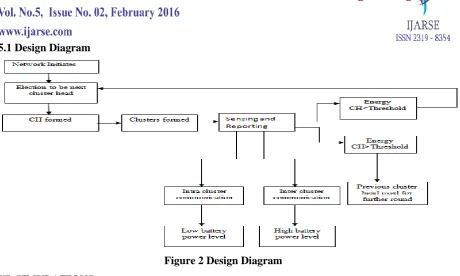
5.1 Design Diagram
Figure 2 Design Diagram
VI. SIMULATIONS
Simulations are conducted in MATLAB. In order to show the performance of MCHAEEC specific intervals and parameters
are taken. MCHAEEC is compared with LEACH, MOD-LEACH in terms of network lifetime and it is clear from the graph
that MCHAEEC outperforms LEACH and MOD-LEACH.
6.1 Simulation Scenario and Parameters
In order to perform simulations a network size 100X100 m² is taken. Total nodes taken are 100 with initial energy of sensor
nodes 0.5J and packet size 4000 bits. Transceiver idle state energy consumption 50nj/bit with data fusion and aggregation
energy consumption 5nj/bit.
6.2 Simulation Results
In a wireless sensor network computing capacity and stored energy is limited. Due to this limiting computing capacities,
network lifetime and throughput is affected. Thus in the simulation the ICHEAC is evaluated using following indices.
6.2.1 Network Life Time
The network lifetime of the sensor network is the lifetime of the network from the starting of the network to the end of the
network. It means the time from where the network starts its operation till the phase network has completed its operation.
The operation is measured in terms of the rounds. Thus the network lifetime is measured in two ways a live nodes and dead
nodes.
6.2.2 Throughput
The amount of data received by the base station describes the rate of the accuracy of the nodes, throughput. The more data
received means high accuracy. The throughput of the sensor network is measured by the total number of packets sent to base
station, packets sent to cluster head during the network lifetime and cluster head formation.
6.3 Simulation Analysis
The implementation of the MCHAEEC is shown in form of graphs and the original LEACH and MOD-LEACH protocol is
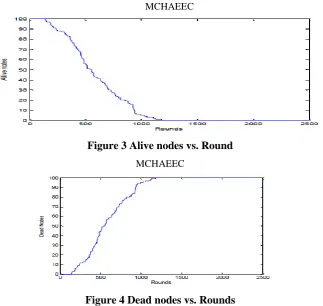
compared to the MCHAEEC. Figure.3 and Figure.4 shows the change of a live nodes and dead nodes over the rounds. In
Figure 3 it is clear that the number of alive nodes are higher between 0 and 500 rounds. Further as the rounds are increasing
rounds. It is clear that number of dead nodes are low in initial rounds ranging between 0 and 500. Between 1000 and 1500
rounds the range of dead nodes is higher. The change of alive nodes and dead nodes show the operational time of the
MCHAEEC protocol.
MCHAEEC
Figure 3 Alive nodes vs. Round
MCHAEEC
Figure 4 Dead nodes vs. Rounds
In Figure 5 and 6,the analysis of the number of packets sent to Base station and Cluster head is shown over rounds in order
to measure accuracy. In Figure 5 it is clear that the packets sent to base station increases as the number of rounds increases.
More packets are sent to base station between 1500 and 2500 rounds.
MCHAEEC
Figure 5 packets to BS between Rounds
Figure 6 Packets to CH between rounds
In Figure 6 the number of packets sent to the cluster head are shown. The number of packets sent to cluster head also
increases as the number of rounds increases. The high number of data packets are sent between 1000 and 2500 rounds. The
more the data packets sent to the cluster head the more accuracy of the network lifetime is achieved. This transmission
shows the accuracy of the network life time. In Figure 7 the cluster head formation is shown over rounds. The variation of
the cluster head formation is shown between 0 and 1000 rounds.
MCHAEEC
Figure 7 Number of Cluster head formed vs. rounds
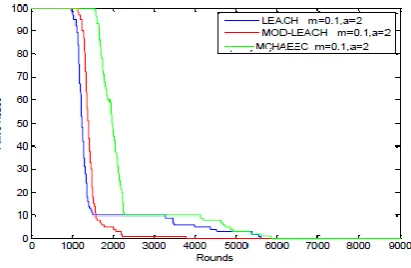
In Figure 8 MCHAEEC is compared with LEACH and MOD-Leach in terms of network life time and MCHAEEC
outperforms both the protocols.
VII. CONCLUSION AND FUTURE WORK
In this work new clustering approach is proposed MCHAEEC, which can be further, utilized in other clustering routing
protocols for better efficiency. In this efficient cluster head replacement scheme is used and dual transmitting power level.
Whenever cluster head is selected in first round then the same node can be used as a cluster head in other round if the energy
of the node is greater than the threshold. In this way the energy of the cluster head is not wasted. If the energy of the cluster
head is less than the threshold then the other node is chosen as a cluster head for next round. In this method the threshold is
given priority for the choosing of the cluster head. And for different types of communication different power levels are used
either low or high. Depending upon the distance the different amplification energy is used for the different types of
communication.
Further the work on data aggregation and fusion can be carried out in cluster selection. Hence there is need to develop the
new protocol which spends least energy in receiving and fusion of the data to base station and much more efficient
mechanisms for the cluster head replacement.
REFERENCES
[1]. P. Krishna, et al., “A survey on sensor networks”, IEEE communications magazine, volume 8, pp 102-114, 2002.
[2]. M. Akbar, N. Javaid, A. A. Khan, Z. A. Khan, U. Qasim, “On Modeling Geometric Joint Sink Mobility with
Delay-tolerant Cluster-less Wireless Sensor Networks”, 4th IEEE Technically Co-Sponsored International Conference on
Smart Communications in Network Technologies (SaCoNet'13) 2013, Paris, France.
[3]. V. Mhatre, et al., “Design of surveillance sensor grids with a lifetime constraint”, 1st European Workshop on
Wireless Sensor Networks (EWSN), Berlin, January 2004.
[4]. W.R. Heinzelman,et al., “Energy efficient communication protocol for wireless micro sensor networks”, Proceedings
of the 33rd Hawaii International Conference on System Sciences (HICSS-33), January 2000.
[5] W. Heinzelman, A. Chandrakasan, and H. Balakrishnan.“Energy-Efficient Communication Protocols for Wireless Microsensor Networks”.In Proceedings of Hawaiian International Conference on Systems Science, January 2000.
[6] C. Intanagonwiwat, R. Govindan, and D. Estrin.”Directed Diffusion: AScalable and Robust Communication
Paradigm for Sensor Networks”.In Proceedings of the 6th Annual ACM/IEEE International Conferenceon Mobile
Computing and Networking(MOBICOM), pp. 56-67, August2000.
[7] D. Estrin, R. Govindan, J. Heidemann, and S. Kumar. “Next Century Challenges: Scalable Coordination inWireless Networks”. In Proceedings of the 5th Annual ACM/IEEE International Conference on Mobile Computing and
Networking( MOBICOM), pp. 263-270, 1999.
[8]. Sze-yao Ni, et al., “The broadcast storm problem in a mobile Ad Hoc network”, Proceedings of MobiCom, August
1999.
[9]. D. Estrin, et al., “Next century challenges: scalable coordination in sensor networks”, MobiCom, August 1999.
[10] M. Tahir, N. Javaid, Z. A. Khan, U. Qasim and M. Ishfaq, “EAST: Energy-Efficient Adaptive Scheme for Transmission In Wireless Sensor Networks”, 26th IEEE Canadian Conference on Electrical and Computer
Engineering (CCECE2013), Regina, Saskatchewan, Canada, 2013.
[11] Smaragdakis G, Matta I, Bestavros A. “SEP: A stable election protocol for clustered heterogeneous wireless sensor networks”, Proc of the Int’1 Workshop on SANPA 2004. pp. 251-261, 2004.
[12]. W.R. Heinzelman,et al., “Energy efficient communication protocol for wireless micro sensor networks”, Proceedings
of the 33rd Hawaii International Conference on System Sciences (HICSS-33), January 2000.
[13] B. Manzoor, N. Javaid, O. Rehman, M. Akbar, Q. Nadeem, A. Iqbal, M. Ishfaq, “Q-LEACH: A New Routing
4th International Conference on Ambient Systems, Networks and Technologies (ANT 2013), 2013, Halifax, Nova
Scotia, Canada, Procedia Computer Science, Volume 19, 2013, Pages 926-931, ISSN 1877-0509.
[14] Mona El_Saadawy,et al, “ Enhancing S-LEACH Security for Wireless Sensor Networks,” IEEE 2012 .
[15] JiaXu,et al, “Improvement of LEACH protocol for WSN,” 2012 IEEE.
[16]. W.R. Heinzelman,et al., “Energy efficient communication protocol for wireless micro sensor networks”, Proceedings