410 | P a g e
INFLUENCE OF INITIAL CRACKS ON LOCATION OF
PLASTIC HINGES IN STEEL FRAMES
Yameen Patel
1, Bhairav Thakkar
21
Under-Graduate Student,
2Associate Professor, School of Science and Engineering,
Navrachana University, Vadodara
ABSTRACT
Plastic hinges that form near the beam column joints have been found to be playing a vital role in pushover analysis of frames. If the plastic hinges shifts away from the column faces, the seismic capacity of frames must be determined accordingly. Various approaches have been adopted by researchers to describe the formation of plastic hinges under flexure in steel frames. Stress fields near beam column joints are significantly affected by the initiation of imperfections in any form for example a crack. Flexural stiffness and strength of cracked members would also be significantly affected and will show changes in stresses. This paper tries to describe a study conducted on shifting of plastic hinges near beam column joints in a steel frame due to initial cracks. A fracture analysis code FRANC2D has been adopted here to generate a model of a two story steel frame having two cracks in beam column joints on the windward side. Stress distribution in expected plastic hinge generation region has been studied in this paper. Behavior of stress distribution around cracks has also been studied taking in to account the location of crack tip, mode of crack etc.
Keywords:
Finite element analysis, Fracture Mechanics, FRANC2D, Plastic hinge, Steel frames.
I. INTRODUCTION
To perform push over analysis or to study the behavior of steel frames under the presence of plastic hinges and
initial cracks, it is necessary to obtain the location and depth of cracks[1]. These cracks influence the stress
distribution and consequently act as hinges in the frames. The plastic hinges may not form in presence of a deep
crack in nearby vicinity. Plastic hinges are usually assumed to form at 0.25L[2]. The location and depth of existing
cracks are usually achieved by non-destructive evaluation techniques. While designing members by Fracture
Mechanics approach, a crack of small length is usually postulated.
In present study, a steel frame with 10mm cracks in the beam column joints region has been considered. The frame
is subjected to horizontal load. An effort to describe the behavior of plastic hinge in such a situation has been made.
As the crack propagates, the relocation of plastic hinges is simulated.
A finite element model for simulating propagation of crack as well as effective stress contours in a beam column
411 | P a g e
applied load, shift in plastic hinge locations is studied as well as the deformed shape is noted. Direction of crack,
mode of failure, crack tip locations etc. have been taken into consideration while modeling as well as analyzing.
II. FINITE ELEMENT SIMULATION
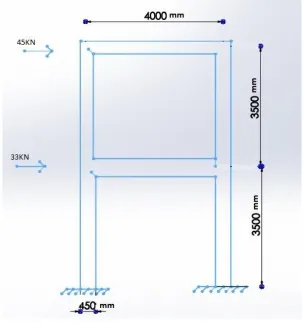
A steel frame with 2 stories has been modeled. Each story has been modeled to be having 3500mm centre to centre
height. Bay distance between two columns is considered to be 4000mm. All the beams and columns considered to
be ISMB450. The frame is considered to be made of mild steel having young’s modulus of elasticity = 200000
N/mm2, poisons ratio = 0.33 and fracture toughness = 220 MPa√m[3]
Figure 1 is the schematic of the simulated two story steel frame with two cracks in beam column joints. All
dimensions in the figure are in mm.
Fig.1 Schematic of steel frame
The bottom two edges of the steel frame have been restrained against deformation in x and y directions [4]. Two
horizontal point loads of 45KN and 33KN were applied on both beam column joints. Upper joint was subjected to
45KN load and lower joint was subjected to 33KN load. With these loads, the frame was simulated to be under
seismic loading.[5] Two non-cohesive, traction-free edge cracks of approximately 10mm length each were generated
on inner corners of both beam-column joints on windward side such that the crack makes a 45o angle with
412 | P a g e
near the expected plastic hinge region was observed[6]. Deformed shape of the frame, stress fields near crack tips,
crack tip locations etc. were also monitored.
III. RESULTS AND DISCUSSION
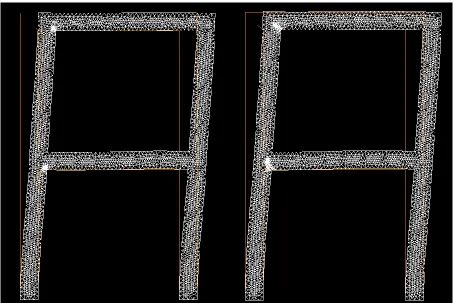
A finite element mash showing steel frame and 10 mm cracks is shown in the figure 2(a) and a finite element mash
showing steel frame with propagated cracks is shown in figure 2(b).
Fig. 1(a): Finite Element Mesh with initial cracks
Fig. 2(b): Finite Element Mesh with propagated cracks
Fig. 2 : Finite element model of two story steel frame
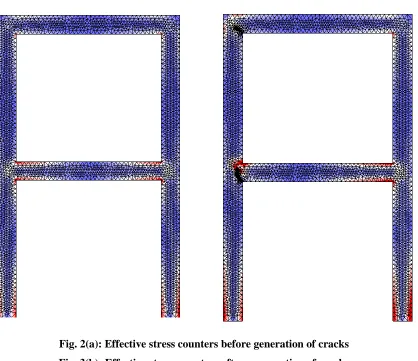
Figure 3(a) shows effective stress contours before generation of cracks and figure 3(b) shows effective stress
413 | P a g e
Fig. 2(a): Effective stress counters before generation of cracks
Fig. 3(b): Effective stress counters after propagation of cracks
Fig. 3: effective stress contours in two story steel frame.
Due to presence in cracks, the plastic hinges in beams were observed to shift to 0.22 L and in columns, the plastic
hinges were observed to shift to 0.20 L approximately[1]-[7]. Plastic hinges near the cracks were observed to be
disappearing.
IV. CONCLUSION
A detailed study on relocation of plastic hinges in a steel frame under seismic loads has been carried out using
FRANC2D. It is observed that due to the initial imperfections the plastic hinges near the cracks tend to disappear
while those on the farther sides of the cracks shifts a little near to the joints. The capacity of such frames is expected
to be significantly deviating from frames without initial imperfections. The value of increment in stress causes a
rapid change in plastic zone of the frame due to the initiation and propagation of cracks. This would mean that the
414 | P a g e
REFERENCES
[1] Location of Plastic Hinges in Columns of Steel Frames. By- B.H.H.Peng, G.a. MacRae, W.R. Walpole,
P.J.Moss and R. Dhakal
[2] Plastic hinge location in columns of steel frames subjected to seismic actions. By- Brian H. H. Peng 1, Gregory
A. MacRae 2, Warren R. Walpole3, and Charles Clifton4
[3] Prashant Kumar (1999), Elements of Fracture Mechanics, Wheeler Publishing.
[4] Study on formation of plastic hinges and the failour of reinforced concrete columns. Earthquake engineering,
tenth world conference.1992 balkema, Rotterdam. By- Younggon Ro & Tanaka yasuo,Naoyuki sato, Harumi
Yashiro.
[5] Relocation of Plastic Hinge of Interior Beam-Column Connections with Intermediate Bars in Reinforced
Concrete and T-Section Steel Inserts in Precast Concrete Frames by-P. Wongmatar, C. Hansapinyo, C.
Buachart. International Journal of Civil, Environmental, Structural, Construction and Architectural
Engineering Vol:9, No:5, 2015
[6] Location of plastic hinges in axially loaded steel members by Brian H. H. Peng1, Gregory A. MacRae2,
Warren R. Walpole3
[7] An overview of the plastic hinge analysis of 3D steel frames. By- Van Long Hoang2, Hung Nguyen Dang1* ,
Jean Pierre Jaspart2 and Jean Francois Demonceau2
[8] AISC. 2001. “Manual of Steel Construction, Load and Resistance Factor Design”, American Institute of Steel
Construction, 3nd Ed., Chicago, USA.
[9] A model pushover analysis procedure for estimating seismic demands for buildings. By- Anil k chopra and
rakesh k goel.
[10] Anderson T L (2005), Fracture Mechanics-Fundamentals and Applications 3e, Taylor and Francis