97 | P a g e
A Review Paper on Li-Fi Technology and Its Application
in Wireless Sensor Network
Ms. Surekha N. Shelke
1, Mr. A. P. Kiranagi
2 1,2Department of Electronics and Telecommunication,
MSS College of Engineering and Technology Jalna (MS), (India
)
ABSTRACT
Li-Fi means Light-Fidelity. Li-Fi technology, proposed by the German Scientist — Harald Haas, Harald Haas
proposed the technology .Today each and every technology is got tremendous advancement. Li-Fi is at
beginning stage but upcoming years we may found it everywhere. Li-fi can be used in number of applications.
This paperproposes the LI-Fi application in wireless sensor network. The sensor networks demand large
electromagnetic spectrum if we use current wireless technologies like Wi-Fi Bluetooth etc. Wi-Fi is of major use
for general wireless coverage withinbuilding, whereas Li-Fi is ideal for high density wireless data coverage in
confined areaand especially useful for applications in areas where radio interference issues are ofconcern, so
the two technologies can be considered complimentary.
Keywords –Light Emitting Diode(LED), Light-Fidelity (Li-Fi),Visible Light Communication
(VLC), Wireless-Fidelity (Wi-Fi), Wireless Sensor Network(WSN).
I. INTRODUCTION
In today‟s Digital world we have electromagnetic wave in almost all networks. Li-fi is new technology that can be used to transfer of data from one end to other end wirelessly.The current wirelessnetworks that connect us to the Internet are very slow when multiple devices are connected. Li-Fi has got a much broader spectrum for transmission compared to conventional methods of wireless communications that rely on radio waves. The basic ideology behind the technology is somewhat similar to fiber optic communication. At one end light source is use to transfer the data by switching light on and off. The light on off human eye doesn‟t notice, because of high switching speed of light. There are number of papers publish on how Li-Fi works.
II.
RELATED WORK
The aimof this paper is to elaborate different aspects advantages limitations of Li-Fi in application of wireless sensor network.
2.1 Li-Fi
98 | P a g e
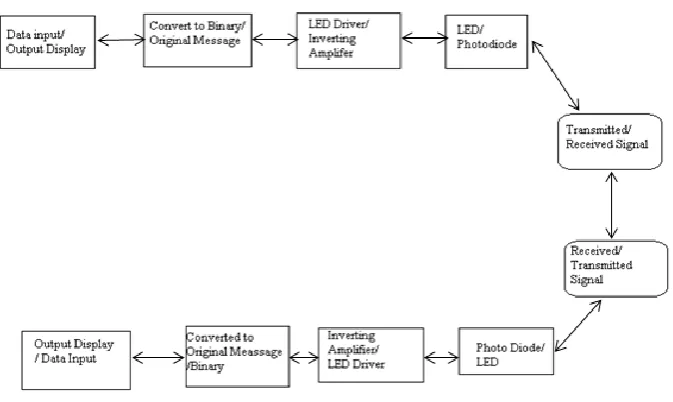
display. MATLAB is used for transmission and reception of image. The algorithms for transmission and reception are made to run simultaneously on respective ends and the image to be transmitted is selected. RS232 is used to connect PC with the transceiver part. The Baud rate used at both transmitter and receiver ends should be the same. The serial ports are opened with the given Baud rate. The received ASCII values are reconstructed into the original image.
Fig 1 The Basic Block Diagram of the System.
Rahul R. Sharma[2] has proposed the Implementation of a Simple Li-Fi Based System. This paper proposes a Li-Fi based system to transfer data from one device to another using visible light. The proposed system consists of Li-Fi transmitter and receiver circuits with LEDs, photo-detector, MAX232A IC and inverter, battery, connecting wires and USB or COM port. The sending device will select some data to the transmitter circuit of the sender‟s device. The LEDs in the transmitter circuit will transmit this data. The photodetector of the receiver
circuit will receive this data from the light detected and will send it to the receiving devicewhich will interpret and obtain the final data that was sent by the sender. The proposed Li-Fi system will consist of Graphical user interface, Data reading module, Data conversion module, Transmitter module, Receiver module, Data
interpreter module.Alao O.D. [3] has given valuable explanation in paper „Light Fidelity (Li-Fi): An Emerging
Technology for The Future about limitations of Li-fi‟. These are as follow 1)You cannot dim the light
2) You need special LED
3)The main problem is that light can„t pass through objects, so if the receiver is inadvertently blocked in
anyway, then the signal will immediately cut out. If the light signal is blocked, or when you need to use yourdevice to send information you can seamlessly switch back over to radio waves.
99 | P a g e
5) High installation cost of the VLC systems can be complemented by large-scale implementation of VLCthough Adopting VLC technology will reduce further operating costs like electricity charges, maintenancecharges etc.
6) One of the major demerits of this technology is that the artificial light cannot penetrate into walls and otheropaque materials which radio waves can do. So a Li-Fi enabled end device (through its inbuilt photo receiver)will never be as fast and handy as a Wi-Fi enabled device in the open air. Also, anothershortcoming is that it only works in direct line of sight. Still, Li-Fi could emerge as a boon to the rapidlydepleting bandwidth of
radio waves. And it will certainly be the first choice for accessing internet in aconfined room at cheaper cost.Mr. Korde[4] has published a review paper on Li-Fi. He has given advantages of Li-Fi over other technologies and
different applications. Li-Fi is ideal for high density wireless data coverage inside a confined area or room and for
relieving radio signal interference issues. The comparison of WI-FI and LI-FI is as per table 1 which is important
for development of Li-Fi for WSN.
Table 1 Comparison between WI-FI and LI-FI
Parameter Li-Fi Wi-Fi
Speed 1-3.5 Gbps 54-250 Mbps Range 10 meters 20-100 meters IEEE standard 802.15.7 802.11b
Spectrumrange 10000 times than WiFi Radio spectrum range Network Topology Point-to-point Point-to-MultiPoint Data Transfer Medium Used light as a carrier Use radio Spectrum
From this comparison it‟s clear that in Li-Fi Network topology is Point to Point, whereas WSN needs Point to
multipoint network.
2.2 Wireless sensor network
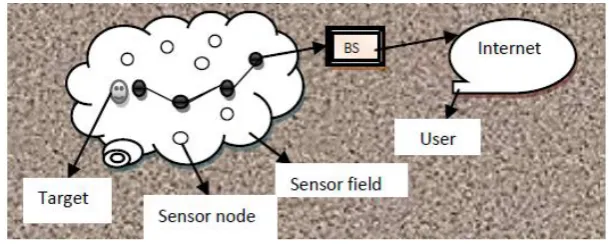
A wireless sensor network is type of wireless network [5]. Basically it consist a collection of tiny device are called sensor node, sensor node has a resource constraint means battery power, storage and communication capability. These sensor nodes are set with radio interface with which they communicated with one another to form a network. Wireless sensor network has very necessary application like remote environmental monitoring and target tracking.
100 | P a g e
Vitthal S Saptasagare has published the paper [9] „Next of Wi-Fi a Future Technology in Wireless Networking Li-Fi Using Led Over Internet of Things‟. In this paper different technologies are compare with Li-Fi with respect speed. The paper gives us information about multiple accesses. A networking solution cannot be realized without a suitable multiple access scheme that allows multiple users to share the communication resources without any mutual cross-talk. Same advantages given in the paper like free access no license requirement, low maintenance cost, etc. Application area where the Li- Fi can be used is explained. The paper [10]WirelessSensor Networks „Future trends and Latest Research Challenges‟ by Dr. Deepti Gupta. In this paper some of the
important points are discus like coordination in Heterogeneous Networks. Since the sensor nodes are energy constraints so the main obstacle in the coordination with other net-works is limited energy of sensor nodes. Sensor networks are very useful for applications like health monitoring, wildlife habitat monitoring, forest fire detection and building controls. To monitor the WSN, the data produced by sensor nodes should be accessible. This can be done by connecting the WSN with existing network infra-structure such as global Internet, a local area network or private internet. There are two type of interconnection techniques: gateway based interconnection technique and overlay based interconnection technique. This paper gives the challenges for research like power, Hardware cost, Security, System architecture, real world protocols. One of the important parameter that we have to consider in design is Time Synchronization Problem.Time synchronization in WSN, is to bring the clocks of the sensor nodes together perfect clock. To bring these clocks together skew and drift of the nodes‟ clock need to be managed. Main challenge for time synchronization in WSN is to design a light
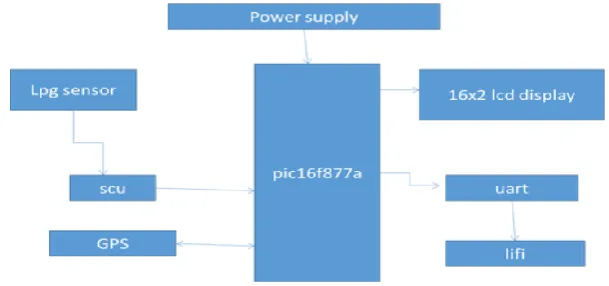
weight, fault tolerant and energy efficient protocol to minimize the energy consumption. The paper „A Real Time Application of Li-Fi Technology in Wireless Communication System‟ is implemented to detected gas leakage. As shown in fig 3 block diagram it uses RS232 serial port and Li-Fi is interfaced to it. So its point to point network connection.
Fig3 Functional block diagram of transmitter system
Transmitting node is constructed using pic16f877 microcontroller Lpg sensor and Li-Fi. At other end Li-Fi receiver is connected to PC by RS232 port as shown in fig 4.
101 | P a g e
III.PROPOSE SYSTEM
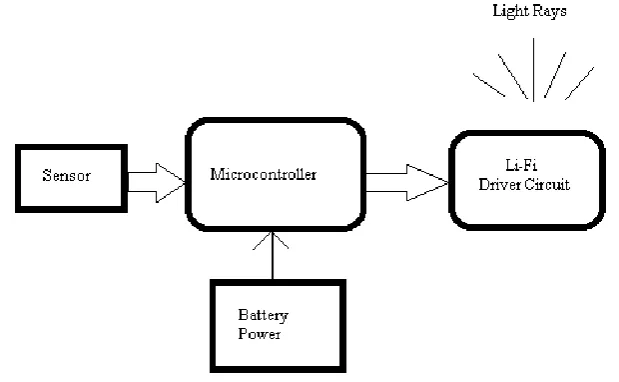
The main part of Wireless sensor network is Wireless nodes and second is monitoring unit as shown in figure. The communication used in between nodes and monitoring unit uses electromagnetic signals like Wi-Fi. In propose system we will use Li-Fi for communicationbetween nodes and monitoring unitbecause of its benefits over existing radio wave. As shown in fig.3 the Li-Fi sensor node will consist of sensor, microcontroller, supply battery, Li- Fi wireless connectivity.
Fig 5 Li-Fi based Wireless Sensor Node
IV.CONCLUSION
This paper presents the application of Li-Fi in Wireless sensor network. Li-Fi can be used in wireless sensor network but needs some improvement like point to multipoint communication. Another limitation is to maintain line of sight and it must require confided room. If WSN network is in industrial area where already very large electromagnetic interference is present in such place LI- Fi can be best choice. In hospitals and EMF radio wave restricted area Li-Fi Sensor network is best if some of the limitations that are discus in this paper are overcome.
REFERENCES
[1] Bharath B., YaswanthDigumarthi ,BIDIRECTIONAL COMMUNICATION IN LI-FI TECHNOLOGY,VOL. 11, NO. 13, JULY 2016, ISSN 1819-6608
[2] Rahul R. Sharma, Raunak, AkshaySanganal,Li-Fi TechnologyTransmission of data through light, Vol 5 (1),150-154 ISSN:2229-6093
[3] Alao O.D., Joshua J.V., Light Fidelity (Li-Fi): An EmergingTechnology for The Future,Volume 3, Issue 3. (May. - Jun. 2016),e-ISSN: 2394-0050, P-ISSN: 2394-0042.
[4] Mr. Korde S. K,Review Paper on Li-Fi (Light Fidelity),Vol-2 Issue-3 2016,IJARIIE-ISSN(O)-2395-4396
[5] KiranMaraiya and Kamal Kant,Application based Study on Wireless Sensor Network, Volume 21– No.8, May 2011, International Journal of Computer Applications (0975 – 8887)
102 | P a g e
[7] T.Kavitha,Programmable Irrigation Control System Using Li-Fi, Vol. 4, Special Issue 6, May 2015, ISSN(Online) : 2319 – 8753ISSN (Print) : 2347 – 6710
[8] UllasChandran,Implementation of Li-Fi Technology for Home Automation and Vehicle Communication, Vol 2 Issue 10 April 2016, ISSN (online): 2349-784X
[9] Vitthal S Saptasagare, Next of Wi-Fi an Future Technology in Wireless Networking Li-Fi Using Led Over Internet of Things, Volume-3, Issue-3March 2014, ISSN: 2278-9359.
[10] Dr. Deepti Gupta, Wireless Sensor Networks ‘Future trends and Latest Research Challenges’, Volume 10,
Issue 2, Ver. II (Mar - Apr.2015), e-ISSN: 2278-2834,p- ISSN: 2278-8735.