A Probabilistic Multimedia Retrieval Model
and Its Evaluation
Thijs Westerveld
National Research Institute for Mathematics and Computer Science (CWI), P.O. Box 94079, 1090 GB Amsterdam, The Netherlands
Email:[email protected]
Arjen P. de Vries
National Research Institute for Mathematics and Computer Science (CWI), P.O. Box 94079, 1090 GB Amsterdam, The Netherlands
Email:[email protected]
Alex van Ballegooij
National Research Institute for Mathematics and Computer Science (CWI), P.O. Box 94079, 1090 GB Amsterdam, The Netherlands
Email:[email protected]
Franciska de Jong
University of Twente, P.O. Box 217, 7500 AE Enschede, The Netherlands
Email:[email protected]
Djoerd Hiemstra
University of Twente, P.O. Box 217, 7500 AE Enschede, The Netherlands
Email:[email protected]
Received 21 March 2002 and in revised form 1 November 2002
We present a probabilistic model for the retrieval of multimodal documents. The model is based on Bayesian decision theory and combines models for text-based search with models for visual search. The textual model is based on the language modelling approach to text retrieval, and the visual information is modelled as a mixture of Gaussian densities. Both models have proved successful on various standard retrieval tasks. We evaluate the multimodal model on the search task of TREC’s video track. We
found that the disclosure of video material based on visual information only is still too difficult. Even with purely visual
in-formation needs, text-based retrieval still outperforms visual approaches. The probabilistic model is useful for text, visual, and
multimedia retrieval. Unfortunately, simplifying assumptions that reduce its computational complexity degrade retrieval eff
ec-tiveness. Regarding the question whether the model can effectively combine information from different modalities, we conclude
that whenever both modalities yield reasonable scores, a combined run outperforms the individual runs.
Keywords and phrases:multimedia retrieval, evaluation, probabilistic models, Gaussian mixture models, language models.
1. INTRODUCTION
Both image analysis and video motion processing have been unable to meet the requirements for disclosing the content of large scale unstructured video archives. There appear to be two major unsolved problems in the indexing and re-trieval of video material on the basis of these technologies, namely, (a) image and video processing is still far away from understanding the content of a picture in the sense of a knowledge-based understanding and (b) there is no effec-tive query language (in the wider sense) for searching image
manually generated annotations, subtitles, captions, and so on [1].
Since the recent advances in automatic speech recogni-tion, the potential role of speech transcripts in improving the disclosure of multimedia archives has been especially given a lot of attention. One of the insights gained by these inves-tigations is that for the purpose of indexing and retrieval, perfect word recognition is not an indispensable condition since not every word will have to make it into the index, relevant words are likely to occur more than once, and not every expression in the index is likely to be queried. Re-search into the differences between text retrieval and spo-ken document retrieval indicates that, given the current level of performance of information retrieval techniques, recog-nition errors do not add new problems to the retrieval task [2,3].
The limitations inherent in the deployment of language features only have already lead to several attempts to deal with the requirements of video retrieval by more closer in-tegration of human language technology and image pro-cessing. The notion of multimodal and even more ambi-tious cross-modal retrieval have come in use to refer to the exploitation of the analysis of a variety of feature types in representing and indexing aspects of video documents [4,5,6,7,8,9].
As indicated, many useful tools and techniques have be-come available from various research areas that have con-tributed to the domain of multimedia retrieval, but the integration of automatically generated multimodal meta-data is most often done in an ad hoc manner. The vari-ous information modalities that play a role in video doc-uments are each handled by different tools. How the various analyses affect the retrieval performance is hard to establish, and it is impossible to give an explana-tion of performance results in terms of a formal retrieval model.
This paper describes an approach which employs both textual and image features and represents them in terms of one uniform theoretical framework. The output from var-ious feature extraction tools is represented in probabilistic models based on Bayesian decision theory and the result-ing model is a transparent combination of two similar mod-els, one for textual features based on language models for text and speech retrieval [10], and the other for image fea-tures based on a mixture of Gaussian densities [11]. Ini-tial deployment of the approach within the search tasks for the video retrieval tracks in TREC-2001 [12] and TREC-2002 [13] has demonstrated the possibility of using this model in retrieval experiments for unstructured video con-tent. Additional experiments have taken place for smaller test collections.
Section 2of this paper describes the general probabilis-tic retrieval model, its textual (Section 2.1), and visual con-stituents (Section 2.2). Section 3presents the experimental setup followed by a number of experimental results to evalu-ate the effectiveness of the retrieval model. Finally,Section 4
summarises our main conclusions.
2. PROBABILISTIC RETRIEVAL MODEL
If we reformulate the information retrieval problem to one of pattern classification, the goal is to find the class to which the query belongs. LetΩ= {ω1, ω2, . . . , ωM}be the set of classes
underlying our document collection andQbe a query repre-sentation. Using the optimal Bayes or maximum a posteriori classifier, we can then find the classω∗, with minimal prob-ability of classification error,
ω∗=arg max i P
ωiQ. (1)
In a retrieval setting, the best strategy is to rank classes by increasing probability of classification error. When no clas-sification is available, we can simply let each document be a separate class. It is hard to estimate (1) directly; therefore, we reverse the probabilities using Bayes’ rule
ω∗=arg max i
PQωiPωi
P(Q) =arg maxi P
QωiPωi.
(2)
If the a priori probabilities of all classes are equal (i.e., P(ωi) is uniform), the maximum a posteriori classifier (2) reduces to the maximum likelihood classifier, which is ap-proximated by the Kullback-Leibler (KL) divergence between query model and class model
ω∗=arg min i KL
Pq(x)Pi(x). (3)
The KL-divergence measures the amount of information there is to discriminate one model from another. The best matching document is the document with the model that is hardest to discriminate from the query model.Figure 1 illus-trates the retrieval framework.1We build models for queries
and documents and compare them using the KL-divergence between the models. The visual part is modelled as a mixture of Gaussians (see Section 2.2); for the textual part, we use the language modelling approach in which documents are treated asbags of words(seeSection 2.1). The KL-divergence between query model and document model is defined as fol-lows:
KLPq(x)Pi(x)= %
PxωqlogP
xωq Pxωi dx
= %
PxωqlogPxωqdx
− %
PxωqlogPxωidx. (4)
The first integral is independent ofωiand can be ignored; thus,
1The query model is here, like the document models, represented as a Gaussian mixture model but it can also be represented as abag of blocks(see
Query model
LM
KL-divergence
Document models
LM LM
LM
This is an example caption. This is an example caption This is an example caption. This is an example caption This is an example caption. This is an example caption This is an example caption. This is an example caption This is an example caption. This is an example caption This is an example caption. This is an example caption
This is an example caption. This is an example caption This is an example caption. This is an example caption This is an example caption. This is an example caption This is an example caption. This is an example caption This is an example caption. This is an example caption This is an example caption. This is an example caption
example caption example caption example caption example caption example caption example caption
example caption example caption example caption example caption example caption example caption
Figure1: Retrieval framework: image represented as Gaussian mixture and text as language model (“bags of words”).
ω∗=arg min i KL
Pq(x)Pi(x)
=arg max i
%
PxωqlogPxωidx.
(5)
When working with multimodal material like video, the documents in our collection contain features in different modalities. This means that the classes underlying our docu-ment collection may contain different feature subclasses. The class conditional densities can thus be described as mixtures of feature densities
Pxωi= F
f=1
Pxωi, fPωi, f, (6)
where F is the number of underlying feature subclasses, P(ωi, f) is the probability of subclass f of class ωi, and P(x|ωi, f) is the subclass conditional density for this subclass. When we draw a random sample from classωi, we first se-lect a feature subclass according toP(ωi, f) and then draw a sample from this subclass usingP(x|ωi, f).
To arrive at a generic expression for similarity between mixture models, Vasconcelos [11] partitions the feature space into disjoint subspaces, where each point in the fea-ture space is assigned to the subspace corresponding to the most probable feature subclass
χk=x:Pωi,kx≥Pωi,lx,∀l=k. (7)
Using this partition, (5) can be rewritten as (the proof is given in [11])
%
PxωqlogPxωidx
= f ,k
Pωq, f
logPωi,k
+
%
χk
Pxωq, f, x∈χklogP
xωi,k Pωi,kxdx
× %
χk
Pxωq, fdx.
(8)
When the subspacesχkform the same hard partitioning of the features space for all query and document models, that is, when
Pωi,kx=Pωq,kx= #
1, ifx∈χk,
0, otherwise, (9)
then
%
χk
Pxωq, fdx #
1, if f =k, 0, otherwise, Pωi,kx=1, ∀x∈χk.
(10)
This reduces (8) to
%
PxωqlogPxωidx
= f
Pωq, flogPωi, f
+
f
Pωq, f % χf
This ranking formula is general and can,in principle, be used for any kind of multimodal document collection. In the rest of the paper, we limit ourselves to video collections rep-resented by still frames and speech-recognized transcripts. The classes underlying our collection are defined through the shots in the videos. Furthermore, we assume that we have two feature subclasses, namely, a subclass generating textual features and another generating visual features. We can now partition the feature space into two distinct subspaces for tex-tual and visual features:χtandχv. This partitioning is hard, that is, a feature can be textual or visual but never both. Our ranking formula becomes
The mixture probabilities for the textual and visual mod-els P(ωi,t) and P(ωi,v) might be derived from background knowledge about the class ωi. If, for example, we know that ωi is a class from a news broadcast, we might assign a higher value to P(ωi,t) since the probability that there is text that helps us in finding relevant information is rela-tively high. On the other hand, ifωiis from a documentary or a silent movie, we might gain less information from the text fromωiand assign a lower value toP(ωi,t). At the mo-ment, however, we have no background information; there-fore, we do not distinguish between classes and use uni-form mixture probabilities. This means that the first and third terms from (12) are independent of ωi and can be ignored.
Our final (general) ranking formula becomes
ω∗=arg max
whereP(t) andP(v) are the class-independent probabilities of drawing textual and visual features, respectively.
2.1. Text retrieval
For the textual part of our ranking function, we use statis-tical language models. A famous application of these mod-els is Shannon’s illustration of the implications of coding and information theory using models of letter sequences and word sequences [14]. In the 1970s, statistical language mod-els were developed as a general natural language-processing
tool, first for automatic speech recognition [15] and later also for, for example, part-of-speech tagging [16] and machine translation [17]. Recently, statistical language models have been suggested for information retrieval by Ponte and Croft [18], Hiemstra [19], and Miller et al. [20].
The language modeling approach to information re-trieval defines a simple unigram language model for each document in a collection. For each documentωi,t, the lan-guage model defines the probabilityP(xt,1, . . . , xt,Nt|ωi,t) of a
sequence ofNttextual features (i.e., words)xt,1, . . . , xt,Nt and
the documents are ranked by that probability. The standard language modelling approach to information retrieval uses a linear interpolation of the document modelP(xt, j|ωi) with a general collection model P(xt, j) [19,20,21,22]. As these models operate on discrete signals, the integral from (13) can be replaced by a sum. Furthermore, if we use the empirical distribution of the query as the query model, then the stan-dard textual part of (13) is
The linear combination needs a smoothing parameter λ which is set empirically on some test collection or alter-natively estimated by the expectation-maximisation (EM)-algorithm [23] on a test collection. The probability of draw-ing textual featurext, jfrom documentωi(P(xt, j|ωi)) is com-puted as follows: if the document contains 100 terms in total and the termxt, joccurs 2 times, this probability would sim-ply be 2/100 = 0.02. Similarly,P(xt, j) is the probability of drawingxt, jfrom the entire document collection.
Using the statistical language modelling approach for video retrieval, we would like to exploit the hierarchical data model of video, in which a video is subdivided into scenes which are subdivided into shots which are, in turn, subdi-vided into frames. Statistical language models are particu-larly well suited for modelling such complex representations of the data. We can simply extend the mixture to include the different levels of the hierarchy, with models for shots and scenes,2
The main idea behind this approach is that a good shot contains the query terms and is part of a scene having more occurrences of the query terms. Also, by including scenes in
the ranking function, we hope to retrieve the shot of inter-est even if the video’s speech describes the shot just before it begins or just after it is finished. Depending on the infor-mation need of the user, we might use a similar strategy to rank scenes or complete videos instead of shots, that is, the best scene might be a scene that contains a shot in which the query terms (co-)occur.
2.2. Image retrieval
In order to specialise the visual part of our ranking formula (13), we need to estimate the class conditional densities for the visual featuresP(xv|ωi). We follow Vasconcelos [11] and model them using Gaussian mixture models. The idea be-hind modelling shots as a mixture of Gaussians is that each shot contains a certain number of classes or components and that each sample from a shot (i.e., each block of 8 by 8 pix-els extracted from a frame) was generated by one of these components. The class conditional densities for a Gaussian mixture model are defined as follows:
Pxvωi= C
c=1
Pθi,cᏳxv, µi,c,Σi,c, (16)
whereCis the number of components in the mixture model, θi,c is component cof class modelωi, andᏳ(x, µ,Σ) is the Gaussian density with mean vectorµand covariance matrix Σ,
Ᏻ(x, µ,Σ)=( 1
(2π)n|Σ|e
−(1/2)x−µΣ, (17)
wherenis the dimensionality of the feature space and
x−µΣ=(x−µ)TΣ−1(x−µ). (18)
2.2.1 Estimating model parameters
The parameters of the models for a given shot can be esti-mated using the EM algorithm. This algorithm iterates be-tween estimating the a posteriori class probabilities for each sampleP(θc|xv) (the E-step) and re-estimating the compo-nents parameters (µc,Σc, andP(θc)) based on the sample dis-tribution (M-step).3
The approach is rather general: any kind of feature vec-tors can be used to describe samples. Our sampling process is as follows (It is illustrated inFigure 2). First, we convert the keyframe of a shot to the YCbCr color space. Then, we cut it in distinct blocks of 8 by 8 pixels. On these blocks, we perform the discrete cosine transform (DCT) for each of the 3 color channels. We now take the first 10 DCT coeffi-cients from the Y-channel and only the DC coefficient from both the Cb and the Cr channels to describe the samples. These feature vectors are then fed to the EM algorithm to find the parameters (µc,Σc, andP(θc)). The EM algorithm first assigns each sample to a random component. Next, we
3Looking at a single shot, we can drop the class subscriptsi.
compute the parameters (µc,Σc, and P(θc)) for each com-ponent, based on the samples assigned to that component.4
We re-estimate the class assignments, that is, we compute the posterior probabilities (P(θc|x) for allc). We iterate between estimating class assignments (expectation step) and estimat-ing class parameters (maximisation step) until the algorithm converges.Figure 3shows a query image and the component assignments after different iterations of the EM algorithm. Instead of a random initialisation, we initially assigned the left-most part of the samples to component 1, the samples in the middle to component 2, and the right-most samples to component 3. This way it is clearly visible how the compo-nent assignments move about the image. Finally, after con-vergence of the EM algorithm, we describe the position in the image plane of each component as a 2D-Gaussian with mean and covariance computed from the positions of the samples assigned to this component.
2.2.2 Bags of blocks
Just like in our textual approach, for the query model, we can simply take the empirical distribution of the query sam-ples. If a query image xv consists of Nv samples xv = (xv,1, xv,2, . . . , xv,Nv), then P(xv,i|ωq) = 1/Nv. For the
doc-ument model, we take a mixture of foreground and back-ground probabilities, that is, the (foreback-ground) probability of drawing a query sample from the document’s Gaussian mix-ture model, and the (background) probability of drawing it from any Gaussian mixture in the collection. In other words, the query image is viewed as a bag of blocks (BoB), and its probability is estimated as the joint probability of all its blocks. The BoB measure for query images then becomes
ω∗v =arg max i
1 Nv
Nv
j=1
logκPxv, jωi+ (1−κ)Pxv, j,
(19)
whereκis a mixing parameter and the background proba-bilityP(xv, j) can be found by marginalising over allM docu-ments in the collection
Pxv, j= M
i=1
Pxv, jωiPωi. (20)
Again, we assume uniform document priors (P(ωi) = 1/Mfor alli). In text retrieval, one of the reasons for mix-ing the document model with a collection model is to as-sign nonzero probabilities to words that are not observed in a document. Smoothing is not necessary in the visual case since the documents are modelled as mixtures of Gaussians having infinite support. Another motivation for mixing is to weight term importance: a common samplex (i.e., a sam-ple that occurs frequently in the collection) has a relatively
EM algorithm
DCT coefficients Take samples
Figure2: Building a Gaussian mixture model from an image.
high probabilityP(x) (equal for all documents) and, there-fore,P(x|ω) has only little influence on the probability esti-mate. In other words, common terms and common blocks influence the final ranking only marginally.
2.2.3 Asymptotic likelihood approximation
Initial 2 iterations 10 iterations 30 iterations
Figure3: Class assignments (3 classes) for the image at the top after different numbers of iterations.
of each image blockxvin the query for each documentωiin the collection. For evaluating a retrieval method, this is fine, but for an interactive retrieval system, optimisation is neces-sary.
An alternative is to represent the query image, like the document image, as a Gaussian model (instead of by its empirical distribution as a bag of blocks) and then com-pare these two models using the KL-divergence. Yet, if we use Gaussians to model the class conditional densities of the mixture components, there is no closed-form solution for the visual part of the resulting ranking formula (13). As a solution, Vasconcelos assumes that the Gaussians are well separated and derives an approximation ignoring the overlap between the mixture components: the asymptotic likelihood approximation (ALA) [11]. Starting from (8), he arrives at
ω∗v =arg max i
%
χv
PxvωqlogPxvωidxv
≈arg max i ALA
PqxvPixv
=arg max i
c
Pθq,c)logPθi,α(c)
+ logᏳµq,c, µi,α(c),Σi,α(c)
−1 2trace
Σ−1
i,α(c)Σq,c
* ,
whereα(c)=k⇐⇒µq,c−µi,kΣi,k<µq,c−µi,lΣi,l,∀l=k. (21)
In this equation, subscripts indicate, respectively, classes and components (e.g.,µi,cis the mean for componentθcof classωi).
2.3. ALA assumptions
The main assumption behind the ALA is that the Gaussians for the componentsθc within a class model ωi have small
overlap; in fact, there are two parts to this [11]. The first as-sumption is that each image sample is assigned to one and only one of the mixture components. The second is that sam-ples from the support set from a single query component are all assigned to the same document component. More for-mally, we have the following assumptions.
Assumption1. For each sample, the component with maxi-mum posterior probability has posterior probability one
∀ωi, x: max k P
θi,kx=1. (22)
Assumption 2. For any documentωj, the component with maximum posterior probability is the same for all samples of the support set of a single query componentθq,k,
∀θq,k, ωj∃l∗,∀x, Pxθq,k>0=⇒arg max l P
θj,lx=l∗.
(23)
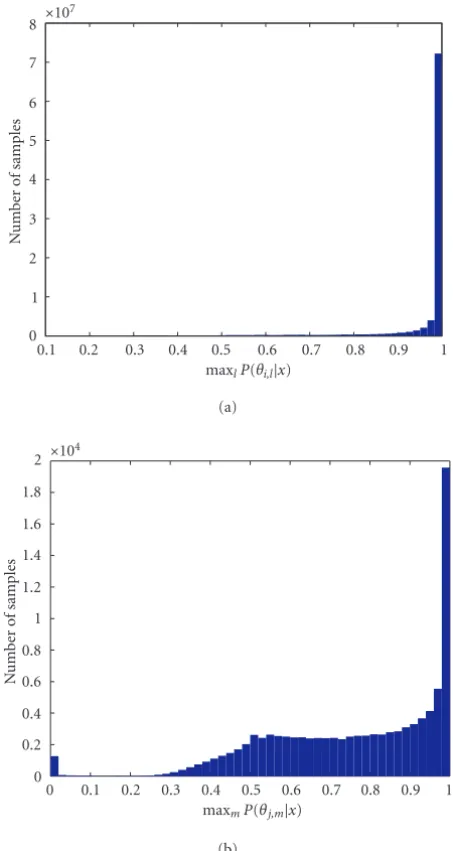
We used Monte Carlo simulation to test these assump-tions on our collection (the TREC-2002 video collection, see
Section 3.1) as follows. First, we took a random documentωi from the search collection and then a random mixture com-ponent θi,k from the mixture model of this document. We then drew 10,000 random samples from this component and, for each samplex, computed
(i) P(θi,l|x), the posterior component assignment within documentifor all componentsθi,l;
(ii) P(θj,m|x), the posterior component assignment in a different randomly chosen document j, for all com-ponentsθj,m.
1
Figure 4: Testing the ALA assumptions 1 (histogram (a)) and 2 (histogram (b)), samplesxare drawn fromP(x|θi,k).
(remember, there should be a component that explains all samples). We repeated this process 100,000 iterations for dif-ferent documents and components selected at random, and histogrammed the results (Figure 4). Both measures should be close to 1, the first to satisfyAssumption 1and the second to satisfyAssumption 2.
As we can see from the plots inFigure 4, the first assump-tion appears reasonable, but the second does not hold.5We
investigate the effect of this observation in the retrieval ex-periments below.
5The bar at probability zero results from a truncation error in the Bayesian inversion to computeP(θj,m|x) from a (too small) probability P(x|θj,m).
3. EXPERIMENTS
We evaluated the model outlined above and the presented measures on the search task of the video track of the Text REtrieval Conference TREC-2002 [13].
3.1. TREC video track
TREC is a series of workshops for large scale evaluation of information retrieval technology [24,25]. The goal is to test retrieval technology on realistic test collection using uniform and appropriate scoring procedures. The general procedure is as follows:
(i) a set of statements of an information need (topic) is created;
(ii) participants search the collection and return the topN results for each topic;
(iii) returned documents are pooled and judged for rele-vance to the topic;
(iv) systems are evaluated using the relevance judgements.
The measures used in evaluation are usually precision and recall oriented. Precision and recall are defined as fol-lows:
precision=number of relevant shots retrieved total number of shots retrieved ,
recall= number of relevant shots retrieved total number of relevant shots in collection.
(24)
The video track was introduced at TREC-2001 to evalu-ate content-based retrieval from digital video [12]. Here, we use the data from the TREC-2002 video track [13]. The track defines three tasks: shot boundary detection, feature detec-tion, and general information search. The goal of the shot boundary task is to identify shot boundaries in a given video clip. In the feature detection task, we have to assign a set of predefined features to a shot, for example,indoor,outdoor, people, andspeech. In the search task, the goal is to find rel-evant shots given a description of an information need, ex-pressed by a multimedia topic. Both in the feature detection task and in the search task, a predefined set of shots is to be used. In our experiments, we focus on the search task.
The collection to be searched in this task consists of ap-proximately 40 hours of MPEG-1 encoded video; in addition, a set of 23 hours of training material was available. The top-ics consist of a textual description of the information need, accompanied by images, video fragments, and/or audio frag-ments illustrating what is needed. For each topic, a system could return a ranked list of 100 video fragments. The top 50 returned shots of each run are then pooled and judged.
1 0.9 0.8 0.7 0.6 0.5 0.4 0.3 0.2 0.1 0
κ
0 0.005 0.01 0.015 0.02 0.025 0.03
MAP
Figure5: MAP on video search task for differentκ.
For the textual descriptions of the shots, we used speech transcripts kindly provided by LIMSI. These transcripts were aligned to the predefined video shots. We did not have or define a semantic division of the video into scenes but de-fined scenes simply as overlapping windows of 5 consecu-tive shots.6We removed common words from the transcripts
(stopping) and stemmed all terms using the Porter stemmer [26]. For the visual description, we took keyframes from the common video shots, and we used EM to find the param-eters of Gaussian mixture models. Keyframe selection was straightforward: we simply used the middle frame from each shot as representative for the shot.
3.2. Estimating the mixture parameters
The model does not specify the value of mixing parameters λ,λShot,λScene, and κ. An optimal value can only be found
a posteriori by evaluating retrieval performance for different values on a test collection; a priori, we must make an edu-cated guess for the right values.
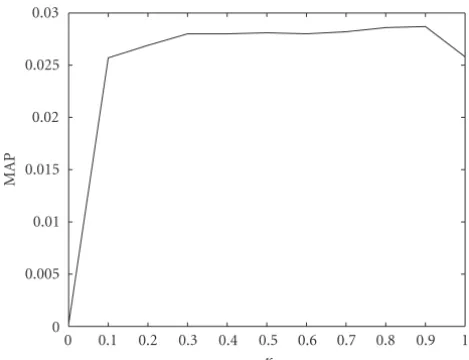
Figure 5shows the MAP scores on the TREC-2002 video track search task forκranging from 0.0 to 1.0. We can see that retrieval results are insensitive to the value of the mixing pa-rameter as long as we take both foreground and background into account. The plot has a similar shape as that found in Hiemstra’s thesis for the λ parameter in the standard lan-guage model [10].
For the transcripts, we tried over thirty combinations of settings, using two sets of text queries (see alsoSection 3.4). For query setTlong, this resulted in optimal settings for MAP withλShot =0.090,λScene =0.210, andλColl =0.700. Here,
modelling the hierarchy in the video makes sense because shot and scene both contribute to results in the ranking (λShot
andλSceneare larger than zero). For setTshort, however, the
optimal settings hadλShot=0.000 and the resulting model is
6In preliminary experiments on the TREC-2001 collection, when vary-ing the window lengths, 5 shots were the optimum.
identical to the original language model. Summarizing and ranking transcript units longer than shots is important, but we cannot conclude from these experiments whether model-ing the hierarchy is really necessary.
In all experiments, the differences between the better pa-rameter choices are not significant, but a particularly bad choice may seriously degrade retrieval effectiveness. In the remainder of this work, we have usedκ=0.9,λShot=0.090,
λScene=0.210, andλColl=0.700.
3.3. Using all or some image examples
In general, it is hard to guess what would be a good example image for a specific query. If we look for shots of theGolden Gate Bridge, we might not care from what angle the bridge was filmed, or if the clip was filmed on a sunny or a cloudy day; visually, however, such examples may be quite different (Figure 6). If a user has presented three examples and no ad-ditional information, the best we can do is to try to find doc-uments that describe all example images well. Unfortunately, a document may be ranked low even though it models the samples from one example image well as it may not explain the samples from the other images.
For each topic, we computed which of the example im-ages would have given the best results if it had been used as the only example for that topic. We compared these best exampleresults to thefull topicresults in which we used all available visual examples. The experiment was done using both the ALA and the BoB measure. In the full topic case, the set of available topics was regarded as one large bag of samples. For the ALA measure, we built one mixture model to describe all available visual examples. For BoB, we ranked documents by their probability of generating all samples in all query images. For the single image queries in thebest ex-ample, we built a separate mixture model from each example and used it for ALA ranking. For BoB ranking, we used all samples from the single visual example. Since it is problem-atic to use multiple examples in a query, we wanted to see if it is possible to guess in advance what would be a good ex-ample for a specific topic. Therefore, for each topic, we also hand-picked a single representative from the available exam-ples and compared thesemanual exampleresults to the other two result sets.
The results for the different settings are listed inTable 1. A first thing to notice is that all scores are rather low. When we take a closer look at the topics with higher average preci-sion scores, we see that these mainly contain examples from the search collection. In other words, we can find similar shots from within the same video, but generalisation is a problem.
Comparing BoB to ALA, we see that, averaged over all topics for each set of examples, BoB outperforms ALA. For some specific topics, the ALA gives higher scores, but again these are cases with examples from within the collection. In general, the BoB approach, which uses fewer assumptions, performs better.
Figure6: Visual examples of the Golden Gate Bridge.
Table1: MAP for full topics, best examples, and manual examples.
Full topic Best example Manual example
Topic BoB ALA BoB ALA BoB ALA
vt075 0.0038 0.0100 0.2438 0.0591 0.2438 0.0560
vt076 0.4854 0.1117 0.4323 0.1327 0.1760 0.0958
vt077 0.0000 0.0000 0.0000 0.0000 0.0000 0.0000
vt078 0.0000 0.0000 0.0000 0.0000 0.0000 0.0000
vt079 0.0000 0.0000 0.0040 0.0015 0.0000 0.0000
vt080 0.0048 0.0020 0.0977 0.0007 0.0977 0.0007
vt081 0.0000 0.0000 0.0000 0.0000 0.0000 0.0000
vt082 0.0330 0.0203 0.0234 0.0022 0.0234 0.0022
vt083 0.0000 0.0000 0.0000 0.0000 0.0000 0.0000
vt084 0.0046 0.0000 0.0046 0.0000 0.0046 0.0000
vt085 0.0000 0.0000 0.0000 0.0000 0.0000 0.0000
vt086 0.0053 0.0000 0.0704 0.0149 0.0704 0.0005
vt087 0.0000 0.0000 0.0000 0.0000 0.0000 0.0000
vt088 0.0046 0.0000 0.0069 0.0139 0.0069 0.0139
vt089 0.0000 0.0000 0.0000 0.0000 0.0000 0.0000
vt090 0.0000 0.0000 0.0305 0.0003 0.0305 0.0003
vt091 0.0095 0.0000 0.0095 0.0000 0.0095 0.0000
vt092 0.0003 0.0000 0.0106 0.0213 0.0000 0.0000
vt093 0.0006 0.0000 0.0006 0.0003 0.0000 0.0000
vt094 0.0021 0.0004 0.0021 0.0013 0.0021 0.0013
vt095 0.0000 0.0000 0.0000 0.0000 0.0000 0.0000
vt096 0.0323 0.0000 0.0323 0.0383 0.0323 0.0383
vt097 0.1312 0.0002 0.1408 0.0496 0.0000 0.0000
vt098 0.0000 0.0000 0.0003 0.0006 0.0003 0.0000
vt099 0.0000 0.0000 0.0000 0.0000 0.0000 0.0000
MAP 0.0287 0.0058 0.0444 0.0135 0.0279 0.0084
different visual examples can indeed degrade results. Look-ing at the results, manually selectLook-ing good examples seems a nontrivial task, but the drop in performance is partly due to the generalisation problem. If one of the image examples happens to come from the collection, it scores high. If we fail to select that particular example, the score for the manual example run drops. Simply counting how often the manu-ally selected example was the same as the best-performing example, we see that this was the case for 8 out of 13 topics.7
7If we ignore the topics for which there is only one example and the ones for which the best example scored 0.
3.4. Using example transcripts
We took two different approaches in building textual queries from the multimedia topics. The first set of textual queries, Tshort, was constructed simply by taking the textual descrip-tion from the topic. In the second set of queries, Tlong, we augmented these with the speech transcripts from the video examples available for a topic. The assumption here is that relevant shots share a vocabulary with example shots; thus, using example transcripts might improve retrieval results. In both sets of queries, we removed common words and stemmed all terms. We found that across topics,Tlong out-performedTshortwith a MAP of 0.1212 against 0.0916. For detailed per-topic information, seeTable 2.
3.5. Combining textual and visual runs
We combined textual and visual runs using our combined ranking formula (13). Since we had no data to estimate the parameters for mixing textual and visual information, we used P(t) = P(v) = 0.5. For the textual part, we tried both short and long queries; for the visual part, we used full queries and best-example queries.Table 2shows the re-sults for combinations with the BoB measure. We also exper-imented with combinations with the ALA measure, but we found that in the ALA case, it is difficult to combine textual and visual scores because they are on different scales. The BoB measure is closer to the KL-divergence and, on top of that, more similar to our textual approach, and thus easier to combine with the textual scores.
For most of the topics, textual runs give the best results; however, for some topics, using the visual examples is useful. This is mainly the case when either the topics come from the search collection or when the relevant documents are outliers in the collection. This illustrates how difficult it is to search a generic video collection using visual information only. We succeed only if the relevant documents are either highly simi-lar to the examples provided or very dissimisimi-lar from the other documents in the collection (and, therefore, relatively similar to the query examples). When both textual and visual runs have reasonable scores, combining the runs can improve on the individual runs; however, when one of them has inferior performance, a combination only adds noise and lowers the scores.
4. CONCLUSIONS
Table2: Average precision per topic for textual runs, BoB runs, and combined runs.
Topic Tshort Tlong BoBfull BoBbest BoBfull BoBfull BoBbest BoBbest
+Tshort +Tlong +Tshort +Tlong
vt075 0.0000 0.0082 0.0038 0.2438 0.0189 0.0569 0.2405 0.3537
vt076 0.4075 0.6242 0.4854 0.4323 0.5931 0.7039 0.5757 0.6820
vt077 0.1225 0.5556 0.0000 0.0000 0.0000 0.0000 0.0000 0.0000
vt078 0.1083 0.2778 0.0000 0.0000 0.0000 0.0000 0.0000 0.0000
vt079 0.0003 0.0006 0.0000 0.0040 0.0003 0.0000 0.0063 0.0050
vt080 0.0000 0.0000 0.0048 0.0977 0.0066 0.0059 0.0845 0.0931
vt081 0.0154 0.0333 0.0000 0.0000 0.0037 0.0000 0.0000 0.0000
vt082 0.0080 0.0262 0.0330 0.0234 0.0181 0.0335 0.0145 0.0210
vt083 0.1669 0.1669 0.0000 0.0000 0.0962 0.0962 0.0078 0.0078
vt084 0.7500 0.7500 0.0046 0.0046 0.6875 0.6875 0.6875 0.6875
vt085 0.0000 0.0000 0.0000 0.0000 0.0000 0.0000 0.0000 0.0000
vt086 0.0554 0.0676 0.0053 0.0704 0.0536 0.0215 0.0791 0.0600
vt087 0.0591 0.0295 0.0000 0.0000 0.0052 0.0003 0.0052 0.0003
vt088 0.0148 0.0005 0.0046 0.0069 0.0052 0.0046 0.0069 0.0069
vt089 0.0764 0.0764 0.0000 0.0000 0.0503 0.0503 0.0045 0.0045
vt090 0.0229 0.0473 0.0000 0.0305 0.0006 0.0075 0.0356 0.0477
vt091 0.0000 0.0000 0.0095 0.0095 0.0000 0.0086 0.0000 0.0086
vt092 0.0627 0.0687 0.0003 0.0106 0.0191 0.0010 0.0078 0.0106
vt093 0.1977 0.1147 0.0006 0.0006 0.0099 0.0021 0.0071 0.0012
vt094 0.0232 0.0252 0.0021 0.0021 0.0122 0.0036 0.0122 0.0036
vt095 0.0034 0.0021 0.0000 0.0000 0.0008 0.0012 0.0011 0.0010
vt096 0.0000 0.0000 0.0323 0.0323 0.0161 0.0161 0.0323 0.0323
vt097 0.1002 0.0853 0.1312 0.1408 0.1228 0.1752 0.1521 0.1474
vt098 0.0225 0.0086 0.0000 0.0003 0.0068 0.0000 0.0004 0.0003
vt099 0.0726 0.0606 0.0000 0.0000 0.0000 0.0000 0.0000 0.0000
MAP 0.0916 0.1212 0.0287 0.0444 0.0691 0.0750 0.0784 0.0870
integrated seamlessly, and evaluated the framework using the search task from the TREC-2002 video track. We found that even though the topics were specifically designed for content-based retrieval and relevance was defined visually, a textual search outperforms visual search for most topics. As we have seen before [6], standard image retrieval techniques cannot readily be applied to satisfy a variety of information requests from a generic video collection. Future work has to show how incorporating different sources of additional informa-tion (e.g., contextual frames, the movement in video, or user interaction) can help improve results.
In the text-only experiments, we saw that using the tran-scripts from the example videos in queries improves results. We also found that it is useful to take transcripts from sur-rounding shots into account to describe a shot. However, it is still unclear whether a hierarchical description of scenes and shots is necessary.
In our visual experiments, we found that the general probabilistic framework is useful for image retrieval. How-ever, we found that one of the assumptions underlying the ALA of the KL-divergence does not hold for the generic video collection we used. This was reflected in the difference in performance of the ALA and the BoB model. Unfortunately, computing the joint block probabilities in the BoB model is
computationally expensive and unsuitable for an interactive retrieval system. Future work will investigate ways to speed up the process.
Furthermore, we noticed generalisation problems. The visual models only gave satisfying results if the relevant doc-uments were either highly similar to the query image(s) (i.e., the query images came from the collection) or highly dissim-ilar to the rest of the collection (i.e., the relevant documents were outliers in the collection).
When either textual or visual results are poor, combining them, thus adding noise, seems to degrade the scores. How-ever, when both modalities yield reasonable scores, a com-bined run outperforms the individual runs.
REFERENCES
[1] F. de Jong, J.-L. Gauvain, D. Hiemstra, and K. Netter,
“Language-based multimedia information retrieval,” inProc.
RIAO 2000 Content-Based Multimedia Information Access, pp.
713–722, Paris, France, April 2000.
[2] J.-L. Gauvain, L. Lamel, and G. Adda, “Transcribing broadcast
news for audio and video indexing,” Communications of the
ACM, vol. 43, no. 2, pp. 64–70, 2000.
spoken documents,” in Intelligent Multimedia Information
Retrieval, M. T. Maybury, Ed., pp. 191–214, AAAI Press/MIT
Press, Cambridge, Mass, USA, 1997.
[4] K. Barnard and D. Forsyth, “Learning the semantics of words and pictures,” inProc. International Conf. on Computer Vision, vol. 2, pp. 408–415, Vancouver, Canada, 2001.
[5] M. La Cascia, S. Sethi, and S. Sclaroff, “Combining textual
and visual cues for content-based image retrieval on the world
wide web,” inProc. IEEE Workshop on Content-Based Access
of Image and Video Libraries, pp. 24–28, Santa Barbara, Calif,
USA, June 1998.
[6] The lowlands team, “Lazy users and automatic video
re-trieval tools in (the) lowlands,” inThe 10th Text REtrieval
Conference (TREC-2001), E. M. Voorhees and D. K. Harman,
Eds., vol. 10, pp. 159–168, National Institute of Standards and Technology, NIST, Gaithersburg, Md, USA, 2002.
[7] T. Westerveld, “Image retrieval: Content versus context,” in
Proc. RIAO 2000 Content-Based Multimedia Information Ac-cess, pp. 276–284, Paris, France, April 2000.
[8] T. Westerveld, “Probabilistic multimedia retrieval,” inProc.
the 25th Annual International ACM SIGIR Conference on
Re-search and Development in Information Retrieval, pp. 437–438,
Tampere, Finland, 2002.
[9] T. Westerveld, A. P. de Vries, and A. van Ballegooij, “CWI
at the TREC-2002 video track,” inThe 11th Text REtrieval
Conference (TREC-2002), E. M. Voorhees and D. K. Harman,
Eds., National Institute of Standards and Technology, NIST, Gaithersburg, Md, USA, 2002.
[10] D. Hiemstra, Using language models for information retrieval, Ph.D. thesis, Centre for Telematics and Information Technol-ogy, University of Twente, The Netherlands, 2001.
[11] N. Vasconcelos, Bayesian models for visual information
re-trieval, Ph.D. thesis, Massachusetts Institute of Technology,
Cambridge, Mass, USA, 2000.
[12] P. Over and R. Taban, “The TREC-2001 video track
frame-work,” inProc. the 10th Text REtrieval Conference
(TREC-2001), E. M. Voorhees and D. K. Harman, Eds., vol. 10, pp.
79–87, National Institute of Standards and Technology, NIST, Gaithersburg, Md, USA, 2002.
[13] A. F. Smeaton and P. Over, “The TREC-2002 video track
re-port,” inThe 11th Text REtrieval Conference (TREC-2002),
E. M. Voorhees and D. K. Harman, Eds., National Institute of Standards and Technology, NIST, Gaithersburg, Md, USA, 2002.
[14] C. E. Shannon, “A mathematical theory of communication,”
Bell System Technical Journal, vol. 27, pp. 379–423, 623–656,
1948.
[15] F. Jelinek, Statistical Methods for Speech Recognition, MIT
Press, Cambridge, Mass, USA, 1997.
[16] D. Cutting, J. Kupiec, J. Pedersen, and P. Sibun, “A practical part-of-speech tagger,” inProc. the 3rd Conference on Applied
Natural Language Processing, pp. 133–140, Trento, Italy, 1992.
[17] P. F. Brown, J. Cocke, S. A. Della Pietra, et al., “A statistical
approach to machine translation,”Computational Linguistics,
vol. 16, no. 2, pp. 79–85, 1990.
[18] J. M. Ponte and W. B. Croft, “A language modeling approach
to information retrieval,” inProc. the 21st Annual
Interna-tional ACM SIGIR Conference on Research and Development
in Information Retrieval, pp. 275–281, Melbourne, Australia,
1998.
[19] D. Hiemstra, “A linguistically motivated probabilistic model
of information retrieval,” inProc. the 2nd European
Confer-ence on Research and Advanced Technology for Digital Libraries,
C. Nicolaou and C. Stephanidis, Eds., pp. 569–584, Heraklion, Crete, Greece, September 1998.
[20] D. R. H. Miller, T. Leek, and R. M. Schwartz, “A hidden
Markov model information retrieval system,” inProc. the
22nd Annual International ACM SIGIR Conference on
Re-search and Development in Information Retrieval, pp. 214–221,
Berkeley, Calif, USA, August 1999.
[21] J. Lafferty and C. Zhai, “Document language models, query
models, and risk minimization for information retrieval,” in
Proc. the 24th Annual International ACM SIGIR Conference on
Research and Development in Information Retrieval, pp. 111–
119, New Orleans, La, USA, September 2001.
[22] K. Ng, “A maximum likelihood ratio information retrieval
model,” inProc. the 8th Text REtrieval Conference,
TREC-8, NIST Special Publications, National Institute of Standards and Technology, NIST, Gaithersburg, Md, USA, 2000. [23] A. P. Dempster, N. M. Laird, and D. B. Rubin, “Maximum
likelihood from incomplete data via the EM algorithm,”
Jour-nal of the Royal statistical Society, Series B, vol. 39, no. 1, pp.
1–38, 1977.
[24] E. M. Voorhees and D. K. Harman, Eds., The 11th Text
RE-trieval Conference (TREC-2002), National Institute of
Stan-dards and Technology, NIST, Gaithersburg, Md, USA, 2002.
[25] E. M. Voorhees and D. K. Harman, Eds., The 10th Text
RE-trieval Conference (TREC-2001), vol. 10, National Institute
of Standards and Technology, NIST, Gaithersburg, Md, USA, 2002.
[26] M. F. Porter, “An algorithm for suffix stripping,”Program, vol. 14, no. 3, pp. 130–137, 1980.
Thijs Westerveldreceived the M.S. degree in computer science from the University of Twente. As a Research Assistant at the same university, he has participated in a num-ber of EU projects in the area of multime-dia information retrieval. Working on the national Waterland project at the CWI, the National Research Institute for Mathemat-ics and Computer Science in the Nether-lands, he investigates, for his Ph.D., the use
of probabilistic models for retrieval from generic multimedia col-lections.
Arjen P. de Vriesreceived his Ph.D. in com-puter science from the University of Twente in 1999, on the integration of content man-agement in database systems. He is espe-cially interested in the design of database systems that support search in multime-dia digital libraries. Arjen works as a Post-doctoral Researcher at the CWI, the Na-tional Research Institute for Mathematics and Computer Science in the Netherlands.
Alex van Ballegooijreceived the M.S. de-gree in computer science from the Vrije Universiteit of Amsterdam in 1999. He works towards his Ph.D. on the national ICES-KIS MIA project at the CWI, the Na-tional Research Institute for Mathematics and Computer Science in the Netherlands. His current research activities entail the in-vestigation of aspects that make a database system suitable for computationally
Franciska de Jongis Full Professor of lan-guage technology at the Computer Science Department of the University of Twente,
Enschede since 1992. She is also affiliated
to the TNO TPD in Delft. She has a back-ground in theoretical and computational linguistics and received the Ph.D. degree at the University of Utrecht in 1991. She worked as a Researcher at Philips Research on the Rosetta machine translation project
(1985–1992). Currently, her main research interest is in the field of multimedia indexing and retrieval. She is frequently involved in in-ternational program committees, expert groups, and review panels and has initiated a number of EU projects.
Djoerd Hiemstrais an Assistant Professor in the Database Group in the Computer Science Department of the University of Twente since 2001. At this same university, he studied computer science and graduated in the field of language technology (1996). In 2000, he worked for three months at Mi-crosoft Research in Cambridge. He wrote a Ph.D. thesis on probabilistic retrieval us-ing language models. Multimedia databases,