A STUDY OF MT-DNA HYPERVARIABLE REGION 1 (HVI) SEQUENCE POLYMORPHISM ON RESIDENTS OF JOHOR IN MALAYSIA
ALIREZA LARI
ii
A STUDY OF MT-DNA HYPERVARIABLE REGION 1 (HVI) SEQUENCE POLYMORPHISM ON RESIDENTS OF JOHOR IN MALAYSIA
ALIREZA LARI
A dissertation submitted in partial fulfillment of the requirements for the award of the degree of
Master of Science (Biotechnology)
Faculty of Biosciences and Medical Engineering Universiti Teknologi Malaysia
iv
v
ACKNOWLEDGEMENT
I would like to express my gratitude to all those who gave me a helping hand to complete this thesis. Special thanks goes to my supervisor, Dr. Mohammed Abu Naser who is most responsible for helping me complete the thesis as well as challenging research it.
vi
ABSTRACT
In the past few decades, lots of studies were carried out to find a way for searching relationships among various races of human beings in understanding their relatedness within a population. This study has been performed to generate DNA sequence data with a view to identifying genetic marker and using them in detecting
a population in a particular area, such as, in our case, Johor, Malaysia. Mitochondrial DNA (MtDNA) sequence is usually used to detect relatedness between the races
vii
ABSTRAK
Dalam beberapa dekad yang lalu, banyak kajian telah dijalankan untuk mencari jalan untuk mencari hubungan di kalangan pelbagai kaum manusia dalam memahami hubungan mereka di kalangan penduduk. Kajian ini telah dilakukan untuk menjana data jujukan DNA dengan tujuan untuk mengenal pasti penanda genetik dan menggunakan mereka dalam mengesan penduduk di kawasan tertentu, seperti dalam kes kami, Johor, Malaysia. DNA Mitokondria (mtDNA) urutan biasanya digunakan untuk mengesan hubungan antara kaum di kalangan penduduk manusia di rantau tertentu. Rentetan rantau ini, termasuk rantau hypervariable 1 (HV1, nt16024-16365) dan rantau hypervariable 2 (HV2, nt73-340) biasanya digunakan dalam kajian forensik. Dalam kajian ini, polimorfisme (HV1) telah disiasat untuk menemui potensi penanda forensik untuk mengesan pelbagai kaum.
Dalam kes ini, amplifikasi PCR selepas pengekstrakan DNA telah dilakukan untuk mengesan urutan (HV1). Kemudian, perbandingan antara Anderson rujukan
viii
TABLE OF CONTENT
CHAPTER TITLE PAGE
DECLARATION DEDICATION
iii iv
ABSTRACT ABSTRAK
vi vii
TABLE OF CONTENTS viii
LIST OF TABLES x
LIST OF FIGURES xi
LIST OF ABBREVIATION xii
1 INTRODUCTION
1.2 Background of Study 1
1.3 Problem Statement 5
1.4 Objectives of Study 6
1.5 Scope of Study 6
1.6 Significance of Study 7
2 LITERATURE REVIEW
ix
2.5.2 Genotype of Cytocrom c 2.5.3 Genotype of Cytocrom b
14 15
2.6 Genomic Identification 15
2.7 2.8
Markers Detector
Mitochondrial genetic disease
16 17
3 RESEARCH METHODOLOGY
3.1 Experimental design 19
3.2 Selection of Sample 20
3.3 3.4 3.5 3.6 3.7 3.8 3.9
Genom DNA Extraction
Analysis of Genomic DNA by Gel Electrophoresis Primer Designing
Amplification of Hypervariable Region 1 (HVI) Purification of PCR Product from Gel Electrophoresis
Sequencing of DNA Bioinformatics Analysis 20 21 21 22 23 24 24
4 RESULTS AND DISCUSSION
4.1 Genomic DNA Extraction 26
4.2 Set of Primers 28
4.3 Amplification of HVI Region by PCR 29 4.4
4.5 4.6 4.7
Purification of PCR Product Sequence of HVI Region Polymorphism Identification Forensic Case of Study
30 30 31 34
5 CONCLUSIONS AND FUTURE WORK
5.1 Conclusions 36
5.2 Future Work 37
REFERENCES 38
x
LIST OF TABLE
TABLE NO. TITLE PAGE
3.1 Primer Sequence Used in this Research 22
3.2 Reagent for Amplification 23
3.3 PCR Amplification Program cycle 23
4.1 HVI Control Region Sequence Polymorphism 33
xi
LIST OF FIGURE
FIGURE NO. TITLE PAGE
1.1 Mitochondrial DNA 2
1.2 Mt DNA and Displacement Loop (D-loop) 3
3.1 Experimental Procedures 18
4.1 DNA Electrophoresis 27
4.2 The Result of PCR 29
4.3 Homopolymer Regions in Mistaken Results 30
xii
LIST OF ABBREVIATION
SYMBOLS DESCRIPTION bp Cyt b COI Base pair Cytochrome b
Cytochrome c- oxidase DNA Deoxyribonuclease acid EDTA Ethylen diamine tetraacetate gr
HV1 HV2
Gram
hypervariable region 1 hypervariable region 2
kb L ml °C % rpm STR SNP SSR TAE Taq µg µl v/v Kilobase Litre Milliliter Degree centigrade Percentage
Revolution per minute Short tandem repeats
single-nucleotide polymorphism Simple Sequence Repeats Tris-acetate-EDTA Termus aquaticus microgram microlitre
volume by volume
CHAPTER 1
INTRODUCTION
1.1 Background of Study
The first effort at reconstructing the evolutionary history of human population with DNA technology was initiated by Brown (1980). He studied on mitochondrial DNA (mtDNA) and revealed the presents of specific patterns of restriction enzyme cleavage on population. In 1987, Cann showed the genetic evidence that ancestor of all existing humans lived in Africa around 200000 years ago. Since then, lots of
studies have been done on the origins of human and their expansion on the earth. (Hedges et al., 1992; Nei 1992; Templeton 1992).
2
DNA sequences such as, Anderson sequence, for tracking down the geographic origin of a race, have been the great achievements.
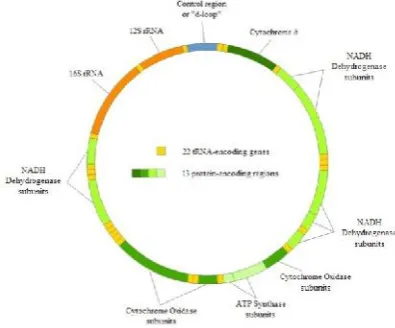
Mitochondria are a tiny organelle which is located in the cytoplasm of cell and situated between the cell nucleus and the outer membrane. There are lots of mitochondria per cell (10 -10 copies), and for each one small circle of DNA has
been evolved from their distant bacterial ancestry (Maruyama et al., 2010). Mitochondrial DNA (mtDNA) has some benefits. First, their inheritance pattern is unique. The eggs of human contains a large number of mitochondria, while the sperm cells relatively lower number of mitochondria that is the numbers required to produce enough energy required during swinging towards the egg. Thus, fertilization accrues without any cooperation of male’s mitochondria thus the child except sex
chromosomes which get from both parents, obtain mitochondrial DNA from their mother. Therefore, mitochondrial DNA can connect the maternal lines of living people who are living in different parts of the word.
The other characteristics of mitochondrial DNA is its ability to change more rapid (20 times faster) than nuclear DNA, due to the lack of an efficient proof-reading system. Hence cannot check the errors while DNA is copied (Sykes 2003).
3
There is a scope for geneticists and historians to use mitochondria DNA for tracing maternal genealogies and help them to trace much deeper evolutionary
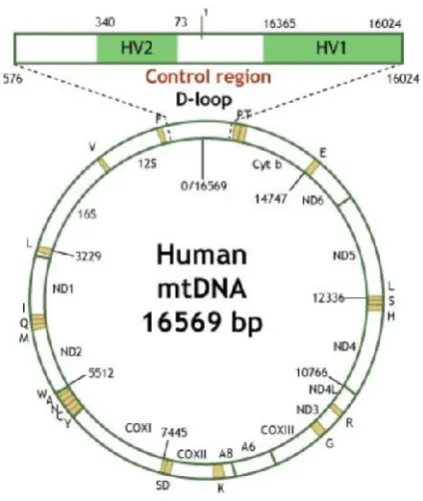
connection of human race (Sykes 2003). The exciting thing about mtDNA is that, possible to discover the traces of some evolutionary relics in the cell. mtDNA replication can play the main role to protect copy number of DNA sequences. Synthesis of the heavy strand – Circular molecules of DNA, such as mitochondrial genomes which includes of two strand of DNA–initiates replication of mtDNA and lead to relocate the parental heavy strand. At 700bp downstream synthesis will be terminated, produce7S DNA (displacement loop or D-loop strand). This unexpected termination creates a characteristic triple stranded arrangement, named the D-loop (Figure 1.2) (Kasamatsu et al., 1971). Although the main function of mitochondrial D-loops is not discovered, D-loop supposed to contribute in regulation of mtDNA replication (Takamatsu et al., 2002). There is a control region in mtDNA which consist of origin of heavy strand (H strand) replication, the displacement loop (D-loop) and both origins of transcription, is the region which is too variable in the human mtDNA genome (Nei, 1995).
4
Analysis of mtDNA D-loop region has confirmed to be a best tool to identify forensic human, particularly for highly degraded samples (Cordner et al.,
2011). As mentioned above, the sequence of the region including hypervariable region 1 (HV1, nt16024-16365) and hypervariable region 2 (HV2, nt73-340) are typically used for forensic studies. Furthermore, the entire D-loop sequence contains the hypervariable region 3 (HV3, nt438-576) and has been explained more information for haplotype determination - combination of DNA sequences at adjacent locations on the chromosome - (Haslindawaty et al., 2010). PCR amplification products of small mtDNA fragments with abundant polymorphisms are preferred for forensic analysis when dealing with highly degraded DNA samples due to observing different distributions of polymorphisms in mtDNA among different population groups (Budowle et al., 2003). Therefore, the important issue is evaluation of the effectiveness of each region in D-loop sequence analysis. Diverse populations groups may show vary distribution of polymorphisms in mtDNA. The important matter is large database availability with distribution in the particular population among evidence sample is essential to estimate mtDNA profile and function of mtDNA markers for the case of study on forensic (Hwa et al., 2012).
Based on technological progress in the field of Human Genome and International HapMap Projects, Single nucleotide polymorphism (SNP) is situated for short tandem repeat (STR) - DNA regions with short repeat units with usually 2-6
bp in length - and specially, for high potential of forensic DNA typing community (Butler et al., 2007). In the human genome, the most frequent form of DNA sequence variations are named as single nucleotide polymorphisms (SNPs), and are used for
5
Usual technologies and scoring single nucleotide polymorphism are time consuming and expensive. Recently, for identifying candidate SNP segment
denaturing high-performance liquid chromatography was used by Lian at 2005.
DNA bar-coding simply defined as screening of one or a few reference gene for: firstly, referring unknown individuals to species, and secondly, improving detection method for identifying new species.
1.2 Problem statement
There are many races in Malaysia. The majority of them are Malay, Chinese and Indian. The main race, Malay represents approximately 50.4% of total Malaysian population and is the focus of this current study. Finding any specific part of country for specific races is impossible due to expansion of new races among indigenous population. It is expected that each of the races has their own unique polymorphism inside the mtDNA genome. However, for distinguishing and identifying one race from the other can be challenging.
6
1.3 Objectives of Study
I. To amplify and sequence the HV1 gene using PCR and sequencer, respectively.
II. To compare obtained sequence data within the samples as well as with the publicly available sequence data for reference sequence.
III. To analyze the polymorphism in HVI gene in a given population and to investigate the usefulness of this polymorphic HVI in Malay race identification.
1.4 Scope of Study
The scope of this study consists of three parts. The first is the collection of
blood samples from fifteen Malay individual living in Johor. The blood samples with pernission were collected from Universiti Teknologi Malaysia (UTM) Health Center, and background information of each individual was also recorded. The second part
7
1.5 Significance of Study
38
REFERENCES
Anderson, RM., Kubacka, I., Chinnery, PF., Lightowlers, RN., Turnbull DM., Howell, N. (1989). Reanalysis and revision of the Cambridge reference sequence for human mitochondrial DNA. Nature Genetics 23(2): 147.
Andreu, a L., Bruno, C., Hadjigeorgiou, G. M., Shanske, S., & DiMauro, S. (1999). Polymorphic variants in the human mitochondrial cytochrome b gene. Molecular genetics and metabolism, 67(1), 49–52. doi:10.1006/mgme.1999.2843.
Ballinger, S. W., Theodore, G., Schurr, Antonio Torroni, Y. Y., Gan, J. A., Hodge, K.
Hassan, K. H., Chens and Douglas, C., Wallace, (1991). Southeast Asian Mitochondrial DNA Analysis Reveals Genetic Continuity of Ancient Mongoloid Migrations, Genetics 130:139-152.
Battersby, B.J., Loredo-Osti, J.C ., Shoubridge, E.A., (2003). Nuclear genetic control of mitochondrial DNA segregation. Nat Genet 33, 183-186.
Bellwood, P. (1979). Man's conquest of the Pacific: the prehistory of Southeast Asia and Oceania. Oxford: Oxford University Press. 462.
Bellwood, P. (1985). Prehistory of the Indo-Malaysian Archipelago. Sydney: Academic Press. 25-28.
39
Birky, C.W., Demko, C.A., P.S., Strausberg, R., (1978). Uniparental inheritance of
mitochondrial genes in yeast: dependence on input bias of mitochondrial DNA and preliminary investigations of the mechanism. Genetics 89, 615-651.
Budowle, B., Allard, MW., Wilson, MR., Chakraborty, R. (2003). Forensics and mitochondrial DNA. applications, debates, and foundations. Ann Rev Genomics Hum Genet. 2003;4:119–141.
Brown, WM., (1980). Polymorphism in mitochondrial DNA of humans as revealed by restriction endonuclease analysis. . 77 (6), 3605-3609.
Brown, W.M., George, M., Wilson , A.C., (1979). Rapid evolution of animal mitochondrial DNA. Proc Natl Acad Sci U S A 76, 1967- 1971.
Brown, M. D., and Wallace, D. C., (1994) Molecular Basis of Mitochondrial DNA Disease, Journal of Bioenergetics and Biomembranes, Vol. 26, No. 3.
Butler, J. M., Coble, M. D., & Vallone, P. M. (2007). STRs vs. SNPs: thoughts on the future of forensic DNA testing. Forensic Science, Medicine, and Pathology, 3(3), 200–205. doi:10.1007/s12024-007-0018-1.
Butler, J. M., Shaler, T. A., Hunter, J. M., Pollart, D. J., Monforte, J. A., Becker, C. H., & Systems, G. T. (1999). Single nucleotide polymorphism determination using primer extension and time-of-flight mass spectrometry Nucleic acids, 1258–1265.
Cann, RL., Stoneking, M., and Wilson, AC. (1987). Mitochondrial DNA and Human Evolution. Nature 325(6099):31-36.
40
Carter, RW. (2007). Mitochondrial diversity within modern human populations. Nucleic
Acids Research 35(9):3039-3045.
Chacon, C. D., Haupt, LM., Lea, RA., Griffiths, LR. (2012). Comparison of genomic
DNA extraction techniques from whole blood samples: a time, cost and quality evaluation study. doi: 10.1007/s11033-011-1408-8. Epub 2012 Jan 7.
Chens, K., & Wallace, D. C. (1992). Southeast Asian Mitochondrial DNA Analysis Reveals Genetic Continuity.
Cooper, D. N., Smith, B. A., Cooke, H. J., Niemann, S., Schmidtke, J., Hum. Genet.
(1985). An estimate of unique DNA sequence heterozygosity in the human genome. 69: 201-205.
Coble, MD., Just, RS., O’Callaghan, JE., Ltmanyi, IH., Peterson, CT., Irwin, JA., Parsons, TJ. (2004). Single nucleotide polymorphisms over the entire mtDNA genome that increase the power of forensic testing in Caucasians. Int J Legal Med 2004; 118: 137-46.
Cordner, SM., Woodford, N., Bassed, R. (2011). Forensic aspects of the 2009 Victorian bushfire disaster. Forensic Sci Int. 2011;205:2–7.
Cohen, A. B. and Yosef, O. B. (2001). From Africa to Eurasia - early dispersals. Quaternary International 75:19-28.
41
Hamblet, N. S., Ragland, B., Ali, M., Conyers, B., Castora, F. J., (2006). Mutations in mitochondrial-encoded cytochrome c oxidase subunits I, II, and III genes detected
in Alzheimer’s disease using single-strand conformation polymorphism. Electrophoresis 2006, 27, 398–408, 2006.
Haslindawaty, A. R. N., Panneerchelvam, S., Edinur, H. A., Norazmi, M. N., & Zafarina, Z. (2010). Sequence polymorphisms of mtDNA HV1, HV2, and HV3 regions in the Malay population of Peninsular Malaysia. International journal of legal medicine, 124(5), 415–26. doi:10.1007/s00414-010-0469-x.
Harihara, S. N., Saitou M., Hirai T., Gojobori K . S. Parks, . Misawa, S. B. Ellepola, T. Ishida, and K. Omoto, (1988). Mitochondrial DNA polymorphism among five Asian populations. Am. J. Hum. Genet. 43: 134-143.
Hedges, SB., Kumar, S., Tamura, K., and Stoneking, M., (1992). Human origins and analysis of mitochondrial DNA sequences. Science 255(5045):737-739.
Hertzberg, M.K, . N. P. Mickelsons, . W. Serjeantsonj., F. Prior and J. Trent (1989). An Asian-specific 9-bp deletion of mitochondrial DNA is frequently found in Polynesians. Am. J. .Hum. Genet. 44: 504-510.
Holland, MM. and Parsons, TJ. (1999) Mitochondrial DNA Sequence Analysis
-Validation and Use for Forensic Casework. Forensic Science Review 11(1): 21-50.
Hoong, L. L. and Lek, K. C. (2005). Genetic polymorphisms in mitochondrial DNA
hypervariable regions I, II and III of the Malaysian population. Vol. 13 (2) : 79-85.
42
Iskandar, C. (1976). Orang Asli: the aboriginal tribes of peninsular Malaysia. oxford: Oxford University Press. 376.
Kasamatsu, H., Robberson, D. L., & Vinograd, J. (1971). A Novel Closed-Circular Mitochondrial DNA with Properties of a Replicating Intermediate, 68(9), 2252– 2257.
Kelly, A. Mohammed M. P. and Donna, M. (2012). DNA Purity. Clinical Microbiology -ewsletter. 34(1): 1-6.
Kenneth, K. K., (2011). Population Genetics of SNPs for Forensic Purposes. 2007-DN-BX-K197.
Kingdom, U. (2006). Original Research Article Ancient Mitochondrial DNA From Malaysian Hair Samples : Some Indications of Southeast Asian Population Movements, 667(December 2005), 654–667. doi:10.1002/ajhb.
Kress, WJ., Wurdack, KJ., Zimmer, EA., Weigt, LA., Janzen, DH . (2005). "Use of DNA barcodes to identify flowering plants. Proc. Natl. Acad. Sci. U.S.A. . 102 (23), 8369–74.
Lahiri, D. K., Bye, S., Nurnberger, J. I., Jr Hodes, M. E., and Crisp, M. (1992). A
non-organic and non-enzymatic extraction method gives higher yields of genomic DNA from whole blood ssamples than do nine other methods tested. J. Biochem. Biophys. Meth. 25:193.
43
Lian, L., & Koh, C. (2005). Genetic polymorphisms in mitochondrial DNA hypervariable regions I, II and III of the Malaysian population.Asia pacific journal
of molecular biology and biotechnology. Vol. 13 (2) : 79-85.
Maruyama, S., Nohira-Koike, C., Minaguchi, K., & Nambiar, P. (2010). MtDNA control region sequence polymorphisms and phylogenetic analysis of Malay population living in or around Kuala Lumpur in Malaysia. International journal of legal medicine, 124(2), 165–70. doi:10.1007/s00414-009-0355-6.
Miller, S. A., Dykes, D. D., and Polesky, H. F. (1988). Asimple salting out procedure for extracting DNA from human nucleated cells. Nucleic Acids Res. 16:1215. mitochondrial DNA sequences. Science 255(5045):737-739.
Moritz, C., & Cicero, C. (2004). DNA barcoding: promise and pitfalls. PLoS biology, 2(10), e354. doi:10.1371/journal.pbio.0020354.
Moyo, M., Amoo, S.O., Bairu, M.W., Finnie, J.F. and Van staden, J. (2008). Optimizing DNA isolation for medicinal plants. South African Journal of Botany. 74,771-775.
Nei, M. (1992). Age of the common ancestor of human mitochondrial DNA. Mol Biol Evol 9(6):1176-1178.
Nei, M. (1995). Commentary Genetic support for the out-of-Africa theory of human evolution, 92(July), 6720–6722.
Parsons, T. J. (2006). Mitochondrial DNA Genome Sequencing and SNP Assay.
44
Piercy, R., Sullivan, K. M., Benson, N., & Gill, P. (1993). The application of mitochondrial DNA typing to the study of white Caucasian genetic identification.
International journal of legal medicine, 106(2), 85–90.
Relethford, JH., (2008). Genetic evidence and the modern human origins debate. Heredity 100(6):555-563.
Sharma, H., Singh, A., Sharma, C., Jain, S. K., & Singh, N. (2005). Mutations in the mitochondrial DNA D-loop region are frequent in cervical cancer. Cancer cell international, 5, 34. doi:10.1186/1475-2867-5-34.
Sobrino, B., Brión, M., & Carracedo, A. (2005). SNPs in forensic genetics: a review on SNP typing methodologies. Forensic science international, 154(2-3), 181–94. doi:10.1016/j.forsciint.2004.10.020.
Sykes, B. (2003). Mitochondrial DNA and human history . Available: https://DanaInfo=genome.wellcome.ac.uk+doc_WTD020876.html. Last accessed 01/16/2013.
Takamatsu, C., Umeda, S., Ohsato, T., Ohno, T., Abe, Y., Fukuoh, A., Shinagawa, H., et al. (2002). Regulation of mitochondrial D-loops by transcription factor A and single-stranded DNA-binding protein. EMBO reports, 3(5), 451–6.
doi:10.1093/embo-reports/kvf099.
Templeton, AR. (1992). Human origins and analysis of mitochondrial DNA sequences.
Science 255(5045):737-737.
45
Thorne, AG., and Wolpoff, MH. (1992). The multiregional evolution of humans. Scientific American 266(4):76-&.
Turner, G., (1987). Late Pleistocene and Holocene population history of East Asia based on dental variation. AmJ.. Phys. Anthropol. 73: 305-321.
Wallace, D. C. (1994). Mitochondrial DNA sequence variation in human evolution and disease. Proc. Natl. Acad. Sci. USA 91: 8739-8746.
Weidenreich, F. (1943). The Skull of Sinanthropus pekinensis: A Comparative Study on a Primitive Hominid Skull. 10th ed. pehpei: Geological Survey of China. 90-89.
Willis, C. (2006). Study of the Human Mitochondrial DNA Polymorphism, 10(1).
Willis, C. (2006). Study of the Human Mitochondrial DNA Polymorphism. McNair Scholars Journal. 10(1).