Strategy for Reducing Interference at Cell
Edge in Next Generation Mobile Networks
using Dynamic Point Selection Transmission
Technique
Kunal P. Nannore 1, Pranay D. Saraf 2
PG Student [MT], Dept. of CSE, G. H. Raisoni College of Engg., Digdoh Hills, Nagpur, Maharashtra, India1
Assistant Professor, Dept. of CSE, G. H. Raisoni College of Engg., Digdoh Hills, Nagpur, Maharashtra, India2 .
ABSTRACT: In an emerging mobile communication system, extremely high frequency band which is called
millimeter wave band take into account for 5th generation (5G) mobile communication system. For such a
communication system, beamforming technique is acknowledged because of poor propagation characteristics of millimeter waves in non line of sight of propagation. Additionally, massive antenna structure is considered for operating multiple beams for spatial radio resource allocation. In such a multi beam based mobile communication system, there is ssue of severe interference between neighboring beams which may lead to cell edge interference and poor performance of user equipments (UEs). In previous research works, various Coordinated Multipoint (CoMP) transmission techniques are used to tackle these problems. But these techniques are insufficient to improve performance of UEs in cell edge regions. In order to enhance system performance, we introduced a strategy for reducing interference at cell edge in next generation mobile networks using Dynamic Point Selection (DPS) Transmission Technique. With proposed strategy, it is feasible to reduce cell edge interference, improve spectral efficiency and performance of UEs in cell edge regions.
KEYWORDS: 5G mobile communication systems, CoMP transmission, DPS transmission, millimeter-wave, multi-beam environment.
I.INTRODUCTION
As growing popularity of mobile devices, the demand of various multimedia contents has increasing tremendously. Within next few years, mobile data traffic is expected to rise 11 times greater than that of nowadays [1]. In order to accommodate the emerging traffic, current mobile communications systems such 2G, 3G, WiMAX, are introduced in the communication market. Despite, above-mentioned technologies are introduced, mobile data traffic has rising continuously. Therefore, to handle such massive data traffic effectively, next generation mobile networks are recommended significantly.
For next generation mobile networks, extremely high frequency (EHF) band of radio frequencies is acknowledged by International Telecommunication Union (ITU). This high frequency of band is called as millimeter waveband which is considered for 5G mobile communication system. As, the millimeter-wave band in the range of 30-300 GHz can be utilized bandwidth a hundred times wider than that of the current mobile communication system [2]. In 5G communication system, along mm wave beam-forming technology with massive antenna structure is operated. With beam-forming technology, communication link quality can be reorganized by shrinking interference. Additionally, with massive antenna structure, communication systems can achieve multiple beams which increase system capacity efficiently by reusing radio resource spatially.
underutilized. The solution for the these problems is Coordinated Multipoint (CoMP) transmission technique to use underutilized resource and reducing severe interference in cell edge regions [2].
In CoMP technique, resource allocation of each beam is tightly coupled with other beams. Accordingly, when multiple beams perform CoMP transmission, resource allocation of each beam should be coordinated by considering both interference between beams and UEs which is affected by CoMP transmission of other beams [2].
II. LITERATURE SURVEY
In the recent years, CoMP techniques are intensively investigated by the researchers. Many researches are rolling on CoMP schemes which is promising solution to improve throughput of cell edge UEs. In 3GPP Release 11, various CoMP techniques are discussed including coordinated scheduling with dynamic point blanking (CS/DPB)[3],dynamic point selection with dynamic point blanking (DPS/DPB)[3] and joint transmission(JT)[4].In [2],for DPS/DPB, data is transmitted from dynamically selected points with dynamic blanking of alternate coordinated points. For JT, data is jointly transferred from multiple points with interference avoidance and signal enhancement [4]. S. Gong ,P. Zhu, X. Meng, X. You states that JT has promising signal combining gains and better system performance[5].
The authors Rajeev Agrawal, Anand Bedekar, Richa Gupta, Suresh Kalyanasundaram, Hans Kroener and Balamurali Natarajan proposed two simple and convenient load aware schemes with dynamic point selection which uses different transmission point switching metrics for serving UEs [6].The Spectral efficiency based DPS (SE-based DPS) scheme given in [7], [8], which is used as the baseline DPS scheme for performance comparison
III. SYSTEM MODEL
In this research model, We consider millimeter wave spectrum (mmWave) spectrum for 5G communication system. The main benefit of millimeter wave spectrum is high system capacity in hundreds of Gbps.In order to efficiently utilize millimeter wave spectrum, we are using beamforming technology with massive antenna structure and Coordinated Multipoint (CoMP) Transmission technique for resource allocation. In this section, we introduce millimeter wave spectrum (mmWave), Beamforming technology and Coordinated Multipoint (CoMP) Transmission technique.
A. Millimeter Wave Spectrum
In the electromagnetic spectrum, the band Extremely high frequency (EHF) consists of very high frequencies ranging from 30 to 300 GHz. Also, the radio waves in this spectrum have wavelengths ranging from ten to one millimeters called as millimetre band or millimetre waves( MMW or mmW). Since most of the millimeter-wave spectrum is underutilized, it is possible to utilize large bandwidth of mmWave band for radio access networks .By using such immense amounts of radio resources, the system capacity of the mobile communication systems can be improved and provide high speed data services as compared to that of the current mobile communication systems.
Recently, many studies have conducted about millimeter wave band which states poor propagation characteristics for mobile communication systems. As correlate to lower bands, radio waves in mmWave spectrum have high atmospheric fading. Thus, they have a short range and suitable for terrestrial communication only. For even short distance, fading is serious issue, caused by absorption of signal by rain drops. The large free space loss and atmospheric saturation restricts propagation to a few kilometers. Due to these reasons, they are preferred for densely packed communications networks. Therefore, it is significant to utilize millimeter wave spectrum in Line of Sight (LOS) propagation..Especially, the frequency in the range of 57-64 GHz is not suitable for mobile communication since it absorbed by oxygen molecule in the atmosphere. Moreover, due to the propagating straight-forwardness of millimeter-wave band, its diffracted and curved signals in non-line-of-sight (NLoS) regions are very weak. In order to use millimeter-wave band for mobile communication systems, it is important to overcome these poor propagation characteristics.
B. Beamforming
characteristics. There are two types of beamforming can be considered, first one is fixed beamforming and other one is adaptive beamforming. Although, fixed beamforming is easy to implement, since a direction of each beam is fixed. Besides, in adaptive beamforming, the directions of the beams are significantly adjusted based on the surrounding environments, but it requires more complicated and unnecessary feedback operation than the fixed beamforming. Thus, fixed beamforming is considered for most of communication systems.
Massive antenna structure can be used to support beamforming technology. Since, the millimeter-waves have very short wavelength, the size of antennas must be miniaturized. Miniaturized antennas have advantaged to be densely integrated on a limited space of base station (BS). Massive antenna structure operating multiple beams can provide spatial division multiple access (SDMA) which offer remarkable performance in radio multiple access communication systems. Therefore, the spectral efficiency can be increased through spatial reuse of radio resource, thus system capacity can be improved.
C. Coordinated Multipoint (CoMP) Transmission Technique
CoMP is an advanced inter-cell cooperation technology specially intended to enhance throughputs of UEs at
cell boundaries. It mitigates inter-cell interference and improves throughput of a UE at cell edge by permitting not only the UE's serving cell, but also other cells to communicate with the UE, through cooperation with each other. Generally, UE access only one cell (serving cell) for communication, but with the help of CoMP scheme, UE able to communicate with more than one cell located in different points. The Cells which regulates data transmitting towards UE are called "CoMP cooperating cells" and cells which are responsible for actual transmission of data towards UE are called "CoMP transmission cells". In short, CoMP is an inter-cell cooperation scheme that permits more than one transmission cell to communicate with a UE to obtain better throughputs at cell boundary areas by decreasing inter-cell interference. CoMP cooperating cells share channel information of a UE, and based on the information, transmission cells are selected [9].
IV. PROPOSED SCHEME
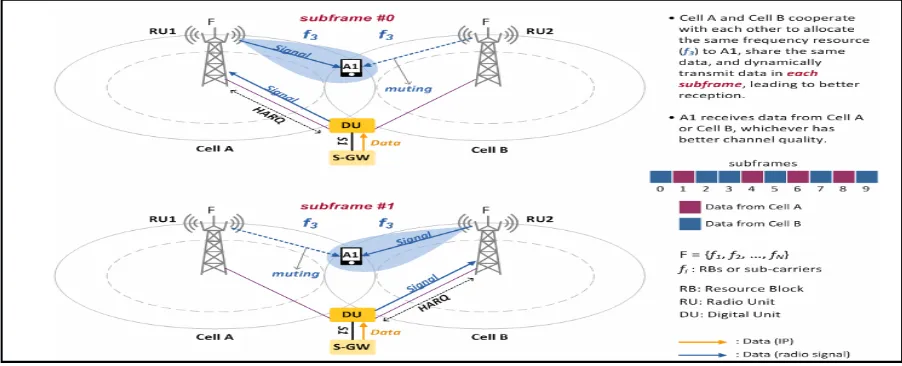
In the proposed scheme, we are introducing advanced inter cell cooperation technology called as “Dynamic Point Selection (DPS) Transmission technique”. It is a multiple point transmission technique in which multiple cells are selected among cooperating cells as transmission cells for better reception of UEs at cell edge.
In DPS scheme, multiple transmitters can transmit the data randomly by using the same radio resources (frequency and time).However,the working of DPS is different than earlier CoMP techniques. First, the channel quality of UEs is checked in each subframe by transmitters, and then transmitter having minimum path loss established the link with for UE and serves the data. Other transmission points which are not selected are muted. Because data is sent from points with better channel quality towards UEs which improves reception quality most effectively [9].
In the fig.1,cell A and cell B cooperate with each other to assign the same frequency resource to UE at the edge of the cell. For effective transmission, the data is converted into number of subframes. Consider subframe #0 for which UE A1 is served by RU1 using frequency resource f3 and at the same instant the transmission from RU2 is muted. The transmission point RU1 selected because the channel quality of RU1 is better than RU2.In the next subframe #1, the channel quality is again analyzed and from that RU2 is selected over RU1.This procedure is repeated for every subframe and transmission of data takes place dynamically from number of transmission points.
V. PERFORMANACE EVALUATION
To evaluate the performance of proposed scheme, we analyze system-level simulations using LabVIEW software. In simulation, we consider a scenario UEs are roaming in the cell. Also, we use antenna structure which focuses multiple beams in the environment. We consider only LoS signal because of millimeter-waves propagation characteristic. In the simulation, we assume downlink transmission which means that BS always transmit packets to UEs.
Fig 1: Simulation Of DPS technique for gain
In Fig. 1, we plot a graph for analyzing gain of transmitted signal from transmitting station which is selected for DPS scheme. The actual gain is calculated with reference of time in terms of decibel (dB).
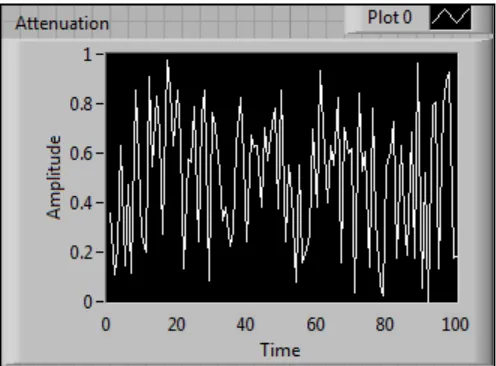
In fig.2, we plot a graph for calculation of attenuation of original signal. The amplitude of the attenuated signal varies between 0 and 1.
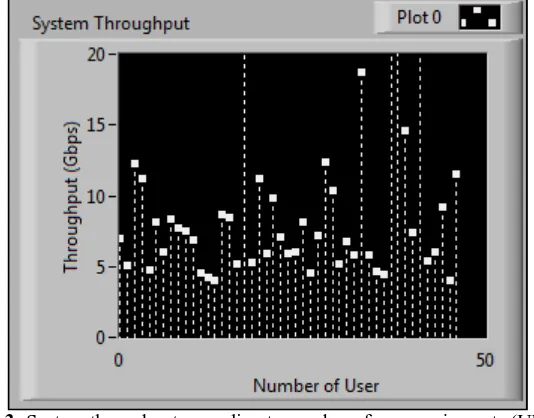
Fig 3: System throughput according to number of user equipments (UEs).
In fig. 3,we plot the graph between Number of UEs and Throughput of the system with help of simulation. The graph shows that the system throughput is increases randomly as no. of user equipments increases.
VI. CONCLUSION AND FUTURE WORK
In proposed work, we successfully evaluate the Dynamic point Selection (DPS) transmission technique in multi beam environment with consideration of millimeter wave spectrum. The graphical results show that the proposed scheme is suitable of reducing interference at the cell edges. Additionally, the DPS scheme increases the spectral efficiency with the system capacity. In the future work, we will consider other coordination CoMP techniques for spectrum management and allocation with better simulation parameters.
REFERENCES
1. OVUM, Mobile Broadband Users and Revenues Forecast Pack to 2014,May 2009.
2. Eun Soo Bae, Jun Suk Kim, and Min Young Chung, “Radio Resource Management for Multi-Beam Operating Mobile Communications”, IEEE Asia pacific conference on communications (APCC), Pattaya, pp.184-188,2014.
3. Lee ,”Coordinated Multipoint Transmission and Reception in LTE-Advanced: Development scenarios and Operational Challenges” IEEE Communication magazine V.50,pp.148-155,2012.
4. Y. Zang , ”Joint Transmission For LTE Advanced System with Non Buffer Full Traffic” Vehicular Technology Conference (VTC), IEEE, May 2012.
5. S. Gong ,P. Zhu, X. Meng, X. You,”Wideband Dynamic Base Station Selection For Downlink Coordinated Multipoint System” in Wireless Communication and Signal Processing (WCSP),IEEE,2011,pp 1-5.
6. Rajeev Agrawal, Anand Bedekar, Richa Gupta, Suresh Kalyanasundaram, Hans Kroener and Balamurali Natarajan, "Dynamic Point Selection for LTE-Advanced: Algorithms and Performance" IEEE Wireless Communications and Networking Conference (WCNC),Istanbul, pp 1392-1397,2014
7. B. Mondal, E. Visotsky, T. A. Thomas, X. Wang, and A. Ghosh, “Performance of Downlink COMP in LTE under practical constraints,” IEEE PIMRC, pp. 2049-2054, Sept. 2012.
8. W. Chunye, P. Skov, and L. Zhang “Performance analysis of Dynamic Point Selection in system level simulation,” CHINACOM, pp. 784-786,Aug. 2012.
BIOGRAPHY