Design of intelligent Street light control
System using Low Cost
AT89C51microcontroller
K. Muralidhar1, Mayank Agarwal2, K. Akash Reddy 3, M. Monica 4 , E.Thirumaleshwari5
Assistant Professor, Dept. of ECE, Lords Institute of Engineering and Technology, Hyderabad, Telangana, India1
UG Students, Dept. of ECE, Lords Institute of Engineering and Technology, Hyderabad, Telangana, India2,3,4,5
ABSTRACT: Smart Street light is an automated system which automates the street. The main aim of Smart Street light is to reduce the power consumption when there are no vehicle movements on the road. The Smart street light will turned to be ON when there are vehicles on the road otherwise the lights will be switched OFF. This proposed system provides a solution for energy saving. This is achieved by sensing an approaching vehicle and then switch ON a block of street lights ahead of the vehicle. As the vehicle passes by, the trailing lights OFF automatically. Thus, we save a lot of energy. So when there are no vehicles on the highway, then all the lights remain OFF. However there is another mode of operation where instead of switching OFF the lights completely, they remain ON with 10% of the maximum intensity of the light. As the vehicle approaches, the block of street light switch to 100% intensity and then as the vehicle passes by the trailing lights revert back to 10% intensity again.
KEYWORDS: IR (Infrared) motion sensor, LDR (Light Dependent Resistor),LEDs (Light Emitting Diode),Microcontroller
I. INTRODUCTION
Street lighting in Sri Lanka evolved from oil and gaslamps in the 17th and 18th centuries to electric lampsin the late 19th century. Today High IntensityDischarge “HID” lamps dominate street lightinginstallations. Then, the country engaged to undertakethe best practices of Light Emitting Diode “LED”conversion as well as to study other aspects of LEDstreet lights, intensity, controls, energy monitoring,public safety, special events, impacts on drivers,bicyclists, pedestrians, and the elderly and sightdisabled. This report outlines generalrecommendations regarding street lighting, as well astechnical specifications on existing systems. Itprovides direction on ways to capitalize on theadditional benefits of LED technology such as theuse of control systems for dimming, changing colorand emergency events.
The research aims were to reduce the sideeffects of the current street lighting system, and finda solution to save power. This system will go into aSwitch-OFF mode and the lamps would not glow, ifthere is no necessity of light. This new system willallow its’ control station to identify the prevailingcondition of each lamp. Hence, the problem will berectified. It will automatically change to Switch-ONmode when the sunlight decreases, thus, willautomatically change to the Switch-OFF mode whensunshine falls on it. It provides a productive methodto save energy by preventing unnecessary wastage ofelectricity which is caused due to manual switchingor lighting of street-lights. Moreover, this will beable to communicate with the control station, whichexamines the current status of the system.Accordingly, can check whether all the systems areworking properly or not. This system basicallyconsists of a Light Dependent Resistor “LDR”,photoelectric sensor, Power supply, Relays andMicro controller. Circuit will work properly to turnstreet lamp ON/OFF. LDR sensor and the photoelectric sensor are the two main conditionsworking in the circuit.
lights will be ON in the places ofthe movement when it is dark. Finally this controlcircuit can be used in long roadways between thecities. This research is written having the aim ofimplementing a system that assists in Street LightingSystem of Sri Lanka.
After dusk, the light sensor will activate thesystem, and will get ready to detect any object byphoto electric sensors, on the road to turn on thestreet lights. The street light can be successfullycontrolled by the microcontroller. The commandsfrom the microcontroller the lights will be ON in theplaces of the movement when it is dark. Finally thiscontrol circuit can be used in long roadways betweenthe cities.
II. RELATED WORK
S.Suganya et al [2] have proposed about Street Light Glow on detecting vehicle movement using sensorisa system that utilizes the latest technology for sources of light as LED lamps. It is also used to control theswitching of street light automatically according to the light intensity to develop flow based dynamic controlstatistics using infrared detection technology and maintain wireless communication among lamppost and controlterminal using ZigBee Wireless protocol. It also combines various technologies: a timer, a statistics of traffic flowmagnitude, photodiodes, LED, power transistors.
K.Santha et al [3] have surveyed on Street Lighting System Based on Vehicle Movements. The systemoperates in the automatic mode which regulates the streetlight according to brightness and dimness algorithm andlight intensity. The control can be made according to the seasonal variation. It includes a time cut-out functionand an automatic control pattern for conserving more electricity. The whole project was implemented using a PICmicrocontroller.Srikanth et al [4] proposed a ZigBee based Remote Control Automatic Street Light System. The systemis designed with the help of ZigBee modules that helps in detecting the faulty lights and control the light. It alsodiscusses about an intelligent system that takes automatic decisions for ON/OFF/DIMMING considering thevehicle movement or pedestrian and also the surrounding environment. PIR motion sensor is used to detectmovement of both living and non-living things.
M.Abhishek et al [5] haveimplemented design of traffic flow based street light control system witheffective utilization of solar energy in the year 2015. They used the renewable source of energy i.e. the solar powerfor street lighting. They have also used 8052 series microcontroller and is developed by replacing the normalbulbs with the LEDs due to which the power consumption is reduced by 3 times. Sensors are placed on either sideof the road which senses the vehicle movement and sends the commands to the microcontroller to switch ON andOFF the lights. Here all the street lights remain switched off and it glows only when it senses the vehiclemovement. Hence, because of the microcontroller, even when its night the lights are switched off.
C.Bhuvaneshwari et al [6] have analyzed the street light with auto tracking system by which one canincrease the conversion efficiency of the solar power generation. Here, the sun tracking sensor is the sensingdevice which senses the position of the sun time to time and gives the output to the amplifier based on light densityof the sun. Sun tracking sensor is LDR, amplifier unit is used to amplify the LDR signals which converts low levelsignals to high level signals and the output is given to comparator. The LM324 IC is used as an amplifier.Comparator compares the signals and gives the command to AT89C51 microcontroller.
Steve Chadwick [7] reports on the two installation case studied in Scotland and Wales and explains thedetails and benefits of the technology. The system was called as MINOS that had a track record of over 100,000units installed and working successfully.
be divided into 2 period of time, namely, at 18.00-22.00 hours and05.00-06.00 hours. The design of a control circuit was experimentally done in this work. The aim of this work isto determine the appropriate system to install in a typical rural area or a typical rural village of Thailand.
III. SYSTEM ARCHITECTURE
Since the HID lamps are not cost effective and not reliable, smart street light system has overcome byreplacing the HID lamps with LED. Due to automation, power consumption and cost effectiveness in the presentfield of electronics and electrical related technologies, industry of street lighting systems are growing rapidly and
going to complex with rapid growth of industry and cities.To control and maintain complex street lighting system more economically, various street light controlsystems are developed. These systems are developed to control and reduce energy consumption of a town's publiclighting system using different technologies which uses IR motion sensors to detect the vehicle movement afterwhich the street light begins to glow. As the vehicle moves, the street light that was glowing switches off and thefollowing lights begins to glow as shown in fig.1
Fig. 1: Generalized block diagram
Fig. 2 : LDR Circuit Diagram(Source : http://static.cactus.io/img/sensors/light/ldr/ldrcircuit.jpg)
A) AT89C51 MICROCONTROLLER
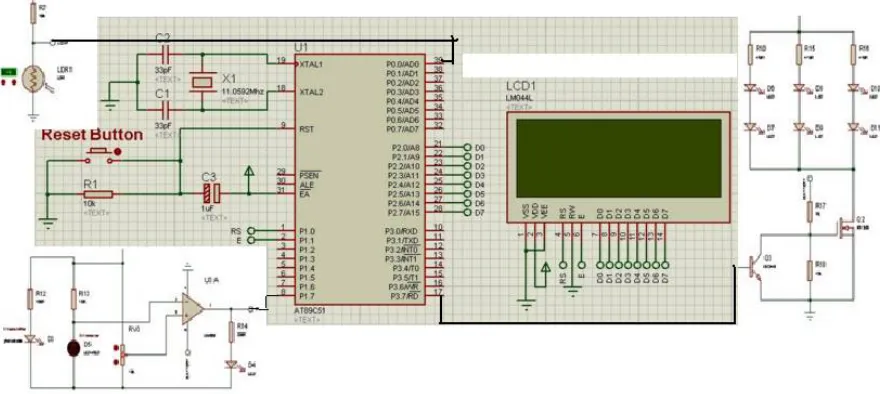
The AT89S52 is a low-power, high-performance CMOS 8-bit microcontroller with 4K bytes of in-systemprogrammable Flash memory. By combining a versatile 8-bit CPU with in-system programmable Flash on a monolithic chip, the Atmel AT89C51 is a powerful microcontroller which provides a highly-flexible and cost effective solution to many embedded control applications.The AT89C51 provides the following standard features: 4K bytes of Flash, 128 bytes of RAM, 32 I/O lines, two data pointers, two 16-bit timer/counters, a six vector two-level interrupt architecture, a full duplex serial port, on-chip oscillator, and clock circuitry. In addition, the AT89C51 is designed with static logic for operation down to zero frequency and supports two software selectablepower saving modes. The Power-down mode saves the RAM contents but freezes the oscillator, disabling all other chip functions until the next interrupt or hardware reset.
B) INFRARED SENSOR
An infrared sensor [12] is an electronic device that emits in order to sense some aspects of thesurroundings. An IR sensor can measure the heat of an object as well as detects the motion. These types of sensorsmeasures only infrared radiation, rather than emitting it that is called as a passive IR sensor. Usually in the infraredspectrum, all the objects radiate some form of thermal radiations. These types of radiations are invisible to oureyes that can be detected by an infrared sensor. The emitter is simply an IR LED and the detector is simply an IRphotodiode which is sensitive to IR light of the same wavelength as that emitted by the IR LED. When IR light
falls on the photodiode. The resistances and these output voltages, change in proportion to the magnitude of the IR light received.
IV. RESULTS & DISCUSSION
All the components areconnected to each other and thus complete the system setup which helps one to understand the steps in a simpleand easy way. With these steps, even when a person who is trying to implement the same, it makes it simple, clearand easy.
1) When the preliminary setup of the hardware is done in the first phase all the components are in accordance to every other component. The five IR sensors are placed next to each other. The 8051 board is connected to the external power supply for the flow of current. All the five IR sensors are connected to the 8051 board. The resistor is placed on the bread board to control the flow of current.
2) In the second phase where all the LED’s glow immediately for few seconds and then switches off. It glows on
as soon as it becomes dark. Except the first LED, all the other LEDs are switched off. The first streetlight is always switched on for security purposes.
Fig.3. flow chart for proposed work
V. CONCLUSION
This project intelligent Street light control System is a costeffective, practical eco-friendly and the safest way to saveenergy. By using Smart Street light, one can save surplus amount of energy which is done by replacing sodiumvapor lamps by LED and adding an additional feature for security purposes. It prevents unnecessary wastage ofelectricity, caused due to manual switching of streetlights when it’s not required. It provides an efficient and smartautomatic streetlight control system with the help of IR sensors. It can reduce the energy consumption andmaintains the cost. The system is versatile, extendable and totally adjustable to user needs. The system is now used only for one way traffic in highways. Continuous use of LDR and IR sensors even in day time.
REFERENCES
[1] “Energy Saving Using LED Automatic Street Light Control System” ,Mitsu Shah1, Charmi Shah2, Hardik Shah3, Riddhi Shah4,J.M. Rathod5 T. D. Pawar6, V. N. Kamat7 .IJREAT International Journal of Research in Engineering & Advanced Technology,Volume 2, Issue 2, Apr-May, 2014 [2]. S. Suganya, R. Sinduja, T. Sowmiya& S. Senthilkumar, Street light glow on detecting vehicle movement using sensor
[3]. K.Santha Sheela, S.Padmadevi, Survey on Street Lighting System Based On Vehicle Movements [4]. Srikanth M, Sudhakar K N, ZigBee Based Remote Control Automatic Street Light System
[5]. M.Abhishek, Syed ajram shah, K.Chetan, K,Arun Kumar, Design and implementation of traffic flow based street light control system with effective utilization of solar energy, International journal of Science Engineering and Advance Technology, IJSEAT, Vol 3, Issue 9, September -2015 [6]. C.Bhuvaneshwari, R.Rajeswari, C.Kalaiarasan, Analysis of Solar energy based street light with auto tracking system, International Journal of Advanced Research in Electrical, Electronics and Instrumentation Engineering, Vol 2, Issue 7, July 2013
[7]. Steve Chadwick, “Street Light Monitoring – a Practical Solution magazine” November/December 2002
BIOGRAPHY
K. Muralidhar completed B.Tech in 2011 & M.Tech in 2014 from JNTUH. Having 2years of teaching Experience. Field of interest is VLSI System Design, wireless communication, Digital Signal processing. Presently working as Assistant Professor in Department of Electronics and Communication Engineering, Lords Institute of Engineering & Technology.
Mayank Agarwal presently pursuing B.Tech 3rd Year in Lords Institute of Engineering and Technology, Hyderabad, Telangana India.
K. Akash Reddypresently pursuing B.Tech 3rd Year in Lords Institute of Engineering and Technology, Hyderabad, Telangana India.
M.Monica presently pursuing B.Tech 3rd Year in Lords Institute of Engineering and Technology, Hyderabad, Telangana India.