Acquiring a Poor Man’s Inflectional Lexicon for German
Peter Adolphs
Deutsches Forschungszentrum für Künstliche Intelligenz, Projektbüro Berlin Rosenstraße 2
D-10178 Berlin [email protected]
Abstract
Many NLP modules and applications require the availability of a module for wide-coverage inflectional analysis. One way to obtain such analyses is to use an morphological analyser in combination with an inflectional lexicon. Since large text corpora nowadays are easily available and inflectional systems are in general well understood, it seems feasible to acquire lexical data from raw texts, guided by our knowledge of inflection. I present an acquisition method along these lines for German. The general idea can be roughly summarised as follows: first, generate a set of lexical entry hypotheses for each word-form in the corpus; then, select hypotheses that explain the word-forms found in the corpus “best”. To this end, I have turned an existing morphological grammar, cast in finite-state technology (Schmid et al., 2004), into a hypothesiser for lexical entries. Irregular forms are simply listed so that they do not interfere with the regular rules used in the hypothesiser. Running the hypothesiser on a text corpus yields a large number of lexical entry hypotheses. These are then ranked according to their validity with the help of a statistical model that is based on the number of attested and predicted word forms for each hypothesis.
1. Introduction
Many NLP modules and applications require the availabil-ity of a module for wide-coverage inflectional analysis. Such a module should enable the user to determine the set of all possible inflectional analyses for a given word form. One way to provide these analyses is to look up the word form in a full-form lexicon. A better solution in terms of maintainability is to use an inflectional lexicon, which lists inflectional stems with their inflectional classes, combined with a morphological analyser that uses those lexical en-tries to analyse the word forms. To my knowledge, there is no such module freely available for German1.
Further-more, existing inflectional lexicons constantly need to be expanded, for instance, to encompass domain-specific vo-cabulary.
The manual creation and maintenance of an inflectional lex-icon is a dull and strenuous task. Since large text corpora nowadays are easily available and inflectional systems are in general well understood, it seems feasible to acquire lexi-cal data from raw texts, guided by our knowledge of inflec-tion. Several methods along these lines have been devel-oped in recent years for different languages including Rus-sian (Oliver et al., 2003), Croatian (Oliver & Tadi´c, 2004), French (Clément et al., 2004; Forsberg et al., 2006), and Slovak (Sagot, 2005).
I present an acquisition method for German that takes only the tokens of a corpus and their frequencies as input, and produces a list of ranked lexical entry candidates as out-put. Lexical entries comprise the inflectional stem and the inflectional class of a lexical word (lexeme). They serve as a basis for inflectional analysis, where word forms are mapped to the set of possible combinations of lexical
iden-1Morphy(Lezius, 2000) is a morphological analyser for
Ger-man covering inflection and a limited set of compounding, and can be used at no charge. Unfortunately, it only provides a graph-ical user interface which cannot be embedded into non-interactive software pipelines. The tool offers a function to export its lexical data as a full-form lexicon instead.
tifiers and morphosyntactic properties, as well as gener-ation, where lexical representations are mapped back to word forms. The method can be summarised as follows: first, generate a set of lexical entry hypotheses for each word-form in the corpus; then, select hypotheses that ex-plain the word-forms found in the corpus “best”. To this end, I have turned an existing morphological grammar, cast in finite-state technology, into a hypothesiser for lexical en-tries. Irregular forms are simply listed, so they do not in-terfere with the regular rules used in the hypothesiser. Run-ning the hypothesiser on a text corpus yields a large number of lexical entry hypotheses. These are then ranked accord-ing to their validity with the help of a statistical model that is based on the number of attested and predicted word forms for each hypothesis.
2. Acquisition System
2.1. System Architecture
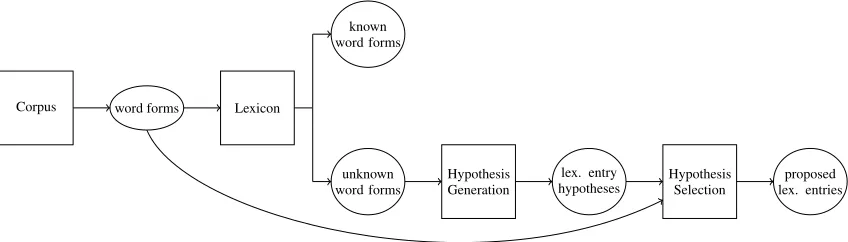
The acquisition system described in the following operates on a tokenised text corpus, which is treated as a ‘bag of words’, that is, the context of particular tokens is not con-sidered in this work. It is assumed that the tokeniser splits the text at white space and at punctuation marks. Further preprocessing steps such as a normalisation of sentence-initial upper-case letters or an undoing of hyphenation have not been applied. However, in order to keep the set of problematic forms small, I have excluded tokens with non-alphabetic characters from the acquisition process. The task of the system is to propose new lexical entries for open-class words. All word forms are therefore first ana-lysed by a lexicon-based inflectional analyser, and only un-known word forms are considered for finding candidates for new lexical entries. The actual acquisition process is then realised as a two-step procedure:
Corpus word forms Lexicon
unknown word forms
known word forms
Hypothesis Generation
lex. entry
hypotheses HypothesisSelection
proposed lex. entries
Figure 1: Overview of the acquisition system
2. selection of plausible lexical entry hypotheses accord-ing to the attested word forms of the hypothetical in-flectional paradigm in the corpus
The system’s general architecture is depicted in figure 1. The hypothesis generation step is explained in more de-tail in subsection 2.2.. The hypothesis selection step is ex-plained in more detail in subsection 2.3..
2.2. Hypothesis Generation
Both the lexical module (called ‘SLEX’) and the hypothe-sis generation module (‘SLES’) are finite-state transducers which are based on the inflectional component of SMOR, a computational model of German morphology (Schmid et al. 2004; the inflectional component goes back to Schiller 1996). Just as SMOR, they are implemented with SFST, a free software package that provides a programming lan-guage and the necessary tools for compiling and running large finite-state transducers (Schmid, 2005), featuring two-level rules (Koskeniemmi, 1984) as well as cascaded archi-tectures using transducer composition as proposed in (Ka-plan & Kay, 1994). The advantages of using finite-state transducers for this lexicon acquisition task are that finite-state transducers are a wide-spread and well-established device for describing morphological patterns declaritively, that the same rule base, if carefully designed, can be used to support both analysis and generation by just switching the direction of the transducer, that the necessary development tools are readily available and are efficient enough to pro-cess large amounts of data, and that the formalism makes it very easy to reuse other transducers by using concatenation and composition.
SMOR and SLES have in common that they concatenate – at least at some level of the analysis – lexical entries, which consist of an inflectional stem (e.g.,Reim, ‘rhyme’) and a symbol for an inflectional class (e.g.,<NMasc_es_e>)2,
with all possible affixes for the specific inflectional class. Both sets – inflectional stems and mappings from inflec-tional classes to the set of possible inflecinflec-tional markers – are represented as transducers. This concatenated trans-ducer is then composed with an additional transtrans-ducer from SMOR, applying morphophonological and orthographic
2SFST supports multi-character symbols, which are enclosed
in angle brackets.
rules, which are triggered by special symbols (for exam-ple,<UL>for ‘umlaut’ or<ˆDel>an e-elision in certain inflectional classes) in the set of inflectional markers. The resulting transducer maps word forms to their under-lying lexical representations, and vice versa. Whereas the lexical representations of a word form in SMOR comprise the lemma (citation form, e.g. the infinitive form for verbs) and the morphosyntactic properties, the lexical representa-tion in SLES consist of the lexical entry and (oprepresenta-tionally) the morphosyntactic properties. SLES can thus be used to determine the set of all possible lexical entries that could give rise to a given word form. This is achieved by us-ing generic inflectional stems (basically .*) for each in-flectional class3. The SLES transducer is designed to be
run in both directions. It can be used to determine the set of possible lexical entries of a word form but it can as well be used to generate the whole set of predicted word forms – that is, the inflectional paradigm – of a lexical entry. An example of running SLES on a given word form, and on a given (hypothetical) lexical entry, is given in figure 2. Once a lexical entry hypothesis is accepted, it can be en-tered into a lexicon, called SLEX. The SLEX transducer combines the functionality of SLES with the lexicon, by composing the lexical representation of SLES with the dis-junction of all entries of a plain text file containing ap-proved lexical entries. Thus, SLEX has basically the same capabilities as the SLES transducer, with the only differ-ence that it outputs confirmed rather than hypothetical lex-ical entries. SLEX is also used to classify word forms into known and unknown forms. For the experiments reported here, SLEX contained lexical entries for roughly 500 lex-emes4for closed word classes such as adpositions (112
lex-emes), pro-forms (104), irregular verbs (196), irregular
ad-3It was necessary to constrain the form of stems for avoiding
both spurious hypotheses during hypothesis generation as well as unwanted interactions between the morpho-phonology transducer when generating word forms from a (hypothetical) lexical repre-sentation. For example, inflectional stems of nouns with an in-flectional class where most forms are formed by attaching-e,-es, -enshould not end withe. Thus, the set of permissible stems is defined as a disjunction of patterns as the following:
[#LETTER#][#letter#]+[ˆe][<NMasc_es_e><NNeut_es_e>]
4Note that irregular, particularly suppletive, paradigms are
prob-frequencies in a corpus but does not require any further in-formation. Thus, it is well suited for acquiring a candidate list of lexical entries that can be manually checked much more efficiently as opposed to manually creating such a list of lexical entries.
A flaw of the current system is that it is not robust to sparse data and errors in the corpus. One possible way to make the system more robust and to improve precision would be to use a probabilistic model over inflectional slots to estimate the plausibility of a word form. This, however, requires the presence of morphologically annotated corpora.
Another natural extension of the current system would be to exploit (categorial) agreement and government relations in the syntactic contexts of word forms, in addition to for-mal differences between word forms, as it is done in the ‘Durm lemmatiser’ for German nouns (Perera & Witte, 2005). Such a syntactic approach is orthogonal to the one presented here.
Acknowledgements
This work was mainly carried out at the Humboldt-Universität zu Berlin, as part of my diploma thesis under the supervision of Prof. Anke Lüdeling and Prof. Ulf Leser. I wish to express my sincere thanks to Stefanie Dipper and Viktor Trón for fruitful discussions on the topics covered here, and to Stefan Evert and Marco Baroni who helped me with the development of the original idea. I am very grate-ful to the IMS Stuttgart, and, in particular, to Uli Heid, for granting me access to the full SMOR lexicon, as well as to Helmut Schmid for the release of SFST and SMOR as free software. Finally, I want to thank the DFKI for supporting my participation at the LREC conference.
References
Brants, S., Dipper, S., Hansen, S., Lezius, W. & Smith, G. (2002). The TIGER Treebank. InProceedings of the Workshop on Treebanks and Linguistic Theories (TLT 2002). Sozopol, Bulgaria.
Clément, L., Sagot, B. & Lang, B. (2004). Morphology based automatic acquisition of large-coverage lexica. In
Proceedings of the 4th International Conference of Lan-guage Resources and Evaluation (LREC 2004). Lisbon, Portugal.
Forsberg, M., Hammarström, H. & Ranta, A. (2006). Mor-phological Lexicon Extraction from Raw Text Data. In
Proceedings of FinTAL - 5th International Conference on Natural Language Processing. Turku, Finland.
Kaplan, R. M. & Kay, M. (1994). Regular Models of Phonological Rule Systems. Computational Linguistics, 20(3), pp. 331–378.
Koskeniemmi, K. (1984). A general computational model for word-form recognition and production. In Proceed-ings of the 10th International Conference on Computa-tional Linguistics (COLING 84), pp. 178–181. Stanford University, California, USA.
Lezius, W. (2000). Morphy - German Morphology, Part-of-speech Tagging and Applications. InProceedings of EURALEX 2000. Stuttgart, Germany.
Lüdeling, A. (2001). On Particle Verbs and Similar Con-structions in German. Stanford, California, USA: CSLI Publications.
Oliver, A., Castellón, I. & Màrquez, L. (2003). Automatic Lexical Acquisition from Raw Corpora: An Application to Russian. InProceedings of the EACL-2003 Workshop on Morphological Processing of Slavic Languages. Bu-dapest, Hungary.
Oliver, A. & Tadi´c, M. (2004). Enlarging the Croatian Morphological Lexicon by Automatic Lexical Acquisi-tion from Raw Corpora. InProceedings of the 4th Inter-national Conference of Language Resources and Evalu-ation (LREC 2004), pp. 1259–1262. Lisbon, Portugal.
Perera, P. & Witte, R. (2005). A Self-Learning Context-Aware Lemmatizer for German. InProceedings of Hu-man Language Technology Conference and Conference on Empirical Methods in Natural Language Processing (HLT/EMNLP 2005), pp. 636–643. Vancouver, Canada.
Sagot, B. (2005). Automatic acquisition of a Slovak Lex-icon from a Raw Corpus. In Matoušek, V., Mautner, P. & Pavelka, T. (Eds.), Text, Speech and Dialogue: 8th International Conference, TSD 2005, Karlovy Vary, Czech Republic, September 12-15, 2005. Proceedings., vol. 3658 of Lecture Notes in Computer Science, pp. 156–163. Berlin / Heidelberg: Springer.
Schiller, A. (1996). Deutsche Flexions- und Kompositions-morphologie mit PC-KIMMO. In Hausser, R. (Ed.), Lin-guistische Verifikation. Dokumentation zur Ersten Mor-pholympics 1994. Tübingen: Max Niemeyer Verlag.
Schmid, H. (2005). SFST Manual. Part of the SFST soft-ware package.
tokens types word forms in TIGER 888,299 89,385
punctuation 119,554 23
word form hapax legomena 45,224 45,224
lemma hapax legomena 30,143 30,143
word forms used in acquisition 740,846 79,249
coverage initial SLEX transducer 316,675 1,474
coverage all hyps with the best score 167,495 17,553
coverage all hyps with the 2 best scores 192,695 22,727
coverage all hyps with the 2 best scores 198,830 23,824
Figure 3: Corpus statistics
nr. best score 2 best scores 3 best scores
1 13,494 1,035 1,035 2 3,563 8,778 1,959
3 53 6,407 5,150
4 12 761 5,112
5 63 1,454
6 74 565
7 4 522
8 464
9 271
. . .
Figure 4: Distribution for the number of competing hypotheses after selecting either the ones with the best score, the 2 best scores, or the 3 best scores. That is, if among all sets of competing hypotheses only the hypotheses with the highest scores are retained, we find e.g.3,563hypotheses that still competes with another hypothesis in the same group.
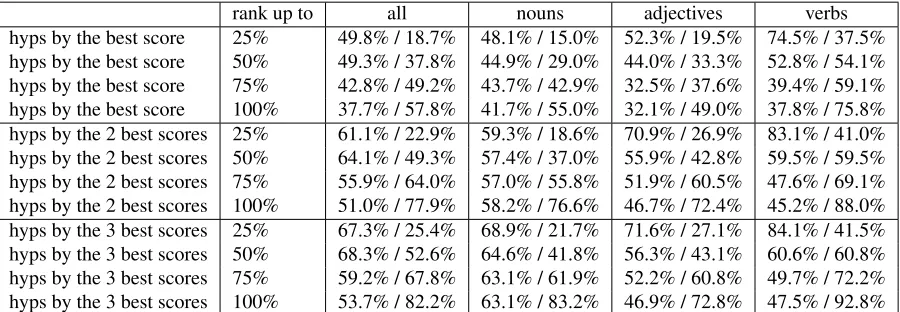
rank up to all nouns adjectives verbs
hyps by the best score 25% 49.8% / 18.7% 48.1% / 15.0% 52.3% / 19.5% 74.5% / 37.5% hyps by the best score 50% 49.3% / 37.8% 44.9% / 29.0% 44.0% / 33.3% 52.8% / 54.1% hyps by the best score 75% 42.8% / 49.2% 43.7% / 42.9% 32.5% / 37.6% 39.4% / 59.1% hyps by the best score 100% 37.7% / 57.8% 41.7% / 55.0% 32.1% / 49.0% 37.8% / 75.8% hyps by the 2 best scores 25% 61.1% / 22.9% 59.3% / 18.6% 70.9% / 26.9% 83.1% / 41.0% hyps by the 2 best scores 50% 64.1% / 49.3% 57.4% / 37.0% 55.9% / 42.8% 59.5% / 59.5% hyps by the 2 best scores 75% 55.9% / 64.0% 57.0% / 55.8% 51.9% / 60.5% 47.6% / 69.1% hyps by the 2 best scores 100% 51.0% / 77.9% 58.2% / 76.6% 46.7% / 72.4% 45.2% / 88.0% hyps by the 3 best scores 25% 67.3% / 25.4% 68.9% / 21.7% 71.6% / 27.1% 84.1% / 41.5% hyps by the 3 best scores 50% 68.3% / 52.6% 64.6% / 41.8% 56.3% / 43.1% 60.6% / 60.8% hyps by the 3 best scores 75% 59.2% / 67.8% 63.1% / 61.9% 52.2% / 60.8% 49.7% / 72.2% hyps by the 3 best scores 100% 53.7% / 82.2% 63.1% / 83.2% 46.9% / 72.8% 47.5% / 92.8%