Disclose Models, Hide the Data—
How to Make Use of Confidential Corpora without Seeing Sensitive Raw Data
Erik Faessler, Johannes Hellrich, Udo Hahn
Jena University Language & Information Engineering (JULIE) Lab Friedrich-Schiller-Universit¨at Jena
Jena, Germany
http://www.julielab.de
Abstract
Confidential corpora from the medical, enterprise, security or intelligence domains often contain sensitive raw data which lead to severe restrictions as far as the public accessibility and distribution of such language resources are concerned. The enforcement of strict mechanisms of data protection consitutes a serious barrier for progress in language technology (products) in such domains, since these data are extremely rare or even unavailable for scientists and developers not directly involved in the creation and maintenance of such resources. In order to by-pass this problem, we here propose to distribute trained language models which were derived from such resources as a substitute for the original confidential raw data which remain hidden to the outside world. As an example, we exploit the access-protected German-language medical FRAMEDcorpus from which we generate and distribute models for sentence splitting, tokenization and POS tagging based on software taken from OPENNLP, NLTKand JCORE, our own UIMA-based text analytics pipeline.
Keywords:confidential corpora, language models, re-usability
1.
Introduction
With the growing potential of language technologies to identify the underlying meaning of spoken or written nat-ural language utterances, we currently witness a growing demand for computational content analytics in many fields. Whereas many application areas can make use of easily and publically accessible language raw data (such as news-paper articles or newswire feeds), others are characterized by varying levels of confidentiality which translate directly into corresponding protection layers to access such data. These concerns are most evident for clinical documents (such as those contained in electronic patient records or ge-nomic databases, cf. e.g. Claerhout and De Moor (2005), Damschroder et al. (2007)), documents from enterprises (e.g. damage claims and case decision letters from insur-ance companies, pharmaceutical test reports, cf. e.g. Small-wood (2012)) or documents related to intelligence, security and police activities (blackmail letters, suicide notes, etc.; cf. e.g. Vetulani (2012)). We call these collections confiden-tialbecause such sensitive data are usually collected under binding protection rules and non-disclosure commitments which preclude extramural use and further exploitation. Indeed we ourselves faced such a confidentiality problem with our FRAMED corpus (Wermter and Hahn, 2004). FRAMED consists of a well-balanced mixture of medi-cal document types such as discharge summaries, pathol-ogy reports but also medical textbook excerpts, all writ-ten in German language. Altogether, FRAMEDis made of 7,000 sentences, with approximately 100,000 tokens. The original FRAMED corpus comes with manually supplied sentence boundary, token segmentation and part-of-speech tags. Over the years, we received several requests for mak-ing this corpus available to the broader language resources community. Unfortunately, in each case we had to deny such requests and apologize for explicit distribution barri-ers which were part of mutual agreements with the
vari-ous clinical departments involved in the creation of this re-source. One of the few cases where we were able to help involved a member of our team carrying out some statis-tical analysis for a requesting group. The results of this work are described in Chapman et al. (2013). This service-oriented perspective, acting as a kind of data oracle, let us think about alternatives to raw data distribution.
In order to mitigate this unsatisfactory situation where a highly coveted corpus remains inaccessible to the language resources community, we here propose the following solu-tion. Rather than distributing the original raw data as a re-source, we distribute language models which were derived from it and capture relevant language characteristics. Ac-cordingly, the analytic potential is shifted from the exploita-tion of a corpus to the re-use of language models without unmasking the raw data which underlie their generation.1 To assure wide re-usability by the NLP community, we have generated sentence and token segmentation models, as well as POS tagging models within the framework of three NLP model repositories, namely OPENNLP,2NLTK3and JCORE.4At our lab web site,5we offer download options for these models. As a consequence, potential consumers of these models may process German-language clinical text by re-using pre-computed models, without requiring access-protected clinical raw data.
1
We are aware of the possibility to read out portions of the textual data stored in models by employing programs accessing the API of the training frameworks being used. However, such an unfriendly use of our service will, at best, render a probabilistic model of the original textual resource, not the specific original one we started from. Of course, all sensitive data which allow to identify an individual patient have been deleted prior to corpus assembly. See also Section 5. where we further discuss this issue.
2http://opennlp.apache.org/ 3http://nltk.org/
4http://www.julielab.de/Resources.html 5
2.
NLP Frameworks
In this section, we illustrate the model-for-data paradigm by selecting some popular NLP frameworks, namely OPENNLP, NLTKand JCORE, as an embedding for con-crete NLP language models which account for sentence splitting, tokenization and POS tagging.
In the JAVAworld, APACHEOPENNLP is very popular and widely used for a range of NLP tasks. It offers basic tools like sentence splitters, tokenizers, name finders, chunkers, parsers and a coreference resolver. OPENNLP comes with a set of pre-trained models (exploiting newspaper/newswire texts as raw data) for download from its web page.
The Natural Language Toolkit (NLTK) is a PYTHON frame-work for general NLP, not specialized to any particular do-main and frequently used for educational purposes (Bird et al., 2009). It offers a comprehensive library of natural language analysis tools such as tokenizers, stemmers, POS taggers, syntactic parsers, and semantic reasoning tools and excels with its comparatively low entry barrier (relative to JAVAtooling). Yet some of its basic components, tokeniz-ers in particular, are only available as rule-based systems. We used NLTK’s PUNKTlibrary for sentence splitting and trained the POS tagger with a MEGAM model.6
The JULIE Lab UIMA Component Repository (JCORE) (Hahn et al., 2008) was built as a repository of interoperable UIMA components7 already adapted to the special needs of the analysis of English life sciences-related literature. It contains self-developed components to account for spe-cial phenomena of the biomedical domain (e.g. espespe-cially hard tokenization problems for protein, gene or chemical names), as well as UIMAwrapper components for estab-lished NLP frameworks like OPENNLP.
There are further tools and frameworks that are very pop-ular in the NLP community, such as GATE8 or LING-PIPE.9 However, most components we are focusing on this paper—sentence splitters, tokenizers and POS taggers—in these frameworks are rule-based and adaptation to certain corpora, if needed, relies on human intuition and thus in-depth manual inspection of the raw data. Since our goal is automatic model learning employing machine learning (ML) methodologies on the basis of language data, we re-frain from considering these tools any further in this paper.
3.
Training on FRAMED
Even some of the frameworks we focus on offer rule-based components besides trainable ones. We re-trained all train-able models for sentence splitting, tokenization and POS tagging for all repositories using FRAMED as the refer-ence corpus. In order to allow for an assessment of the model quality, we performed a 10-fold cross-validation for all trained components. All tools except NLTK’s sentence splitter come with evaluation methods of their own. How-ever, the NLTKPOS tagger does not implement a cross-validation algorithm. Thus, for the employed NLTKtools we conducted the cross-validation with custom algorithms.
6
http://www.umiacs.umd.edu/˜hal/megam/ 7
http://uima.apache.org/ 8
https://gate.ac.uk/
9http://alias-i.com/lingpipe/
Some of these evaluation tools useF1metrics, whereas
oth-ers measure accuracy. For the JCOREtools, we added F-score numbers to the evaluation report.
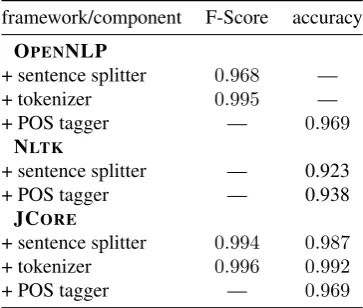
An overview of the results is given in Table 1. Data for NLTK’s tokenizer is missing because it is rule-based and requires manual tuning; JCORE’s POS tagger is basically a wrapper for OPENNLP’s tagging tool, so data are the same as for the OPENNLP POS tagger. We provide all evaluation values available, i.e. cells containing only a dash indicate that an evaluation for the corresponding measure was not offered by the tool’s evaluation method.
framework/component F-Score accuracy
OPENNLP
+ sentence splitter 0.968 —
+ tokenizer 0.995 —
+ POS tagger — 0.969
NLTK
+ sentence splitter — 0.923
+ POS tagger — 0.938
JCORE
+ sentence splitter 0.994 0.987 + tokenizer 0.996 0.992
+ POS tagger — 0.969
Table 1: 10-fold cross-validation results for selected frame-work and various components.
Overall, the data indicate a nice fit of the trained models with the FRAMEDgold standard within an F-score range of 0.97 to 0.99. The lowest performance on sentence splitting can be attributed to the NLTKsentence splitter, tokeniza-tion performance between OPENNLP and JCOREseems on par with each other. The POS tagging performance varies markedly between OPENNLP and NLTK.
While these raw evaluation data may provide a first impres-sion on tool performance, the real benefit of training mul-tiple language models for the same task is that users may choose between models depending on their application and specific task requirements. This choice is hard, if not im-possible, to justify in the absence of data to test on. As a substitute, we now turn to a detailed error analysis of the different taggers on otherwise hidden data.
4.
Error analysis
The following error analysis is structured by model type, i.e. models for sentence splitting, tokenization and part-of-speech tagging. Once again, 10-fold cross-validations were used. In this way, the whole corpus has been employed as test data and contributes to the error analysis.
4.1.
Sentence splitters
This section deals with statistics and the types of errors ob-served on FRAMEDusing the sentence models trained on the corpus. Sentence detection is the task of disambiguat-ing potential sentence-delimitdisambiguat-ing characters such as dots, colons etc. All errors of all sentence splitter models have been manually reviewed and classified.
It reaches anF1score of0.968on FRAMEDwith mostly
default parameters. However, the set of possible end-of-sentence symbols has to be explicitly specified for the tool in order to archieve this performance figure. Otherwise, the sentence boundary detector will, e.g. not split at colons causing the performance of the tool to drop to0.789F1.
For the OPENNLP sentence splitter, we encountered a to-tal of 165 errors; Table 2 contain a breakdown into error classes. Error categories we distinguish here mean that the error happened after an abbreviation, a semicolon, etc.
error class number %
Total 165 100.00
FP 97 58.79
FN 68 41.21
Abbreviation 82 49.70
FP 71 43.03
FN 11 6.67
Semicolon (FN only) 28 16.97
Fullstop 20 12.12
FP 5 3.03
FN 15 9.09
Enumeration 17 10.30
FP 10 6.06
FN 7 4.24
Date (FP only) 7 4.24
Other 11 6.67
FP 4 2.42
FN 7 4.24
Table 2: Error statistics for OPENNLP sentence splitter (‘FP’ stands for false positive, ‘FN’ for false negative).
A closer look at the context of the error sources ‘semicolon’ and ‘fullstop’ reveals that a large portion of those mis-takes can be attributed to an idiosyncratic property of the FRAMEDcorpus, namely pseudo-sentences without even a predicate. In extreme cases, such sentences consist of a single term, e.g. ‘Aufnahme-EKG:’. In such cases, the er-ror which occurs is thatbeforesuch keyword-sentences no split is carried out. Thus, the pseudo-sentence is handled as an extension of the previous sentence.
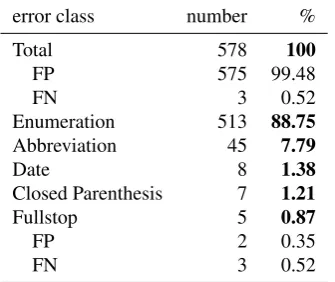
The NLTK sentence boundary detector (Kiss and Strunk, 2006) is an unsupervised tool that heavily relies on the detection of collocation expressions with a special focus on the detection of abbreviations. It reaches0.923F1 on
FRAMED. The error statistics can be found in Table 3. Most errors (more than 88%) are due to erroneous splits af-ter enumerations like ‘3.’, ‘D.’ etc. Only relatively few er-rors have their origin in a wrong split after abbreviations. This proliferation of enumeration errors may be a direct consequence of the principle of the sentence splitter to fo-cus on the identification of collocations. Enumerations do not, in general, follow such a pattern and are thus diffi-cult to handle. As an example for the disambiguation of a dot following a number consider an expression such as ‘12. Juni’ (‘12thof June’). The pattern described is ‘[num-ber]. [month]’. General enumerations do not follow such a collocation pattern but rather ‘[number]. [arbitrary word]’ which is clearly non-discriminative.
error class number %
Total 578 100
FP 575 99.48
FN 3 0.52
Enumeration 513 88.75
Abbreviation 45 7.79
Date 8 1.38
Closed Parenthesis 7 1.21
Fullstop 5 0.87
FP 2 0.35
FN 3 0.52
Table 3: Error statistics for NLTKsentence splitter. All er-rors are false positives (FP), unless indicated otherwise.
JCORE’s sentence splitter (Tomanek et al., 2007) is based on conditional random fields (CRF). It scores 0.994F1on
FRAMEDin a 10-fold cross-validation and thus shows the highest performance of sentence splitters in this compari-son. Error class statistics are shown in Table 4.
error class number %
Total 122 100.00
FP 64 66.39
FN 58 33.60
Abbreviation 83 68.03
FP 54 44.26
FN 29 23.77
Number followed by dot or colon 22 18.03
FP 10 8.20
FN 12 9.84
Colon in open parentheses (FN only) 17 13.93
Table 4: Error statistics for JCORE’s sentence splitter.
The main source of errors are abbreviations with 68%. The other major error class is built up by numbers followed by a dot or a colon, however with no particular tendency of the kind of numerical expression. Errors are a few enu-merations as well as date expressions. The third group of errors stems from splits not made after colons in expres-sions like ‘(links:’ or ‘(Lebergewicht:’. While there may be good reasons why the corpus specifies splits at these lo-cations, in practice sentence boundaries within non-closing parenthesis expressions should be very rare.
Overall, the three tools have their individual strengths and weaknesses concerning their performance on FRAMED. The OPENNLP sentence splitter has some problems with abbreviations, particularly the abbreviation ‘n.’ which oc-curs frequently within the corpus. JCORE’s splitter does not share this particular problem but errs similarly often on abbreviations despite having the best performance of all three tools. Here, the NLTKsentence detector makes the fewest errors but, on the other hand, does not handle enu-merations so well.
4.2.
Tokenizers
them or the main error class was rather well-defined. For tokenization, however, only a sample of the error types can be reviewed because of their diversity. For the two tokeniz-ers employed, namely from OPENNLP and from JCORE, samples of 50 errors each were chosen randomly.
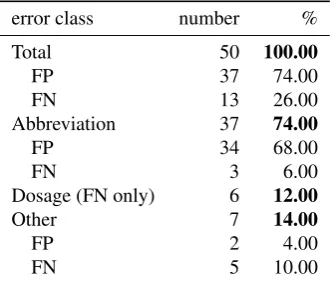
Most of the errors for the OPENNLP tokenizer depicted in Table 5 can be traced to abbreviations, with a remark-able percentage rate of 74%. Another source of errors is again a special feature of FRAMEDwhere expressions like ‘4x7mg’ appear regularly as dosage expressions (i.e. ‘four times 7mg’). An error in the Dosage class may mean that either before or after the multiplication character ‘x’ a tok-enization error occurred. This error happens on a frequent basis, however not always.
error class number %
Total 50 100.00
FP 37 74.00
FN 13 26.00
Abbreviation 37 74.00
FP 34 68.00
FN 3 6.00
Dosage (FN only) 6 12.00
Other 7 14.00
FP 2 4.00
FN 5 10.00
Table 5: Error statistics for the OPENNLP tokenizer based on a random error sample of size 50.
JCORE’s error statistics for tokenization is shown in Table 6 and much more diverse, as indicated by a percentage rate of 30% for the ’other’ error class. Those errors do not fol-low a particular pattern and consist of missing splits at full stops, commas and semicolons as well as additional splits at plus or percent characters. Most of the errors occur at the ‘x’ multiplication character, all of which are missing splits. Similarly to the OPENNLP tokenizer, this error oc-curs quite frequently, yet not always. As an extreme case, consider an expression like ‘18x7x4’ which is tokenized as ‘18x 7 x 4’ missing a single split in a longer sequence of necessary split decisions (‘18’ ‘x’ ‘7’ ‘x’ ‘4’).
Finally, the error class “x’ as prefix or suffix’ is unique to JCORE’s tokenizer in our experiments. It means that in words like ‘Appendix’ the trailing ‘x’ is mistakenly judged as a multiplication character and split off. This
er-error class number %
Total 50 100.00
Multiplication (FN only) 27 54.00
‘x’ as prefix or suffix (FP only) 5 10.00 Split of floating numbers (FP only) 3 6.00
Other 15 30.00
FP 9 18.00
FN 6 12.00
Table 6: Error statistics for the JCOREtokenizer based on a random error sample of size 50.
ror happens regularly, but not always. Furthermore, float-ing numbers, written with a comma in German texts (such as ‘16,7’), are mistakenly split in some cases.
4.3.
Part-of-Speech Taggers
Due to the large number of tags in a POS tagset (the standard German STTS tagset incorporates 54 elements (Schiller et al., 1999)), error analysis is not as easily car-ried out as for the sentence and token segmentation tasks. To carefully assess the behaviour of the two POS taggers— the OPENNLP POS tagger and the NLTK POS tagger— different perspectives are taken on the errors of each com-ponent ranging from very specific information to more and more generalized and aggregated analysis data.
First, the 20 most frequent errors are given where we fo-cus on the decision task which exact tag was expected and which tag was actually tagged instead. This view is very fine grained because we distinguish as single errors whether ADJD was tagged instead of VVPP and whether VVPP was tagged instead of ADJD. We call this viewasymmetric. In an alternativesymmetricerror scenario, we abstract away from these directional issues. In order to avoid an overly specific error discussion—the STTS-MEDtag set used for FRAMED consists of 57 tag elements—we, furthermore, map this original tag set to the coarser-grained 12-element universal tag set (Petrov et al., 2012).10 This way, errors involving the same general part of speech type, e.g. verbs or adjectives, can easier be distinguished from ones trans-gressing different POS class boundaries. Depending on the application such major category errors (classifying, e.g. a verb as an adjective) might be more critical than in-between category misclassifications (classifying, e.g. a finite verb as an infinitive).
The OPENNLP POS tagger made overall 3,064 errors in a 10-fold cross-validation on FRAMED. The asymmetric, fine-grained error statistics are displayed in Table 7. Most errors deal with the wrong classification of proper nouns (NE vs. NN). However, these errors only make up close to 6% of all errors. Misclassifications between verbs and adjectives are the second most important error class on the level of 4%.
An even more telling view on error types is provided by the symmetric error overview in Table 8. When direction is ignored the NN-NE error class falls to second rank behind errors involving VVPP and ADJD tags.
Data aggregation is further elevated when we map the spe-cific STTS-MEDtags to the universal tag set, as shown in Table 9 for the asymmetric case and in Table 10 for the symmetric case. Here it becomes even more apparent that lots of errors (16.94%) involve the incorrect classification of verbs into the wrong verbal form, followed by misclas-sification of adjectives into verbs and vice versa. Both are crucial for any form of relation extraction.
With 6,085 errors, the NLTKPOS tagger almost doubles the error rate of the OPENNLP POS tagger on the FRAMED corpus. The error statistics are organized in the same way
10
expected actual number %
Total 3,064 100
NE NN 183 5.97
ADJD VVPP 142 4.63
VVPP ADJD 116 3.79
VVINF VVFIN 112 3.66
ADJA NN 106 3.46
VVFIN VVINF 97 3.17
ADJD ADJA 96 3.13
PRELS ART 85 2.77
VVFIN VVPP 83 2.71
NNL NN 73 2.38
NN NE 65 2.12
ADJD NN 55 1.80
NN ADJA 54 1.76
VVFIN ADJA 54 1.76
TRUNC NN 47 1.53
REF ENUM 46 1.50
VVPP VVFIN 45 1.47
VVINF VVPP 44 1.44
ADV ADJD 43 1.40
ADJD ADV 41 1.34
Table 7: Asymmetric POS tag error statistics of OPENNLP POS tagger on the basis of the STTS-MEDtagset.
tag1 tag2 number %
Total 3,064 100
ADJD VVPP 258 8.42
NE NN 248 8.09
VVFIN VVINF 209 6.82
ADJA NN 160 5.22
VVFIN VVPP 128 4.18
ADJA ADJD 107 3.49
ART PRELS 103 3.36
ENUM REF 87 2.84
ADJD ADV 84 2.74
NN NNL 84 2.74
ADJA VVFIN 74 2.42
ADJD NN 74 2.42
ADJD VVFIN 73 2.38
VVINF VVPP 61 1.99
ADJA ADV 50 1.63
NN TRUNC 47 1.53
VAFIN VAINF 45 1.47
ADJA VVINF 40 1.31
PDAT PDS 39 1.27
APPR PTKZU 36 1.17
Table 8: Symmetric POS tag error statistics of OPENNLP POS tagger on the basis of the STTS-MEDtagset.
as above. Corresponding to the previous figures, the fine-grained asymmetric and symmetric errors are displayed in Tables 11 and 12, respectively. Error statistics derived from aggregations to the universal tag set are shown in Tables 13 and 14. Again, the classification into the wrong verbal form is a dominant error, however, misclassifications
be-expected actual number %
Total 3,064 100
VERB VERB 519 16.94
NOUN NOUN 333 10.87
VERB ADJ 272 8.88
ADJ VERB 211 6.89
ADJ NOUN 163 5.32
PRON DET 119 3.88
ADJ ADJ 107 3.49
PRON PRON 101 3.30
X NOUN 101 3.30
X X 90 2.94
NOUN ADJ 83 2.71
ADV ADJ 80 2.61
PRON ADJ 58 1.89
ADJ ADV 55 1.80
CONJ ADP 55 1.80
PRT ADP 55 1.80
VERB NOUN 43 1.40
X ADJ 36 1.17
PRON ADV 30 0.98
ADJ X 29 0.95
Table 9: Asymmetric POS tag error statistics of OPENNLP POS tagger on the basis of the universal tagset.
tag1 tag2 number %
Total 3,064 100
VERB VERB 519 16.94
ADJ VERB 483 15.76
NOUN NOUN 333 10.87
ADJ NOUN 246 8.03
DET PRON 138 4.50
ADJ ADV 135 4.41
ADJ ADJ 107 3.49
PRON PRON 101 3.30
NOUN X 97 3.17
X X 90 2.94
ADP PRT 84 2.74
ADJ PRON 67 2.19
ADJ X 65 2.12
ADP CONJ 63 2.06
NOUN VERB 53 1.73
ADV CONJ 43 1.40
ADJ ADP 39 1.27
ADV PRON 39 1.27
ADV NOUN 32 1.04
ADV ADP 29 0.95
Table 10: Symmetric POS tag error statistics of OPENNLP POS tagger on the basis of the universal tagset.
in-expected actual number %
Total 6,085 100
NN ADJA 391 6.42
ADJA NN 356 5.85
NE NN 252 4.14
ADJD VVPP 229 3.76
VVFIN VVPP 219 3.60
PTKVZ APPR 167 2.74
ADJD ADJA 145 2.38
VVPP VVFIN 131 2.15
VVFIN ADJA 130 2.14
ADV ADJA 117 1.92
ART PRELS 114 1.87
VVFIN VVINF 111 1.82
VVINF VVFIN 111 1.82
ADV ADJD 93 1.53
VVINF ADJA 88 1.45
NN NE 86 1.41
ADJD NN 85 1.40
VVPP ADJD 78 1.28
PIDAT ADJA 75 1.23
PIAT ADJA 73 1.20
Table 11: Asymmetric POS tag error statistics of NLTK POS tagger on the basis of the STTS-MEDtagset.
tag1 tag2 number %
Total 6,085 100
ADJA NN 747 12.27
VVFIN VVPP 350 5.75
NE NN 338 5.55
ADJD VVPP 307 5.04
VVFIN VVINF 222 3.65
ADJA VVFIN 195 3.20
APPR PTKVZ 190 3.12
ART PRELS 184 3.02
ADJA ADJD 155 2.55
ADJA ADV 140 2.30
ADJD ADV 136 2.23
ADJD NN 135 2.22
ADJA VVINF 118 1.94
ADJD VVFIN 114 1.87
APPR PTKZU 103 1.69
NN NNL 100 1.64
VVINF VVPP 87 1.43
ADV NN 86 1.41
VAFIN VAINF 81 1.33
ADJA VVPP 80 1.31
Table 12: Symmetric POS tag error statistics of NLTKPOS tagger on the basis of the STTS-MEDtagset.
volved in and the number of occurrences of these single tags. This way, the effects of mis-tagging are weighed against their distributional importance. This intuition is captured by the notion of thepercentaged tag error ratio defined as
expected actual number %
Total 6,085 100
VERB VERB 831 13.65
VERB ADJ 496 8.15
NOUN ADJ 486 7.99
ADJ NOUN 452 7.43
NOUN NOUN 452 7.43
ADJ VERB 424 6.97
PRON ADJ 305 5.01
PRT ADP 237 3.89
ADV ADJ 211 3.47
ADJ ADJ 155 2.55
VERB NOUN 152 2.50
X NOUN 121 1.99
DET PRON 114 1.87
PRON PRON 102 1.68
ADP PRT 97 1.59
PRON DET 94 1.54
PRON NOUN 79 1.30
ADP ADJ 77 1.27
X X 68 1.12
ADJ ADV 66 1.08
Table 13: Asymmetric POS tag error statistics of NLTK POS tagger on the basis of the universal tagset.
tag1 tag2 number %
Total 6,085 100
ADJ NOUN 938 15.41
ADJ VERB 920 15.12
VERB VERB 831 13.65
NOUN NOUN 452 7.43
ADP PRT 334 5.49
ADJ PRON 306 5.03
ADJ ADV 277 4.55
NOUN VERB 217 3.57
DET PRON 208 3.42
ADJ ADJ 155 2.55
PRON PRON 102 1.68
NOUN X 97 1.59
ADV NOUN 93 1.53
ADJ ADP 90 1.48
NOUN PRON 80 1.31
ADP CONJ 79 1.30
X X 68 1.12
ADJ X 58 0.95
ADV VERB 56 0.92
ADV CONJ 52 0.85
Table 14: Symmetric POS tag error statistics of NLTKPOS tagger on the basis of the universal tagset.
[tag error ratio]i:=
#tagging errors for tagi
#tagging decisions for tagi
×100
tag errors number error ratio
ADJD 395 4,039 9.78
VVFIN 307 2,659 11.55
ADJA 219 10,358 2.11
VVINF 215 801 26.84
VVPP 209 2,123 9.84
NE 199 1,184 16.81
NN 176 23,657 0.74
ADV 169 3,517 4.81
PRELS 88 524 16.79
NNL 79 457 17.29
APPR 68 7,965 0.85
PTKVZ 59 405 14.57
ENUM 57 866 6.58
XY 50 333 15.02
KON 46 3,119 1.47
VAFIN 39 2,565 1.52
PIDAT 37 296 12.50
PIAT 34 360 9.44
ART 29 10,418 0.28
CARD 26 2,189 1.19
KOUS 24 497 4.83
PPER 23 772 2.98
PROAV 18 324 5.56
VAINF 16 524 3.05
VMFIN 12 856 1.40
APPRART 6 1,582 0.38
$( 3 2,712 0.11
PRF 3 633 0.47
$, 1 3,848 0.03
PTKNEG 1 341 0.29
$. 0 7,560 0.00
Others 454 2,115 —
Table 15: Tag-wise error ratio of the OPENNLP POS tagger on the basis of the STTS-MEDtagset.
the error ratio for each tag. For reasons of compactness, we only depict tags with a total number of occurrences of 250 or higher. High error numbers, obviously, do not necessar-ily coincide with high error ratios. The third element of the list, ‘ADJA’, has more than 219 erroneous annotations, yet by the sheer number of decisions, this is hardly more than 2% of all tagging decisions for this tag item. So this error is almost negligible. Similar arguments can be brought for-ward for ‘NN’, ‘APPR’, etc. However, care must clearly be taken in the case of ‘VVFIN’, ‘VVINF’ or ‘NE’ whose ab-solute errors are in similar ranks to the previously discussed items but whose error ratios are exceeding 10%, which is a substantial proportion of errors.
Table 16 tells a similar story for the NLTKPOS tagger on the basis of the STTS-MED tagset. The highest absolute error numbers do little harm when compared with the error ratios for ‘NN’, ‘APPR’, ‘ART’, etc. However, ‘ADJD’, ‘VVFIN’, ‘NE’, etc. suffer from rather high error rates. Based on such considerations one might argue in favor or against one or the other language model depending on the requirements of the task to be solved. Still, such data help assess the potential value of the model under scrutiny.
tag errors number error ratio
NN 688 23,657 2.91
ADJD 629 4,039 15.57
VVFIN 575 2,659 21.62
ADJA 540 10,358 5.21
ADV 339 3,517 9.64
VVPP 330 2,123 15.54
NE 300 1,184 25.34
VVINF 300 801 37.45
PTKVZ 240 405 59.26
APPR 217 7,965 2.72
ART 128 10,418 1.23
PIDAT 109 296 36.82
NNL 100 457 21.88
PROAV 99 324 30.56
PIAT 96 360 26.67
KON 84 3,119 2.69
XY 81 333 24.32
PRELS 80 524 15.27
VMFIN 72 856 8.41
CARD 68 2,189 3.11
KOUS 68 497 13.68
VAINF 65 524 12.40
VAFIN 63 2,565 2.46
ENUM 56 866 6.47
PPER 39 772 5.05
APPRART 13 1,582 0.82
$( 2 2,712 0.07
PTKNEG 2 341 0.59
$, 1 3,848 0.03
PRF 1 633 0.16
$. 0 7,560 0.00
Others 688 2,115 —
Table 16: Tag-wise error ratio of NLTKPOS tagger on the basis of the STTS-MEDtagset.
5.
De-Compiling Models to Trace Raw Data
We here claim that the model-for-data paradigm might re-place the need for accessing sensitive raw data by the alter-native disclosure of language models incorporating the rel-evant regularities contained in the raw data. When dealing with such sensitive data, one must assure that the published models do not incorporate large continuous portions of the corpus such as complete sentences. This requirement is ab-solutely crucial when we distribute language models rather than the original confidential data. Yet, a large variety of ML algorithms actually store different data configuration sets directly taken or derived from the training data. Ac-cordingly, the process of de-identification of confidential data (for medical application, cf. e.g. Meystre et al. (2014)) is by no means not made obsolete by our solution. Indeed, all person names, dates and addresses in FRAMED have been altered to block recognizability of patients.
means of weighted feature functions where the specific fea-ture instances are derived from training data and weights are chosen to fit the model to the data. CRFs addition-ally create a state-transition-graph where the states corre-spond to the possible labels in the data, e.g. POS tags. The crucial part for both types of models are the feature func-tions. Those functions capture information about the actual data to base the classification decision on. One of the most important features for classifier performance is the lexical identity of a classification unit, for example in POS tag-ging. Thus, ME or CRF models can be used to generate an enumeration of token strings observed in the training data, resulting in a set of unigrams. Fortunately, for the use case at hand, no sequence data on the observation level (i.e. words) are stored in these models. Only a label tran-sition model for CRFs is available. Thus, the only direct information that can be derived about the original corpus is which words are included in it.
More critical given these concerns is the NLTK sentence detector which stores the set of identified abbreviations and collocations as a main part of the model. Thus, the most frequent bi-grams are stored as collocations within the sen-tence detector model. Numbers are masked by the expres-sion##number##for generalization purposes. The dis-closure of such collocation patterns should also not reveal any sensitive information.
While we judge the disclosed information about FRAMED to be generally uncritical, this discussion shows that caution must guide the decision which ML algorithms to use taking into account the de-compilation capabilities inherent to any of the models being used.
6.
Conclusion
We propose a new way to by-pass the restricted access to corpora containing sensitive, usually confidential, and thus often protected textual data. The solution we propose is based on the idea to distribute models computationally de-rived from such data, rather than the original, i.e. textual raw data. The models we generate are based on (train-able) software provided by well-known NLP portals such as OPENNLP or NLTK. In addition, we offer a version for our text analytics pipeline, JCORE, which is UIMAbased. As an example of access-restricted copora, we here deal with FRAMED, a textual language resource composed mainly of clinical documents. We currently make avail-able models for sentence and token segmentation, as well as POS tagging, yet plan to cover syntactic and semantic models in the future.
We claim that our approach bears a great potential for paving the way to or, at least, improving text analytics ca-pabilities in fields where access to raw corpus data is highly regulated, if not excluded. The free distribution of trained models (from our website) and the lack of distribution re-strictions, e.g. by appropriate GPL licenses, are additional organizational means to foster software reusability under heavily restricted conditions of corpus accessibility in sen-sitive, often strictly confidential domains.
Still an open legal issue our work might raise is how “derivative” models are relative to the raw data. The no-tion of derivability is key for licensing categories
formu-lated, e.g. under the Creative Commons (CC) framework, relating, in particular to the CC-ND (no derivative use) cat-egory. Such concerns are crucial, e.g. for processing lots of social media data (Facebook, Twitter, etc.) the majority of which are, e.g. under the CC-ND constraint.
7.
References
Bird, S., Klein, E., and Loper, E. (2009). Natural Lan-guage Processing with Python: Analyzing Text with the Natural Language Toolkit. O’Reilly, Sebastopol, CA. Chapman, W. W., Hillert, D., Velupillai, S., and et al.
(2013). Extending the NEGEXlexicon for multiple lan-guages. In MedInfo 2013 – 14th World Congress on Medical and Health Informatics, pages 677–681. Claerhout, B. and De Moor, G. J. E. (2005). Privacy
pro-tection for clinical and genomic data: The use of privacy-enhancing techniques in medicine. Journal of Medical Informatics, 74:257–265.
Damschroder, L. J., Pritts, J. L., Neblo, M. A., andet al. (2007). Patients, privacy and trust: Patients’ willingness to allow researchers to access their medical records. So-cial Science & Medicine, 64(1):223–235.
Hahn, U., Buyko, E., Landefeld, R., and et al. (2008). An overview of JCORE, the JULIE Lab UIMA compo-nent repository. In Towards Enhanced Interoperability for Large HLT Systems: UIMA for NLP Workshop @ LREC’08, pages 1–7.
Kiss, T. and Strunk, J. (2006). Unsupervised multilingual sentence boundary detection. Computational Linguis-tics, 32(4):485–525.
Meystre, S. M., Ferr´andez, O., Friedlin, F. J., and et al. (2014). Text de-identification for privacy protection: A study of its impact on clinical text information content. Journal of Biomedical Informatics.
Petrov, S., Das, D., and McDonald, R. (2012). A univer-sal part-of-speech tagset. In LREC ’12 – 8th Interna-tional Conference on Language Resources and Evalua-tion, pages 2089–2096.
Schiller, A., Teufel, S., St¨ockert, C., and Thielen, C. (1999). Guidelines f¨ur das Tagging deutscher Textcor-pora mit STTS (Kleines und großes Tagset). Technical report, Inst. f¨ur masch. Sprachverarbeitung, U. Stuttgart; Seminar f¨ur Sprachwissenschaft, U. T¨ubingen.
Smallwood, R. F. (2012). Safeguarding Critical E-Documents. Implementing a Program for Securing Con-fidential Information Assets. John Wiley, Hoboken/NJ. Tomanek, K., Wermter, J., and Hahn, U. (2007). Sentence
and token splitting based on conditional random fields. InPACLING ’07 – 10th Conference of the Pacific Asso-ciation for Computational Linguistics, pages 49–57. Vetulani, Z. (2012). Language resources in a public
secu-rity application with text understanding competence. A case study: POLINT-112-SMS. InLanguage Resources for Public Security Applications Workshop @ LREC ’12, pages 54–63.