Proceedings of Recent Advances in Natural Language Processing, pages 701–706,
Pyramid-based Summary Evaluation
Using Abstract Meaning Representation
Josef Steinberger1,2,Peter Krejzl2, andTom´aˇs Brychc´ın1,21NTIS – New Technologies for the Information Society,
Faculty of Applied Sciences, University of West Bohemia, Czech Republic 2Department of Computer Science and Engineering,
Faculty of Applied Sciences, University of West Bohemia, Czech Republic
{jstein,krejzl,brychcin}@kiv.zcu.cz
Abstract
We propose a novel metric for evaluating summary content coverage. The evalua-tion framework follows the Pyramid ap-proach to measure how many summariza-tion content units, considered important by human annotators, are contained in an au-tomatic summary. Our approach automa-tizes the evaluation process, which does not need any manual intervention on the eval-uated summary side. Our approach com-pares abstract meaning representations of each content unit mention and each sum-mary sentence. We found that the proposed metric complements well the widely-used ROUGE metrics.
1 Introduction
Evaluating the quality of automatic summaries is a known problem, which has attracted many com-putational linguists. Summary quality has differ-ent aspects, mainly the readability and the contdiffer-ent coverage. Readability scores the summary by its grammaticality, non-redundancy, referential clar-ity, focus, structure or coherence. For many use cases (e.g. skimming through a summary of related news articles), content coverage decides whether the summary is useful or not.
The Pyramid method (Nenkova et al.,2007) is a well-designed framework for measuring content coverage. It computes how many summarization content units (SCUs) are shared between model summaries and the target system summary. The matching cannot be done on the lexical level, be-cause the same information is often expressed in different words. In the past DUC/TAC1challenges
1Document Understanding Conference (DUC), followed by Text Analysis Conference (TAC), was a series of summa-rization shared tasks initiated by NIST (Over et al.,2007).
the matching was done by humans. Although the participants received a precise feedback on their summaries, it was not possible to evaluate a new set of summaries after the evaluation exercise.
There has been many approaches to perform a fully automatic evaluation, including the most widely used ROUGE (Lin,2004). Although they can rank the systems well enough on the whole corpus, their correlation with human judgements on the summary level is limited.
Abstract meaning representation (AMR) was in-troduced byBanarescu et al.(2013). AMR is in-tended to abstract meaning away from syntax. Sen-tences, which are similar in meaning should be assigned the same AMR, even if they are not identi-cally written. The abstractive ability makes it very suitable for summarization, already shown byLiu et al.(2015). And as the pyramid matching requires dealing with paraphrases, it led us to the idea to use AMR for automatic pyramid evaluation.
Next, we discuss the past summarization shared tasks and evaluation metrics. An overview of the AMR format, a state-of-the-art parser, and an AMR graph similarity metric are described in Section
3. In Section 4, we define a novel metric, de-noted as APE2. We evaluate the metric and
com-pare/combine it with other metrics in Section5.
2 Related Work
The most widely used automatic content evaluation metric is ROUGE (Lin and Hovy,2003;Lin,2004). It measures the word n-gram overlap between eval-uated summary (peer) and the reference summaries (models, ideally written by humans). DUC/TAC evaluations showed that ROUGE correlates well with human judgements when scores of each peer are averaged over all topics of a corpus (Pearson’s r is greater than .9).On the other hand, when
as-2APE denotes usingAMR forPyramid-basedEvaluation.
sessing individual summaries, correlation drops to ∼.6).ROUGE-2 (bigrams) and ROUGE-SU4 (bi-grams with skip distance up to 4 words) correlated best on most of the corpora. Basic Elements (Hovy et al.,2005;Tratz and Hovy,2008) were designed to address the problem of variable-size of seman-tic units by scoring syntacseman-tically coherent units. Head-modifier (BE-HM) pairs performed the best. In the first DUC conferences, only a manual scale-based evaluation method was used. Later, it was complemented by the Pyramid method. The pyramid approach involves two tasks. First, human annotators identify SCUs, sets of text fragments that express the same basic content, in model sum-maries and create a pyramid (SCUs are weighted according to the number of models, in which they appear). Second, they evaluate a new summary against the pyramid. Thepyramid scoreis com-puted by the total weight of all SCUs present in the candidate divided by the total SCU weight possi-ble for an average-length summary (Nenkova et al.,
2007). Although, creating a pyramid automatically would be useful for creating a new evaluation cor-pora, having an automated scoring of a new sum-mary against a human-produced pyramid would make the method far more useful for developers. They would use a standard corpus and evaluate different versions of summarizers.
Several approaches for automating the pyramid scoring has been proposed. Harnly et al. (2005) tested several similarity metrics for matching SCUs against summaries and achieved the best results with unigram overlaps and single-linkage cluster-ing. Passonneau et al.(2013) added two semantic similarities: a string comparison and a distribu-tional semantics method, which performed better.
Emulating the pyramid method was one of the goals of the past TAC AESOP tasks in 2009 (Dang and Owczarzak,2009), 2010 (Owczarzak and Dang,2010), and 2011 (Owczarzak and Dang,
2011;Owczarzak et al.,2012). In 2009, several sub-missions achieved high correlations on the summa-rizer level. In 2010, ROUGE metrics were ranked very high, again based on summarizer-level correla-tions. In 2011, summary-level correlations revealed a room for improvement as the best Pearson corre-lation was .752 (Giannakopoulos and Karkaletsis,
2011), followed by ROUGE-SU4 (.736). Many models have been already proposed for the pyramid matching (Harnly et al.,2005;Passonneau et al.,
2013), but the use of semantic relations between
the sentence units has not been discussed yet.
3 Abstract Meaning Representation
Graph-structured semantic representations enable a direct semantic analysis of sentences.Banarescu et al.(2013) started annotating the logical meaning of sentences into AMR. In a nutshell, AMR graph is a rooted, labeled, directed acyclic graph, com-prising a sentence. It is intended to abstract away from syntax and incorporates semantic roles, coref-erence, questions, modality, negation, and further linguistic phenomena3.
Formally, we define a set of all possible triples:
T =
(r, n1, n2) rn1==relation typevariable n2=variable or concept
(1)
AMR is then a subset ofT:A⊆T.
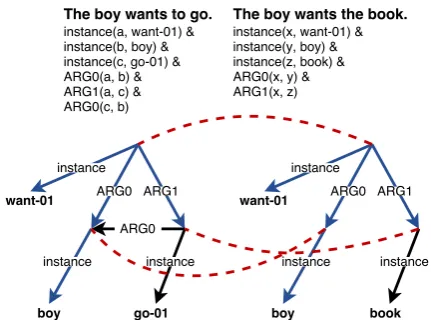
An example sentence, logical triples and corre-sponding AMR graph is illustrated in Figure1(left part). AMR introduces variables (graph nodes) for entities, events, properties, and states. Each node in the graph represents a semantic concept. These concepts can either be English words (boy), Prop-Bank framesets (want-01) (Palmer et al.,2005), or special keywords. Theinstance relation assigns to each concept a variable which can be reused in other triples. Edge labels denote the relations that hold between entities (e.g.ARG-0relation be-tweenwant-01and boy). The AMR triples take one of these forms:relation(variable,concept) or
relation(variable1,variable2).
Figure 1: AMR trees and semantic matching.
Flanigan et al. (2014) introduced the first ap-proach to parse sentences into AMR, which
quires algorithms for alignment, structured predic-tion, and statistical learning (JAMR4). In order to
automatically parse English into AMR, JAMR em-ploys a two-part algorithm. First, it identifies the key concepts using a semi-Markov model. Second, it identifies the relations between the concepts by searching for the maximum spanning, connected subgraph, a similar approach to maximum span-ning tree described inMcDonald et al.(2005).
Cai and Knight (2013) introduced semantic match (Smatch), a metric that calculates the degree of overlap between two semantic feature structures. It first computes the maximum number of match-ing triples among all possible variable mappmatch-ings. To obtain the best variable mapping, Smatch exe-cutes a brief search which uses integer linear pro-gramming and a hill climbing method (described byCai and Knight(2013)). We define a function (mmt) which takes two AMRs, finds the optimal variable mapping, and returns the maximum num-ber of matching triples:
mmt :T×T →Z+ (2)
Given the maximum number of matching triples, we can compute precision, recall, and F1 score, which is the Smatch score.
For our example (Figure1), the highest scoring variable alignment is ifa = x, b = y and c = z. The blue-arrow relations are matched (4), the black-arrow relations are not matched (2 left, 1 right). Thus recall is4/6, precision is4/5. and the resulting Smatch score is .73.
4 APE – AMR-based Pyramid Evaluation
The aim is to measure how many SCUs identified by humans in a set of model summaries are con-tained in the target (evaluated) peer summary. As-sume we have a sequence ofCSCUsc={ci}Ci=1.
Their weights (λi) are based on the number of
models, in which they were mentioned. Each SCU is described by a sequence of its mentions
ci ={dj}Dj=1i , whereDiis the number of models,
in which SCUciis mentioned. Model summaries
contain a sequence ofM sentencesm={mi}Mi=1,
and the peer summary is a sequence ofP sentences
p={pi}Pi=1.
Every sentence from all models and from the peer is parsed by an AMR parser, resulting in a sequence of AMR trees. Ami ⊆ T is the set of
AMR triples of sentencemi, similarlyApi ⊆T is 4Available at http://github.com/jflanigan/jamr.
the set of AMR triples of sentence pi. As each
SCU mention dj is a part of a model sentence mi,Adj contains only those triples ofAmi whose
constituents are contained in the SCU mention:
Adj ⊆ Ami. These represent the “gold triples”,
which are searched in the peer summary sentences. For each sentence in the peer summary, we get the corresponding AMR tree and match its triples against the gold ones. The Smatch variable map-ping is used for getting a common set of triples (function mmt, see Equation 2). If there is a sentence that contains a larger percentage of gold triples than a threshold (τ), the SCU is considered covered by the peer summary. Note that compared to the Smatch score, which calculates the F1 score, APE is a recall measure. The pyramid score is then computed the same way as discussed in Section2: the total weight of all SCUs present in the candidate (wp) divided by the total SCU weight possible for
an average-length summary (wideal) (Nenkova and Passonneau,2004). The APE algorithm5follows:
Algorithm 1APE: computes the pyramid score for a given peer summary (p) and SCUs (c). wideal
acts as a normalization factor. functionAPE(p,c)
wp←0
for all1≤i≤Cdo matched←false
d←ci
for all1≤j≤Dido for all1≤k≤Pdo
ifmmt(Adj,Apk)/
Adj
> τthen
wp←wp+λi
matched←true break
ifmatchedthenbreak returnwp/wideal
5 Results and Discussion
We selected TAC’09 corpus for evaluation, because 2009 was the last time DUC/TAC contained a gen-eral summarization task6. The corpus contains 44
topics. For each topic, there are 4 model sum-maries and the manually created pyramid. 55 par-ticipating systems were ranked according to the manual Pyramid scores, producing a gold ranking of the systems for each topic. Overall, there are
5Altough the complexity of the algorithm is quite large, the runtime was not an issue in our experiments.
44×55 = 2420evaluation scores. An automatic evaluation metric runs2420 evaluations as well, and we can study its correlation with the manual pyramid score (theper-summaryscenario). The other option is to calculate an average score for each system and look at the correlation of the av-erages (55 scores): theper-systemscenario. The TAC’09 AESOP task concluded that on the system level, the correlation is sufficient (the best Pear-son’s r was .978, ROUGE-SU4: .921), but the metrics are much worse on the summary level.
ROUGE-SU47and BE-HM were taken as
base-lines. We report three types of correlations. Pear-son’s tests the strength of a linear dependency be-tween the two sequences. Spearman rank correla-tion is preferable for ordinal comparisons, absolute values are less relevant. Kendall’s tau is less sensi-tive to outliers. Results are in Table1.
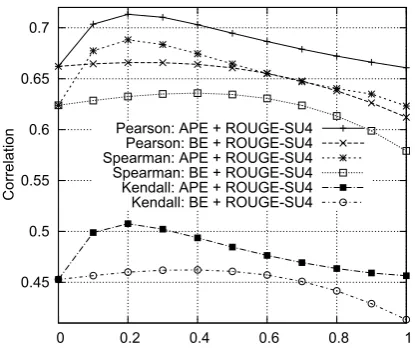
We can observe that ROUGE-SU4 correlates bet-ter than BE-HM and about the same as APE (.66 Pearson, .62 Spearman, .45 Kendall). These num-bers do not show whether the information added by APE’s relations improves the summary evaluation. However, if we combine APE and ROUGE-SU4 by a linear combination (α×APE+ (1−α)×
ROUGE-SU4), we see a significant improvement. In the case of a “blind combination” (i.e. without looking at the test data,α =.5), we notice an ab-solute improvement of 3.7% in Pearson, 4.0% in Spearman, and 3.2% in Kendall. In the case of the optimalα = .2, a lower weight of the AMR relations, we see an improvement of 5.1% in Pear-son, 6.4% in Spearman, and 5.5% in Kendall. The improvement is much larger than if BE-HM is com-bined with ROUGE-SU4. Combining all the three metrics yields only a marginal improvement. Fig-ure2shows how the correlation depends onα.
We also noticed a large correlation between the gold number of SCUs (annotated in peers) and APE’s number of SCUs: Pearson’srwas .769. This further shows the positive effect of AMR relations.
The optimal setting forτ was .75, we tested all levels ofτwith step .05. This means that 3/4 of the triples has to match between an SCU mention and a peer sentence to consider the SCU captured.
We further studied how different relation types affect the metric. The JAMR parser found 57 rela-tion types. 51 relarela-tion types affected the correla-tion positively. These included verb arguments,
7ROUGE-SU4 was selected to represent the ROUGE fam-ily because it correlated best in the TAC AESOP experiments.
Metric α Pearson Spearman Kendall
ROUGE-SU4 .662 .624 .453 BE-HM .612 .579 .413 APE .661 .623 .456 APE+ROUGE-SU4 .2 .713 .688 .508 APE+ROUGE-SU4 .5 .695 .664 .485 BE-HM+ROUGE-SU4 .2 .666 .633 .460 BE-HM+ROUGE-SU4 .5 .661 .634 .461
Table 1: Correlations of the evaluation metrics with the manual pyramid score. Except for ROUGE-SU4 vs. APE, all differences are statistically sig-nificant with p-value=.01 measured by t-test and Fisher’s transformation.
0.45 0.5 0.55 0.6 0.65 0.7
0 0.2 0.4 0.6 0.8 1
Correlation
α
Pearson:BAPEB+BROUGE-SU4 Pearson:BBEB+BROUGE-SU4 Spearman:BAPEB+BROUGE-SU4 Spearman:BBEB+BROUGE-SU4 Kendall:BAPEB+BROUGE-SU4 Kendall:BBEB+BROUGE-SU4
Figure 2: Linear combination of the metrics com-pared with human scores.
operands8 (relations linking entity name parts),
number-based relations (e.g.unit), time-based (e.g. date parts), prepositions, and most of the semantic relations, including thepolarity. Six relation types had a negative effect. Thenamerelation probably boosted the weight of the named entities too much. Syntactically oriented relations (e.g.mod) do not seem to be useful.
6 Conclusion
We showed that semantic relations among sentence items can improve the current summarization eval-uation metrics. The approach is very sensitive to the quality of the AMR parser. It is expected to improve when AMR parsing advances. Our future work includes experiments with the latest findings in AMR parsing, e.g.Wang et al.(2015);Damonte et al.(2016). There has been made much progress on the Semantic Textual Similarity (STS) shared task in recent years (Agirre et al.,2016). We plan
to incorporate the metrics to further boost the eval-uation performance. We found optimal settings of the parameters (τ andα), however, we need to investigate whether it generalizes across all sum-marization domains. As SCUs need to be manu-ally created before performing summary evaluation, our final future work includes finding a way to use AMR to extract SCUs from model summaries and create the pyramid.
Acknowledgements
This publication was supported by the project LO1506 of the Czech Ministry of Education, Youth and Sports under the program NPU I., by Grant No. SGS-2016-018 Data and Software Engineering for Advanced Applications and by project MediaGist, EUs FP7 People Programme (Marie Curie Actions), no. 630786.
References
Eneko Agirre, Carmen Banea, Daniel Cer, Mona Diab, Aitor Gonzalez-Agirre, Rada Mihalcea, German Rigau, and Janyce Wiebe. 2016. Semeval-2016 task 1: Semantic textual similarity, monolingual and cross-lingual evaluation. In Proceedings of the 10th International Workshop on Semantic Eval-uation (SemEval-2016). Association for Computa-tional Linguistics, San Diego, California, pages 497– 511. http://www.aclweb.org/anthology/S16-1081.
Laura Banarescu, Claire Bonial, Shu Cai, Madalina Georgescu, Kira Griffitt, Ulf Hermjakob, Kevin Knight, Philipp Koehn, Martha Palmer, and Nathan Schneider. 2013. Abstract meaning representa-tion for sembanking. In Proceedings of the 7th Linguistic Annotation Workshop and Interoper-ability with Discourse. Association for Computa-tional Linguistics, Sofia, Bulgaria, pages 178–186. http://www.aclweb.org/anthology/W13-2322.
Shu Cai and Kevin Knight. 2013. Smatch: an evaluation metric for semantic feature structures. In Proceedings of the 51st Annual Meeting of the Association for Computational Linguistics (Vol-ume 2: Short Papers). Association for Computa-tional Linguistics, Sofia, Bulgaria, pages 748–752. http://www.aclweb.org/anthology/P13-2131.
John M. Conroy, Judith D. Schlesinger, and Dianne P. O’Leary. 2011. Nouveau-rouge: A novelty metric for update summarization. Computational Linguis-tics37:1–8.
Marco Damonte, Shay B. Cohen, and Giorgio Satta. 2016. An incremental parser for abstract mean-ing representation. arXiv preprint at arXiv:1608 .06111.
Hoa T. Dang and Karolina Owczarzak. 2009. Overview of the tac 2009 summarization track. In National Institute of Standards and Technology, editors, Proceedings of Text Analysis Conference (TAC-09). Gaithersburg, MD.
Jeffrey Flanigan, Sam Thomson, Jaime Carbonell, Chris Dyer, and Noah A. Smith. 2014. A discriminative graph-based parser for the ab-stract meaning representation. In Proceedings of the 52nd Annual Meeting of the Associa-tion for ComputaAssocia-tional Linguistics (Volume 1: Long Papers). Association for Computational Lin-guistics, Baltimore, Maryland, pages 1426–1436. http://www.aclweb.org/anthology/P14-1134. George Giannakopoulos and Vangelis Karkaletsis.
2011. Autosummeng and memog in evaluating guided summaries. In National Institute of Stan-dards and Technology, editors, Proceedings of Text Analysis Conference (TAC-11). Gaithersburg, MD. Aaron Harnly, , Ani Nenkova, Rebecca Passonneau,
and Owen Rambow. 2005. Automation of sum-mary evaluation by the pyramid method. In Pro-ceedings of the International Conference on Recent Advances in Natural Language Processing (RANLP 2005). Borovets, Bulgaria.
Eduard Hovy, Chin-Yew Lin, and Liang Zhou. 2005. Evaluating duc 2005 using basic elements. In Pro-ceedings of the Fifth Document Understanding Con-ference (DUC). Vancouver, Canada.
Chin-Yew Lin. 2004. ROUGE: a package for auto-matic evaluation of summaries. InProceedings of the Workshop on Text Summarization Branches Out. Barcelona, Spain.
Chin-Yew Lin and Eduard Hovy. 2003. Auto-matic evaluation of summaries using n-gram co-occurrence statistics. In Proceedings of HLT-NAACL. Edmonton, Canada.
Fei Liu, Jeffrey Flanigan, Sam Thomson, Norman Sadeh, and Noah A. Smith. 2015. Abstract meaning representation for sembanking. In Proceedings of the 2015 Annual Conference of the North American Chapter of the ACL. Association for Computational Linguistics, Denver, Colorado, page 10771086. Ryan McDonald, Fernando Pereira, Kiril Ribarov,
and Jan Hajic. 2005. Non-projective depen-dency parsing using spanning tree algorithms. In Proceedings of Human Language Technol-ogy Conference and Conference on Empirical Methods in Natural Language Processing. As-sociation for Computational Linguistics, Van-couver, British Columbia, Canada, pages 523– 530. http://www.aclweb.org/anthology/H/H05/H05-1066.
North American Chapter of the Association for Com-putational Linguistics (NAACL).
Ani Nenkova, Rebecca Passonneau, and Kathleen McKeown. 2007. The pyramid method: incorporat-ing human content selection variation in summariza-tion evaluasummariza-tion. ACM Transactions on Speech and Language Processing4(2).
Paul Over, Hoa Dang, and Donna Harman. 2007. DUC in context. Information Processing and Manage-ment43(6):1506–1520. Special Issue on Text Sum-marisation (Donna Harman, ed.).
Karolina Owczarzak, John M. Conroy, Hoa Trang Dang, and Ani Nenkova. 2012. An assessment of the accuracy of automatic evaluation in sum-marization. In Proceedings of Workshop on Eval-uation Metrics and System Comparison for Au-tomatic Summarization. Association for Computa-tional Linguistics, Montr´eal, Canada, pages 1–9. http://www.aclweb.org/anthology/W12-2601. Karolina Owczarzak and Hoa T. Dang. 2010.
Overview of the tac 2010 summarization track. In National Institute of Standards and Technology, editors, Proceedings of Text Analysis Conference (TAC-10). Gaithersburg, MD.
Karolina Owczarzak and Hoa T. Dang. 2011. Overview of the tac 2011 summarization track: Guided task and aesop task. In National Institute of Standards and Technology, editors, Proceed-ings of the Text Analysis Conference (TAC-11). Gaithersburg, MD.
Martha Palmer, Paul Kingsbury, and Daniel Gildea. 2005. The proposition bank: An annotated cor-pus of semantic roles. Computational Linguistics 31(1):71–106.
Rebecca J. Passonneau, Emily Chen, Weiwei Guo, and Dolores Perin. 2013. Automated pyramid scoring of summaries using distributional semantics. In Pro-ceedings of the 51st Annual Meeting of the Asso-ciation for Computational Linguistics. Association for Computational Linguistics, Sofia, Bulgaria, page 143147.
Stephen Tratz and Eduard Hovy. 2008. Summarization evaluation using transformed basic elements. In Na-tional Institute of Standards and Technology, editors, Proceedings of Text Analysis Conference (TAC-08). Gaithersburg, MD.