Fully Automated Analysis of Padding-Based Encryption
in the Computational Model
Gilles Barthe, Juan Manuel Crespo, C´esar Kunz, Benedikt Schmidt∗ Benjamin Gr´egoire† Yassine Lakhnech‡ Santiago Zanella-B´eguelin§
June 2013
Abstract
Computer-aided verification provides effective means of analyzing the security of cryptographic prim-itives. However, it has remained a challenge to achieve fully automated analyses yielding guarantees that hold against computational (rather than symbolic) attacks. This paper meets this challenge for public-key encryption schemes built from trapdoor permutations and hash functions. Using a novel combination of techniques from computational and symbolic cryptography, we present proof systems for analyzing the chosen-plaintext and chosen-ciphertext security of such schemes in the random oracle model. Building on these proof systems, we develop a toolset that bundles together fully automated proof and attack finding algorithms. We use this toolset to build a comprehensive database of encryption schemes that records attacks against insecure schemes, and proofs with concrete bounds for secure ones.
Keywords: Attack finding, automated proofs, provable security, public-key encryption, static equiva-lence.
∗IMDEA Software Institute, Spain.
E-mail: {gilles.barthe,benedikt.schmidt,juanmanuel.crespo,cesar.kunz}@imdea.org
†
INRIA Sophia Antipolis – M´editerran´ee, France. E-mail: [email protected]
‡Universit´e de Grenoble, VERIMAG, France. E-mail:
§Microsoft Research, UK. E-mail:
Contents
1 Introduction 3
2 Cryptographic Background 4
2.1 Padding-Based Public-Key Encryption . . . 4
2.2 Security of Padding-Based Encryption Schemes . . . 5
3 Symbolic Tools 7 3.1 Syntax and Semantics of Expressions . . . 7
3.2 Equality and Deducibility . . . 7
3.3 Inequality and Static Distinguishability . . . 8
4 Proof Systems 9 4.1 Chosen-Plaintext Security . . . 9
4.2 Chosen-Ciphertext Security . . . 11
4.3 Concrete Bounds . . . 13
4.4 Soundness . . . 14
4.5 Examples . . . 14
4.5.1 OAEP . . . 15
4.5.2 PSS-E . . . 16
5 Attacks 19 5.1 Universal Attacks . . . 20
5.2 Existential Attacks . . . 20
6 Experimental Validation 21 6.1 Security Analysis . . . 21
6.2 Practical Interpretation for RSA . . . 22
6.3 Generation of Encryption Schemes . . . 23
6.4 Experiments . . . 23
7 Related Work 25 8 Conclusion 25 A Definitions and Proofs 29 A.1 Algebraic Expressions as Programs . . . 29
A.2 Soundness of Deducibility and Apartness . . . 32
A.3 Soundness of CPA logic . . . 33
A.4 Soundness of CCA logic . . . 40
1
Introduction
Two different models for analyzing the security of cryptographic constructions have developed over the years and coexist until today, each with its own advantages and disadvantages: the computational model and the symbolic model.
The computational model has its roots in the work of Goldwasser and Micali [22] and views cryp-tographic primitives as functions on bitstrings. Adversaries are modeled as probabilistic algorithms and security is defined in terms of their success probability and computational resources. Security proofs are reductions, showing how a successful attack can be converted into an efficient algorithm that breaks the security of primitives. Often, computational proofs quantify the efficiency of reductions, giving concrete
security bounds.
The symbolic model, which originates from the seminal work of Dolev and Yao [20], views cryptographic primitives as function symbols in a term algebra of expressions. The properties of primitives and the capabilities of adversaries are modeled using equational theories. This model enables automated analysis, but can miss attacks that are possible in the computational model.
A celebrated article by Abadi and Rogaway [2] bridges the gap between the two models: it gives sufficient conditions under which symbolic security implies computational security; symbolic methods that exhibit this property are called cryptographically sound. This result, originally proved for symmetric encryption, has since been extended to richer theories [18]. Cryptographic soundness opens the perspective of combining the best of both worlds: fully automated proofs of computational security. However, its applications have remained confined to protocols. Developing cryptographically sound symbolic methods for primitives remains a challenge.
A recent alternative to cryptographically sound symbolic methods uses programming language tech-niques for reasoning about the security of cryptographic constructions directly in the computational model. This alternative is embodied in tools likeCryptoVerif [13] and EasyCrypt [5], which have been used to ver-ify emblematic cryptographic constructions. Proofs built using these tools yield reductions with concrete security bounds. However, these tools are primarily interactive and their use requires expert knowledge. Combining them with fully automated methods that apply to large classes of cryptographic primitives has remained an open problem.
A converse goal to proving security is finding attacks. Recent work [3] explores the use of symbolic methods to find attacks and estimate their success probability. Automating attack finding can provide valuable feedback during cryptographic design and be used to evaluate empirically the completeness of automated security analyses by answering questions such as how many constructions that may be secure cannot be proven so.
Contributions We present new methods for automatically analyzing the security of padding-based en-cryption schemes, i.e. public-key enen-cryption schemes built from hash functions and trapdoor permutations, such asOAEP[12],OAEP+ [30],SAEP[15], orPSS-E[17]. These methods rest on two main technical con-tributions.
First, we introduce specialized logics for proving chosen-plaintext and chosen-ciphertext security. Proof rules have a symbolic flavor and proof search can be automated, yet one can extract concrete security bounds from valid derivations. This is achieved through a novel combination of symbolic and computational methods; for instance, the logics use symbolic deducibility relations for computing bounds of the probability of events, and for checking the existence of reductions to computational assumptions.
chosen-ciphertext security. Our methods are inspired by static equivalence [1], and exploit algebraic properties of trapdoor permutations to find attacks against realizations of schemes that are consistent with computa-tional assumptions.
We demonstrate the strengths of our methods by implementing a toolset, called ZooCrypt, and by evaluating it extensively. The toolset can be used either in batch mode or in interactive mode:
• The batch mode allows to take a census of padding-based encryption schemes. We used it to build a database of more than one million entries. The database records for each scheme and set of assumptions, either an adversary that breaks the security of the scheme or a formal derivation that proves its security.
• The interactive mode allows to build proofs or attacks for a selected scheme, and forms the backbone of a cryptographic tutor. The tutor guides users in building security proofs or exhibiting attacks for a scheme chosen by the user or selected from the database. In proof mode, the tutor provides the user with the set of applicable rules at each step of the derivation; upon completion of the derivation, the tutor outputs alternative derivations that deliver better bounds.
We stress that we focus on padding-based encryption primarily for illustrative purposes. Padding-based schemes include many practically relevant constructions, and provide an excellent testbed to evaluate the effectiveness of our methods and illustrate their working. However, our methods are applicable to other settings; see§ 8 for a discussion.
Contents § 2 provides background on public-key encryption schemes and their security; § 3 introduces symbolic tools that are the base of our analyses; § 4 describes logics for plaintext and chosen-ciphertext security, while§5 covers attack finding techniques;§6 reports on the implementation ofZooCrypt
and on its evaluation. We conclude with a survey of related work and directions for future work.
Supplemental material, including a web interface for browsing results and a preliminary version of a proof tutor, is available at
http://easycrypt.info/zoocrypt/
2
Cryptographic Background
This section provides some background on padding-based public-key encryption schemes and their security.
2.1 Padding-Based Public-Key Encryption
A public-key encryption scheme is a triple of probabilistic algorithms (KG,E,D):
Key Generation The key generation algorithm KG outputs a pair of keys (pk, sk); pk is a public-key
used for encryption,sk is a secret-key used for decryption;
Encryption Given a public-key pkand a message m,Epk(m) outputs a ciphertext c;
Decryption Given a secret-keyskand a ciphertextc,Dsk(c) outputs either messagemor a distinguished
We require that for pairs of keys (pk, sk) generated byKG,Dsk(Epk(m)) =m holds for any message m.
We study public-key encryption schemes built from trapdoor permutations, hash functions and basic bitstring operations, such as bitwise exclusive-or (⊕), concatenation (k) and projection. We let {0,1}n
denote the set of bitstrings of length n and [x]ℓ
n the bitstring obtained from x by dropping its n most
significant bits and taking theℓmost significant bits of the result.
Trapdoor permutations are functions that are easy to evaluate, but hard to invert without knowing a secret trapdoor. Formally, a family of trapdoor permutations on{0,1}nis a triple of algorithms (KG, f, f−1) such that for any pair of keys (pk, sk) output byKG,fpk andfsk−1 are permutations on{0,1}n and inverse
of each other. The security of a family of trapdoor permutations is measured by the probability that an adversary (partially) invertsf on a random input.
Definition 1 (One-Way Trapdoor Permutation). Let Θ = (KG, f, f−1) be a family of trapdoor permuta-tions on {0,1}n and let k, ℓ be such that k+ℓ≤n. The probability of an algorithm I in q-inverting Θon
bits [k+ 1. . . k+ℓ]is
Succs-pd-OWΘ (k, ℓ, q,I) def
= Pr
h
OWℓk : [s]ℓk ∈S∧ |S| ≤qi
where OWℓk is the experiment:
(pk, sk)← KG;s← {$ 0,1}n;S ← I(f
pk(s), pk)
This definition generalizes the set partial-domain one-wayness problem of Fujisaki et al. [21], which corresponds to the casek= 0. We defineSuccs-pd-OWΘ (k, ℓ, q, t) as the maximal success probability over all inverters executing in time t, and omit the first parameter when it is 0. When k = 0, ℓ= n, and q = 1, the experiment corresponds to the standard one-wayness problem, and we note this quantity SuccOW
Θ (t).
2.2 Security of Padding-Based Encryption Schemes
We consider two security notions for public-key encryption: chosen-plaintext security, or IND-CPA, and adaptive chosen-ciphertext security, or IND-CCA. Both can be described succinctly using the following experiment, or game, in which an adversary Arepresented as a pair of procedures (A1,A2) interacts with
a challenger:
(pk, sk)← KG;
(m0, m1, σ)← AH1~(pk); b← {$ 0,1};
c⋆ ← E
pk(mb);
¯
b← AH2~(c⋆, σ)
The challenger first generates a fresh pair of keys (pk, sk) and gives the public key pk to the adversary, which returns a pair of messages (m0, m1) of its choice. The challenger then samples uniformly a bit b,
encrypts the messagemb and gives the resulting ciphertextc⋆ (the challenge) to the adversary. Finally, the
adversary outputs a guess ¯b forb. Note that A1 and A2 can communicate with each other throughσ and
have oracle access to all hash functionsH~ used in the scheme. We call this basic experimentCPA; we define the experiment CCA similarly, except that the adversary A is given access to a decryption oracle Dsk(·),
with the proviso that A2 cannot ask for the decryption of the challenge ciphertextc⋆. In the remainder,
we noteLH the list of queries that the adversary makes to a hash oracle H in either experiment, and LD
the list of decryption queries thatA2 makes during the second phase of theCCAexperiment.
Definition 2 (Adversary Advantage). The advantage of A against the CPA and CCA security of an encryption scheme Π = (KG,E,D) is defined respectively as:
AdvCPA
Π (A) def
= 2 PrCPA: ¯b=b −1 AdvCCA
Π (A) def
= 2 PrCCA: ¯b=b −1
We define AdvCPA
Π (t, ~q) (resp. AdvCCAΠ (t, ~q)) as the maximal advantage over all adversaries A that
execute within time tand make at most qO queries to oracleO.
To define asymptotic security, we consider instead of a single scheme, a family of schemes Πη indexed
by a security parameter η ∈ N. The above probability quantities thus become functions of η. We say
that a scheme is secure if the advantage of any adversary executing in time polynomial inη is a negligible functionν ofη, i.e.∀c. ∃nc.∀n > nc. ν(n)< n−c.
A security proof for a padding-based encryption scheme is a reduction showing that any efficient adversary against the security of the scheme can be turned into an efficient inverter for the underlying trapdoor permutation. Security proofs are typically in the random oracle model, where hash functions are modeled as truly random functions. One seemingly artificial property of the random oracle model is that reductions to computational assumptions are allowed to adaptively choose the responses of oracles modeling hash functions; this property is called programmability. In contrast, we only consider proofs in the non-programmable random oracle model, where reductions are only allowed to observe oracle queries and responses.
For illustrative purposes, we useOAEP[12] as a running example. RSA-OAEP, which instantiatesOAEP
withRSAas trapdoor permutation is recommended by several international standards.
Definition 3 (OAEP). Let (KGf, f, f−1) be a family of trapdoor permutations on {0,1}n, ρ∈N, and let
G:{0,1}k→ {0,1}ℓ H:{0,1}ℓ → {0,1}k
be two hash functions such thatn=k+ℓandρ < ℓ. OAEPis composed of the following triple of algorithms:
KG def
= (pk, sk)← KGf; return (pk, sk)
Epk(m)
def
= r← {$ 0,1}k; s←G(r)⊕(mk0ρ); t←H(s)⊕r; return f
pk(skt)
Dsk(c)
def
= skt←fsk−1(c); r←t⊕H(s); m←s⊕G(r); if [m]ρℓ−ρ= 0ρ then return[m]ℓ0−ρ else return⊥
Additionaly, we use PSS-E, a variant of OAEP introduced by Coron et al. [17], as a running example throughout the paper.
Definition 4 (PSS-E). Let (KGf, f, f−1) be a family of trapdoor permutations on {0,1}k, k0 ∈N, and let
G:{0,1}k1 → {0,1}k−k1 H:{0,1}k−k1 → {0,1}k1
be two hash functions such that k1< k. PSS-E is composed of the following triple of algorithms:
KG def
= (pk, sk)← KGf; return (pk, sk)
Epk(m)
def
= r $
← {0,1}k0; s←H(mkr); t←G(s)⊕(mkr); return f
pk(skt)
Dsk(c)
def
= skt←fsk−1(c);x←t⊕G(s); if s=H(x) then return[x]k−k1−k0
3
Symbolic Tools
We introduce algebraic expressions to model padding-based encryption schemes, and symbolic notions to model the knowledge that either an adversary or an honest user can derive from an expression.
3.1 Syntax and Semantics of Expressions
Expressions are built from a setRof random bitstrings and a setX of variables, using bitstring operations, hash functions drawn from a set H, and trapdoor permutations drawn from a set F. The grammar of expressions is
e ::= x variable
| r uniformly random bitstring
| 0n all-zero bitstring of lengthn
| f(e) permutation
| f−1(e) inverse permutation
| H(e) hash function
| e⊕e exclusive-or
| eke concatenation
| [e]ℓn dropnbits then take ℓbits
where x ∈ X, r ∈ R, n, ℓ ∈ S, f ∈ F, and H ∈ H. To avoid unnecessary parentheses, we let ⊕ take precedence over concatenation. For instance, the encryption algorithm of OAEPmay be represented as the expression:
f(G(r)⊕(mk0)kH(G(r)⊕(mk0))⊕r).
Expressions are typed using a size-based type system. A type ℓ ∈ S is either a size variable or the sum k+nof two types. We note |e|the type of an expressione, which intuitively represents the length of the bitstring it denotes. For instance, the type of e1ke2 is |e1|+|e2|and e1⊕e2 is well-typed iff|e1|=|e2|.
In an asymptotic setting, we interpret size variables as functions that grow polynomially with the security parameter.
We letR(e),X(e),F(e) andH(e) denote, respectively, the sets of random bitstrings, variables, trapdoor permutation, and hash function symbols occurring in an expressione. We note e{~e1/~e0}the simultaneous
substitution of~e0by~e1ineandSTH(e) the set of sub-expressions ofethat are of the formH(e′). Abusing
notation, we write e.g. R(e1, e2) instead of R(e1)∪ R(e2).
Given values for size variables in |e|and trapdoor permutations with adequate domains, we interpret a well-typed expression eas a probabilistic algorithmLeM that calls oracles inH(e) and takes as parameters values for variables inX(e). The algorithm is implicitly parametrized by public and secret keys (if required) of the trapdoor permutations that occur in e. See Appendix A.1 for a formal definition.
3.2 Equality and Deducibility
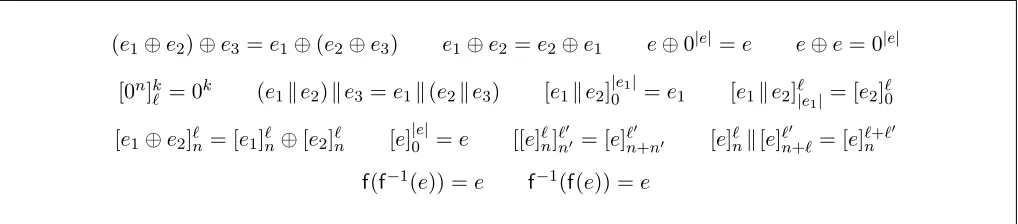
We model algebraic properties of bitstrings using the equational theory =E, defined as the smallest
con-gruence relation on well-typed expressions that contains all instances of the axioms of Figure 1. The relation =E is sound [10] for all trapdoor permutations and valid key pairs. This means that for all closed
expressionss and t, s=E timplies that LsM andLtM return the same value when shared random bitstrings
are jointly sampled; formally,
(e1⊕e2)⊕e3=e1⊕(e2⊕e3) e1⊕e2 =e2⊕e1 e⊕0|e|=e e⊕e= 0|e|
[0n]k
ℓ = 0k (e1ke2)ke3 =e1k(e2ke3) [e1ke2]
|e1|
0 =e1 [e1ke2]ℓ|e1|= [e2]
ℓ
0
[e1⊕e2]ℓn= [e1]ℓn⊕[e2]ℓn [e]|0e|=e [[e]ℓn]ℓ
′
n′ = [e]ℓ ′
n+n′ [e]ℓnk[e]ℓ ′
n+ℓ = [e]ℓ+ℓ
′
n
f(f−1(e)) =e f−1(f(e)) =e
Figure 1: Equational theory for algebraic expressions
We use the standard notion of deducibility from symbolic cryptography to reason about adversarial knowledge. Informally, an expression e′ is deducible from e if there exists an efficient algorithm that computes e′ frome. We use contexts to describe such algorithms symbolically. A context is an expression with a distinguished variable ∗. The application C[e] of a context C to an expression e is defined by substitution.
Definition 5 (Deducibility). An expression e′ is deducible from another expression e, written e ⊢ e′, if
there is a context C such that
1. R(C) =∅, X(C)⊆ {∗};
2. f−1 does not occur in C, and 3. C[e] =E e′.
We define⊢⋆ analogously, but dropping restriction 2.
In Appendix A.1 we prove that⊢is sound in the following sense: e⊢e′ implies that there is an efficient algorithm that computes e′ from e and the public keys of the trapdoor permutations ine and e′. For ⊢⋆
we obtain an identical result, except that the corresponding algorithm can also use the secret keys of the trapdoor permutations. Note that we do not require⊢-completeness, also known as6⊢-soundness [10], since we never use the deducibility relation to conclude that an expression is not computable from another.
3.3 Inequality and Static Distinguishability
Static equivalence [1] models symbolic indistinguishability of expressions. Informally, two expressions e0
ande1 are statically equivalent if all tests of the formC[·] =E C′[·] succeed fore0 if and only if they succeed
fore1. Since the completeness of =E with respect to the computational interpretation of expressions is an
open question, we use a relation inspired by static equivalence to model distinguishability of expressions. We call this relation static distinguishability, and define it in terms of an apartness relation ♯ in place of
6
=E. The soundness of this relation implies that if s ♯ t holds, then the probability that the results of LsM
andLtMcoincide when shared random bitstrings are jointly sampled is negligible. For a given set of axioms Γ, the relation♯ is inductively defined by the rules given in Figure 2.
We use axioms of the form
Γ⊆ {s ♯ t|s, t∈ {0} ∪ X }
s ♯ t∈Γ s ♯ t [Ax]
C[s]♯ C[t] s ♯ t [Ctx]
r /∈ R(s) r ♯ s [Rnd]
s ♯ u t=E u
s ♯ t [EqE]
e ♯ e1 · · · e ♯ ek H /∈ H(s)
H(e)♯(⊕ik=1H(ei))⊕s
[Hash]
Figure 2: Proof rules for apartness♯
Definition 6 (Static Distinguishability). The relation6≈ is the smallest symmetric relation on well-typed expressions such that e0 6≈e1 iff there are contexts C and C′ such that
1. R(C, C′) =∅, X(C)⊆ {∗}; 2. f−1 does not occur in C, C′, and 3. C[e0] =E C′[e0] and C[e1]♯ C′[e1].
We use static distinguishability to find attacks on encryption schemes. For the attacks to be meaningful, we rely on the soundness of 6≈, which follows from the soundness of =E and ♯. Informally, if e0 6≈ e1
holds, then there is an efficient algorithmdistinguish that when given as input the public keys of trapdoor permutations and a value computed using Le0M returns 0, but when given instead a value computed using
Le1M returns 1, except with negligible probability.
As an example, the expressions e0 =f(r)k(r⊕0) ande1=f(r)k(r1⊕r2) are statically distinguishable,
because for the contexts
C= [∗]|0f(r)| andC′ =f[∗]||rf(|r)|
it holds that C[e0] =E C′[e0] andC[e1]♯ C′[e1]. A simple distinguisher algorithm applies the algorithms
corresponding toC andC′ to its input and returns 0 if this yields equal bitstrings and 1 otherwise.
4
Proof Systems
This section introduces logics for proving chosen-plaintext and chosen-ciphertext security of padding-based encryption schemes by reduction to computational assumptions on the underlying trapdoor permutations. For the sake of readability, our presentation separates the derivation of valid judgments (§ 4.1 and § 4.2) from the computation of concrete security bounds from valid derivations (§ 4.3). The soundness of the logics is stated in§ 4.4 and proven in the Appendix.
4.1 Chosen-Plaintext Security
Judgments predicate over the probability of an eventφin theCPA experiment where the challenge cipher-text is computed using Lc⋆M, which we denoteCPA(c⋆). Events are drawn from the grammar
φ::=Guess|Ask(H, e)|φ∧φ
pˆc⋆:φ r /∈ R(e)
pˆc⋆{e⊕r/r}:φ{e⊕r/r}
[Opt]
pˆc⋆:φ
pˆc⋆{f(r)/r}:φ{f(r)/r}
[Perm]
pˆc⋆2:φ2 c⋆1=E c⋆2 φ1=⇒Eφ2
pˆc⋆1:φ1
[Sub]
pˆc⋆{r1kr2/r}:φ{r1kr2/r} r1, r2∈ R/ (c⋆, φ) r16=r2
pˆc⋆:φ
[Split]
pˆc⋆:φ r1, r2∈ R/ (c⋆, φ) r16=r2
pˆc⋆{r1kr2/r}:φ{r1kr2/r}
[Merge]
pˆc⋆:φ 0c⋆:Ask(H, e) r /∈ R(e) H /∈ H(c⋆, φ, e)
pˆc⋆{H(e)/r}:φ{H(e)/r}
[Fail1]
pˆc⋆:φ 0c⋆{H(e)/r}:φ{H(e)/r} ∧Ask(H, e) r /∈ R(e) H /∈ H(c⋆, φ, e)
pˆc⋆{H(e)/r}:φ{H(e)/r}
[Fail2]
X(c⋆) =∅ 1/
2c
⋆:Guess[Ind]
~ek R(c⋆)km⊢⋆r r /∈ R(c⋆) 0c⋆:Ask(H1, e1)∧ · · · ∧Ask(Hn, en)
[Rnd(|r|, ~H)]
~ekr2km⊢[r1]ℓk f(r1)kr2km⊢c⋆ r16=r2 (f, k, ℓ)∈Γ
0c⋆:Ask(H1, e1)∧ · · · ∧Ask(Hn, en)
[OWℓk(f, ~H)]
Figure 3: Proof rules of the CPA logic (=⇒E denotes implication in first-order logic with respect to =E)
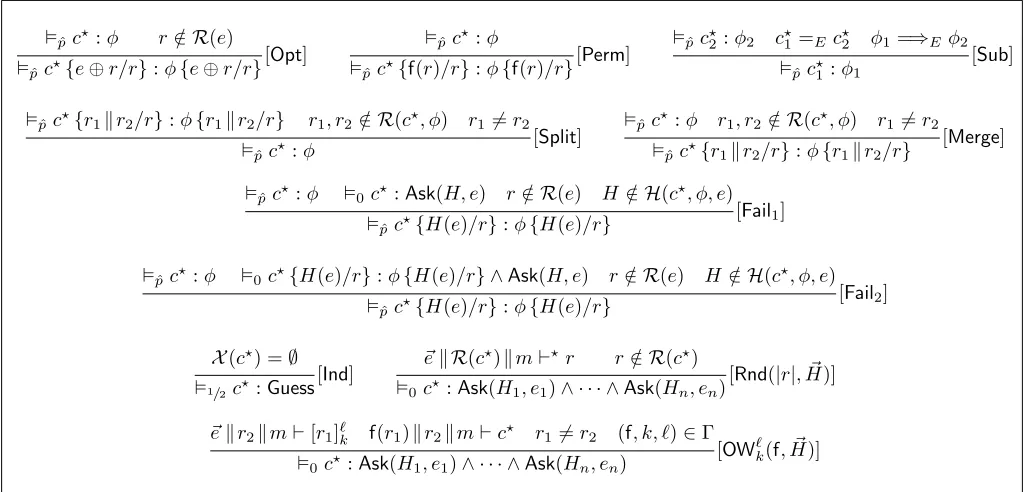
Judgments are of the form pˆ c⋆ : φ, where c⋆ is a well-typed expression with X(c⋆) ⊆ {m}, φ is an
event, and ˆp ∈ {0,1/2} is a probability tag1. The CPA logic is designed to ensure that if pˆ c⋆ : φ is
derivable, then the probability of φ in the experiment CPA(c⋆) is upper bounded by ˆp plus a negligible
term. In particular, if 1/2 c⋆ : Guess is derivable, then any scheme Π with encryption algorithm Lc⋆M is
asymptotically secure against chosen-plaintext attacks.
Derivability in the logic is parametrized by a set Γ of computational assumptions of the form (f, k, ℓ), where f ∈ F and k, ℓ∈ S. Such assumptions state that it is hard to compute [r]ℓk from f(r). There is no restriction on Γ: it may contain assumptions for several permutations, and multiple assumptions for any given permutation.
Figure 3 presents the rules of the proof system. Note that the terminal rules [Rnd] and [OW] are decorated with information that is needed to compute concrete bounds (§ 4.3). We only allow to apply a rule if all instances of expressions are well-typed; this implies that for any valid derivation ∇there exists a common typing environment for all rule applications.
The rules [Opt], [Perm], [Merge], and [Split] correspond to bridging steps in proofs and allow reformu-lating judgments into equivalent forms. The rule [Opt] corresponds to optimistic sampling, which allows substituting e⊕r by r provided that r /∈ R(e). The rule [Perm] replaces all occurrences of f(r) by r. The rule [Merge] replaces the concatenation of two random bitstrings r1 and r2 with a fresh random
bit-string r. The rule [Split] performs the opposite transformation; it replaces a random bitstring r with the concatenation of two fresh random bitstrings r1 and r2.
Rule [Sub] can be used to weaken the event and replace expressions in judgments with equivalent expressions. This rule is often needed to prepare the ground for the application of another rule: e.g. rule
1
[Opt] can be applied to a judgment that contains H(r) to obtain H(e⊕r) by first using [Sub] to replace H(r) by H(e⊕(e⊕r)).
The rules [Fail1] and [Fail2], for equivalence up to failure, correspond to specialized forms of Shoup’s Fundamental Lemma [31] and create two branches in a derivation. These rules can be used to substitute an expressionH(e) by a random bitstringr, incurring a probability loss in the reduction corresponding to the probability of the CPA adversary asking the queryH(e). One can choose to analyze this probability either after (as in rule [Fail1]) or before applying the substitution (as in rule [Fail2]).
Finally, the rules [Ind], [Rnd], and [OW] are terminal and provide a means of directly bounding the probability of an event. The first two rules are information-theoretic, whereas the third formalizes a reduction to a computational assumption. The rule [Ind] closes a branch when the challenge ciphertext no longer depends on a plaintext variable; in terms of the CPA experiment, this means that the challenge is independent from the hidden bit b, and hence the probability that an adversary guesses it is exactly1/2.
The rule [Rnd] closes a branch in the case when the adversary must make a number of oracle queries that would require guessing random values that are independent from its view. The rule [OW] closes a branch when it is possible to find a reduction to the problem of partially inverting a trapdoor permutation: this is the case when the image of a random element (the challenge of an inverter) can be embedded in the challenge ciphertext of the CPA experiment in such a way that its (partial) pre-image can be computed from the oracle queries made by theCPAadversary. To apply this rule,r1 is usually obtained by searching
for applications of f in c⋆ and r2 is set to the concatenation of all random bitstrings in R(c⋆)\ {r1}.
Additionally, one must check that the assumption (f, k, ℓ) is an assumption in Γ.
4.2 Chosen-Ciphertext Security
Judgments are of the formpˆ(c⋆, D) :φ, where ˆpis a probability tag,c⋆ is an expression,Dis a decryption
oracle, and φ is an event. The challenge ciphertext c⋆ and the tag ˆp can take the same values as in the
CPA logic, whereas the decryption oracle is drawn from the following grammar
F ::= findxinLH, F | ⋄
T ::= e=e′ | Ask(H, e) | T∧T
D ::= F :T⊲e
We assume thatDdoes not contain random bitstrings and that all variables in expressions inDare bound by find, except for a distinguished parameter c denoting the ciphertext queried to the oracle. The above grammar is sufficiently expressive to encode decryption algorithms of padding-based schemes, as well as plaintext-simulators used in reductions.2
Informally, given as input a ciphertext c, an algorithm find~xinLH~ :T⊲esearches among the queries
made by an adversary to oraclesH~ for values~vsatisfying T. If such values are found, it returns the value of e{~v/~x}; otherwise, it returns ⊥. Conditions in T are interpreted as equality checks on bitstrings and membership tests in the lists of oracle queries made by the adversary. We writeT ⊲einstead of⋄:T⊲e
and noteLDMthe interpretation ofD as an algorithm.
Events of the logic are as in the CPA logic or of the form∃x∈LD. T. Events Guessand Ask(H, e) are
defined as in the CPA logic but for the CCA experiment. For∃x ∈ LD. T, the quantified variable ranges
2
pˆc⋆:φ STf−1(T, t) =∅
pˆ(c⋆, F :T⊲t) :φ
[Pub(F, T, t)]
pˆ(c⋆,findxinLH, F :T ∧x=e⊲t) :φ pˆ(c⋆, F :T{e/x} ∧Ask(H, e)⊲t{e/x}) :φ
[Find]
pˆ(c⋆2, F :T2⊲t2) :φ2 c⋆1=Ec⋆2 φ1=⇒E φ2 T1⇐⇒ET2 t1=Et2
pˆ(c⋆1, F :T1⊲t1) :φ1
[Conv]
0(c⋆, D) :∃c∈LD. c=c⋆
[False]
STH(c⋆) ={H(e⋆)} STH(T, t) ={H(e)}
pˆ(c⋆, T ∧Ask(H, e)⊲t) :φ 0(c⋆, T ∧Ask(H, e)⊲t) :∃c∈LD. T∧e⋆=e neglr(T{r/H(e)})
pˆ(c⋆, T ⊲t) :φ [
Bad]
neglr(Ti)
negl
r(T1∧T2)
[PAndi]
cke⊢⋆[r]ℓ
k r6∈ R(e′)
negl
r(e=e′)
[PEqs(ℓ)] cke⊢
⋆[r]ℓ k
negl
r(Ask(H, e))
[PRnd(ℓ, H)]
r /∈ R(c⋆, e)
0c⋆:e=r
[Eqs(|r|)] ~ek R(c
⋆)km⊢⋆r r /∈ R(c⋆)
0c⋆:∃c∈LD.Ask(H1, e1)∧ · · · ∧Ask(Hn, en)
[Rnd(|r|, ~H)]
~ekr2km⊢[r1]ℓk f(r1)kr2km⊢c⋆ r16=r2 (f, k, ℓ)∈Γ
0c⋆:∃c∈LD.Ask(H1, e1)∧ · · · ∧Ask(Hn, en) [
OWℓk(f, ~H)]
Figure 4: Proof rules for CCAjudgments, proof rules for tests, and extended rules for theCPA logic
over the ciphertexts queried to the decryption oracle during the second phase of theCCAexperiment; tests are interpreted as described above.
A judgment pˆ (c⋆, D) : φ predicates over the probability of φ in the CCA experiment where the
challenge ciphertext is computed using Lc⋆M, and decryption queries are answered by LDM; we note this experimentCCA(c⋆, D). The judgment states that the probability ofφin this experiment is upper bounded
by ˆpplus a negligible term.
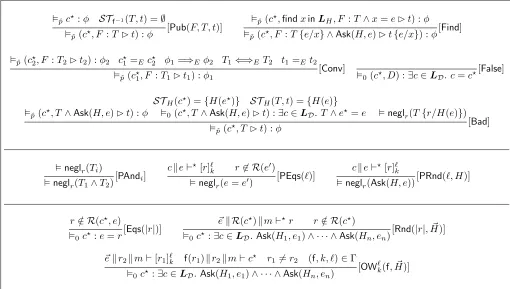
Figure 4 presents the rules of the logic. The rule [Bad] allows to transform the decryption oracle so that it rejects ciphertexts whose decryption requires to make oracle queries that have not yet been made by the adversary. The resulting decryption oracle no longer makes new queries to the given oracleH. It suffices to consider two events that can lead the adversary to distinguish between the original and transformed oracles: 1. when the adversary makes a decryption query c such that T succeeds after making a query H(e) that is also needed to compute the challenge ciphertext; 2. when the test T succeeds, even though it gets a random answer fromH. The probability of this last event can be proven negligible using the rules [PAnd], [PEqs], and [PRnd] in Figure 4.
The rule [False] captures the fact that the adversary cannot ask for the decryption of c⋆ during the
second phase of the CCAexperiment; the probability of this happening is 0. Rule [Conv] allows switching between observationally equivalent decryption oracles and weakening the event considered. This rule is usually used to transform a test that requiresf−1 into an equivalent test that only requiresf, so that [Pub] becomes applicable.
B(tA,~q)(∇) =
B(∇1) +B(∇2) ifL∇= [Fail1,2]
B(∇1) +B(∇2) +qDB(∇3) ifL∇= [Bad]
B(tS,~qS)(∇1) if L∇= [Pub(F, T, u)]
1/2 ifL∇= [Ind]
0 ifL∇= [False]
qH~ ×2−ℓ ifL∇= [Rnd(ℓ, ~H)]
qH ×2−ℓ ifL∇= [PRnd(ℓ, H)]
2−ℓ ifL∇= [Eqs(ℓ)]
2−ℓ ifL
∇= [PEqs(ℓ)] Succs-pd-OWΘ
f (k, ℓ, qH~, tI) ifL∇= [OW
ℓ k(f, ~H)]
B(∇1) otherwise
where tI = tA +T(C2) +qH~ ×T(C1), where C1, C2 are the contexts witnessing the first and second
deducibility conditions in the premise of [OWℓk(f, ~H)], qH~ =QHi∈H~ qHi, and
tS=tA+qD×(T(u) +T(T)× Y
HjinF
qHj) q S
Hi =qHi+qD×(Qi(u) +Qi(T)× Y
HjinF
qHj)
Figure 5: Computation of concrete security bounds from logical derivations
The rule [Pub] links the CCA logic with the CPA logic, and captures the intuition that an adversary does not gain any advantage from getting access to a publicly simulatable decryption oracle. Note that the judgment in the premise may be of the formpˆc⋆:φ, whereφis an event of theCCAlogic. This kind
of judgment is handled by the rule [Eqs] and the generalized rules [Rnd] and [OW] given in Figure 4.
4.3 Concrete Bounds
In this section we show how to extract concrete security bounds from derivations in our logics. Security bounds p are drawn from the grammar
p::=ǫ|1/2+ǫ q::= 1|q×q |qH |qD t::=tA |q|q×tf |t+t ǫ::= 0|2−k|Succs-pd-OWΘ
f (k, ℓ, q, t)|q×ǫ|ǫ+ǫ
where k, ℓ∈ S, H ∈ H,f ∈ F, tf is a worst-case bound for the time required to evaluate f, and tA is the
execution time ofA.
Security bounds are computed from a derivation ∇ in the CPA or CCA logic using a function B
parametrized by the computational resources of an adversary, namely, its execution time tA and the
number of oracle queries it can make, ~q. The definition of function B is given in Figure 5. In this figure, we omit resource parameters when they remain unchanged. Moreover, for a derivation ∇ with rule R at its root, we useL∇ to refer toR’s label and∇i to refer to the derivation of thei-th premise ofR (premises
are enumerated from left to right).
For all bridging rules, the bound is inherited from their single premise. For rules [Fail1] and [Fail2],
experiment andp2 bounds the probability of failure. Rule [Bad] is similar except that bounds come from
the probability of two different failure events, and one can be triggered in any decryption query.
The case of rule [Pub] represents a reduction from CCA to CPA, where a simulator S uses a CCA
adversaryA to win in the CPA experiment. We therefore have to compute bounds for the computational resources (tS, ~qS) used by S in terms of the resources of A and the plaintext-simulator F : T ⊲u. We
first define a functionTthat computes a bound for the time required to evaluate a testT or an expression u. Then, tS can be defined as tA+qD×tD where tD is the the time required to evaluate the test T on
each combination of queries traversed byF, plus the time required to evaluate the answeru. Similarly, we define a functionQi that bounds the number of queries made toHi during the simulation of the decryption
oracle, and use it to compute qHS
i.
The rules [Ind] and [False], yield exact bounds that can be readily used. The cases of rules [Rnd], and [PRnd], [Eqs], [PEqs], correspond to the probability of guessing a random bitstring of length ℓin qH~, qH,
or just 1 tries. In the case of rule [OW], the bound is the maximal success probability against set partial-domain one-wayness over all inverters using the same resources as the reduction we construct. Whenk= 0 andℓ=|f|, we can alternatively use the standard reduction from set one-wayness to one-wayness to obtain the bound SuccOWΘf (tA+qH~ +qH~ ×tf). Here, the adjusted time bound accounts for the fact that the inverter inspects every combination of queries made to H~, computes a value, applies f to that value and compares the result to its challenge to find the right pre-image.
4.4 Soundness
Let Π be an encryption scheme with encryption algorithm Lc⋆M and decryption algorithm LDM. Assume that the interpretations of trapdoor permutations satisfy all the assumptions in Γ.
Theorem 7. If ∇ is a derivation of1/2 c⋆:Guess underΓ, then
AdvCPAΠ (tA, ~q)≤2B(tA,~q)(∇)−1
Moreover, this bound is negligible if tA and all qH in ~q are polynomial in the security parameter, and all
assumptions in Γ hold.
Theorem 8. If ∇ is a derivation of1/2 (c⋆, D) :Guess underΓ, then
AdvCCAΠ (tA, ~q)≤2 B(tA,~q)(∇)−1
Moreover, this bound is negligible if tA, all qH in ~q, and qD are polynomial in the security parameter, and
all assumptions in Γ hold.
The proofs of these theorems rest on showing the soundness of each individual rule using game-based techniques. The proofs appear in the Appendix.
4.5 Examples
∇OW :
[Rnd(k, G)]
0f(r′kr) :Ask(G, r′′)
[Opt]
0f(r′kr) :Ask(G, r′′⊕r)
[OWn0(f,(H, G))]
0f(r′′) :Ask(H,[r′′]ℓ0)∧Ask(G, H([r′′]ℓ0)⊕[r′′]kℓ)
[Merge]
0f(r′kr) :Ask(H, r′)∧Ask(G, H(r′)⊕r)
[Fail2]
0f(r′kr) :Ask(G, H(r′)⊕r)
[Opt]
0f(r′kH(r′)⊕r) :Ask(G, r)
∇PDOW:
[Rnd(k, G)]
0f(r′kr′′) :Ask(G, r)
[Opt]
0f(r′kr′′⊕r) :Ask(G, r)
[OWℓ0(f, H)]
0f(r) :Ask(H,[r]ℓ0)
[Merge]
0f(r′kr) :Ask(H, r′)
[Opt]
0f(r′kr′′⊕r) :Ask(H, r′)
[Fail1]
0f(r′kH(r′)⊕r) :Ask(G, r)
∇OAEP:
[Ind]
1/
2f(r′kH(r′)⊕r) :Guess
[Opt]
1/2f(r′⊕(mk0)kH(r′⊕(mk0))⊕r) :Guess
∇
0f(r′kH(r′)⊕r) :Ask(G, r)
[Opt]
0f(r′⊕(mk0)kH(r′⊕(mk0))⊕r) :Ask(G, r)
[Fail1]
1/
2f((G(r)⊕(mk0))kH(G(r)⊕(mk0))⊕r) :Guess
Figure 6: Derivations for CPA security of OAEPunder one-wayness and partial-domain one-wayness
4.5.1 OAEP
We illustrate the use of the CPA logic to prove the chosen-plaintext security of OAEPunder one-wayness (OW) and partial-domain one-wayness (PDOW) assumptions on the underlying trapdoor permutation. Additionally, we give the concrete security bounds extracted from the corresponding derivations.
The proofs under one-wayness and partial-domain one-wayness share a common part, depicted at the bottom of Figure 6. This first part proceeds by applying [Fail1] to replace the expressionG(r) with a fresh
random bitstring r′. To close the branch corresponding to theGuessevent, we apply optimistic sampling, replacingr′⊕(mk0) by r′. In the judgment thus obtained, the challenge ciphertext does not depend on
the plaintext, so we conclude by applying [Ind]. We continue with the branch corresponding to the failure eventAsk(G, r) applying optimistic sampling. At this point there are two different ways to proceed, that yield proofs w.r.t. different hypotheses.
The derivation for PDOW is depicted in the middle of Figure 6. The proof proceeds by applying rule [Fail1] to replace H(r′) by a fresh random bitstring r′′. The rule [Opt] is then applied in both premises to
replace r′′⊕r by justr. The branch corresponding to the event Ask(G, r) can be closed by applying rule
[Rnd] because the challenge ciphertext does not depend on r anymore. The branch corresponding to the eventAsk(H, r′) is closed by merging the random bitstringsr′ and rasr and then reformulating the event as Ask(H,[r]ℓ
0). At this point, it is clear that querying H on the ℓ most significant bits of r amounts to
inverting f in its ℓmost significant bits, so we conclude applying [OWℓ0(f, H)].
The derivation for OW is depicted at the top of Figure 6. It proceeds by applying rule [Opt] to move the expressionH(r′) from the challenge expression to the event, that becomesAsk(G, H(r′)⊕r). We then
apply [Fail2] to replaceH(r′) by a fresh random bitstring r′′. Note that this rule performs a substitution
only on one of the branches. The branch corresponding to eventAsk(G, r′′⊕r) is closed using rule [Opt] to replacer′′⊕r byr′′, so that the event no longer depends on the challenge ciphertext and we can conclude
∇Ask:
[OWk1
0 (f, G)]
0f(r) :Ask(G,[r]k01)
[Merge]
0f(r′′kr′) :Ask(G, r′′)
[Rnd(k0, H)]
0f(r′′kr′) :Ask(H, mkr)
[Fail1]
0f(H(mkr)kr′) :Ask(G, H(mkr))
[Opt]
0f(H(mkr)kr′⊕(mkr)) :Ask(G, H(mkr))
∇PSS-E:
[Ind]
1/2f(r′′kr′) :Guess
[Rnd(k0, H)]
0f(r′′kr′) :Ask(H, mkr)
[Fail1]
1/2f(H(mkr)kr′) :Guess
[Opt]
1/
2f(H(mkr)kr′⊕(mkr)) :Guess
∇Ask [
Opt]
0f(H(mkr)kr′⊕(mkr)) :Ask(G, H(mkr))
[Fail1]
1/
2f(H(mkr)kG(H(mkr))⊕(mkr)) :Guess
Figure 7: A derivation forCPA security of PSS-E
reformulate the event accordingly and obtain
Ask(H,[r′′]ℓ0)∧Ask(G, H([r′′]ℓ0)⊕[r′′]kℓ).
If the adversary manages to query [r′′]ℓ
0 to H and H([r′′]ℓ0)⊕[r′′]kℓ to G, then the pre-image r′′ of the
challenge ciphertext can be computed from LG and LH. Indeed, the ℓ most significant bits of r′′ are a
query inLH, while the remaining k bits are the exclusive-or of the answer to this query and some query
inLG. Hence, a CPA adversary that triggers this event can be used to fully invert functionf, and we can
conclude by applying rule [OW0n(f,(H, G))].
Concrete security bound. Applying the bound functionB(tA,(qG,qH))to the derivation∇OAEP,∇PDOW
gives
1/2+qG×2−k+Succs-pd-OW
Θ (ℓ, qH, tA+qH).
Applying the bound functionB(tA,(qG,qH)) to the derivation∇OAEP,∇OWgives (after applying the standard
reduction from set one-wayness to one-wayness)
1/2+qG×2−k+SuccOW
Θ (tA+qGqH ×tf).
4.5.2 PSS-E
We prove the chosen-plaintext security and chosen-ciphertext security of PSS-E by exhibiting derivations in the CPA and CCA logics. Moreover, we illustrate how to derive concrete security bounds from these derivations. The encryption algorithm of PSS-E is given by the following expression
f(H(mkr)kG(H(mkr))⊕(mkr))
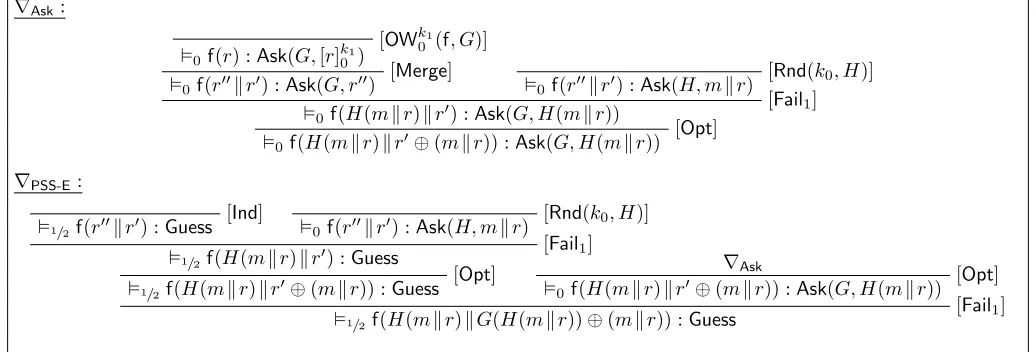
Chosen-plaintext security. The derivation for chosen-plaintext security output by our tool is depicted in Figure 7. The proof starts by applying the rule [Fail1], replacing the hashG(H(mkr)) by a fresh random
In the branch corresponding to the Guessevent, we apply optimistic sampling, replacingr′⊕(mkr) by
r′, and then [Fail
1] again, obtaining two premises. The premise corresponding to the originalGuessevent is
proved using rule [Ind] since the challenge ciphertext no longer depends on m. The premise corresponding to the failure event can be discharged using [Rnd] becausemkr⊢⋆ randr does not appear in the challenge
ciphertext, meaning that the adversary would have to guessr to trigger failure.
The derivation ∇ of the remaining premise of the first application of rule [Fail1] is obtained using a similar strategy. We first apply [Opt] followed by [Fail1], resulting in two premises:
• 0 f(r′′kr′) :Ask(G, r′′)
• 0 f(r′′kr′) :Ask(H, mkr)
To prove the first premise, observe that any adversary that asks r′′toG, can be used to invertf on its
k1 most significant bits. However, before applying rule OW, we must first apply [Merge] to replace r′′kr′
by a fresh random variable r, so that the judgment has the appropriate form.
The second premise corresponds to the same situation encountered before, where the adversary must querymkr toH to trigger failure, butr does not occur in the challenge ciphertext. We conclude as before using Rnd.
Concrete security bound. Applying the bound functionB(tA,(qG,qH)) to the derivation∇PSS-E yields
1/2+ 2qH ×2−k0
+Succs-pd-OWΘ (k1, qG, tA+qG).
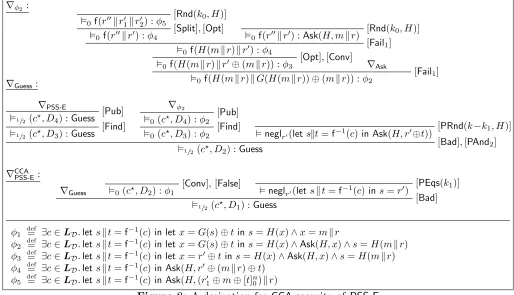
Chosen-ciphertext security. The derivation for chosen-ciphertext security output by our tool is de-picted in Figure 8. For the sake of clarity, we use let notation and pattern matching to avoid explicit projections and repetition.
Let n=k−k1−k0. Initially, we have
c⋆ = f(H(mkr)kG(H(mkr))⊕(mkr))
D1 = letskt=f−1(c) in letx=G(s)⊕tin s=H(x)⊲[x]n0
We are interested in proving the judgment 1/2 (c⋆, D1) : Guess. We begin by applying rule [Bad] to
strengthen the test in the decryption oracle to check also thatAsk(H, x) holds, so as to reject ciphertexts that would require new queries toH. The corresponding algorithm is
D2 = letskt=f−1(c) in letx=G(s)⊕t in s=H(x)∧Ask(H, x)⊲[x]n0
Note that an adversary is able to distinguish between D1 and D2 only if it can produce a ciphertext c
that passes the test without querying H(x) in the first place. This is only possible if the adversary either guesses this hash or learns something about it from the challenge ciphertext. The first case corresponds to the premise neglr′(let skt= f−1(c)in s =r′) and can be proven using [PEqs(k1)]. The second case corresponds to the premise
0(c⋆, D2) :∃c∈LD.let skt=f−1(c) in letx=G(s)⊕t in s=H(x)∧x=mkr
∇φ2:
[Rnd(k0, H)]
0f(r′′kr′1kr2′) :φ5
[Split],[Opt]
0f(r′′kr′) :φ4
[Rnd(k0, H)]
0f(r′′kr′) :Ask(H, mkr)
[Fail1]
0f(H(mkr)kr′) :φ4
[Opt],[Conv]
0f(H(mkr)kr′⊕(mkr)) :φ3 ∇Ask
[Fail1]
0f(H(mkr)kG(H(mkr))⊕(mkr)) :φ2
∇Guess:
∇PSS-E [ Pub]
1/2(c ⋆, D
4) :Guess
[Find]
1/
2(c ⋆, D
3) :Guess
∇φ2
[Pub]
0(c⋆, D4) :φ2
[Find]
0(c⋆, D3) :φ2
[PRnd(k−k1, H)]
neglr′(letskt=f−
1
(c)in Ask(H, r′⊕t))
[Bad],[PAnd2]
1/
2(c ⋆, D
2) :Guess
∇CCA PSS-E:
∇Guess
[Conv], [False]
0(c⋆, D2) :φ1
[PEqs(k1)]
neglr′(letskt=f−1
(c)ins=r′)
[Bad]
1/2(c ⋆, D
1) :Guess
φ1
def
= ∃c∈LD.letskt=f−
1
(c)in letx=G(s)⊕tins=H(x)∧x=mkr φ2
def
= ∃c∈LD.letskt=f−
1
(c)in letx=G(s)⊕tins=H(x)∧Ask(H, x)∧s=H(mkr) φ3
def
= ∃c∈LD.letskt=f−
1
(c)in letx=r′⊕tins=H(x)∧Ask(H, x)∧s=H(mkr)
φ4
def
= ∃c∈LD.letskt=f−
1
(c)in Ask(H, r′⊕(mkr)⊕t)
φ5
def
= ∃c∈LD.letskt=f−
1
(c)in Ask(H,(r′
1⊕m⊕[t]n0)kr)
Figure 8: A derivation for CCAsecurity of PSS-E
To prove the premise corresponding to the original Guess event, we apply rule [Bad] again, but this time with G(s). We obtain the following decryption oracle
D3 = letskt=f−1(c) in letx=G(s)⊕t in s=H(x)∧Ask(H, x)∧Ask(G, s)⊲[x]n0
The premise
negl
r′(letskt=f−1(c) in letx=r′⊕t ins=H(x)∧Ask(H, x)) can be readily discharged using the rules [PAnd2] and [PRnd(k−k1, H)].
To prove the two premises corresponding to CCA judgments, we first apply rules [Find] and [Conv] to reformulate the decryption oracle as follows:
D4 = finds, x inLG,LH :c=f(skG(s)⊕x)∧s=H(x)⊲[x]n0
Note that this decryption oracle ispublic, i.e. it does not usef−1 and can be efficiently simulated. Hence, we can apply rule [Pub] and proceed reasoning in the (extended)CPA logic. The branch corresponding to the original Guessevent can be proven using the same derivation∇PSS-E in Figure 7 that we used to prove
CPA security.
We have only one outstanding goal,
0c⋆ :∃c∈LD.letskt=f−1(c) in letx=G(s)⊕tin s=H(x)∧Ask(H, x)∧s=H(mkr)
To prove it, we first apply [Fail1] to replace G(H(mkr)) with a fresh random bitstringr′. The derivation
[Opt] and [Conv] to simplify the premise corresponding to the original event, obtaining
0 f(H(mkr)kr′) :∃c∈LD.let skt=f−1(c)in Ask(H, r′⊕(mkr)⊕t)
We then apply [Fail1] again, this time to replaceH(mkr) with a fresh random bitstringr′′. The premise
corresponding to the failure event can be readily proved using [Rnd(k0, H)] as in the proof of CPAsecurity.
To prove the remaining premise, observe that to trigger the event Ask(H, r′⊕(mkr)⊕t), the adversary
should be able to compute [r′⊕t]k0
n ⊕r, butris now independent of the challenge ciphertext. We formalize
this reasoning by first splitting r′ and then applying rule [Opt] to replace [r′⊕t]k0
n ⊕r by simply r. We
conclude applying rule [Exists] and [Rnd(k0, H)].
Concrete security bound. The concrete security bound B(tA,(qG,qH,qD))(∇ CCA
PSS-E) obtained from this proof is
B(tS,(qG,qH,qD))(∇PSS-E) +B(tS,(qG,qH,qD))(∇φ2) +qD×(2
−k1 +q
H ×2k1−k)
wheretS =tA+qDqGqH ×tf, and
B(tS,(qG,qH,qD))(∇PSS-E)≈ 1/2+ 2qH ×2
−k0+Succs-pd-OW
Θ (k1, qG, tA+qDqGqH ×tf)
B(tS,(qG,qH,qD))(∇φ2) = 3qH ×2−k
0+Succs-pd-OW
Θ (k1, qG, tA+qDqGqH ×tf)
Observe that tS comes from the two applications of rule [Find] and can be improved to tA+qDqH ×tf,
because to answer a decryption query, the simulator D4 just needs to traverse LH to find a value for x,
the value ofsis determined by H(x). The overall bound is, ignoring constant factors,
1/2+qH ×2−k0
+qD×2−k1+qD×qH ×2k1−k+Succs-pd-OWΘ (k1, qG, tA+qDqH×tf)
In comparison, the bound given by Coron et al. [17] is:
1/2+qH ×2−k0
+qD×2−k1 +Succs-pd-OWΘ (k1, qG+qH, tA+qDqH ×tf)
The differences are due to the use of a slightly different reduction, where the hash oracle H is assumed to issue a query G(s) each time it produces a response s. This assumption would make redundant the application of rule [Bad] in∇Guess in our reduction, eliminating the terms coming from∇φ2 and qD×qH×
2k1−k. The resulting bound, once adjustingq
G for the additional queries issued by H, coincides with that
of Coron et al.
5
Attacks
5.1 Universal Attacks
To find universal attacks against the CPA security of an encryption scheme with encryption algorithm e, we search for closed expressions m0 and m1 that do not contain symbols of the form f−1 such that e{m0/m} 6≈e{m1/m}. By soundness of6≈, there exists an efficient algorithmdistinguishthat returns 0 for
inputLe{m0/m}Mand 1 for inputLe{m1/m}Mwith overwhelming probability. To mount an attack against
CPA security using this algorithm, an adversary chooses plaintexts Lm0M and Lm1M, receives the challenge
ciphertext c⋆, and returnsdistinguish(c⋆). An example of a scheme vulnerable to this attack is a scheme with encryption algorithm given by
e=f(r)k(G(r)⊕m)kH(m)
A CPA adversary can use the distinguisher obtained from the contextsC = [∗]||Hr|+(m|m)|| and C′ =H(0|m|) to
tell appart e{0/m} from e{1/m}.
To refute CCA security, we search for malleability attacks using deducibility. Specifically, we search for closed expressions m0 and ∆ 6= 0|m| such that e{m0/m} ⊢ e{m0⊕∆/m}; let C be the context
witnessing the deducibility. This would imply an effective attack against CCA security: choose plaintexts m0 and m1 6= m0 and obtain the challenge c⋆; then query the decryption oracle on LC[c⋆]M, xor the
result with ∆, and return 0 if it equals Lm0M and 1 otherwise. An example of a scheme vulnerable to a
universal attack of this form is the Zheng-Seberry cryptosystem [33], whose encryption algorithm is given by e=f(r)k(G(r)⊕(mkH(m))); takem0= 0|m| and ∆ = 1|m|.
5.2 Existential Attacks
To find existential attacks against a scheme with encryption algorithmew.r.t. a set of assumptions Γ, we find universal attacks against modified versions of it. An example can elucidate better the point.
Consider the encryption algorithm of ZAEP[8],e=f(rkG(r)⊕m). To show that there is no blackbox reduction from the CPA security of ZAEPto the assumption (f,0,|f|), we instantiate f as follows
f(akb) =akf2(b) (1)
If f2 is a one-way permutation, the permutation f satisfies the assumption (f,0,|f|). Using static
distin-guishability, we find an attack on e′ =rkf2(G(r)⊕m) given by the contexts
C = [∗]||mr|| andC′ =f2
G[∗]|0r|
which can be used to distinguishe{0/m}and e{1/m}.
To show that there is no blackbox reduction of theCCAsecurity of ZAEPto an arbitrary Γ, we use the instantiation
f(a) = f′[a]|0a|−c [a]
c
|a|−c (2)
In general, to prove that there is no blackbox reduction for a fixed set of one-wayness assumptions Γ, we must either find a universal attack or instantiations for the trapdoor permutations that yield attacks and are compatible withall assumptions in Γ. For example, the instantiation (2) above is compatible with any set of assumptions, while (1) is compatible with all assumptions except those of the form (f, k, ℓ) with 0< ℓ and k+ℓ≤ |a|. In addition to the aforementioned instantiations, we also use instantiations of the form
f(akbkc) =f1(a)kb⊕akc
which allow us to find attacks iff is used in such a way that part of its input is leaked or interdependent.
6
Experimental Validation
We implemented the proof search and attack finding methods described in§4 and§5 in a toolset that we coinZooCrypt. ZooCryptcan prove the CPAand CCAsecurity of a scheme under different assumptions on the trapdoor permutations it uses, or find attacks that are consistent with these assumptions.
6.1 Security Analysis
To analyze the security of a scheme with encryption algorithm given by an expression c⋆ under a set of assumptions Γ, the toolset follows the workflow depicted in Figure 6.1:
1. Checks that c⋆ is well-typed and that encryption is invertible, i.e.c⋆⊢⋆ m;
2. Searches for attacks against CPA security;
3. Searches for proofs of CPA security. If a proof is found, computes the corresponding security bound;
4. Searches for malleability attacks againstCCAsecurity;
5. If aCPA proof has been found, synthesizes a decryption algorithmDand searches for a proof of CCA
security. If a proof is found, computes the corresponding security bound.
The results of this security analysis are an adversary for each attack found, and derivations for all security proofs together with the set of assumptions effectively used and the corresponding concrete security bound. Steps 3 and 5 implement proof search algorithms for the logics. These algorithms try to build a valid derivation bottom up, by applying rules in a prescribed order. Simple heuristics allow to improve the efficiency of the search and to ensure termination.
A crucial step in the above workflow is synthesizing a decryption algorithm that reject as many invalid ciphertexts as possible, with the aim of easing the construction of a plaintext simulator during a CCA
analysis. Indeed, an encryption algorithm typically admits several correct decryption algorithms, because the consistency condition gives complete freedom of choice as to what should be the result of decrypting an invalid ciphertext. The tool infers such algorithms using a method inspired by [9, 16] to analyze the
redundancy built into ciphertexts. We exploit the fact that our algorithm for checking static equivalence
Well-typed and invertible?
Search for chosen-plaintext attacks
Attack found?
Search for proof of CPA security
Proof found?
Output CPA bound
Search for malleability attacks
Attack found?
Search for proof of CCA security
Proof found?
CPA secure, CCA undecided No
Yes
No No Yes
Incorrect scheme No
Output attack Yes
Not CPA secure
Output attack
Yes CPA if proof found Not CCA secure Search for malleability attacks
Attack found? No Security undecided
Yes No
Output CCA bound Yes
CCA secure
Figure 9: Security analysis workflow
6.2 Practical Interpretation for RSA
Concrete security bounds can be used to guide the choice of practical parameters for realizations of en-cryption schemes based on RSA. In order to validate the quality of the bounds output by our tool, we implemented a method based on an extrapolation of the estimated cost of factoring the RSA-768 integer from theRSAFactoring Challenge [24], and on the lattice basis reduction of set partial-domain one-wayness to one-wayness for RSA[21].
LettN be the cost of factoring anN-bitRSAmodulus: Kleinjung [24] estimates thatt768 = 267, whereas
Lenstra [26] suggests to extrapolate based on the ratio
tN
tM
≈ exp((1.9229) log(N)
1/3log(log(N))2/3
exp((1.9229) log(M)1/3log(log(M))2/3
The success probability of partially inverting RSA on its k most significant bits, SuccOWRSA(k, q, t) can be upper bounded by a function ofSuccOWRSA(t′), wheret′ depends ont.
Proposition 9 ([21]). Let Θbe RSA with an ℓ-bit modulus such that ℓ <2k. Then,
Fixing a maximum number of queries to oracles and an admissible advantage p, our tool can estimate from the security bound obtained from a derivation, the minimum RSA modulus length N such that no adversary executing within time tA achieves either aCPA orCCAadvantage greater thanp.
For instance, a reasonable security target might be that no CCAadversary executing within time 2128
and making at most 260 hash queries and 230decryption queries achieves an advantage of more than 2−20.
From these values, the estimated cost of invertingRSA, and the bound found for theCCAsecurity of OAEP
under the same partial-domain one-wayness assumption as in [21], our tool estimates a minimum modulus length of 4864 bits, and a ciphertext overhead of around 200 bits.
6.3 Generation of Encryption Schemes
Our tool also implements an algorithm that generates expressions denoting encryption algorithms within budget constraints specified as the number of concatenation, exclusive-or, hash and trapdoor permutation constructors.
Candidate encryption schemes are generated following a top-down approach that uses variables to represent holes in partially specified expressions. Starting from a fully unspecified expression, i.e. just a variablex, at each iterative step the tool picks a hole and replaces it with either:
• An expression of the formf(x),H(x),x⊕yorxky, for fresh variablesxandy, if the budget permits;
• A hole-free sub-expression ofeor one of 0, m,r; this does not consume the budget.
An incremental type-checker is used at each step to discard partially specified expressions that do not have any well-typed instance. For example, e⊕(ekx) is immediately discarded becauseecannot be assigned a size regardless of any substitution for the holex.
We trim large parts of the search space by implementing an early pruning strategy in the style of [28]. Concretely, we apply some simple filters during generation. For instance, given an expressionewith holes, we check for the existence of a substitutionσfor holes respecting the budget constraints such thateσ⊢⋆ m,
and that it is not the case that for all such substitutions eσ ⊢ m oreσkm ⊢ R(e). These filters can be implemented efficiently using memoization to drastically reduce their computational cost.
6.4 Experiments
We evaluate our tools on encryption schemes generated under different budget constraints. Figure 1 summarizes the results of the automated security analysis of §6.1. In the figure, schemes are classified in rows by their size, measured by the total number of operators used in the expression denoting their encryption algorithm.
The reported experiment has been conducted under two classes of assumptions:
1. Γ1 ={(f,0,|f|)|f∈ F(c⋆)}, i.e. assuming that all trapdoor permutations are one-way;
2. Γ2 ={(f, kf, nf)|f ∈ F(c⋆)} such that 0≤kf and kf +nf ≤ |f|for allf ∈ F(c⋆), i.e. one arbitrary
one-wayness assumption for each trapdoor permutation;
The columns grouped underOW CPAreport the results obtained when analyzing CPAsecurity under Γ1.
Size Total OW CPA (% of Total) CPA (% of Total) CCA (% of CPA Proof + CPA Undec.) Proof Attack Undec. Proof Attack Undec. Proof Attack NR Undec.
4 2 1 1 0 2 0 0 0 2 0 0
(50.00%) (50.00%) (0.00%) (100.00%) (0.00%) (0.00%) (0.00%) (100.00%) (0.00%) (0.00%)
5 44 8 36 0 12 32 0 0 13 0 0
(18.18%) (81.82%) (0.00%) (27.27%) (72.73%) (0.00%) (0.00%) (100.00%) (0.00%) (0.00%)
6 335 65 270 0 93 241 1 1 96 5 0
(19.40%) (80.60%) (0.00%) (27.76%) (71.94%) (0.30%) (0.98%) (94.12%) (4.90%) (0.00%)
7 3263 510 2735 18 750 2475 38 45 739 45 62
(15.63%) (83.82%) (0.55%) (22.98%) (75.85%) (1.16%) (5.05%) (82.94%) (5.05%) (6.96%)
8 32671 4430 27894 347 6718 25336 617 536 6531 306 1192
(13.56%) (85.38%) (1.06%) (20.56%) (77.55%) (1.89%) (6.26%) (76.25%) (3.57%) (13.92%)
9 350111 43556 301679 4876 66775 274813 8523 7279 62356 3035 16496
(12.44%) (86.17%) (1.39%) (19.07%) (78.49%) (2.43%) (8.16%) (69.93%) (3.40%) (18.50%)
10 644563 67863 569314 7386 133476 491189 19898 20140 112993 12794 32397
(10.53%) (88.33%) (1.15%) (20.71%) (76.20%) (3.09%) (11.29%) (63.36%) (7.17%) (18.17%)
Total 1030989 116433 901929 12627 207826 794086 29077 28001 182730 16185 50147
(11.29%) (87.48%) (1.22%) (20.16%) (77.02%) (2.82%) (10.11%) (65.95%) (5.84%) (18.10%)
Table 1: Evaluation of the tool on generated encryption schemes
results when analyzingCPA and CCA security under all assumptions of the form Γ2. In this case, column
Proof indicates the number of schemes proved secure under some assumption of the form Γ2, column
Attack the number of schemes for which an attack was found for all assumptions of the form Γ2, and
column Undec. the number of schemes for which security could not be decided. The attack and proof search algorithms are extremely efficient, e.g. proof search for schemes of size 7 takes on average 0.1ms for
CPA and 0.5ms forCCA on a modern workstation
Observe that the figures in the first two groups suggest the separation between one-wayness and partial-domain one-wayness: the stronger the assumption, the more schemes can be proven secure and the less attacks can be found.
Finally, column NR in the CCA group counts the number of schemes that are CPA secure but non-redundant, meaning that all ciphertexts are valid. Non-redundant schemes can be CCAsecure [7, 25], but their proofs require random oracle programmability, which is out of the scope of our logics.
Validation We also evaluated our automated proof search and attack finding algorithms on a number of schemes from the literature, including the over one hundred variants of OAEP and SAEP surveyed by Komano and Ohta [25]. In all cases, our results are consistent with published results, and in most we are able to prove security under exactly the same assumptions and obtain the same security bounds. As evidence of the effectiveness of our methodology, we observe that our analyses decide theCPA security of all 72 variants of OAEPin the taxonomy of [25]. The results forCCAsecurity are more nuanced: for about 20% of schemes, we fail to find proofs or attacks when they exist.
ForCPAsecurity our methods seem to achieve empirical completeness, which suggests that completeness may be provable for some class of schemes or for some mild extension. A closer examination of the schemes on which our CCA analysis is unable to decide security reveals that this is either due to the fact that our approximation of inequality in rules [Eqs] and [PEqs] is too coarse, or because the schemes are non-redundant.