A preliminary version of this paper appears inAdvances in Cryptology – ASIACRYPT ’09, Lecture Notes in Computer Science Vol. 5912, pp. 232–249, Mitsuru Matsui ed., Springer-Verlag, 2009. This is the full version.
Hedged Public-Key Encryption:
How to Protect Against Bad Randomness
Mihir Bellare∗ Zvika Brakerski† Moni Naor‡ Thomas Ristenpart§ Gil Segev¶ Hovav Shachamk Scott Yilek∗∗
April 21, 2012
Abstract
Public-key encryption schemes rely for their IND-CPA security on per-message fresh randomness. In practice, randomness may be of poor quality for a variety of reasons, leading to failure of the schemes. Expecting the systems to improve is unrealistic. What we show in this paper is that we can, instead, improve the cryptography to offset the lack of possible randomness. We provide public-key encryption schemes that achieve IND-CPA security when the randomness they use is of high quality, but, when the latter is not the case, rather than breaking completely, they achieve a weaker but still useful notion of security that we call IND-CDA. This hedged public-key encryption provides the best possible security guarantees in the face of bad randomness. We provide simple RO-based ways to make in-practice IND-CPA schemes hedge secure with minimal software changes. We also provide non-RO model schemes relying on lossy trapdoor functions (LTDFs) and techniques from deterministic encryption. They achieve adaptive security by establishing and exploiting the anonymity of LTDFs which we believe is of independent interest.
∗
Department of Computer Science and Engineering, University of California, San Diego, USA. Supported in part by NSF grants CCF 0915675, CNS 0904380 and CNS 1116800. http://cseweb.ucsd.edu/˜mihir/.
†
Stanford University, Stanford, CA 94305, USA. Email: [email protected]. This work was completed while the author was a Ph.D. student at the Weizmann Institute of Science.
‡
Incumbent of the Judith Kleeman Professorial Chair, Department of Computer Science and Applied Mathematics, Weizmann Institute of Science, Rehovot 76100, Israel. Email: [email protected]. Research supported in part by a grant from the Israel Science Foundation.
§
University of Wisconsin–Madison, Madison, WI 53715, USA. Email: [email protected]. This work was completed while the author was a Ph.D. student at the University of California, San Diego.
¶
Microsoft Research, Mountain View, CA 94043, USA. Email: [email protected]. This work was completed while the author was a Ph.D. student at the Weizmann Institute of Science, and supported by the Adams Fellowship Program of the Israel Academy of Sciences and Humanities.
k
Department of Computer Science and Engineering, University of California, San Diego, USA. Supported in party by a MURI grant administered by the Air Force Office of Scientific Research.
∗∗
Contents
1 Introduction 3
2 Preliminaries 6
3 Attacks when Randomness is Bad 7
4 Security against Chosen Distribution Attack 8
4.1 Sources . . . 8
4.2 Indistinguishability under chosen-distribution attack . . . 9
4.3 IND-CDA for non-distinct sources . . . 11
5 The Role of Anonymity in Adaptive CDA Security 12 6 Constructions of Hedged Public-key Encryption 18 6.1 Hedging in the Random Oracle Model . . . 18
6.2 Hedging via Composition . . . 25
6.3 Hedging by Randomizing Deterministic Encryption . . . 27
6.4 RtD and PtD Without Universality . . . 29
1
Introduction
Cryptography ubiquitously assumes that parties have access to sufficiently good randomness. In practice this assumption is often violated. This can happen because of faulty implementations, side-channel attacks, system resets or for a variety of other reasons. The resulting cryptographic failures can be spectacular [23, 25, 32, 2, 14]. What can we do about this? One answer is that system designers should build “better” systems, but this is clearly easier said than done. The reality is that random number generation is a complex and difficult task, and it is unrealistic to think that failures will never occur. We propose a different approach: designing schemes in such a way that poor randomness will have as little as possible impact on the security of the scheme in the following sense. With good randomness the scheme achieves whatever (strong) security notion one is targeting, but when the same scheme is fed bad (even adversarially chosen) randomness, rather than breaking completely, it achieves some weaker but still useful notion of security that is the best possible under the circumstances. We call this “hedged” cryptography.
Previous work by Rogaway [35], Rogaway and Shrimpton [36], and Kamara and Katz [29] considers various forms of hedging for the symmetric encryption setting. In this paper, we initiate a study of hedged public-key encryption. We address two central foundational questions, namely to find appropriate definitions and to efficiently achieve them. Let us now look at all this in more detail.
The problem. Achieving the standard IND-CPA notion of privacy [24]requires the encryption algorithm to be randomized. In addition to the public key and message, it takes as input a random string that needs to be freshly and independently created for each and every encryption.
Weak (meaning, low-entropy) randomness does not merely imply a loss of theoretical security. It can lead to catastrophic attacks. For example, weak-randomness based encryption is easily seen to allow recovery of the plaintext from the ciphertext for the quadratic residuosity scheme of [24] as well as the El Gamal encryption scheme [22]. Brown [14] presents such an attack on RSA-OAEP [9] with encryption exponent 3. Ouafi and Vaudenay [33] present such an attack on Rabin-SAEP [12]. We present an alternative attack in Section 3.
The above would be of little concern if we could guarantee good randomness. Unfortunately, this fails to be true in practice. Here, an “entropy-gathering” process is used to get a seed which is then stretched to get “random” bits for the application. The theory of cryptographically strong pseudorandom number generators [10] implies that the stretching can in principle be sound, and extractors further allow us to reduce the requirement on the seed from being uniformly distributed to having high min-entropy, but we still need a sufficiently good seed. (No amount of cryptography can create randomness out of nothing!) In practice, entropy might be gathered from timing-related operating system events or user keystrokes. As evidence that this process is error-prone, consider the recent randomness failure in Debian Linux, where a bug in the OpenSSL package led to insufficient entropy gathering and thence to practical attacks on the SSH [32] and SSL [2, 40] protocols. Other exploits include [26, 20].
The new notion. The idea is to provide two tiers of security. First, when the “randomness” is really random, the scheme should meet the standard IND-CPA notion of security. Otherwise, rather than failing completely, it should gracefully achieve some weaker but as-good-as-possible notion of security. The first important question we then face is to pick and formally define this fallback notion.
Non-adaptive H-IND Adaptive H-IND
REwH1 IND-CPA IND-CPA + ANON-CPA
REwH2 IND-CPA IND-CPA
RtD IND-CPA, PRIV IND-CPA, (u-)LTDF
PtD (u-)LTDF (u-)LTDF
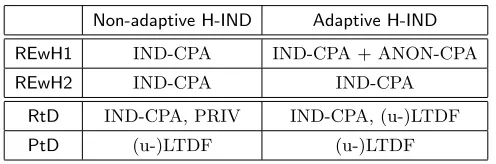
Figure 1: Table entries for the first two rows indicate the assumptions made on the (randomized) encryp-tion scheme that underlies the RO-model hedged schemes in quesencryp-tion. The entries for standard model scheme RtD are the assumptions on the underlying randomized and deterministic encryption schemes, respectively, and forPtD, on the underlying deterministic encryption scheme, which is the only primitive it uses.
way, we can exploit for security whatever entropy might be present in the randomness or the message, and in particular achieve security even if neither taken alone is random enough.
Notice that if the message and randomness together have low min-entropy, then we cannot hope to achieve security, because an adversary can recover the message with high probability by trial encryption with all message-randomness pairs that occur with a noticeable probability. In a nutshell, our new notion asks that this necessary condition is also sufficient, and in this way is requiring security that is as good as possible.
We denote by H-IND our notion of hedged security that is satisfied by encryption schemes that are secure both in the sense of IND-CPA and in the sense of IND-CDA.
Adaptivity. Our IND-CDA definition generalizes the indistinguishability-style formalizations of PRIV-secure deterministic encryption [7, 11], which in turn extended entropic security [19]. But we consider a new dimension, namely, adaptivity. Our adversary is allowed to specify joint message-randomness distributions on to-be-encrypted challenges. The adversary is said to be adaptive if these queries depend on the replies to previous ones. Non-adaptive H-IND means IND-CPA plus non-adaptive IND-CDA and adaptive H-IND means IND-CPA plus adaptive IND-CDA.
Non-adaptive IND-CDA is a notion of security for randomized schemes that becomes identical to PRIV in the special case that the scheme is deterministic. Adaptive IND-CDA, when restricted to deterministic schemes, is an adaptive strengthening of PRIV that we think is interesting in its own right. As a consequence of the results discussed below, we get the first deterministic encryption schemes that achieve this stronger notion.
Schemes with random oracles. Our random oracle (RO) model schemes and their attributes are summarized in the first two rows of the table of Figure 1. Both REwH1and REwH2efficiently transform an arbitrary (randomized) IND-CPA scheme into a H-IND scheme with the aid of the RO. They are simple ways to make in-practice encryption schemes H-IND secure with minimal software changes. REwH1 has the advantage of not changing the public key and thus not requiring new certificates. It always provides non-adaptive H-IND security. It provides adaptive H-IND security if the starting scheme has the extra property of being anonymous in the sense of [4]. Anonymity is possessed by some deployed schemes like DHIES [1], makingREwH1 attractive in this case. But some in-practice schemes, notably RSA ones, are not anonymous. If one wants adaptive H-IND security in this case we suggest REwH2, which provides it assuming only that the starting scheme is IND-CPA. It does this by adding a randomizer to the public key, so it does require new certificates. The schemes are extensions of the EwHdeterministic encryption scheme of [6] and similar to [21].
has not yet been built. Prior work, however, does show how to construct PRIV-secure DE without ROs for block sources [11]. (Messages being encrypted have high min-entropy even conditioned on previous messages.) But H-IND introduces three additional challenges: (1) the min-entropy guarantee is on the joint message-randomness distribution rather than merely on the message; (2) we want a single scheme that is not only IND-CDA secure but also IND-CPA-secure; and (3) the adversary’s queries may be adaptive.
We are able to overcome these challenges to the best extent possible. We provide schemes that are H-IND-secure in the same setting as the best known PRIV ones, namely, for block sources, where we suitably extend the latter notion to consider both randomness and messages. Furthermore, we achieve these results under the same assumptions as previous work.
Our standard model schemes and their attributes are summarized in the last two rows of the table of Figure 1. RtD is formed by the generic composition of a deterministic scheme and a randomized scheme and achieves non-adaptive H-IND security as long as the base schemes meet their regular conditions. (That is, the former is PRIV-secure for block sources and the latter is IND-CPA.) Adaptive security requires that the deterministic scheme be a u-LTDF. (A lossy trapdoor function whose lossy branch is a universal hash function [34, 11].) PtD is simpler, merely concatenating the message to the randomness and then applying deterministic encryption. It achieves both non-adaptive and adaptive H-IND under the assumption that the deterministic scheme is a u-LTDF. For both schemes, the universality assumption on the LTDF can be dropped by modifying the scheme and using the crooked leftover hash lemma as per [11]. (This is why the “u” is parenthesized in the table of Figure 1.)
Anonymous LTDFs. Also of independent interest, we show that any u-LTDF is anonymous. Here we refer to a new notion of anonymity for trapdoor functions that we introduce, one that strengthens the notion of [4]. This step exploits an adaptive variant of the leftover hash lemma of [28].
Why anonymity? It is exploited in our proofs of adaptive security. Our new notion of anonymity for trapdoor functions is matched by a corresponding one for encryption schemes. We show that any encryption scheme that is both anonymous and non-adaptive H-IND secure is also adaptively H-IND secure. Anonymity of the u-LTDF, in our encryption schemes based on the latter primitive, allows us to show that these schemes are anonymous and thereby lift their non-adaptive security to adaptive.
Related work. In the symmetric setting, several works have recognized and addressed the problem of security in the face of bad randomness. Concern over the quality of available randomness is one of Rogaway’s motivations for introducing nonce-based symmetric encryption [35], where security relies on the nonce never repeating rather than being random. Rogaway and Shrimpton [36] provide a symmetric authenticated encryption scheme that defaults to a PRF when the randomness is known.
Kamara and Katz [29] provide symmetric encryption schemes secure against chosen-randomness at-tack (CRA). Here the adversary can obtain encryption under randomness of its choice but privacy is only required for messages encrypted with perfect, hidden randomness. Entropy in the messages is not considered or used. We in contrast seek privacy even when the randomness is bad as long as there is compensating entropy in the message. Also we deal with the public key setting.
Many works consider achieving strong cryptography given only a “weak random source” [31, 17, 13]. This is a source that does have high min-entropy but may not produce truly random bits. They show that many cryptographic tasks including symmetric encryption [31], commitment, secret-sharing, and zero knowledge [17] are impossible in this setting. We are not in this setting. We do assume a small amount of initial good randomness to produce keys. (This makes sense because it is one-time and because otherwise we can’t hope to achieve anything anyway.) On the other hand our assumption on the randomness available for encryption is even weaker than in the works mentioned. (We do not even assume it has high min-entropy.) Our key idea is to exploit the entropy in the message, which is not done in [31, 17, 13]. This allows us to circumvent their negative results.
it [39].
We should note that the term hedging was previously used by Shoup to describe an encryption scheme that is simultaneously provably secure under one set of assumptions in the random oracle model and provably secure under a (stronger) set of assumptions in the standard model [38].
2
Preliminaries
Notation. Vectors are written in boldface, e.g. x. If x is a vector then |x| denotes its length and x[i] denotes its ith component for 1≤i≤ |x|. We say thatxis a vector overDifx[i]∈Dfor all 1≤i≤ |x|. Throughout,k∈Ndenotes the security parameter and 1kits unary encoding. Unless otherwise indicated, an algorithm is randomized. The set of possible outputs of algorithm A on inputs x1, x2, . . . is denoted [A(x1, x2, . . .)]. “PT” stands for polynomial-time.
Games. Our security definitions and proofs use code-based games [8], and so we recall some background from [8]. A game (look at Figure 2 for examples) has an Initialize procedure, procedures to respond to adversary oracle queries, and a Finalize procedure. A game G is executed with an adversary A as follows. First, Initialize executes, and its outputs are the inputs to A. Then A executes, its oracle queries being answered by the corresponding procedures of G. When A terminates, its output becomes the input to the Finalize procedure. The output of the latter is called the output of the game, and we let GA ⇒ y denote the event that this game output takes value y. Our convention is that the running time of an adversary is the time to execute the adversary with the game that defines security, so that the running time of all game procedures is included.
Public-key encryption. A public-key encryption (PKE) scheme is a tuple of PT algorithms AE = (P,K,E,D) with associated message length parametern(·) and randomness length parameterρ(·). The parameter generation algorithm P takes as input 1k and outputs a parameter string par. The key generation algorithm K takes input par and outputs a key pair (pk,sk). The encryption algorithm E takes inputs pk, message m ∈ {0,1}n(k) and coins r ∈ {0,1}ρ(k) and returns the ciphertext denoted
E(pk, m; r). The deterministic decryption algorithm D takes input sk and ciphertext c and outputs either ⊥ or a message in {0,1}n(k). For vectorsm,r with |m|= |r|=v we denote by E(pk,m; r) the
vector (E(pk,m[1] ; r[1]), . . . ,E(pk,m[v] ; r[v])). We say that AE is deterministic if E is deterministic. (That is, ρ(·) = 0.)
We consider the standard IND-CPA notion of security, captured by the game INDAE where AE =
(P,K,E,D) is an encryption scheme. In the game, Initializechooses a random bitb, generates param-eters par←$P(1k) and generates a key pair (pk,sk)←$K(par) before returning pk to the adversary.
ProcedureLR, on input messagesm0 andm1, returnsc←$E(pk, mb). Lastly, procedure Finalizetakes
as input a guess bit b0 and outputs trueifb=b0 and false otherwise. An IND-CPA adversary makes zero or more queries (m0, m1) to LR with |m0| =|m1|. Since a simple hybrid shows that allowing a single query is sufficient, we will unless otherwise noted restrict attention to the case where adversaries make a single query. For IND-CPA adversary A we let AdvindAE-,Acpa(k) = 2·Pr
INDAAE,k⇒true
−1.We say AE is IND-CPA secure ifAdvindAE,A(·) is negligible for all PT IND-CPA adversariesA.
Following [6], for anyk we define the maximum public-key collision probability by
maxpkAE(k) = max
w∈{0,1}∗Pr
h
pk=w : par←$P(1k) ; (pk, sk)←$K(par)
i
.
Universal hash functions. A family of functions is a tuple of algorithms H = (P,K, F) with as-sociated message length n(·). It is required that the domain of F(K,·) is {0,1}n for every k, every
par ∈ [P(1k)], and every K ∈ [K(par)]. We say that H is universal if for every k, all par ∈ [P(1k)],
we say H is pairwise-independent if for every k, all par ∈[P(1k)], all distinctx
1, x2 ∈ {0,1}n(k), and all y1, y2 ∈R(par), the probability that F(K, x1) =y1∧F(K, x2) =y2 is at most 1/|R(par)|2, where again
the probability is over K←$K(par).
We say a familyHhas 2t-bounded range if for all k, allpar ∈ P(1k), |R(par)| ≤2t(k).
We say a family H is efficiently invertible if there is an efficient algorithm F−1 such that for all 1k, all par ∈[P(1k)], all K ∈[K(par)], and allx∈ {0,1}n(k) it is the case thatF−1(K, F(K, x)) =x.
Lossy Trapdoor Functions (LTDFs). To a deterministic PKE scheme (recall that a family of injective trapdoor functions and a deterministic encryption scheme are, syntactically, the same object) AE = (Pd,Kd,Ed,Dd) with message lengthnd(·) we can associate an (nd, `)-lossy key generatorKl. This
is a PT algorithm that, on inputpar, outputs a valuepkfor which the mapEd(pk,·) has image size at most 2nd(k)−`(k). The parameter`is called the lossiness of the lossy key generator. We associate toAE, lossy key generatorKl, and a LOS adversaryA the functionAdvlosAE,Kl,A(k) = 2·PrLOSAAE,K
l,k ⇒true
−1, where game LOSAE,Kl works as follows. Initialize chooses a random bit b and generates parameters
par←$Pd(1k), ifb= 0 runs (pk,sk)←$Kd(par) and if b= 1 runspk←$Kl(par). It then returns pk (to
the adversary A). When A finishes, outputting guess b0, Finalize returns true if b = b0. We say Kl is
universal-inducing ifH= (Pd,Kl,Ed) is a family of universal hash functions with message length nd.
A deterministic encryption scheme AE is a (nd, `)-lossy trapdoor function (LTDF) if there exists a (nd, `)-lossy key generator such that AdvlosAE,Kl,A(·) is negligible for all PT A. We say it is a universal (nd, `)-lossy trapdoor function (u-LTDF) if in addition Kl is universal-inducing.
Lossy trapdoor functions were introduced by Peikert and Waters [34], and can be based on a variety of number-theoretic assumptions, including the hardness of the decisional Diffie-Hellman problem, the worst-case hardness of lattice problems, and the hardness of Paillier’s composite residuosity problem [34, 11, 37]. Boldyreva et al. [11] observed that the DDH-based construction is universal.
3
Attacks when Randomness is Bad
The traditional security model of IND-CPA for PKE schemes, given in the last section, mandates good per-message randomness. In this section we highlight the catastrophic attacks that can occur when randomness is bad. Consider encryption E(pk, m; r) of a message m under public key pk and random-ness r. For the attacks discussed below we assume that the random number generator is broken but not necessarily under adversarial control (as was the case in the Debian vulnerability [32] and other weak PRNG vulnerabilities [2, 26, 20]). Broken means the valuer is predictable by the adversary (technically, has little or even no min-entropy). Our eventual security definitions will make no such simplifying as-sumption and will instead ask that our schemes achieve (the best possible) security even in the face of adversarially-subverted random number generators.
Plaintext recovery attacks. Many prominent PKE schemes are vulnerable to fast plaintext recovery attacks when randomness is predictable. As mentioned in the introduction both El Gamal encryption [22] and Goldwasser-Micali encryption [24] are vulnerable. For the former, encryption under public key X is E(X, M;r) = (gr, Xr·M), so the ability to predictrimmediately givesXrand leads to message recovery.
The Goldwasser-Micali scheme fails analogously.
One can utilize Coppersmith’s method in the univariate case [16, 27] to recover plaintexts from Rabin-SAEP [12] ciphertexts when randomness is known. The Rabin-SAEP padding function [12] for
m-bit messageM and s1-bit randomnessr is (mk0s0)⊕H(r)kr, whereHis a random oracle mapping s1-bit strings to (m+s0)-bit strings; the bit sizes must satisfy m < n/4 and m+s0 < n/2, where n is
the bitlength of the Rabin modulus N. For a ciphertext C whose randomness r is known, we can write
f(x) = (x·2s0+s1 +a)2 −C where a is known. There exists a small root x0 of f(x) modN: one such
that x0 < 2n/4; computing this root reveals the plaintext M. (Specifically, let H(r) = hLkhR, where
in the univariate case [16, 27] it is possible to find a root to a degree-δ polynomial modulo N if that root is smaller than N1/δ, which the parameters here easily satisfy. Thus a single ciphertext with known (not necessarily adversarially-generated) randomness suffices to leak the plaintext. In fact, this is used crucially in the proof of security of Rabin-SAEP to handle decryption queries. We note that a recent work by Ouafi and Vaudenay [33] against the SQUASH-0 hash function also gives a “known-coins” message recovery attack against Rabin-SAEP.
Brown [14] gives an attack against RSA-OAEP [9] with e= 3 and known randomness. The attack is based on Coppersmith’s method and is essentially the same as the one we described above against Rabin-SAEP. One difference is that exponentiation by e = 3 yields a cubic polynomial, reducing the size of the small roots that can be extracted; another is that OAEP padding includes two Feistel rounds instead of one so there are two unknowns, which means that the attack is only heuristic.
All hybrid encryption (KEM/DEM) schemes are vulnerable to plaintext recovery when randomness is predictable, which is unfortunate due to the wide use of hybrid encryption in practice. Briefly hybrid encryption E(pk, M ; r) first runs a key encapsulation routine (c1, K) ← ψ(pk ; r) and then encrypts the message via symmetric encryption c2 ←E(K, M). The full ciphertext is (c1, c2). Ifr is predictable,
then an adversary can run ψ(pk; r) itself to recompute K and use it to recover the plaintext. Note the structure of some KEM/DEMs is such that even when r is not predictable, but even just re-used, then attacks exist. Consider when the symmetric encryption is CTR-mode encryption. Then encrypting two messages m andm0 under the same randomness r would immediately revealm⊕m0 to the adversary. Ciphertexts leak plaintext, randomness equality. As pointed out in the introduction, there exists an inherent insecurity for any PKE scheme when both messages and randomness are predictable. Given a ciphertext E(pk, m; r) the adversary can easily determine the message via a trial-encryption brute-force attack. Thus, any message-privacy security notion for PKE when randomness is bad will require that the pair (m, r) has high min-entropy.
4
Security against Chosen Distribution Attack
When randomness may be bad, traditional notions such as IND-CPA are no longer achievable. We there-fore formalize a new security goal to complement IND-CPA: indistinguishability under chosen distribution attack. The adversary attempts to learn partial information about challenge messages when the message and randomness are together sampled from an unpredictable source.
4.1 Sources
We generalize the notion of a source to consider a joint distribution on the messages and the randomness with which they will be encrypted. A t-source (t ≥ 1) with vector length v(·), message length n(·), and randomness length ρ(·) is a probabilistic algorithm M that on input 1k returns a (t+ 1)-tuple (m0, . . . ,mt−1,r). The vectorsm0, . . . ,mt−1each havev(k) elements in{0,1}n(k)andrhasv(k) elements
in{0,1}ρ(k). We say thatMhas min-entropy µ(·) if
Pr [ (mb[i],r[i]) = (m, r) ]≤2−µ(k)
for all k ∈ N, all b ∈ {0, . . . , t−1}, all i ∈ {1, . . . ,|r|}, all (m, r) ∈ {0,1}n(k)× {0,1}ρ(k), and where the probability is over the coins used to run (m0,m1,r)←$M(1k). We say it has conditional
min-entropy µ(·) if
Pr(mb[i],r[i]) = (m, r) | ∀j < i(mb[j],r[j]) = (m0[j],r0[j])
≤2−µ(k)
procedure Initialize(1k):
par←$P(1k) (pk,sk)←$K(par)
b←${0,1} Retpar
procedure LR(M): Ifpkout=truethen
Ret⊥
(m0,m1,r)←$M(1k) RetE(pk,mb;r)
procedure RevealPK(): pkout←true
Retpk
procedure Finalize(b0): Ret (b=b0)
Figure 2: Game CDAAE,k
For any pair of vectors (m,r) of lengthv, we define the equality pattern of (m,r) to be the bit-valued matrixE(m,r)withvrows andv columns for whichEi,j(m,r)= 1 if (m[i],r[i]) = (m[j],r[j]) andEi,j(m,r)= 0 otherwise for 1 ≤i≤j ≤v. This always-symmetric matrix describes the equality relations between all elements of the two vectors. A distinct t-source Mwith vector lengthv(·) is one for which
PrhE(mb,r)=Iv(k) : (m0, . . . ,mt−1,r)←$M(1k)
i
= 1
for all k∈Nand all b∈ {0, . . . , t−1} and whereIv(k) denotes the v(k) byv(k) identity matrix.
We fix some notation for referring to commonly used types of sources. At-source with vector length
v(·), message lengthn(·), randomness length ρ(·), and min-entropyµ(·) is referred to as • a (µ, v, n, ρ)-mr-source when t= 1 and ρ(·)>0;
• a (µ, v, n)-m-source whent= 1 andρ(·) = 0;
• a (µ, v, n, ρ)-mmr-source when t= 2 and ρ(·)>0; and • a (µ, v, n)-mm-source whent= 2 andρ(·) = 0.
Each “m” indicates the source outputting one message vector and an “r” indicates a randomness vector. When the source has conditional min-entropyµ(·) we write block-source instead of source for each of the above.
4.2 Indistinguishability under chosen-distribution attack
Let AE = (P,K,E,D) be an encryption scheme. A CDA adversary is one whose LR queries are all
mmr-sources. Game CDAAE of Figure 2 provides the adversary with two oracles. The advantage of CDA
adversary Ais
AdvcdaAE,A(k) = 2·Pr
CDAAAE,k⇒true
−1.
In the random oracle model we allow all algorithms in Game CDA to access the random oracle; impor-tantly, this includes the mmr-sources.
Discussion. Adversary A can query LR with an mmr-source of its choice, an output (m0,m1,r) of which represents choices of message vectors to encrypt and randomness with which to encrypt them. (An alternative formulation might have CDA adversaries query two mr-sources, and distinguish between the encryption of samples taken from one of these. But this would mandate that schemes ensure privacy of messagesand randomness.) This allowsAto dictate a joint distribution on the messages and randomness. In this way it conservatively models even adversarially-subverted random number generators. Multiple LR queries are allowed. In the most general case these queries may be adaptive, meaning depend on answers to previous queries.
Note that Initialize does not return the public key pk to A. A can get it at any time by calling RevealPK but once it does this, LR will return ⊥. The reason is that we inherit from deterministic encryption the unavoidable limitation that encryption cannot hide public-key related information about the plaintexts [6]. (When the randomness has low entropy, the ciphertext itself is such information.)
As we saw in the previous section, no encryption scheme is secure when both messages and randomness are predictable. Formally, this means chosen-distribution attacks are trivial when adversaries can query
mmr-sources of low min-entropy. Our notions (below) will therefore require security only for sources that have high min-entropy or high conditional min-entropy.
Similarly, we inherit from deterministic encryption the unavoidable limitation that we cannot allow arbitrary equality patterns. For simplicity we have restricted attention to adversaries that query distinct sources. These always output message, randomness pairs that are distinct. A detailed discussion of the role of equality patterns is given in Section 4.3.
Notions. We can assume (without loss of generality) that a CDA adversary makes a singleRevealPK query and then no further LR queries. We say A is a (µ, v, n, ρ)-adversary if all of its LR queries are distinct (µ, v, n, ρ)-mmr-sources. We say that a PKE scheme AE with message length n(·) and randomness length ρ(·) is IND-CDA secure for distinct (µ, v, n, ρ)-mmr-sources if for all PT (µ, v, n, ρ) adversaries A the functionAdvcdaAE,A(·) is negligible. Scheme AE is H-IND secure for distinct (µ, v, n, ρ
)-mmr-sources if it is IND-CPA secure and IND-CDA secure for (µ, v, n, ρ)-mmr-sources. We can extend these notions to distinct mmr-block-sources by restricting to adversaries that query distinct mmr -block-sources. Theorem 4.1 below allows one to generalize from distinct sources to sources with other equality patterns.
On adaptivity. We can consider non-adaptive IND-CDA security by restricting attention in the notions above to adversaries that only make a single LR query. Why do we not focus solely on this (simpler) security goal? The standard IND-CPA setting (implicitly) provides security against multiple, adaptive LR queries. This is true because in that setting a straightforward hybrid argument shows that security against multiple adaptiveLR queries is implied by security against a single LRquery [5, 3]. We wish to maintain the same standard of adaptive security in the IND-CDA setting. Unfortunately, in the IND-CDA setting, unlike the IND-CPA setting, adaptive security is not implied by non-adaptive security. In short this is because a CDA adversary necessarily cannot learn the public key before (or while) making LR queries. To see the separation, consider a PKE scheme that appends to every ciphertext the public key used. This will not affect the security of the scheme when an adversary can only make a single query. However, an adaptive CDA adversary can query an mmr-source, learn the public key, and craft a second source that uses the public key to ensure ciphertexts which leak the challenge bit.
Given this, our primary goal is the stronger notion of adaptive security. That said, non-adaptive hedge security is also relevant because in practice adaptive adversaries might be rare and, as we will see, one can find non-adaptively-secure schemes that are more efficient and/or have proofs under weaker assumptions.
Adaptive PRIV. A special case of our framework occurs when the PKE schemeAE being considered has randomness length ρ(k) = 0 for all k (meaning also that adversaries query mm-sources, instead of
mmr-sources). In this case we are considering deterministic encryption, and the IND-CDA definition and notions give a strengthening (by way of adaptivity) of the PRIV security notion from [6, 7, 11]. (For non-adaptive adversaries the definitions are equivalent.) For clarity we will use PRIV to refer to this special case, and let AdvprivAE,A(k) =AdvcdaAE,A(k).
Resource usage. Recall that by our convention, the running time of a CDA adversary is the time for the execution of the adversary with game CDAAE,k. Thus, A being PT implies that the mmr-sources
is not restrictive. Non-PT sources were needed in [11] for showing that single-message security implied (non-adaptive) multi-message security for deterministic encryption of block sources.
4.3 IND-CDA for non-distinct sources
Above we restricted the IND-CDA security notion to consider only attackers that querydistinct t-sources. These are sources that output vectors that have the identity equality pattern. Here we investigate relaxations of this requirement, showing that any achievable relaxation is implied by security against distinct sources.
Unachievable notions. We start with having no restrictions on equality patterns entirely. A relaxed source IND-CDA adversary is one whose LR queries are all mmr-sources, these not necessarily being distinct. Then, as in the deterministic encryption setting [6], we have that no encryption scheme can be hedge secure against such adversaries. Let A be the adversary that makes a queryM which returns (m0,m1,r) = ((a, a),(a, a0),(r, r)) for some a 6= a0 and random r. Then A can win trivially because
the (two) components of the returned vector c are equal if b= 0 and unequal otherwise. This example points to a fundamental limitation with encryption: equality of plaintext and randomness is leaked by ciphertexts. To have an acheivable notion of security, then, we must ensure that CDA adversaries cannot use plaintext-randomness equalities in order to trivially learn the challenge bit b.
Recall the equality pattern definition from the last section. The equality patterns for the pairs of vectors ((a, a),(r, r)) and ((a, a0),(r, r)) used in the attack of the last paragraph are
E(m0,r)=
"
1 1 1 1
#
and E(m1,r) =
"
1 0 0 1
#
.
In that example, the adversary takes advantage of the fact thatE(m0,r) 6=E(m1,r). We must exclude such
“trivial” adversaries by restricting attention to adversaries that only query sources Mthat do not leak information via equality-patterns. One might therefore be tempted to just enforce that equality patterns do not leak anything about b directly. This can be captured by requiring that anymmr-source outputs vectors m0,m1,r such that E(m0,r) = E(m1,r) holds with high probability. However, this relaxation is
still trivial to win against: an attacker can choose Mso that the equality pattern encodes (say) all the bits that are common between the first messages of m0 and m1.
An achievable notion. We now give a restriction that is sufficient to bar trivial adversaries. At-source Mhas equality-pattern respectζ(·) if there exists a family of reference equality-patterns{Eˆv(k)}k∈Nsuch
that
Pr
"
_
b
E(mb,r) 6= ˆEv(k) : (m0, . . . ,mt−1,r)←$M(1k)
#
≤2−ζ(k) (1) for all k∈Nand allb∈ {0, . . . , t−1}. In the ROM the probability above must hold with respect to any fixed RO (i.e., the probability is taken over just the coins used by Mdirectly.) An IND-CDA adversary has equality-pattern respect ζ(·) if all mmr-sources it queries have equality-pattern respect at leastζ(·). Intuitively, as long as ζ(k) is large enough for every k of interest, the equality pattern cannot leak any information to the attacker — it is almost always certainly some fixed equality pattern. We note that with probability related to their conditional min-entropy, block sources already output vectors whose equality pattern is the identity matrix.
The following lemma shows that the fixed equality pattern might as well be the identity equality pattern. In other words, the relaxation to non-distinct sources above is equivalent to security against distinct sources.
with equality-pattern respect at leastζ(·). Then there exists IND-CDA adversary B such that for all k
AdvcdaAE,A(k)≤AdvAEcda,B(k) +4q(k) 2ζ(k) .
B makesq(·) LRqueries, each being a distinct (µ, v0, n, ρ)-mmr-source withv0 ≤v. AdversaryB runs in at most twice the running time of A.
Proof: Fix anykand let v=v(k), q=q(k), andζ =ζ(k). Let adversary B work as follows. It runs A, outputs the same bit output byA, and responds to LRqueries as follows.
Let M be an mmr-source queried by A to LR. Then B runs (m0,m1,r)←$M and computes the
equality pattern ˆE =E(m0,r). AdversaryB derives from ˆE a vectorp of sizev, defined as follows. Let c = 1. Then for j = 1 to v do the following. Let i≤j be the least value isuch that ˆEi,j = 1. If i=j
then increment cand letp[j] =c. Otherwise, letp[j] =p[i]. It sets v0 to be the final value ofc, which is the number of distinct message, randomness pairs in (m0,r). The vectorpkeeps track of which message,
randomness pairs are (with high probability) duplicates of others for the source M.
Adversary B then defines a distinct mmr-source M0 that works as follows. It runs M to get vectors (m0,m1,r). It then defines vectors (m00,m01,r0) as follows. For each 1 ≤ j ≤ v, it lets i = p[j] and
sets (m00[i],m01[i],r0[i]) = (m0[j],m1[j],r[j]). Then, it outputs the vectors (m00,m01,r0). By construction
|m0
0|=|m01|=|r0|=v0 and, moreover, M
0 is a distinct mmr-source with min-entropy µ(k). If Mis a
block-source, then M0 additionally has conditional min-entropy at least µ(k).
AdversaryB queriesM0 and retrieves a vectorc of ciphertexts. It then usespto determine which of the ciphertexts in c should have been duplicates. That is, for 1≤j ≤v, it letsi=p[j] and sets c0[j] =c[i]. It then returns c0 to adversaryA.
We bound the advantage ofAby that ofB. The simulation byB is correct (it matches the IND-CDAAE,k
game Aexpects) as long as for eachLRquery the equality pattern computed byB matches the equality pattern of the vectors output by Mwhen run within M0. Since Mis equality pattern respecting, the equality pattern of its output always matches a reference ˆEv with probability at least 1−2−ζ. So for any query byA, the two patterns resulting from the two runs ofMwill not match with probability at most 2·2−ζ. A union bound gives that the probability of failure across all queries is at most 2q·2−ζ. Thus
AdvcdaAE,A(k)≤2
PrCDABAE,k ⇒true+2q 2ζ
−1 =AdvcdaAE,B(k) +
4q
2ζ .
5
The Role of Anonymity in Adaptive CDA Security
Before detailing specific constructions, we first provide some general results on the relationship between anonymity and adaptive hedge security. For encryption schemes, anonymity (also called key privacy) requires that ciphertexts leak no information about the public key used to perform encryption. In the randomized setting, this was first formalized by Bellare et al. [4]. Here we will review the key-privacy notion for randomized encryption from [4], present a weaker variant of it that will be useful later, and then give a new notion of key privacy in the face of chosen-distribution attacks. The last proves to be sufficient for a general implication that any encryption scheme which is anonymous and non-adaptively hedge secure is also adaptively hedge secure. We will finish by showing that all universal LTDFs are anonymous in this new sense.
scheme can be secure against chosen-distribution attacks when LR queries can be made knowing the public key. LetAE = (P,K,E,D) be an encryption scheme. Given a public keypkforAE, letMbe the distribution that samples (m0, m1, r) from the set of all triples for which the first bit of the ciphertext
output byE(pk, mb;r) isb. Note thatMhas high conditional min-entropy for sufficiently long messages
and that it can be implemented efficiently using a loop that samples uniformly and checks the result using pk. An adversary can always then win a variant of game CDA that instead returns pk at the end of Initializeusing M.
Moreover, consider the situation in which AE reveals public keys via its encryption algorithm. For example, it prepends all ciphertexts with the public key pk used. (Note this does not impact message privacy.) No such encryption scheme will meet adaptive IND-CDA security, because the adversary can query an arbitrary high conditional min-entropy source, extract pk from the resulting ciphertexts, and then has enough information to query the source Mdescribed above in its second query.
This implies that achieving adaptively-secure hedge encryption requires an encryption scheme that, minimally, does not allow recovery of a public key from ciphertexts. In fact, we will formalize a stronger notion of key privacy under chosen distribution attacks and show that this is sufficient for achieving adaptive security.
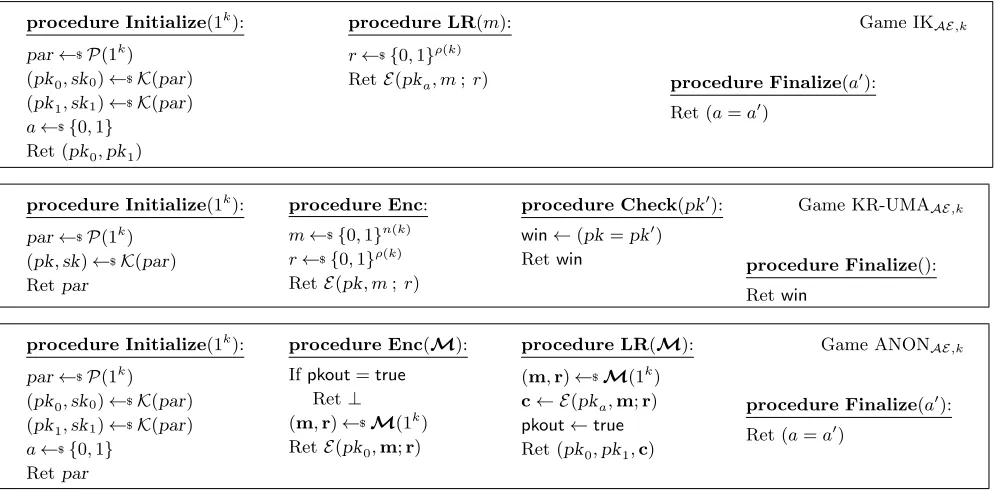
Key-privacy with good randomness. First, however, we review the key privacy notion of [4], referred to as indistinguishability of keys. It applies to settings where randomness is always good. LetAE be an encryption scheme. Game IKAE,k is shown in Figure 3. The advantage of an IK adversaryA is
AdvikAE,A(k) = 2·Pr
IKAAE,k ⇒true
−1.
We say that a PKE scheme AE with message length n(·) and randomness length ρ(·) is IK secure if for all PT adversariesA the functionAdvikAE,A(·) is negligible.
Figure 3 also details game KR-UMA, which formalizes a weaker anonymity notion when good ran-domness is used. Let AE be an encryption scheme. This notion, called key recovery under unknown message attack, will be useful as a technical tool in Section 6. The advantage of a KR-UMA adversaryA
is
AdvkrAE-uma,A (k) = Pr
KR-UMAAAE,k ⇒true
.
We say that a PKE schemeAE with message lengthn(·) and randomness length ρ(·) is KR-UMA secure if for all PT adversariesA the functionAdvikAE,A(·) is negligible.
The following gives that IK security implies KR-UMA security.
Theorem 5.1 LetAE be a PKE scheme andA be a KR-UMA adversary making at mostqe queries to
Enc and qc queries toCheck. Then there exists an IK adversary B such that for allk
AdvkrAE-uma,A (k)≤AdvikAE,B(k) +qc·maxpkAE(k).
Adversary B runs in time that of A and makesqe LR.
Proof: We build IK adversary B from the KR-UMA adversary A. Adversary B, on input (pk0,pk1), first runsA(par). When Amakes a Enc query,B picks a random message and queries itsLR oracle on it, returning the result. When A makes aCheck query, B determines if pk1 =pk, returning true if so and false otherwise. WhenA finishes,B outputs 1 ifCheck ever returned true and otherwise returns 0. Now consider the case that a= 1 in the execution of IKBAE,k. Then B’s simulation of KR-UMAAE,k is
perfect, meaning
PrIKBAE,k⇒true | a= 1= PrKR-UMAAEA ,k ⇒true=AdvkrAE-uma,A (k).
Next consider if a = 0. Then the execution of A and its queries’ responses are entirely independent of
pk1, and so the probability thatA queriesCheck on pk1 is at most qc·maxpkAE(k). Thus
procedure Initialize(1k):
par←$P(1k) (pk0,sk0)←$K(par) (pk1,sk1)←$K(par)
a←${0,1} Ret (pk0,pk1)
procedure LR(m):
r←${0,1}ρ(k) RetE(pka, m; r)
Game IKAE,k
procedure Finalize(a0):
Ret (a=a0)
procedure Initialize(1k):
par←$P(1k) (pk,sk)←$K(par) Retpar
procedure Enc:
m←${0,1}n(k)
r←${0,1}ρ(k) RetE(pk, m;r)
procedure Check(pk0): win←(pk=pk0) Retwin
Game KR-UMAAE,k
procedure Finalize():
Retwin
procedure Initialize(1k):
par←$P(1k) (pk0,sk0)←$K(par) (pk1,sk1)←$K(par)
a←${0,1} Retpar
procedure Enc(M):
Ifpkout=true Ret⊥
(m,r)←$M(1k) RetE(pk0,m;r)
procedure LR(M):
(m,r)←$M(1k)
c← E(pka,m;r) pkout←true Ret (pk0,pk1,c)
Game ANONAE,k
procedure Finalize(a0):
Ret (a=a0)
Figure 3: Key privacy games. Combining all the above we derive that
AdvikAE,B(k) = Pr
IKBAE,k ⇒true | a= 1
−PrIKBAE,k⇒true | a= 0
≥ AdvkrAE-uma,A (k)−qc·maxpkAE(k)
Key-privacy under chosen-distribution attack. We now formalize a notion of anonymity for chosen-distribution attacks. Let AE = (P,K,E,D) be an encryption scheme. Game ANONAE shown in
Figure 3 provides the adversary with two oracles. An ANON adversary A is one whose queries are all
mr-sources. The advantage of ANON adversaryA is AdvanonAE,A(k) = 2·Pr
ANONAAE,k⇒true
−1.
We say that a PKE schemeAE with message lengthn(·) and randomness lengthρ(·) is ANON secure for distinct (µ, v, n, ρ)-mr-sources if for all PT adversaries A that only query distinct (µ, v, n, ρ)-mr-sources the function AdvanonAE,A(·) is negligible. We can extend this notion tomr-block-sources in the obvious way.
In the special case that the randomness length of AE is always zero, the ANON definition formalizes anonymity for deterministic encryption or, equivalently, trapdoor functions, generalizing a definition from [4].
While we will use ANON mainly as a technical tool to show schemes meet adaptive IND-CDA, it is also of independent interest as a new security target for PKE schemes when key privacy is important. (That is, one might want to hedge against bad randomness for anonymity as well as message privacy.) From non-adaptive to adaptive hedge security. The following theorem shows that achieving ANON security and non-adaptive IND-CDA security are sufficient for achieving adaptive IND-CDA security.
Theorem 5.2 LetAE = (P,K,E,D) be an encryption scheme with message lengthn(·) and randomness length ρ(·). Let A be a IND-CDA adversary making q(·) LR queries, each being a distinct (µ, v, n, ρ
that for all k
AdvcdaAE,A(k)≤q(k)·AdvcdaAE,B(k) + 2q(k)·AdvanonAE,C(k).
B makes one LR query consisting of a distinct (µ, v, n, ρ)-mmr-source (resp. block-source). C makes at mostq(k)−1Enc queries and oneLR query, all these consisting of distinct (µ, v, n, ρ)-mr-sources (resp. block-sources). Both B and C run in the same time as A.
Before giving the proof we first fix some useful definitions. Let game CDA1AE,k be the same as
game CDAAE,k (Figure 2) except that the line of code b←${0,1} is replaced by b←1 and Finalize is
omitted. (Recall that when Finalize is omitted, the output of the game is the output of A.) Similarly define CDA0AE,k except withb←0. Then a standard argument gives that
AdvcdaAE,A(k) = Pr
CDA1AAE,k ⇒1
−PrCDA0AAE,k ⇒1
. (2)
We can analogously define ANON1AE,k and ANON0AE,k.
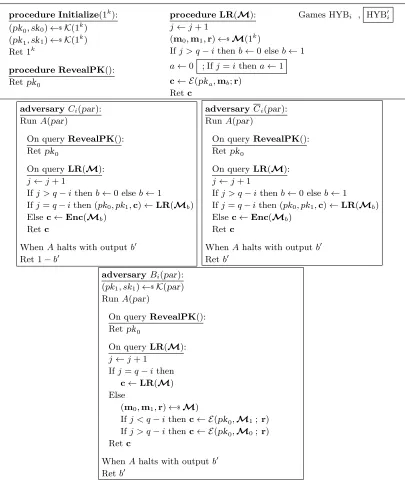
Proof of Theorem 5.2: Fix a k ∈N and letq =q(k). Let A be a IND-CDA adversary against AE. We perform a hybrid argument to bound A’s advantage. Let HYB0,· · · ,HYBq be a sequence of hybrid
games that work as shown in Figure 4 (boxed statement omitted). In game HYBi the first q−i LR
queries are answered using the m1 vector and the last iLR queries are answered using the m0 vector.
Note that HYB0 = CDA1 while HYBq = CDA0. Also defined in Figure 4 are games HYB00, . . . ,HYB0q.
Each HYB0i is the same as HYBi except that a distinct key is used to answer the (q−i)th LRquery. Let
hi = Pr
HYBAi ⇒1
for 0≤i≤ q and let h0i = Pr
HYB0iA⇒1
for 0≤i≤q. Then a union bound gives that
AdvcdaAE,A(k) = X
0≤i≤q−1
(hi−h0i+h
0
i−h
0
i+1+h 0
i+1−hi+1)
= X
0≤i≤q−1
(hi−h0i) +
X
0≤i≤q−1
(h0i−h0i+1) + X
0≤i≤q−1
(h0i+1−hi+1). (3)
We bound each of the three sums by appropriate adversaries, details of which are given in Figure 4. First we define ANON adversariesCi, parameterized byi∈[0.. q−1], and ANON adversariesCi, parameterized
by i∈[1.. q]. The difference betweenCi and Ci is that the latter outputs the complement ofA’s output
bit. By construction we have that
hi = Pr
h
ANON1Ci1 AE,k⇒1
i
and h0i= PrhANON0Ci,1 AE,k⇒1
i
fori∈[0.. q−1] and also that
h0i = PrhANON1Ci
AE,k⇒1
i
and hi= Pr
h
ANON0Ci
AE,k⇒1
i
for i∈[1.. q]. Let C be the adversary that first chooses d←${0,1} and, thenj←$[0 +d ..(q−1) +d].
It then outputs b0 ⊕d. By construction if d= 1, then C implements Cj and otherwise implements Cj.
Then we have that
q−1
X
i=0
(hi−h0i) + q
X
i=1
(h0i−hi) = q−1
X
i=0
PrhANON1Ci
AE,k⇒1
i
−PrhANON0Ci
AE,k⇒1
i + q X i=1 Pr h
ANON1Ci
AE,k⇒1
i
−Pr
h
ANON0Ci
AE,k⇒1
i
= 2q·Advanon
AE,k(C) (4)
procedure Initialize(1k):
(pk0,sk0)←$K(1k) (pk1,sk1)←$K(1k) Ret 1k
procedure RevealPK(): Retpk0
procedure LR(M): Games HYBi , HYB0i
j←j+ 1
(m0,m1,r)←$M(1k)
Ifj > q−ithenb←0 elseb←1
a←0 ; Ifj=ithena←1
c← E(pka,mb;r)
Retc
adversary Ci(par):
RunA(par)
On queryRevealPK(): Retpk0
On queryLR(M):
j←j+ 1
Ifj > q−ithenb←0 elseb←1 Ifj=q−ithen (pk0, pk1,c)←LR(Mb)
Elsec←Enc(Mb)
Retc
WhenAhalts with outputb0
Ret 1−b0
adversaryCi(par):
RunA(par)
On queryRevealPK(): Retpk0
On queryLR(M):
j←j+ 1
Ifj > q−ithenb←0 elseb←1 Ifj=q−ithen (pk0, pk1,c)←LR(Mb)
Elsec←Enc(Mb)
Retc
WhenAhalts with outputb0
Retb0
adversaryBi(par):
(pk1, sk1)←$K(par) RunA(par)
On queryRevealPK(): Retpk0
On queryLR(M):
j←j+ 1 Ifj=q−ithen
c←LR(M) Else
(m0,m1,r)←$M)
Ifj < q−ithenc← E(pk0,M1; r) Ifj > q−ithenc← E(pk0,M0; r) Retc
WhenAhalts with outputb0
Retb0
Figure 4: Hybrid games and adversaries used in proof of Theorem 5.2. For an mmr-source M, the
For the remaining sum, we define CDA adversariesBi fori∈[0.. q−1]. By construction
h0i−h0i+1 = Pr
h
CDA1Bi
AE,k⇒1
i
−Pr
h
CDA0Bi
AE,k⇒1
i
for i∈[0.. q−1]. Let B be the CDA adversary that chooses c←${0, . . . , q−1} and then executes the
code of Bc. A straightforward analysis gives that q−1
X
i=0
(h0i−h0i+1) =q·AdvcdaAE,k(B). (5) Substituting into (3) according to (4) and (5) completes the proof.
Given a non-adaptively IND-CDA secure scheme, Theorem 5.2 reduces the task of showing it adap-tively secure to that of showing it meets the ANON definition. Of course, ANON is still an adaptive notion. (Adversaries can formulate theirLR query to be a source that’s a function of previously seen ci-phertexts.) Nevertheless, it formalizes a sufficient condition for adaptive CDA security of any PKE scheme and captures the relationship between adaptivity and anonymity. We believe this is an interesting (and novel) application of anonymity.
Universal LTDFs are anonymous. We now establish that u-LTDFs are anonymous. While this result might also be of general interest, it will be specifically useful for schemes based on u-LTDFs. Intuitively u-LTDFs are anonymous because the lossy mode admits a universal hash, implying that no information about the public key is leaked by outputs (generated from sources with high conditional min-entropy). One might expect that formalizing this intuition would follow from straightforward application of the Leftover Hash Lemma (LHL) [28]. However our anonymity definitions are adaptive, so one cannot apply the LHL (or even the generalized LHL [18]) directly. Rather, we first show an adaptive variant of the LHL is implied by the standard LHL via a hybrid argument. See Appendix A for details. Here we use it to prove the following theorem.
Theorem 5.3 LetAEd = (Pd,Kd,Ed,Dd) be a (deterministic) encryption scheme with message length
n(·) and an associated universal-inducing (n, `)-lossy key generator Kl. Let A be an ANON adversary making q(·) Enc queries and a single LR query, each of these being a (µ, v, n)-m-block-source. Then there exists LOS adversary B such that for allk
AdvanonAE
d,A(k)≤2·Adv los
AEd,B(k) + 3·q(k)·v(k)·
p
2n(k)−`(k)−µ(k) . B runs in time that of A.
Before giving the proof, we first considerRtDandPtDwhen instantiated with a deterministic encryption scheme that is a u-LTDF. We can apply Theorem 5.3 to conclude ANON security for both schemes. Combining this with Theorems 6.2 and 5.2 yields proof of adaptive hedge security for RtD. Likewise, combining it with Theorems 6.3 and 5.2 yields proof of adaptive hedge security forPtD. Also Theorems 5.2 and 5.3 combine with [11, Th. 5.1] to give the first adaptively-secure deterministic encryption scheme (based on u-LTDFs).
Proof of of Theorem 5.3: LetK0 denote Kd and K1 denote Kl. We define games Hα,β,a forα, β, a∈
{0,1}. For α, β, a ∈ {0,1} let p(α, β, a) = Pr
HAα,β,a(k)⇒1
. Here α selects between the normal or universal modes for pk0,β selects between the normal and universal modes forpk1, and aselects which of pk0 orpk1 is used to respond to theLR query ofA. Then
AdvanonAE,A(k) = p(0,0,1)−p(0,0,0)
= p(0,0,1)−p(1,1,1)
+ p(1,1,1)−p(1,1,0)
+ p(1,1,0)−p(0,0,0)
.
procedure Initialize(1k):
(pk0, sk0)←$Kα(1k) (pk1, sk1)←$Kβ(1k)
procedure Enc(M): (m,r)←$M
c← Ed(pk0,rkm) Retc
procedure LR(M):
m←$M
c← Ed(pka,m)
Ret (pk0, pk1,c)
Game Hα,β,a procedure Finalize(a0): Reta0
Figure 5: Games Hα,β,a forα, β, a∈ {0,1}used in the proof that any universal LTDF is anonymous.
Ba(pk0, pk1). It runsA. WhenA makes query Enc(M) it lets m←$Mand returns Ed(pk0,m) to A.
When A makes queryLR(M) it lets m←$M and c← Ed(pka,m) and returns (pk0, pk1,c) to A. Let ddenote the output of A. ThenB0 returns 1−dand B1 returnsd.
Define game R to be work like games H1,1,a except that all queries are answered by selectingc[i]←$Rfor
1≤i≤ |m|(instead of applyingEdtom). HereRis the range ofH= (Kl,Ed). LetpR= Pr[RA(k)⇒1].
Now we bound
p(1,1,1)−p(1,1,0) = p(1,1,1)−pR
+ pR−p(1,1,0)
term by term.
We design LH adversary A0 so that pR −p(1,1,0) ≤ AdvalhH,A0(k). Adversary A0 first computes
(pk1, sk1)←$K1(1k). It runs A, forwarding any Enc query M of A to its RoR oracle and
return-ing the result. It forwards any LR query of A to its RoR oracle gets back c, queries RevealPK to retrieve pk0, and returns (pk0, pk1,c) to A. It outputs whatA outputs.
We design LH adversary A1 so that p(1,1,1)− pR ≤ AdvalhH,A1(k). Adversary A1 first computes
(pk0, sk0)←$K1(1k). It runsA. WhenAmakesEncqueryMit lets m←$Mandc← Ed(pk0,m) and
returns c toA. WhenA makesLR query Mit queries its RoRoracle to get c, queries RevealPKto get pk1, and returns (pk0, pk1,c) to A. It outputs whatA outputs.
6
Constructions of Hedged Public-key Encryption
We now build hedged public-key encryption schemes. These are schemes that simultaneously achieve IND-CPA security and IND-CDA security. Such schemes do not sacrifice any security when randomness is good, but should randomness be poor, IND-CDA provides another line of defense. We start with schemes in the RO model which are easy to deploy and fast. We then analyze constructions that can achieve security in the standard model.
6.1 Hedging in the Random Oracle Model
Randomized-encrypt-with-hash. Let AEr = (Pr,Kr,Er,Dr) be a (randomized) PKE scheme with
message length nr(·) and randomness length ρ(·). Let R : {0,1}∗ → {0,1}∗ be a random oracle. Let REwH[AEr] = (Pr,K,E,Dr) be the scheme parametrized by randomizer length κ that works as follows.
Parameter generation and decryption are the same as in AEr. Key generation, on input parr, runs
Kr(parr) to get (pkr,skr), chooses K←${0,1}κ(k), and lets pk = (pkr,K) and sk =skr. Encryption is
defined by
ER((pkr,K), m; r) =Er(pkr, m; r 0
) where r0 is the first ρ(k) bits of R(pkrkKkrkm).
is 0. The scheme is also reminiscent of constructions in the symmetric setting that utilize a PRF to ensure good randomness [29, 36], as well as schemes using the Fujisaki-Okamoto transform [21].
REwH is hedge secure. The next theorem will establish the hedge security of REwH for various instantiations. The scheme achieves non-adaptive IND-CDA security when AEr is IND-CPA. It achieves adaptive IND-CDA security when AEr is additionally key-anonymous in the sense of [4] or when the
randomizer length κ is sufficiently large (e.g.,κ(k)≥k).
Theorem 6.1 [REwH is H-IND secure] Let AEr = (Pr,Kr,Er,Dr) be a PKE scheme with message length n(·) and randomness length ρ and let AE = REwH[AEr] = (Pr,Kr,E,Dr) be the PKE scheme
constructed from it.
• (IND-CPA) LetA be an IND-CPA adversary Then there exists an IND-CPA adversaryB such that for all k
AdvindAE-,Acpa(k)≤2·AdvindAEr-cpa,B (k) where B runs in time at most max{Time(A),2h·Time(Er)}.
• (IND-CDA) LetAbe an adversary that makesq(·)LRqueries each consisting of a distinct (µ, v, n, ρ
)-mmr-source and making at mosth(·) random oracle queries. Then there exists an IND-CPA adversary
B such that for allk
AdvAEcda,A(k)≤2·AdvAErind-cpa,B (k) +(q(k))
2v(k) +h(k)
2µ(k) +χ
where
χ=
min
h(k) 2κ(k),Adv
kr-uma AEr,C (k)
ifq(·)6= 1
h(k)·maxpkAEr(k)
2κ(k) ifq(·) = 1
Adversary B runs in time at most that of A and makesq(k)v(k) queries. AdversaryC runs in time at most that ofA and makesq(k)v(k) Encqueries and h(k) Check queries.
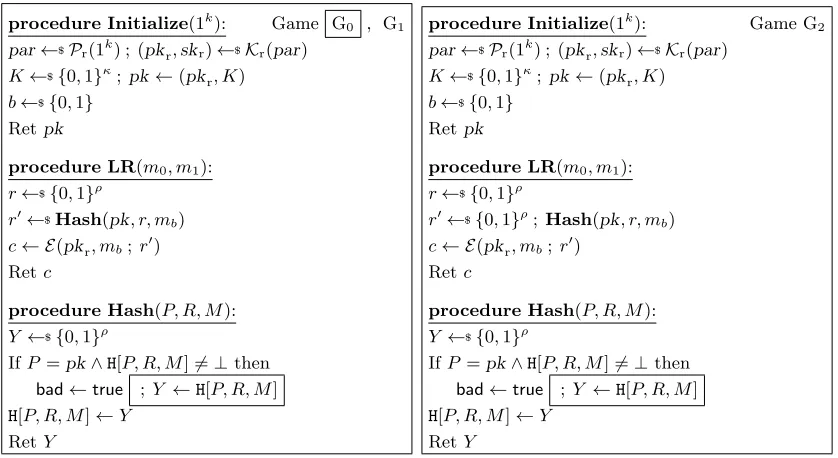
Proof: Fix some k ∈ N and let q = q(k), v = v(k), κ = κ(k), and n = n(k). We begin by proving the IND-CPA portion of the theorem. Let A be an IND-CPA adversary that makes one LR query and does not repeat any Hash queries (this is without loss of generality). Games G0, G1, and G2 are
shown in Figure 6. All the games include a Finalize procedure (not shown explicitly) that is the same as the IND-CPA Finalize procedure. Game G0 (boxed statement included) implements exactly the
IND-CPAAE,k game. Game G1 removes the boxed statement, which ensured consistency between the use
of Hash inLR and with direct queries to Hashby A. In G1, independent randomness (which is never
used again in the game) is used to encrypt the challenge message. Game G2 makes this explicit. We will
now justify that
AdvindAE-,Acpa(k) = 2·Pr
IND-CPAAAE,k ⇒true
−1
= 2·PrGA0 ⇒true−1 (6)
≤2· Pr
GA1 ⇒true
+ Pr
GA1 setsbad
−1 (7)
= 2· PrGA2 ⇒true+ PrGA2 setsbad −1 (8) ≤2·PrhIND-CPAB1
AEr,k ⇒true
i
+ PrhIND-CPAB2
AEr,k⇒true
i
−1 (9)
= 2·AdvindAEr-cpa,B (k) (10)
By construction G0 is equivalent to INDAE,k, justifying (6). The fundamental lemma of game-playing [8]
procedure Initialize(1k): Game G
0 , G1
par←$Pr(1k) ; (pk
r,skr)←$Kr(par)
K←${0,1}κ;pk←(pkr, K)
b←${0,1} Retpk
procedure LR(m0, m1):
r←${0,1}ρ
r0←$Hash(pk, r, mb)
c← E(pkr, mb; r0)
Retc
procedure Hash(P, R, M):
Y ←${0,1}ρ
IfP=pk∧H[P, R, M]6=⊥then bad←true ;Y ←H[P, R, M]
H[P, R, M]←Y
RetY
procedure Initialize(1k): Game G
2
par←$Pr(1k) ; (pk
r,skr)←$Kr(par)
K←${0,1}κ; pk←(pkr, K)
b←${0,1} Retpk
procedure LR(m0, m1):
r←${0,1}ρ
r0←${0,1}ρ;Hash(pk, r, mb)
c← E(pkr, mb; r0)
Retc
procedure Hash(P, R, M):
Y ←${0,1}ρ
IfP =pk∧H[P, R, M]6=⊥then bad←true ;Y ←H[P, R, M]
H[P, R, M]←Y
RetY
Figure 6: Games used in the IND-CPA proof for Theorem 6.1.
follows. It simulates game G2 forA, using its LR oracle to answer A’s LR query. It outputs whatever
bit A outputs. Then, Pr[GA2 ⇒true] = Pr[INDB1
AEr,k ⇒true].
Since badis only set in G2 ifA queriesHash(P, R, M) withR=r and the choice ofr is independent of
the answers given to A’s queries, we have that
PrGA2 setsbad ≤ h 2ρ .
However, it is easy to construct an IND-CPA adversary against AEr that has advantage h/2ρ using
time 2·Time(Er). Let adversary B2 work as follows. It queries its LR oracle on two distinct messages m0, m1 to get back ciphertext c. It then repeats h times the following procedure: (1) choose a value r
uniformly from {0,1}ρ (but without replacement between iterations); (2) run c0 ← E
r(pkr, m0; r) and c1 ← Er(pkr, m0; r); and (3) if c =c0 let b0 = 0 or if c= c1 let b0 = 1. Finally B2 outputs b0 if it was
set during an iteration and otherwise outputs a random bit. Let “Succ” be the event that one of the values r chosen by B2 matches the randomness used in responding to theLR query. Let “nSucc” be the complementary event. We have that
PrhINDB2
AEr,k ⇒true
i
= PrhINDB2
AEr,k ⇒1 | Succ
i
·Pr [Succ] + Pr
h
INDB2
AEr,k⇒1 | nSucc
i
·Pr [nSucc] = h
2ρ +
1 2
1− h 2ρ
= h
2ρ+1 +
1 2 .
Here we have used the fact that Pr[Succ] = h/2ρ and that b0 will only be set if event Succ occurs. Applying the definition of advantage gives that AdvindAEr-cpa,k (B2) = h/2ρ ≥ Pr[GA2 setsbad]. We have justified equation (9). Let adversary B choose d←${1,2} and execute the code of Bd. Then, we have
that
Pr
INDBAEr,k⇒true
= 1 2
PrhINDB1
AEr,k ⇒true
i
+ PrhINDB2
AEr,k ⇒true
i
We now prove the IND-CDA portion of the theorem. Informally, the sequence of games moves from the setting of the IND-CDA experiment to one in which true random coins are used to answer challenge queries. This is accomplished by setting a flagbadshould the random oracle be queried on domain points colliding with the public key and challenge randomness, message pairs output by a message sampler. If
bad is never set (such a query never occurs) then the challenge encryptions can be done with random coins. Note that both message samplersMand the adversary itself can query the random oracle. While Mknows the challenge messages to be handled, we will show that the adversary (and hence, any queried M) does not know the public key pk before the query to RevealPK. This is because at least one of the following arguments: AEr is anonymous, we are considering only non-adaptive hedge security, or the randomizer has sufficient length to be unpredictable. Once we are in a setting in which true random coins are used, then we can use the IND-CPA security of AEr to conclude security.
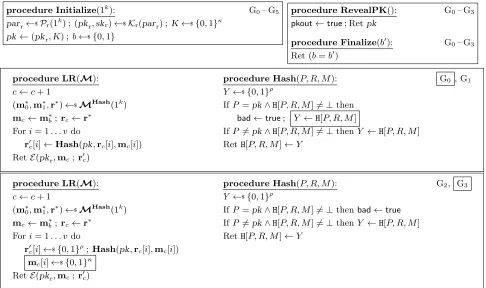
To formalize this we use a sequence of games G0−→G1 −→G2−→G3 −→G4−→G5. The games can
be found in Figures 7 and 9. We will justify the following sequence of inequalities. PrCDAAAE,k⇒true
= PrGA0 ⇒true (11)
≤ PrGA1 ⇒true+ PrGA1 setsbad (12) = PrGA2 ⇒true+ PrGA2 setsbad (13) ≤ PrGA3 ⇒true+ PrG3A setsbad + 2·AdvindAEr-cpa,B (k) (14)
= 1
2 + Pr
G3A setsbad + 2·AdvAErind-cpa,B (k). (15) Unless otherwise indicated, the Initialize,RevealPK, and Finalize procedures used in each game are those shown at the top of Figure 7. Game G0 (boxed statement included) implements game CDAAAE,k,
justifying (11). Game G1 excludes the boxed statement, which ensured consistent responses for hash
queries associated to challenge points. Since games G0 and G1 are identical-until-badwe can apply the
fundamental lemma of game-playing [8] to derive (12). In G1 removal of the boxed statement means that
the coins rc[i] used with Er are not used elsewhere in the game — the table entries H[P, R, M] storing
values rc[i] are never referred to again becauseP =pk. Game G2 (boxed statement omitted) is the same
as G1 except that queries to Hash made in the LR procedure are handled directly. This implements
the same functionality as in G1, justifying (13). In this game it is clear that Er uses randomness not
associated with any hash query. Game G3 is the same as G2 except that, now, challenge queries are
responded to by encrypting all zero messages.
We justify (14) using two IND-CPA adversaries B1 andB2 that each make qv queries. Both adversaries
runA, simulating forAexactly game G2in the case that the IND-CPA challenge bit is one and simulating
G3 in the case that the IND-CPA challenge bit is zero. It does this using its own LR oracle to answer
the A’s challenge queries. Adversary B1 uses the output bit of A to determine the IND-CPA challenge
bit. Adversary B2 uses whetherbad was set to true in the course of the game; if so it guesses that the IND-CPA challenge bit was set to 1. By construction then we have that
Pr
GA2 ⇒true
= PrhIND1B1
AEr,k ⇒1
i
and Pr
GA3 ⇒true
= PrhIND0B1
AEr,k ⇒1
i
and that Pr
GA2 setsbad
= PrhIND1B2
AEr,k ⇒1
i
and Pr
GA3 setsbad
= PrhIND0B2
AEr,k ⇒1
i
.
Let B choose d←${1,2}and execute Bd. Then a standard argument justifies (14).
In game G3 the responses to queries by adversary A are independent of the challenge bit b. Thus
Pr[GA3 ⇒true] = 1/2, justifying (15).
All that remains is to bound the probability that badis set in game G3. In game G3 all query responses
procedure Initialize(1k): G0– G5
parr←$Pr(1k) ; (pkr,skr)←$Kr(parr) ; K←${0,1}
κ
pk←(pkr,K) ; b←${0,1}
procedure RevealPK(): G0– G3 pkout←true; Retpk
procedure Finalize(b0): G0– G3 Ret (b=b0)
procedure LR(M):
c←c+ 1 (m∗0,m
∗ 1,r
∗
)←$MHash(1k)
mc←m∗b;rc←r∗
Fori= 1. . . vdo
r0c[i]←Hash(pk,rc[i],mc[i])
RetE(pkr,mc;r0c)
procedure Hash(P, R, M): G0 , G1
Y ←${0,1}ρ
IfP=pk∧H[P, R, M]6=⊥then bad←true; Y ←H[P, R, M]
IfP6=pk∧H[P, R, M]6=⊥thenY ←H[P, R, M] RetH[P, R, M]←Y
procedure LR(M):
c←c+ 1 (m∗0,m
∗ 1,r
∗
)←$MHash(1k)
mc←m∗b;rc←r∗
Fori= 1. . . vdo
r0c[i]←${0,1}ρ;Hash(pk,rc[i],mc[i]) mc[i]←${0,1}n
RetE(pkr,mc;r0c)
procedure Hash(P, R, M): G2, G3
Y ←${0,1}ρ
IfP=pk∧H[P, R, M]6=⊥thenbad←true IfP6=pk∧H[P, R, M]6=⊥thenY ←H[P, R, M] RetH[P, R, M]←Y
Figure 7: Games used in the IND-CDA proof for Theorem 6.1.
algorithms are executed in RevealPK. The hash queries associated to the resulting challenge message, randomness pairs are deferred untilFinalize. Any sequence of queries that lead tobadbeing set in game G3 results inbadbeing set in game G4, meaning that Pr[G3 setsbad] = Pr[G4 setsbad].
In game G5 (Figure 9, boxed statement excluded) we split the setting ofbadinto two cases. Flag bad1 is
set in the case that pkouthas not yet been set, while flagbad2 is set in the case thatpkout has been set
to true. Note that for the former we have dropped the requirement that H[P, R, M]6=⊥for queries that occur before pkout is set. Moreover, we emphasize that hash queries from an execution of M happen beforepkoutis set while the hash queries related to resulting challenge message, randomness pairs happen after pkout is set. Game G6 is the same as G5 except that the boxed statement is included. It follows bad1 being set, however, so G5 and G6 are identical-until-bad1. We have that
PrGA4 setsbad ≤ PrGA5 setsbad1 ∨GA5 setsbad2
= Pr
GA6 setsbad1 ∨GA6 setsbad2
≤ PrGA6 setsbad1
+ PrGA6 setsbad2
.
We bound the probability of setting each flag in turn.
Upper bound on setting bad2. We start with bounding the probability of setting bad2, which
cor-responds to a hash query made after the public key is revealed. Note that in game G6 no query after pkout =true can set bad2 because of a query made when pkout=false. In particular, no queries made
by a message sampler M set H[pk,·,·] entries. Thus the setting of bad2 can only occur because of an A query and a query made inFinalize are the same or because two queries in Finalize are the same. More formally, the cases are: (1) there exists values 1≤u≤c and 1≤y ≤v such that a previous query Hash(P, R, M) withR =ru[y] and M =mu[y] was made byA; or (2) there exists values 1≤t < u≤c