A Distributed Three-hop Routing Protocol to
Increase throughput and makes full use of
widespread base station in Hybrid Wireless
Networks
Dr.V.Goutham1, Mrs.P.Jyothi2, K.Tejasvi3
1,2,3
Department of Computer Science and Engineering, Teegala Krishna Reddy Engineering College,
Meerpet, Telangana, India
Abstract- An proficient data routing protocol is significant in such networks for elevation in terms of network capacity and scalability. Hybrid wireless networks conjoining the recompenses of both mobile ad-hoc networks and arrangement wireless networks have been getting augmented consideration due to their ultra-high recital. Conversely, most routing protocols for these networks merely cartel the ad-hoc transmission mode with the cellular transmission mode, which receives the hitches of ad-hoc transmission. A Distributed Three-hop Routing Protocol to upsurge throughput and makes full routine of pervasive base station in Hybrid Wireless Networks presents a Distributed Three-hop Routing protocol (DTR) for hybrid wireless networks. DTR divides a message data stream into segments and transmits the segments in a distributed manner and makes full spatial reuse of a system via its high speed ad-hoc interface and relieves mobile gateway congestion via its cellular interface. Additionally, sending segments to a number of base stations simultaneously increases throughput and makes full use of widespread base stations. DTR significantly reduces overhead due to short path lengths and the elimination of route discovery and maintenance. DTR also has a congestion control algorithm to avoid overloading base stations.
Keywords- Hybrid wireless networks, Routing algorithm, Load balancing, Congestion control
I. INTRODUCTION
The growing desire to increase wireless network capacity for high performance applications has stimulated the development of hybrid wireless networks [6].A hybrid wireless network entails in cooperation an infrastructure wireless network and a mobile ad-hoc network. Wireless devices such as smart-phones, tablets and laptops, have both an infrastructure interface and an adhoc interface. As the number of such devices has been increasing sharply in recent years, a hybrid transmission structure will be widely used in the near future. Such a structure synergistically combines the inherent advantages and overcome the drawbacks of the infrastructure wireless networks and mobile ad-hoc networks. In a mobile ad-hoc network, with the absence of a central control infrastructure, data is routed to its destination through the intermediate nodes in a multi-hop manner. The multi-multi-hop routing needs on-demand route
discovery or route maintenance [10]. Since the messages are transmitted in wireless channels and through dynamic routing paths, mobile ad-hoc networks are not as reliable as infrastructure wireless networks. Additionally, because of the multi-hop transmission feature, mobile ad-hoc networks are only suitable for local area data transmission. The infrastructure wireless network (e.g. cellular network) is the major means of wireless communication in our daily lives. It excels at inter-cell communication and Internet access. It makes possible to maintain the universal network connectivity and ubiquitous computing by assimilating all kinds of wireless devices into the network. In an infrastructure network, nodes communicate with each other through base stations (BSes). Because of the long distance one-hop diffusion between BSes and mobile nodes, the infrastructure wireless networks can provide higher message transmission reliability and channel access efficiency, but suffer from higher power consumption on mobile nodes and the single point of failure problem [11]. A hybrid wireless network synergistically syndicates an infrastructure wireless network and a mobile adhoc network to influence their advantages and overcome their shortcomings, and lastly upsurges the throughput capacity of a wide-area wireless network. A routing protocol is a precarious component that affects the throughput capacity of a wireless network in data transmission.
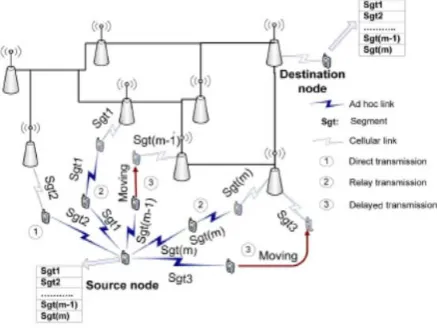
Taking advantage of this feature, we propose a Distributed Three-hop Data Routing protocol (DTR). In DTR, a source node divides a message stream into a number of segments. Each segment is sent to a neighbor mobile node. Based on the QoS requirement, these mobile relay nodes choose between direct transmissions or relay transmission to the BS. In relay transmission, a segment is forwarded to another mobile node with higher capacity to a BS than the current node. In direct transmission, a segment is directly forwarded to a BS. In the infrastructure, the segments are reorganised in their original order and sent to the destination. The number of routing hops in DTR is confined to three, including at most two hops in the ad-hoc transmission mode and one hop in the cellular transmission mode. To overcome the aforementioned shortcomings, DTR tries to limit the number of hops. The first hop forwarding distributes the segments of a message in different directions to fully utilize the resources, and the possible second hop forwarding ensures the high capacity of the forwarder. DTR also has a congestion control algorithm to balance the traffic load between the nearby BSes in order to avoid traffic congestion at BSes. Using self-adaptive and distributed routing with highspeed and short-path ad-hoc transmission, DTR significantly increases the throughput capacity and scalability of hybrid wireless networks by overcoming the three shortcomings of the previous routing algorithms. It has the following features_ Low overhead. It eliminates overhead caused by route discovery and maintenance in the ad-hoc transmission mode, especially in a dynamic environment. Hot spot reduction. It alleviates traffic congestion a mobile gateway nodes while makes full use of channel resources through a distributed multi-path relay. High reliability. Because of its small hop path length with a short physical distance in each step, it alleviates noise and neighbor interference and avoids the adverse effect of route breakdown during data transmission.
II. RELATED WORK
In order to increase the capacity of hybrid wireless networks, various routing methods with different features have been proposed. One group of routing methods integrate the ad-hoc transmission mode and the cellular transmission mode [1,]Dousse et al. [6] built a Poisson Boolean model to study how a BS increases the capacity of a MANET. Lin et al. [5] proposed a Multihop Cellular Network and derived its throughput. Hsieh et al. [14] investigated a hybrid IEEE 802.11 network architecture with both a distributed coordination function and a point coordination function. Luo et al. [1] proposed a unified cellular and ad-hoc network architecture for wireless communication. Cho et al. [16] studied the impact of concurrent transmission in a downlink direction (i.e. from BSes to mobile nodes) on the system capacity of a hybrid wireless network. In [17, 18], a node initially communicates with other nodes using an ad-hoc transmission mode, and switches to a cellular transmission mode when its performance is better than the ad-hoc transmission. The above methods are only used to assist intra-cell ad-hoc transmission rather than inter-cell
transmission. In inter-cell transmission [1, 5, 6], a message is forwarded via the ad-hoc interface to the gateway mobile node that is closest to or has the highest uplink transmission bandwidth to a BS. The gateway mobile node then forwards the message to the BS using the cellular interface. However, most of these routing protocols simply combine routing schemes in ad-hoc networks and infrastructure networks, hence inherit the drawbacks of the ad-hoc transmission mode as explained previously. DTR is similar to the Two-hop transmission protocol [19] in terms of the elimination of route maintenance and the limited number of hops in routing. In Two-hop, when a node’s bandwidth to a BS is larger than that of each neighbor, it directly sends a message to the BS. N Otherwise, it chooses a neighbor with a higher channel and sends a message to it, which further forwards the message to the BS. DTR is different from Two-hop in three aspects. First, Two-hop only considers the node transmission within a single cell, while DTR can also deal with inter-cell transmission, which is more challenging and more common than intra-cell communication in the real world. Second, DTR uses distributed transmission involving multiple cells, which makes full use of system resources and dynamically balances the traffic load between neighboring cells. In contrast, Two-hop employs single-path transmission.
Fig. 2: Data transmission in the DTR protocol
The throughput capacity of the hybrid wireless network under different settings has also been an active research topic in the hybrid wireless network. The works in [7] have studied the throughput of hybrid network with n nodes and m stations. Liu et al. [8] theoretically studied the capacity of hybrid wireless networks under an one-dimensional network topology and a two dimensional strip topology. Wang et al. [9] studied the multicast throughput of hybrid wireless networks and designed an optimal multicast strategy based on deduced throughput.
III. DISTRIBUTED THREE-HOP ROUTING PROTOCOL
3.1 Assumption and Overview
an infrastructure wireless network and a mobile ad-hoc network. We assume every mobile node is dual-mode; that is, it has ad-hoc network interface such as a WLAN radio interface and infrastructure network interface such as a 3G cellular interface. DTR aims to shift the routing burden from the adhoc network to the infrastructure network by taking advantage of widespread base stations in a hybrid wireless network. Rather than using one multi-hop path to forward a message to one BS, DTR uses at most two hops to relay the segments of a message to different BSes in a distributed manner, and relies on BSes to combine the segments. When a source node wants to transmit a message stream to a destination node, it divides the message stream into a number of partial streams called segments and transmits each segment to a neighbor node. Our DTR algorithm avoids the shortcomings of adhoc transmission in the previous routing algorithms that directly combine an ad-hoc transmission mode and a cellular transmission mode. Rather than using the multihop ad-hoc transmission, DTR uses two hop forwarding by relying on node movement and widespread base stations. All other aspects remain the same as those in the previous routing algorithms (including the interaction with the TCP layer). DTR works on the Internet layer. It receives packets from the TCP layer and routes it to the destination node, where DTR forwards the packet to the TCP layer. The data routing process in DTR can be divided into two steps: uplink from a source node to the first BS and downlink from the final BS to the data’s destination. Critical problems that need to be solved include how a source node or relay node chooses nodes for efficient segment forwarding, and how to ensure that the final BS sends segments in the right order so that a destination node receives the correct data. Also, since traffic is not evenly distributed in the network, how to avoid overloading BSes is another problem. Below, Section 3.2 will present the details for forwarding node selection in uplink transmission and Section 3.3 will present the segment structure that helps ensure the correct final order of segments in a message, and DTR’s strategy for downlink transmission. Section 3.4 will present the congestion control algorithm for balancing a load between BSes.
3.2 Uplink Data Routing
A long routing path will lead to high overhead, hot spots and low reliability.DTR tries to limit the path length. It uses one hop to forward the segments of a message in a distributed manner and uses another hop to find high-capacity forwarder for high performance routing. As a result, DTR limits the path length of uplink routing to two hops in order to avoid the problems of long-path multi-hop routing in the ad-hoc networks. Explicitly, in the uplink routing, a source node initially divides its message stream into a number of segments, then transmits the segments to its neighbor nodes. The neighbor nodes onward segments to BSes, which will forward the segments to the BS where the destination resides. Below, we first explicate how to delineate capacity, then introduce the way for a node to collect the capacity information from its neighbors, and lastly present the details of the DTR routing algorithm. Throughput can be measured by bandwidth, mobility can
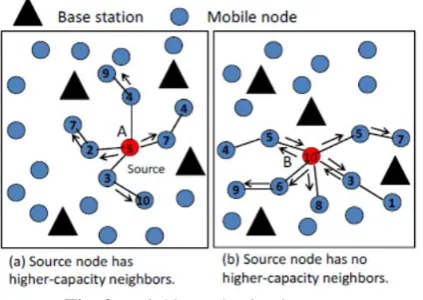
be measured by the speed of node movement, and routing speed can be measured by the speed of data forwarding. Bandwidth can be estimated using the nonintrusive technique proposed in [13]. In this work, we take throughput and routing speed as examples for nthe QoS requirement. We use a bandwidth/queue metric to reflect node capacity in throughput and fast data forwarding. The metric is the ratio of a node’s channel bandwidth to its message queue size. A larger bandwidth/ queue value means higher throughput and message forwarding speed, and vice versa. When electing neighbors for data forwarding, a node needs the capacity information (i.e., queue size and bandwidth) of its neighbors. Also, a selected neighbor should have enough storage space for a segment. To keep track of the capacity and storage space of its neighbors, each node periodically exchanges its current capacity and storage information with its neighbors. In the adhoc network component, every node needs to periodically send “hello” messages to identify its neighbors. Taking Advantage of this policy, nodes piggyback the capacity and storage information onto the “hello” messages in order to reduce the overhead caused by the information exchanges. If a node’s capacity and storage space are altered after its last “hello” message sending when it receives a segment, it sends its current capacity and storage information to the segment forwarder. Then, the segment forwarder will choose the highest capacity nodes in its neighbors based on the most restructured information.
Fig. 3: Neighbor selection in DTR.
IV. IMPLEMENTATION
sends it to the destination mobile node. A robust issue is guaranteeing that the segments are combined in the correct order. For this persistence, DTR specifies the segment structure format. Each segment contains eight fields, including:
(1) source node IP address(denoted by S) (2) destination node IP address(denoted by D) (3) message sequence number (denoted by m) (4) segment sequence number (denoted by s); (5) QoS indication number (denoted by q); (6) data;
(7)length of the data; and (8) checksum.
Fields (1)-(5) are in the segment head. The part of the source IP address field is to inform the destination node where the message comes from. The destination IP address field indicates the destination node, and is used to locate the final BS. After sending out a message stream to a destination, a source node may send out another message stream to the same destination node. The message sequence number differentiates the different message streams initiated by the same source node. The segment sequence number is used to find the correct transmission sequence of the segments for transmission to a destination node. The data is the actual information that a source node wants to transmit to a destination node. The length field specifies the length of the DTR segment including the header in bytes. The checksum is used by the receiver node to check whether the received data has errors. The QoS indication number is used to indicate the QoS requirement of the application. Thus, each segment’s head includes the information represented by (S;D; m; s; q)(m; s = 1; 2; 3; :::). When a segment with head (S;D; m; s; q) arrives at a BS, the BS contacts D’s home BS to find the destination BS where D stays via the mobile IP protocol. It then transmits the Segment to the destination BS through the infrastructure[20] network component. After arriving at the BS, the segment waits in the[14] cache for its turn to be transmitted to its destination node based on its message and segment sequence numbers. At this time, if another segment comes with a head labeled (S;D; (m + 1); s; q), which means that it is from the same source node but belongs to another data stream, the BS will put it to another stream[13]. If the segment is labeled as (S;D; m; (s+1); q), it means that this segment belongs to the same data stream of the same source node as segment (S;D; m; s; q). The combination of the source node’s sequence number and segment sequence number helps to locate the stream and the position of a segment in the steam. In order to integrate the segments into their correct order to retrieve the original data, the segments in the BS are transmitted to the destination node in the order of the segments’ [15] sequence in the original message. If a segment has not arrived at the final BS, its subsequent segments will wait in the final BS until its arrival.
V. EXPERIMENTAL EVALUATION
node selects the better transmission mode between direct transmission and relay transmission. If the source node can find a neighbor that has higher bandwidth to the BS than itself, it transmits the message to the neighbor [16]. Otherwise, it in a straight line conveys the message to the BS. The pretend network consists of 50 mobile nodes and 4 BSes. In the adhoc component of the hybrid wireless network, mobile nodes are randomly deployed around the BSes in a field of 1000_1000 square meters. We used the Distributed Coordination Function (DCF) of the IEEE 802:11 as the MAC layer protocol. The transmission range of the cellular interface was set to 250 meters, and the raw physical link bandwidth was set to 2Mbits/s. The transmission power of the ad-hoc interface was set to the minimum value required to keep the network linked for most times, even when nodes are in motion in the network. Then, the influence of the transmission range on different methods’ performance is controlled. Specifically, we set the transmission range through the ad-hoc interface to 1.5 times of the average distance between neighboring nodes, which can be obtained by measuring the simulated network. We used the two-ray propagation model for the physical layer model. Constant bit rate (CBR) was nominated as the traffic mode in the experiment with a rate of 640kbps. In the experiment, we randomly chose 4 source nodes to constantly send messages to randomly elected destination nodes. The number of channels for each BS was set to 10. We expected that there was no capacity degradation during transmission between BSes. This hypothesis is realistic considering the advanced technologies and hardware presently used in wired infrastructure networks. There was no message retransmission for unsuccessful transmissions in the experiments. We employed the random way-point mobility model [17] to generate the moving direction, speed, and pause duration of each node. In this model, each node moves to a random position with a speed randomly chosen from. The pause time of each node was set to 0.
Fig. 4: Throughput vs. network size (simulation).
Fig. 5: Delay vs. network size.
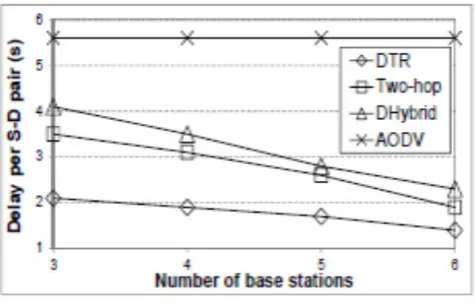
Fig. 6: Delay vs. number of BSes.
We set the number of segments of a message to the connection degree of the source node. The simulation warm up time was set to 100s and the simulation time was set to 1000s. We conducted the experiments 5 times and used the average value as the final experimental result. To make the methods comparable, we did not use the congestion control algorithm in DTR unless otherwise indicated. The short routing paths in Two-hop reduce congestion and signal interference, thus enabling better spatial reuse as in DTR. Meanwhile, Two-hop enables nodes to adaptively switch between direct transmission and relay transmission.[18]Hence, part of the transmission load is transferred to relay nodes, which carry the messages until meeting the BSes. As a result, gateway nodes connecting mobile nodes and BSes are not easily overloaded [19]. Therefore, the throughput of two-hop is higher than DHybrid.
VII.CONCLUSION
REFERENCES
[1] H Luo, R. Ramjee, P. Sinha, L. Li, and S. Lu. Ucan: A unified cell and ad-hoc network architecture. In Proc. of MOBICOM, 2003. [2] P. K. McKinley, H. Xu, A. H. Esfahanian, and L. M. Ni.
Unicastbased multicast communication in wormhole-routed direct networks. TPDS, 1992.
[3] H. Wu, C. Qiao, S. De, and O. Tonguz. Integrated cell and ad hoc relaying systems: iCAR. J-SAC, 2001.
[4] Y. H. Tam, H. S. Hassanein, S. G. Akl, and R. Benkoczi. Optimal multi-hop cellular architecture for wireless communications. In Proc. of LCN, 2006.
[5] Y. D. Lin and Y. C. Hsu. Multi-hop cellular: A new architecture for wireless communications. In Proc. of INFOCOM, 2000.
[6] P. T. Oliver, Dousse, and M. Hasler. Connectivity in ad hoc and hybrid networks. In Proc. of INFOCOM, 2002.
[7] E. P. Charles and P. Bhagwat. Highly dynamic destination sequenced distance vector routing (DSDV) for mobile computers. In Proc. of SIGCOMM, 1994.
[8] C. Perkins, E. Belding-Royer, and S. Das. RFC 3561: Ad hoc on demand distance vector (AODV) routing. Technical report, Internet Engineering Task Force, 2003.
[9] D. B. Johnson and D. A. Maltz. Dynamic source routing in ad hoc wireless networks. IEEE Mobile Computing, 1996.
[10] V. D. Park and M. Scott Corson. A highly adaptive distributed routing algorithm for mobile wireless networks. In Proc. Of INFOCOM, 1997.
[11] R. S. Chang, W. Y. Chen, and Y. F. Wen. Hybrid wireless network protocols. IEEE Transaction on Vehicular Technology, 2003. [12] G. N. Aggelou and R. Tafazolli. On the relaying capacity of
nextgeneration gsm cellular networks. IEEE Personal Communications Magazine, 2001.
[13] T. Rouse, I. Band, and S. McLaughlin. Capacity and power investigation of opportunity driven multiple access (ODMA) networks in TDD-CDMA based systems. In Proc. of ICC, 2002. [14] H. Y. Hsieh and R. Sivakumar. On Using the Ad-hoc Network
Model in Wireless Packet Data Networks. In Proc. of MOBIHOC, 2002.
[15] L. M. Feeney, B. Cetin, D. Hollos, M. Kubisch, S. Mengesha, and H. Karl. Multi-rate relaying for performance improvement in ieee 802.11 wlans. In Proc. of WWIC, 2007.
[16] J. Cho and Z. J. Haas. On the throughput enhancement of the downstream channel in cellular radio networks through multihop relaying. IEEE JSAC, 2004.
[17] B. Liu, Z. Liu, and D. Towsley. On the capacity of hybrid wireless networks. In Proc. of INFOCOM, 2003.
[18] H. Y. Hsieh and R. Sivakumar. A hybrid network model for wireless packet data networks. In Proc. of GLOBECOM, 2002.
[19] Y. Wei and D. Gitlin. Two-hop-relay architecture for nextgeneration WWAN/WLAN integration. IEEE Wireless Communication, 2004. [20] X. J. Li, B. C. Seet, and P. H. J. Chong. Multihop cellular networks:
Technology and economics. Computer Networks, 2008.
[21] B. Bengfort, W. Zhang, and X. Du. Efficient resource allocation in hybrid wireless networks. In Proc. of WCNC, 2011.
AUTHORS
[1] Dr V. Goutham is a Professor and Head of the Department of Computer Science and Engineering at Teegala Krishna Reddy Engineering College affiliated to J.N.T.U Hyderabad. He received Ph.d from Aacharya Nagarjuna University, M.Tech from Andhra University and B.Tech from J.N.T.U Hyderabad. He worked for various MNC Companies in Software Testing and Quality as Senior Test Engineer. His research interests are Software Reliability Engineering, software testing, software Metrics, and cloud computing.
[2] Mrs.P.Jyothiis working as a Assistant Professor in the Department of computer Science and Engineering at Teegala Krishna Reddy Engineering College affiliated to J.N.T.U Hyderabad.