HYBRID SOLAR/WIND GENARATION
CONTROLLED BY FUZZY SYSTEM BASED STATIC
VAR CONTROLLER (SVC)
Shadab Shakeel
1, Ameenuddin Ahmed
2 1Student,M.Tech,
2Assistant Prof.,Department of Electrical & Electronics Engineering,
Al-falah University, (India)
ABSTRACT
In today’s growing phase where there is a limit of non-renewable source of energy we have to move towards
renewable source of energy for the production of electricity. Till now various methods have been observed for
generation of electricity using renewable sources of energy like Solar power, Wind energy, Hydro power etc.
While some have extended towards making the Hybrid model of above given sources of energy for generation.
In this paper we have explained the hybrid model of wind and solar by using Fuzzy based SVC to achieve a pure
sinosodial output. SVC has been used as a controlled device to control the output waveform of the hybrid
system and to minimize the effect of reactive power. The essential feature of the SVC is that it has the ability to
absorb or inject the reactive power with power grid at a faster rate. SVC also helps in restoring the stability and
controlling the voltage dip after severe disturbances such as faults or wind farm mechanical power variation. It
injects or absorbs the reactive power through a voltage source converter very rapidly. Its multi pulse
configuration generates voltage waveforms with lesser harmonics in it. The SVC’s dynamic response is very fast and is able to pass from capacitive to inductive mode of operation in few cycles. When the ac voltage of the
system decreases the SVC reacts by injecting reactive power in the system and the SVC is said to be in
capacitive mode. The dynamic model of the proposed system is simulated using Simulink MATLAB software. To
validate the effect of SVC the solar wind hybrid system is subjected to different disturbances. Here I have used
SVC in conjugation with solar and wind hybrid model to show the controlled output. The SVC here is controlled
by fuzzy logic controller.
Keywords: SVC, Fuzzy Logic Controller, Wind Energy, Solar Energy, MATLAB, Reactive Power.
I. INTRODUCTION
of energy that gives us replacement of oil, coal and gas .The radiations that are radiating from the sun is absorbed by the earth’s atmosphere that is equal to 3.8 ẋ 10 24 J .The radiations that are radiating from the sun
has to go through the different layers of atmosphere to the earth’s surface, while going through the different atmospheric layer there are various dust particles, gas molecules that decreases the concentration of radiation, But there may occur a failure in the system of solar panel or in the sites which are remotely located wind turbines or wave energy converter which might have temporary inconvenience but this effect is not long-lasting damage, and can be easily rectified whenever we require, but there are various several major consequences that could direct us a major failure of large hydroelectric dam, damage of methane digester or fire in a biomass plantation .Anything that is in the world implies the flow of energy in one of energy into different form of energy .Word energy can be described as an input source for any type of body or for the machines .Thus crude fuels, natural gas, oil, electric energy and nuclear energy are the main sources of energy. Solar energy, windenergy, water energy are the other forms of energy source. In this paper a hybrid model of solar and wind is developed by using fuzzy system based on SVC. In this paper, it is an effective way to get the electric power by integrating the Hybrid solar/wind generating system and then regulated and stabilized with the help of Static VAR Compensator which includes wind power/voltage stabilization and harmonic filtering. The simulation circuit will include all realistic components of the system along with fuzzy based controller for SVC. The SVC based system with Fuzzy controller gives the best output which we will not get in previous case. The SVC model used here is controlled by fuzzy based controller.
II. SOLAR ENERGY
Photovoltaic cell is a device used to convert solar energy into electrical energy. They generate electricity when they absorb the sunlight .Photovoltaic cells are made of semiconductor devices and when these absorb photons present in the sunlight free electrical charges are generated which can be collected on the contacts present on the surfaces of the semiconductors. Photovoltaic cells are not like heat engines, so do not require to operate at high temperature, they usually operate at room temperature as they are adapted to the weak energy flux of solar radiation. There theoretical efficiency is of the order of 45%. Their efficiencies decrease very rapidly with the increase in temperature. Photovoltaic cells are famously known for power generation in space craft in which the silicon solar cells is most widely developed. The silicon cell has a crystal of silicon on which the doping material is concentrated to form a semiconductor. The efficiency of the photo cell is defined as a power developed per unit area of array divided by solar energy flux in the free space.
Photo- current of the module:
I
ph= [I
scr+ K
i(T-298)] * λ/1000
Reverse saturation current of the module:
I
rs= I
scr/ [exp (qV
oc/N
SKAT)-1]
Saturation current module Io;
I
0=I
rs[ ]
3exp[
{ - }]
III. WIND ENERGY
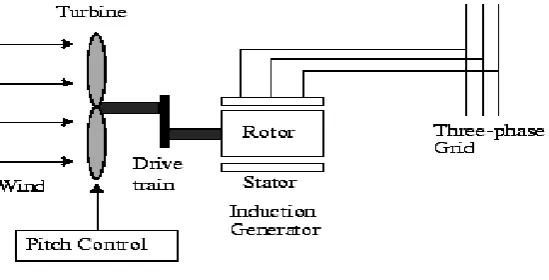
It is defined as the system in which the kinetic energy of the wind is converted to mechanical energy which in turn is used to generate electrical energy. The machines which are used to convert the kinetic energy of the wind into mechanical energy usually consist of sails, vanes or blades radiating from the hub or the central axis. The axis can be horizontal in most of the cases or vertical in some cases. When the wind hits the blade it rotates around the axis and the motion of the blades can be put to useful work .The devices which are used in wind conversion system are known as wind turbines because they convert the kinetic energy of the wind into the rotational energy and the device used for this is known as rotor. These wind turbines are connected to electrical generator to the required electrical energy and the connection of these two devices is known as aero generator. A transmission system is usually used to increase the speed of the rotor with the help of gear system. Wind mills are in the usage for more than dozen centuries for grinding grain and pumping water and now scientists are looking to generate electricity in large quantity with the help of wind turbines and interest in this field is increasing .Wind energy system can play an important role in reducing the energy crises of the world and can be used to produce efficient energy in remote areas. The wind speeds in India usually remain in between 5 to 20 km/hr. There are usually three factors which determine the output of the electrical energy generated from the wind energy, wind speed, cross section of wind swept by rotor, the conversion efficiency of the rotor, transmission system and the generator.
Figure 2: Wind Energy System.
IV. PERMANENT MAGNET SYNCHRONOUS GENERATOR (PMSG) USED IN WIND
ENERGY SYSTEM
PMSG isused in WE CS because of its advantage such as better reliability, lower maintenance and more efficient. The model of PMSG is established in the d-q synchronous frame as shown in figure 3.
Figure3: Simulink Model of PMSG.
Figure4: Equivalent Circuit of PMSG in d-q Reference Frame.
V. STATIC VAR COMPENSATOR WITH FUZZY BASED CONTROLL
Static VAR Compensator is an electrical device for providing fast acting reactive power compensation on high-voltage electricity transmission network. SVC is a part of the flexible ac transmission system (FACTS) family of devices. The svc is an automated impedance matching device if the power system’s reactive load is capacitive (leading), the svc will use reactors to supply VAR’s to the system, bringing the system closer to unity power
factor and lowering the system voltage. A similar process is carried out with an inductive (lagging) condition and capacitor banks. Thus providing a power factor closer to unity and consequently a higher system voltage svc’s are used both on bulk power transmission circuits to regulate voltage and contribute to steady state
Figure6: Circuit Diagram of SVC.
Figure7: Simulink Model of SVC with Fuzzy Based Controller.
VI. SIMULATION AND RESULTS
With the help of above discussion we see that the hybrid solar and wind energy system is connected and the resultant output from PV cell is purely DC. From next step we will see that the system DC voltage is converted into AC with the help of bridge we will convert DC into AC. The output which we will get from wind energy system is fed to the permanent magnet synchronous generator which will give AC output directly. The combination of both outputs which we will get from bridge and from permanent magnet synchronous generator contains distorted output. Also the waveform is also not sinusoidal due to presence of harmonics in it.
Figure8: Output Waveform of PV Cell.
.
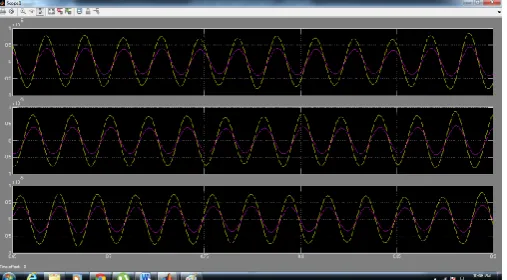
Figure 9: Combined Voltage and Current Waveform for Hybrid Solar/Wind Plantwith/Without
Using SVC.
Figure 10: Voltage and Current Waveform with Improved Phase Difference with the Help of
SVC Using Fuzzy Controller.
VII. CONCLUSION
VAR’s to the system, bringing the system closer to unity power factor and lowering the system voltage. Hence,
we see here that the output gets controlled with the help of SVC based hybrid system.
REFRENCES
[1] M. E. Haque, K. M. Muttaqi and M. Negnevitsky, “Control of a Stand alone variable Speed wind turbine with a permanent magnet synchronous generator”, Proceeding of IEEE power and energy society general meeting, pp.
20-24 July 2008.
[2] M. E. Haque, M. Negnevitsky and K. M. Muttaqi,“A novel control strategy for a variable speed wind turbine with a permanent magnet synchronous generator”. IEEE Transactions on industry application, vol. 46, no. 1, pp.
331-339, Jan/fib 2010.
[3] N. Mohan, T. M. Undeland and W. P.Robbins, “Power Electronic: Converters, Application, and Design”, Wiley, 2002.
[4] W. D. Kellogg, M. H. Nehrir, G. Venkataramanan, and V. Greez, “Generating Unit Sizing and Cost Analysis for Stand-alone Wind, Photovoltaic and Hybrid Wind/PV Systems”, IEEE Trans. Energy Conversion, Vol. 13, No. 1, pp. 70-75, March 1998.
[5] Fernando Valencaga, Pablo F. Puleston and Pedro E. Battaiotto, “Power Control of a Solar/Wind Generation System Without Wind Measurement: A Passivity/Sliding Mode Approach”, IEEE Trans. Energy Conversion, Vol. 18, No. 4, pp. 501-507, December2003.
[6] Kurozumi, Kazuhiro et al, “Hybrid system composed of a wind power and a photovoltaic system at NTT Kume-jima radio relay station”, INTELEC, International Telecommunications Energy Conference 1998, pp. 785-789.
[7] Pierre Giroux, Gilbert Sybille, Hoang Le-Huy “modeling and simulation of distribution STATCOM using Simulink power system blockset”IECON’01: the 27th annual conference of the IEEE industrial electronics
society.
[8] Sandeepkaur, G S Kochar, D S Mahal, SunitaGoyal “ power quality improvement using distributed static synchronous compensator” international conference on electrical power and energy system.
[9] G.sundar ,S.Ramareddy,”digital simulation of SVC for voltage fluctuations” Inter National journal of engineering science and technology Vol.2(5),2010,1131-1135.
[10] M. G. Molina, P. E. Mercado “Control Design and Simulation of SVC with Energy Storage for Power Quality Improvements” 2006 IEEE PES Transmission and Distribution Conference and Exposition Latin America,Venezuela.
[11] Power system block set for Use with Simulink, User’s guide, the math worksInc, 2000.
[12] K Ken, “STATCOM: Theory, Modeling, Applications,” in IEEE PES 1999 winter meetingproceedings,pp. 1177-1183.
[13] Bhimsingh, ALkaAdya, A P Mittal and J R P Gupta, “Modeling of DSTATCOM for distribution system”, Int. J. energy technology and policy, Vol. 4, no.1/2, 2006, pages: 142-160.
[14] K. R. Padiyar Department of Electrical Engineering Indian Institute of Science Bangalore 560-012, India. FACTS CONTROLLERS IN POWER TRANSMISSION AND DISTRIBUTION.
[16] Y. HU Member, IEEE, Zhe CHEN, Senior Member, IEEE, and H. McKenzie “Voltage Source Converters in Distributed Generation Systems “ DRPT 2008 6-9 April 2008 Nanjing China.
[17] N.G. Hingorani “Introducing custom power”, IEEE spectrum, vol.32, June 1995, PP.41-48.
[18] T. F. Chan, L. L. Lai, “permanent magnet machines for distributed generation: a review”, Proc. 2007 IEEE power