Available Online at www.ijcsmc.com
International Journal of Computer Science and Mobile Computing
A Monthly Journal of Computer Science and Information Technology
ISSN 2320–088X
IMPACT FACTOR: 5.258
IJCSMC, Vol. 5, Issue. 4, April 2016, pg.200 – 205
Secure Synchronous MANET Routing
Policy to Achieve High Performance and
Efficiency in Wireless Network
Manoj Kumar Khinchi
1,
Dr. Bharat Bhushan
21
Research Scholar of Department of computer science, Singhania University, Rajasthan, India 2
Head, Department of Computer Science and Applications, Guru Nanak Khalsa College, Haryana, India
{Email: 1 [email protected], 2 [email protected]}
Abstract—Wireless networking is growing in day to day business due to its portable working scenario, peoples like to work in wireless communication due to its less complex architecture that lead network user increase every day, so one can say that wireless MANET network are now the most desire part of user’s business life, therefore it does high demand of wireless network devices to overcome from the limitation of network and to give more easy to use platform to the users , author investigate many traditional protocols and routing algorithm that make wireless communication more reliable and efficient, on the other hand devices makes network more complex because device follow parameters of limitation that deal with heavy traffic and congestion issues , many time performance degrades and efficiency gets down makes wireless network very poor and demands to introduce some more advance tools and techniques to manage this traffic pattern with high performance and efficiency.
Proposed MANET policy has been designed to meet wireless users requirement, the implementation of proposed technique provides good performance factors as well as quality of services issues for efficient communication, in this paper author present a implementation based comparative study of proposed MANET routing model with existing methods in order to compare performance factors and define new proposed approach in present MANET network.
Keywords— MANET, Routing Protocols, Wireless Network, Efficiency, Traffic Pattern
I. INTRODUCTION
mobile devices cooperate to each other , among the available networking nodes also play routers responsibility to take over the decision of forwarding packets from one to other node within the network [14].
Specially in MANET, it happens that due to frequently rooming of nodes many time destination node goes down to for out of range that create complexity issues for maintaining such request packets until the destination node will aging found at specified range , in this case network need more superior way to explorer the operation of routing as in [5]. In case of MANET author found that dynamic changes are frequently going during the operation required more intelligent routing mechanism that prevents network from unfair decision and behaviour of mobile nodes as in [1][2]. MANET network users are growing increasingly one need to focus on the major requirements of the network on efficiency over data and voice wireless communication , such multimedia applications are mostly demanded by maximum number of peoples in social networking also that put stress over the network due to high volume and large size of data , wireless portable devices makes communication easy and efficient due to its inherent quality in communication, MANET provides efficient utilization policy for underlying network nodes but developers need to focus on the major prospects of limited are communication network for quality purpose [15].
In this paper author propose an approach for MANET that resolve the routing issues at its maximum extent by having some synchronous routing policy performing at each and every intermediate node of the network for the purpose of efficient working scenario and without centralized infrastructure network.
In Fig.1 node S finds different route to precede request for node D, proposed SSR routing model eligible for performing the best routing dynamically due to synchronous routing factors, buffer optimization take part during the routing process to control over the network processing.
II. BACKGROUND STUDY
A. MABR- Modified Associatively Based Routing Protocol
routing agent to minimize network overheads [4]. At each node having a kind of tale called “Location information table” assigned at every node that is the extension of LAR existing protocol and the reaming network node will tract the initial node rout by GPS system as well, based on this tracing system all node will get update his table to proceed every upcoming request similarly.
B. ABAM- on Demand Associativity Based Multicast Routing for AD HOC Mobile Networks
In [9] author found ABAM multicasting wireless networking strategy. The major concept is to manage the stability factor of node during multicasting operation, it is ongoing for the hierarchical tree route discovery, selection and configuration process to achieve extended operation mode. The objective is how to reduce route reconstruction management [13]. To migrate all the node of tree oriented network it employs route reconstruction techniques, to repair the breakage in the tree architecture it follow and perform reconstruction of route with single operation, all the upper level and sub tree has been repaired by this algorithm frequently , it is robust so that every repairing has been triggered by a node activity . Multicast grouping operation also has been handled by dynamic event handler based on the decision of individual mobile node for joining the group as defined in [10]. In [7] we can see that there is a multicast routing policy has been proposed for the purpose of evaluation of performance that has been called by high dynamic process of multicast technique as found in [9]. The process has been use for multicasting in between the node group based on demand at dynamic time with stability measurement which has been also use in ABR for unicasting as in [12].
III.GRAPHICAL ANALYSIS BETWEEN VARIOUS MANET ROUTING PROTOCOL AND PROPOSED SSR MODEL
A. Average End to End Delay
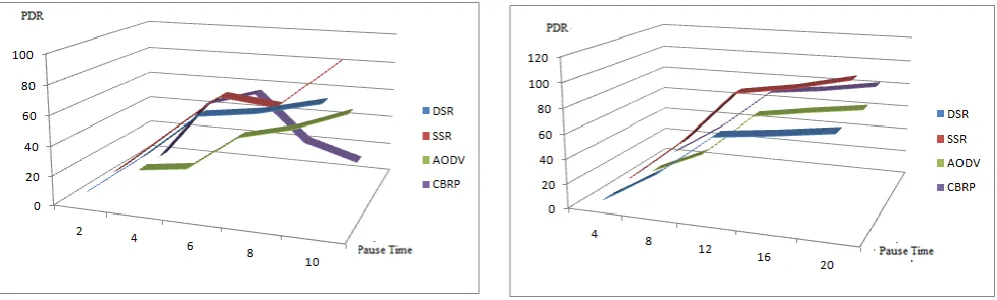
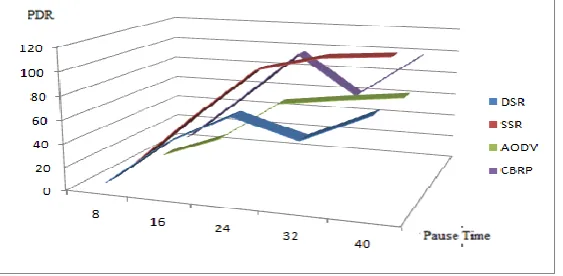
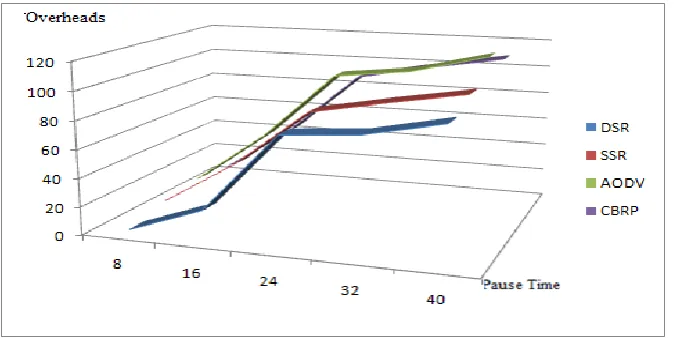
1. Fig. 5-7 shows the performance of SSR, CBRP, AODV and DSR by analysing and evaluating delivered data packets from one end to other, author found that data packets delivery ratio and maintenance has been considered over different number of data packets. Author found the evaluation of its first packet with 0.145, 1.98 and 1.45 for DSR, AODV and CBRP protocols respectively. We found that the overall maintenance and overheads of CBRP and an individual unit of AODV‟s. Author also found in SSR model that Showing less overhead then CBRP and AODV protocols, since lower average performance measurement CBRP and the number of outs route requests and replies is very less than that of DSR.
IV.CONCLUSION
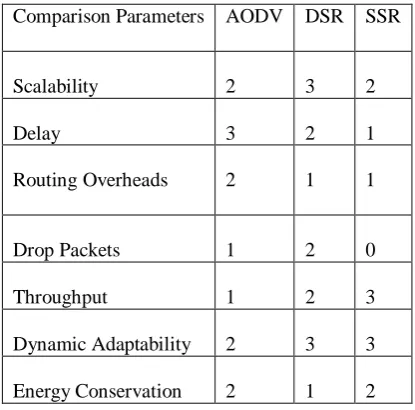
In this section author conclude the paper with comparison between most identified routing protocols like AODV,DSR and SSR based on the major factor of comparisons like scalability , adaptability, reliability and drop packets as many more , to identify the performance measurement among the different proposals , in table one can observe that SSR is most suitable for multicasting as well as other types of communication therefore in few cases DSR and AODV is seems to be good but not considered for large network. Based on the parameter which has been achieved by the new SSR routing is simply fulfils the requirements of MANET user‟s by exploring the capacity of traditional routing policy over wireless channels.
Comparison Parameters AODV DSR SSR
Scalability 2 3 2
Delay 3 2 1
Routing Overheads 2 1 1
Drop Packets 1 2 0
Throughput 1 2 3
Dynamic Adaptability 2 3 3
Energy Conservation 2 1 2
REFERENCES
[1] C.-K Toh; “Ad Hoc Mobile Wireless Networks”; Prentice Hall PTR 2002;ISBN 0- 130078174. [2] H. Zhou, “A Survey on Routing Protocols in MANETs”, Technical Report: MSU-CSE-03-08, Mar. 2003.
[3] Jacquet, P., Laouiti, A., Minet, P., and Viennot, L.: „Performance analysis of OLSR multipoint relay flooding in two ad hoc wireless network models’, Research Report-4260, INRIA, Sept. 2001.
[4] A. N. Al-Khwildi, T. Sulaiman, S. R. Chaudhry, Y. K. Casey, H.S. Al-Raoneshdiy, A Novel On-Demand Link State Routing Protocol for Ad Hoc Wireless Networks” Fourth Generation Mobile Forum, 4GMF ANNUAL CONFERENCE, July 2005, SAN DIEGO, USA.
[5] Laura Marie Feeney. A taxonomy for routing protocols in mobile ad hoc networks. Technical report, Swedish Institute of Computer Science, Sweden, 1999.
[6] I. Ari, N. Jethani, A. Rangnekar, S. Natarajan,“Performance Analysis and Comparison of Ah-Hoc Routing Protocols”, CMSC 691T, MOBILE COMPUTING, PROJECT REPORT, May, 2000.
[7] S.-J. Lee, M. Gerla, and Chai-Keong Toh, “A Simulation Study of Table-Driven and On- Demand routing Protocols for Mobile Ad Hoc Networks”, a Computer Science Department, University of California, 2000.
[8] Charles. E. Perkins and P. Bhagwat; “Highly Dynamic Destination-Sequenced Distance-Vector Routing (DSDV) for Mobile Computers”. Presented at ACM SIGCOMM'04 Conference on Communications Architectures, Protocols and Applications; London, October 2004.
[9] Z. J. Haas, “The Routing Algorithm for the Reconfigurable Wireless Networks”. In Proceedings of 6th International Conference on Universal Personal Communications ICUPC, October 2010, vol. 2, pp.
[10] Routing Protocols in Wireless Sensor Networks: A Survey2012 Second International Conference on Advanced Computing & Communication Technologies.
[11] Performance Comparison of Routing Protocols in MANET Varying Network Size International Journal of Smart Sensors and Ad Hoc Networks (IJSSAN) ISSN No. 2248-9738 (Print) Volume-1, Issue-2, 2011.
TABLE 1