EUROPHYSICS LETTERS
Europhys. Lett., 23 (2), pp. 99-104 (1993)
10 July 1993
Plasmon Effects in Solid-state Radiation Detectors.
T. C. CHOY(*) and A. M.
STONEHAM(**)
(*) Department of Physics, Monash University
-
Clayton, Victoria 3168, Australia(**I
AEA Technology, Hamell Laboratory-
OxfordshireOX11
O R A , England(received 14 October 1992; accepted in h a l form 18 May 1993)
PACS. 29.40P - Semiconductor detectors.
PACS. 29.70G - Energy loss and energy range relations.
PACS. 71.46G - Exchange, correlation, dielectric and magnetic functions, plasmons.
Abstract. - We have examined the role of plasmons on the electron energy response of solid-state (Si and Ge) radiation detectors. We found that at the level of parts per thousand, internal-conversion electron calibration techniques do not suffice to yield an adequate response function. In particular, spectral distortions in the detection of low-energy beta-particles have been found which are not accounted for by the usual calibration methods. Thus, a small but significant error can arise from energy loss to low-energy plasmons in Si and Ge detectors. The proximity of the plasmon energy to the end-point singularity and the quadratic form of the beta-decay spectrum may account for the effect interpreted as a 17 keV neutrino. Similar errors can also arise in other subtle solid-state measurements as, for example, in the X-ray edge absorption and emission spectra of metals and semiconductors.
100 EUROPHYSICS LETTERS
measured in detector operation. Of course, not all plasmons are uncorrected for. In fact, most are already included in the energy calibration. Only a small fraction with long wavelengths can escape detector correction (see below).
The main thrust of our paper is this. The energy loss of fast electrons in solids contains essentially two components. One is electron-hole pairs, the other is plasmon excitation. The
two components need not be independent: plasmons may decay to produce electron-hole pairs, and if this were the only decay mechanism, the route by which the carriers are produced would be of no concern to the user of the detector and also of no interest here. However, if some plasmons can lose energy in other ways which do not yield charge separation into observed charge carriers, or if the lifetime for some plasmons is much longer than a typical electron-hole energy collection time, there will be an effect on the observed spectrum. In the next section we shall argue, on the basis of known properties of plasmons, that this is in fact the case. In the third section we shall, without loss of generality, introduce a simplified model for the above plasmon energy loss as a (statistically independent) Poisson process. We emphasize that for this paper we are not so much concerned with the plasmon process in detail (hence the use of a simplified model). Rather our main interest is to demonstrate its effects on the measured spectrum, which seem to play a subtle role in the case of the beta-decay spectral shapes.
Key properties of p l a s m "
-
We start from the key properties of plasmons and their generation by fast electrons. The plasmon energy gp is determined by the electron density, and has a value of 16 to 17 eV in Si and Ge, the standard detector materials. The plasmon energy is significantly larger than either the energy I to create an electron-hole pair (3.76 eV for Si, 2.96eV for Ge [9]) or than the band gap (1.16eV for Si and 0.74eV for Ge at 100 K [lo]). The similarity of plasmon energy in Si and Ge means that the mean free path A(E) for plasmon generation by fast electrons of energyE
is very similar in the twomaterials. Typically (see below) A varies from about 140nm (at 100 keV) to 250nm (at
200 keV). These mean free paths are in fact much less than the total particle energy range
R(E).
We can readily compute the latter from the integral over the inverse stopping power, in accordance with the classic Bethe formula. With the above values, R(100 keV) is about 58 pm (Si) and 28 pm(Ge);
R(200 keV) is about 215 pn (Si) and 104 p (Ge). Such values are in good agreement with the data of Mukoyama [ll]. The rangeR(E)
is therefore about three orders of magnitude larger than A(E), the mean free path for plasmon generation. Substantial numbers of plasmons will be generated, though some will simply decay to yield observable carriers or lead to effects already included in detector calibration.The main processes of energy collection in detectors come directly from the electron-hole pairs generated and indirectly from those plasmons with wave vectors larger than qc
,
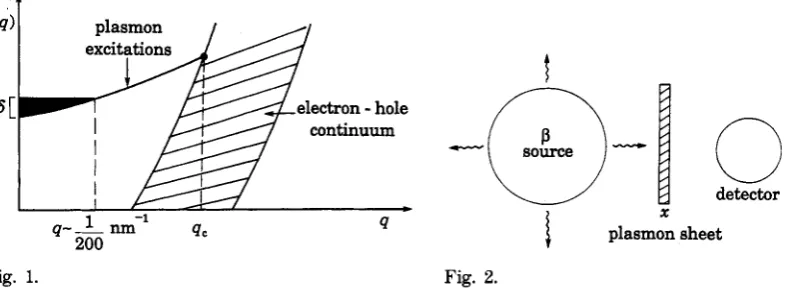
whereq c is the highest wave vector for which plasmons are well defined, being the value at which the plasmon dispersion curve (fig. 1) merges with the electron-hole continuum. The lifetime of the short-wavelength plasmons ( qc is about 11 nm-' for the systems we are considering) is about 0.1 fs, far shorter than the mean Rutherford collision time for energy loss I , which is around 10 ps at 100 keV. However, the plasmon reciprocal lifetime varies as the square of the wave vector [12], so longer-wavelength plasmons are longer-lived. Hence we can see that optical wavelength plasmons can act as an energy sink, with lifetimes much longer than the passage time of the electron. The plasmons involved are therefore those in the region 8, as indicated in fig. 1, which have a maximum wave vector of ij. Their contribution to the total plasmon energy loss is small, of the order of parts per thousand. The smallness of the loss is why the effect is not seen in internal-conversion (IC) measurements, where losses to
T. C. CHOY et al.: PLASMON EFFECTS IN SOLID-STATE RADIATION DETECTORS 101
t
detector
\
plasmon sheetFig. 1. Fig. 2.
Fig. 1. - Schematic representation of the excitation energy spectra E ( q ) for the energy collection processes in solid-state Ge and Si detectors. The main feature is an electron-hole continuum (with a semiconductor band gap) and a plsmon E,(q) spectrum; these merge at wave vector q e . The dark region 6 for wave vectors below represents energy loss due to long-wavelength plasmons as discussed in the second section.
Fig. 2. - Schematic representation of the model for the plasmon energy loss in region 6 as shown in fig. 1. The plasmon sheet might correspond to a near-surface region of a few times 100 nm thickness (see the second section).
one of width 625 eV [6] due to electron backscatter, the other of width 32 eV (see below) from plasmon losses. The
full
width from both mechanisms is the root mean square of the twocomponents, 625.8 eV: unless measurements are made to an accuracy of 0.5 eV or better, our proposed plasmon effect will be undetectable in IC energy checks. By comparison with the above background, the mean plasmon loss we propose is of the order of 1 to 2 plasmon energies in the 120 keV region and normally this would lead to insignificant errors in the experimental resolution function for most measurements. However, near to a spectral singularity, notably the maximum energy cut-off W in beta-decay, we shall see that the singularity conspires with the above plasmon loss and the distortions are enhanced. Although our results above are based entirely on incident-electron-energy loss in the detector solid, the same analysis remains valid for other types of radiation detections. It should be considered, for example, in the study of the X-ray absorption edge in metals, if effects at high sensitivity are sought, as in determining power laws at the edge singularity[14].
Estimate of effects. - We now examine the effect on the spectrum due to energy loss to plasmons in the energy sink 6. Our simplified model assumes a sheet of thickness
x
of approximately ?j (see fig. l), in which the incident fast electrons are scattered (fig. 2), giving an energy loss prior to the deposition of the major part of their energy. In the lastsection we argued that the plasmons concerned are mainly of optical wavelengths, hence we shall adopt the value of
x
of about 200 nm, though it could be longer. One picture is that this region may be a near-surface layer, but, as emphasized earlier, we do not need to presume such a detailed model for the purpose of this paper.102 EUROPHYSICS LETTERS
Now the loss function f(z, A) can be related to the microscopic probability W ( E , E ) that an
electron of energy E loses energy E by plasmon scattering, per unit energy per unit
length [15]:
where, for A in atomic units,
From recent electron energy loss spectroscopy measurements, the numbers are very similar for Si and Ge. Here we quote the numbers of Raether [16], which give cp of order 17 eV, and a kinetic energy E, at wave vector q, of 4.11 eV for a qc of 11 nm-'
.
Two assumptions are made here, one is that of an infinitely long-lived plasmon whose energy dispersion is therefore neglected[15] and a second where we shall assume in the interest of simplicity that the energy loss is an independent Poisson process. If (1) holds, the latter can be justified to a certain extent via Landau straggling theory[17], in view of the smallness of x / A ( l ) .However, the first assumption (and thus the validity of (1) in general) is satisfactory only as a starting point, for it is not strictly in accordance with our discussions earlier in the second section concerning plasmon lifetimes. We shall not pursue these details here, as it would involve abandoning the simplified model and require sophisticated theoretical calculations for cross-sections of the kind discussed in the recent literature[19], in which the complete plasmon loss function in the detector has to be calculated, as opposed to our simplified surface sheet model. Since our emphasis is on the effects of this energy loss we shall proceed as follows. Assuming f ( x , A ) to be a discrete Poisson distribution, with contributions cor- responding to the emission of different numbers of plasmons (cf. 1151, fig. 4.21,
Note that, as we have fixed
x
as 200 nm on the basis of optical-plasmon lifetimes, we shall have no other parameters in the theory. Using eq. (2) for A(E), we can obtain the distributionAx,
A). We now turn to the expression for the observed spectrum N ( E ) in terms of the initial spectrum N , ( E ) and the loss functionAx,
A):m
N ( E ) = dAN,(E
+
A)f(x,
A).0
(4)
Using eq. (3) and thereby specialising to the case
x
S A , as in the case of beta-decay at the 150 keV range, we find now thatW E ) = N , ( E ) C ( E ) , ( 5 )
where C(E) is a measure of the distortion from our uncorrected plasmon loss. For the case of
T. C. CHOY et al.: PLASMON EFFECTS IN SOLID-STATE RADIATION DETECTORS 103
1.00
0.96
0.92
0.88
110 130 150 1
E (keV)
0
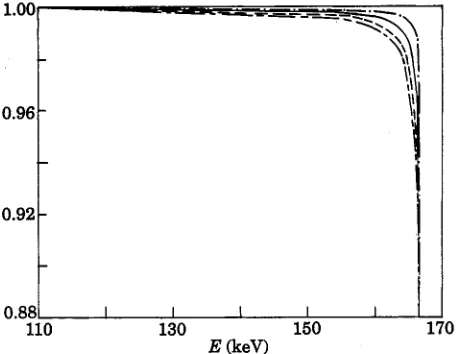
Fig. 3. - The function C ( E ) which relates the observed beta-spectrum N ( E ) to the actual incident spectrum N , ( E ) (eq. (8)). The function saturates at the n = 4 plasmon absorption curve for %/A = 2 due to the large n! in eq. (5). The cut-off W was taken as 167 keV.
-.-
n = 1,-
?z = 2, --- n = 3,n = 4.
---
beta-decay [201 for which N , ( E ) has a quadratic,
ie.
(W-
E ) 2 energy dependence, then C(E) has the form( W - E )
The plot of C(E) is shown in fig. 3 for a fixed value of
x/A
= 2, as we have found that the energy dependence of A has no significant effects in this simplified model for the energy range shown in the figure. We see that there is a distortion error of about several parts per thousand near to the cut-off W which was taken as 167 keV [6]. The shape function C(E) in fact saturates at the 4-plasmon absorption curve due to the large factorial n in eq. (6). Although the model appears simplified, we can however conclude that plasmon loss corrections are crucial for detailed studies of end-point or edge spectrum behaviour using solid-state detectors.Conclusion. - We stress that the plasmon effect we propose is very small though potentially important. It appears that experimental efforts have not adequately addressed this issue regarding the detector response and other factors [2]. This is not surprising since our energy loss is only of one to two plasmons (about 32 ev), which manifests itself in the linewidth increase of only 0.8 eV (see the second section). In the case of beta-decay and the possible existence of a 17keV neutrino, this level of energy calibration accuracy is also demanded over a rather wide energy range of about 17 keV, which makes stringent demands on the stability of the instruments. It does not appear that this can be achieved using IC
104 EUROPHYSICS LETTERS
absorption spectra. Qualitatively, we see that the analysis can be carried over by changing the quadratic term in eq. (6) to one with an exponent a
-
0.25 [14]. However, in this case both the exponent and the X-ray plasmon cross-section are smaller. Hence the spectral distortions we have described are likely to be less severe than in the case of beta-decay. Even though our analysis in the previous section employs a simplified model, clearly a more sophisticated calculation, in which the plasmon lifetime differences would emerge from abinitio
band structures [19], will not affect our main results. Thus we conclude that we have identified an anomaly due to plasmon loss in the detector which conspires with the end-point singularity that is likely to be significant for detailed studies of beta-decay spectra. Indeed, the anomaly may partially or totally explain the recent controversy over the existence of a 17 keV neutrino [7]. Our results suggest that energy checks for detector response must be made with much higher resolution, and independent experiments are needed to verify small energy losses from collective excitations.* * *
TCC would like to thank Prof.
B.
BOLTON in Monash University, Dr. N. A. JELLEY and Prof. Sir R. PEIERLS of the University of Oxford for useful discussions.AMs
would like tothank Drs. T. W. CONLON, D. J. FINDLAY and J. FREEMAN of Hanvell Laboratory, UK, for helpful discussions.
R E F E R E N C E S
[l] KNOLL G. F., Radiation Detection and Measurement (Wiley, New York, N.Y.) 1979. [23 KOONIN S. E., Nature, 354 (1991) 468.
[3] SIMPSON J. J., Phys. Rev. Lett., 54 (1985) 1891.
[4] HIME A. and SIMPSON J. J., Phys. Rev. D, 39 (1989) 1837. [5] SIMPSON J. J. and HIME A., Phys. Rev. D., 39 (1989) 1825. [6] HIME A. and JELLEY N. A., Phys. Lett., 257 (1991) 441. [7] WARK D., Physics World, 5 (1992) 20.
[8] BICHSEL H., Rev. Mod. Phys., 60 (1988) 663.
[9] ALIG R. C. and BLOOM S., Phys. Rev. Lett., 35 (1975) 1522.
[lo] BLAKEMORE J. S., Semiconductor Statistics (Dover, New York, N.Y.) 1962, pp. 60 and 67. [ll] MUKOYAMA T., NucL Znstrum Methods, 134 (1976) 125;
[12] DUBOIS D. F., Ann. Phys. (N.Y.), 7 (1959) 174; 8 (1959) 24. [13] PLANSKOY B., N w L Znstmm Methods, 61 (1968) 285. [14] OHTAKA K. and TANABE Y., Rev. Mod. Phys., 62 (1990) 929.
E151 PINES D. and NOZIERES P., The Theory of Quantum Liquids. Vol. I: N o m 1 Femzi Liquids
[l6] RAETHER H., Excitations of Plasmons and Interband Transitions by Electrons, Springer Tracts
[171 LANDAU L., J. Phys. (Moscow), 8 (1944) 201.
[18] STONEHAM A. M., T h e w of Defects in Solids (Clarendon Press, Oxford) 1975.
[19] FARID B., ENGEL G., DALIN R. and VAN HAERINGEN W., Phys. Rev. B, 44 (1991) 13349. [ZO] Wu C. S. and MOSZKOWSKI S. A., Beta Decay, Interscience Monogmphs and Texts in Physics and
(W. A. Benjamin Inc., New York, N.Y.) 1966.
Mod. Phys., Vol. 88 (Springer, Berlin-Heidelberg-New York) 1980.