Technology (IJRASET)
A Novel Visibility Algorithm for Captured
Distorted Road Scenes
M. Saritha1, K. Riyazuddin2
M. Tech student, Dept. of E.C.E, Annamacharya Institute of Technology and Sciences, Rajampet, Andhra Pradesh Assistant Professor Dept. of E.C.E, Annamacharya Institute of Technology and Sciences, Rajampet, Andhrapradesh
Abstract: The visibility of images of outdoor road scenes will commonly become degraded when captured during inclement storm conditions. Localized light sources often result from activating of street lights and vehicle headlights in these conditions. Traditional state of the art restoration techniques are incapable to work with hazy images that featured localized light sources and process is also delay. Therefore, we propose a new method to enhance the road scenes hazy images using wavelength consideration and de hazing algorithm .This algorithm worked supported on the dark channel prior and depth map calculation .In contrast based technique, the local contrast of hazy image will be restored to achieve better visual perception .Here, physically based technique is utilized to increase the clarity of hazy images. It uses atmospherically light and transmission map components to obtain the scene objects from the degradation.
Keywords: Image de hazing, light scattering, wave length compensation, atmospheric light source, dark channel prior
I. INTRODUCTION
The visibility in images of captured on out of door scenarios can often experience degradation as result of phenomena which include absorption and scattering of skylight by the atmospherically light particles such as haze, fog, mist etc. Correspondingly visibility degradation can be problematic to many systems which works under wide range of the weather conditions including communicative transporting systems, out of door object recognition, surveillance systems, and remote sensing systems and so on. The amount of absorption and scattering depends on the depth of the scene between a traffic camera and scene point. So, scene depth information is essential for recovering scene radiance in image of hazy environments. These techniques can be divided into two groups given depth and unknown depth. Given depth works based on the supposition that the depth is given, this is when used by these advanced to restore hazy images. However, given depth approaches are not compatible for visibility restoration.
II. RELATED WORK
The processing of hazy images focalize singly on corresponding scattering or color turn distortion. Techniques are goal on removal of skylight scattering distortion intercept image de hazing to restore the clarity of the hazy images. Color turn reparation techniques calculate the hazy image environmental parameters by execute color registry with examination of light attenuation. An apply histogram equaling in both RGB and HIS color spaces to balance the photometric brightness distortion distribution of color and dynamically combine the brightness of an object in a discrepancy dependent way by using controllable multicolor light source to remunerated color loss. A methodical approach is required to take all the factors regarding light scattering, color change and possible presence of artificial skylight source into contemplation. The traditional restoration methods not suitable for restoration of hazy images. We presents the new proposed technique is the low complexity wavelength compensation and de hazing algorithm, expensive optical instruments or stereo images pairs are no longer required and this algorithm requires less computational resources and complexity is reduced when compared to conventional Wavelength compensation and Image de hazing algorithm.
III. PROPOSED METHOD
Technology (IJRASET)
wavelength compensation and image de hazing algorithm are utilized to removal the haze effect and color change.
Input hazy image
Output haze free image
No
Yes
Fig1: Flow chart of proposed WCID algorithm
A. Hazy image photographic system
The hazy image photographic system is providing with an atmospherically lighting in photographic environment the origin in increase to flesh sky light of camera for avoiding the in efficient lighting in photographic system. The light from both the camera and artificial skylight origin is casual on surface appoint in the scene and reflective back to camera. In the path between the subject and camera d(x) hazing and color distortion happen due to light scattering and varying degrees of attenuation encountered with distinct wavelength.
B. Dark channel prior algorithm
The dark channel prior which is an existent shoe depth derivative method is supported on the deed that, in most of the no background skylight patches on a haze free road image, at least one color channel has very intenseness at some pixels. The minimum intensity in such a patch should have a very low value, called a dark channel. In a local patch cannot found the pixels which contain a very low value, the existence of likeness are mean. The dark channel prior algorithm quantified of haze concentration .It is turn stipulate the object camera distance, i.e., the depth map
The hazy image can be modeled by Radiative Transport equation
I( )x j( )x (1t( ) ) .x B
Where λЄ {red, green, blue} Depth map estimation Image segmentation Atm osph eric light
Image de hazing and wavelength compensation
Technology (IJRASET)
Here
x
is a point on the hazy scene, I( )x is the image captured by the camera.j x
( )
Is the scene radiance at point( )
x
i.e. the actual amount of light source reflected from point( )
x
,t
( )
x
is the residual energy ratio ofj x
( )
reflecting from pointx
inthe haze image before reaching the camera.
B
Is the homogeneous background light and
is the light wave length. Describes thewavelength
and object camera distanced x
( )
describes the delay of scene radiance in the haze.The dark channel can be calculated by using the equation
Dark channel = min
(
I
( ))
x
Where λЄ {red, green, blue}
I
( )
x
Denotes the camera is captured by hazy image. The background lightB
is usually assumed to be the highestbrightness value an image of pixel intensity. In the brightest pixel value among all the local pixels to the background light follows
B
= max (min (I
( )
x
)
The depth map can be calculated by using the formula
Depth map = 1-min {median (
I
(x))/B
}Block effect reduced by the median filter
C. Image segmentation
The foreground and background region of the underwater image are segmented supported on the depth map derived using threshold Front ground if
d x
( )
< thresholdBackground if
d x
( )
>threshold .D. Determination of atmospherically light source
The existence of an atmospherically skylight source can be determined by compare with the difference between the mean photometric brightness of the foreground and background images .Higher mean photometric brightness in the foreground particularize the existence of a supplementary.
E. Removal of atmospherically light source
For removing the atmospherically light source, first the average intenseness of both the foreground and background image is calculated. Then take the dispute intenseness is find the luminousness updated foreground intenseness is find out by deduct the difference intenseness from the foreground intensity. Then by adding updated foreground with the background the image free of artificial light source is obtained.
F. Compensation of light scattering and color change
After removing the atmospherically light source and deriving distance d(x) between an object and the camera, he haze can be removed by deduct the scattering term (1 d x( ))
rer
N
from image perceived by the camera. Next, the color change conflict during the
object camera path can be accurate by separating the de hazed image by the wavelength dependent ratio d x( ) rer
N
IV. EVALUATION RESULTS
A. Subjective Evaluation Results
Technology (IJRASET)
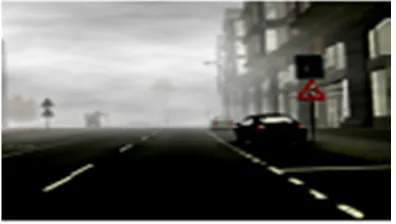
effective image restoration technique for images captured in wide range of weather conditions.Fig2:input hazy image
B. Existing method
Fig 3: output haze free image using DCP algorithm C. Proposed method
Fig4: Output haze free image using WCID algorithm
D. Objective Evaluation Results
[image:5.612.208.406.261.373.2]The objective analysis shows in below Tab. I. the objective evaluation results improvement in road hazy image. .In this we are calculated the PSNR, MSE, RMSE, correlation coefficient, r E matric and sigma tabulated below.
Table 1: Performance results
parameter Existing method Proposed method
E matric 0.5000 0.5000
r 1.0008 1.0002
sigma 0 0
PSNR 55.7714 65.1016
MSE1 0.5206 0.0607
RMSE1 0.7215 0.2464
Technology (IJRASET)
V. CONCLUSION
The hazy image is suffers from low contrast and resolution due to poor visibility conditions. The hazy image enhancement using low complexity wavelength compensation algorithm is used to enhance haze image by de hazing algorithm. In this project influence of the atmospheric light is removed from the hazy image. If the presence of atmospheric light is detected the influence of it is eliminated from the hazed input image. The haze effect can be removed by using WCID algorithm. The low complexity is achieved by using a median filter in the dark channel prior algorithm.
REFERENCES
[1]Shih-chia Huang, Bo-Hai Chen, and Yi-Jiu Cheng “An efficient visibility enhancement algorithm for road scenes captured by intelligent transportation systems” IEEE transactions on intelligent transportations systems 2014.
[2] Della Raju, Jain Sara Babe “Removal of artificial light source and image debasing in under water images using WCID algorithm” IEEE transactions on ISSN 2275-0181 Vol 3 Issue-3, march 2014.
[3] Y.J. Cheng, B.H. Chen, S.C. Huang, “A novel visibility restoration algorithm for single hazy images”Proc. IEEE Int. Conf. Syst., Man, Cybern., Oct.2013, pp.847-851.
[4] Y.J. Cheng, B.H. Chen, S.C. Huang, S.Y. Kuo, A.Kopylov, O.Seredin, Y. Vizilter, L.Mestetskiy, B.Vishnyakov, O.Vygolov, C.R.Lian, and C.T.Wu, “Visibility enhancement of single hazy images using hybrid dark channel prior,” in Proc.IEEE Int. Syst.,Man,Cybern.,Oct.2013,pp.3627-3632.
[5] W.L. Li, B. Gu, J.T. Huang, S.Y. Wang, and M.Hgradient domain,”IET Image Process.,vol.6, no.5,pp.589-595,Jul.2012.
[6] K. He, J. Sun, and x. Tang, “Single image haze removal using dark channel prior,” IEEE Trans. Pattern Anal.Mach.Intell.,vol.33,no.12,pp.2341-2353,dec.2011. [7] B. Xie, F. Guo, and Z. Cai,”Improved single image de hazing using dark channel prior and multi scale retinex,” in Proc.Int.Conf.Intell.Syst.Des.Eng.Appl.,Oct.2010,pp.848-851.
[8] R. Fattal ,“Single image dehazing,” in Proc. ACM SIGGRAPH,2008,p.72.
[9] R. Tan, “Visibility in bad weather conditions from a single image,” in Proc. IEEE Conf. Comput. Vis. Pattern Recognit., Jun. 2008, pp.1-8.
[10] K. Tan and J.P. Oakley, “Enhancement of color images in poor visibility conditions,” Proc. ICIP, SEP. 2000, VOL.2, PP.788-7912.
BIOGRAPHY
M. Saritha received B. Tech degree from degree from J.N.T. University Anantapur. She is currently studying M. Tech in Electronics and Communication Engineering from J.N.T. University from Ananthapur India. Her resereash interests include Digital Signal
Processing and Image Processing. K. Riyazuddin received B. Tech and M. Tech Degree in Electronics and Communication Engineering from J.N.T. University,
Anantapur, A.P, India. Presently he is working as an assistant professor in department of E.C.E in Annamacharya Institute of Technology and Science, Rajampet, A.P. India. His research interess includes Signal Processing and Communication systems.