Ionic liquids at electrified interfaces
Maxim Fedorov
ú,†and Alexei Kornyshev
ú,‡Department of Physics (Scottish University Physics Alliance), University of Strathclyde, John Anderson Bldg, 107 Rottenrow, Glasgow G4 0NG, United Kingdom
, and Department of Chemistry, Faculty of Natural Sciences, Imperial College London, C1Bldg, South Kensington Campus, London, SW7 2AZ, United Kingdom
E-mail: [email protected]; [email protected]
Contents
1 Introduction 4
2 RTILs and some of their properties 7
2.1 What to we imply by RTILs? The main features and applications. . . 7
2.2 A closer look at some of RTILs’properties . . . 11
2.2.1 Thermophysical parameters . . . 14
2.2.2 Transport properties . . . 15
2.2.3 Dielectric properties . . . 17
2.2.4 Electrochemical Stability . . . 18
3 EDL before RTILs 21
úTo whom correspondence should be addressed
4 Principles of the theory of EDL in RTILs at flat electrodes 30
4.1 Mean field theory . . . 30
4.2 Model independent result . . . 37
4.3 Notes on the structure and capacitance of the EDL in RTIL mixtures with neutral solvents . . . 38
4.4 Beyond the mean-field: direct simulations of ionic liquids at electrified interfaces 40 4.4.1 Course-grained models: forest behind the trees . . . 43
4.4.2 The forest is made from trees. From physics to chemistry: fully atom-istic models . . . 53
5 Experimental studies of EDL in RTILs at flat electrodes 60 5.1 EDL capacitance . . . 60
5.2 Molecular-level structure of the EDL . . . 65
5.3 Structural transitions in the EDL: from multilayer to monolayer structure . . 70
5.4 EDL properties: a closer look at temperature dependence . . . 72
6 Electrode reactions and their kinetics in RTILs 73 6.1 Pros and contras for using RTILs as solvents for electrochemical reactions . . 74
6.2 Electrochemical reactions in RTILS: electron transfer limited or ion transport limited? . . . 75
6.2.1 Redox current in quantum electrochemistry . . . 76
6.3 What will matter in RTILs? . . . 78
6.3.1 Reorganisation Energy . . . 78
6.3.2 Work terms . . . 81
6.3.3 The Driving force and the potentially new form of the Frumkin correction 81 6.3.4 Matrix element of transition (overlap integral) . . . 82
6.4 Experiments: examples of few case studies . . . 83
7.1 Electrochemical capacitors: targets and challenges . . . 85
7.2 The superionic effect in narrow nanopores: experiments vs theory . . . 88
7.3 Energy storage in nanoporous electrodes: what is the optimal size for the pores?104 7.4 Larger nanopores and the capacitance oscillations . . . 105
7.5 ‘Quantized friction’ in confined nanofilms of RTILs . . . 107
8 Examples of other applications of RTILs at EIs 109 8.1 Batteries . . . 109
8.2 Fuel Cells . . . 112
8.3 Solar Cells . . . 112
8.4 Flexible energy storage devices . . . 112
8.5 Miniaturized nanocarbon based electronics . . . 113
8.6 Polymer electrolyte composite electroactuators . . . 113
9 Conclusions 115
10 Nomenclature 119
1 Introduction
Until recently, ‘room-temperature’ (<100-150 C) liquid-state electrochemistry was mostly
electrochemistry of diluted electrolytes1–4 where dissolved salt ions were surrounded by
a considerable amount of solvent molecules. Highly concentrated liquid electrolytes were
mostly considered only in the narrow (albeit important) niche of high-temperature
electro-chemistry of molten inorganic salts5–7 and in the even narrower niche of ‘first-generation’ room temperature ionic liquids, RTILs (such as chloro-aluminates and alkylammonium
ni-trates).8–12 The situation has changed dramatically in 2000s after the discovery of new
moisture- and temperature-stable RTILs.13,14 These days, the ‘later generation’ RTILs
at-tracted wide attention within the electrochemical community.15–29 Indeed, RTILs, as a class of compounds, possess a unique combination of properties (high charge density, electrochem-ical stability, low/negligible volatility, tunable polarity etc) that make them very attractive substances from fundamental and application point of view.30–36Most importantly, they can mix with each other in ‘cocktails’ of one’s choice to acquire the desired properties (e.g. wider temperature range of the liquid phase37) and can serve as almost ‘universal’ solvents.35,38,39 However, RTIL systems are far from a conventional ‘text-book picture’ describing an
electrolyte (e.g NaCl aqueous solution) as small (atomistic) ‘roundish’ ions with uniform
charge density on their surface dissolved in a large amount of solvent, interacting with each
other via long-range Coulomb forces. On the contrary, there is no solvent in a neat RTIL
electrolyte, unless it is deliberately added or they sorb water from the environment; neither themolecular RTILs ions are ‘small’ (on an atomistic scale) nor they are ‘roundish’. To make things even more complicated, their molecular charge density is highly non-uniform.40–44But it is this complexity that makes them liquid at room and in some cases even much lower temperatures.45 That means that the effects of short-range ion-ion interactions, molecular shape of ions and ion molecular charge distribution are very important for their properties both in the bulk and at interfaces. We also note that the large electrochemical window
of many commercially available RTILs11,15,46 allows one to achieve high electrode charge
found now experimentally in RTIL-based systems.47 This all makes the RTILs at electrified interfaces (EIs) to be an important field of research (and this view is justified by the ever growing number of publications on the subject).
There is a large number of known RTIL cations and anions readily available.30,35,49,50 Moreover, as mentioned, many RTILs can be easily mixed with each other and with vari-ous organic and ionorganic polar solvents, giving practically infinite number of solvent-free or solvent-enriched electrolytes with tunable properties.15,19,30,35,51 That makes the task of choosing the most optimum RTIL for any given application to be highly non-trivial.
There-fore, the main goal of the article is to overview the main qualitative trends in the RTIL
behavior at EIs in order to reveal the most important factors that determine their
proper-ties and behaviour there.
The fact that RTILs are far from conventional diluted electrolytes sets a number of challenges, both for theorists as well as experimentalists. To a large extent this is due to inapplicability of standard models (e.g. Gouy-Chapman theory) for theoretical studies of these systems and interpretation of experimental results on RTILs.52 Not unrelated to this, RTILs attract the attention of not only chemists and applied scientists but also of theoretical physicists, based on purely fundamental grounds. Indeed, RTILs represent unique examples of highly concentrated, dense room temperature ionic plasma that exhibits strong ‘Coulomb correlations’,53–55 the field lying at the frontier line of modern statistical mechanics.56–58
Each RTIL is an overall neutral assembly of charged particles. As the majority of their applications deal with their behaviour near interfaces30–36 and, particularly, near electrified interfaces, understanding of the charge and electric potential distribution in RTILs at inter-faces is crucial for understanding their performance as electrolytes.61 This article is devoted to the discussion of the properties of RTILs at different electrified interfaces, in particular the RTILs response to charging the interface and how it manifests itself in a number of selected applications.
molten salts, HTMSs (to avoid confusion, we will use this abbreviation or simply ‘molten salts’ below when we discuss high temperature ionic liquids).
It is well known that the EDL plays a crucial role in ‘electrodics’.2,59 The potential drop across in the EDL and its response to charging determines the electrical capacitance of the electrode/electrolyte interface, i.e. thereby the energy stored in the EDL capacitors. The potential distribution in the EDL controls electrochemical kinetics, because the voltage dif-ference between the electrode and the point where the reactant (donor or acceptor of the electron) sits is the driving force of electrochemical reactions.2,3,60,61 Since the electrochem-ical current depends exponentially on this driving force, even small changes in the value of the potential drop may change the current by orders of magnitude. Obviously, understand-ing the potential distribution in RTILs and its dependence on the applied potential that are both expected to be different from what they are in ordinary electrolytes, is a primary task for electrochemistry of RTILs.
Understanding the double layer properties is equally important for other applications. In electrowetting applications that use RTILs as the material of the organic droplet surrounded by aqueous electrolyte and lying at the electrode surface, the way how the droplet will change its shape with varying voltage of the electrode is determined by the potential distribution in the droplet.62–65 In the recently discovered phenomenon of ‘quantized’ friction between spontaneously charged solid surfaces,66the lubrication capacity of the nano-layers of RTIL is determined by the distribution of ions between them.66–70 In molecular gating applications of RTILs the current across a molecule which bridges two electrodes in a nanogap the EDL determines the ability to control independently the potentials of the two electrodes (relative to the reference electrode).65 This list could be continued.
We will therefore devote a large part of this article to understanding the main properties of the EDL in RTILs. We start with the EDL at flat electrodes and then proceed to electrodes with enhanced, volume filling, surface area.
for artificial muscles (such a flashy name is often assigned to all electroactuators, although the whole muscle is a more complicated hierarchical construction),76 as well as for sensor applications.77,78 Ion transport dynamics also determines how fast the electrowetting lense will be changing its shape.51 Not going into details of this yet poorly explored territory, we only briefly discuss main mechanisms of charge transport of ions in RTILs and some aspects of the EDL transient behaviour, as there are yet more questions than answers here, and the work in this area is in progress.
The review is organised as follows. We will start with the main principles of the EDL theory in RTILs, then proceed to (molecular-scale) computer simulations of RTILs at EIs , and then discuss recent experiments that investigate the validity of theoretical/modeling predictions. Clarifying this picture as far as we can, we will then overview some manifes-tations of the EDL in RTILs in the properties of the selected applications, such as EDL supercapacitors, electroactuators, electrode kinetics, extraction of metals, and quantized friction.
Trying to be as comprehensive as possible, we will nevertheless have to restrict ourselves to most recent developments, on former achievements referring the readers to earlier surveys (see e.g.14–22,27).The last note before we begin; this article is not a handbook: it overviews main principles and qualitative features rather than specific data. Some of those will be drawn in the context of ideas discussed in this review.
To set the scene, we start with a definition of RTILs and a brief overview of some of their pertinent physico-chemical and electrochemical properties, to which we will sporadically refer later in the review.
2 RTILs and some of their properties
2.1 What to we imply by RTILs? The
main
features and
appli-cations.
and melt at or below 100-150¶C.17,30,35,50,79 In the following we will use this (broad)
def-inition, if not stated otherwise. In this section we only briefly overview some pertinent properties of RTILs because there is a number of excellent reviews on this subject already in the context of synthesis and catalysis,35,50,79 industrial applications30,33 etc.36,80,81 A short but comprehensive overview of the history of the subject can be found in the Wilkes’ 2002 review.82
The first accounts of RTILs is commonly attributed to Walden, who reported in 1914 synthesis and characterisation of a new organic salt, ethylammonium nitrate, that was liquid at room temperature (m.p. 12¶C).83 However, analysis of the literature shows that the
dis-covery date of the first RTIL as well as the names of discoverers might be disputed.30,82 E.g. Gabriel and Weiner reported in 1888 a new organic salt, ethanol-ammonium nitrate with m.p. 52-55¶C;84(for more historical details we address the readers to Refs30,82). Later on in 1930s
and 1940s several other RTILs were discovered85that were mixtures of alkylpyridinium-based organic salts (halides) with aluminium (III) chloride.8 Since then there were several attempts to explore this intriguing class of substances,86,87 particularly by electrochemists88that soon recognized an enormous potential of RTILs as ‘electrolytes without solvent’ (or only with minor solvent additives) for applications in batteries,89 supercapacitors and electrodeposi-tion.8
In 1980s Wilkes and Hussey with co-workers discovered that alkylimidazolium
halogenoa-luminates90 have much larger liquid range than alkylpyridinium halogenoaluminates and
these RTILs are more stable in terms of reduction of the alkylimidazolium cation.90–98 In
parallel with the research on halogenoaluminate-based RTILs, several groups explored other low-temperature molten salts known by that time such as tetra-n-alkylammonium-based
RTILs and alkylammonium nitrates and thiocyanates.16,99
(particularly in 50s-70s of the past century) was in high temperature ionic liquids - the
molten inorganic salts (m.p. 300-1000¶C) and their applications in metal production
pro-cesses.5,101,102
A ‘rediscovery’ of RTILs two decades ago was mainly due to (i) discovery of RTILs with stable organic anions (such as PF6-, BF4-, and, [(CF3SO2)2N]-) in 1990s13,103 and (ii) breakthroughs in organics synthesis of RTIL components that reduced their costs (such as e.g. the Biphasic Acid Scavenging Utilizing Ionic Liquids (BASIL) process introduced by
the BASF company in 2002104). This was followed by an exponential explosion of interest
to RTILs with thousands of papers published annually on various aspects of their chemistry and physics. For enthusiasts of metrics in science one can draw just one illustrative figure: according to the ISI Web of Knowledge, in 2012 the overall number of papers published on the subject ‘ionic liquids’ during only this year was around 104. The enormous ‘popularity’ of RTILs is related to their unique properties and the vast number of applications that are already employing RTILs or can potentially employ them in the future.30,33,36,105
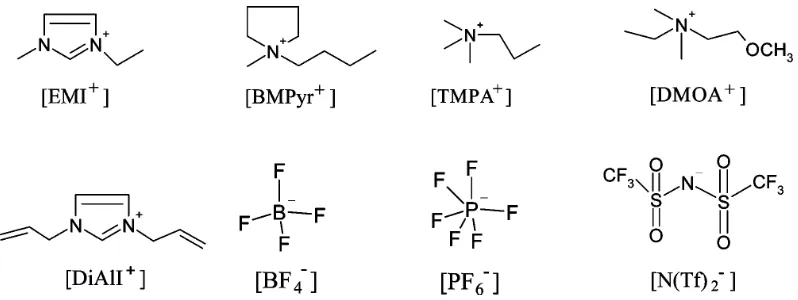
Following Stark106 the ’chemical space’ of functional variations of RTILs can be repre-sented as a three-dimensional domain with anions, cations and their (chemical) functional groups as (generalised) coordinates (see Figure 1).
The features of RTILs that make them special are, briefly, as follows:
• Unlike molten salts composed of small, ‘roundish’ inorganic ions, the ions of RTIL are ordinarily large organic ions (at least one of them – usually the cation), containing
substantial amount of hydropobic constituents35,79 (see Figure 1). They often have
anisotropic and asymmetric shapes. These two features, that principally differ them from molten inorganic salts, reduce the freezing temperature of the liquid: the Coulomb interactions are weaker in the range of their action, whereas their complicated shape does not let the RTIL ions easily acquire stable ordered crystal structures.45
• RTILs are electrolytes without solvents staying liquid in a broad temperature interval
around the room temperature.11,107
Figure 1: General representation of the the ‘chemical space’ of functional variations of
RTILs. R states for the functional group. Most popular choice for R is the alkyl
sub-stituent CH3(CH2)n (n= 1,3,5, . . .); there are also many other choices available.35,79 The layout of the figure was inspired by Fig. 1 in Ref.106
• Those RTILs that a composed from less reactive ions are more inert electrochemically than many standard electrolytes; i.e. as solvents at electrodes they can sustain higher voltages before their electrochemical (and thermal213) decomposition.11,46,107,113–118
• Different RTILs can be mixed with each other and one can make ‘cocktails’ of them.38,39 Moreover, RTILs can be slightly diluted by adding to them organic dipolar solvents.119,120 The resulting mixture can be called a designer solvent, as it can be adjusted to provide targeted functions for reactions of substances dissolved in them.35,50 Since thousands of RTILs has been or can be synthesized, the discovery of RTILs made a revolution in chemistry: one in principle can have practically unlimited number of solvents and electrolytes, whereas in the past they all could be counted.3,121
Calling RTILs green electrolytes is more of a wishful thinking122–124 as quite many of
[image:10.612.111.504.70.361.2]are difficult to wash away.131 But the other listed properties make them very promising in various applications (we focus on those applications where interfacial and electrical double layer properties of RTILs are important).
What are these? They can be used as:
• designer solvents for homogeneous and surface catalysis and synthesis.35,50,132
• extraction liquids for purification of metals,133 proteins and colloids30 and biomass conversion;134,135
• media for electrochemical reactions, electrocatalysis, and electrodeposition;11,15,16,19,136–140
• electrolytes for power sources and generators, such as supercapacitors,37,72,73,141–144 batteries,113,118,145,146 solar cells,147–151 and, prospectively, fuel cells (once RTILs with high proton conductance will be found);152
• liquids for electrowetting based variable lenses and microfluidics applications;153–155
• lubricants, from macromechanisms to micro and nanodevices;66,68,70,156,157
• the organic liquid component for self-assembled nanoplasmonic devices;158
• electronic gating media for single molecule devices159,160 and electrolyte-gated transis-tors for organic and printed electronics160–164 and superconductors;165
• chemical and electrochemical sensing;21,166,167
The list could be continued but these are those applications that are clearly seen now.
2.2 A closer look at
some
of RTILs’properties
• A large collection of thermodynamical, thermochemical and transport properties data of RTILs and their mixtures is given in the IL Thermo database.168There is also recent critical review by Aparicio et al169 on thermo-physical properties of new RTILs that analyses different experimental methods for measuring thermophysical properties and possible sources of errors.
• Book of Zhang et al “Ionic liquids: physicochemical properties”.170 To the best of our knowledge this is the most extensive handbook on physico-chemical properties of ionic liquids currently available (the book was preceded by an earlier publication by the same group of authors171). The book contains a large database of physical properties of ionic liquids172 including density, viscosity, phase transition temperatures, thermal decomposition temperature, polarity and the electrochemical window.
• The 2005 compiled book “Electrochemical aspects of Ionic Liquids” edited by Ohno17
provides a large amount of data on electrochemical behaviour of RTILs. The book also provides good introduction to the subject and contains many innovative ideas that were later developed by the authors of the contributed chapters and other groups.
• The 2008 complied volume “Electrodeposition from ionic liquids” edited by Endres,
MacFarlane, and A. Abbott173 provides a good introduction to electrochemistry of
RTILs and contains a large amount of information on relevant electrochemical and physical-chemical properties that might be difficult to find elsewhere.
• The 2008 review by Hapiot and Langost on electrochemical reactivity in RTILs140that
discusses different physical and electrochemical properties of RTIL-based system in a view of their applications as reactive media for electrochemical reactions at interfaces.
See also the Chapter 4 in the review by Yoshida et al139 on modern strategies in
electroorganic synthesis that also discusses applications of RTILs as reactive media for electrocatalytic reactions.
To overview the typical ranges of main properties of RTILs that are relevant to the
Wasserscheid.33 Several important properties of RTILs are also discussed in more details below.
Table 1: Typical ranges of RTILs properties.*
Property Lower limit example Typical values for mostof RTILs Upper limit example
Melting Point/glass transition [EMIM]Cl/AlCl3 = (1:2) =
≠96¶C (glass transition) 0¶C - 60¶C 100≠150
¶C depending on
the defenition of RTILs
Density [HMPyr][N(CN)2] = 0.92
gL≠1 1.1 - 1.6 gL≠1 (i) [EMIM]Br-AlBrgL≠13:1/2 = 2.2
Viscosity [EMIM]Cl-AlCl14mPa s(3i):1/2 = 40-800 mPa s(i) [BMIM]Cl (supercooled) =40.89 Pa s(i)
Thermal stability [EMIM][OAc] =
≥200¶C(ii) 230¶C-300¶C(ii) [EMIM][TFSA] =400¶C(ii)
Surface tension [C12MIM][PFmNm≠16] = 23.6 30-50 mNm≠1 [MMIM[MeSOmNm≠14] = 59.8
Heat capacity [BMIM][MeSO4] = 247
Jmol≠1K≠1 300 to 400 Jmol≠1K≠1 [OMIM][TFSA] = 654Jmol≠1K≠1
Water miscibility [TFSA]≠, [P(C2F5)3F3]≠ many ILs do not mix withwater but also can be
extracted from water
[RSO3]≠, [RSO4]≠,
[R2PO4]≠
Hydrolytic stability [BF4]≠, [PF6]≠
heterocyclic cations can hydrolyze under extreme
conditions
[TFSA]≠, [OTf]≠,
[CH3SO3]≠
Base stability [Al2Cl7]≠, [HSO4]≠
all 1,3-dialkylimidazolium RTILs are subject to
deprotonation [PR4]
+, [OAc]≠
Corrosion [TFSA]≠, [OTf]≠ most RTILs are corrosiveversus Cu; additives
available
Cl≠, HF formed from
[MFx]≠ hydrolysis
Toxicity [cholinium][OAc] often increasing toxicity foraquatic systems with
increasing lipophilicity [EMIM][CN]
Static dielectric constant [HMIM][PF6]=8.9174 10-15174,175
(2-hydroxyethyl)ammonium lactate=85.6±3175
*Large part of the table is reproduced from Ref.33(Table 1 there); data taken from the Ref.33 and
references therein if not specified otherwise. The abbreviations in the table are as follows [EMIM]: 1-ethyl-3-methylimidazolium, [HMPyr]: 1-hexyl-1-methyl-pyrrolidinium, [BMIM]:
1-butyl-3-methylimidazolium, [CnMIM]: 1-alkyl-3-methylimidazolium, [TFSA]: [(CF3SO2)2N]-, [BMMIM]:
1-butyl-2,3 dimethylimidazolium.
(i) At room temperature.
2.2.1 Thermophysical parameters
Most RTILs at normal atmospheric pressure stay in the liquid state up to temperatures as high as 200-300¶C where water and the most common organic solvents already evaporate.169
Due to the strong ion-ion interactions, volatility of RTILs is typically very low.49Therefore, in principle, RTILs themselves could also withstand high operation temperatures in energy
storage devices.179 However, if these are double layer supercapacitors, elevated
tempera-tures180 can activate undesired electrochemical reactions,213 involving RTIL ions both at cathodes and anodes, which will narrow down the window of electrochemical stability of RTIL (see also discussion below).
We note that at temperatures higher than 200-300 ¶C most RTILs start to
decom-pose; moreover, the RTIL thermal decomposition process can generate flammable and toxic gases.36,80
Following to Aparicio, Atilhan and Karadas,169the melting point of ionic liquids depends on a balance between cation and anion symmetry, flexibility of chains in the ions, and charge accessibility. Increasing the length of alkyl chains in the cations and/or increasing the anion size generally leads to decrease in the RTIL melting points.168,169,181
We note that there are already available quite advanced procedures for predictions of
melting points and thermodynamic stability of RTILs,182 (as well as other thermophysical
parameters, see Ref.183); however their usage is still not widely applied in the field. As was pointed by Coutinho, Carvalho and Oliveira in their recent review on predictive models for
thermophysical and transport properties of pure RTILs,184 the major problems in
2.2.2 Transport properties
As was mentioned in the Introduction, transport properties of RTILs directly affect perfor-mance of RTIL-based electrochemical applications.185In fact, high viscosity and low diffusion of ions of most of electrochemically stable RTILs are the main bottlenecks in the develop-ment of electrochemical applications of RTILs in energy storage and electrodeposition areas.
Indeed, at room temperatures viscosity of RTILs varies between 20-40,000 cP30 (compare
with viscosity of standard solvents that varies in the range of 0.2-100 cP). Even low-viscous RTILs have viscosity around 20-30 cP at room temperatures186that is an order of magnitude higher that viscosity of water at these temperatures (≥1 cP)30 and molten inorganic salts
at high temperatures (1-3 cP).55
Transport properties of RTILs are also of considerable fundamental interest to liquid and soft matter scientists due to a large number of intriguing phenomena there.187,188 For example, experimental results on ion mobility in RTILs show that small anions have a re-duced mobility compared to (much larger) cations;187,189,190this interesting counterintuitive phenomenon can be explained by their stronger solvation by the counterions. Many RTILs show also non- Arrhenius behavior of kinetic coefficients.191
Following Kowsari et al192the main factors that determine the magnitude of self-diffusion in imidazolium-based RTILs are the ion size, the geometric shape of the RTIL anion and the charge delocalization in the anion. Tsuzuki in his recent mini-review193summarized the main factors controlling the diffusion of ions in ionic liquids and their mixtures: the size and shape of ions; the magnitude of interaction between cation and anion; conformational flexibility; molecular mass of ions; solvent additives, and the effects of formation local nanostructures.
See also the work by Okoturo and Van der Noot191 that discusses several molecular-scale
factors influencing the viscosity of RTILs. An overview of transport properties of common RTILs can be found in the Galinski et al review on RTIL-based electrolytes.11
In general, viscosity of RTILs decreases with the increase of the size of ions and tempera-ture.184,194Also, Krossing and co-workers observed that for a given class of RTILs the
viscos-ity and conductivviscos-ity of RTILs have strong dependence on the RTIL molecular volume.195,196
different imidazolium-based RTILs with BF4-anion and its dependence on temperature.197 They found that the values of the electrical conductivity decrease value as the alkyl chain of the studied cations increases. The authors of this work also studied effects of anions on the
conductivity of EMIM-based RTILs, systematically varying the anion size.197 They found
that there is an optimum size of anion (that correspond to BF4-) where the conductivity
reaches its maximum value (15.71 mS cm≠1 at room temperature for [EMIM][BF4]).
First-generation chloroalumiate-based RTILs usually show low viscosity and high ionic conductivity compared to the hydrophobic RTILs based on large hydrophobic anions (e.g. TFSA);191,201 therefore, chloraluminates and halogen-based other RTILs have favorable elec-trochemical properties for processes like electrodeposition that stimulates researchers to continue to investigate these substances (e.g. in a view of developing electroplating applica-tions)12,202,203despite several issues with stability and large hydrophilicity of chloroaluminate-based RTILs (many of them dangerously react with water especially at higher Lewis acid-ity).30 It should be noted, however, that it is more difficult to prepare a high-purity
hy-drophilic RTIL than a hydrophobic RTIL.173,201
In the context of comparing viscosities of different classes of RTILs we also would like to refer to the research paper of Okoturo and Van der Noot191that presents thorough investiga-tion of the absolute viscosity behaviour of ten air/moisture-sensitive acidic chloroaluminate-based RTILs and thirteen air/moisture-tolerant RTILs. They reported that “the Arrhenius plot was not linear for the majority of the RTILs and some of these RTILs were better fitted with the Vogel-Tammann-Fulcher (VTF) equation. Those RTILs which obeyed the Arrhe-nius law typically contained asymmetric cations and the majority did not contain functional groups. Those RTILs which obeyed the VTF law contained small and symmetrical cations with low molar mass. Those RTILs which obeyed neither the Arrhenius nor the VTF law consisted of cations which were less symmetric, contained functional groups (e.g., OH and
C=O) and had higher molar mass. The glass transition temperatures T0 (calculated from
We also note that slow dynamics of most RTIL systems poses a challenge to modelling
transport and dynamic properties of RTILs.188 In general, molecular simulations of RTIL
systems require specific adjustments of standard molecular models and force fields; otherwise, the calculated values of diffusion coefficients, viscosity and ionic conductivity can be far from even qualitative correlations with experimental data.198–200
Due to the high viscosity and low ion mobility, neat RTILs have low conductivity (in spite of high concentration of charge carriers) that is in the range of 0.1-18 mS cm≠1,107 which
is much lower than the conductivity range for conventional aqueous electrolytes applied in electrochemistry that is around 400-800 mS cm≠1.11Conductivity at the level of 10 mS cm≠1
is typical for ionic liquids based on the [EMIM]+ cation (14 mS cm≠1 for [EMIM][BF4]).
RTILs based on such cations as pyrrolidinium or piperidinium show lower conductivities that are at the level of 1-2 mS cm≠1. We note that dissolution on Li+ ion in neat RTILs increases
their viscosity and lowers conductivity.107
In many electrochemical applications RTILs are mixed with organic solvents (mostly acetonitrile and propylene carbonate) to decrease viscosity and increase conductivity.204,205 Such, [EMIM][BF4] mixture with acetonitrile at the concentration of 2 mol/dm solution in acetonitrile shows a conductivity of 47 mS cm≠1 (compare with the conductivity of the neat
[EMIM][BF4] that is 14 mS cm≠1).11
2.2.3 Dielectric properties
challenging.174,209 The most popular method for determining the static dielectric constant values is different dielectric relaxation spectroscopy techniques.79,174–176 We note, however, that several other parameters and techniques are used in the general context of determin-ing RTIL polarity such as Kosower’s Z values determined by the charge-transfer
absorp-tion band of 1-ethyl-4-(methoxycarbonyl)pyridinium iodide,177 and the Kamlet-Taft solvent
parameters178 (hydrogen-bond acidity (–), hydrogen-bond basicity (—), and (particularly) dipolarity/polarizability fiú); see extended discussions on this subject in Refs.174,209,210
According to Refs.79,174,175static dielectric constants of different RTILs vary in the range of 7 to 85 with many of widely used RTILs having the dielectric constant around 10-15. The work of Kobrak174 shows interesting trends in relationships between the dielectric response of RTILs and the molecular structure of RTIL ions. Kobrak pinpoints that “if a high dipo-larity/polarizability is desired for a certain task, the liquid should either (1) incorporate very small ions, or (2) incorporate ionic structures that frustrate the formation of nanoscale domains.” From another side we would like to cite in this context the recent work of Choi
et al176 on imidazolium acrylates and methacrylates and their ionomers. Using dielectric
spectroscopy, they shown that polymerization of ionic liquids can significantly enhance their
static dielectric constant (they report values as high as ≥ 140 at room temperature). They
explain this effect by synergistic dipole alignment of long polymer segments in response to the external field.176
2.2.4 Electrochemical Stability
For electrochemical applications of RTILs, their stability at charged interfaces is of spe-cial interest. Electrochemical window (EW) is usually defined as the operating potential range or the difference between the maximum oxidation and reduction potentials for a given solvent-electrode system. In many modern applications of RTILs (batteries, supercapacitors, electrocatalysys, electrodeposition etc), there is a strong need for ionic liquids that electro-chemically stable at as wide as possible potential range (we will discuss this in more details below). Most of commonly used RTILs have much higher electrochemical windows (up to 5-6 V but typically about 2-3 V) than aqueous electrolytes (see107,211). A large collection
Refs.26,46,170,173,212
Lane recently overviewed main mechanisms of electroreduction of RTIL cations.212
Fol-lowing this review, the best estimates of maximum cathodic stabilities for main types of RTIL cations can be arranged as pyridinium<sulfonium<1,2-dialkylimidazolium<1,2,3-trialkylimidazolium<morpholinium<phosphonium <quaternary ammonium (see Fig.16 in
Ref.212) with the cathodic limit of -2.7V for phosphonium and quaternary ammonium
cations. A comprehensive study of Hayyan et al46 summarises the electrochemical stability
of cations of as follows: [P4,666]+ > [N112,102]+ > [HMpyr]+ > [EMIM]+ >[MOEMMor]+= [MOPMPip]+ > [S222]+ > [BMPy]+. The oxidative limits for anions reported in this paper were found to follow the sequence of [TFSI]- > [TPTP]- > [TfO]- > [DCA]- > [TFA]- .46
Moreover, a recent work by Fletcher et al213 reported two RTILs with
electrochem-ical windows at the platinum electrode to be as high as 8-9 V, hexyltriethylammonium bis(trifluoromethylsulfonyl)imide ([HTE][TFSI]) and butyltrimethylammonium
bis(trifluoromethylsulfonyl)imide ([BTM][TFSI]). The authors of the work213 also discuss
some observed trends in relationships between the ion geometry and their electrochemical stability and melting point. Such, they find that increasing the chain length of the alkyl groups leads to improved chemical inertness of the RTIL ions. They also note that de-creasing the symmetry of the quaternary ammonium cations lowers the melting points of the corresponding ionic liquids (see also discussions on relationships between the molecular structure of RTIL ions with their melting points and other transport and thermophysical properties in35,50,214). These results need verification by other groups and tests that such enormous enhancement of electrochemical stability is not an artifact related to formation of passivation layers on platinum electrodes. However, if approved, it could open new avenues towards development of RTILs of exceptional electrochemical stability.
Naturally, the electrochemical window of a particular RTIL strongly depends on the
type of electrodes used.173 A good summary of types of electrodes that have been used in
conjunction with RTILs is given by Endres et al.173Following this source as well as analysis of the literature data,26,107,170,211 one may conclude that for fundamental studies of RTILs at EIs most popular electrodes are made from Au, Hg and Pt due their stability. Au and
recent work of Lust and co-workers attracted attention to potential use of Bi electrodes for fundamental studies on RTILs as well as applications.216 Indeed, Bi electrodes have certain advantages: their costs are much less than for Au and Pt electrodes, they are much less toxic than then Hg electrodes, they are stable and operationally efficient.217 From another side, it was shown that copper electrodes sufficiently decrease elecrochemical stability of RTILs with fluorinated ions.218
There has recently been great interest in RTIL properties at the interface with carbon-based electrodes (amorphous carbon, graphite, carbide-derived-carbon, carbon cloth, nanocar-bon composites etc)27,179,219–222 due to large amount of current and potential applications of these materials (see more detailed discussion on this subject later on in the manuscript). For ions in aqueous solutions, surface charge densities between -40 to +80 µC/cm2 have
been reported.223 The determination of experimentally accessible electrode charge densities
in RTILs is rather difficult. Upon considering the area under an experimentally measured
capacitance/potential-curve starting from the potential of zero charge, the surface charge density can be roughly estimated224 that shows that for the spherical ion PF
6- at a Au(111) electrode, the surface charge density can be as high as +30 +40 µC/cm2.225 In their recent
work Costa, Pereira and Silva226 reported that the surface charge densities for different imidazolium-mased RTILs and their mixtures at a Hg electrode can be as high as -/+ 25
µ C/cm2 for a potential window of ≥2.5 V. Therefore, we anticipate that for RTILs with
higher electrochemical windows the cathodic/anodic limits for the electrode charge density
could be at least around -40/+50µC/cm2. The cathodic upper values are comparable with
the surface charge density on muscovite mica that has a fixed layer charge of around -32 to -34 µ C/cm2.73,227,228
Even a small amount of water impurities (as well as some other additives) have a profound effect on electrochemical stability of RTILs at EIs. Such, it was shown in Ref.229than even a small amount of water intake from atmosphere significantly decreases electrochemical window for several types of RTILs. Because even hydrophobic RTILs absorb some minor amounts
of water from the atmosphere229 this issue becomes important both for fundamental studies
3 EDL before RTILs
The first concepts of EDL were developed a century ago in the context of ordinary inorganic electrolytic solutions.
The earliest model for EDL was suggested by Helmholtz in 1853.233 In this model the
EDL is described mathematically as a simple, plane dielectric capacitor, assuming that the counter charge of ions forms the second plate of the capacitor, oppositely charged with respect to the first plate - the electrode. This picture corresponds to a single layer of ions driven to the surface by the electric field of the electrode and totally screening it. Helmholtz model did not imply any space charge of ions behind that layer. Presumably because of
the Helmholtz model, the mere term double layer (sometimes quite confusing, because the
EDL is normally not one layer thick) has forever established itself in the scientific literature. In the Hemholtz model, the electrostatic potential drops linearly between the electrode and electrolyte, and the whole drop is confined between those two plates. The capacitance of such EDL is just the same as of a macroscopic capacitor and it is given as
C=CH =
‘ú
4fid, (1)
where d is the distance between the plates and ‘ú is the effective dielectric constant of the
medium between them (note that throughout the paper all electrostatics related equations, will be consistently written in Gaussian system of units234). With d= 0.5nm and ‘ú= 5 for
a water layer with ‘frozen’ orientational polarizability with only librations allowed, one gets
C= 8.5 =µF/cm2 which is of the order of the typically measured capacitance of inorganic
electrolytes.
However, in real systems the EDL is (generally) not one layer thick because of entropy: thermal disorder does not allow all counterions to gather on a monolayer-thick plane. Instead, a space charge of ions forms at the polarized interface, which was clarified half a century later. French physicist Gouy has pioneered a theory of such space charge in 1909-1910235,236 and British physical chemist Chapman in 1913 developed it in a form that we now call the
Poisson-Boltzman theory of diffuse EDL, or the Gouy-Chapman theory (GCh theory). The
⁄G, the value of which is found self consistently and it depends on the potential drop across the EDL, U. For 1-1-electrolyte, using modern notations, this expression reads as follows
⁄G=
⁄D
cosh(u/2) , u= eU kBT
, ⁄D=
Û
1 8fiLBc0
, LB =
e2
‘kBT
. (2)
Here u = eU / kBT , i.e. it is the potential drop across the double layer measured in
the units of the so called ‘thermal voltage’, kBT/e where kB is the Boltzmann constant,
T is the absolute temperature and e is the elementary charge; at room temperature kBT
e=0.0256 V/e, usually memorised as 25mV. ⁄D is the Debye length expressed here through
the Bjerrum length, LB (the length at which the energy of the Coulomb interaction of two
elementary charges in a dielectric medium with a macroscopic dielectric constant‘is equal to
the thermal energy kBT), and the bulk electrolyte concentration. Note that it is nowadays that we express the Gouy length, ⁄G, through the Debye length, ⁄D; whereas ⁄D itself was
introduced by Debye and Hückel a decade later237 with, however, a reference to the Gouy
paper.
As a function of the electrode surface charge density ‡, the Gouy length reads as
⁄G=
⁄D
Ò
1 + 4fi2LB2⁄D2(‡/e)2
. (3)
The Gouy length turns into the Debye length at small voltages, uæ0, ⁄G æ ⁄D; at large
voltages, u∫1,⁄G¥2e≠u/2, i.e. ⁄G becomes exponentially small with increasing electrode polarization; as a function of the electrode charge at large charges it, however, diminishes only hyperbolically as⁄G ¥ 2fiLB1|‡/e|. Hence the differential capacitance of the diffuse EDL,
C=CGC© 4 ‘
fi⁄G
, (4)
has a U-shape (Figure 2), growing unlimitedly with the electrode polarization regardless of its sign, in contradiction to experiments in which the capacitance always levels off at large voltages.
Figure 2: The U-shape of the capacitance predicted by the Gouy-Chapman theory (eq 4).
length diminishes unlimitedly, because there is no finite size of ions or any discreteness scale in the Gouy-Chapman theory.
An attempt to introduce such discreteness effect was made by Stern,238 motivated in
the first place by that controversy. To avoid the unlimitedly large capacitances of the EDL, contradicting experimental observations, he introduced a ‘cut-off’, having added a compact layer capacitance, the analogue of the Helmholtz capacitance, in series to the Gouy-Chapman capacitance, such that
1
C =
1
CH +
1
CGC(u(utot)). (5)
In the Gouy-Chapman-Stern model, the potential drops down linearly within the compact layer, and then decays quasi-exponentially in the diffuse layer. Generally the overall potential droputotsplits into two parts,utot- uacross the Stern layer andu across the Gouy-Chapman
[image:23.612.121.430.70.408.2]according to the equation:
U= V
1 +KGC(u)
KH
, (6)
where the symbol K stands for the integral capacitance, defined as the ratio of the
minus-charge accumulated in the compact layer (equal to the minus-charge of the electrode) to the voltage drop across the layer minus its value at zero charge, i.e. potential of zero charge (p.z.c). The integral capacitance is related to the differential one as:
K= 1
u≠u0 u
⁄
u0
C(uÕ)duÕ= ‡ ‡ s
0 1 Cd‡
(7)
where u0 is the pzc.
However, for moderate electrode polarizations (and not too high ion concentrations) the original GCh theory (eq 2 and 4) has proved to work very well. Therefore, it became a background of many estimates not only in electrochemistry but also in colloid science and biophysics.239–244 Practically every textbook starts the introduction of the principles of EDL from the GCh theory. The latter suggests that the minimum of capacitance in solution without specifically adsorbing electrolyte coincides with p.z.c, at least in dilute electrolytes
where the diffuse layer capacitance dominates the total one in a wide range of electrode
potentials. This has offered an easy method for estimating the value of p.z.c for different electrode/electrolyte interfaces. More involved methods have also been developed,245,246 but the early one still remains to be one of the easiest and most reliable.
For large electrode polarization and not too dilute electrolytes, it is the compact layer that determines the capacitance. That contribution has been evaluated from experiments by drawing the so called Parson-Zobel plots,247 namely showing the experimental values of the
inverse capacitance C≠1experimental vs. the calculated inverse Gouy-Chapman capacitance
C≠1GC, at varied electrolyte concentrations. If eq 5 is valid and the value of CH does not depend on electrolyte concentration (the so called ‘Graham ansatz’, for review see2), one must get a straight line with the intercept in the limit of high concentrations, usually extrapolated, giving the value of C≠1H. Such lines can be plotted for different electrode
the charge of the electrode voltage.2,248
Hence, many models were proposed to describe the nonlinear polarization of the compact
layer, for review see monographic articles.248,249 These models spanned from descriptions
of the monolayers of solvent molecules at the interface, adsorption-desorption of organic molecules if present in the solution, to the profiles of the electronic excess charge density at electrodes and even surface reconstruction.2,250
Most importantly the Graham ansatz is valid only in the absence of specific adsorption of ions. An extension of the theory that takes into account effects of the specific ion adsorbtion
has been made first by Graham and Parsons,5,251,252 and a review of further developments
can be found in the Vorotyntsev’s monographic chapter.253
Much effort was devoted later on to develop a unified theory of EDL without distinguish-ing compact and diffuse part, either on a phenomenological level248,254,255or on the molecular level considering ions and solvent molecules on the same footing.4,256–258The upshot of those studies is that in the systems without specific ionic adsorption, there is a contribution to ca-pacitance that is independent of electrolyte concentration. Therefore, the apparent compact layer contribution appears automatically upon incorporation of the structure of the solvent into the theory. We refer the reader to the corresponding reviews mentioned above; the progress along those lines for the cases when the ions adsorb specifically was also reviewed in detail.248
In the last few years we witness a renaissance in developing more sophisticated statistical mechanical or extended mean-field models for the EDL within the so called restrictive prim-itive model of electrolytes (charged hard spheres in a background with a constant dielectric permittivity), which we will selectively cover in sections to follow later in the review in the context of potential applications to RTILs.
For the subject of this article, we will need first to focus on one direction in this research area. Conceptually, one of the main weaknesses of the GCh theory is the neglect of the finite size of ions (that allows them to accumulate at large voltages at any concentration
at the electrode). Such, 1999 simulation work of Boda, Henderson and Chan259 showed
are important. However this drawback usually does not manifest itself in the theory of ordinary (diluted) electrolytic solutions. With increase of the voltage, long before the ions will start ‘feeling’ their excluded volume, electrochemical reactions involving these ions or solvent at the corresponding electrodes will take place. For this reason the pioneering works that were devoted to the inclusion of the excluded volume effects in the EDL theory260–264 did not receive enough credit and attention in electrochemical community (as well as some follow up literature that also missed to notice those works;265–267 more detailed exploration of the history of this subject and more references of this kind one can find in Ref.268). All these works were rediscovered only recently in the context of such highly concentrated ionic systems as RTILs or in microfluidics, where the effects of the finite size of ions start playing important role at voltages below the onset of electrochemical reactions. In fact, several results from these works were independently reproduced again. We will dwell on the most important of them and generally on a detailed description of the excluded volume effects in the context of the problems where they become crucial: EDL in RTILs.
Obviously, integral characteristics of the double layer are not the whole story. Whereas the capacitance is an important characteristics of energy storage devices, as a diagnostic feature it integrates out many details which one must be interested to reveal. The key char-acteristics are the molecular-scale distribution of ions and the whole molecular picture of the EDL. The greatest interest is nowadays in a direct assessment of that structure through X-ray269–271 and neutron scattering,272,273 angle-resolved and energy-resolved X-ray
photo-electron spectroscopy (XPS),274,275 metastable induced electron spectroscopy (MIES)
scan-ning probe techniques,276neutral-impact-collision ion scattering spectroscopy (NICISS, that recently became popular method for investigating interfacial properties of RTILs),231,277–279
or any other in situ methods, including STM and AFM measurements.280
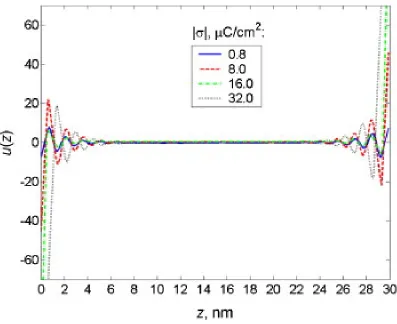
of the charge larger than the absolute value of the difference between the charge of the electrode and the charge of the first layer. And off these decaying charge oscillations go over several layers before reaching electroneutrality in the ‘bulk’. Torrie and Valleau were among the first who used simulation techniques (Monte-Carlo) for systematical studies of EDL formation at charged interfaces in concentrated electrolytes. In their 1980 work they have shown that at high concentration of ions in an electrolyte, the charge density in the EDL starts to oscillate.285 Their pioneering works on modelling EDL in concentrated electrolytes have shown apparent limitations of the GCh theory.286,287
However, the physical nature of overscreening, to our knowledge has never been clearly rationalized in the literature. We will get back to this issue, when discussing the situation with RTILs, where it becomes central for small and medium electrode polarizations.
Note that the papers by Tosi et al on molten salts did not study the effect of the voltage on the ionic distribution near the interface, having limited the analysis to the linear response.284 The nonlinear response was much more difficult to handle, and here simulation has started to play a pivotal role, as we discuss later in this review. For molten salts such study has been performed in Ref.,288 albeit not for a wide set of charges of the electrode. It has, however, detected some suppression of overscreening at large electrode polarization. We will dwell on a similar phenomenon in the context of RTILs later in this review.
The detailed Monte Carlo simulation studies of overscreening by Tosi et al were inspired
by a short note by Dogonadze and Chizmadzhev.289 Based on the experimental evidence
Indeed, it can be shown exactly that that the differential capacitance of EDL is inversely proportional to the centre of mass of the excess charge distribution in the double layer
⁄(‡) = lim
”‡æ0
S W W W U
zsú
0 dz”flion(‡, z)z zú
s
0 dz”flion(‡, z)
©
zú
s
0 dz”flion(‡, z)z
≠”‡ T X X X V= zú ⁄ 0 dz I
≠dflion(‡, z)
d‡ J
z (8)
where ”flion(‡, z) =flion(z)|‡+”‡≠flion(z)|‡ is the difference between the charge densities in
the liquids at the charge of the electrode equal to ‡+”‡ and ‡ and z is some distance in
the electroneutral bulk which may be put equal to infinity for large separation between the electrodes. Namely,
C= ‘ú
4fi⁄(‡) (9)
where ‘ú is the is the effective dielectric function of the dipole active degrees of freedom
in the electrolyte - due to vibrations and rotations of ionic pairs and clusters, electronic polarisability of ions of the solute and solvent molecules, etc. In the case of solvent-free RTIL it is the polarizability of all the degrees of freedom that are faster than translational motions of the same ions of RTIL, and it redresses Coulomb interactions in RTIL. Systematic measurements show that for many RTILs ‘ú is of the order of 10, c.f. Refs.174,189,290 But in
the case of molten salts this is just due the electronic polarizability of ions, and ‘ú≥2.
Oscillations in the potential distribution are related with the oscillations in flion(‡, z) as a function ofz, because the distribution of electrostatic potential in the double layer is given
by
IL(z) =≠4
fi ‘ú
z
⁄
0
(z≠zÕ)flion(zÕ)dzÕ. (10)
All in all, had the first peak in ”flion(‡, z) been totally dominating, the Dogonadze-Chizmadjhev conjecture would have been justified. However, even in HTMSs more than one peak is seen on the density profiles (not talking about RTILs). The way how all these peaks get restructured with applied voltage is decisive for the capacitance dependence upon voltage.
to all sorts of experimental artifacts (for critical review see Ref.292). In particular, the controversy in the data for the temperature dependence of the EDL capacitance in molten salts (different trends reported by different authors) that challenged theorists for decades, remains unresolved (see also discussion on this subject in the following sections below).
There is one issue to be mentioned before we conclude this section. In the mid-late 1980s there was a great interest in understanding the role of the electrons of the electrode in the result for EDL capacitance, specifically the effect of the spillover of the surface electron cloud into the solvent, and of the response of the surface electronic profile to charging (for reviews read.2,293,294 Indeed, the distance to the centre of mass of the excess charge distribution should be calculated not from the hypothetical ‘edge of the electrode’, say the edge of it ionic skeleton, but from a position of the excess charge in the electrode. This position is determined by the distribution of electrons near the interface and the latter is affected by the net charge of the electrode. The effect on the compact layer capacitance and its dependence on the electrode potential could be substantial, the surface electronic profile of the electrode being sensitive to the electrode polarization.2 How important this effect is for ionic liquids is not clear, as so far all the attention has been addressed to the double layer on the liquid side. It is, however, very important for any electrolyte, whether the electrode is an ideal metal, semiconductor or semimetal.
this in mind, when trying to interpret experimental data on various carbon electrodes. We note that this conclusion has not been approved by recent findings of Shklovskii et al.297 Theoretical estimates reported in that work suggested that the electric field should decay to zero within the first graphite layer. However, the recentquantum density functional theory (DFT) study by Luque and Schmickler that explicitly considered the layered structure of the graphite electrode showed that “on the basal plane of graphite, an external field pene-trates over a distance of a few tenth of a nm into the surface”.298 Luque and Schmickler also showed that the induced charge density inside the first several layers of graphite strongly oscillates (displaying Friedel-like oscillations). This work used a combination of the quan-tum DFT results with the hard-sphere model for the electrolyte solution to calculate the overall capacitance of the graphite/electrolyte interface. The computational and theoretical results presented in this work were shown to be in an excellent agreement with experimental data.298
Therefore, one may conclude that, indeed, the interfacial capacity between graphite and an electrolyte solution with high ionic concentration is dominated by the electronic response of graphite. However, there are still many open questions in this area (e.g effects of surface roughness, impurities, chemical modification of the surface and surface adsorption). Further detailed investigations of the appropriate quantum chemistry level combined with an ade-quate description of the liquid side are needed for various carbon materials. This is perhaps one of the most important challenges for the theory, in view of a wide use of carbon materials in supercapacitors, batteries and other electrochemical applications.27,71,74,142,144,179,299–310
4 Principles of the theory of EDL in RTILs at flat
elec-trodes
4.1 Mean field theory
sug-gested in a 2007 feature article52 in the context of the overall broad discussion of various new features that EDL in RTILs may exhibit in contrast to EDL in ordinary diluted elec-trolytes. The approach used simple principles of the lattice gas model, in which N+ cations
and N≠ anions, with a fixed total number ¯N =N++N≠, are distributed over N available
lattice sites. The distribution is random except for when it is influenced by electric field. The electrostatic potential of this field is self-consistently determined by the distribution of ions near the boundary with the electrode the polarization of which is taken into account through the boundary condition.
The free energy of such system may be approximated by
F =e (N+≠N≠) +B+N+2+B≠N≠2+CN+N≠≠kBTln( N!
N≠N+≠N≠)!N+!N≠!. (11)
Here the electrostatic potential and the distribution of ions are related via the Poisson
equation, which for a system with the anisotropy axis (the one perpendicular to the surface of the flat electrode), z, reads as
‘0d 2
dz2 = 4fie[c≠≠c+] (12)
with concentrations c≠ =Ni/ , c+=N+/ where is the total volume of the system.
The second, third, and fourth terms in eq 11 take into account for specific interactions between cations and anions, the nontrivial consequences of which were the subject of intensive investigations in this class of models in different contexts in the past.311–313 In the first
approximation, however, as in Ref.52 one can drop these terms out, just putting B+ =
B≠=C= 0 as this is the only way to keep the algebra simple and get analytical results.
Minimization of the free energy with respect to N+ and N≠ gives ‘Fermi-like’ distributions
of cation and ion densities as a function of electrostatic potential:
c+=c0 exp
1
≠keBT 2
1≠“+“cosh1ke BT
2 =c0 exp
1 e
kBT 2
1≠“+“cosh1ke BT
2 (13)
controlled by a single parameter of the model, the ratio of average concentration in
concen-tration,
“= ¯N /N= 2c0/cmax. (14)
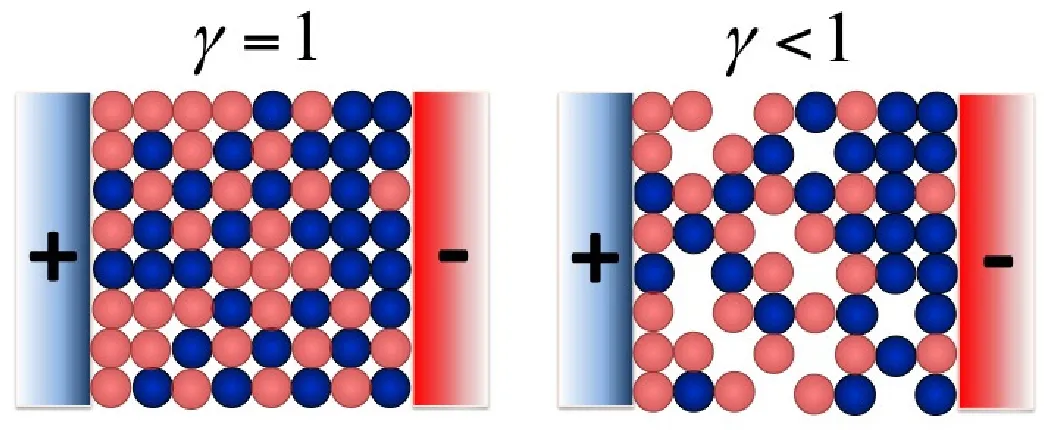
The physical meaning of this parameter is straightforward (see Figure3). In solvent-free ionic liquids: 1≠“ is the portion of free volume, i.e. the portion of voids in the system (analogous
to what is called porosity, with “ being equivalent to what is called compacity314). Some
RTILs spontaneously absorb some small amount of water from the air20,30,38,130,229,231,315,330 or they can be deliberately mixed with some amount of organic solvents (usually for the purpose of increasing the mobility of ions);35,50,120,316–320 1≠“ will then characterise the
volume portion of those molecules. The case of “= 1 corresponds to an ultra dense system
with no voids (or no solvent). The value of “ should vary for different RTILs, but for many
of them is expected to lie around or above 1/2; however, in the case of an RTIL with solvent
additives it can be substantially lower.
Combination of eq 12 and eq 13 gives the so called Poisson-Fermi equation,
d2 dz2 =
8fiec0
‘ú
sinh1 e kBT
2
1 + 2“sinh212ke BT
2. (15)
This nonlinear second order differential equation can be easily integrated subject to the corresponding two boundary conditions, and this solution will give us the distribution of potential (z). For a single double layer at one electrode located atz= 0, one may use as the
boundary conditions (i) the Gaussian law at the electrode/electrolyte interface,≠‘úddz---x=0=
4fi‡, where ‡ is the surface charge density, and (ii) the absence of the electric filed in the
electroneutrality region, d dz
--x
æŒ= 0. Setting the potential in the bulk, z æ Œ, at zero,
together with the full solution for (x), one gets the potential drop across the EDL,V = (0),
thus establishing the relationship between V and ‡. The capacitance per unit surface area
of the electrode then is obtained C=dVd‡ at any value of electrode potential.
Figure 3: A cartoon showing an ionic liquid between two electrodes, representing the concept
of the compacity parameter “ (red spheres standing for anions, blue spheres - cations, and
empty space in the lattice representing voids) For these 2D cartoons,“= 1 for the left picture
and “= 13/18 for the right picture.
(x) at the flat interface we refer the reader to the Ref.52 here outlining just the main points:
the absolute value of the potential decreases from (0) to zero (i)monotonously (mean-field solution!); and, (ii) slower than the Gouy-Chapman solution. How much slower? This is determined by the compacity factor, “. When“= 0 the shape of (z) is the same as in the
Gouy-Chapman theory; however, when“ approaches 1 the shape becomes much less prolate
[image:33.612.77.599.137.352.2]saturation’ or ‘crowding’ and it has an important consequence on the voltage-dependence the EDL differential capacitance.47,321
The resulting expression for the latter through the overall potential drop across the double layer, written for compactness in dimensionless units, u=eU/kBT, reads
C=CDcosh
3u
2
4 1
1 + 2“sinh21u22 ˆ ı ı ı
Ù 2“sinh
21u 2
2
lnË1 + 2“sinh21u22È. (16)
The particular case of “= 1 can also be retrieved:
C=CDcosh
3u
2
4 Ô2|sinh(u/2)| Ò
ln[coshu]coshu. (17)
In the both expressions
CD= 4‘ú
fiLD , ⁄D =
Û
1
8fiLBc0 , LB =
e2
‘úkBT. (18)
which are the Debye capacitance, the Debye length, and the Bjerrum length, respectively. These three factors have the same form as in electrolytic solutions, but they use‘ú, the ‘high
frequency dielectric constant’ of the RTIL that for pure, solvent- free RTILs is determined by all dipole-active collective excitations in RTIL (see subsection 2.2.3 above); an addition of organic solvent molecules can affect (usually increase) that value.
The first of the three factors in eq 16 is the Gouy-Chapman capacitance, but the two other factors convert the result into something very different. Such, the second factor in eq 17 makes the voltage-dependence of capacitance opposite to the Gouy-Chapman one: the curve takes a bell-shape instead of the U-shape. The behaviour of the more general case, 16, depends on the value of “. For “>1/3 it has a bell shape, whereas for “<1/3 it has
a double hump shape, called camel shape in Ref.52 In Figure 4 we reproduce plots of that
paper that show these qualitatively different modes of behaviour.
The physical nature of the two different modes of behaviour is clear. The crossover from the bell shape to the camel shape takes place when the density of electrolyte is diminished.
Figure 4: The capacitance given by the mean-field theory, eq 16, for indicated values of the
compacity parameter, “. The graph shows ’camel’ and ’bell’ shapes, for small and large
values of “, respectively. Reproduced from Ref.52
possible local density. For small “ there is some room to make the double layer more dense
with the increase of voltage, filling up the voids (the free volume) in the liquid, or if instead of voids we have some space occupied by organic solvent, expelling solvent molecules out
of the double layer.323 This will provide the Gouy-Chapman like behaviour (see Figure 2
[image:35.612.119.483.116.428.2]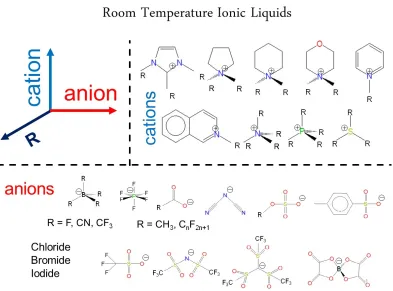



![Fig ur e 9 : D i� e r e nt ia l c a pa c it a nc e o f E D Lin [P y r 1 3 ][T FSI ] s imula t e d in R e f .3 8 8( t he fig ur e is r e pr o duc e d f r o m t his w o r k ) .](https://thumb-us.123doks.com/thumbv2/123dok_us/1633358.116602/57.612.106.506.117.456/fig-d-lin-t-fsi-imula-g-duc.webp)