www.orgchemres.org Org. Chem. Res., Vol. 5, No. 2, 159-166, September 2019.
Four-component Cascade Reaction was Programmed and Catalyzed by
B(OH)
3.H
2O
as an Efficient and Green Catalytic System
A.R. Moosavi-Zare
a,*, H. Afshar-Hezarkhani
a, V. Khakyzadeh
band H. Goudarziafshar
aa
Sayyed Jamaleddin Asadabadi University, Asadabad, 6541861841, I. R. Iran b
Faculty of Science,Department of Chemistry, K. N. Toosi University of Technology, P. O. Box: 15875 - 4416, Tehran, Iran (Received 12 March 2018, Accepted 3 November 2018)
An aqueous solution of boric acid, as an efficient and green catalytic system, was efficiently utilized for four-component cascade
reaction of aryl aldehydes, dimedone, β-ketoesters and ammonium acetate to give hexahydroquinolines. Reaction of boric acid with water
led to the generation of H+, and efficiently catalyzed the reaction under mild and green condition. Also, optimization of the reaction condition was investigated using the response surface method {Central Composite Design (CCD)}.
Keywords: Boric acid, Hexahydroquinoline, Cascade reaction,Aqueous solution
INTRODUCTION
A cascade reaction, also known as a domino reaction or tandem reaction, is a chemical process through which at least two consecutive reactions are being carried out continuously without isolating any intermediates, changing reaction conditions and adding reagents. The cascade reaction is often fast because of its intramolecular nature. Clean reaction condition, high atomic economy and much complexity in effectively one step are among other main advantages of this reaction [1-7].
Quinolines with a 1,4-dihydropyridine structure are promising scaffolds due to their pharmacological activities. This part of quinoline derivatives has many applications in medicinal chemistry, and has been also applied as
antiasthmatic, antibacterial antihypertensive, anti-
inflammatory, antimalarial, and tyrosine kinase inhibiting compounds [8-13]. One of the significant classes of DHPs with a modified structural scaffold is hexahydroquinolines (HHQs) which could be synthesized by the Hantzsch reaction by the condensation of various aromatic aldehydes,
*Corresponding author. E-mail: [email protected]
dimedone, β-ketoesters and ammonium acetate via the one-pot multi-component condensation reaction using different catalysts including FeF3 [14], K7[PW11CoO40] [15],
PPA-SiO2 [16], HClO4-SiO2 [17], silica-bonded
imidazolium-sulfonic acid chloride [18],[Dsim]HSO4 [19],
magnetite nano-Fe3O4 [20], [HMIM]C(NO2)3 [21].
According to the relevant properties of HHQs, the employ of new catalysts with high novelty and effectiveness are still needed.
Herein, we have introduced the solvent-free synthesis of hexahydroquinolines using an aqueous solution of boric acid as an efficient and green catalytic system with high yields and short reaction times (Scheme 1). Optimization of the reaction condition was investigated using the response surface method {Central Composite Design (CCD)}.
EXPERIMENTAL
All chemicals were purchased from Merck or Fluka chemical companies. The known products were identified by comparison of their melting points and spectral data with those reported in the literature.Progress of the reactions was monitored by TLC using silica gel SIL G/UV 254 plates.
The 1H NMR (300 MHz) and 13C NMR (75 MHz) spectra were recorded on a Bruker Avance DPX-250 FT-NMR spectrometer (d in ppm). Melting points were recorded on a Büchi B-545 apparatus in open capillary tubes.
Procedure
for
the
Synthesis
of
Hexahydroquinolines
To a mixture of dimedone (1 mmol, 0.14 g), aryl aldehyde (1 mmol), ethyl acetoacetate (1 mmol, 0.13 g) and ammonium acetate (1.2 mmol, 0.092 g) in a 10 ml round-bottomed flask connected to a reflux condenser, was added boric acid (10 mol%, 0.0062 g) and a few drops of water, and the resulting mixture was stirred at 50 ºC for an appropriate time. After completion of the reaction as monitored by TLC, the reaction mixture was cooled to room temperature. The crude product was purified by recrystallization from ethanol (95%).
Spectral Data Analysis for Compounds Ethyl
2,7,7-Trimethyl-5-oxo-4-phenyl-1,4,5,6,7,8-hexa-hydroquinoline-3-carboxylate (1). White solid, isolated
yield 81%; melting point: 204-205 ºC (Ref. [20]: 203- 205 ºC); 1H NMR (300 MHz, DMSO-d6): δ (ppm) 0.85 (s,
3H), 1.00 (s, 3H), 1.13 (t, J = 7.0 Hz, 3H), 2.01-2.20 (m, 2H), 2.29 (s, 3H), 2.38-2.50 (m, 2H), 3.97 (q, J = 7.0 Hz, 2H), 4.82 (s, 1H), 7.05 (m, 1H), 7.18 (t, J = 6.7 Hz, 2H), 7.21 (t, J = 6.5 Hz, 2H), 9.12 (s, 1H); 13C NMR (75 MHz, DMSO-d6): δ (ppm) 14.5, 18.8, 26.8, 29.5, 32.6, 36.5, 50.6,
59.6, 103.4, 109.9, 113.5, 126.9, 128.8, 130.5, 146.0, 150.3, 167.0, 194.7.
Ethyl 4-(4-hydroxyphenyl)-2,7,7-trimethyl-5-oxo-
1,4,5,6,7,8-hexahydroquinoline-3-carboxylate (15).White
solid, isolated yield 85%; melting point: 238-240 ºC (Ref. [20]: 232-234 ºC); 1H NMR (300 MHz, DMSO-d6): δ (ppm)
0.86 (s, 3H), 1.00 (s, 3H), 1.14 (t, J = 7.0 Hz, 3H), 1.96 (d,
J = 16.0 Hz, 1H), 2.15 (d, J = 16.1 Hz, 1H), 2.26 (s, 3H), 2.36-2.49 (m, 2H), 3.96 (q, J = 7.0 Hz, 2H), 4.74 (s, 1H), 6.56 (d, J = 8.1 Hz, 2H), 6.93 (d, J = 8.1 Hz, 2H), 8.94 (s,
1H), 9.01 (s, 1H); 13C NMR (75 MHz, DMSO-d
6): δ (ppm)
14.6, 18.7, 26.9, 29.6, 32.6, 35.3, 50.8, 59.4, 104.6, 110.8, 114.9, 128.8, 138.9, 144.8, 149.6, 155.7, 167.5, 194.7.
RESULTS AND DISCUSSION
At first, to find the best reaction condition for the synthesis of hexahydroquinoline derivatives, the reaction of dimedone (1 mmol), 4-nitrobenzaldehyde (1 mmol), ethyl acetoacetate (1 mmol) and ammonium acetate (1.2 mmol) was selected as a model reaction. To compare the efficiency of the reaction in solvent-free versus solvent conditions, the model reaction was tested in various solvents at 50 °C (Table 1).
From Table 1, as it is clear, higher yield and lowest reaction time were obtained in H2O as solvent at 50 ºC. The
model reaction was also tested at 25 and 80 ºC in H2O; the
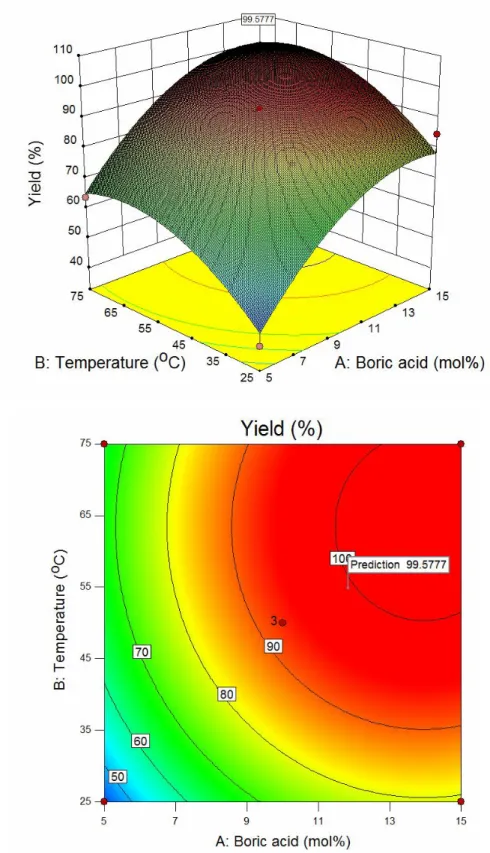
best result was obtained at 50 ºC. Therefore, water could be selected as a suitable solvent for the model reaction (entry 5). In sequence, to find the exact reaction condition for preparation of hexahydroquinolines, amounts of boric acid and temperature were selected as effective factors. The factors optimization was performed by central composite design (CCD). The yield of the reaction was chosen as a response. In this design, there are three points of cubic, coming from the factorial design, axial and center points. Some preliminary experiments were initially done to determine the range of the variables (Table 2). According to the CCD methodology, eleven tests in different conditions were designed (Table 3). After performing the tests, our analysis showed that reaction could be modeled by a second order polynomial equation (Eq. (1)),
O
O
50 oC
Ar O
N H
OC2H5
O O C2H5O
NH4OAc
O O Ar
Water HO B OH
OH
X = -10.94 × [A]2 - 9.94 × [B]2 + 17.33 × [A] + 10.67 × [B] + 93.00 (1) where X is the yield of the reaction, and the terms are in the actual factor. The analysis of variance for the presented model is shown in Table 4.
The Model F-value of 47.7 and the p-value < 0.0001 prove the acceptability of the model. The prediction power of the model (Pred. R2) was 0.88 which was in reasonable
agreement with Adj. R2 of 0.94 (the difference is less than
0.2).
By using of three-dimensional surface graphs, obtained from the model, the effect of the operating factors on the yield was investigated (Fig. 1). According to model and 3D graph and contour graph, optimal operational conditions are B(OH)3 = 12 mmol and temperature = 55 ºC which was in
good agreement with experimental results.
To investigate the efficacy and the generality of the catalyst, dimedone was reacted with various aromatic aldehydes,ethyl acetoacetate and ammonium acetate under
Table 1. Effect of a Few Drops of Different Solvents on the Reaction of Dimedone, 4-Nitrobenzaldehyde, Ethyl Acetoacetate and Ammonium Acetate, in the Presence of B(OH)3 (0.006 g, 10 mol %)
Entry Solvent Temp.
(°C)
Time (min)
Yield (%)b
1 CHCl3 50 60 Trace
2 EtOAC 50 60 Trace
3 EtOH 50 60 Trace
4 CH2Cl2 Reflux 60 Trace
5 H2O 50 5 92
6 Acetone Reflux 60 Trace
7 THF 50 60 Trace
8 - 50 60 Trace
aAll reactions were carried out at 50 ºC except entries 4 and
6, which were proceeded at reflux temperature of solvent. bIsolated yield.
Table 2. The Levels and Range of the Independent Variables
Range and level Variables
-α -1 0 +1 +α
B(OH)3 (mol%) 2.92 5 7.5 10 17.07
Temperature (°C) 15 25 50 75 85
Table 3. The Designed Experiments by CCD Methodology and Corresponding Responses
The factors
Test A = B(OH)3
(mol%)
B= Temperature (°C)
Yield (%)a
1 5 25 40
2 10 50 93
3 10 50 93
4 5 75 64
5 2.92 50 50
6 17 50 95
7 15 25 85
8 10 85 93
9 15 75 94
10 10 15 56
11 10 50 93
aIsolated yield.
Table 4. Analysis of Variance for the Response Surface Quadratic Model
Source Sum of
squares
df Mean
square
F Value
p-value Prob > F
Model 4267.44 4 1066.86 47.70 0.0001
A-Boric acid 2402.62 1 2402.62 107.42 < 0.0001
B-Temperature 910.06 1 910.06 40.69 0.0007
A2 675.55 1 675.55 30.20 0.0015
B2 557.67 1 557.67 24.93 0.0025
Residual 134.19 6 22.37 Trace
Lack of fit 134.19 4 33.55 Trace
Pure error 0.000 2 0.000 Trace
Fig. 1. Three-dimensional response surfaces for the effect of factors on the yield of the reaction time. Left (3D graph), right (contour graph).
Entry 1 Time: 7 min Yield: 81% MP: 204-205oC (Lit.203-205oC [20])
Entry 2 Time: 5 min Yield: 92% MP: 245-258oC (Lit.242-244oC [20])
Entry 3 Time: 5 min Yield: 90% MP: 255-259oC
(Lit.257-259oC [20])
Entry 4 Time: 10 min Yield: 87% MP: 235-238oC
(Lit.- [24])
Entry 15 Time: 7 min Yield: 85% MP: 238-240oC
(Lit.232-234oC [20]) Entry 5
Time: 5 min Yield: 92% MP: 249-253oC
(Lit.255-257oC [20])
Entry 6 Time: 6 min Yield: 75% MP: 227-230oC
(Lit.235-237oC [20])
Entry 7 Time: 8 min Yield: 80% MP: 250-251oC
(Lit.245-256oC [20])
Entry 8 Time: 7 min Yield: 73% MP: 214-216oC
(Lit.220oC [20])
Entry 16 Time: 5 min Yield: 89% MP: 229-234oC
(Lit.229-234oC [20])
Entry 9 Time: 10 min Yield: 85% MP: 239-240oC
(Lit.246oC [20])
Entry 10 Time: 7 min Yield: 95% MP: 205-207oC (Lit.205-207oC [20])
Entry 11 Time: 5 min Yield: 92% MP: 255-256oC (Lit.257-258oC [20])
Entry 12 Time: 6 min Yield: 90% MP: 231-233oC (Lit.235-237oC [20])
Entry 13 Time: 5 min Yield: 95% MP: 247-251oC
(Lit.245-256oC [25])
Entry 14 Time: 6 min Yield: 75% MP: 227-230oC
(Lit.235-237oC [21])
N H OEt O O N H OEt O O NO2 N H OEt O O OMe N H OEt O O S N H OEt O O OH N H OEt O O Br N H OEt O O Br N H OEt O O Cl N H OEt O O NO2 Cl N H OEt O O Cl Cl N H OEt O O N N H OEt O O NO2 N H OEt O O OMe N H OEt O O Cl N H OEt O O OMe OMe N H OEt O O OMe MeO
Fig. 2. The synthesis of HHQs from dimedone, aryl aldehydes, β-ketoesters and ammonium acetate
the optimized reaction conditions. All reactions proceeded efficiently to give the desired hexahydroquinoline derivatives in high yields and in short reaction times. Therefore, aqueous solution of boric acid was a highly efficient and general catalytic system for the preparation of HHQs (Fig. 2).
B(OH)4- and H+ are generated in the aqueous solution
through interaction of B(OH)3 with water and attraction of
OH– with boric acid [22,23]. In the mechanism supported by
the literature [18-25], at first, dimedone is converted to its
enol form and then reacts with activated aldehyde (by H+) to give intermediate I. Also, the activated ethyl acetoacetate (by H+) reacts with ammonia (resulted from ammonium acetate) to afford enamine II. Then, the intermediate I and enamine II react with each other to produce intermediate III. III is converted to IV by tautomerization, and intermediate IV gives V by an intramolecular nucleophilic attack of the NH2
group to the activated carbonyl group and by the elimination of one molecule H2O. Finally, hexahydroquinonine is formed
by tautomerization of V (Scheme 2).
O Ar
H
N H
H H
O O O O
H
NH4OAc
HOAc
OR O O
H2N
OR O
O
HO Ar
OR O
HN
O
O Ar
OR O
H2N
-H2O
O Ar
OR O
N H
O Ar
OR O
N H
H II
III IV
O
O Ar H
- H2O
I
V H
- H2O
HN
OR O H
B O
H
O H
O
H B
O H
O H
O H
O H
O H H
H
O H
H H
O H H
H
O H H
H 2 H2O
CONCLUSIONS
In this work, we have reported four-component cascade reaction of aryl aldehydes, dimedone,
β-ketoesters and ammonium acetate to give
hexahydroquinolines using an aqueous solution of a boric acid at 50 °C under mild and green conditions.
ACKNOWLEDGEMENTS
We are thankful to the Sayyed Jamaleddin Assadabadi University for the support to this work.
REFERENCES
[1] A.R. Moosavi-Zare, M.A. Zolfigol, O. Khaledian, V. Khakyzadeh, M.D. Farahani, M.H. Beyzavi, H.G. Kruger, Chem. Engin. J. 248 (2014) 122.
[2] A.R. Moosavi-Zare, M.A. Zolfigol, O. Khaledian, V. Khakyzadeh, M.D. Farahani, H.G. Kruger, New J. Chem. 38 (2014) 2342.
[3] A. Khazaei, F. Abbasi, A.R. Moosavi-Zare, New J. Chem. 38 (2014) 5287.
[4] M.A. Zolfigol, A. Khazaei, A.R. Moosavi-Zare, J. Afsar, V. Khakyzadeh, O. Khaledian, J. Chin. Chem. Soc. 62 (2015) 398.
[5] A.R. Moosavi-Zare, M.A. Zolfigol, M. Zarei, A.
Zare, V. Khakyzadeh, A. Hasaninejad, Appl. Catal. A: Gen. 467 (2013) 61.
[6] A. Khazaei, A.R. Moosavi-Zare, Z. Mohammadi, V. Khakyzadeh, J. Afsar, J. Chin. Chem. Soc. 63 (2016) 165.
[7] M.A. Zolfigol, S. Baghery, A.R. Moosavi-Zare, S.M. Vahdat, J. Mol. Catal. A: Chem. 409 (2015) 216. [8] R. Simsek, U.B. Ismailoglu, C. Safak, I.
Sahin-Erdemli, Farmaco. 55 (2000) 665.
[9] R.D. Larsen, E.G. Corley, A.O. King, J.D. Carrol, P. Davis, T.R. Verhoeven, P.J. Reider, M. Labelle, J.Y.
Gauthier, Y.B. Xiang, R. Zamboni, J. Org. Chem. 61 (1996) 3398.
[10] Y.L. Chen, K.C. Fang, J.Y. Sheu, S.L. Hsu, C.C. Tzeng, J. Med. Chem. 44 (2001) 2374.
[11] G. Roma, M.D. Braccio, G. Grossi, M. Chia, Eur. J. Med. Chem. 35 (2000) 1021.
[12] D. Doube, M. Bloun, C. Brideau, C. Chan, S.
Desmarais, D. Eithier, J.P. Falgueyeret, R.W. Friesen, M. Girad, Y. Girad, J. Guay, P. Tagari, R.N. Yong, Bioorg. Med. Chem. Lett. 8 (1998) 1255.
[13] M.P. Maguire, K.R. Sheets, K. Mcvety, A.P. Spada, A. Ziberstein, J. Med. Chem. 37 (1994) 2129. [14] R. Surasani, D. Kalita, A.V.D. Rao, K. Yarbagi, K.B.
Chandrasekhar, J. Fluorine Chem. 135 (2012) 91.
[15] M.M. Heravi, K. Bakhtiari, N.M. Javadi, F.F.
Bamoharram, M. Saeedi, H.A. Oskooie, J. Mol. Catal. A: Chem. 264 (2007) 50.
[16] A. Khojastehnezhad, F. Moeinpour, A. Davoodnia, Chin. Chem. Lett. 22 (2011) 807.
[17] M. Maheswara, V. Siddaiah, G..L.V. Damu, C.V. Rao,
ARKIVOC. 2 (2006) 201.
[18] A.R. Moosavi-Zare, M.A. Zolfigol, M. Zarei, A. Zare, J. Afsar, Appl. Catal. A: Gen. 505 (2015) 224. [19] A. Zare, F. Abi, A.R. Moosavi-Zare, M.H. Beyzavi,
M.A. Zolfigol, J. Mol. Liq. 178 (2013) 113.
[20] A. Khazaei, A.R. Moosavi-Zare, H.
Afshar-Hezarkhani, V. Khakyzadeh, RSC Adv. 4 (2014) 32142.
[21] M.A. Zolfigol, S. Baghery, A.R. Moosavi-Zare, S.M. Vahdat, H. Alinezhad, M. Norouzi, RSC Adv. 4 (2014) 57662.
[22] W.L. Jolly, Mc Graw-Hill. (1984) 198.
[23] A. Khazaei, H.A. Alavi Nik, A.R. Moosavi-Zare, J. Chin. Chem. Soc. 62 (2015) 675.
[24] A. Tadjarodi, A. Azad, M.G. Dekamin, S. Afshar, R. Hejazi, A. Mollahosseini, JNS. 5 (2015) 327.
[25] G. Mohammadi Ziarani, A. Badiei, Y. Khaniania, M. Haddadpour, J. Chem. Chem. Eng. 29 (2010).