···
Journal of Civil Engineering and Materials Application http://jcema.com
:
Journal home page
Received: 22 December 2019 • Accepted: 12 February 2020
10.22034/JCEMA.2020.212110.1012 doi:
Application of Gene Expression Programming Model to
Present a New Model for Bond Strength of Fiber Reinforced
Polymer and Concrete
1 Visiting Associate Professor, Aalto University, Marine technology group, Espoo, Finland. 2 Department of Civil Engineering, Mashhad Branch, Islamic Azad University, Mashhad, Iran. 3 Department of Hydraulic Engineering, Mashhad Branch, Islamic Azad University, Mashhad, Iran. 4 Department of Civil Engineering, Hakim Sabzevari University, Sabzevar, Iran
5 Associate Professor, Aalto University, Marine technology group, Espoo, Finland.
*Correspondence s ho ul d be ad dr e sse d to Has sa n S ag hi , Department of Civil Engineering, Iran University of Science and Technology, Espoo, Finland. Tel: +98514401287; Fax: Email: [email protected]
Copyright © 2019 Hassan Saghi et al. This is an open access paper distributed under the Creative Commons Attribution License.Journal of Civil Engineering and Materials Application
is published by Pendar Pub; Journal p-ISSN 2676-232X; Journal e-ISSN 2588-2880.
1. INTRODUCTION
iber-reinforced polymer (FRP) is built of a polymer matrix reinforced with fibers. The application of FRP is an effective method to ensure load path continuity between concrete surface and FRP. It is also used to increase the bond strength of concrete structures. Because of high strength-to-weight ratios and high corrosion resistance of FRPs, they are used to strengthen concrete structures [1-6]. For example, Singh [7] presented a new equation to estimate FRP-to-FRP bond capacity. They experimentally studied on
bonded FRP-to-FRP lap joints and suggested models to calculate the bond capacity. Castillo et al. [8] presented a review of the design models of reinforced concrete structures strengthened with FRP composites. In another study, Castillo et al. [9] experimentally studied on bent FRP anchor specimens to characterize their behavior upon the occurrence of the fiber rupture failure mode. Properly designed FRP anchors can fully develop the strength of FRP strips. However, the comprehensive impact of some
F
ABSTRACT
In this paper, the gene expression-programming model was applied to present a novel model for the bond strength of concrete and fiber-reinforced polymer estimation. In order to do this, collected data were divided into the trained and tested ones by gene expression programming (GEP) means. The input parameters are the width of fiber-reinforced polymer, the width of concrete, thickness of fiber-reinforced polymer, the elastic modulus of fiber-reinforced polymer (FRP), concrete cylinder compressive strength, and bond length. The output parameters are the bond strength of concrete and FRP. Finally, a novel relationship was derived using the GEP to predict the bond strength of FRP -to-concrete composite joints. Results showed that the presented relationship was more convenient than the other models and that it was a powerful tool to predict the bond strength values of the FRP -to-concrete composite. For example, R-square (R2) of the present work is 0.92 compared to that (< 0.82) reported for other models. Among the models presented by other researchers, that of Dai et al. is more accurate than the other ones, and the model offered by Khalifa et al. has the lowest accuracy.
Keywords
: Fiber Reinforced Polymers; Bond Strength; Gene Expression Programming; Concrete.··· parameters such as the strength ratio of FRP anchor to FRP
strip, the bend ratio, the spike embedment depth, and the dowel angle on the anchor strength have not been considered in existing equations. Therefore, some researchers, such as Sun et al. [10]
,
incorporated these parameters in existing equations to improve the efficiency of current FRP anchors.Chen et al. [11] studied the effects of FRP thickness and confining on the flexural performance of hybrid bonded FRP strengthened reinforced concrete beams. They experimentally studied some samples with and without hybrid bonded strengthening under four-point bending. They showed that when the failure mode was FRP rupture, increasing the confining effect increased the load-carrying capacity, whereas increasing the FRP thickness increased the load-carrying capacity. Externally bonded FRP system is one of the main approaches to increase the seismic capacity of reinforced concrete structures. In this regard, Castillo et al. [12] studied the seismic behavior of the reinforced concrete columns strengthened with FRP. They calculated the instant capacity of the FRP strengthened columns for the failure of the FRP sheets and FRP anchors. The authors also studied the tension-compression cyclic loading effectiveness on the capacity of the anchors and assessed its influence on column behavior with FRP transverse reinforcement.
In the past two decades, the FRP bridge deck has been a suitable alternative for the refurbishment of existing bridges because FRP has some properties such as lightweight, high strength, and high resistance. Therefore, some researchers investigated the use of FRP composites in bridges [13]. In addition to the experimental methods, some researchers used numerical approaches to simulate reinforced concrete structures anchored with FRP anchors. For example, Yang et al.
[
14] used the finite element method to analyze FRP-strengthened reinforced concrete test slabs anchored with FRP anchors. They also proposed a semi-empirical load-slip model for modeling the FRP anchors. Their results showed a good agreement between the numerical results and test measurements.The bond strength between FRP composites and substrates is an important parameter in the design of FRP systems. Thus, some researchers studied the bond strength between FRP composites and substrates. For instance, Vaculik et al. [15] collated a database of some individual tests investigating the FRP-to-masonry bond strength through shear pull-tests. In their next research, Vahedian et al. [16] developed a novel theoretical model through stepwise regression analysis of some single shear FRP-to-timber joints to report the behavior of FRP externally bonded to timber. They finally presented a novel new model for the bond strength of FRP-to-timber joints determination. Their results showed a good agreement between the predicted loads and ultimate applied loads. Dai et al. [17] presented nonlinear bond stress-slip models for the FRP and concrete interface by using two parameters, namely interfacial ductility index, and interfacial fracture energy.
The interfacial behaviors of bonded concrete and carbon FRP were experimentally studied by Woo and Lee [18]. New formulae were suggested for the shear bond strength estimation by Wu et al. [19]. Mashrei et al. [20] estimated the concrete-to-FRP composite joints by using the ANN method compared with available experimental data. They showed that the presented method could accurately estimate the aforementioned parameter. Zhang et al. [21] predicted the concrete-FRP bonded joints by using the model uncertainty.
Different anchorage techniques are widely applied in shear strengthened reinforced-FRP concrete systems. Therefore, some researchers evaluated the bond performance of these techniques in T-beams [22]. Lezgy-Nazargah et al. [23] studied the accuracy and reliability of available bond-slip laws for numerical modeling of FRP-concrete interfaces. A layered global-local finite element model with low degrees of freedom was also presented for the materially nonlinear analysis of reinforced concrete beams by Lezgy-Nazargah [24]. Lin et al. [25] studied the reliability of width factor models and found that plate rigidity, concrete strength, concrete width, and FRP plate width were the most important influential parameters. Cover separation, critical diagonal crack induced interfacial debonding, intermediate crack induced interfacial debonding, and plate end interfacial debonding are the different debonding failure modes in the concrete-FRP composites [26]. Kalfat and Al-Mahaidi [27] coupled the properties of bidirectional fiber patch and FRP spike anchors to make a new anchorage system with strength properties.
Gene expression programming (GEP) is a new technique for the creation of computer programs that uses character linear chromosomes composed of genes structurally organized in a head and a tail. It is a powerful tool to model the nonlinear relationships. Therefore, some researchers used GEP in different problems by estimating different parameters of concrete, such as slump, cost, and concrete strength using the GEP model [28-32]. For example, Power et al. [33] used the GEP model predict wave run up on beaches, including a wide array of beach types with varying sediment sizes and bed roughness. They showed that the presented explicit GEP model was more accurate in comparison to all other empirical models. Jafari and Mahini [34] used the GEP model to provide references for three types of lightweight concretes containing clay and natural pumice aggregates with maximum nominal sizes of 12.7 mm and 19.2 mm, respectively, and presented three equations to obtain the compressive strength of a specific mixture. Their results indicated that the proposed derivations could be a useful and practical method for engineers.
According to the literature, the external bonding of FRP composites is a popular technique for strengthening concrete structures, which is still of interest to researchers. On the other hand, GEP is a new and powerful technique for the creation of computer programs. In this paper, therefore, a novel relationship was derived using GEP to predict the bond strength of FRP and concrete composite joints.
···
2. METHODOLOGY
In this paper, the single-lap shear test was used to present a relationship for fundamental interface bond stress–slip and the bond strength (See Figure. 1). GEP is a new technique for the creation of computer programs that uses the character linear chromosomes composed of genes structurally organized in a head and a tail. The chromosomes function as a genome that are subjected to modification by means of mutation, transposition, root transposition, gene
transposition, gene recombination, and one- and two-point recombination. The chromosomes encode expression trees, which are the object of selection. The creation of these separate entities (genome and expression trees) with distinct functions allows the algorithm to perform with high efficiency, which greatly surpasses existing adaptive techniques
.
Figure 1. Single-lap shear test; a) Elevation; b) Plan form.
3. RESULTS AND DISCUSSION
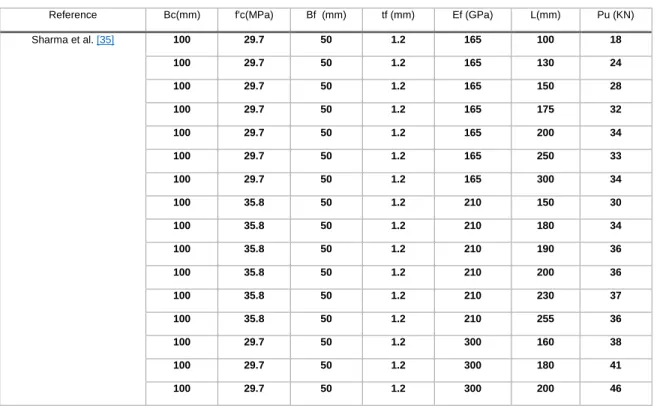
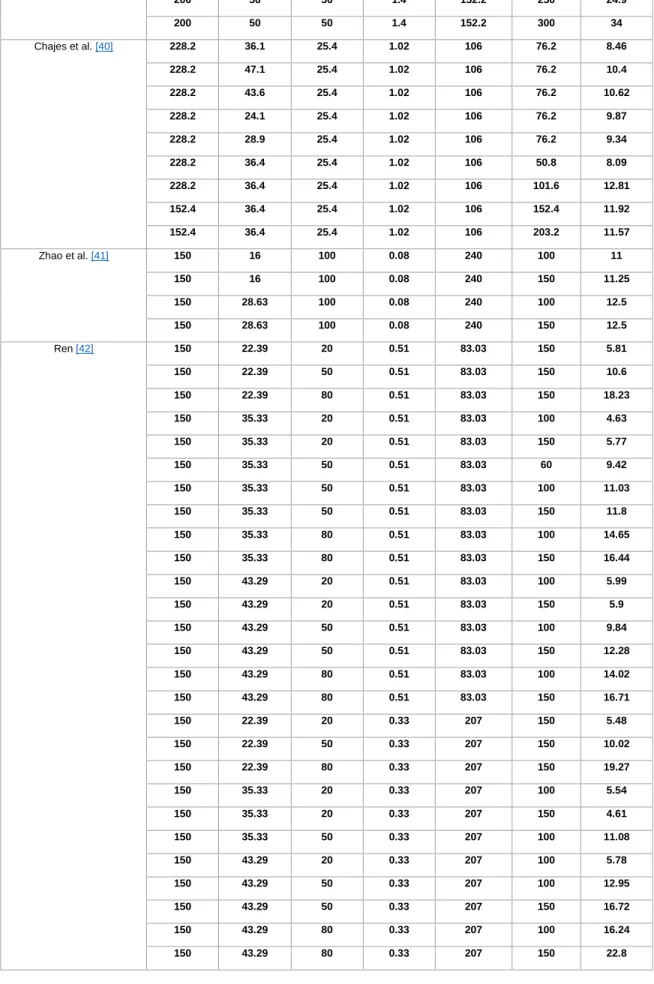
In this paper, the GEP model was implemented to present a novel model for the bond strength of concrete and fiber-reinforced polymer estimation. In order do this; available
data were collected from the literature, as summarized in Table 1.
Table 1. The available data collected from the literature
Reference Bc(mm) f'c(MPa) Bf (mm) tf (mm) Ef (GPa) L(mm) Pu (KN)
Sharma et al. [35] 100 29.7 50 1.2 165 100 18
100 29.7 50 1.2 165 130 24
100 29.7 50 1.2 165 150 28
100 29.7 50 1.2 165 175 32
100 29.7 50 1.2 165 200 34
100 29.7 50 1.2 165 250 33
100 29.7 50 1.2 165 300 34
100 35.8 50 1.2 210 150 30
100 35.8 50 1.2 210 180 34
100 35.8 50 1.2 210 190 36
100 35.8 50 1.2 210 200 36
100 35.8 50 1.2 210 230 37
100 35.8 50 1.2 210 255 36
100 29.7 50 1.2 300 160 38
100 29.7 50 1.2 300 180 41
···
100 29.7 50 1.2 300 250 45
Yao et al. [36] 100 29.7 50 1.2 300 300 45
150 23 25 0.17 256 75 5.2
150 23 25 0.17 256 85 5.8
150 23 25 0.17 256 95 6
150 23 25 0.17 256 115 6
150 23 25 0.17 256 145 6.1
150 23 25 0.17 256 190 6.6
150 27.1 25 0.17 256 100 5.9
150 27.1 50 0.17 256 100 11
150 27.1 75 0.17 256 100 14
150 27.1 100 0.17 256 100 19
150 18.9 25 0.17 256 95 5.6
150 19.8 25 0.17 256 95 6.1
150 21.1 15 0.17 256 95 4.1
150 21.1 25 0.17 256 95 6.2
150 21.1 50 0.17 256 95 12
150 21.1 75 0.17 256 95 14
150 21.1 100 0.17 256 95 15
150 24.9 25 0.17 256 95 6.7
150 24.9 25 0.17 256 145 6.91
150 24.9 25 0.17 256 190 7.26
150 24.9 25 0.17 256 240 6.7
Takeo et al. [37] 100 28.88 40 0.17 230 100 8.75
100 26.66 40 0.17 230 100 8.85
100 28.88 40 0.17 230 200 9.3
100 26.66 40 0.17 230 200 8.5
100 28.88 40 0.17 230 300 9.3
100 26.66 40 0.17 230 300 8.3
100 24.99 40 0.17 230 100 8.8
100 26.17 40 0.17 230 100 8.41
100 24.4 40 0.17 230 100 7.89
100 24.99 40 0.33 230 100 11.4
100 24.99 40 0.5 230 100 13.5
100 24.4 40 0.17 230 100 11.23
100 49.97 40 0.17 230 100 7.9
100 24.99 40 0.11 230 100 7.7
100 26.17 40 0.11 230 100 6.95
Toutanji et al. [38] 200 17 50 0.42 110 100 7.56
200 17 50 0.66 110 100 9.29
Woo and Yun [39] 200 30 10 1.4 152.2 50 5.15
200 30 10 1.4 152.2 100 7.55
200 30 10 1.4 152.2 150 7.7
200 30 10 1.4 152.2 200 7.9
200 30 10 1.4 152.2 250 6.25
···
200 40 10 1.4 152.2 50 5.1
200 40 10 1.4 152.2 100 6.85
200 40 10 1.4 152.2 150 6.35
200 40 10 1.4 152.2 200 6.95
200 40 10 1.4 152.2 250 6.8
200 40 10 1.4 152.2 300 6.4
200 50 10 1.4 152.2 50 4.55
200 50 10 1.4 152.2 100 7.1
200 50 10 1.4 152.2 150 7.78
200 50 10 1.4 152.2 200 7.65
200 50 10 1.4 152.2 250 6.8
200 50 10 1.4 152.2 300 7.25
200 30 30 1.4 152.2 50 9.3
200 30 30 1.4 152.2 100 16.25
200 30 30 1.4 152.2 150 16.2
200 30 30 1.4 152.2 200 22.1
200 30 30 1.4 152.2 250 15.6
200 30 30 1.4 152.2 300 15.85
200 40 30 1.4 152.2 50 9.15
200 40 30 1.4 152.2 100 14.9
200 40 30 1.4 152.2 150 16.05
200 40 30 1.4 152.2 200 16.15
200 40 30 1.4 152.2 250 16.11
200 40 30 1.4 152.2 300 16.9
200 50 30 1.4 152.2 50 9.2
200 50 30 1.4 152.2 100 17.8
200 50 30 1.4 152.2 150 15.22
200 50 30 1.4 152.2 200 18.5
200 50 30 1.4 152.2 250 19
200 50 30 1.4 152.2 300 17.73
200 30 50 1.4 152.2 50 13.3
200 30 50 1.4 152.2 100 26
200 30 50 1.4 152.2 150 27.8
200 30 50 1.4 152.2 200 27.2
200 30 50 1.4 152.2 250 24.84
200 30 50 1.4 152.2 300 23
200 40 50 1.4 152.2 50 10.7
200 40 50 1.4 152.2 100 24.5
200 40 50 1.4 152.2 150 27.45
200 40 50 1.4 152.2 200 19.3
200 40 50 1.4 152.2 250 21.9
200 40 50 1.4 152.2 300 27.3
200 50 50 1.4 152.2 50 10.8
200 50 50 1.4 152.2 100 16
200 50 50 1.4 152.2 150 21.25
···
200 50 50 1.4 152.2 250 24.9
200 50 50 1.4 152.2 300 34
Chajes et al. [40] 228.2 36.1 25.4 1.02 106 76.2 8.46
228.2 47.1 25.4 1.02 106 76.2 10.4 228.2 43.6 25.4 1.02 106 76.2 10.62 228.2 24.1 25.4 1.02 106 76.2 9.87 228.2 28.9 25.4 1.02 106 76.2 9.34 228.2 36.4 25.4 1.02 106 50.8 8.09 228.2 36.4 25.4 1.02 106 101.6 12.81 152.4 36.4 25.4 1.02 106 152.4 11.92 152.4 36.4 25.4 1.02 106 203.2 11.57
Zhao et al. [41] 150 16 100 0.08 240 100 11
150 16 100 0.08 240 150 11.25
150 28.63 100 0.08 240 100 12.5
150 28.63 100 0.08 240 150 12.5
Ren [42] 150 22.39 20 0.51 83.03 150 5.81
150 22.39 50 0.51 83.03 150 10.6 150 22.39 80 0.51 83.03 150 18.23 150 35.33 20 0.51 83.03 100 4.63 150 35.33 20 0.51 83.03 150 5.77
150 35.33 50 0.51 83.03 60 9.42
150 35.33 50 0.51 83.03 100 11.03 150 35.33 50 0.51 83.03 150 11.8 150 35.33 80 0.51 83.03 100 14.65 150 35.33 80 0.51 83.03 150 16.44 150 43.29 20 0.51 83.03 100 5.99
150 43.29 20 0.51 83.03 150 5.9
150 43.29 50 0.51 83.03 100 9.84 150 43.29 50 0.51 83.03 150 12.28 150 43.29 80 0.51 83.03 100 14.02 150 43.29 80 0.51 83.03 150 16.71
150 22.39 20 0.33 207 150 5.48
150 22.39 50 0.33 207 150 10.02
150 22.39 80 0.33 207 150 19.27
150 35.33 20 0.33 207 100 5.54
150 35.33 20 0.33 207 150 4.61
150 35.33 50 0.33 207 100 11.08
150 43.29 20 0.33 207 100 5.78
150 43.29 50 0.33 207 100 12.95
150 43.29 50 0.33 207 150 16.72
150 43.29 80 0.33 207 100 16.24
150 43.29 80 0.33 207 150 22.8
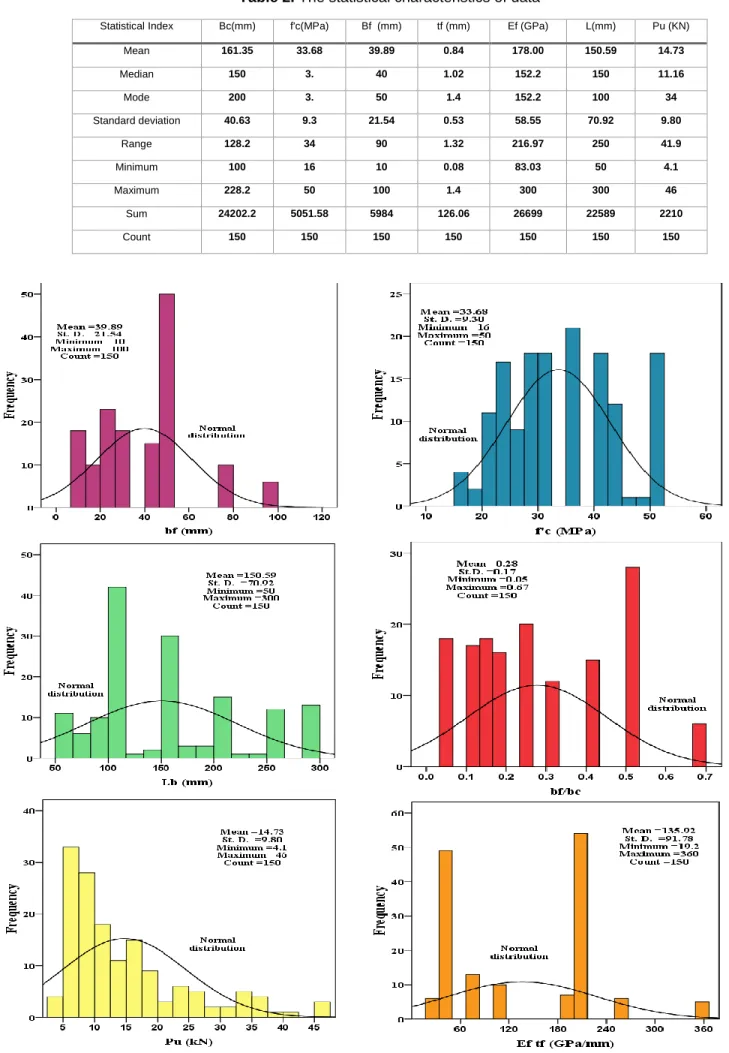
In this step, available data were evaluated by their statistical characteristics summarized in
···
Table 2. The statistical characteristics of data
Statistical Index Bc(mm) f'c(MPa) Bf (mm) tf (mm) Ef (GPa) L(mm) Pu (KN)
Mean 161.35 33.68 39.89 0.84 178.00 150.59 14.73
Median 150 3. 40 1.02 152.2 150 11.16
Mode 200 3. 50 1.4 152.2 100 34
Standard deviation 40.63 9.3 21.54 0.53 58.55 70.92 9.80
Range 128.2 34 90 1.32 216.97 250 41.9
Minimum 100 16 10 0.08 83.03 50 4.1
Maximum 228.2 50 100 1.4 300 300 46
Sum 24202.2 5051.58 5984 126.06 26699 22589 2210
Count 150 150 150 150 150 150 150
···
Based on the input parameters, the bond strength of concrete and
FRP
was defined as follows:
)
t
,
E
,
L
,
b
b
,
b
,
(f'
f
P
b f fc f f c u
(1)
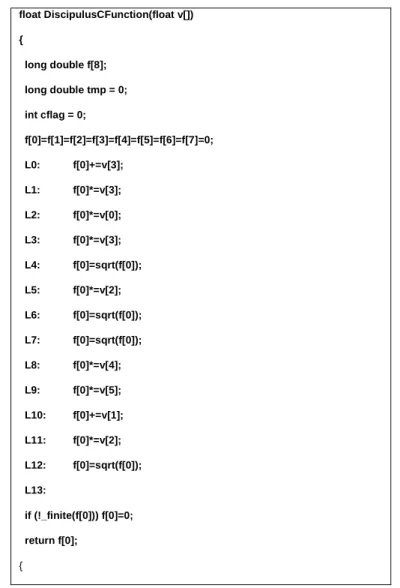
In the next step, 150 data were randomly divided into 120 and 30 sets to train and test by GEP means, respectively. Different LGP models were evaluated, and the best model was adopted in this paper, the results of which as a C++
program are shown in Figure 3. The parameters v [0], v [1], v [2], v [3], v [4], and v [5] are f'c, Bf, Bf/ Bc, L, tf, and Ef, respectively. f [0] is the output of the program.
float DiscipulusCFunction(float v[])
{
long double f[8];
long double tmp = 0;
int cflag = 0;
f[0]=f[1]=f[2]=f[3]=f[4]=f[5]=f[6]=f[7]=0;
L0: f[0]+=v[3];
L1: f[0]*=v[3];
L2: f[0]*=v[0];
L3: f[0]*=v[3];
L4: f[0]=sqrt(f[0]);
L5: f[0]*=v[2];
L6: f[0]=sqrt(f[0]);
L7: f[0]=sqrt(f[0]);
L8: f[0]*=v[4];
L9: f[0]*=v[5];
L10: f[0]+=v[1];
L11: f[0]*=v[2];
L12: f[0]=sqrt(f[0]);
L13:
if (!_finite(f[0])) f[0]=0;
return f[0];
}
Figure 3. The best model of LGP to predict the bond strength of concrete and FRP
The derived equation using the model shown in Figure 2 was derived as follows:
(2)
4 c
c f f f f c f
L
f'
L
b
b
E
t
(b
b
b
)
P
u
···
23
To validate the presented model in this step, it was implemented to predict the bond strength of concrete andFRP using available data summarized in
Table 1
. Theresults (Figure 4) indicate a good agreement between the literature data and the results of the present model.
Figure 4. Comparison of the literature data and the results obtained from the present model for the bond strength of concrete and FRP.
Some models suggested by researchers for the bond strength of concrete and FRP estimation are summarized in
Table 3
.Table 3. Relations for estimation of the bond strength of concrete and FRP suggested by some researchers
Researcher Equations
Maeda et al. [43]
) 10
2 . 110
( 6 f f
e f
u b L E t
P Eftf
e e
L 6.130.58ln
Khalifa et al. [44]
f f
c e
f
u E t
f L b P 3 / 2 6 42 ' 10 2 . 110
Chen and Teng [45]
c e f 1 w
u
0
.
315
b
L
f
'
P
c f c f w b b b b / 1 / 2
e e e1 ifL L
L L 2 π sin L L if 1 β c f f e f t E L ' Dai et al. [17]
f f f f f
u
(
b
2
b
)
2
E
t
G
P
Gf 0.254(fc) N/mm236 . 0 ' mm 77 . 3 bf
In this step, these models were employed to predict the bond strength of concrete and FRP using available data
···
Figure 5. Comparison of the literature data and the results obtained from the existing models for the bond strength of concrete and FRP
In this step, Relative Error (RE) was estimated for different methods, and the results are shown in Figure 6.
Figure 6. Comparison of the Relative Error (RE) of different models
Furthermore, some criteria between the experimental and predicted values were used as follows:
n in
i
i i i
i n
i
i i i i
t
t
h
h
t
t
h
h
R
1 1
2 2
1
)
(
)
(
)
)(
(
(3)
n
t
h
RMSE
n
i
i i
12
)
(
···
ni
i i
t
h
n
MAE
1
1
(5)
Herein, the statistical characteristics of the present model and other reported models are summarized in Table 4.
Table 4. Comparison of the statistical characteristics of the present model and other reported models
Statistical Characteristic R R2 RMSE MAE Max |RE|
Saghi et al. (Present work) 0.96 0.92 2.73 1.92 10.89
Maeda et al. [43] 0.87 0.76 4.85 3.30 16.01
Khalifa et al. [44] 0.83 0.68 6.08 4.03 22.19
Chen and Teng [45] 0.84 0.71 5.28 3.14 20.21
Dai et al. [17] 0.91 0.82 4.65 3.31 19.24
The results show that the suggested relationship is more accurate than other reported models. For example, R-square (R2) of the present work is 0.92, while this parameter is less than 0.82 for other reported models. Based on the RMSE criterion, the current study, Dai et al. [5], Maeda et al. [43], Chen and Teng [45], and Khalifa et al. [44] are the highest accuracy, respectively. But, based on the MAE criterion, the current study, Maeda et al. [43], Dai et al. [5], Chen and Teng [45], and Khalifa et al. [44] are the highest accuracy,
respectively. By considering the Max |RE |criterion, we can see that the current study, Maeda et al. [43]
, Dai et al.
[5], Chen and Teng [45], and Khalifa et al. [44] are the highest accuracy, respectively. So, among the models presented by other researchers, that of Dai et al. [5] is more accurate than the others, and the model offered by Khalifa et al. [2] has the lowest accuracy.3.1. Parametric study of the presented model
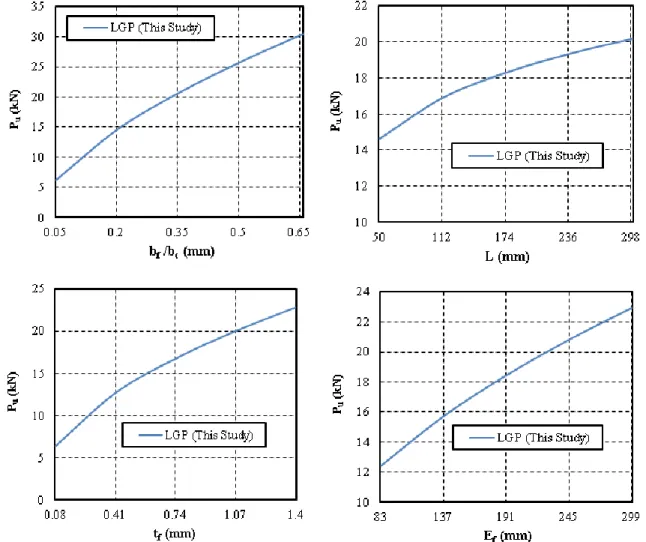
In this step, a parametric study was conducted on the terms of the proposed model, and the results are shown in Figure 7. As expected, there is a logical relationship between the bond strength of concrete and FRP with the
independent variables (width of FRP (bf), width of concrete (bc), thickness of FRP (tf), elastic modulus of FRP (Ef), concrete cylinder compressive strength (f’c), and Bond length (L)).
···
26
Figure 7. Parametric study of the independent terms in the present model
4. CONCLUSION
In this paper, GEP was used to present a novel relationship to predict the bond strength of FRP and concrete composite joints. In order to do this, available data were divided into trained and tested ones. The input parameters, including the width of FRP, the width of concrete, the thickness of FRP, the elastic modulus of FRP, concrete cylinder compressive strength, and bond length, were used as input parameters. These parameters were
applied in the GEP model to present a novel relationship. According to the results, the suggested relationship is more accurate than the other models. For example, R-square (R2) of the present work is 0.92 compared to that (< 0.82) reported for other models. Among the models presented by other researchers, that of Dai et al. is more accurate than the other ones, and the model offered by Khalifa et al. has the lowest accuracy.
FUNDING/SUPPORT
Not mentioned by authors.
ACKNOWLEDGMENT
Not mentioned by authors.
AUTHORS CONTRIBUTION
The authors declare that they have no conflict of
interest.
CONFLICT OF INTEREST
The author (s) declared no potential conflicts of
interests with respect to the authorship and/or
publication of this paper.
···
5. REFERENCES
Lee H, Jang H, Chung W. Effect of Recycled Concrete on the Flexural Behavior of Concrete-Filled FRP Tubes. International Journal of Concrete Structures and Materials. 2019 Dec 1;13(1):12. [View at Google Scholar] ; [View at Publisher].
[2] Chung L, Hur MW, Park T. Performance Evaluation of CFRP Reinforced Concrete Members Utilizing Fuzzy Technique. International Journal of Concrete Structures and Materials. 2018 Dec 1;12(1):78. [View at Google Scholar] ; [View at Publisher].
[3] Sennah K, Tropynina E, Ibrahim Z, Hedjazi S. Structural Qualification of a Developed GFRP-Reinforced Concrete Bridge Barrier using Ultimate Load Testing. International Journal of Concrete Structures and Materials. 2018 Dec 1;12(1):63. [View at Google Scholar] ; [View at Publisher].
[4] Lee C, Shin S, Lee H. Balanced ratio of concrete beams internally prestressed with unbonded CFRP tendons. International Journal of Concrete Structures and Materials. 2017 Mar 1;11(1):1-6. [View at Google Scholar] ; [View at Publisher].
[5] Al-Nimry HS, Ghanem AM. FRP confinement of heat-damaged circular RC columns. International Journal of Concrete Structures and Materials. 2017 Mar 1;11(1):115-33. [View at Google Scholar] ;
[View at Publisher].
[6] Osman BH, Wu E, Ji B, Abdulhameed SS. Repair of pre-cracked reinforced concrete (RC) Beams with openings strengthened using FRP sheets under sustained load. International Journal of Concrete Structures and Materials. 2017 Mar 1;11(1):171-83. [View at Google Scholar] ; [View at Publisher].
[7] Singh A, del Rey Castillo E, Ingham J. FRP-to-FRP bond characterization and force-based bond length model. Composite Structures. 2019 Feb 15;210:724-34. [View at Google Scholar] ; [View at Publisher].
[8] del Rey Castillo E, Kanitkar R, Smith ST, Griffith MC, Ingham JM. Design approach for FRP spike anchors in FRP-strengthened RC structures. Composite Structures. 2019 Apr 15;214:23-33. [View at Google Scholar] ; [View at Publisher].
[9] del Rey Castillo E, Dizhur D, Griffith M, Ingham J. Experimental testing and design model for bent FRP anchors exhibiting fiber rupture failure mode. Composite Structures. 2019 Feb 15;210:618-27. [View at Google Scholar] ; [View at Publisher].
[10] Sun W, Liu H, Wang Y, He T. Impacts of configurations on the strength of FRP anchors. Composite Structures. 2018 Jun 15;194:126-35. [View at Google Scholar] ; [View at Publisher].
[11] Chen C, Wang X, Sui L, Xing F, Chen X, Zhou Y. Influence of FRP thickness and confining effect on flexural performance of HB-strengthened RC beams. Composites Part B: Engineering. 2019 Mar 15;161:55-67. [View at Google Scholar] ; [View at Publisher].
[12] del Rey Castillo E, Griffith M, Ingham J. Seismic behavior of RC columns flexurally strengthened with FRP sheets and FRP anchors. Composite Structures. 2018 Nov 1;203:382-95. [View at Google Scholar] ; [View at Publisher].
[13] Kim YJ. State of the practice of FRP composites in highway bridges. Engineering Structures. 2019 Jan 15;179:1-8. [View at Google Scholar] ; [View at Publisher].
[14] Yang J.Q., Smith S.T., Wang Z. and Lim Y.Y. Numerical simulation of FRP-strengthened RC slabs anchored with FRP anchors., Construction and Building Materials, 172 (2018): 735-750. [View at Google Scholar] ; [View at Publisher].
[15] Vaculik J, Visintin P, Burton NG. Global database of FRP-to-masonry bond strength tests. Data in brief. 2018 Oct 1;20:2065-71. [View at Google Scholar] ; [View at Publisher].
[16] Vahedian A, Shrestha R, Crews K. Bond strength model for externally bonded FRP-to-timber interface. Composite Structures. 2018 Sep 15;200:328-39. [View at Google Scholar] ; [View at Publisher].
[17] Dai J, Ueda T, Sato Y. Development of the nonlinear bond stress–slip model of fiber reinforced plastics sheet–concrete interfaces with a simple method. Journal of composites for construction. 2005 Feb;9(1):52-62. [View at Google Scholar] ; [View at Publisher].
[18] Woo SK, Lee Y. Experimental study on interfacial behavior of CFRP-bonded concrete. KSCE Journal of Civil Engineering. 2010 May 1;14(3):385-93. [View at Google Scholar] ; [View at Publisher].
[19] Wu Y, Zhou Z, Yang Q, Chen W. On shear bond strength of FRP-concrete structures. Engineering Structures. 2010 Mar 1;32(3):897-905. [View at Google Scholar] ; [View at Publisher].
[20] Mashrei MA, Seracino R, Rahman MS. Application of artificial neural networks to predict the bond strength of FRP-to-concrete joints. Construction and Building Materials. 2013 Mar 1;40:812-21. [View at Google Scholar] ; [View at Publisher].
[21] Zhang D, Gu XL, Yu QQ, Huang H, Wan B, Jiang C. Fully probabilistic analysis of FRP-to-concrete bonded joints considering model uncertainty. Composite Structures. 2018 Feb 1;185:786-806. [View at Google Scholar] ; [View at Publisher].
···
[22] Godat A, Ceroni F, Chaallal O, Pecce M. Evaluation of FRP-to-concrete anchored joints designed for FRP shear-strengthened RC T-beams. Composite Structures. 2017 Sep 15;176:481-95. [View at Google Scholar] ; [View at Publisher].
[23] Lezgy-Nazargah M, Dezhangah M, Sepehrinia M. The effects of different FRP/concrete bond-slip laws on the 3D nonlinear FE modeling of retrofitted RC beams-A sensitivity analysis. Steel Compos. Struct., Int. J. 2018 Jan 1;26(3):347-60. [View at Google Scholar] ; [View at Publisher].
[24] Lezgy-Nazargah M. An efficient materially nonlinear finite element model for reinforced concrete beams based on layered global-local kinematics. Acta Mechanica. 2018 Mar 1;229(3):1429-49. [View at Google Scholar] ; [View at Publisher].
[25] Lin JP, Wu YF, Smith ST. Width factor for externally bonded FRP-to-concrete joints. Construction and Building Materials. 2017 Nov 30;155:818-29. [View at Google Scholar] ; [View at Publisher].
[26] Lu XZ, Teng JG, Ye LP, Jiang JJ. Bond–slip models for FRP sheets/plates bonded to concrete. Engineering structures. 2005 May 1;27(6):920-37. [View at Google Scholar] ; [View at Publisher].
[27] Kalfat R, Al-Mahaidi R. Improvement of FRP-to-concrete bond performance using bidirectional fiber patch anchors combined with FRP spike anchors. Composite Structures. 2016 Nov 1;155:89-98. [View at Google Scholar] ; [View at Publisher].
[28] Baykasoğlu A, Güllü H, Çanakçı H, Özbakır L. Prediction of compressive and tensile strength of limestone via genetic programming. Expert Systems with Applications. 2008 Jul 1;35(1-2):111-23. [View at Google Scholar] ; [View at Publisher].
[29] Yeh IC, Lien LC. Knowledge discovery of concrete material using genetic operation trees. Expert Systems with Applications. 2009 Apr 1;36(3):5807-12. [View at Google Scholar] ; [View at Publisher].
[30] Nazari A. Compressive strength of geopolymers produced by ordinary Portland cement: Application of genetic programming for design. Materials & Design. 2013 Jan 1;43:356-66. [View at Google Scholar] ; [View at Publisher].
[31] Nazari A, Safarnejad MG. Prediction early age compressive strength of OPC-based geopolymers with different alkali activators and seashell powder by gene expression programming. Ceramics International. 2013 Mar 1;39(2):1433-42. [View at Google Scholar] ;
[View at Publisher].
[32] Nazari A, Abdinejad V. Modeling Charpy impact behavior of Al6061/SiCp laminated nanocomposites by genetic programming.
Ceramics International. 2013 Mar 1;39(2):1991-2002. [View at Google Scholar] ; [View at Publisher].
[33] Power HE, Gharabaghi B, Bonakdari H, Robertson B, Atkinson AL, Baldock TE. Prediction of wave runup on beaches using Gene-Expression Programming and empirical relationships. Coastal Engineering. 2019 Feb 1;144:47-61. [View at Google Scholar] ; [View at Publisher].
[34] Jafari S, Mahini SS. Lightweight concrete design using gene expression programing. Construction and Building Materials. 2017 May 15;139:93-100. [View at Google Scholar] ; [View at Publisher].
[35] Sharma SK, Ali MM, Goldar D, Sikdar PK. Plate–concrete interfacial bond strength of FRP and metallic plated concrete specimens. Composites Part B: Engineering. 2006 Jan 1;37(1):54-63. [View at Google Scholar] ; [View at Publisher].
[36] Yao J, Teng JG, Chen JF. Experimental study on FRP-to-concrete bonded joints. Composites Part B: Engineering. 2005 Mar 1;36(2):99-113. [View at Google Scholar] ; [View at Publisher].
[37] Takeo K, Matsushita H, Makizumi T, Nagashima G. Bond characteristics of CFRP sheets in the CFRP bonding technique. Proceedings of Japan concrete institute. 1997 Jun;19(2):1599-604. [View at Google Scholar].
[38] Toutanji H, Saxena P, Zhao L, Ooi T. Prediction of interfacial bond failure of FRP–concrete surface. Journal of composites for construction. 2007 Aug;11(4):427-36. [View at Google Scholar] ; [View at Publisher].
[39] Woo SK, Lee Y. Experimental study on interfacial behavior of CFRP-bonded concrete. KSCE Journal of Civil Engineering. 2010 May 1;14(3):385-93. [View at Google Scholar] ; [View at Publisher].
[40] Chajes MJ, Finch WW, Thomson TA. Bond and force transfer of composite-material plates bonded to concrete. Structural Journal. 1996 Mar 1;93(2):209-17. [View at Google Scholar] ; [View at Publisher].
[41] Zhao HD, Zhang Y, Zhao M. Research on the bond performance between CFRP plate and concrete. InProc., 1st Conf. on FRP Concrete Structures of China 2000 (pp. 247-253). [View at Google Scholar].
[42] Ren HT. Study on basic theories and long time behavior of concrete structures strengthened by fiber reinforced polymers. Dalian University of technology. 2003. [View at Google Scholar].
[43] Sato Y. Ultimate shear capacity of reinforced concrete beams with carbon fiber sheet. InProceedings of Third International
···
Symposium of Non-Metallic (FRP) Reinforcement for Concrete Syructures 1997 (Vol. 1, pp. 499-506). [View at Google Scholar] .
[44] Khalifa A, Gold WJ, Nanni A, MI AA. Contribution of externally bonded FRP to shear capacity of RC flexural members. Journal of composites for construction. 1998 Nov;2(4):195-202. [View at Google Scholar] ; [View at Publisher].
[45] Chen JF, Teng JG. Anchorage strength models for FRP and steel plates bonded to concrete. Journal of structural engineering. 2001 Jul;127(7):784-91. [View at Google Scholar] ; [View at Publisher].