Development of a marine sensitivity mapping database and GIS
integration. Stage 1. Review of current habitat and species
information
Contract no. FC 73-02-245
Report to Cyngor Cefn Gwlad Cymru / Countryside Council for Wales
Harvey Tyler-Walters Olwen Ager Keith Hiscock
December 2002
Reference:
Tyler-Walters, H., Ager, O.E.D. & Hiscock, K., 2002. Development of a marine sensitivity mapping
database and GIS integration. Stage 1. Review of current habitat and species information. Report to Cyngor Cefn Gwlad Cymru / Countryside Council for Wales from the Marine Life Information Network (MarLIN). Plymouth: Marine Biological Association of the UK. [Contract no. FC 73-02-245]
Development of a marine sensitivity mapping database and GIS integration. Stage 1. Review
of current habitat and species information.
Contents
1. AIMS AND BACKGROUND TO CONTRACT...9
2. TIMETABLE...9
3. METHODOLOGY...9
4. RESULTS...10
4.1. Introduction ...10
4.2. Existing gaps in knowledge concerning sensitivity and recoverability of key marine species and biotopes ...10
4.2.1 Current MarLIN species Key Information reviews ...10
4.2.2 Existing gaps concerning sensitivity and recoverability of key marine species...15
4.2.3 Current MarLIN biotope Key Information reviews...20
4.2.4 Existing gaps concerning sensitivity and recoverability of key marine biotopes...23
4.2.5 Existing gaps concerning sensitivity and recoverability information...23
4.3. The extent to which spatial and temporal factors have been taken into account in existing sensitivity and recoverability assessments...25
4.3.1 Spatial factors ...25
4.3.2 Temporal factors...25
4.3.3 Relevance of MarLIN ‘Environmental factors’ and ‘Key information fields’ to assessing spatial and temporal change...26
4.4. Environmental factors used for sensitivity assessment by SensMap, MarLIN and the UK Marine SACs project...27
4.4.1 Environmental factors ...27
4.4.2 Maritime activities and their associated environmental factors ...27
4.5. Extending species and biotope sensitivity assessments to the biotope complex, habitat complex and ‘lifeform’ levels...30
4.5.1 Introduction ...30
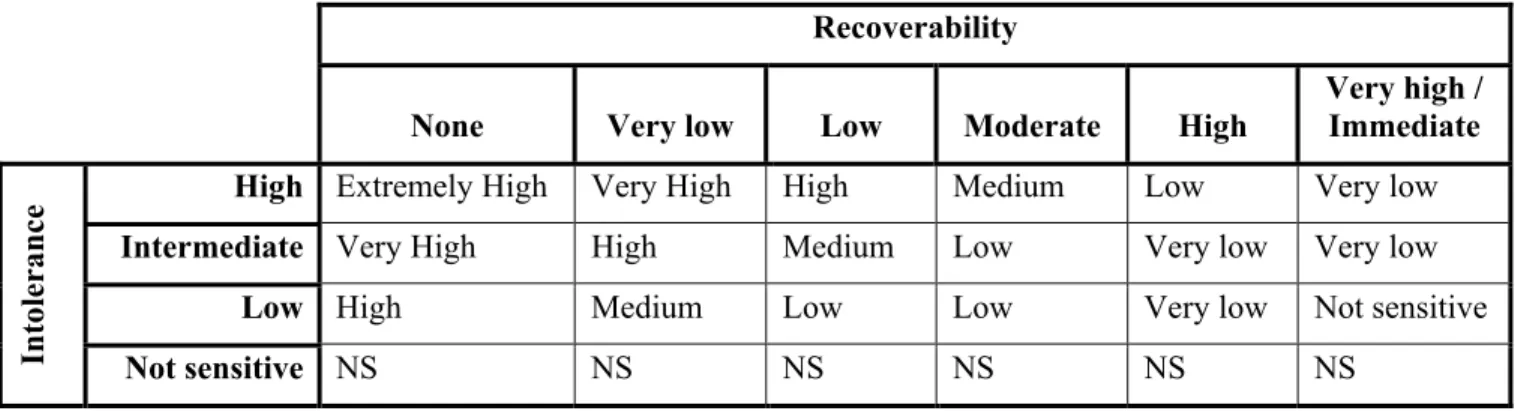
4.5.2 Combining sensitivity (=intolerance) and recoverability ...31
4.5.3 Assessing sensitivities at the biotope complex, ‘lifeform’ and habitat complex levels ...32
5. CONCLUSIONS...33
6. ACKNOWLEDGEMENTS...34
7. REFERENCES...34
Development of a marine sensitivity mapping database and GIS integration. Stage 1. Review of current habitat and species information.
Contract specification
A thorough but concise review of current sensitivity data is needed, to identify remaining gaps in knowledge, especially in relation to key species and habitats. A review of any temporal and spatial influence of factors on species and biotope sensitivity will be required and, in addition, a methodology for translating the sensitivity of species and biotopes to more aggregated levels, including biotope complex, ‘lifeform’ and habitat complex will be required. The objectives of the contract are:
i) review existing gaps in knowledge concerning sensitivity and recoverability of key marine species and habitats, including BAP habitats and species and nationally rare and scarce species or habitats; ii) review the extent to which spatial and temporal factors have been taken into account in existing
sensitivity and recoverability assessments and where absent how best to incorporate them; iii) identify common environmental factors used for sensitivity assessment by SensMap, MarLIN and
the UK Marine SACs project and highlight different factors where present, and
iv) develop a draft protocol for extending species and biotope sensitivity assessments to the biotope complex, habitat complex and ‘lifeform’ levels, taking into account the SensMap approach.
List of Figures
Figure 1. The number of researched biotope Key Information reviews within Annex I habitats... 22
List of Tables
Table 1. Key Information reviews completed by MarLIN. Priority 1 species, designated or listed under statute or convention. ... 12 Table 2. UK Biodiversity Action Plan Species of Conservation Concern present in Welsh waters... 14 Table 3. Keystone, characterizing and representative species for which MarLIN full Key Information
reviews have been prepared. ... 15 Table 4. Keystone and important characterizing species not yet researched by MarLIN and known to be
present in Welsh waters... 19 Table 5. The number of MarLIN researched biotope Key Information reviews and represented biotopes
within BAP habitat and species reviews. ... 21 Table 6. Biotopes considered in the UK Marine SACs habitat reviews that have been researched or
represented by MarLIN... 22 Table 7. Comparison between environmental factors used to assess sensitivity by MarLIN, SensMap, and
the UK Marine SACs project. ... 29 Table 8. Combining ‘intolerance’ and ‘recoverability’ to identify ‘sensitivity’. ... 31
List of Appendices
Appendix 1. Biology and Sensitivity Key Information reviews – priority and terminology………...37
Appendix 2. Key Information reviews and basic information completed by MarLIN……….43
Appendix 3. Species selected as indicative of the sensitivity of the biotopes researched by MarLIN…….65
Appendix 4. Complete list of MarLIN researched and represented biotopes at November 2002………...79
Appendix 5. The marine natural heritage importance of the MarLIN researched biotopes………..…91
Appendix 6. The number of MarLIN researched biotope Key Information reviews and represented biotopes within BAP habitat and species reviews………..………...103
Appendix 7a. Nationally rare and scarce biotopes in the MarLIN database..………..……….107
Appendix 7b. Nationally scarce biotope complexes in the MarLIN database..………...…....….111
Appendix 7c. Nationally rare biotopes in the MarLIN database ...………..………….…113
Appendix 8. Biotopes considered in the UK Marine SACs habitat reviews that have been researched or represented by MarLIN ….……….…..117
Appendix 9. Researched biotopes Key Information within ‘lifeforms’………...……….….…119
Appendix 10. Comparison of biotopes of Welsh interest (supplied by CCW) with full list of biotopes taken from Connor et al (1997a, b) and biotopes researched or represented by MarLIN………..123
Appendix 11. Species biology and sensitivity key information (September 1999 onwards)……...……....141
Appendix 12. Biotope biology and sensitivity key information (May 2000 onwards)…………..…….…..147
Appendix 13. Maritime and coastal activities to environmental factors matrix………...…..…..…151
The Marine Life Information Network
®for Britain and Ireland (
MarLIN
)
Development of a marine sensitivity mapping database and GIS integration.
Stage 1. Review of current habitat and species information.
Executive summaryInformation to support sensitivity assessment is being collected by the Marine Life Information Network for Britain and Ireland (MarLIN) and MarLIN has published a series of sensitivity (intolerance) and recovery reviews. Biological and sensitivity information from MarLIN and other sources could be used to derive sensitivity and recovery assessments for mapping. The MarLIN research forms the largest body of collated knowledge on marine species and habitat sensitivity in the UK. It is, therefore, the best source of
information to use for mapping sensitivity of seabed species and biotopes using a scientific approach. Stage 1 of this sensitivity mapping project aimed to identify existing gaps in knowledge concerning the biology and sensitivity of marine species and habitats and identify a unified approach to develop a sensitivity mapping database.
The report outlines a review of the coverage of Key Information reviews prepared by the MarLIN programme compared to Welsh interest species and biotopes, the biotope classification for Britain and Ireland, Annex I habitats of the Habitats Directive, priority BAP species and habitats, and nationally rare and scarce species and biotopes. In addition, the MarLIN and SensMap approaches to sensitivity assessment were compared and a draft protocol for the derivation of the sensitivities of biotopes complexes and higher hierarchical units in the biotope classification proposed.
The project has:
• identified a few gaps in our coverage of the present MNCR biotope classification;
• identified a list of keystone or important characterizing species that require additional research; • developed Key Information reviews of species and biotopes, and a subsequent sensitivity assessment
rationale that incorporates considerations of spatial, seasonal and temporal factors where information allows;
• demonstrated that the MarLIN list of environmental factors include all of the environmental factors addressed by the SensMap programme and the UK Marine SACs project;
• developed an ‘activities to factors matrix’ that addresses the majority of the activities identified by the SensMap programme except activities associated with oil spill clean-up;
• proposed a non numerical approach to the combination of intolerance and recoverability and
suggested that biotope sensitivities are the most practical unit for the derivation of the sensitivities of biotope complexes, ‘lifeforms’ and habitat complexes, and
• suggested that, when combining biotope sensitivities to derive the sensitivities of higher hierarchical units in the biotope classification, the highest or worst-case sensitivity should be reported, in
The Marine Life Information Network
®for Britain and Ireland (
MarLIN
)
Development of a marine sensitivity mapping database and GIS integration.
Stage 1. Review of current habitat and species information
1. Aims and background to contractThe project aims to identify existing gaps in knowledge and identify a unified approach to develop a sensitivity mapping database.
The sensitivity of an individual (or individual colony) of a species or a biotope, biotope complex, ‘lifeform’, or habitat complex, can be defined as the combined appraisal of its level of intolerance to an external factor and the longer term implications of this in terms of recovery.
A theoretical model (SensMap) for assessing and mapping the sensitivity of marine habitats and species to maritime activities has been developed by the Countryside Council for Wales (CCW) and partners under the European Union INTERREG programme. The model proposes a methodology for Marine Intertidal Phase 1 and broad-scale subtidal habitat maps to be produced according to the sensitivity of biotopes and species to activities as diverse as oil spills to bird watching. Sensitivity to activities can be assessed against a list of specific factors relating to those activities. If linked to information on the distribution and location of coastal activities, the likely vulnerability of sensitive species could also be mapped. A combination of vulnerability and conservation importance would highlight those biotopes and species in most need of attention and conservation action could then be prioritized.
Information to support sensitivity assessment is being collected by the Marine Life Information Network for Britain and Ireland (MarLIN). MarLIN has published a series of sensitivity (intolerance) and recovery reviews. Biological and sensitivity information from MarLIN and other sources could be used to derive sensitivity and recovery assessments for mapping. This body of research will be used for sensitivity mapping, as it forms the largest body of collated knowledge on marine species and habitat sensitivity in the UK.
2. Timetable
The work was undertaken between 28 October and 20 December 2002 according to the following timetable. i) Produce draft report by 6 December.
ii) Comments received from CCW Nominated officer by 16 December.
iii) Produce final report by 20 December and submit on CD-ROM and as Adobe Portable Document Format.
3. Methodology
The development of the MarLIN approach to sensitivity assessment and the biology and sensitivity key information reviews of species and biotopes have been undertaken in projects that were jointly funded by the Department for Environment, Food and Rural Affairs (Defra), English Nature (EN) and Scottish Natural Heritage (SNH). In addition, this report has considered work undertaken by the UK Marine SACs project and the SensMap programme.
The development of standard criteria and definitions, sensitivity and recoverability assessment scales and the sensitivity assessment rationale of the MarLIN programme are detailed in Hiscock et al. (1999), Tyler-Walters & Jackson (1999), Tyler-Tyler-Walters et al. (2001) and on the MarLIN Web site (www.marlin.ac.uk). The development of the SensMap approach to sensitivity assessment is detailed by Cooke & McMath (2000) and McMath et al. (2000). No attempt has been made to reproduce their information here, except by way of explanation. The reader should refer to the above texts for detailed information. A summary of key terms and components of the Key Information research is provided in Appendix 1.
The MarLIN programme has prepared biology and sensitivity key information reviews of numerous species and biotopes. The results of the programme are summarized in the text while the complete lists of species and biotopes have been included as appendices. The MNCR biotope classification published by Connor et al., (1997a, b) is used as the standard reference for biotopes throughout the report.
The review undertaken here has adopted the following methods:
i) Review existing gaps in knowledge. A review is first given of the structure of MarLIN biotope and species Key Information reviews and the information currently researched. ‘Species of conservation concern’ and interest biotopes present in Wales are listed and those reviewed by MarLIN identified. Species not researched by MarLIN are identified as gaps in information. ii) Extent to which spatial and temporal factors have been taken into account. The relevant
sections of the species and biotope Key Information reviews were collated and the utility of the information in relation to sensitivity mapping reviewed.
iii) Identify common environmental factors used for sensitivity assessment by SensMap, MarLIN and the UK Marine SACs project and highlight different factors. The
environmental factors and the maritime activities addressed by the different programmes were compared and gaps identified.
iv) Develop a draft protocol for extending sensitivity assessments to the biotope complex, habitat complex and lifeform levels. The proposed MarLIN approach to combining sensitivity and recoverability for mapping and the use of biotope sensitivities to derive the sensitivity of higher hierarchical units in the biotope classification were discussed, with reference to the SensMap approach.
In order to establish what gaps there are in species researched that should be identified as of conservation concern, the list of ‘Marine Species of Conservation Concern in Welsh waters’ prepared by CCW and extracted from a list maintained by JNCC, was used. In order to establish what gaps there are in biotopes researched, the biotopes researched by MarLIN were compared with the nationally rare and scarce biotopes listed in the biotope classification, the list of biotopes of ‘Welsh interest’ provided by CCW, lists of
‘lifeforms’ in the SensMap report, and habitats identified under the UK Marine SACs project, UK Biodiversity Action Plan (BAP), and Annex I of the Habitat Directive.
4. Results
4.1. Introduction
A description of the content of MarLIN Biology and Sensitivity Key Information Reviews and the MarLIN database is given in Appendices 2-10.
4.2. Existing gaps in knowledge concerning sensitivity and recoverability of key marine species and biotopes
4.2.1 Current MarL IN species Key Information reviews
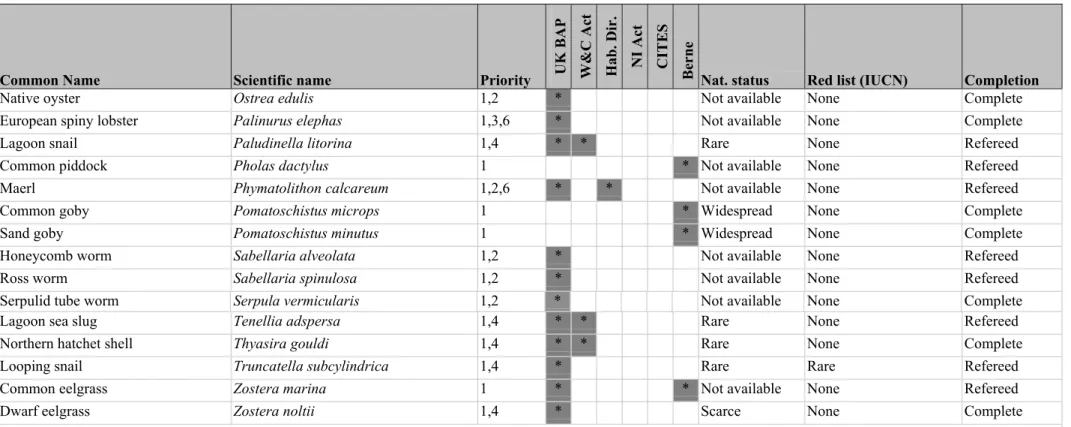
At the end of November 2002 the MarLIN Web site biology and sensitivity key information database contained full Key Information reviews of 149 species and basic information on an additional 280 species. A complete list of the species information at the end of November 2002 is shown in Appendix 2. Full key information reviews of important marine species listed under national legislation or international conventions are shown in Table 1. The full Key Information reviews include:
• 35 species listed under international conventions or national legislation;
• of which 29 are UK Biodiversity Action Plan (BAP) species, 12 are nationally rare and 5 are nationally scarce species;
• all the benthic marine species that are subject to Species Action Plans under the UK BAP (UK Biodiversity Group, 1998), and
• 96 keystone or representative species.
The only BAP Species Action Plan species not fully researched is Styela gelatinosa for which the literature was very limited and only basic information could be completed. Styela gelatinosa is not recorded in Wales. Full Key Information reviews have also been completed for keystone or characteristic species of the
• Sabellaria alveolata reefs; • Sabellaria spinulosa reefs;
• Seagrass beds (Zostera marina and Z. noltii); • Modiolus modiolus beds;
• Maerl beds (Phymatolithon calcareum, Lithothamnion corallioides, and Lithothamnion glaciale), and
• Saline lagoons (including all six marine species included in separate ‘species statements’).
The full Key Information reviews are augmented by the basic information pages. Basic information pages were completed for an additional 280 species as shown in Appendix 1 and included:
• 23 species designated or listed under statute or international convention, all of which are UK BAP species;
• 18 nationally rare and 28 nationally scarce species; • 110 keystone, representative or characteristic species; • 20 marine species likely to be affected by climate change; • 4 non-native or climate change species, and
• 44 educational information species.
Overall, we have at least basic information on all the marine invertebrate species listed on the UK BAP ‘long list’ of species of conservation concern with the present exceptions of the bryozoan Lophopus crystallinus and the pseudoscorpion Neobisium maritimum.
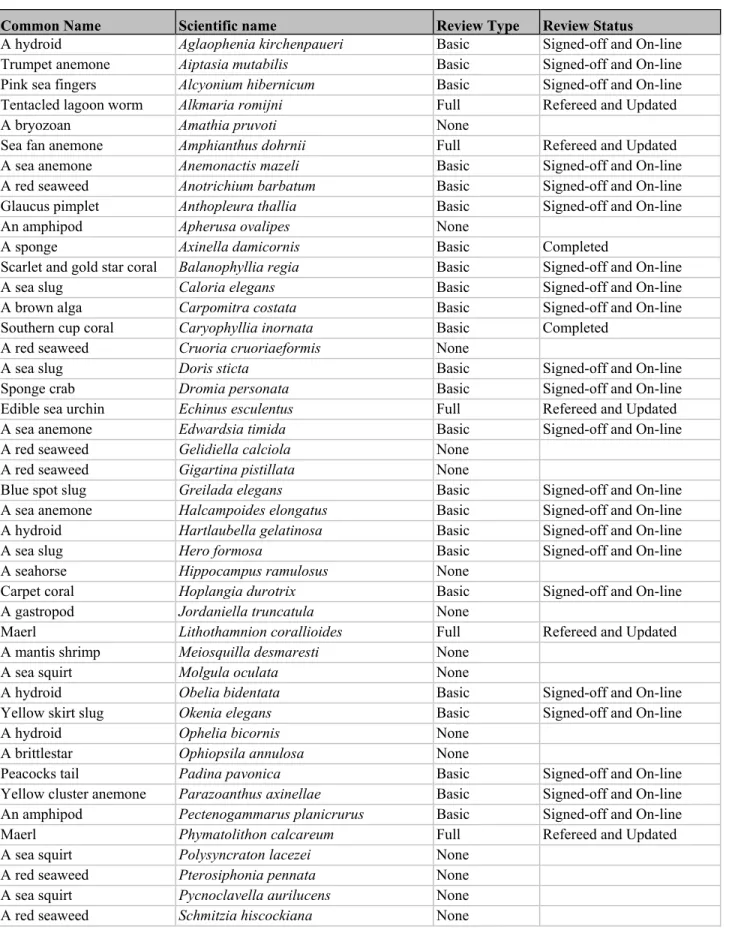
The list of marine species of conservation concern (UK BAP) present in Welsh waters is shown in Table 2. We have completed 5 full Key Information reviews on these species and have basic information on 33 of species listed.
12
Table 1. Key Information reviews completed by MarLIN. Priority 1 species, designated or listed under statute or convention.
Common Name Scientific name Priority UK B
A
P
W&C Ac
t
Hab
. Dir.
NI Act CITES
Berne Nat. status Red list (IUCN) Completion
Tentacled lagoon worm Alkmaria romijni 1,4 * * Scarce None Refereed
Sea fan anemone Amphianthus dohrnii 1,6 * Rare None Complete
Lagoon sandworm Armandia cirrhosa 1,4 * * Rare None Refereed
Knotted wrack Ascophyllum nodosum (*) 1,2 * * Widespread None Refereed
Fan Mussel Atrina fragilis 1,6 * * * Scarce None Refereed
DeFolin's lagoon snail Caecum armoricum 1,4 * * Rare Insufficiently known Refereed
A hydroid Clavopsella navis 1,4 * * Rare None Refereed
Edible sea urchin Echinus esculentus 1,2 * Widespread Lower Risk (LR/nt) Refereed
Ivell's sea anemone Edwardsia ivelli 1,4 * * Rare Data deficient Complete
Pink sea fan Eunicella verrucosa 1,6 * * Scarce Vulnerable (VU A1d) Complete
The tall sea pen Funiculina quadrangularis 1 * Not available None Complete
Lagoon sand shrimp Gammarus insensibilis 1,4 * * Scarce None Refereed
Giant goby Gobius cobitis 1,4 * Rare None Complete
Couch's goby Gobius couchi 1,4 * Rare None Complete
Sunset cup coral Leptopsammia pruvoti 1,4,6 * Rare None Complete
Maerl Lithothamnion corallioides 1,2 * * Not available None Refereed
Maerl Lithothamnion glaciale 1,2 * Not available None Complete
Horse mussel Modiolus modiolus 1,2,6 * Not available None Basic
Starlet sea anemone Nematostella vectensis 1,4 * * Scarce Vulnerable (VU A1ce) Complete
Dog whelk Nucella lapillus 1,2 * Not available None Complete
Legend:
UK BAP = UK Biodiversity Action Plan; W&C Act = Wildlife & Conservation Act (1981); Hab. Dir. = EC Habitat Directive; NI Act = Wildlife (NI) Order 1985; CITES = CITES Convention; Berne = Berne Convention; Nat. Status = National Status; Completion = status of the Key Information review.
(* = the Ascophyllum nodosum review included Ascophyllum nodosum ecad mackaii)
Prioritization criteria (see text for details): 1 = Statute, Habitats Directive Annex, Red list; UK BAP; 2 = Key, Representative/ Important characterizing; 3 = Exploited; 4 = Nationally rare or scarce; 5 = Non-native; 6 = Climate change; R = Research; E = Education.
13
Table 1(continued). Key Information reviews completed by MarLIN. Priority 1 species, designated or listed under statute or convention.
Common Name Scientific name Priority UK B
A
P
W&C Ac
t
Hab
. Dir.
NI Act CITES
Berne Nat. status Red list (IUCN) Completion
Native oyster Ostrea edulis 1,2 * Not available None Complete
European spiny lobster Palinurus elephas 1,3,6 * Not available None Complete
Lagoon snail Paludinella litorina 1,4 * * Rare None Refereed
Common piddock Pholas dactylus 1 * Not available None Refereed
Maerl Phymatolithon calcareum 1,2,6 * * Not available None Refereed
Common goby Pomatoschistus microps 1 * Widespread None Complete
Sand goby Pomatoschistus minutus 1 * Widespread None Complete
Honeycomb worm Sabellaria alveolata 1,2 * Not available None Refereed
Ross worm Sabellaria spinulosa 1,2 * Not available None Refereed
Serpulid tube worm Serpula vermicularis 1,2 * Not available None Complete
Lagoon sea slug Tenellia adspersa 1,4 * * Rare None Refereed
Northern hatchet shell Thyasira gouldi 1,4 * * Rare None Complete
Looping snail Truncatella subcylindrica 1,4 * Rare Rare Refereed
Common eelgrass Zostera marina 1 * * Not available None Refereed
Dwarf eelgrass Zostera noltii 1,4 * Scarce None Complete
Legend:
UK BAP = UK Biodiversity Action Plan; W&C Act = Wildlife & Conservation Act (1981); Hab. Dir. = EC Habitat Directive; NI Act = Wildlife (NI) Order 1985; CITES = CITES Convention; Berne = Berne Convention; Nat. Status = National Status; Completion = status of the Key Information review.
Prioritization criteria (see text for details): 1 = Statute, Habitats Directive Annex, Red list; UK BAP; 2 = Key, Representative/ Important characterizing; 3 = Exploited; 4 = Nationally rare or scarce; 5 = Non-native; 6 = Climate change; R = Research; E = Education.
Table 2. UK Biodiversity Action Plan Species of Conservation Concern present in Welsh waters. Marine mammals and reptiles are omitted. The soft coral listed as Parerythropodium corallioides is now known to be Alcyonium hibernicum (McFadden, 1999).
Common Name Scientific name Review Type Review Status
A hydroid Aglaophenia kirchenpaueri Basic Signed-off and On-line Trumpet anemone Aiptasia mutabilis Basic Signed-off and On-line Pink sea fingers Alcyonium hibernicum Basic Signed-off and On-line Tentacled lagoon worm Alkmaria romijni Full Refereed and Updated
A bryozoan Amathia pruvoti None
Sea fan anemone Amphianthus dohrnii Full Refereed and Updated A sea anemone Anemonactis mazeli Basic Signed-off and On-line A red seaweed Anotrichium barbatum Basic Signed-off and On-line Glaucus pimplet Anthopleura thallia Basic Signed-off and On-line
An amphipod Apherusa ovalipes None
A sponge Axinella damicornis Basic Completed
Scarlet and gold star coral Balanophyllia regia Basic Signed-off and On-line
A sea slug Caloria elegans Basic Signed-off and On-line
A brown alga Carpomitra costata Basic Signed-off and On-line Southern cup coral Caryophyllia inornata Basic Completed
A red seaweed Cruoria cruoriaeformis None
A sea slug Doris sticta Basic Signed-off and On-line
Sponge crab Dromia personata Basic Signed-off and On-line
Edible sea urchin Echinus esculentus Full Refereed and Updated
A sea anemone Edwardsia timida Basic Signed-off and On-line
A red seaweed Gelidiella calciola None
A red seaweed Gigartina pistillata None
Blue spot slug Greilada elegans Basic Signed-off and On-line A sea anemone Halcampoides elongatus Basic Signed-off and On-line A hydroid Hartlaubella gelatinosa Basic Signed-off and On-line
A sea slug Hero formosa Basic Signed-off and On-line
A seahorse Hippocampus ramulosus None
Carpet coral Hoplangia durotrix Basic Signed-off and On-line
A gastropod Jordaniella truncatula None
Maerl Lithothamnion corallioides Full Refereed and Updated
A mantis shrimp Meiosquilla desmaresti None
A sea squirt Molgula oculata None
A hydroid Obelia bidentata Basic Signed-off and On-line
Yellow skirt slug Okenia elegans Basic Signed-off and On-line
A hydroid Ophelia bicornis None
A brittlestar Ophiopsila annulosa None
Peacocks tail Padina pavonica Basic Signed-off and On-line
Yellow cluster anemone Parazoanthus axinellae Basic Signed-off and On-line An amphipod Pectenogammarus planicrurus Basic Signed-off and On-line
Maerl Phymatolithon calcareum Full Refereed and Updated
A sea squirt Polysyncraton lacezei None
A red seaweed Pterosiphonia pennata None
A sea squirt Pycnoclavella aurilucens None
Table 2 (continued). UK Biodiversity Action Plan Species of Conservation Concern present in Welsh waters. Marine mammals and reptiles are omitted. The soft coral listed as Parerythropodium corallioides is now known to be Alcyonium hibernicum (McFadden, 1999).
Common Name Scientific name Review Type Review Status
A sponge Stella grubii None
A sponge Stylostichon dives None
A hydroid Tamarisca tamarisca Basic Signed-off and On-line
A sponge Tethyspira spinosa None
Thumbnail crab Thia scutellata Basic Signed-off and On-line
A sea slug Trapania maculata Basic Signed-off and On-line
A sea slug Tritonia nilsodhneri Basic Signed-off and On-line Penny weed Zanardinia prototypus Basic Signed-off and On-line
4.2.2 Existing gaps concerning sensitivity and recoverability of key marine species Keystone, characterizing and representative species
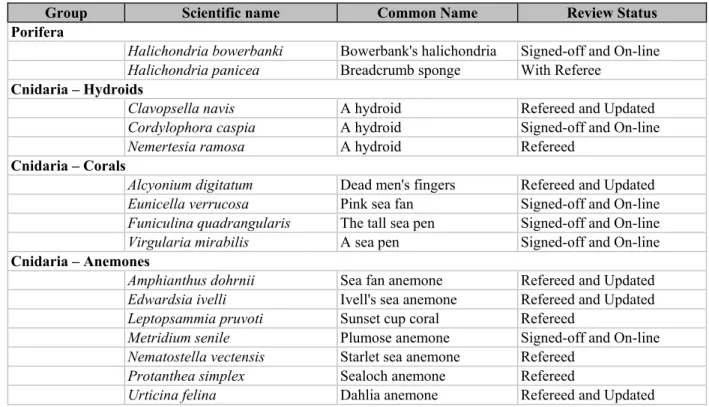
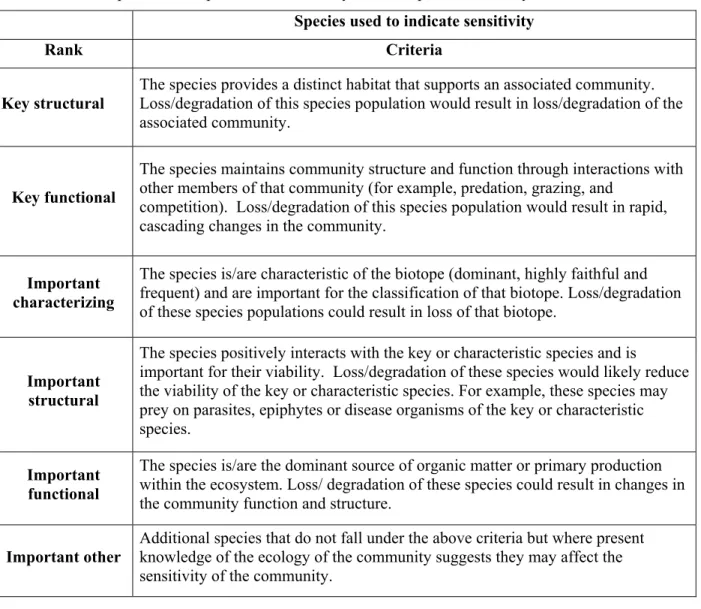
The MarLIN database now contains full Key Information review on all of the marine BAP species, except Styela gelatinosa and many of the keystone or characteristic species of BAP Habitat Action Plans. In addition, the MarLIN programme has prepared full Key Information reviews on many keystone, and characterizing species, and representatives of the major groups of marine benthic species (Table 3.). The representative species include many key or characterizing species of important marine benthic habitats and/or have been used in the biotope Key Information reviews (see below) to ‘represent’ the sensitivity of similar species. Appendix 3 lists the species used to indicate biotope sensitivity and their community importance in the biotope Key Information reviews.
Table 3. Keystone, characterizing, and representative species for which MarLIN full Key Information reviews have been prepared.
Group Scientific name Common Name Review Status
Porifera
Halichondria bowerbanki Bowerbank's halichondria Signed-off and On-line Halichondria panicea Breadcrumb sponge With Referee
Cnidaria – Hydroids
Clavopsella navis A hydroid Refereed and Updated Cordylophora caspia A hydroid Signed-off and On-line Nemertesia ramosa A hydroid Refereed
Cnidaria – Corals
Alcyonium digitatum Dead men's fingers Refereed and Updated Eunicella verrucosa Pink sea fan Signed-off and On-line Funiculina quadrangularis The tall sea pen Signed-off and On-line Virgularia mirabilis A sea pen Signed-off and On-line Cnidaria – Anemones
Amphianthus dohrnii Sea fan anemone Refereed and Updated Edwardsia ivelli Ivell's sea anemone Refereed and Updated Leptopsammia pruvoti Sunset cup coral Refereed
Metridium senile Plumose anemone Signed-off and On-line Nematostella vectensis Starlet sea anemone Refereed
Protanthea simplex Sealoch anemone Refereed
Table 3(continued). Keystone, characterizing, and representative for which MarLIN full Key Information reviews have been prepared (continued).
Group Scientific name Common Name Review Status
Annelida – Polychaetes
Alkmaria romijni Tentacled lagoon worm Refereed and Updated Aphelochaeta marioni A bristleworm Refereed and Updated Arenicola marina Blow lug Refereed and Updated Armandia cirrhosa Lagoon sandworm Refereed and Updated Capitella capitata A polychaete Signed-off and On-line Hediste diversicolor Ragworm Signed-off and On-line Lanice conchilega Sand mason Signed-off and On-line Magelona mirabilis A polychaete Refereed
Nephtys hombergii A catworm Signed-off Polydora ciliata A bristleworm With Referee Pomatoceros triqueter A tubeworm Signed-off
Sabellaria alveolata Honeycomb worm Refereed and Updated Sabellaria spinulosa Ross worm Refereed and Updated Serpula vermicularis Serpulid tube worm Signed-off and On-line Spio filicornis A bristleworm Signed-off and On-line Spiophanes bombyx A bristleworm Signed-off and On-line Crustacea – Barnacles
Balanus crenatus An acorn barnacle Refereed and Updated Chthamalus montagui Montagu’s stellate barnacle Refereed and Updated Chthamalus stellatus Poli’s stellate barnacle Refereed and Updated Semibalanus balanoides An acorn barnacle Refereed and Updated Crustacea – Amphipods
Bathyporeia pelagica An amphipod With Referee
Gammarus insensibilis Lagoon sand shrimp Refereed and Updated Gammarus salinus A gammarid shrimp Signed-off and On-line Hyale prevostii An amphipod Refereed and Updated Jassa falcata An amphipod Refereed and Updated Talitrus saltator A sand hopper Signed-off and On-line Crustacea - Isopods
Eurydice pulchra An isopod Signed-off and On-line Crustacea – Decapods
Callianassa subterranea A burrowing mud shrimp With Referee Liocarcinus depurator Harbour crab With Referee
Neomysis integer An opossum shrimp Signed-off and On-line Pisidia longicornis Long-clawed porcelain crab Signed-off and On-line Mollusca – Gastropods
Caecum armoricum DeFolin’s lagoon snail Refereed and Updated Crepidula fornicata Slipper limpet Refereed and Updated Helcion pellucidum Blue – rayed limpet Refereed and Updated Hydrobia ulvae Laver spire shell Refereed and Updated Lacuna vincta Banded chink shell Refereed and Updated Littorina littorea Common periwinkle Refereed and Updated Nucella lapillus Dog whelk Signed-off and On-line Paludinella litorina Lagoon snail Refereed and Updated Patella vulgata Common limpet Refereed and Updated Philine aperta A sea slug Signed-off and On-line Tenellia adspersa Lagoon sea slug Refereed and Updated Truncatella subcylindrica Looping snail Refereed and Updated
Table 3(continued). Keystone, characterizing, and representative species for which MarLIN full Key Information reviews have been prepared (continued).
Group Scientific name Common Name Review Status
Mollusca – Bivalves
Abra alba A bivalve Signed-off and On-line Atrina fragilis Fan Mussel Refereed and Updated Cerastoderma edule Common cockle With Referee
Cerastoderma glaucum Lagoon cockle Refereed and Updated Ensis spp. Razor shell Refereed and Updated Macoma balthica Baltic tellin Refereed and Updated Modiolus modiolus Horse mussel Signed-off and On-line Mya arenaria Sand gaper Refereed and Updated Mytilus edulis Common mussel Refereed and Updated Ostrea edulis Native oyster Signed-off and On-line Pecten maximus Great scallop Signed-off
Pholas dactylus Common piddock Refereed and Updated Thyasira gouldi Northern hatchet shell Refereed
Venerupis senegalensis Pullet carpet shell With Referee
Fabulina fabula A bivalve Signed-off and On-line Brachiopoda
Neocrania anomala A brachiopod Signed-off and On-line Bryozoa
Bugula turbinata A bryozoan Signed-off and On-line Conopeum reticulum A bryozoan Signed-off and On-line Electra pilosa A sea mat With KH
Flustra foliacea Hornwrack Signed-off and On-line Pentapora fascialis Ross Refereed and Updated Umbonula littoralis An encrusting bryozoan Refereed and Updated Echinodermata
Antedon bifida Rosy feather-star Signed-off and On-line Asterias rubens Common starfish Refereed and Updated Brissopsis lyrifera A heart urchin With Referee
Amphiura chiajei A brittle star With Referee
Henricia oculata Bloody Henry starfish Refereed and Updated Amphiura filiformis A brittle-star Signed-off and On-line Ophiothrix fragilis Common brittle star Refereed and Updated Echinocardium cordatum Sea potato Refereed and Updated Echinus esculentus Edible sea urchin Refereed and Updated Psammechinus miliaris Green sea urchin Refereed
Neopentadactyla mixta Gravel sea cucumber Refereed and Updated Chordata - Sea squirts
Ascidiella scabra A sea squirt Signed-off and On-line Botryllus schlosseri Star ascidian Signed-off and On-line Ciona intestinalis A sea squirt Refereed and Updated Clavelina lepadiformis Light bulb sea squirt Signed-off and On-line Molgula manhattensis Sea grapes Signed-off and On-line Morchellium argus A colonial tunicate With Referee
Chordata - Fish
Gobius cobitis Giant goby With Referee Gobius couchi Couch's goby With Referee Pomatoschistus microps Common goby With Referee Pomatoschistus minutus Sand goby With Referee
Table 3(continued). Keystone, characterizing, and representative species for which MarLIN full Key Information reviews have been prepared (continued).
Group Scientific name Common Name Review Status
Rhodophycota - red algae
Rhodothamniella floridula A red seaweed Signed-off and On-line Ahnfeltia plicata A red seaweed Signed-off and On-line Ceramium nodulosum A red seaweed Signed-off and On-line Chondrus crispus Carragheen Signed-off and On-line Corallina officinalis Coral weed Refereed and Updated Delesseria sanguinea Sea beech Refereed and Updated Furcellaria lumbricalis A red seaweed Signed-off and On-line Lithophyllum incrustans An encrusting coralline alga Refereed and Updated Lithothamnion corallioides Maerl Refereed and Updated Lithothamnion glaciale Maerl Signed-off and On-line Palmaria palmata Dulse Refereed and Updated Phymatolithon calcareum Maerl Refereed and Updated Chromophycota - brown algae
Alaria esculenta Dabberlocks Refereed and Updated Ascophyllum nodosum Knotted wrack Refereed and Updated Chorda filum Sea lace or Dead man's rope Signed-off and On-line Fucus ceranoides Horned wrack Refereed and Updated Fucus distichus A brown seaweed Refereed and Updated Fucus serratus Toothed wrack Refereed and Updated Fucus spiralis Spiral wrack Refereed and Updated Fucus vesiculosus Bladder wrack With Referee
Halidrys siliquosa Sea oak With KH
Himanthalia elongata Sea thong Refereed and Updated Laminaria digitata Oarweed Signed-off and On-line Laminaria hyperborea Tangle or cuvie Refereed
Laminaria saccharina Oarweed Refereed
Pelvetia canaliculata Channelled wrack Refereed and Updated Saccorhiza polyschides Furbelows With Referee
Chlorophycota - green algae
Cladophora rupestris A green seaweed Signed-off and On-line Enteromorpha intestinalis Gut weed Signed-off and On-line Vascular plants
Zostera marina Common eelgrass Refereed and Updated Zostera noltii Dwarf eelgrass Signed-off and On-line
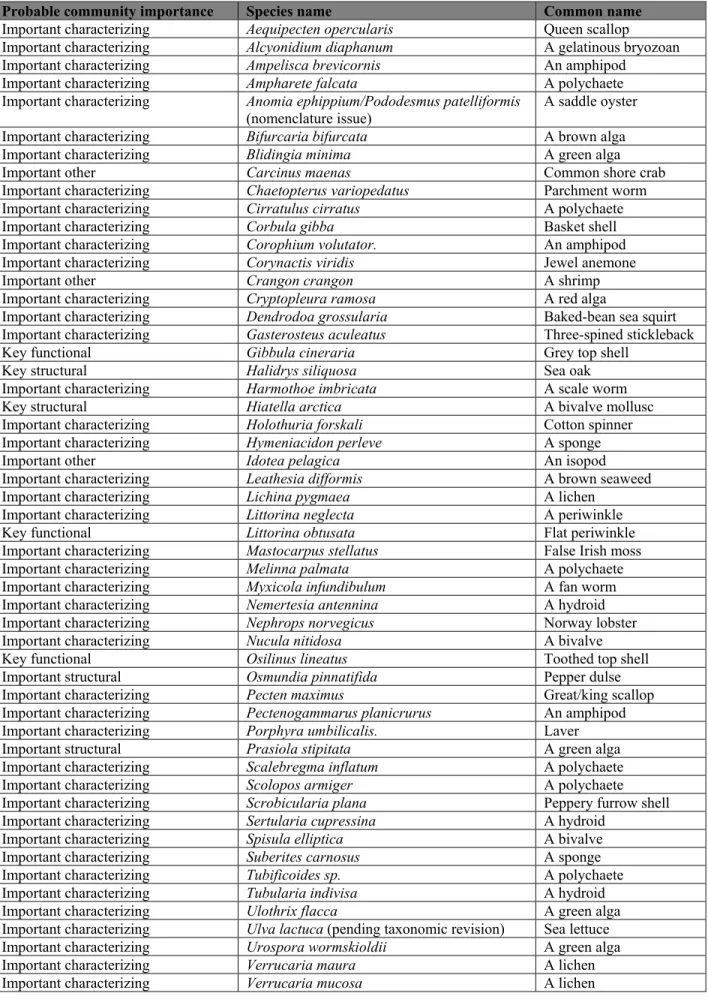
While MarLIN has made major in-roads into assessing the sensitivities of many keystone, characterizing or representative species there are undoubtedly gaps in the research, primarily due to the time constraints and the focus of the past contract work. Other keystone or important characterizing species that may require research are shown in Table 4. Table 4 lists species that are known to be important in marine benthic communities or that are important characterizing species in the description of biotopes under the biotopes classification (Connor et al., 1997a, b). Species listed are ones that are additional to those currently used to identify sensitivity of biotopes, which are dominant or abundant in biotopes and for which it is believed there would be sufficient information to research a full review.
Nationally rare and scarce species
The MarLIN database contains full Key Information reviews on only 17 nationally rare or scarce species (see above) and basic information on another 46 species out of the 172 nationally rare and scarce species listed by Connor & Hill (1998; as amended in 2002).
Table 4. Keystone and important characterizing species not yet researched by MarLIN and known to be present in Welsh waters.
Probable community importance Species name Common name
Important characterizing Aequipecten opercularis Queen scallop
Important characterizing Alcyonidium diaphanum A gelatinous bryozoan Important characterizing Ampelisca brevicornis An amphipod
Important characterizing Ampharete falcata A polychaete Important characterizing Anomia ephippium/Pododesmus patelliformis
(nomenclature issue) A saddle oyster Important characterizing Bifurcaria bifurcata A brown alga Important characterizing Blidingia minima A green alga
Important other Carcinus maenas Common shore crab
Important characterizing Chaetopterus variopedatus Parchment worm Important characterizing Cirratulus cirratus A polychaete
Important characterizing Corbula gibba Basket shell
Important characterizing Corophium volutator. An amphipod Important characterizing Corynactis viridis Jewel anemone
Important other Crangon crangon A shrimp
Important characterizing Cryptopleura ramosa A red alga
Important characterizing Dendrodoa grossularia Baked-bean sea squirt Important characterizing Gasterosteus aculeatus Three-spined stickleback
Key functional Gibbula cineraria Grey top shell
Key structural Halidrys siliquosa Sea oak
Important characterizing Harmothoe imbricata A scale worm
Key structural Hiatella arctica A bivalve mollusc
Important characterizing Holothuria forskali Cotton spinner Important characterizing Hymeniacidon perleve A sponge
Important other Idotea pelagica An isopod
Important characterizing Leathesia difformis A brown seaweed
Important characterizing Lichina pygmaea A lichen
Important characterizing Littorina neglecta A periwinkle
Key functional Littorina obtusata Flat periwinkle
Important characterizing Mastocarpus stellatus False Irish moss
Important characterizing Melinna palmata A polychaete
Important characterizing Myxicola infundibulum A fan worm Important characterizing Nemertesia antennina A hydroid Important characterizing Nephrops norvegicus Norway lobster
Important characterizing Nucula nitidosa A bivalve
Key functional Osilinus lineatus Toothed top shell
Important structural Osmundia pinnatifida Pepper dulse Important characterizing Pecten maximus Great/king scallop Important characterizing Pectenogammarus planicrurus An amphipod Important characterizing Porphyra umbilicalis. Laver
Important structural Prasiola stipitata A green alga
Important characterizing Scalebregma inflatum A polychaete
Important characterizing Scolopos armiger A polychaete
Important characterizing Scrobicularia plana Peppery furrow shell Important characterizing Sertularia cupressina A hydroid
Important characterizing Spisula elliptica A bivalve
Important characterizing Suberites carnosus A sponge
Important characterizing Tubificoides sp. A polychaete
Important characterizing Tubularia indivisa A hydroid
Important characterizing Ulothrix flacca A green alga
Important characterizing Ulva lactuca (pending taxonomic revision) Sea lettuce Important characterizing Urospora wormskioldii A green alga
Important characterizing Verrucaria maura A lichen
More nationally rare and scarce species may be the subject of research. However, in MarLIN’s experience it is usually very difficult to prepare a full Key Information review on nationally rare or scarce species since they are, by their very nature, often poorly studied. Where the information on an important characterizing or keystone species is inadequate to complete a full Key Information review, the relevant or available
information is included in the supporting information for the biotope Key Information review. 4.2.3 Current MarL IN biotope Key Information reviews
At the end of November 2002 the MarLIN Web site biology and sensitivity key information database contained full Key Information reviews of 117 biotopes. Theses biotopes are representative of an additional 157 biotopes. The MarLIN database base therefore, contains biology and sensitivity Key Information relevant to 274 biotopes included in the MNCR biotope classification (Connor et al., 1997a, b). A complete list of the biotope Key Information reviews and their ‘represented’ biotopes at the end of November 2002 is shown in Appendix 4. The biotopes researched were identified as important within the interest features of Annex I habitats of the Habitats Directive and/or within UK BAP habitats. The marine natural heritage importance of the biotopes researched is shown in Appendix 5.
Biodiversity Action Plan habitats
The researched biotope Key Information reviews include examples of all the marine UK BAP habitats and several coastal BAP habitats. They are listed in full in Appendix 5, listed by BAP habitat in Appendix 6 and summarized in Table 5 below.
The only BAP habitats for which no biotopes have been researched are: • coastal sand dunes;
• coastal vegetated shingle;
• machair;
• oceanic seas, and • offshore shelf sediment.
The coastal BAP habitats above are outside the remit the MarLIN programme, which prioritises marine benthic species and habitat and the biotope classification does not yet include many offshore biotopes. Nationally rare and scarce habitats
Connor et al. (1997a, b) provides the national status of many but not all biotopes in the biotope classification. The MarLIN database includes biotope Key Information reviews of:
• 24 nationally scarce biotopes, which represent another 23 nationally scarce biotopes, and • 13 nationally rare biotopes, which represent another 13 nationally rare biotopes.
The nationally rare and scarce biotopes, and their status (researched or represented) are listed in Appendix 7a-d. Several biotope complexes are listed as nationally rare or scarce, while the national status of their component biotopes differs or is not available. For example, the biotope complex ‘Littoral Sabellaria (honeycomb worm) reefs’ (MLR.Sab) is listed as nationally rare but consists of a single biotope which is listed as nationally scarce. Nationally rare and scarce biotope complexes and the status of their component biotopes (researched or represented) are also shown in Appendix 7a-d.
All the nationally scarce biotope have been researched or are represented by other biotopes but following national rare biotopes are not:
• Sargassum muticum in eulittoral rockpools LR.FK.Sar
• Hydroids, ephemeral seaweeds and Littorina littorea in shallow eulittoral mixed substrata pools LR.Rkp.H
Table 5. The number of MarLIN researched biotope Key Information reviews and represented biotopes within BAP habitat and species reviews.
UK BAP (Habitat)
No. Researched (represented) Species action plan
Ascophyllum nodosum ecad. mackii beds 1
Priority BAP habitat
Coastal and floodplain grazing marsh 2(1)
Coastal saltmarsh 3(1)
Coastal sand dunes 0
Coastal vegetated shingle 0
Littoral and sublittoral chalk 6(2)
Lophelia pertusa reefs 1
Machair 0
Maerl beds 2(4)
Maritime cliff and slopes 3(8)
Modiolus modiolus beds 1(3)
Mud habitats in deep water 9(2)
Mudflats 2(10)
Reedbeds 1
Sabellaria alveolata reefs 1
Sabellaria spinulosa reefs 2
Saline lagoons 36(29)
Seagrass beds 2
Serpula vermicularis reefs 1
Sheltered muddy gravels 5
Sublittoral sands and gravels 9(7)
Tidal rapids 3
Broad BAP habitat
Inshore sublittoral rock 56
Inshore sublittoral sediment 43
Littoral rock 24(42)
Littoral sediment 9(15)
Oceanic seas 0
Offshore shelf rock 1
Offshore shelf sediment 0
Supralittoral rock 3(8)
Supralittoral sediment 1
Annex I habitats of the Habitats Directive
The researched biotopes prioritized habitats included within agreed interest features of Annex I habitats in the seas around England and Scotland. The Annex I habitats that include researched biotopes are shown in Appendix 5 and the number of researched biotopes within each Annex I habitat is shown in Figure 1. Please note that more than one biotope may occur in more than one Annex I habitat. The numbers shown in Figure 1 are augmented by the represented biotopes.
UK Marine SACs habitats
The UK Marine SACs project commissioned reviews of the biology and sensitivity of numerous marine habitats (see below for discussion). Due to the similarity in our research priorities, i.e. Annex I habitats, there is considerable similarity between MarLIN's research coverage and the UK Marine SACs programme. The researched and represented biotopes included in the MarLIN database and considered under the UK Marine SACs programme are shown in Appendix 8 and summarised in Table 6 below.
Appendix 8 demonstrates that we have researched many of the biotopes addressed under the UK Marine SACs project.
Figure 1. The number of researched biotope Key Information reviews within Annex I habitats.
Table 6. Biotopes considered in the UK Marine SACs habitat reviews that have been researched or represented by MarLIN.
UK Marine SAC
Number Researched (represented)
Zostera biotopes 2
Intertidal Sand and Mudflats & Subtidal Mobile Sandbanks 10(17)
Sea Pens and Burrowing Megafauna 5(2)
Subtidal Brittlestar Beds 1(1)
Maerl 2(4)
Intertidal Reef Biotopes 19(45)
Infralittoral Reef Biotopes with Kelp Species 12(29)
Circalittoral Faunal Turfs 14(20)
Biogenic reefs 4(1)
Lifeforms
The biotope Key Information reviews included in the ‘lifeforms’ identified by SensMap (McMath et al., 2000) are listed in Appendix 9. In order to accommodate researched biotope Key Information reviews, ‘reedbeds’ and ‘soft rock communities’ were added as ‘lifeforms’. It can be seen that the MarLIN database includes numerous examples of biotopes within the listed ‘lifeforms’ and include examples of all the ‘lifeforms’ listed by the SensMap report (McMath et al., 2000).
Bays (86)
Lagoons (35) Intertidal mudflats and sandflats (8)
Estuaries (56) Reefs (68)
4.2.4 Existing gaps concerning sensitivity and recoverability of key marine biotopes MNCR biotope classification
The number of researched biotope Key Information reviews and the biotopes they represent are compared with the full biotope classification (Connor et al., 1997a, b) and the list of biotopes of Welsh interest in Appendix 10.
The MarLIN database contains at least one biotope Key Information review for every biotope complex in the biotope classification and often more. Although we have only researched two examples of saltmarsh
biotopes, these biotopes are outside our expertise and more rightly fall under terrestrial biology. Welsh interest biotopes
The list of Welsh interest biotopes includes 301 biotopes of which 243 are included in the MNCR biotope classification (Connor et al., 1997a, b). The additional 58 Welsh biotopes seem to be specific additions to the classification, presumably to accommodate regional variation in marine habitats. The MarLIN database includes:
• biotope Key Information reviews of 72 of the Welsh interest biotopes, which • represent another 118 Welsh interest biotopes.
The following 12 Welsh interest biotopes are neither researched or represented: • LR.Rkp.FK.Sar - Sargassum muticum in eulittoral rockpools
• LR.Rkp.H - Hydroids, ephemeral seaweeds and Littorina littorea in shallow eulittoral mixed substrata pools
• LMU.Sm.NVC SM12 - Rayed Aster tripolium
• LMU.Sm. NVC SM8 - Salicornia spp.
• LMX.MytFab - Mytilus edulis and Fabricia sabella in poorly-sorted muddy sand or muddy gravel shores
• LMX.Mare - Mya arenaria and polychaetes in muddy gravel shores
• MIR.KR.Ldig - Laminaria digitata on moderately exposed or tide-swept sublittoral fringe rock • SCR.BrAs.NeoPro.Den - Neocrania anomala, Dendrodoa grossularia and Sarcodictyon roseum on
reduced or low salinity circalittoral rock
• IGS.Mrl.Phy - Phymatolithon calcareum maerl beds in infralittoral clean gravel or coarse sand • IGS.FaS.ScupHyd - Sertularia cupressina and Hydrallmania falcata on tide-swept sublittoral
cobbles or pebbles in coarse sand
• CMX.SspiMx - Sabellaria spinulosa and Polydora spp. on stable circalittoral mixed sediment • CMX.ModHo - Sparse Modiolus modiolus, dense Cerianthus lloydii and burrowing holothurians on
sheltered circalittoral stones and mixed sediment
However, LMX.Mare and LR.Rkp.H were omitted since they are to be discontinued in the current revision of the biotope classification. Although IGS.Mrl.Phy is not researched, its sub-biotope IGS.Mrl.Phy.Hec is researched and is probably representative. The saltmarsh NVC communities are also poorly represented in the MarLIN database but were not considered to be relevant to the programme as a whole.
4.2.5 Existing gaps concerning sensitivity and recoverability information
The above exposition demonstrates that the MarLIN database includes biology and sensitivity information of a large number of keystone, characterizing, and representative marine species and the majority of the
important marine biotopes. When taken together with the representative biotopes the MarLIN database contains biology and sensitivity information of relevance to most of the marine benthic habitats in the seas of England, Scotland and Wales.
Information resources in Plymouth
The MarLIN Key Information reviews have synthesized information from a wide variety of sources, including review journals, the scientific literature, grey literature and specific reports. The Key Information reviews present the best available scientific information on the species or biotopes concerned. Emphasis has been given to direct evidence of environmental affect and subsequent recovery, wherever possible.
The MarLIN programme draws on the information resources of the National Marine Biological Library (NMBL), Plymouth. The NMBL is a specialist marine biology library with a huge collection of otherwise unavailable grey literature and archive material. The MarLIN database presently contains over 3200 bibliographic entries to information used to complete the full Key Information reviews.
The Key Information reviews have benefited from input for marine biologists resident at the Marine Biological Association of the UK (MBA), as well as external experts and referees.
UK Marine SACs project
The UK Marine SACs project provides a major source of information on the biology and sensitivity of important marine habitats in the UK. The UK Marine SACs project commissioned ‘overviews of the dynamic and sensitivity characteristics for conservation and management of marine SACs’ of the major marine habitats by expert marine biologists as well as reviews of the likely impacts from specific marine sectors. The relevant UK Marine SACs reviews are listed below.
Reviews of the ‘dynamic and sensitivity characteristics for conservation and management of marine SACs’: • Biogenic reefs
• Circalittoral Faunal Turfs
• Infralittoral Reef Biotopes with Kelp Species • Intertidal Reef Biotopes
• Intertidal Sand and Mudflats & Subtidal Mobile Sandbanks
• Maerl
• Sea Pens and Burrowing Megafauna • Subtidal Brittlestar Beds
• Zostera biotopes
The above reviews are augmented by:
• Marine habitat reviews - A summary of ecological requirements and sensitivity characteristics for conservation management of marine SACs
• Good practice guidelines for ports and harbours operating within or near UK European marine sites • Guidelines for managing the collection of bait and other shoreline animals within UK European
marine sites
• A review of the effects of fishing within UK European marine sites
• Guidelines for managing water quality impacts within UK European marine sites • A review of the effects of recreation interactions within UK European marine sites • Guidelines on the impact of aggregate extraction on European marine sites
• Investigating and managing water quality impacts in saline lagoons
The above reviews have proven to be an invaluable source of information for the assessment of the sensitivity of several groups of biotopes.
Dealing with gaps in information
The UK Marine SACs project reviews (listed above) provided detailed information to support our sensitivity assessments, although they often did not contain enough information for all the environmental factors considered. But in several cases there was not enough information on the species biology to complete a full Key information review or the communities ecology was poorly studied. Wherever possible the community ecology has been inferred from survey data and descriptions of the habitat and the general biology or similar communities and associated species. In all cases, the inferences used are clearly stated.
For example, there was not enough information on the gaping file shell Limaria hians to complete a full Key Information review. The relevant information on distribution, habitat, recruitment, and reproduction were incorporated into the biotope review of Limaria hians beds. In addition, much of the information on ecological relationships and habitat complexity was derived from survey data, species lists and descriptions of the habitat.
Other examples where information was deficient or the ecology or the community was poorly studied included:
• Beggiatoa spp. on anoxic mud;
• faunal turf communities, especially erect bryozoan or sponge dominated communities; • Ocnus planci aggregation on sheltered sublittoral muddy sediment, and
• Musculus discors beds on moderately exposed circalittoral rocks.
In many cases information on tolerance to chemical contamination has proved to be difficult to obtain. Information from experimental studies is often readily available but only for species that lend themselves to experimentation (e.g. easy to obtain and maintain in captivity). In addition, the relevance of experimental studies to the natural environment is often unclear. By necessity, inferences have been made for groups of species (e.g. mussels, polychaetes, hydroids and bryozoans), usually with low confidence.
The MarLIN approach to sensitivity assessment includes an assessment of the level or evidence and hence confidence, for each sensitivity assessment (see Tyler-Walters et al., 2001). In summary, where evidence on the sensitivity or recoverability is derived from direct experimentation or studies of species and habitats then ‘high’ to ‘moderate’ confidence is given in the assessment. If sensitivity and recoverability assessments are based on the biological characteristics of the species or habitats alone then ‘low’ confidence is reported, while ‘very low’ confidence is reported if the assessments are based on informed judgement alone.
Therefore, each sensitivity assessment is ‘tagged’ with an assessment of the level of evidence on which the assessment is based. In addition, the evidence used to make the assessment is summarized in an explanation or ‘rationale’ that accompanies the assessment.
4.3. The extent to which spatial and temporal factors have been taken into account in existing sensitivity and recoverability assessments
4.3.1 Spatial factor s
Spatial environmental factors are those that vary from site-to-site and that determine the presence and abundance of a species and which biotope develops at a site. Most spatial environmental factors will vary only within a limited range and the continued presence of the same biotopes and dominant species at the same location over many years is evidence that species and biotopes tolerate variation within normal limits of such factors as seawater temperature, salinity, suspended sediment concentration and strength of wave action.
The species and biotope Key Information (see Appendices 11 and 12 respectively for the list of fields) reviews address spatial factors in the form of habitat preferences. Restrictions on recruitment and hence recovery caused by geographical or hydrographical isolation are addressed wherever possible.
4.3.2 Temporal fac tors
Some species vary in abundance with time and the species composition of biotopes may vary without them becoming a different biotope. It is important to identify what those changes are likely to be so that increases
or decreases in abundance of species alone or of species in a biotope can be ascribed to natural variability or to variability brought about by an extreme but natural event or to human activity. For instance, the
abundance of foliose algae varies with time of year (see Hiscock, 1986) and a low abundance or absence of some species is to be expected during winter. Some species, such as the light bulb sea squirt Clavelina lepadiformis, appear in large amounts in one year but may be virtually absent in another and this seems to be natural variability. Some sea slugs may go ‘missing’ for several decades before re-appearing. An
exceptionally cold winter may result in mortality of a wide range of species (see Crisp, 1964). Information on such seasonal or long-term natural fluctuations is descriptive and is included under the ‘Reproduction and longevity’ fields for species reviews and in the ‘Seasonal /temporal changes’ field in biotope reviews. Where relevant or where information allows, potential successional change is also addressed. In addition, seasonal and longer-term change in recruitment of species and of dominant or important characterizing species in biotopes is addressed under ‘Recruitment processes’ whilst temporal change in biotopes is addressed under ‘Time for community to reach maturity’.
Spatial, seasonal and temporal change is therefore factored into the sensitivity assessment of biotopes as a matter of course. However, seasonal and long term changes in marine benthic communities, especially subtidal communities, are poorly studied. As above, the level of information available on particular communities varies and the hence the confidence in our recoverability assessments vary accordingly. Overall, information on seasonal and long term change was researched or inferred from similar communities for all but three of the 117 biotopes researched.
4.3.3 Relevance of M arLIN ‘Environmental factors’ and ‘Key information fields’ to assessing spatial and temporal change
The Key Information fields included in the species Key Information reviews are shown in Appendix 7. Spatial factor such as distribution, abundance, and habitat preferences are included, along with issues relevant to reproduction such as reproductive season, age at maturity, fecundity, reproductive type, larval dispersal range and settlement period (month or season).
A species ability to recover from destruction of the population is dependent on its ability to recruit and recolonize the habitat. Recoverability from environmental factors that reduce viability (low sensitivity) is primarily dependent on the species ability to regrow and regenerate. Therefore, more key information fields were required to assess recoverability from factors to which the species is highly sensitive than those to which it had a low sensitivity.
The Key information fields that affect temporal change and that are used to assess recoverability from environmental factors at different levels of sensitivity include:
• Abundance;
• Size at maturity; • Growth rate;
• Mobility;
• Distribution; • Life span; • Age at maturity; • Generation time; • Reproductive type; • Reproductive frequency; • Fecundity;
• Larval settling time, and • Dispersal potential.
In assessing likely recoverability, potential larval dispersal and recruitment ability often differ from effective dispersal and recruitment and are often limited by hydrographic regimes that are difficult to assess.
Restrictions on recruitment and hence recovery caused by geographical or hydrographical isolation are addressed wherever possible. Information on reproduction, fecundity and dispersal capabilities of many marine species is poorly studied. It often proved necessary to make inferences on the likely recruitment of a chosen species from information on similar species or reproduction in its group as a whole. For example, recruitment in brooding bryozoans (e.g. Parasmittina trispinosa) may be inferred from studies of recruitment of fouling species such as Bugula spp, while recruitment in hydroids may be inferred from studies of Obelia spp., Nemertesia spp. or hydroids as a group, depending on the species of interest.
Precedence was given to direct evidence on the recruitment or recovery of species, or groups of species, from experimental studies, colonization or artificial habitats and long term studies of recovery after environmental perturbation, e.g. the recovery of intertidal populations after oil spills.
4.4. Environmental factors used for sensitivity assessment by SensMap, MarLIN and the UK Marine SACs project
4.4.1 Environment al factors
The MarLIN and SensMap programme both assess sensitivity to environmental factors. Natural events and anthropogenic activities affect marine habitats and species by causing a change to the environmental factors to which the species or habitats are normally exposed. If this change in the environmental factor is outside the tolerance limits of the species or habitat then ‘damage’ may occur.
The SensMap list of factors is divided into Primary, Secondary and Tertiary factors. The SensMap Tertiary categories are more precise for physical disturbance, synthetic compounds, hydrocarbon contaminants, and nutrient enrichment in particular. Whilst some of the detailed categories listed by SensMap might be difficult to find information for, many do give the sort of precision needed when dealing with specific pollutants or types of disturbance. Currently, MarLIN specifies the category of disturbance, heavy metal, chemical contaminant, or oil type for which evidence has been found in the sensitivity assessment but it is not be possible to access information directly from a search for a specific detailed category, although searches could be developed.
The environmental factors used by MarLIN, the Secondary factors used by SensMap and the factors listed by the UK Marine SACs project are compared in Table 7. The differences between the lists are predominantly minor and based mainly on terminology. All the factors included in the SensMap programme and the UK Marine SAC project are addressed by the environmental factors used within the MarLIN programme. 4.4.2 Maritime acti vities and their associated environmental factors
Coastal and environmental regulators and managers are concerned primarily with the management, control, or operation of ‘activities’. Therefore, an ‘activities to factors’ matrix was developed to indicate those environmental factors that were likely to change due to specified maritime and coastal activities. A similar approach is used by the SensMap programme (McMath et al., 2000; Section 4, Appendix 3).
The ‘activities to factors’ matrix (Appendix 13) was derived from the Marine Conservation Handbook (Eno, 1991) as amended by Cooke & McMath (2000) and discussion with the Marine Habitats Team (JNCC), and the MarLIN Biology and Sensitivity Key Information Sub-programme Technical Management Group. Wherever possible the list of activities and environmental factors was in agreement with the guidance provided on marine candidate SACs by English Nature, under Regulation 33 of the ‘The Conservation (Natural Habitats, &c.) Regulations 1994’ (SI 1994/2716), and further guidance provided by Joint Nature Conservation Committee to OSPAR (the Oslo and Paris Convention for the Protection of the Marine Environment of the North-east Atlantic).
The maritime and coastal activities identified for the MarLIN programme are shown in Appendix 14. The list should not be regarded as definitive or exhaustive. A comprehensive list would be too long to be practicable. Therefore, many of the activities listed represent classes or groups of activities. Each of the activities shown in the matrix and the types of activity that they are used to represent in Britain and Ireland are defined.
The ‘activities to factors’ matrix was developed to contribute a search tool for species or biotopes sensitive to specific maritime activities. The ‘activities to factors’ matrix is duplicated within the MarLIN database. The search tool allows the user to select a specific maritime activity (e.g. scallop dredging) to identify
environmental factors likely to change as a result of that activity, and hence, species or biotopes that have been assessed as sensitive (high, intermediate or low) to that environmental factor.
Although the formats differ, the majority of the primary, secondary and tertiary activities identified by the SensMap programme (see McMath et al., 2000; Section 4, Appendix 1) are included in the MarLIN
definition of activities (Appendix 14). However, the following activities are not defined in the MarLIN list. Oil spill clean-up:
• bioremediation, • burning at sea, • burning of vegetation, • cutting of vegetation,
• high pressure ambient water temperature flushing, • hot water flushing,
• low pressure ambient water temperature flushing, • mechanical removal of residual smaller volumes of oil, • natural recovery
• physical bulk oil removal at sea, • physical bulk oil removal on shore • warm water flushing
• shoreline cleaning agents, • sinking,
Table 7. Comparison between environmental factors used to assess sensitivity by MarLIN, SensMap, and the UK Marine SACs project.
MarLIN environmental factors SensMap Report secondaryenvironmental factors UK Marine SAC environmentalfactors
Substratum loss Substrate Removal of
substratum Smothering Suspended sediment Desiccation Humidity Changes in emergence regime
Emergence Regime Increase inexposure/desiccation Changes in water
flow rate Tidal Flow
Changes in wave exposure Changes to geo-morphology Wave Exposure Water movement/ Hydrophysical regime
Noise disturbance Noise
Visual presence Noise & visualdisturbance Visual Entanglement Collision Physical disturbance
/ abrasion Amputation
Displacement Physical disturbance Displacement Physical disturbance/damage Changes in
temperature Temperature Temperature
Turbidity Physical
Changes in turbidity
Changes to water properties Light Physical Water clarity Polychlorinated biphenyls (PCBs) Organophosphate Biocides Organochlorine Biocides Other Synthetic Biocides Other Synthetic Organic Compounds Inorganic Oxidising Agents Synthetic compound contamination Inorganic Reducing Agents Synthetics Heavy metal
contamination Metals Heavy metals
Oil & Petrochemicals Hydrocarbon
contamination Oil Cleaning Agents Oil
Radionuclide
contamination Radionuclides
Nutrients Organic carbon Changes in nutrient
levels Changes to environmental quality Algal toxins Nutrients Red tides
Changes in salinity Salinity Salinity
Chemical
Changes in oxygenation
Changes to water
properties Dissolved Oxygen
Chemical Oxygen Introduction of microbial pathogens / parasites Disease Pathogens/parasites/ disease Introduction of
non-native species Addition of biota Non-native species
Extraction of target
species Removal of target biota Harvesting ofspecies Biological
Extraction of non-target species Direct changes to trophic structure Biological Removal of predators