Accurate Neural Network Description of Surface Phonons in Reactive
Gas
−
Surface Dynamics: N
2
+ Ru(0001)
Khosrow Shakouri,
*
,†Jo
̈
rg Behler,
‡Jo
̈
rg Meyer,
†and Geert-Jan Kroes
*
,††Gorlaeus Laboratories, Leiden Institute of Chemistry, Leiden University, P.O. Box 9502, 2300 RA Leiden, The Netherlands
‡Universität Göttingen, Institut für Physikalische Chemie, Theoretische Chemie, Tammannstrasse 6, 37077 Göttingen, Germany
*
S Supporting InformationABSTRACT: Ab initio molecular dynamics (AIMD) simulations enable the accurate
description of reactive molecule−surface scattering especially if energy transfer involving
surface phonons is important. However, presently, the computational expense of AIMD rules out its application to systems where reaction probabilities are smaller than about 1%.
Here we show that this problem can be overcome by a high-dimensional neural networkfit
of the molecule−surface interaction potential, which also incorporates the dependence on
phonons by taking into account all degrees of freedom of the surface explicitly. As shown
for N2 + Ru(0001), which is a prototypical case for highly activated dissociative
chemisorption, the method allows an accurate description of the coupling of molecular and surface atom motion and accurately accounts for vibrational properties of the employed slab model of Ru(0001). The neural network potential allows reaction probabilities as low
as 10−5to be computed, showing good agreement with experimental results.
T
he accurate simulation of atomic and molecular scatteringfrom metal surfaces often requires a reliable description of surface phonon motion,1−4especially if the projectile is heavier than dihydrogen. Although it may often be possible to obtain reasonably accurate descriptions of the scattering dynamics with a reduced dimensionality representation of the surface
vibrations,5 for quantitative agreement, it is mandatory to use
an ab initio molecular dynamics (AIMD) approach.6,7 AIMD
recently enabled a chemically accurate description of the
reaction of CHD3with Ni(111).8The high accuracy of AIMD
stems from its ability to include the motion of the atoms in the upper surface layers by computing the interatomic forces
on-the-fly through electronic structure methods, which for
molecules scattering from metal surfaces usually rely on density
functional theory (DFT).9However, AIMD is computationally
expensive, presently making simulations of long-lasting or low-probability chemical processes infeasible. This poses a severe challenge: how can we enable AIMD-quality simulations of
molecule−surface reaction processes associated with low
probabilities at affordable computational costs?
Here we address this question for the N2 + Ru(0001)
reaction, which is considered a paradigm for highly activated
dissociative adsorption. Dissociation of N2over Ru surfaces is
also of practical interest as this reaction is the rate-determining
step in ammonia synthesis, for which Ru is an efficient
catalyst.10,11The N2+ Ru(0001) system has therefore received
a lot of attention in a series of experimental studies.12−18These
experiments have shown that the dissociation probabilityS0of
N2is very small (for the collisional energy range of∼1−2.75
eV, the measured values are S0 ≈ 10−6−10−3),
16−18 even though the minimum barrier height is only about 1.8 eV.17,19,20 It has been suggested that the low reactivity is due to
nonadiabatic effects, such as electron−hole pair excitation.21 Subsequent quasi-classical trajectory (QCT) calculations
carried out within the Born−Oppenheimer static surface
(BOSS) approximation showed that the low reactivity could be well explained by the barrier representing an extremely
narrow bottleneck to reaction.19,20 However, discrepancies
between theory and experiment remained, and it was suggested
that surface phonons might play an important role.19,20
As simulating the low probability N2+ Ru(0001) reaction
with AIMD would require running too many (∼5 × 10⁵)
expensive AIMD trajectories, instead we investigate the role of phonons by developing a DFT-quality high-dimensional (HD)
neural network potential (NNP) for N2 + Ru(0001). The
applicability of artificial neural networks to describing chemical reactions has already been proven for, for example, bulk materials,22,23organic reactions,24,25simulations of solid−liquid interfaces,26molecules interacting with static surfaces,27−29and, very recently, energy transfer to metal surfaces in scattering of
HCl from Au(111).30However, in the latter molecule−surface
scattering study, reaction probabilities and scattering
proba-bilities were not yet calculated, althoughfinal rotational state
distributions in scattering were presented. In this work, for the
first time, we apply the HD-NNP approach to reactive
molecule−surface scattering with inclusion of surface atom
motion.
Here, in order to construct a HD-NNP for N2+ Ru(0001),
we employ the method of Behler−Parrinello,31through which
the energy is expressed as a sum of environmentally dependent
Received: March 31, 2017 Accepted: April 25, 2017 Published: April 25, 2017
Letter
pubs.acs.org/JPCL
atomic energies, and the atomic environments are described by
many-body atom-centered symmetry functions.32,33 The
accuracy of the HD-NNP is assessed by comparison with the
DFT reference data for N2+ Ru(0001) as well as with available
experimental results regarding the phonons of Ru. After this validation step, the HD-NNP is used to generate reaction
probabilities for comparison with experiments17,18 and to
quantitatively analyze the role of phonons and the surface temperature (Ts).
The HD-NNP is developed from a data set of 25 000 N2+
Ru(0001) structures, including the concomitant information on their energy and forces. To obtain the data, we carried out DFT
calculations with the RPBE functional34as implemented in the
Vienna Ab initio Simulation Package (VASP),35−38which was
also used in earlier studies.19,20The DFT calculations used a 3
×3 surface unit cell and seven atomic layers of Ru atoms, of
which the bottom layer was kept stationary while the N2
molecule was placed on the top side of the slab. The
calculations employed a plane wave cutoffof 550 eV and a 7
×7×1Γ-point centered mesh of k-points.
The HD-NNP was constructed using the RuNNer
pack-age.32,39 The DFT data included 5000 configurations of two
nitrogen atoms on an ideally frozen surface and 20 000
configurations on the thermally disordered Ru(0001) surface.
For the latter, the thermal displacements of the atoms from their equilibrium positions were sampled randomly from a Gaussian distribution, making sure to also include data for
surface temperatures (up toTs= 900 K) higher than those used
in the experiments simulated below (up toTs = 600 K). For
both the N and the Ru atoms, radial and angular symmetry functions were used to describe interactions with neighbor
atoms within their chemical environment up to a cutoffradius
of 5.82 Å.31,32
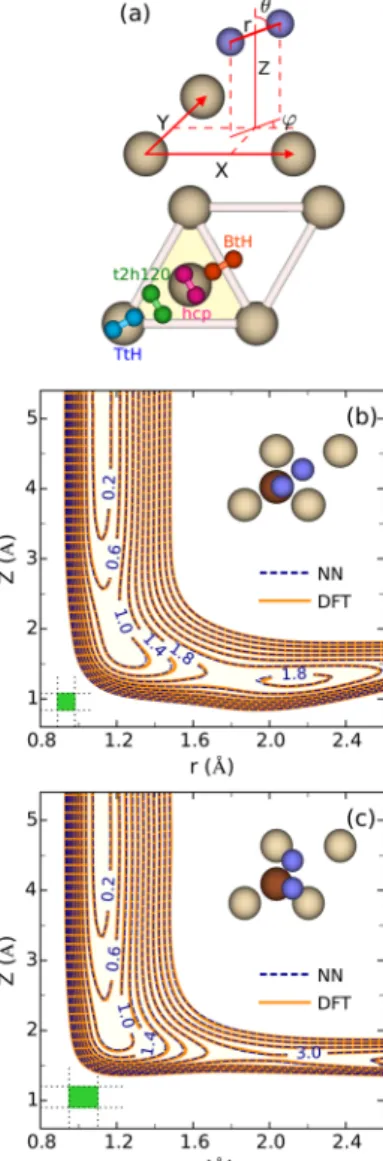
As afirst test of the HD-NNP, we examine two-dimensional
(2D) cuts through the potential energy surface (PES), showing
it as a function of the molecular coordinatesrandZ(seeFigure
1a) for impact on the bridge site at two different orientations of
the molecule (Figure 1b,c). The 2D cuts provided by the
HD-NNP are compared with DFT data computed on afine grid and
then interpolated with splines. In this particular case, the surface atoms were kept frozen at their equilibrium positions to facilitate the comparison. The dissociation geometries studied
are close to the minimum barrier geometry found in ref 40.
Direct comparison shows that the HD-NNP accurately predicts the DFT data for the geometries and the static surface
configuration considered. To check whether a similar accuracy
is obtained also for other dissociation geometries and for distorted surface geometries, the 25 000 points on which the HD-NNP is based was divided in a test set of 5000 points (which were picked at random from the complete set) and a
training set of 20 000 points. With thefit based on the training
set, the total energy of each structure present in the test data set was evaluated and a root-mean-square (RMS) deviation of 38 meV (less than 1 kcal/mol) from the DFT data was obtained for the total energies. The same or higher accuracy is expected from the HD-NNP constructed with the aid of the complete set, which was used in the reactive scattering calculations reported below.
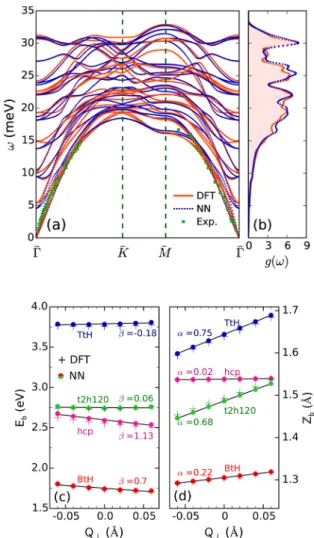
The so-constructed HD-NNP also accurately describes vibrational properties of the Ru(0001) slab, as evidenced by the corresponding phonon band structure and density of states.
Our phonon calculations are based on the so-called “direct
method”42 as implemented in an in-house version of the
phonopy code,43,44interfacing both the VASP and LAMMPS45
codes and using the same computational setups as described before. We have verified that 3×3 multiples of the surface unit cell yield converged phonon band structures and densities of states. The results for the phonon band structure are
summarized in Figure 2a for the path given by the
high-symmetry points Γ̅−K̅−M̅−Γ̅ through the surface Brillouin
zone and compared with the results obtained directly from
RPBE-DFT calculations and with experimental results (ref41).
Note that for accurate extraction of the phonon dispersion relation, the RMS error in the interatomic forces, from which the required force constants are derived, should be less than
0.001 eV/Å. The acoustic phonon mode frequencies inFigure
2a obtained from the HD-NNP are in excellent agreement with
both the RPBE-DFT and the experimental results.41Likewise,
the frequencies of the highest optical phonon modes at pointΓ̅,
that is, ω(Γ̅) ≈ 31−32 meV, are consistent with the results
Figure 1.(a) Illustration of molecular coordinates in the center of mass system and of four dissociation geometries. (b,c) 2D elbow maps of the PES, for N2on Ru(0001), as a function of the (r,Z) coordinates
forθ= 80°andφ= 40°(b) and forθ=φ= 90°(c). The blue dashed and orange solid curves describe the HD-NNP and the spline interpolated raw DFT data, respectively. The mesh size used for the interpolation is specified as a green rectangle. The insets schematically depict the orientation of N2with respect to the surface. The energy
difference between successive contour lines is 0.4 eV.
obtained with high-resolution electron−electron-loss
spectros-copy (30.4−32 meV).46
The good agreement between the NN and DFT descriptions of the phonons is not restricted to the depicted Γ̅−K̅−M̅−Γ̅
path; there is also excellent agreement between the RPBE-DFT
and the HD-NNP results for the phonon density of statesg(ω)
for the calculations where all phonon modes in the surface
Brillouin zone are taken into account (Figure 2b). The density
function g(ω) also enables us to evaluate the effective Debye
temperatureTDof Ru(0001). To do this, the density of states
for acoustic phonon modes needs to be fit as gD(ω) ∝ ω2
within the Debye model. The resultingTDfrom the HD-NNP
is 410 K, which agrees well with TD = 423 K as obtained
directly from our RPBE-DFT calculations and also with the
values of 400−410 K obtained in low-energy electron
diffraction measurements.47,48Altogether, the good agreement
noted between the NNP and DFT suggests that the HD-NNP yields an accurate description of the lattice dynamics of the Ru(0001) surface.
To further validate the NNfit, we also examine the quality of
the HD-NNP for the coupling between molecular and surface atom motion, at some stationary points. Starting from the ideal rigid Ru(0001) surface and using the HD-NNP, barrier
geometries and heights are computed for the four (X, Y, φ)
dissociation geometries indicated in Figure 1a, through
three-dimensional Newton−Raphson optimizations of (r, Z, θ)
geometries. InFigure 2c, the coupling of the reaction barrier
height (Eb) to the motion of an individual Ru atom in the
uppermost surface layer is investigated separately for the aforementioned dissociation geometries. Vertical displacements
(Q⊥) of the surface Ru atom nearest to N2are considered. An
approximation toEbis also calculated directly through DFT by
computing the DFT energy for the molecular coordinates
found from the HD-NNP and shown by “+” markers for
reference. As seen, the barrier height exhibits roughly a linear
dependence onQ⊥, which agrees with the findings of similar
studies on other adsorbate−surface systems.49,50 In a similar
vein, the vertical shift of the barrier location Zb along the
molecular coordinateZalso depends approximately linearly on
Q⊥, as illustrated inFigure 2d (in the procedure to obtainZb
through DFT calculations, therandθcoordinates were kept at
the values obtained from the HD-NNP). In summary, and following the definitions of ref49, the electronic couplingβ= −ΔEb/Q⊥and the mechanical couplingα=ΔZb/Q⊥, which can
be taken as representative of the coupling between molecular and surface atom motion, are well described with the HD-NNP.
This suggests that the HD-NNP may be used with confidence
to assess the effects of surface temperature and of energy
exchange with phonons on the dissociative chemisorption of N2
on Ru(0001).
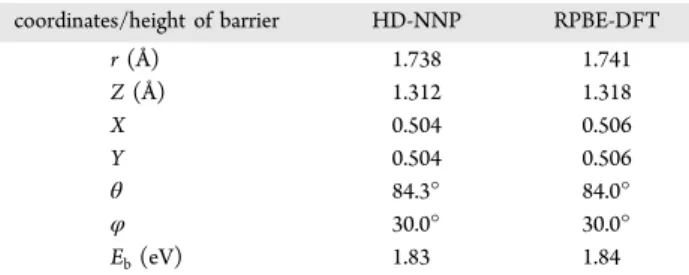
As a final test of the NN fit, we also checked whether the
HD-NNP accurately describes the minimum barrier geometry and barrier height. For the HD-NNP, the minimum barrier
geometry and height were found by performing a Newton−
Raphson search incorporating all molecular coordinates but
keeping the surface atomsfixed in their ideal geometry. The
search was started from a bridge-to-hollow adsorption geometry as it was previously shown20,40that this dissociation geometry is close to the minimum barrier geometry. For comparison, we also calculated the minimum barrier coordinates and energy directly with RPBE-DFT using the
climbing-image nudged elastic band51 (CI NEB) technique.
The results are summarized inTable 1. The barrier geometry
and height derived from the HD-NNP are in excellent agreement with the raw DFT results.
We now turn to the effect of phonons on the reaction
dynamics (Figure 3a,b). Comparisons were made with three
types of experiments,17,18which we refer to here as Exps. 1−3.
In Exp. 1, a nozzle temperature (Tn) of 1100 K was used, and
seeding with H2was carried out. The average collision energy
was varied by changing the seeding ratio. Exp. 2 concerns a
single experiment performed for Tn= 1150 K using He as a
seeding gas. Both experiments were done by the same group
and used Ts = 575 K for the surface (ref 18). Careful error
analysis was performed, estimating the extracted reaction probabilities to be accurate to within a factor 5. In Exp. 3
(ref17),Ts= 600 K andTnwas varied between 350 and 1000
K to change the collision energy using seeding in H2. The
results were not accompanied by error analysis. We do not
Figure 2.(a) Phonon dispersion of Ru(0001) along the path through the surface Brillouin zone given by the high-symmetry pointsΓ̅−K̅− M̅−Γ̅. The blue dots are extracted from HD-NNP, and the orange solid curves are from RPBE-DFT calculations. The green squares indicate the acoustic phonon modes obtained from experimental measurements (ref41). (b) Corresponding phonon density of states as a function of the frequency of phonon modes. (c) Variations of the reaction barrier height for the four representative dissociation geometries described inFigure 1a, with the vertical displacement of an individual Ru atom in the topmost surface layer. The plus markers indicate the reaction barrier heights calculated through DFT for the same barrier geometry as that found from HD-NNP. (d) Vertical shift of the barrier location along the molecular coordinateZas a function of the lattice coordinateQ⊥.
consider the experiments performed by the same group and
published in ref16as it is not clear how this group could have
achieved collision energies as high as 4 eV with a
hydrogen-seeded beam using Tn up to 700 K (assuming an average
translational energy of 2.7kBTnfor H252and no velocity slip, the
average collision energy could not have been higher than 2.3 eV in these experiments). When comparing our dynamics results to the experiments considered, we give the highest weight to Exps. 1 and 2 as they come with thorough error analysis.
In performing the dynamics calculations using the mobile
surface, the seven-layer slab of Ru(0001) wasfirst equilibrated
to the surface temperature used in the experiments. The initial
quantum states of N2were statistically populated in accordance
with the value of Tn used in the experiments, and our
calculations mimic the velocity distribution of the molecular
beams in the experiments. In our quasi-classical dynamics calculations, dissociative chemisorption was operationally defined to occur oncer> 2.5req, wherereq= 1.117 Å denotes
our RPBE value for the equilibrium N−N distance in the gas
phase. In this study, 5×10⁵trajectories for incident energies of
Ek< 2 eV and 105trajectories forE
k≥2 eV were run, ensuring
statistically converged results over the incidence energy range
of 1.5−3.25 eV. The outcome of our quasi-classical simulations
is summarized in Figure 3. Taking into account the
uncertainties in the reaction probabilities measured in Exp. 1,
the calculated sticking probabilitiesS0computed with the RPBE
functional are in good agreement with the experimental values
(cf. the full squares and circles in Figure 3a), and the same
holds true for Exp. 2 (cf. the blank circle and star marker). There are sizable discrepancies between the calculated results and the results of Exp. 3, especially for collision energies of >2.0 eV. However, as noted before, we attach greater weight to the comparison with the results of Exps. 1 and 2. Future
calculations could assess the possible effects that electron−
hole pair excitation might have on the calculated reaction probability. Most likely, their inclusion in the dynamical model should somewhat diminish the calculated reaction probabilities,
although work in which the effect of their inclusion was
investigated for similar systems suggests a much smaller role for electron−hole pair excitation than for the phonons for a similar
N2+ metal system.
3
Also, the error analysis of ref 18clearly
suggests that it would be worthwhile to invest efforts in
improving the accuracy of the measurements for this
paradigmatic reactive molecule−surface system.
The HD-NNP also allows us to assess the influence of
surface temperatureTson the reactivity by comparing withTs=
0, that is, the Ru surface is static at the beginning of each trajectory but additionally accounts for energy dissipation into
phonons during the collision of N2with the surface, as well as
with 6D dynamics performed within the rigid surface approximation. As to the latter, we note that for the highest collision energy studied the rigid surface result overestimates
the value obtained for Ts = 575 K by more than a factor 2
(green triangles vs red squares). Clearly, allowing energy transfer from the molecule to the surface yields a decreased reaction probability. Compared to the 0 K simulations, raising
Tsto 575 K enhances the reaction probability by factors of 3−5
for incidence energies between 1.75 and 2.25 eV, emphasizing
the need to model the effect ofTs for this important reaction.
We emphasize again that the HD-NNP allows us to study these
effects and take them into account in comparing with
experiment even for low collision energies where reaction
probabilities are on the order 10−5−10−4, which would at
present have been impossible with AIMD simulations. In summary, we have tested the applicability of a HD-NNP for describing the interaction of a molecule with a thermally
distorted surface, taking the N2+ Ru(0001) system, which is a
paradigm of activated dissociative chemisorption, as an
example. The HD-NNP fitted to RPBE-DFT calculations on
this system accurately describes the lattice dynamics within the employed slab model of Ru(0001), the electronic and mechanical coupling between molecular and surface atom motion, and the interaction of the molecule with the metal surface. Furthermore, the HD-NNP allows sticking probabilities
as small as 10−5to be computed accurately in QCT calculations
simulating both molecular and surface atom motion. Sticking probabilities computed with the HD-NNP are in good agreement with experimental molecular beam sticking proba-Table 1. Minimum Barrier Geometry and Its HeightEbAs
Obtained from the HD-NNP and RPBE-DFT Calculationsa
coordinates/height of barrier HD-NNP RPBE-DFT
r(Å) 1.738 1.741
Z(Å) 1.312 1.318
X 0.504 0.506
Y 0.504 0.506
θ 84.3° 84.0°
φ 30.0° 30.0°
Eb(eV) 1.83 1.84
aFor the RPBE-DFT calculations, the CI NEB method has been
employed.
Figure 3.Dissociative sticking probability of N2 on Ru(0001) as a
function of its average translational energy. (a) Quasi-classical dynamics calculations are compared with two types of experiments18 for N2beams seeded by H2(Exp. 1) and He (Exp. 2). The full squares
indicate the sticking probability of N2 forTs = 575 K including the
effect of phonons (HD-NNP, Ts = 575). The probability S0 is also
shown forTs= 0 with the surface treated as mobile (HD-NNP,Ts=
0). The green triangles show the results obtained within the ideal rigid surface approximation (6D dynamics). (b) Same as that in (a), but the sticking probability is compared with experimental results of ref17 (Exp. 3) forTs= 600 K.
bilities accompanied by a solid error analysis. The HD-NNP tested here allows accurate calculation of reaction probabilities for cases where these probabilities are too small for AIMD to be applicable.
■
ASSOCIATED CONTENT*
S Supporting InformationThe Supporting Information is available free of charge on the
ACS Publications websiteat DOI:10.1021/acs.jpclett.7b00784. Description of the electronic structure calculations, training data set for the neural network potential, construction of the HD-NNP, phonon calculations for
Ru(0001), and quasi-classical simulations of N2
dis-sociative adsorption on Ru(0001); convergence tests of the reaction barrier height (Table S1), parameters of radial and angular symmetry functions (Tables S2 and
S3), 2D cut through the PES and sampling of (r, Z)
points (Figure S1), short-range radial and angular functions (Figure S2), velocity distribution characterizing
the N2 beam (Figure S3), and comparison of reaction
probabilities for zero and small nonzero rotational
temperatures (Figure S4) (PDF)
■
AUTHOR INFORMATIONCorresponding Authors
*E-mail: [email protected]. Phone: +31 (0)71 527
4533. Fax: +31 (0)71 527 4397 (K.S.).
*E-mail: [email protected]. Phone: +31 (0)71 527
4396. Fax: +31 (0)71 527 4397 (G.-J.K.).
ORCID
Khosrow Shakouri:0000-0002-5550-9731 Jörg Behler: 0000-0002-1220-1542 Jörg Meyer: 0000-0003-0146-730X Geert-Jan Kroes:0000-0002-4913-4689
Notes
The authors declare no competingfinancial interest.
■
ACKNOWLEDGMENTSThis work was supported by the European Research Council through an ERC-2013 advanced grant (No. 338580) and with computer time granted by NWO-EW. The authors also thank Dr. Francesco Nattino, Prof. Micha Asscher, Prof. Aart Kleijn, and Prof. Alan Luntz for many useful discussions. J.B. is grateful for a DFG Heisenberg professorship (Be3264/11-1), and J.M.
acknowledges financial support from NWO VIDI Grant No.
723.014.009.
■
REFERENCES(1) Nave, S.; Jackson, B. Methane dissociation on Ni(111): The role of lattice reconstruction.Phys. Rev. Lett.2007,98, 173003.
(2) Nattino, F.; Costanzo, F.; Kroes, G. J. N2 dissociation on
W(110): An ab initio molecular dynamics study on the effect of phonons.J. Chem. Phys.2015,142, 104702.
(3) Novko, D.; Blanco-Rey, M.; Juaristi, J. I.; Alducin, M. Ab initio molecular dynamics with simultaneous electron and phonon excitations: Application to the relaxation of hot atoms and molecules on metal surfaces.Phys. Rev. B: Condens. Matter Mater. Phys.2015,92, 201411.
(4) Meyer, J.; Reuter, K. Modeling heat dissipation at the nanoscale: An embedding approach for chemical reaction dynamics on metal surfaces.Angew. Chem., Int. Ed.2014,53, 4721−4724.
(5) Busnengo, H. F.; di Cesare, M. A.; Dong, W.; Salin, A. Surfacé temperature effects in dynamic trapping mediated adsorption of light molecules on metal surfaces: H2on Pd(111) and Pd(110).Phys. Rev.
B: Condens. Matter Mater. Phys.2005,72, 125411.
(6) Groß, A.; Dianat, A. Hydrogen dissociation dynamics on precovered Pd surfaces: Langmuir is still right.Phys. Rev. Lett. 2007, 98, 206107.
(7) Nattino, F.; Galparsoro, O.; Costanzo, F.; Díez Muiño, R.; Alducin, M.; Kroes, G. J. Modeling surface motion effects in N2
dissociation on W(110): Ab initio molecular dynamics calculations and generalized Langevin oscillator model.J. Chem. Phys.2016,144, 244708.
(8) Nattino, F.; Migliorini, D.; Kroes, G. J.; Dombrowski, E.; High, E. A.; Killelea, D. R.; Utz, A. L. Chemically accurate simulation of a polyatomic molecule-metal surface reaction.J. Phys. Chem. Lett.2016, 7, 2402−2406.
(9) Kohn, W.; Sham, L. J. Self-consistent equations including exchange and correlation effects.Phys. Rev.1965,140, A1133−A1138. (10) Kitano, M.; Kanbara, S.; Inoue, Y.; Kuganathan, N.; Sushko, P. V.; Yokoyama, T.; Hara, M.; Hosono, H. Electride support boosts nitrogen dissociation over ruthenium catalyst and shifts the bottleneck in ammonia synthesis.Nat. Commun.2015,6, 6731.
(11) Hellman, A.; Baerends, E. J.; Biczysko, M.; Bligaard, T.; Christensen, C. H.; Clary, D. C.; Dahl, S.; van Harrevelt, R.; Honkala, K.; Jonsson, H.; et al. Predicting catalysis: Understanding ammonia synthesis from first-principles calculations.J. Phys. Chem. B2006,110, 17719−17735.
(12) Diekhöner, L.; Mortensen, H.; Baurichter, A.; Luntz, A. C.; Hammer, B. Dynamics of high-barrier surface reactions: Laser-assisted associative desorption of N2from Ru(0001).Phys. Rev. Lett.2000,84,
4906−4909.
(13) Dahl, S.; Logadottir, A.; Egeberg, R. C.; Larsen, J. H.; Chorkendorff, I.; Törnqvist, E.; Nørskov, J. K. Role of steps in N2
activation on Ru(0001).Phys. Rev. Lett.1999,83, 1814−1817. (14) Murphy, M. J.; Skelly, J. F.; Hodgson, A.; Hammer, B. Inverted vibrational distributions from N2recombination at Ru(001): Evidence
for a metastable molecular chemisorption well.J. Chem. Phys. 1999, 110, 6954−6962.
(15) Egeberg, R. C.; Larsen, J. H.; Chorkendorff, I. Molecular beam study of N2dissociation on Ru(0001).Phys. Chem. Chem. Phys.2001,
3, 2007−2011.
(16) Romm, L.; Katz, G.; Kosloff, R.; Asscher, M. Dissociative chemisorption of N2on Ru(001) enhanced by vibrational and kinetic
energy: Molecular beam experiments and quantum mechanical calculations.J. Phys. Chem. B1997,101, 2213−2217.
(17) Romm, L.; Citri, O.; Kosloff, R.; Asscher, M. A remarkable heavy atom isotope effect in the dissociative chemisorption of nitrogen on Ru(0001).J. Chem. Phys.2000,112, 8221−8224.
(18) Diekhöner, L.; Mortensen, H.; Baurichter, A.; Jensen, E.; Petrunin, V. V.; Luntz, A. C. N2dissociative adsorption on Ru(0001):
The role of energy loss.J. Chem. Phys.2001,115, 9028−9035. (19) Díaz, C.; Vincent, J. K.; Krishnamohan, G. P.; Olsen, R. A.; Kroes, G. J.; Honkala, K.; Nørskov, J. K. Multidimensional effects on dissociation of N2on Ru(0001).Phys. Rev. Lett.2006,96, 096102.
(20) Díaz, C.; Vincent, J. K.; Krishnamohan, G. P.; Olsen, R. A.; Kroes, G. J.; Honkala, K.; Nørskov, J. K. Reactive and nonreactive scattering of N2from Ru(0001): A six-dimensional adiabatic study.J.
Chem. Phys.2006,125, 114706.
(21) Diekhöner, L.; Hornekær, L.; Mortensen, H.; Jensen, E.; Baurichter, A.; Petrunin, V. V.; Luntz, A. C. Indirect evidence for strong nonadiabatic coupling in N2 associative desorption from and
dissociative adsorption on Ru(0001).J. Chem. Phys.2002,117, 5018− 5030.
(22) Behler, J.; Martonak, R.; Donadio, D.; Parrinello, M. Metadynamics simulations of the high-pressure phases of silicon employing a high-dimensional neural network potential.Phys. Rev. Lett. 2008,100, 185501.
(23) Khaliullin, R. Z.; Eshet, H.; Kühne, T. D.; Behler, J.; Parrinello, M. Nucleation mechanism for the direct graphite-to-diamond phase transition.Nat. Mater.2011,10, 693−697.
(24) Gastegger, M.; Marquetand, P. High-dimensional neural network potentials for organic reactions and an improved training algorithm.J. Chem. Theory Comput.2015,11, 2187−2198.
(25) Wei, J. N.; Duvenaud, D.; Aspuru-Guzik, A. Neural networks for the prediction of organic chemistry reactions.ACS Cent. Sci.2016,2, 725−732.
(26) Natarajan, S. K.; Behler, J. Neural network molecular dynamics simulations of solid-liquid interfaces: Water at low-index copper surfaces.Phys. Chem. Chem. Phys.2016,18, 28704−28725.
(27) Jiang, B.; Li, J.; Guo, H. Potential energy surfaces from high fidelity fitting of ab initio points: The permutation invariant polynomial - neural network approach. Int. Rev. Phys. Chem. 2016, 35, 479−506.
(28) Lorenz, S.; Groß, A.; Scheffler, M. Representing high-dimensional potential-energy surfaces for reactions at surfaces by neural networks.Chem. Phys. Lett.2004,395, 210−215.
(29) Blank, T. B.; Brown, S. D.; Calhoun, A. W.; Doren, D. J. Neural network models of potential energy surfaces.J. Chem. Phys.1995,103, 4129−4137.
(30) Kolb, B.; Luo, X.; Zhou, X.; Jiang, B.; Guo, H. High-dimensional atomistic neural network potentials for molecule-surface interactions: HCl scattering from Au(111).J. Phys. Chem. Lett.2017,8, 666−672. (31) Behler, J.; Parrinello, M. Generalized neural-network representation of high-dimensional potential-energy surfaces. Phys. Rev. Lett.2007,98, 146401.
(32) Behler, J. Atom-centered symmetry functions for constructing high-dimensional neural network potentials.J. Chem. Phys.2011,134, 074106.
(33) Behler, J. Representing potential energy surfaces by high-dimensional neural network potentials.J. Phys.: Condens. Matter2014, 26, 183001.
(34) Hammer, B.; Hansen, L. B.; Nørskov, J. K. Improved adsorption energetics within density-functional theory using revised Perdew-Burke-Ernzerhof functionals.Phys. Rev. B: Condens. Matter Mater. Phys. 1999,59, 7413−7421.
(35) Kresse, G.; Hafner, J. Ab initio molecular dynamics for liquid metals.Phys. Rev. B: Condens. Matter Mater. Phys.1993,47, 558−561. (36) Kresse, G.; Hafner, J. Ab initio molecular-dynamics simulation of the liquid-metal amorphous-semiconductor transition in germa-nium.Phys. Rev. B: Condens. Matter Mater. Phys. 1994,49, 14251− 14269.
(37) Kresse, G.; Furthmüller, J. Efficiency of ab-initio total energy calculations for metals and semiconductors using a plane-wave basis set.Comput. Mater. Sci.1996,6, 15−50.
(38) Kresse, G.; Furthmüller, J. Efficient iterative schemes for ab initio total-energy calculations using a plane-wave basis set.Phys. Rev. B: Condens. Matter Mater. Phys.1996,54, 11169−11186.
(39) Behler, J.RuNNer, A program for constructing high-dimensional neural network potentials; Theoretische Chemie, Georg-August-Universität: Göttingen, Germany, 2017.
(40) Díaz, C.; Perrier, A.; Kroes, G. J. Associative desorption of N2
from Ru(0001): A computational study.Chem. Phys. Lett.2007,434, 231−236.
(41) Braun, J.; Kostov, K. L.; Witte, G.; Surnev, L.; Skofronick, J. G.; Safron, S. A.; Wöll, C. Surface phonon dispersion curves for a hexagonally close packed metal surface: Ru(0001).Surf. Sci.1997,372, 132−144.
(42) Parlinski, K.; Li, Z. Q.; Kawazoe, Y. First-principles determination of the soft mode in cubic ZrO2.Phys. Rev. Lett.1997,
78, 4063−4066.
(43) Togo, A.; Tanaka, I. First principles phonon calculations in materials science.Scr. Mater.2015,108, 1−5.
(44) Meyer, J.Ab initio modeling of energy dissipation during chemical reactions at transition metal surfaces. Ph.D. thesis, Freie Universität Berlin, Germany, 2012.
(45) Plimpton, S. Fast parallel algorithms for short-range molecular dynamics.J. Comput. Phys.1995,117, 1−19.
(46) Heid, R.; Bohnen, K.-P.; Moritz, T.; Kostov, K. L.; Menzel, D.; Widdra, W. Anomalous surface lattice dynamics of a simple hexagonal close-packed surface.Phys. Rev. B: Condens. Matter Mater. Phys.2002, 66, 161406.
(47) Schwegmann, S.; Seitsonen, A. P.; Dietrich, H.; Bludau, H.; Over, H.; Jacobi, K.; Ertl, G. The adsorption of atomic nitrogen on Ru(0001): Geometry and energetics. Chem. Phys. Lett. 1997, 264, 680−686.
(48) Michalk, G.; Moritz, W.; Pfnür, H.; Menzel, D. A LEED determination of the structures of Ru(001) and of CO/Ru(001)-31/2×
31/2R30°.Surf. Sci.1983,129, 92−106.
(49) Nave, S.; Jackson, B. Methane dissociation on Ni(111) and Pt(111): Energetic and dynamical studies.J. Chem. Phys.2009,130, 054701.
(50) Bonfanti, M.; Díaz, C.; Somers, M. F.; Kroes, G. J. Hydrogen dissociation on Cu(111): The influence of lattice motion. Part I.Phys. Chem. Chem. Phys.2011,13, 4552−4561.
(51) Henkelman, G.; Uberuaga, B. P.; Jónsson, H. A climbing image nudged elastic band method for finding saddle points and minimum energy paths.J. Chem. Phys.2000,113, 9901−9904.
(52) Rettner, C. T.; Michelsen, H. A.; Auerbach, D. J. Quantum-state-specific dynamics of the dissociative adsorption and associative desorption of H2 at a Cu(111) surface. J. Chem. Phys. 1995, 102,
4625−4641.