INTENSIFICATION OF EDUCATIONAL CLOUD COMPUTING
AND CRISIS OF DATA SECURITY IN PUBLIC CLOUDS
P.Shanthi Bala Lecturer,
Department of Computer Science, Pondicherry University, Puducherry.
Abstract
Cloud computing is an emerging technology that access remote servers through Internet to maintain data and applications. It incorporates the advantages of grid and utility computing. This paper expresses the importance of cloud computing and various security crisis related to data management. It also includes various tools for developing cloud computing and services performed by cloud computing with their key components. The cloud is a virtualization of resources that maintains and manages itself. Furthermore, it deals about how the user can securely access data, resources and services to fulfill their dynamically changing needs. In this paper, guidelines to develop cloud computing for education are provided.
Keywords
Cloud computing, Data Management, Security Issues
I INTRODUCTION
Cloud computing allows consumers to use applications without installation and access their personal files at any computer with Internet access. This technology used for more efficient computing by centralizing storage, memory, processing and bandwidth.
The user does not require knowledge or expertise to control the infrastructure of clouds; it provides only abstraction. It can be utilized as a service of an Internet with high scalability, higher throughput, quality of service and high computing power. Cloud computing providers deliver common online business applications which are accessed from servers through web browser. The name cloud computing was inspired by the cloud symbol that is often used to represent the Internet in flow charts and diagrams [9].
Managing data in Internet based computing is a critical issue in today’s IT world particularly in public clouds in which resources are made available over the internet by third party. All information resides in clouds; whenever client needs they can access data. Security must be provided in accessing database, resources and programs from cloud computing environment for customer satisfaction.
Cloud computing consists of applications, platforms and infrastructure segments. Each segment performs different operations and offers different products for businesses and individuals around the world.
The business application [9] includes Software as a Service (SaaS), Utility Computing, Web Services, Platform as a Service (PaaS), Managed Service Providers (MSP), Service Commerce and Internet Integration.
This paper organized as follows: Next section describes about various components of cloud computing with its characteristics. The components are used to provide well defined service to end users. Section 3 describes the services provided by cloud computing. Various steps to develop cloud computing for any web based application will be described in section 4. The importance of virtualization and role of open source software will be discussed in section 6.Various data security issues arises in cloud computing are illustrated in section 6. Section 7 describes educational cloud computing. Finally section 8 concludes the paper.
II ARCHITECTURE
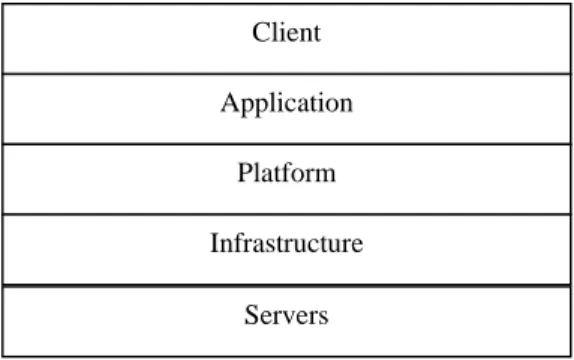
Cloud computing is a style of computing paradigm in which real-time scalable resources such as files, data, programs, hardware, and third party services can be accessible from a Web browser via the Internet. Fig.1 shows service model for cloud infrastructure.
Fig.1 Cloud infrastructure
The services in cloud computing is dynamically changed based on end user’s request. The requests from multiple users processed by the service provider through cloud according to QoS requirements. The end user concerns about response time and quality of service. Fig 2 shows various components of cloud computing.
A cloud client consists of computer hardware and computer software that relies on cloud computing for application delivery, or specifically designed for delivery of cloud services. It includes Internet explorer, Mozilla fire box, mobile, thin client, etc[2].
A cloud application influences cloud computing in software architecture, often eliminating the need to install and run the application on the customer's own computer. In turn, it minimizes the burden of software maintenance, ongoing operation, and support. It comprises web mail, face book, security as a service, software as a service, storage, etc.
Users
Clouds Service Providers
Node
A cloud platform delivers a computing platform, generally consuming cloud infrastructure and supporting cloud applications. It facilitates deployment of applications without cost and complexity of buying and managing the underlying hardware and software layers. It includes database, Google application engine, etc.
Cloud infrastructure is the delivery of computer infrastructure, typically a platform virtualization environment, as a service. It comprises virtual machines and network.
The server consists of computer hardware and computer software products that are specifically designed for the delivery of cloud services.
It utilizes all the services provided by the service providers’ on-demand basis and relinquishes the resources after the service is completed. It supports agility, reliability, scalability, security, maintainability and device and location dependency.
Clouds are classified into three types based on visibility. Resources are dynamically utilized on self service basis over Internet via web services are termed as external or public clouds. Data and processes are managed by an organization which uses public clouds for open access called internal or private clouds. Hybrid cloud comprises both public and private clouds.
Security and private issues are main concern in cloud computing. It must adopt the most sophisticated and up-to-date tools and procedure to provide better security and privacy. Next section deals about various services provided by cloud computing.
III SERVICES
Cloud computing provides various services in application, platform and infrastructure levels. Services can be split into three major categories. They are Infrastructure-as-a-Service (IaaS), Platform-as-a-Service (PaaS) and Software-as-a-Service (SaaS) [2].
1. Infrastructure-as-a-Service (IaaS):
Infrastructure-as-a-Service (IaaS) provides virtual servers with unique IP addresses and blocks of storage in on demand basis. Customers benefit from an API from which they can control their servers. Because customers can pay for exactly the
amount of service they use, like for electricity or water, this service is also called utility computing.
The components included in IaaS are platform virtualization, computer hardware, Internet, computer network, utility computing and service level agreements.
2. Platform-as-a-Service (PaaS):
It is a set of software and development tools hosted on the provider's servers. Developers can create applications using the provider's APIs. Google Apps is one of the most famous Platform-as-a-Service providers.
It provides services to develop, test, deploy, host and maintain applications in the same integrated development environment and support team collaboration development.
3. Software-as-a-Service (SaaS):
SaaS is the broadest market. In this case, the provider allows the customer to use its applications only. The software interacts with the user through a user interface. These applications can be anything from web based email to applications like Twitter or Last FM.
The services can able to reuse the fine grained software components across a network. It considers Everything as a Service (EaaS). The methods are used to develop cloud computing for a web service application will be described in next section.
IV DEVELOPMENT OF CLOUD COMPUTING In future, cloud computing plays significant role in all Internet based applications. To build efficient web based application cloud infrastructure should pursue the following steps [10].
1.Selection of technology
2.Determine application infrastructure 3.Prepare network infrastructure
4.Provide visibility and automation of management tasks
5.Integration
The developer should decide which technology will be perfectly suitable for their on-demand application infrastructure. They should also resolve application
Starts Development Clouds
Technology
Application Infrastructure
Network Infrastructure Automation
Integration
Fig. 3 Development steps for Clouds Client
Application Platform Infrastructure
Servers
infrastructure which is to be used to make efficient use of resources and ensure scalability. Other methods of load balancing/application delivery also are considered. It also provides visibility into application capacity, performance as well as resource management.
Subsequently select network infrastructure to deal with an on-demand application infrastructure. In addition it should provide visibility and automation of management tasks. Visibility is a key to an on-demand infrastructure. An associated management systems and the infrastructure must know what is running, when and where to evaluate available resources.
Finally integrate all the moving parts, such that the infrastructure and realizes the benefits of automation, abstraction and resource sharing.
The integration, automation of all the pieces of the infrastructure like storage, network, and application enables the infrastructure to act on-demand. The realization of cost-reduction benefits will be marginalized without automation [10].
The integration process automates workflow. Automation tasks monitor the application infrastructure from the network layer to the applications executing in the environment constantly.
The importance of virtualization and role of open source in cloud computing are described in next section.
V VIRTUALIZATION
Cloud computing uses virtualization for cost effective access of computing resources of connected network and those virtual machines need to be co-located on the same server [11]. A virtual machine is a software implementation of a computer that executes programs like a real machine. It is used to create a virtual environment, which is called as virtualization. Virtualization enables the user to access multiple operating systems at the same time and understand the infrastructure of a network through a process of aggregation. A virtual environment is used exclusively for applications and not for operating system kernels.
Virtualization is the primary step in cloud infrastructure. It is important to re-evaluate the suitability of each critical layer of the architecture for inclusion in the new infrastructure model. It provides a complete system platform that supports the execution of a complete operating system so that the user can operate software located on the computer platform.
The application is isolated from the computer being used with virtual machine software. This software can be used on various computer platforms. Hence it is possible to create separate versions of the same software for different computers and operating systems. JVM is a famous example of an application virtual machine. Virtual machine can be combined together to create a more powerful machine.
Open source software plays a vital role in cloud computing by allowing its basic software elements i.e.
virtual machine images and appliances, to be created from easily accessible components.
The importance of Open Source Software in Cloud Computing includes
Developers can create a database appliance by layering MySQL software onto an instance of the Open Solaris Operating System and performing customizations. These appliances enable cloud computing applications to be deployed, created and dynamically scaled on demand.
The components of open source can be used to assemble large applications generates more open source components very easily.
Cloud Computing saves money by effectively combining resources with other organization to evaluate.
Many open source software (OSS) projects are commoditized technologies because a group of talented developers are tired of paying for services that can be cloned easily.
Next section describes various security issues arises in cloud computing.
VI SECURITY ISSUES
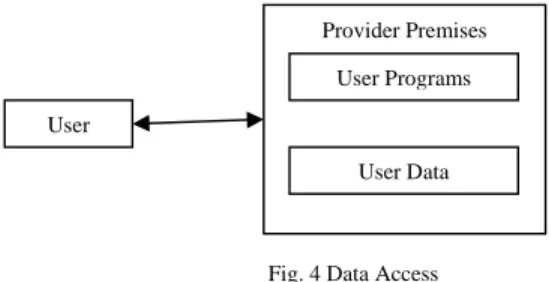
Security is one of the critical issue arises in cloud computing because both user data and programs are residing in provider premises. Fig 4 shows the skeleton of data access from cloud service provider.
Security must be provided at different levels of accessing i.e. server, database, Internet, program and privacy of the data. For example in cloud data storage, a user stores data through cloud service provider into a set of cloud servers, which are running in a simultaneous, cooperated and distributed manner. Data redundancy can be employed for fault tolerance. The user interacts with the cloud servers via cloud service providers to access or retrieve the data. In some cases, the user may need to perform the operations such as update, insert and delete on data. In addition, it supports confidentiality, integrity, availability and non- repudiation.
Security issue arises in cloud data storage because services provided by cloud service provider which may be self-interested, untrusted, possibly malicious and economically motivated adversary. The service provider has the capability to compromise a number of cloud data storage servers in different time
Provider Premises
User
User Programs
User Data
intervals and subsequently is able to modify or delete users’ data after certain period.
Specifically, weak adversary is interested in corrupting the user’s data files stored on individual servers. An adversary can pollute the original data files by modifying or introducing its own fraudulent data to prevent the original data from being retrieved by the user. The strong adversary is worst case scenario; in which adversary can compromise all the storage servers so that the user can intentionally modify the data files as long as they are internally consistent. In fact, this is equivalent to the case where all servers are colluding together to hide a data loss or corruption incident.
In order to achieve assurance of data storage correctness and data error localization, the concept of pre-computed verification tokens are used [1].
Secure communication between clients and service providers are obtained by the use of SSL protocol [2]. This exchange is needed to manage different virtual environments and it is implemented using the XMPP protocol [3]. Methodologies based on Virtual Private Network (VPN) [4], X.509 certificates [5] and SSL protocol are used to create secure communications between the machines on the physical business network and the enterprise virtual environment. It guarantees data confidentiality, authentication, message integrity and prevention of replay attacks.
Load balancing, interoperability and scalable storage are some other issues related to cloud computing.
Next section, deals about the several guidelines to develop educational cloud computing and its related issues.
VII EDUCATIONAL CLOUD COMPUTING Education is a self-enlightening process. It is an important component of life because it equips us with all that is needed to make our dreams come true. It fetches better prospects in career and growth. It is necessary to learn new things, such as the latest trends or some of the things from way back thousands of years ago. One of the best parts of education is that everyone can learn the basic things on how to handle situations such as family problems, how to answer to the assignments and how to face some of our fears. This is real life and it is not like a movie or a cartoon [12].
All the country spends huge amount for education from primary to higher education either directly or indirectly. Now a day, most of the communication takes place through Internet. Particularly, in today's society, Internet has become a very important learning tool. It is used for day- today activities, such as a place to look up research, a method of getting in touch with friends and family, and somewhere to go to find information about almost anything imaginable. The most popular uses of the Internet include entertainment and education. Many people argue that the internet should be used for educational purposes only. The internet is a very valuable resource when it comes to education, but it is not limited to that area.
The evolving demands of the global economy make education vital to sustainable social and economic success. Education is a fundamental human right and is the single most important investment in the future of individuals, communities, the nation, and the world.
Cloud computing is a correct choice for providing flexibility for all educational institutions. Based on the academic organization’s needs, the platform and applications in cloud computing may be on the institution campus, off campus, or a combination of both. It should provide effective infrastructure and deployment model for their dynamic demands.
The benefits of cloud computing can support education institutions to resolve some of the common challenges like reduction of cost and provide flexibility and accessibility.
In educational cloud computing, the developer should provide following services for effectiveness and enrichment of education.
Infrastructure as a Service: Educational institutions can utilize on-demand computing and storage to host, scale, and manage applications and services for entire organization or individual departments within it, globally or locally.
Platform as a Service: It consists of an operating system, a fully relational database, claims-based access controller which provides security-enhanced connectivity and federated access for on-premise applications. It provides on-demand scalability, and reduced time to market for educational applications.
Software as a Service: It provides collaboration and online communication between students and staff without any cost of the education institution. It should deliver security-enhanced, hosted communication and collaboration tools. It must help the institution to protect itself from spam and malware, encrypt data to preserve confidentiality, and maintain access to e-mail during and after emergency situations. Furthermore, it should help automate workflows and centralize information.
The advantages of cloud computing in various institutions as follows:
1. Low-Cost and Free Technology: There has been a huge growth in low-cost and free technology for social interaction, publishing, collaborating, editing, content creation, computing, etc.
2. Content Growth: The amount of content (art, expression, opinions, true and false information of all forms) is growing at an exponential rate, available to a broad audience, and anyone can contribute.
3. Collaboration: Technology is rapidly improving the ability to communicate and collaborate with others.
The aspects should be considered for developing education based cloud computing are working principles, significance of development, growth of the system and implications of the education, etc. Fig.5 shows one of the cloud computing in which the user can effectively share infrastructure, platform and services and resources.
Fig.5 Educational Cloud Computing
Moreover it should include Service Level Agreement to meet agreed terms related to server performance and availability. It ensures institution can receive web service requests, response time and availability. The some legal issues arises in cloud computing are privacy, confidentiality, transparency, publicity and warranty, etc.
Next section concludes this work. VIII CONCLUSION
In today's modern world, innovation of modern technologies is becoming inevitable to satisfy the customer's requirements. To overcome the business demands, the company has to keep an eye on worldwide collaboration, innovation and productivity. These are the essentials for a company to compete with other companies. Thus the concept cloud computing evolves. This paper investigates the infrastructure of cloud computing, their services. Security issues and virtual cloud computing are discussed. Cloud computing for educational institutions is developed. In future, service level agreements (SLA) can be considered in educational cloud computing.
REFERENCES
[1] Cong Wang, Qian Wang, Kui Ren , Wenjing Lou, 2009, “Ensuring Data Storage Security in Cloud Computing” in IEEE Computing.
[2] “OpenSSL Project - http://www.openssl.org/.” [3] “Xmpp - http://www.xmpp.org/rfcs/.”
[4] S. Khanvilkar and A. Khokhar, 2004 “Virtual Private Networks: an overview with performance evaluation,” Communications Magazine, IEEE, vol. 42, no. 10, pp. 146– 154.
[5] C. Adams and S. Farrell, 1999, “Internet X.509 Public Key Infrastructure: Certificate Management rotocols,” RFC 2510. [6] G Minutoli, M Fazio, M Paone and A Puliafito, 2009,
“Virtual business networks with Cloud Computing and Virtual Machines”, IEEE.
[7] Börje Ohlman, Anders Eriksson and René Rembarz, 2009, “What Networking of Information Can Do for Cloud Computing”, 18th IEEE International Workshops on Enabling Technologies: Infrastructures for Collaborative Enterprises
[8] Prasad B, Enumi C and Ian L, 2009, A taxonomy and survey of cloud computing systems, 5th
International Joint Conference on IMC, IMS and IDC.
[9] Voas J, Jia Z, “Cloud computing: New wine or just new bottle?” IEEE 2009.
[10] “Service Level Agreement and Master Service Agreement”, http://www.softlayer.com/sla.html, accessed on April 05, 2009.
[11] L. Wang et al., 1. “Scientific Cloud Computing: Early Definition and Experience,” Proc. 10th Int’l Conf. High-Performance Computing and Communications (HPCC 08), IEEE CS Press, 2008, pp. 825–830.
[12] Norman J. Dauerer, Edward E. Kelley,” Managing Data Security On The World Wide Web”, IEEE 1997.
[13] www.f5.com
[14] http://mylovetechnology.com
[15] http://www.buzzle.com/articles/why-is-education-so-important.html
[16] www.sentrigo.com [17] www.sunmicrosystems.com [18] www.microsoft.com
[19] www.cloudservices.microfocus.com
AUTHORS PROFILE
Ms. P.Shanthi Bala, Lecturer, Department of Computer Science, Pondicherry University, Puducherry, received her postgraduate and undergraduate from Pondicherry University, Pondicherry. Her research interests include Artificial intelligence, Ontology and Networks.