Breaches: Minimizing the
Enterprise Attack
Surface
A New Net Technologies Whitepaper
Mark Kedgley
CTO - New Net Technologies
©2014 new net technologies
www.nntws.com page 1
Abstract
When developing an information security strategy, prevention is still better than cure. Organizations get breached because they leave gaps in their defenses. Gaps that are subsequently exploited.
The aggregate of these vulnerabilities is referred to as the Enterprise Attack Surface. This whitepaper looks at how you can assess and measure your Enterprise Attack Surface and what you can do to minimize your exposure to cyber attacks.
If there was a security product that gave 100% protection, wouldn’t
we all be using it?
Instead the breaches just keep coming –
Target - 40 million payment cardholder details stolen and in total, personal information for more than 70 Million individuals has been stolen
The Australian Information Commissioner reports a 20% increase in reported personal information breaches
The discovery of the Windigo trojan and previously the Hand of Thief malware shows that there are now more occurrences of malware to non-Windows platforms For many, security defenses are falling well short of the effectiveness needed.
The Enterprise Attack Surface
Organizations get breached because they leave gaps in their defenses. Gaps that are subsequently exploited.
Protection is provided by layered, overlapping defence measures and operational procedures. Any gap leaves the enterprise with a Cyber Security Achilles Heel, a weak spot or vulnerability that an attacker can exploit. We call this the Enterprise Attack Surface.
“
”
What happened at Target?
In mid-December, we learned criminals forced their way into our system, gaining access to guest cred-it and debcred-it card informa-tion. The investigation has recently determined that certain guest information was taken. That included names, mailing addresses, email addresses or phone numbers. We have part-nered with a leading third-party forensics firm who is thoroughly investigating the breach
How many guests were affected by the addi-tional stolen informa-tion?
Up to 70 million individuals may be affected.
How many credit or debit cards were im-pacted?
Approximately 40 mil-lion credit and debit card accounts may have been impacted between Nov. 27 and Dec. 15, 2013
source: target.com Jan 2014
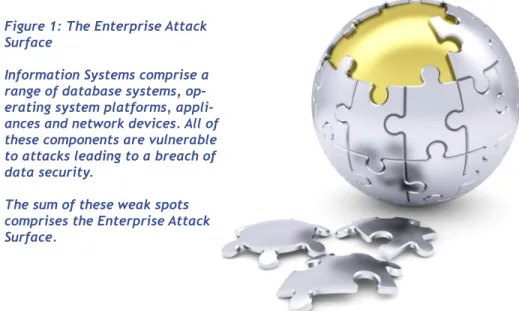
Figure 1: The Enterprise Attack Surface
Information Systems comprise a range of database systems, op-erating system platforms, appli-ances and network devices. All of these components are vulnerable to attacks leading to a breach of data security.
The sum of these weak spots comprises the Enterprise Attack Surface.
How prone is your organization to an attack?
How do you measure or assess this and, working on the basis that what you can’t measure, you can’t ever manage, this should be a priority Information Management metric.
There are a variety of options available but the most commonly used is the Vulner-ability Scanner. Tools like Qualys or Nessus provide an automated means to scan sys-tems, effectively logging onto each and every device then running through a security audit checklist.
The report generated provides a list of vulnerabilities that are present for the system and an overall percentage score, sometimes with a weighting factor applied based on an attributed severity for each vulnerability.
The concept behind this kind of Vulnerability Scanner is that it is providing a transient measure of security at that point in time. In one respect, with new software vulner-abilities being discovered every day, there is merit in assuming that yesterdays’ scan results are out of date and that you should always be starting with a fresh view. However, this philosophy and approach results in a poor solution when considering the broader requirements for both vulnerability and configuration management.
These are explored in the following section, with solutions outlined to deal with the issues highlighted.
“
”
‘
The Traditional
Vulnerability
Scanner approach
results in a poor
solution when
considering the
broader
require-ments for both
vulnerability and
configuration
man-agement’
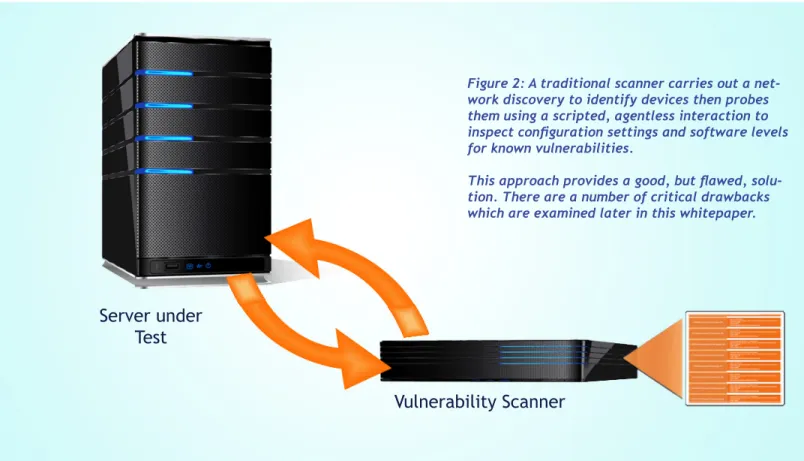
Figure 2: A traditional scanner carries out a net-work discovery to identify devices then probes them using a scripted, agentless interaction to inspect configuration settings and software levels for known vulnerabilities.
This approach provides a good, but flawed, solu-tion. There are a number of critical drawbacks which are examined later in this whitepaper.
Vulnerability Scanner
Server under
www.nntws.com page 3 Software Flaw and Configuration-based Vulnerabilities
Organizations such as NIST (see http://csrc.nist.gov/publications/nistir/ir7502/nistir-7502_CCSS.pdf)
define these in much detail in order to draw the distinction between ‘software flaw vulnerabilities’ and what they term as ‘security configuration issue vulnerabilities’. Software Flaw vulnerabilities are defects in a software component that inadvertently provide a potential exploit. When a Software Flaw Vulnerability is discovered, a patch or update is required to replace the flawed software component with a modified ver-sion to eliminate the security exploit.
By contrast, Security Configuration Issue Vulnerabilities present a very different chal-lenge. To give a simple example of a security configuration issue vulnerability, con-sider the use of a common setting on all platforms - maximum password age.
Who reading this welcomes being forced to change their password? It’s always hassle and there is the counter argument which says forcing users to change passwords more frequently may increase risk as users are more likely to be writing down passwords in order to remember them!
However, recent data thefts at eBay (see http://www.scmagazine.com/ebay-hacked-all-users-asked-to-change-passwords/article/347967/) and, indirectly at Target, could have been prevented
or their impact lessened through a more short-lived password age. Put simply, a more short-lived password has far less potential for damage than one that is valid for months.
Security versus Convenience, Ease of Use versus System Defenses Therein lies the security vulnerability associated with password age. The example neatly encapsulates the core issue of security configuration vulnerabilities and why they represent a bigger problem than software vulnerabilities.
Any manufacturer of a software product aims to provide something that is easy to use, quick to deliver results and requiring as little user intervention as possible.
All of which, of course, are in direct conflict with the objectives of maximizing system security. As a consequence, default security config-uration settings for any operating system, database system or network device are typically weak.
The situation is compounded further in that, by definition, default settings are known to everyone including would-be hackers, which further lessens the effectiveness of default security settings. For example, an SNMP community string default of ‘public’ is common knowledge, with the net effect that it provides no protection whatso-ever.
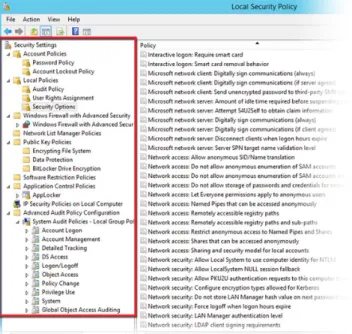
Now consider that a contemporary Windows platform has over 500 such settings spread across the Security Policy, the need for automa-tion of the auditing funcautoma-tion is essential in order to ensure vulner-abilities are kept at bay. A decent Vulnerability Scanner will highlight where vulnerabilities or deviation from compliance exist and usually provide advice for mitigating the vulnerability.
But if default settings typically leave a system prone to exploit, which settings should be used to provide the maximum level of security?
Figure 3: Windows Security and Audit Policy comprises hundreds of settings to mitigate vulnerabilities - but they must be configured correctly to be effective
Configuration Hardening Standards - Does a truly ‘authoritative’ source exist?
Naturally the manufacturer of the operating system, application, appliance or data-base system will typically provide security configuration best practice guidelines, for example the Microsoft Threat and Countermeasures Guide (see http://technet.microsoft. com/en-us/library/hh125921%28v=ws.10%29.aspx) is very comprehensive for 2008R2 and Win7, and similar resources can be found for other Windows versions and applications. Move outside of the Microsoft arena, and most mainstream manufacturers provide their equivalent guides, for example RedHat’s “Red Hat Enterprise Linux 6 Security Guide” (see https://access.redhat.com/site/documentation/en-US/Red_Hat_Enterprise_Linux/6/ pdf/Security_Guide/Red_Hat_Enterprise_Linux-6-Security_Guide-en-US.pdf). The problem is that there is not - naturally enough - any consistency between the various manufacturers’ content in terms of detail and presentation.
Alternatively, as mentioned in the previous section, NIST (National Institute of Stan-dards and Technology, the measurement stanStan-dards laboratory for the US) provides guidance in this area, with configuration checklists now provided via the National Vulnerability Database (see http://web.nvd.nist.gov/view/ncp/repository). However, while there is a good deal of content for a range of OS, applications and database systems, most of this is presented in SCAP format only, requiring an SCAP compatible scanner to access the content.
Therefore for many security professionals, the preferred source of material will be the Center For Internet Security, or CIS (see http://benchmarks.cisecurity.org/downloads/ benchmarks/).
The CIS Benchmarks repository provides consistently presented hardening checklists in both PDF and OVAL/SCAP formats.
The PDF Benchmarks provide detailed background on each hardened configuration setting recommended, the potential threat and the relevant commands required to both audit and remediate the vulnerability.
Best of all, the CIS Benchmark material has been developed on a definitive, consen-sus basis to combine Manufacturer best practice guidance with input from security researchers and academic institutions, creating the most comprehensive source of authoritative guidance available.
Note: NNT are one of a handful of CIS Certified Vendors, automating the auditing of systems for compliance with CIS Benchmark Checklist settings
CIS Benchmark material has been developed on a definitive, consensus basis to combine Manu-facturer best practice guidance with input from security research-ers and academic insti-tutions, creating the most comprehensive source of authoritative guidance available
“
www.nntws.com page 5 Vulnerability Scanner - A flawed solution?
Earlier on it was suggested that a Vulnerability Scanner provided a good, but flawed, solution when seeking to minimize the Enterprise Attack Surface. Here we explore what the issues are that render the Vulnerability Scanner an incomplete solution. 1. How secure is the Enterprise right now, and will it still be as secure in 24 hours time?
Returning to the ‘Security versus Convenience’ conflict from earlier, the challenge in running secure IT operations is that configuration settings can ‘drift’ over time. For example, an engineer needs to update the eCommerce Web Site to include some additional pages: Get prompted for UAC every step, or speed things up by disabling this feature? Use sudo for every command, or just enable remote logon for root? Con-nect via the jump server, or configure a local account for access? Enable the Installer Service and disable the firewall temporarily while the work is undertaken?
Whether it stems from time pressures to get a job done more quickly, from a process of elimination when troubleshooting, or through corner-cutting for convenience, se-curity settings may become weakened during normal operational activities. Of course, the next time the scheduled scan runs this increased Attack Surface will be identi-fied and addressed. However, up until that time, the Enterprise is left in a vulnerable state, more prone to exploits and security breaches.
The only way to address this issue is to schedule scans to be run more frequently.
2. The scan results show hardening measures are in place, but given that zero day malware, phishing attacks and insider threats may yet result in a breach, how do I protect systems against these attack vectors?
Bad news! Even with systems hardened in line with CIS Checklist settings, the enter-prise still can’t be guaranteed to be 100% secure. New exploits are revealed all the time and zero day malware will evade AV defenses, while phishing attacks or ‘inside man’ threats can bypass security measures by exploiting employees’ trusted-status. This is where the Vulnerability Scanner begins to look very one-dimensional in its contribution to minimizing the Enterprise attack surface. Given that threats go be-yond the exploitation of vulnerabilities, the need for a more comprehensive solution becomes apparent.
Figure 4: ‘Security versus Convenience’ - the more hardened and secure a system, the more difficult it becomes for legitimate, desirable maintenance to be performed.
Engineers are human - and may just cut corners to make life easier for themselves, while at the same time, increasing the Enterprise At-tack Surface...
Vulnerability Scanner - A flawed solution? contd.
The concept of providing a ‘Host Intrusion Detection’ function goes beyond the verification of compliance with a hardened build standard. Identification of malware requires a detailed inspection of files and the filesystem as a whole to provide vis-ibility of new or modified file. This extended remit increases the work required of the scanner by an exponential factor.
For this malware-detection function, we now need the scanner to analyze tens of thousands of files rather than the few hundred needed to verify compliance. Further-more, in order to detect Trojans masquerading as legitimate system files, the scan-ner needs a ‘DNA fingerprint’ of each file to be held. The security industry consensus is that the only way to achieve this is via a one-way cryptographic hash value being generated for each file.
3. How much does vulnerability and compliance management ‘cost’ in terms of Host Resources?
The previous two issues - the requirements for both a host intrusion detection func-tion and for frequent (ideally continuous) verificafunc-tion of compliance with a hardened build standard - both have implications in terms of resource requirements.
There is always a price for monitoring - the resource requirements when scanning a host depends on the scope and breadth of the analysis being performed. A typical compliance report will take a few minutes to complete per host but in a large enter-prise with hundreds or thousands of hosts, the aggregate resource usage in both host and network bandwidth terms quickly becomes significant, especially for geographi-cally remote sites.
However, if a wide scale file integrity check is factored in to serve as a host intrusion detection safeguard, the resource issue becomes considerably more acute.
Three issues come into play - the first is the sheer numbers of files involved. A typical scan of all system files on a contemporary Windows server will amount to at least 15,000 files by the time all driver files, executables and DLLs across the System 32, SysWOW64 and Program Files/Program Files (x86) folders. Just to inspect the files and their attributes, then compare to the previous baseline record of the filesystem immediately makes the scanner task an exponentially prolonged and more resource-intensive task.
The next problem is that there is a need to provide the filehashing capability, which means a ‘dissolvable’ agent has to be copied across the network to the host. The agent is called ‘dissolvable’ because it is a transient program/binary that is removed from the host once its work is done.
But the real issue arises once filehashes are being generated. Even a ‘basic’ SHA1 hash will require CPU muscle and, the more files there are and the bigger the file sizes involved will all go to magnify the hit on resources.
Now you are looking at scan workloads that require careful consideration. Run this type of scan on a busy, live system and you risk compromising performance and busi-ness services.
www.nntws.com page 6 Vulnerability Scanner - A flawed solution? contd.
3. How much does vulnerability and compliance management ‘cost’ in terms of Host Resources? contd.
Therefore scheduling scans to run out of hours is the only ‘safe’ option, and in a busy, 24/7 operation, even these scans should be spread as sparsely as possible.
Even if the agent is permanently deployed, such as in hybrid-SIEM systems that try and provide an element of file integrity monitoring, the periodic re-scan and re-hash of the filesystem will still need to be scheduled for ‘dark hours’ only.
For example, one enterprise grocery store chain is known to take a whole month to scan just 600 servers, before repeating the process again for the next month.
In other words, the resulting solution for compliance enforcement and host intrusion detection can only provide monthly alerts.
If you consider Target lost 40 million payment card numbers and personal information for 70 million customers in just over two weeks, monthly scans start to look like a toothless and ineffective measure.
But if real-time detection of breaches is now just as critical as ensuring preventative defenses are in place, how can the right balance be found between scan frequency and the required host/network resource costs?
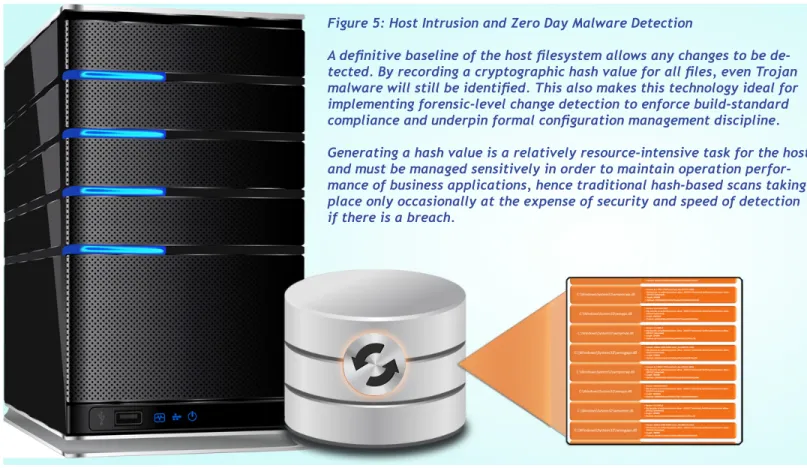
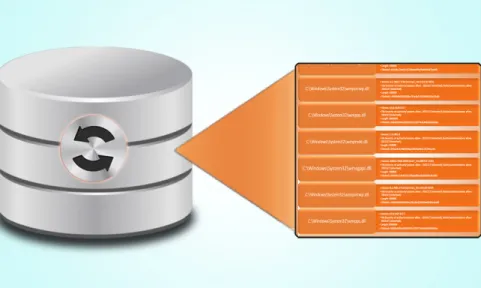
Figure 5: Host Intrusion and Zero Day Malware Detection
A definitive baseline of the host filesystem allows any changes to be de-tected. By recording a cryptographic hash value for all files, even Trojan malware will still be identified. This also makes this technology ideal for implementing forensic-level change detection to enforce build-standard compliance and underpin formal configuration management discipline. Generating a hash value is a relatively resource-intensive task for the host and must be managed sensitively in order to maintain operation perfor-mance of business applications, hence traditional hash-based scans taking place only occasionally at the expense of security and speed of detection if there is a breach.
Real-Time Detection: Continuous, Real-Time Protection
To summarize, the three key problems with external vulnerability scanners are:
1. Results are ‘in the moment’ only - vulnerabilities will not be detected until the next scan
2. Host Intrusion/ Malware Detection not provided by standard scanner solutions as this requires a Hash-Value signature for each file to be captured
3. Generating the Hash-value signature is a Host-resource intensive task, so must be used sparingly (see problem 1 again - malware can cause damage every minute it is in place so ‘time to detection’ is critical)
The ideal solution will therefore provide a real-time, continuous detection mecha-nism, but without generating the repeated resource loads that a traditional Tripwire-like agent or a SIEM/Scanner solution will.
Real-Time FIM Model
1. Run initial one-time baseline
There is no getting away from the need to use an agent if we are to use hash values which is, after all, the industry-standard for definitive file version identification. However, in the Real-Time FIM model, the baseline only needs to be run once, provid-ing a significant advantage over the traditional, repeated monthly re-scans.
2. Use real-time, triggered file change detection
Using a local agent on each host to provide the hash function isn’t new, whether it be a ‘dissolvable’ agent used by some scanners, or the permanently deployed variety like the traditional Tripwire agent or SIEM system like LogRhythm.
However, the real innovation is that, once the initial ‘fat’ baseline has been run, use a ‘file sniffer’ approach to ONLY subsequently gener-ate a hash value when a qualifying filechange is observed.
No file changes this week? No hash generation required! No wasted load on the host.
But, if new files suddenly appear on the host, or existing files are changed as with a Trojan, the ‘Continuous, Real-Time Protection’
solution will pounce and analyze these new/ changed files BUT NO OTHER FILES.
Instead of needing a complete re-baseline of the entire filesystem, we are now using laser-precision FIM techniques to minimize resourc-es to the bare minimum AND at the same time providing real-time detection of threats. Talk about a perfect solution!
Figure 6: Real-Time Continuous FIM provides the perfect solution for both enforcement of compliance and build-standards, and the fastest host intru-sion and malware detection capability in the event of a breach.
Conclusion - The NNT View
You don’t have to search too far to realize that the discovery of new vulner-abilities is a daily event. Cyber security breaches are also becoming more professional and more effective, with Target proving how damaging even a 2 week breach can be.
There are some key questions to ask yourself if you are responsible for man-aging secure systems handling personal identification information or payment cards/financial data:
How well protected are your systems? Has your Enterprise Attack Surface
been reduced to its absolute minimum?
How comprehensive and up to date is your implementation of a Hardened Build Standard? Remember, eBay were breached by having a weak password-ageing policy, allowing much more damage to be done than might otherwise have been the case
If there was a drift from this hardened build standard, how long would you be at risk before discovering the vulnerabilities?
And, if you did get breached, how long would it take you to realize this? As a result, how big would your losses be, both in direct financial terms and in terms of customer trust and competitiveness in your market?
NNT Change Tracker Enterprise - Real-Time, continuous FIM...and Certified by the Center for Internet Security
Change Tracker Enterprise has been certified by the CIS which means you can trust NNT to accurately deliver the most comprehensive, consensus-de-rived hardening checklists
NNT provide CIS Benchmark checklist coverage for all Windows, Unix and
Linux Operating Systems, SQL Server and Oracle Database Systems, and for Network Devices and appliances such as Cisco ASA firewalls
Compliance is continuously enforced meaning vulnerabilities are highlight-ed more quickly than with traditional vulnerability scanners
Better still, NNT Change Tracker Enterprise provides continuous real-time FIM across all system, application, driver and configuration files providing peace of mind that system integrity is being maintained
And if the worst case scenario does happen and your systems are breached or infected with malware, this will be detected within seconds, minimizing damage and costs
TO REQUEST A FREE TRIAL OR DISCUSS ANY AREA COVERED IN THIS WHITEPAPER, PLEASE CONTACT US AT [email protected]
About NNT
NNT Change Tracker Enterprise provides continuous protection against known and emerging cyber security threats in an easy to use solution. Unlike traditional scanning solutions, Change Tracker Enterprise uses automated File Integrity Monitor-ing agents to provide continuous real-time detection of vulner-abilities. And if the unthinkable happens, immediate notification when malware is introduced to your systems.
Operating at a forensic level within the IT infrastructure, Change Tracker works across all popular platforms such as:
Windows, all versions Linux, all versions, including Ubuntu, SUSE, CentOS, RedHat
Unix, all versions includ-ing Solaris, HPUX, AIX
VMWare, all versions including ESXi
Database Systems, includ-ing Oracle, SQL Server, DB2, PostgreSQL, My SQL
Network Devices and Appliances, all types and manufacturers, includ-ing routers, switches and firewalls, from Cisco, Nortel, Juniper and Checkpoint Securing your IT Estate against the Cyber Threats of today, NNT Change Tracker Enterprise helps you to prevent security breaches of your systems. Feature-rich, easy to use and affordable Change Tracker is a compre-hensive and powerful solution for validating, achieving and maintaining compliance with corporate governance or security standards.
www.nntws.com
©2014 New Net Technologies UK Office - Spectrum House, Dun-stable Road, Redbourn, AL3 7PR Tel: +44 8456 585 005 US Office - 928 Strada Place, Naples
Florida 34108 Tel: +1-888-898-0674