Volume 1, Issue 2, 2007
E-Class as a Step toward Solving e-Learning Problems: Analytical Study for the SQU Case Naeema H. Jabr, Associate Professor, Department of Library and Information Science, Sultan Qaboos
University, Oman, [email protected]
Sabah Abdul-Kareem Kallow, Assistant Professor, Department of Library and Information Science, Sultan Qaboos University, Oman, [email protected]
Mousa Al-Kindee, \assistant Orofessor, College of Education, Sultan Qaboos University, Oman,
Abstract
As e-learning is becoming a growing trend in today’s educational system, much attention has been given to its different practices, such as e-class and online courses. This is motivated by the need to increase the value of classroom exercises as a teaching tool by improving communication, understanding, and self-learning in order to increase the speed of information transfer, processing, and utilization.
Sultan Qaboos University (SQU) has utilized e-learning since September 2001 through the WebCT and Moodle, thus taking advantage of the many benefits of the new information and telecommunication technologies. Such an innovation has helped faculty to use WebCT as an aid to traditional class. This study, however, proposes that e-class is made an alternative application to the traditional class. The main purposes underlying this suggestion are: (a) to take advantage of the available expertise to teach either a larger number of students or several classes simultaneously, (b) to take advantage of the available demonstrators and technicians to help control classes and communications, (c) to disseminate electronic literacy, which is considered to be the main characteristic of the current era, as well as to make the interactive opportunities available to lecturers, demonstrators, and students, and (e) to participate in the international trends toward electronic learning. To achieve the above purposes, two different faculty and student questionnaires were developed. 297 students, 29 faculty members, and 3 technicians were selected as the main audience of the study. In most cases, around 60% of the students showed that the main shortcomings of e-learning come from the style appearance of faculty to provide better course quality. Reflections and attitudes average mean scores toward the effectiveness of e-learning and the organization of materials show no differences among science and social science respondents, the only significant differences being found between medical science and sciences respondents in terms of knowledge integration.
Keywords: e-class learning, e-learning, online course, Sultan Qaboos University, Introduction
Multimedia and web-enhanced learning has become increasingly attractive to universities, both for financial and technological reasons. Today, developing teaching and curriculum with technological facilities involves, in some way, introducing e-learning, as a part technology in order to assist both students and teachers. As a result, capturing classroom lectures for later access, following up new readings, and tracing discussions on current issues have become popular research topics with several different approaches and contributions. This may involve a lecturer in creating course websites, integrating online discussions or even bringing together computer-based resources to support a subject area. With e-learning come new issues and responsibilities that may be sensitive to how technology-based methods and materials are introduced and integrated into learning and teaching. Evaluation of the current applications can provide a framework for thinking about such matters and can help judge the required changes in practice which could be beneficial to developing e-class. In addition, evaluation offers a means to investigate, provide evidence, learn, share and make judgments about what we do and how we do it. For the university, evaluation is important in order to ensure the quality of academic practice as it plans and finances the program of WebCT to be side by side with traditional teaching and training. Education has traditionally consisted of a student or group of students receiving instruction from a teacher with everyone collected in one location. learning is changing the way instruction happens today. E-learning is the acquisition of knowledge and/or skills wherein time and/or space separates the learner and
provider. This occurs for the purpose of giving students and teachers more flexibility and options concerning when and how to study and teach. In general, the potential of web-enhanced learning has become increasingly attractive to universities, both for financial and technological reasons.
Basically, the success or failure of e-learning rests on the enthusiasm with which educational technologies are embraced by the faculty, administrators, and students. Alexander (1995) states that, computers would serve as patient tutors, scrupulous examiners and tireless schedulers of instruction. Furthermore, the benefits to students include the freedom to follow their own paths of learning, at their own pace. They will have immediate access to their lecturers, who can work individually with each student through the discussion board and e-mail. While Kulik, Kulik and Cohn (1980) emphasize that the previous studies of the 1960s and 1970s in this field, aimed at supporting the effectiveness of computer-based teaching as a supplement to conventional teaching.
Actually, converting face-to-face lecture offerings to electronic delivery formats is one of the greatest challenges facing faculty, administrators, and students at both the undergraduate and graduate level. In addressing this challenge, it is evident that there are many approaches to managing e-learning
development applying different formats and appeared in different names to handle the process of e-learning. With just a quick browsing through the internet, searching for the topic, one can find thousands of sites using the following terms: (date of browsing is: 5/12/2005)
- “e-Learning” (43,600,000site)
- “internet learning” (223,000site)
- “online learning” (13,700,000site)
- “Distance learning” (45,600,000site)
- “Web-based learning” (1,130,000site)
- “Virtual learning“ (1,690,000 site)
- “e-class” (1,950,000 site)
- “Virtual e-class” (36 site)
- “e-chalk“ (13,200 site)
- “e-courses” (309,000 site)
- “online courses” (37,600,000 site)
The search was repeated on 9/7/2006 (seven months later) and the results were:
- “e-learning” (142,000,000site)
- “internet learning” (376,000site)
- “online learning” (39,600,000site)
- “Distance learning” (96,600,000site)
- “Web-based learning” (1,820,000site)
- “Virtual learning“ (4,610,000 site)
- “e-class” (4,000,000 site)
- “Virtual e-class” (6 site)
- “e-chalk“ (18,100 site)
- “e-courses” (3,310,000 site)
- “online courses” (24,100,000 site)
In general, e-learning is a growing trend in today’s educational system and the terms “e-class” and “online courses” become more popular as if they are synonymous with e-learning. About two-thirds have the accredited four-year colleges and graduate schools in the United States complement their campus class-offerings with classes via the internet.(Perrin and Mayhew, 2000). As the number of universities and other institutions applying e-learning programs increase, the styles and methods being applied increase too. Currently, Henderson (2003) mentions three basic styles of e-learning, which are:
1- Synchronous Learning: means "real time" where a group of students meet with an instructor over the Internet. They are all online at the same time while they are communicating with each other. The instructor can interact with the students, and students can interact with other students. In other words, all students and the instructor are "there" at the same time. There are scheduled on-line meetings with other students and teachers, which can include live chats and videoconferencing. This requires collaboration and communication at agreed times, so it is much like the traditional classroom experience except the "there" is online instead of physically
together. The word synchronous, then, means "all at the same time" and refers to the "gathering of all the students at the same time". With this method, there are greater
opportunities for socialization, but reduced flexibility because 24-hour access is rarely possible since students could be in different places and different time zones around the world or students who could be busy with their day jobs while they are trying to take an e-course before or after work.
2- Self-Directed Learning Style: Means students act alone to work through the material step-by-step, that is, "teach yourself" type of education. Each module of such a style might have:
a. Text to read (the analog of reading a book) b. Recorded lectures to listen to
c. Self-check quizzes to take d. Simulation to practice
3- Asynchronous (collaboration) Learning Style: means that material posted to the program can be accessed at any time, twenty-four hours a day, seven days a week. This style blends the characteristics of the other two styles. A group of students meet with an instructor over the Internet and can communicate, but not necessarily online, at the same time. Students act alone to study material and interact by learning messages that are expected to be responded to within a matter of hours.
E-class, on the other hand, is an educational entity where its design depends on the use of information and telecommunication technologies for the purposes that make time and place lessof a factor. It achieves online communication between the teacher and his/her students in many classes at the same time.
Why E-class?
The increased use of interactive exercises such as e-learning and simulations as well as online training, is considered to be one of the most important developments in social, economics, and business pedagogy. In fact, computerization and telecommunication greatly increase the value of classroom exercises as a teaching tool by improving communications, understanding, and self-learning, and increasing the speed of information transfer, processing, and utilization.
From the learning point-of-view, if we assume that different students learn in different ways –some prefer reading, others learn by doing, some prefer visual contacts others face to face, and so on-then different tools are required. One useful benefit that e-learning offers is a framework and knowledge set of tools to place learning resources and to think in a pedagogical way about learning. Furthermore, since
computerization decreases the burden of running a class in terms of time constraints, complex exercises and the increased number of students within each group, instructors will be able to offer students significantly more time, more opportunities to view the lecture individually, and richer, realistic up-to-date exercises. Based on this, e-learning will offer the students and trainers substantially richer educational, practical, and vocational knowledge.
Actually, technology changes the way students think, what they learn, and how they interact with peers and instructors. In this respect, Perrin and Mayhew (2000) find that taking an online course is merely either a way to supplement their traditional learning experience or be as an alternative to the classroom setting. Whether taking online courses as supplements or alternatives, both are considered to be approaches with the following advantages (Mather, 1998):
- Bringing education from traditional class room to the living room of their houses where everyone in the family can participate.
- The flexibility of e-courses allows students to set their own hours at a pace which is comfortable for them
- Participants to e-learning can go as fast or slow as they wish
- E-learning allows students to have more control over their learning experience
In addition to the above advantages, Trinkle (1999) notes that some students who take online courses actually find that they are drawn into the subject matter more deeply than in traditional courses because of the online discussions.The role of the instructor within such an experience is changed. Pritchard (1998) indicates that the instructor in e-learning can play a vital role of serving both as a mentor and a
humanizer. As a mentor, the instructor acts as a resource, directing students to solutions by providing insight on where to go, who to contact, and how to solve problems in general. And drawing out personal commitment, participant interaction, and enthusiasm, the instructor is seen as a humanizer.
E-class began with the goal of producing a classroom environment in which electronic notes taken by students and teachers could be preserved and accessed later, augmented by audio and video recordings. E-class has since evolved into a collection of capture-enabled programs that attempt to preserve as much as possible of the lecture experience, with little or no human intervention. Generally speaking, the in-class experience to the instructor or students enrolled in a course taught using e-class is not significantly different from a typical classroom equipped with modern presentation equipment. While e-class will eliminate or alleviate the need for students to take notes, pen and paper cannot always adequately capture the richness of a modern classroom lecture while they are too busy writing everything down to pay attention. Hazemi and Hailes (2002) present the goals of e-class for faculty, students, and pedagogical practices as follows:
Faculty Goals
•
Empower Faculty by providing him/her with the most required software tools for use with electronic chalkboards.•
Allow professors to fully use the software tools with minimal effort and minimal change to their current routine.Student Goals
•
Empower students by providing them with the necessary software tools for use both during classes and study. (Although not required, we assume each student has a computer in the classroom. )•
Develop technology to support real time group interaction during classes: voting, consensus, group controlled throttle, etc.Pedagogical Goals
•
Develop technology to support better recording of group activity.•
Support long-term learning and not just memorization for regurgitation on an exam•
Facilitate:o
traditional lectures: electronic blackboards and notebooks,o
student questions and discussion: the student has the ability to use private display to drive group display,o
small group interactions: students can share displays, ando
individual work: students can do back-of-the-envelope calculations using spread sheets during lectures or discussions mean to explore points.Specifically, and for the purpose of the current study, advancement in telecommunication technologies have created opportunities for solving many of the teaching and learning problems, among them, those related to the availability of qualified faculty members, classes timetable, the increasing number of students, etc. Therefore, this study is considered to be a response to many such problems, including:
1- The increased needs for higher education as a consequence of the increasing number of those who completed high school, versus the limited number of the already accepted ones;
2- SQU has already developed its educational environment and integrated it with the use of technologies that could provide quick access to knowledge and achieve the project of e-class; 3- The problem of the insufficiency of qualified staff, especially in specialized fields of knowledge, in
light of the increase in the enrollment of student;
4- The problem of class timetable arrangements that could be balanced between the factors related to the increased number of students and limited number of lecturers, and the pressure of time
The Purpose of the Study:
Based on the above problems, the project of e-class could be considered as a step toward solving these problems since it leads to:
1- Taking advantage of the available expertise to teach a larger number of students or several classes simultaneously
2- Taking advantage of the available demonstrators and technicians to help control classes and communications
3- Disseminating electronic literacy which is considered to be the main characteristic of the current era, and to make interactive opportunities available among lecturers, demonstrators, and students
4- Achieving cost effectiveness for both the university and the society 5- Participating in the international trends toward electronic learning
6- Adding more flexibility to the academic and routine works to expand the educational process beyond the limited time, lecturers, and traditional classroom experience.
7-Statement of the Problem:
In general, besides the advantages mentioned above, Russell (2001) reports several unfortunate consequences of e-learning in relation to what he call "virtual schooling", including:
•
Students will not develop a deep understanding of their own emotions, or that of others. Without the full bandwidth of face-to-face interaction, understanding of reactions can be reduced.•
The opportunity to form patterns of life-long friendship, which will be reduced. Children oftenmeet others at school who remain important to them for many years.
•
By emphasizing the cognitive domain at the expense of the affective, understanding is reduced. It is much easier to teach facts with the use of a computer than to make people wise.•
As the face-to-face component of subjects is reduced, the school subjects themselves will change, and become less rich. The teaching method will affect the content.•
Differences in learning styles will mean that some students may learn less effectively than before. Conventional schools do not suit everybody, and it would be very surprising if virtual schools would be satisfactory for everyone.•
Virtual schools may be promoted due to the self-interest of the economist, bureaucrat, or on-line entrepreneur, rather than on the evidence of educational research or merit.•
Resentment by those who are unhappy with the virtual approach can lead to disruption. Just as some students disrupt their classes because they dislike conventional schools, it is likely that some virtual students will make life difficult for their parents or for the community where they study.•
The long-term effect on the relationships of future adults and their society is unknown. It is a possibility that poor socialization will lead to problems in the years ahead.Tracing these disadvantages through the evaluation of the current applications of WebCT at SQU becomes a critical issue. Although the university invests a large amount of its budget on supporting online and e-learning activities, little efforts have been made to evaluate the experience. Thus, our research question and the hypotheses below are tested to evaluate the current practice in order to justify the decision toward applying e-class as an alternative practice. The research questions and the
hypotheses below are divided into two parts, one related to students’ evaluation and the second to faculty evaluation, as follows:
Students Part:
1- Can we consider the e-class as an alternative that may solve the shortages and disadvantages of e-Learning practices?
Answering the question below requires insight into the available applications (WebCT), and this is the main concern of the study.
2- Are there significant differences in the means scores of three factors (effectiveness, organization and clarity, and knowledge integration) among groups of different colleges?
3- Are there significant differences in the means scores of the three factors among the two groups of the science and social science colleges ?
Faculty Part:
The purpose of this part of the questionnaire is: 1- To identify:
The faculty members’ level of technological skills from their point of view
Approaches that they depend upon to develop their technological skills
The main characteristics which shape their use and participation in developing their courses with the use of WebCT
2- To find out their use and application of the WebCT tools, including:
The content tools
The communication tools
The assessment tools
The study tools.3- To evaluate the faculty respondent's attitudes toward the use of the WebCT as:
Teaching aid.
Class management.
A tool for assessment.4- In addition to the above, the study is intended to test the following hypothesis:
Are there significant differences between the two groups (Sciences and Social Sciences) in their level scores of their attitudes toward the WebCT as:
A teaching aid
Class management
A tool for assessment. Justification of the Study
Measuring e-learning experiences and standards at any organization can offer insight into new approaches or provide an opportunity to self-evaluate approaches. If we define the features of most forms of distance education in the way that learners and teachers are not within eyesight of each other, e-class, can then bridge this gap by offering such an opportunity. It is supposed to be a course management system that enables the efficient delivery of high quality online education. For administrators, evaluation will serve as a means in future planning of investment in technology and human resources’ development. For students, e-class permits access to materials to foster interactivity among them and between them and their teachers. It is important to remember that with e-class a human guide is made available in the form of a faculty member, or instructor who leads the student group directly toward a learning goal.
The overall aim of the evaluation, however, is to ensure that the e-learning practice and its basic outcomes are of clear benefit to the SQU community and is perceived as good value for money. This will lead us to the decision of whether or not a new development of electronic practice that enhances education and a means to integrate it into everyday use of technology in learning is required. The main point here is that e-class will carry the advantages of both e-learning and traditional learning that places emphasize on face to face communication.
The objectives of the study can then be abstracted from the advantages of e-Class theme to ensure that: 1. Solving the problem of miss-communication between lecturer and student in announcing an important
2. The entire body of students can access the ‘lecturer note and tutorial’ after a class has been finished at any time.
3. The entire body of students can be involved in the classes’ activities, like topic discussion, at any time without attending the class
4. The student can access previous questions in a way of practice before exams.
5. The learning process can be more interesting when it combines the animation, graphic or video component in learning.
Research Instruments and Data Collection
Input from faculty members, students, and administrators or technicians will serve as feedback for studying the current situation in terms of planning for the future; moreover, descriptive and analytical methods will be applied in studying the previous projects regarding the subject of electronic class and electronic learning. However, the questionnaire is considered as the main quantitative measurement in collecting the input data. It is also to be used as a measure of the general qualitative reaction to e-learning in general and to the acceptable features of the e-class they consider to be supportive to their learning. Based on this, we have administered two different faculty and students’ questionnaires, each of which was designed to cover several factors that can be tested to answer the researchable questions. Interviews with three technicians from the Center of Educational Technology –CET were also conducted to collect historical and technical information.
Population and Sampling
The main target audience for outputs of the study is:
•
Students registered in courses offered making use of WebCT. The use of student feedback is a key component in evaluating the current application in the teaching process. Consequently, engaging with them as the main end-users of any new e-learning approaches is very critical to future development;•
Faculty members applying WebCT in their courses to extract lessons learned and to improve on practice;•
The technical teams at the Center for Educational Technology in order to satisfy monitoring requirements and accountability.The interviewer distributed questionnaires to all students registered in one of the available courses during the Fall Semester 2005; and data was collected from the (297) responses, as follows (table 1)
Colleges Frequency Percent Valid Percent Cumulative Percent
Valid Agriculture 8 2.7 2.7 2.7
Arts & Social Sciences 120 40.4 40.4 43.1
Science 6 2.0 2.0 45.1 Education 49 16.5 16.5 61.6 Engineering 89 30.0 30.0 91.6 Medicine 8 2.7 2.7 94.3 Language Center 9 3.0 3.0 97.3 Commerce 8 2.7 2.7 100.0 Total 297 100.0 100.0
In the same semester of the study, questionnaires were also sent by mail to all faculty members using WebCT in their courses. Twenty-nine responses were collected. Table 2 shows the distribution of faculty among colleges.
Missing
Respondents Percentage Valid
Percentage Colleges 1 30 96.8 Agriculture 9.73 10 Arts & S. S 19.46 20 Science 6.52 6.7 Education 12.94 13.3 Engineering 6.52 6.7
Medic & Health Sciences 19.46 20
Language Center 16.15 16.7
Others 6.52 6.7
In addition to the questionnaires, an interview was conducted with three technical members at CET to collect facts about the statistical and historical data that support the background, the statistical analysis, and the distribution of the questionnaire.
Review of SQU E-Learning Practices:
There has been considerable work on the general theme of e-learning, but there are few notable studies about the evaluation of the e-class experiences. The majority of what is available provides either qualitative or quantitative assessment of access behaviors. Few studies have been traced and most are concerned with the use of automated capture and access in the college classroom.( Brotherton, 2001). Researchers at Microsoft Research have reported on a number of controlled studies exploring
summarization and skimming techniques and the impact on rapid browsing of the multimedia streams that capture and access systems which promise to deliver [Bargeron 1998, He 1999, and Li 2000]. According to SQU practices, it has been found that SQU started applying e- learning in September 2001 with the participation in the WebCT project . The experience, however, began with only 8 courses offered by colleges and centers such as Education, Medicine, Science, and the Language Center. Almost 1200 students were involved in the practice.
The aim of e-learning, then, is to manage the courses and to provide an effective learning environment that:
•
Facilitates the dissemination of e-learning literacy among the SQU society•
Serves the learning process by providing the required information about the course for both faculty and students•
Encourages the communication skills among the students and their lecturer•
Provides links to more reading and other related cites in order to have direct access to up-to-date literature and information.The responsibility of managing e-learning practices lies with the Center of Educational Technology (CET). Another step toward the e-learning practices is the use of the Moodle Program as a tool for e-learning in both languages (English and Arabic). Several workshops and training programs as well as on-work consultations have been offered to faculty, technicians, and students. The main reason for such activities are: to help faculty in the design and management of their courses, and to help students in registering and following the proper and appropriate steps while accessing the online registered courses by providing online help and guidance and by offering direct consultation by telephone or personal visits.
Data Analysis and Discussions
As we distributed two different questionnaires, this part analyzes the responses and discusses the output within the two separate groups, i.e. students and faculty.
For students, three research questions were submitted, the first to find out the students’ response to e-class as an alternative for solving problems facing them while practicing e-learning courses; the second attempted to determine if there would be differences in their attitudes toward three factors affecting their use based on the college’s background; and the last question was used to find out the differences in the three factors’ mean scores as related to the two different disciplines, science and social sciences.
A- To answer the first research question, the researchers attempted to find the main factors affecting the success of the use of WebCT in order to discover the shortages or the disadvantages of the two systems, so that they might judge whether or not e-class can be an alternative. The three factors are: effectiveness of e-learning practices, organization and clarity of e-learning practices, and knowledge integration. 1- Effectiveness of e-learning covers five statements to measure the degree of agreement from the
students’ point of view. Table 3 below shows that only 49% of all the responses of students agree about the effectiveness of using WebCT in supporting their course. Although 63% of the students agree that teachers applied available technology effectively, only 35% of them agree that the appearance style of their teachers stimulates their interests in the topics. In addition to this, 43% of them had sufficient time to understand the content or clarify difficulties through the use of WebCT. This is clearly related to faculty’s limited time as compared to the large number of students participating in the exercise. Moreover, online courses were generally viewed as being supportive and not alternatives to traditional ones. Such limitations and duplications added more obligation and more commitments to both faculty and students.
Effectiveness of e-learning practices
Evaluation Statements Agree # and (%) Disagree # and (%) In Between # and (%) The teacher applied available technology effectively
as an aid to teaching 188 (63%) 32 (11%) 77 (26%)
The educational technology was effectively used to help creating friendly supportive learning environment
153 (51%) 53 (18%) 91 (31%) There was generally sufficient time to understand
content, clarify difficulties, and satisfy course requirements
128 (43%) 92 (31%) 77 (26%) The appearance style of the teacher(s) stimulates my
interest in the topic
104 (35%) 72 (24%) 121 (41%) E-learning style provides better opportunities for me
to contribute from my own understanding 151 (51%) 59 (20%) 87 (29%) Percentage from the total of despondences (297* 5
questions = 1485) 724 (49%) 308 (21%) 453 (30%)
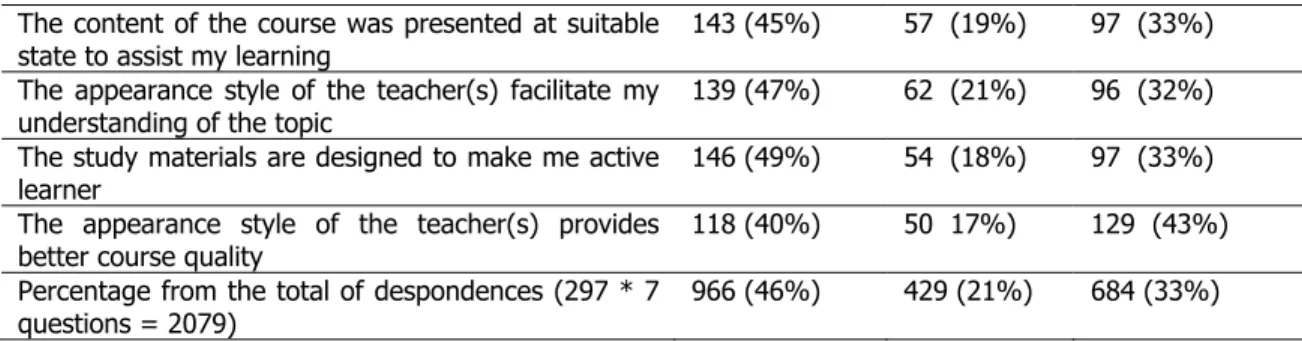
2- Organization and Clarity of e-learning practices include seven statements to measure the degree of agreement towards using WebCT or Moodle as being supportive practices. Table 4 shows that around 46% of the students find what they got from the systems being clear and organized. Moreover, only 40% of them show that the appearance style of the teacher(s) provides better course quality.
Organization & clarity of e-learning practices
Evaluation Statements
Agree
# and % Disagree # and % In Between # and % The materials were organized to facilitate maximum
learning 148 (50%) 63 (21%) 86 (29%)
The aims and objectives of the courses were made clear to me at the beginning of the semester
147 (50%) 69 (23%) 81 (27%) Relationships between the lectures of the course
The content of the course was presented at suitable
state to assist my learning 143 (45%) 57 (19%) 97 (33%) The appearance style of the teacher(s) facilitate my
understanding of the topic 139 (47%) 62 (21%) 96 (32%) The study materials are designed to make me active
learner
146 (49%) 54 (18%) 97 (33%) The appearance style of the teacher(s) provides
better course quality 118 (40%) 50 17%) 129 (43%)
Percentage from the total of despondences (297 * 7
questions = 2079) 966 (46%) 429 (21%) 684 (33%)
3- Knowledge integration: This contains three statements to test the students’ degree of agreement toward their point of view regarding the knowledge integration of the available information to their traditional courses. In general only (52%) of them agree that the knowledge they got integrated with the course’s requirements, while only 48% of them show that e-learning style provides ways that accommodate the differences in student personal levels. For more details, Table 5 shows the results within each statement.
Knowledge integration
Evaluation Statements
Agree
# and % Disagree # and % In Between # and % The educational technology was well integrated to
teaching of the course(s0
162 (54%) 62 (21%) 73 (25%) From the beginning of the semester, the course
provided me with a good introduction of the course subject
162 (54%) 58 (20%) 77 (26%) E-learning style provides ways that accommodate
the differences in student personal levels
143 (48%) 54 (18%) 100 (34%) Percentage from the total of despondences (297 *
3 questions =891) 467 (52%) 174 (20%) 250 (28%)
B- To answer the second research question,namely whether there are significant differences in the degree of the students’ agreement toward the three factors (effectiveness, organization and clarity of online courses, and the knowledge integration) among different colleges, the One-way ANOVA test was applied for different aims:
1- First, One-way ANOVA was applied to test the differences in the effectiveness’ mean scores among groups of different colleges. Table -6- shows that the significant value is 0.733 which s larger than 0.05. This means we reject the hypothesis that says there are significant differences among groups and accept the null hypothesis that emphasize the similarity in the respondents reflections towards the effectiveness of online courses and the use of WebCT in learning .
ANOVA EFFECTIV 24.601 7 3.514 .628 .733 1617.123 289 5.596 1641.724 296 Between Groups Within Groups Total Sum of
Squares df Mean Square F Sig.
2- Second, the One-way ANOVA was used to test the differences in the mean scores of the students’ attitudes towards the organization and clarity of online courses among groups of different colleges. Table -7- shows that the significant value is 0.337, which is larger than 0.05. This means we reject the hypothesis that says there are significant differences among groups and accept the null
hypothesis that emphasizes the similarity in the respondents’ attitudes towards the organization and clarity of online courses and the use of WebCT in learning.
ANOVA ORGANIZ 81.722 7 11.675 1.141 .337 2956.521 289 10.230 3038.242 296 Between Groups Within Groups Total Sum of
Squares df Mean Square F Sig.
3- Third, the One-way ANOVA was also used to test the differences in the mean scores of the students’ attitudes towards the knowledge integration of online courses among groups of different colleges. Table -8- shows that significant value is 0.029, which is smaller than 0.05. This means we accept the hypothesis that there are significant differences among different groups and reject the null hypothesis that emphasize the similarity in the respondents attitudes towards the knowledge integration of online courses and the use of WebCT in learning .
ANOVA KNOWLG 44.459 7 6.351 2.266 .029 809.992 289 2.803 854.451 296 Between Groups Within Groups Total Sum of
Squares df Mean Square F Sig.
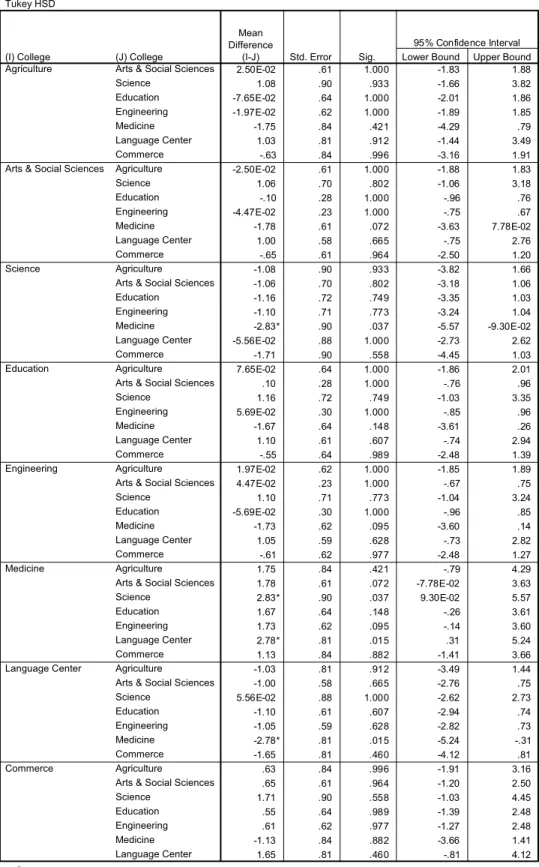
To find out the size of differences among groups of different colleges, a post hoc test was applied and the results show the differences between the college of Medicine and the College of Science and the
Language Center. No significant differences were appeared among the respondents of other colleges. More details appear in Table (9).
Table -9- Multiple Comparisons Dependent Variable: KNOWLG
Tukey HSD 2.50E-02 .61 1.000 -1.83 1.88 1.08 .90 .933 -1.66 3.82 -7.65E-02 .64 1.000 -2.01 1.86 -1.97E-02 .62 1.000 -1.89 1.85 -1.75 .84 .421 -4.29 .79 1.03 .81 .912 -1.44 3.49 -.63 .84 .996 -3.16 1.91 -2.50E-02 .61 1.000 -1.88 1.83 1.06 .70 .802 -1.06 3.18 -.10 .28 1.000 -.96 .76 -4.47E-02 .23 1.000 -.75 .67 -1.78 .61 .072 -3.63 7.78E-02 1.00 .58 .665 -.75 2.76 -.65 .61 .964 -2.50 1.20 -1.08 .90 .933 -3.82 1.66 -1.06 .70 .802 -3.18 1.06 -1.16 .72 .749 -3.35 1.03 -1.10 .71 .773 -3.24 1.04 -2.83* .90 .037 -5.57 -9.30E-02 -5.56E-02 .88 1.000 -2.73 2.62 -1.71 .90 .558 -4.45 1.03 7.65E-02 .64 1.000 -1.86 2.01 .10 .28 1.000 -.76 .96 1.16 .72 .749 -1.03 3.35 5.69E-02 .30 1.000 -.85 .96 -1.67 .64 .148 -3.61 .26 1.10 .61 .607 -.74 2.94 -.55 .64 .989 -2.48 1.39 1.97E-02 .62 1.000 -1.85 1.89 4.47E-02 .23 1.000 -.67 .75 1.10 .71 .773 -1.04 3.24 -5.69E-02 .30 1.000 -.96 .85 -1.73 .62 .095 -3.60 .14 1.05 .59 .628 -.73 2.82 -.61 .62 .977 -2.48 1.27 1.75 .84 .421 -.79 4.29 1.78 .61 .072 -7.78E-02 3.63 2.83* .90 .037 9.30E-02 5.57 1.67 .64 .148 -.26 3.61 1.73 .62 .095 -.14 3.60 2.78* .81 .015 .31 5.24 1.13 .84 .882 -1.41 3.66 -1.03 .81 .912 -3.49 1.44 -1.00 .58 .665 -2.76 .75 5.56E-02 .88 1.000 -2.62 2.73 -1.10 .61 .607 -2.94 .74 -1.05 .59 .628 -2.82 .73 -2.78* .81 .015 -5.24 -.31 -1.65 .81 .460 -4.12 .81 .63 .84 .996 -1.91 3.16 .65 .61 .964 -1.20 2.50 1.71 .90 .558 -1.03 4.45 .55 .64 .989 -1.39 2.48 .61 .62 .977 -1.27 2.48 -1.13 .84 .882 -3.66 1.41 1.65 .81 .460 -.81 4.12 (J) College
Arts & Social Sciences Science Education Engineering Medicine Language Center Commerce Agriculture Science Education Engineering Medicine Language Center Commerce Agriculture
Arts & Social Sciences Education Engineering Medicine Language Center Commerce Agriculture
Arts & Social Sciences Science Engineering Medicine Language Center Commerce Agriculture
Arts & Social Sciences Science Education Medicine Language Center Commerce Agriculture
Arts & Social Sciences Science Education Engineering Language Center Commerce Agriculture
Arts & Social Sciences Science Education Engineering Medicine Commerce Agriculture
Arts & Social Sciences Science Education Engineering Medicine Language Center (I) College Agriculture
Arts & Social Sciences
Science Education Engineering Medicine Language Center Commerce Mean Difference
(I-J) Std. Error Sig. Lower Bound Upper Bound 95% Confidence Interval
The mean difference is significant at the .05 level. *.
C- to answer the third research question, If there are significant differences in the mean scores of the three factors among the two groups of colleges: Science and Social Science; a T-test was conducted after grouping the colleges as Science and Social Sciences as following:
Sciences: (Group 1) • Agriculture 08 • Science 06 • Engineering 18 • Medicine 08 Total 40
Social Sciences: (Group 2) • Arts and Social Sciences 08
• Education 49
• Language Center 09
• Commerce 08
Total 74
Tables (10, 11, 12) show the significant values of each factor as following:
1- Sig. value= 0.626 for the effectiveness which is larger than (0.05) thus we reject the hypothesis and accept the null hypothesis that emphasizes the similarity in the respondents reflections towards the effectiveness of the online courses between sciences and social sciences.
Independent Samples Test
5.098 .026 -.489 112 .626 -.23 .46 -1.15 .69 -.442 60.450 .660 -.23 .51 -1.25 .80 Equal variances assumed Equal variances not assumed EFFECTIV F Sig.
Levene's Test for Equality of Variances
t df Sig. (2-tailed) Mean Difference
Std. Error
Difference Lower Upper 95% Confidence
Interval of the Difference t-test for Equality of Means
2- Sig. value=0.207 for the organization and clarity of online courses which means that there are no significant differences among the two groups.
Independent Samples Test
20.324 .000 -1.269 112 .207 -.79 .62 -2.02 .44 -1.093 53.669 .279 -.79 .72 -2.24 .66 Equal variances assumed Equal variances not assumed ORGANIZ F Sig.
Levene's Test for Equality of Variances
t df Sig. (2-tailed) DifferenceMean DifferenceStd. Error Lower Upper 95% Confidence
Interval of the Difference t-test for Equality of Means
3- Sig. value= 0.990 for the knowledge integration of online courses which means that there are no significant differences among the two groups.
Independent Samples Test between Sciences and Humanities 3.151 .079 .013 112 .990 4.73E-03 .37 -.72 .73 .012 66.627 .990 4.73E-03 .39 -.77 .78 Equal variances assumed Equal variances not assumed KNOWINT F Sig.
Levene's Test for Equality of Variances
t df Sig. (2-tailed)
Mean Difference
Std. Error
Difference Lower Upper 95% Confidence
Interval of the Difference t-test for Equality of Means
In summary, both groups of students (sciences or social science) have no significant differences in their attitudes toward the three factors related to the effectiveness, clarity and organization, and knowledge integration of their online courses
Second: Faculty Responses
A sample of 30 faculty members was selected from the list of those who have already applied WebCT to their courses. One of the respondents’ questionnaires was avoided because of the incomplete data. The main characteristics of the faculty sample are listed in table -13-. The data presented in the table show that around 76% of the respondents are male and only 24% of them are female. This percentage however reflects the infrastructure of the faculty at SQU where the male group is larger than female group.
Variables Missing Respondents Percentage Valid
Percentage Gender 2 29 93.5 Male 7122 75.9 Female 22.67 24.1 College 1 30 96.8 Agriculture 9.73 10 Arts & S. S 19.46 20 Science 6.52 6.7 Education 12.94 13.3 Engineering 6.52 6.7 Medic & HS 19.46 20 Language Center 16.15 16.7 Others 6.52 6.7 Degree 2 29 93.5 MS 38.712 41.4 PhD 48.415 51.7 Others 6.52 6.9
In this part, however, we will analyze the collected data from the 29 respondents to answer the three research questions and to test the hypothesis as well.
Question 1: To identify:
a- The level of the faculty’s’ technological skills from their point of view :
e-29) , and the Microsoft Office (14 out of e-29), others had fair to good skills. As noticed from the data in table -14-, only 4 respondents had no skills to use the whiteboard facility of the WebCT and the other 14 had either fair or good skills.
Technological Skills
Statements Fair Good Excellent No skills
Computer Presentations 3 179 Internet/ Web 121 16 e-mail 1 243 1 Video Conferencing 16 8 4 1 Whiteboard 6 118 4 Microsoft Office 123 14 Statistical Analysis 1012 4 3
b- Approaches faculty members depended upon to develop their technological skills. 89% of the faculty depended primarily upon themselves while 58% participated in workshops or asked for help and consultancy from friends. Table 15 shows the number and percentage (from 29 respondents) for each approach.
Approaches being depended upon to develop technological skills Approaches
Number Percentage
Workshops 17 58.6
Formal training programs 17.25
Online training 17.25
Self development 89.726
Consultants (friends, help tools, … 58.617
Others 29 100
c- The main characteristics that shape their use of the WebCT:
As it appears in table 16, 52% of the respondents used the WebCT for almost 1-2 years while only 1 person use it for 3-4 years and 6 for more than (4)years.
13 of the 29 were involved only with one course whereas 9 used the WebCT for more than 3 courses.
These courses are developed by 12 members themselves and 9 of them used different ways to develop their courses including the help tools, consultants from friends and assistance from colleges.
The language they depended on for their online courses was mostly English, 70%. Only 2 of them applied the Arabic, while the rest, 6 respondents, used both languages, English and Arabic. The data included within their online courses are: text 15% or text and pictures 58;, only 27% use text, pictures, video, and audio.
Usage of e-learning at SQU
Length of involvement with WebCT PercentageNumber
• Less than one year 247
• 1-2 years 5215
• 3-4 years 031
• More than 4 years 216
Number of courses applying WebCT
• 1 course 4113
• 2 courses 103
• 3 courses 103
• 4 More than 3 courses 299
Course development participations
• Self developer 4412
• Help from e-learning consultants at SQU 0000
• Using help tools of WebCT 0401
• Assistance from colleagues and friends 1905
• All 3309
Languages of online courses
• English 19 70
• Arabic 2 07
• Both 6 22
Type of data presented within online courses
• Text 4 15
• Video
• Audio
• Pictures
• Text and Pictures 5815
• All 07 27
Question 2: To find out faculty’ use and application of the WebCT tools including:
Descriptive statistical analysis was applied to find out the faculty’s level of using the basic WebCT tools, including:
The content tools.
The communication tools.
The assessment tools.
The study tools.Based on that, faculty members were required to check their level of use (Regular, often, Seldom, Never) against the statements related to the above tools.
According to the content tools, the results show that 22 of them use the content module and (19) of them use the syllabus tool. Contrary to that 19 members either seldom or never use the image design or the CD-ROM tools and 18 of them seldom or never use the index or the compile tools.
For the communication tools, on the other hand 21 of them often or regularly use the e-mail as a communication tool, but 22 of them seldom or never use the whiteboard and 21 seldom or never use the chat.
According to the study tools, most of the tools were reportedly seldom or never used, such as Student Tips (20), Student Homepage (18), Language (16), and only 10 of the respondents often or regularly used my Progress Tool. See Table (17) for more details.
Use of WebCT Tools
Tools Never
(Parentage) (Parentage) Seldom (Parentage Often (Parentage) )Regular 1- Course Content Tools
• Content module 2 (7%) 4 (14%) 9 (32%) 13 (47%) • Syllabus 3 (11%) 4 (15%) 9 (35%) 10 (39%) • Glossary 7 (27%) 11 (42%) 5 (19%) 3 (12%) • Search 8 (33%) 6 (25%) 6 (25%) 4 (17%) • Image design 15 (63%) 4 (17%) 2 (8%) 3 (12%) • Calendar 2 (8%) 9 (38%) 8 (33%) 5 (21%) • Index 7 (30%) 11 (48%) 4 (18%) 1 (4%) • CDROM 15 (71%) 4 (19%) 1 (5%) 1 (5%) • Compile 8 (32%) 10 (40%) 4 (16%) 3 (12%) 2- Communication Tools • Discussion 5 (20%) 4 (16%) 4 (16%) 12 (48%) • Mail 6 (22%) 9 (33%) 12 (45%) • Chat 16 (64%) 5 (20%) 1 (4%) 3 (12%) • Whiteboard 16 (64%) 6 (24%) 2 (8%) 1 (4%) 3- Assessment Tools • Quiz 11 (39%) 7 (25%) 3 (11%) 7 (25%) • Self-test 11 (44%) 8 (32%) 1 (4%) 5 (20%) • My grades 6 (24%) 5 (20%) 4 (16%) 10 (40%) • Assignment 5 (18%) 6 (21%) 6 (21%) 11 (40%) Study Tools • My Progress 11 (48%) 2 (9%) 4 (17%) 6 (26%) • Language 14 (64%) 2 (9%) 2 (9%) 4 (18%) • Student Presentation 9 (39%) 2 (9%) 6 (26%) 6(26%) • Student Homepage 13 (57%) 5 (21%) 2 (9%) 3 (13%) • Student Tips 15 (65%) 5 (22%) 2 (9%) 1 (4%)
Question 3: Faculty’s Respondents evaluation regarding the use of WebCT tools as a:
a- Teaching aid tool: The average of (87%) of the participants reported that they agree with the WebCT as a helpful tool providing course-related knowledge feedback (80%), creating a friendly supportive learning environment (86%), and facilitating maximum learning.
b- Management tool: The respondents showed a lower level of agreement towards the statement related to using WebCT as a tool for class management the average percentage of agreement is (61%), they were positive about the adequacy of the time the WebCT allows for completing the students; assignments (70%) but agree less with the WebCT as a help tool for students to function as a team members (45%).
c- Assessmenttool : (83%) of the participants agree that WebCT is a tool that provides students both the ability to improve their knowledge and the technological skills required to communicate outside the class schedule, but less agree (48%) with WebCT as being a tool providing student with the feeling that assessment tasks are fair. Still there are general positive attitudes in the overall agreement related to the assessment the average score is (70%). For more details, see table (18) below.
Evaluating attitudes toward the use of WebCT by Faculty Degree of Agreements Factors
Not Agree
(# and %) (# and %)Agree No Comments (# and %) WebCT as a Teaching Aid:
• Facilitates maximum learning 1 (3%) 28 (94%) 1 (3%) • Helps creating friendly supportive
learning environment
2 (7%) 26 (86%) 2 (7%)
• Helps providing a useful feedback about the topic progress
4 (13%) 24 (80%) 2 (7%)
The Average of Agreement
87%
WebCT as a Tool for Class Management • Helps managing the course work
load within the available time 2 (7%) 8 20 (67%) (26%)
• Helps students to work
independently 2 (7%) 25 (83%) 3 (10%)
• Helps students to make connections between courses
6 (20%) 15 (50%) 9 (30%) • Helps in developing the students
ability to function as a team members
6 (21%) 13 (45%) 10 (34%) • Provides students with adequacy
of the time allowed for completing their assignment
3 (11%) 19 (70%) 5 (19%) • Helps students achieving their
course requirements regardless of the face to face meeting
5 (17%) 16 (53%) 9 (30%) The Average of Agreement
61%
WebCT as a Tool for Assessment: WebCT Provides Students with:
• The ability to improve their knowledge
2 (7%) 25 (83%) 3 (10%) • The technological skills
required to communicate outside the class schedule
1 (3%) 24 (83%) 4 (14%) • The freedom to browse and
negotiate their assessment results
3 (10%) 20 (69%) 6 (21%) • The ability to browse the
explanation of assessment criteria whenever its needed
1 (3%) 20 (69%) 8 (28%) • The feelings that assessment
tasks are fair tests 2 (7%) 14 (48%) 13 (45%)
The Average of Agreement
70%
4- In addition to the above, the study intended to test the following hypothesis:
Are there significant differences among the two groups (Sciences and Social sciences) in their level scores of their attitudes toward the WebCT as:
a- A teaching aid b- Class management
T-Test analysis is applied and the result is as follows:
a- Table (19) shows that the T-test significant value is (0.051), which shows a little bit larger value than the significance level of (0.05). This means we reject the hypothesis and accept the null hypothesis which says that there are no significant differences in the two groups regarding their attitude toward WebCT as a teaching aid.
Independent Samples Test
.009 .924 -.838 27 .409 -.88 1.05 -3.02 1.27 -.762 8.845 .466 -.88 1.15 -3.49 1.73 Equal variances assumed Equal variances not assumed MANAGE F Sig.
Levene's Test for Equality of Variances
t df Sig. (2-tailed) Mean Difference
Std. Error
Difference Lower Upper 95% Confidence
Interval of the Difference t-test for Equality of Means
a- As with the first factor, the results show no differences in the score level of the participators; attitude toward WebCT as a tool for class management, the significant value is (0.0956), this means we reject the hypothesis. See table (20) bellow.
Independent Samples Test
3.768 .062 -.056 28 .956 -1.81E-02 .33 -.69 .65 -.051 16.019 .960 -1.81E-02 .36 -.77 .74 Equal variances assumed Equal variances not assumed TEACHING F Sig.
Levene's Test for Equality of Variances
t df Sig. (2-tailed) Mean Difference
Std. Error
Difference Lower Upper 95% Confidence
Interval of the Difference t-test for Equality of Means
b- Here, there is another rejection of the hypothesis as related to the factor of using WebCT as a tool for assessment. The significant value is (0.0754) which is greater than (0.05) thus, again we accept the null hypothesis that insures no significant differences in participants’ attitudes. See table (21) bellow.
Independent Samples Test
1.372 .251 .277 28 .784 .24 .88 -1.56 2.05 .265 20.899 .794 .24 .92 -1.68 2.16 Equal variances assumed Equal variances not assumed MANAGE F Sig.
Levene's Test for Equality of Variances
t df Sig. (2-tailed) Mean Difference
Std. Error
Difference Lower Upper 95% Confidence
Interval of the Difference t-test for Equality of Means
In summary, both sciences and social science groups appear not to have significant differences in their attitudes toward using the WebCT.
Conclusion
In reviewing the results of the study we may conclude that:
1- In most cases, around 60% or more of the students showed that the main shortcomings of e-learning come from the style appearance of faculty to provide better course quality. Searching for the reasons behind such attitude, it was found that faculty with online courses (using WebCT) almost always refer their students to the course contents and readings, but most of the faculty are not using the chats or the whiteboard for online communicating with their students. This result may also be a reflection of two facts; first, the large number of the registered students and the their interest in chatting which faculty don’t prefer and this could be related to the level of faculty’ technological skills within these practices (only 11 of 29 respondents having mastered the use of the whiteboard activities or videoconferences); second, because the online course does not stand by itself as a separate practice rather than, in many practices, being a subsidiary tool to the traditional class. In fact many courses were appeared as duplicates to traditional practices. With such practices faculty kept acting as traditional lecturers teaching in a traditional class and, to keep up with available technology, they apply WebCT to send their students what they used to get from printed materials such as syllabus, list of readings, some articles and simple kinds of take home test. The students on the other hand, used to handle knowledge and assignments through the printed materials, usually print what they receive online. As a result of such practices, the presence of the faculty is not quite clearly acceptable.
2- Reflections and attitudes’ average mean scores toward the effectiveness of e-learning (WebCT applications) and the organizations of materials show no differences among sciences and social sciences respondents (students) basically because 89.7% of faculty depended either upon self development or consulting help from friends and colleagues so the experiences are about the same in average. The only significant differences were found between medical science and sciences respondents in terms of knowledge integration. This result very much depends on the availability of video and audio medical materials as well as e-databases and medical cases which have been considered as critical materials to the medical studies.
3- Moreover, only 45% of the faculty members found the WebCT as a helpful tool for students to function as working teams, which will decrease the effectiveness of group assignments. On the other hand, only 48% of the faculty show their agreement toward using WebCT as a tool that supports the students with the positive feelings towards the assessment tasks and look at them as unfair tests.
Recommendations:
Based on the results above and the review of related literature and e-class practices, we defiantly suggest the movement towards e-class practices in which both the traditional class practice and the online notice taking with the use of technology combine together so that students can go back and review the backup copy of the lecture at a later time instead of using paper and pen to take notes, in addition to that they will not miss the richness of the instructor’s notes. Within such combination the appearance style of faculty will be clearer and more acceptable.
More benefits and advantages can be achieved with the e-class practice as it tends to solve many of the WebCT incomplete accessing that influences both students and faculty’s attitudes and feelings. Among these benefits and advantages are:
1- Theoretically and practically the idea of the e-class practices has been developed to intensify the use of information and telecommunication technologies for better use of time and space (students don’t need to wait until evening to take class just because of the faculty schedule time, the space availability, and the session group size), and to achieve the online
communication in a way that promote the direct (a) appearance style of the lecturer and (b) online interactive communication between the lecturer and his/her students in many sessions for the same course simultaneously.
2- From the technological and pedagogical point of view, e-class practice offers the advantages from the combination between e-learning and traditional class. Such advantages are:
a. the face to face communication which (65%) of the students either disagree or are not sure about the teachers’ appearance when they access the WebCT
b. students, then can learn in different ways such as reading, direct conversation, practicing by doing just on time of the class, reflecting, sharing discussions, or visual contacting
c. getting benefits from computerization and telecommunication technologies that decrease the time required for faculty to schedule students interviews and consultancies and for students to submit questions or asking for advice without hesitation or shyness
d. regardless of the different levels of learning, teachers can offer significantly more opportunities for students to share individually
e. in addition to the point above, e-class practices empower interactive
communication among students for group discussion so that they will indirectly stabilize their personalities
f. providing students with the opportunity of attending the lecture on time and rescanning it any time and any where suitable for them. This easy access to lectures will help them control their learning experience.
3- E-class practices can open a wider window for class cooperation between SQU and other private colleges in Oman so that additional value can be achieved from the best practices of the expensive qualified faculty.
4- As SQU is the only unique government university in Oman, it will be of great interest to apply technologies to learning and to keep its prestige of traditional lecture practices by well known specialized faculty.
5- Although the shortcomings was not with the WebCT application by itself as an e-learning package, as it is mentioned above, but it is with the partially access of the available tools (content, communication, assessment and study) of the application, so e-class, with no suspect, designed to cover such incomplete application of the WebCT as well as to solve other learning problems, including:
a. the increasing number of students who are required to register for the same course at the same time
b. finding qualified faculty members
c. Preparing classes’ timetable with several sections to several groups for each one course.
References:
Alexander, Shirley, 1995, Teaching and learning on the World Wide Web. Sydney, University of Technology. http://ausweb.scu.edu.au/aw95/education2/alexander/
Bargeron, D., Gupta, A., Sanocki, E., and J. Grudin, 1998, Annotations for streaming video on the web: system design and usage studies, Microsoft Research: Redmond, WA.
Brotherton, J.A. 2001, e-Class: Building, observing and understanding the impact of capture and access in an educational setting. Ph.D. Thesis. Georgia Institute of Technology, 2001. Cited in Jason A. Brotherton & Gregory D. Abowd. Lessons learned from eclass: assessing automated capture and access in the classroom. http://www.cc.gatech.edu/classes/AY2003/cs7470_spring/papers/eclass-evaluation.pdf
Clay, Melanie. "Development of training and support programs for distance education instructors." Online Journal of Distance Learning Administration (Fall 1999 - Volume 2, Number 3). Available:
http://www.westga.edu/~distance/clay23.html
Frydenberg, Jia, 2002, Quality standards in e-learning: a matrix of analysis. International Review of Research in Open and Distance Learning. (October - 2002)
http://www.irrodl.org/content/v3.2/frydenberg.html
Gerson و Steven, 2003, ME-CLASS: Creating a guide to online course development for distance Learning faculty. )(3/03/2003
http://www.westga.edu/~distance/ojdla/winter34/gerson34.html
Hazemi, Reza and Stephen Hailes, 2002, The digital university: building a learning community teaching with technology today. Volume 9, Number 1: September 20.
http://www.uwsa.edu/ttt/articles/ploetz2.htm
He, L., Sanocki, E., Gupta, A., and J. Grudin, 1999, Auto-summarization of audio-video presentations,. Microsoft Research: Redmond, WA.
Henderson, Allan J., 2003 The e-Learning question and answer book: a survival guide for trainers and business managers. N.Y.: American Management Association, AMCOM, 2003. Pp129-137.
Kulik J.A, Kulik C.C & Cohen P.A, 1980, 'Effectiveness of computer based college teaching: a meta-analysis of findings' in Review of Educational Research, 50,525-544.
Li, F.C., Gupta, A., Sanocki, E., He, L., and Y. Rui. 2000, Browsing digital video. in CHI 2000. Hague, Amsterdam.
Mather, M. A. , 1998, Virtual schooling: going the distance- any distance- to school. Technology and Learning. (18), PP. 30-36.
McKenzie, et al., 2000, "Needs, Concerns and practices of online Instructors." Online Journal of Distance Learning Administration (Fall 2000 - Volume 3, Number 3). Available:
http://www.westga.edu/~distance/ojdla/fall33/mckenzie33.html
Perrin, Kay M and Dionne Mayhew. 2000, "The reality of designing and implementing an internet-based course" Online Journal of Distance Learning Administration, (Vol III, No. IV, Winter2000)
http://www.westga.edu/~distance/ojdla/winter34/mayhew34.html
Powers, S. M., & Dutt, K. M. 1996, Expanding class discussion beyond the classroom walls. On the Horizon: Technology Tools for Today's Campuses. Available World Wide Web
Roblyer, M.D., and Leticia Ekhaml. 2000,"How Interactive are YOUR distance courses? A rubric for assessing interaction in distance learning." Online Journal of Distance Learning Administration (Summer 2000 - Volume 3, Number 2). Available:
http://www.westga.edu/~distance/roblyer32.html
Rocklin, T., 1997, Using an e-mail list to support student learning. Available World Wide Web
http://www.uiowa.edu/~centeach/majordomo.html
Rockwell, Kay, et al.2000, "Faculty education, assistance and support needed to deliver education via distance." Online Journal of Distance Learning Administration (Summer 2000 - Volume 3, Number 2). Available: http://www.westga.edu/~distance/rockwell32.html
Rockwell, Kay, et al. 1999, "Incentives and obstacles influencing higher education faculty and
administrators to teach via distance." Online Journal of Distance Learning Administration (Winter 1999 - Volume 2, Number 4). Available: http://www.westga.edu/~distance/rockwell24.html
Russell, Glenn, 2001, Is Virtual schooling a virtual reality? The Educational Technology Journal. Vol 10|No 6|March|2001. http://www.fno.org/mar01/virtualschool.html
Scarce, R., 1996, Using electronic mail discussion groups to enhance students' critical thinking skills. On the Horizon: Technology Tools for Today's Campuses. Available World Wide Web
http://www.sunsite.unc.edu/horizon/
Trinkle, Dennis, 1999, Distance education: A means to an end, no more, no Less. Chronicle of Higher Education, 45 (48), A60.