Can Topic Familiarity Override Language
Proficiency in Reading Comprehension?
Soheil Mahmoudi
English Time Language School, Pendik Branch, Istanbul, Turkey
Asgar Mahmoudi
Department of English Language, Ardabil Branch, Islamic Azad University, Ardabil, Iran
Abstract—The present study investigated the impact of topical knowledge and language proficiency on the
reading comprehension of Iranian EFL students. The Oxford Placement Test (OPT) was used at the beginning of the study to divide the students into two groups of low and high proficiency. Both the high and low proficiency students later read two texts of almost the same level of difficulty but different in terms of their familiarity to the students. The obtained results indicated that topic familiarity cannot override language proficiency in reading comprehension; that is, low-proficiency students could not catch up with high-proficiency students even in familiar topics.
Index Terms—reading comprehension, background knowledge, vocabulary knowledge, syntactic knowledge
I. INTRODUCTION
A. General Overview
Many EFL students find reading comprehension as one of the most challenging parts of standardized tests (Al-Shumaimeri, 2006; Burgoyne et al., 2013). Researchers, EFL teachers, and curriculum developers have always attempted to find out what the components of reading comprehension are but many of them have come to the conclusion that reading comprehension is an inferential process which needs both bottom-up and top-down processes. Reading comprehension is, therefore, an interactive process that involves vocabulary and syntactic knowledge in addition to background knowledge to be accomplished (Al-Shumaimeri’s 2006; August et al., 2006; Burgoyne et al., 2013). Vocabulary knowledge and topic familiarity but have been found to be more influential than syntactic knowledge in comprehending a text. But how much and by what mechanisms these factors affect reading comprehension are issues which have not been answered precisely yet. Also, investigations on whether topic familiarity can override language proficiency in low-proficiency readers have brought about mixed results. This study tried to take a further step in clarifying these issues.
B. Vocabulary Knowledge
Vocabulary knowledge plays a significant role in understanding a text and limited vocabulary knowledge may bring about comprehension difficulties (Hall et al., 2014; Burgoyne et al., 2013). Ma and Lin (2015), in their study on the relationship between vocabulary knowledge and reading comprehension performance of Taiwanese students, found that subcomponents of vocabulary knowledge correlated significantly with students’ reading comprehension performance. Vocabulary size, for example, had the highest correlation (r=.43) with reading comprehension. Vocabulary knowledge is a prerequisite for understanding a text (Ma & Lin, 2015). In a similar study, Huang (1997, as cited in Ma and Lin, 2015), also, concluded that the failure of Taiwanese students in comprehending English texts was due to deficient vocabulary knowledge.
C. Background Knowledge
Vocabulary knowledge but is not the only influential factor in reading comprehension. Fisher and Frey (2009) and Laufer (1992), for example, emphasize the role of background knowledge in reading comprehension in addition to vocabulary knowledge and that, like vocabulary knowledge, topical knowledge correlates highly with reading comprehension. To understand a text, students need to relate previously learned concepts with the new ones (Fisher, n.d.). Topic familiarity facilitates processing and understanding of a text (Burgoyne et al., 2013). Kendeou and Broek (2007) have also underlined the profound role of prior knowledge and text structure interaction in readers’ comprehension of general as well as scientific texts.
readers depend more on their linguistics knowledge, that is, proficiency, when they cannot activate background knowledge. This means that linguistic proficiency of highly proficient students should not be underestimated. Students with high proficiency overcome difficulties in comprehending a text even when they cannot link the new information to the previously learned ones.
Another issue in relation to reading comprehension is the quality of text itself. If a text is written in a confusing way, even though topic familiarity might help, whatever the proficiency level, comprehension might be hampered. Inaccurate ideas and complex text structure according to Kendeou and Broke (2007) hinder comprehending texts, specifically scientific texts.
D. Statement of the Problem and Significance of the Study
Comprehending English passages has always been difficult for Iranian EFL students, especially the low-proficiency ones, for two major reasons: first, most of the original English texts contain western values and traditions with which Iranian students are not familiar. Second, their vocabulary knowledge or language proficiency is not so high as to let them overcome unknown concepts.
Due to the fact that reading comprehension performance is extremely important for students’ success in universities, understanding how much topic familiarity and language proficiency affect reading comprehension seems to be necessary. Of course, studies addressing this issue have already been conducted in different parts of the world, but the findings are mixed with some placing more emphasis on students’ proficiency and others on their topic familiarity.
More to the point, most of the findings about the factors affecting reading comprehension are not generalizable to other contexts due to:
1. background knowledge differences (such as knowledge of different religious beliefs and practices and cultural value judgments)
2. proficiency levels of the students taking part in different studies, and 3. generality and specificity of the selected topics
The significance of this study lied in the fact that a general religious subject was used to study the effect of topic familiarity and its interaction with language proficiency. A religious ritual is most likely to be known by an absolute majority of people living in a society in which it is practiced. However, usually people of different religious convictions know little about each other’s religious beliefs and rituals. For example, almost all Iranians, regardless of whether they are dedicated believers of Islam or not, are familiar with the ritualistic practices of Eid al-Fitr (called Eide Fetr in Iran). However, the majority of them are not familiar with the ritualistic practices of Christians or the followers of other religions. Therefore, it was thought that this can be a good starting point to evaluate the potential of topic familiarity in overriding the effect of language proficiency.
E. Variables of the Study
There were two independent categorical variables in this study each having two levels. The first one of these independent variables was students’ proficiency with the two levels of poor readers and good readers. Topic familiarity, the second independent variable, had also two levels comprising familiar and unfamiliar topics. There was also a dependent variable, called reading comprehension performance, the values for which were obtained by measuring students’ performance on reading comprehension tests.
F. Research Question and Hypothesis
The present study tried to answer the following research question:
RQ: Can topic familiarity override linguistic proficiency of students in reading comprehension? The following null hypothesis was formulated based on the stated research question:
H0: Topic familiarity cannot override linguistic proficiency of students in reading comprehension. G. Design of the Study
This study enjoyed an ex-post-facto design because no variable was manipulated in the study and the only thing done was to give the participants a proficiency test followed by two reading comprehension tests. No treatment, no control group, and no random assignment were involved but students were divided into two proficiency groups of high and low in each class based on their performance on OPT. OPT measures students’ grammatical, vocabulary, reading and writing abilities. According to the guidelines of the test, any part of the test can be omitted if it does not serve objectives of the study. Since writing ability is not related to reading comprehension in its strictest sense, the participants were not tested on this part of OPT. Vocabulary and grammatical knowledge but contribute to students’ comprehension of the reading material directly. That is why, the participants were asked to answer questions in these sections in addition to the reading section.
II. LITERATURE REVIEW
Researchers have always sought solutions to the problem of comprehending a text in a foreign language. Some of them have prescribed syntactic and semantic simplification and many others activities that are believed to enrich vocabulary knowledge. EFL instructors may have unclear ideas about the importance of components of reading comprehension and about the extent to which each component affects comprehension (Grabe & Stoller, 2002).
B. In Support of Background Knowledge
One of the main approaches toward reading comprehension has been based on Bartlett’s (1932) schema theory. Schemata has been categorized into formal and content schemata, however, elaboration on different types of schemata was not an issue in this study. This study looked at schemata in general as the amount of relevant knowledge needed in general English reading comprehension courses named cultural schema by Yule (1996).
In a study Al-Shumaimeri (2006) concluded that there was not a meaningful difference between the high- and low-proficiency students’ performance on familiar texts but this difference was significant on the unfamiliar texts to the benefit of highly proficient students. Moreover, Oller (1995) mentioned that cultural schema helps readers associate text information with their personal experience and infer the implied meaning. For cultural schema Erten and Razi (2009) have given the interesting example of different expectations Turkish and British students may have about breakfast, the former expecting tea, cheese, and olive, and the latter expecting coffee, cereal, and bacon.
Although some scholars claim that new schema should be created, modified and changed for reading comprehension to happen, the majority of them believe that there is little need for schema creation. Preexisting schema can be activated and used in many occasions (Nassaji, 2002). Comprehension will simply fail if the needed schema is not activated (Carrell, 1984, as cited in Nassaji, 2002). A good example to explain how schema helps comprehension would be the one given by Nassaji (2002, p. 449), “if in reading a text, a reader encounters a sentence such as “He pounded a nail into the wall,” the word “hammer,” which is one of the default values associated with the verb “pound,” will be simultaneously activated and used to fill in the empty slot for the agent of the verb, leading to the inference that the pounding has been probably done with a hammer.” Some researchers (e.g., Carrell & Eisterhold, 1983, as cited in Burgoyne et al., 2013) believe that background knowledge is only activated and utilized when vocabulary and linguistic knowledge is provided.
Due to the fact that reading comprehension is an inferential process, text familiarity thus helps students infer and make out what the text is about (Chou, 2011). Hammadou (1991) found that beginner-level students depended more on inference than advanced-level students since inference helps novice students link their previous information with the new unfamiliar one. Inferencing happens based on the readers’ schemata or prior knowledge (Anderson & Pearson, 1984). Needless to say, comprehension happens through a process of linking new information in the text to the prior knowledge in the mind, linking one part of the text to the other parts, and connecting different elements to each other. Therefore, making out the relationship between the above mentioned processes is only possible with the means of inferencing (Nassaji, 2002).
There is evidence that topic familiarity enhances the understanding of a text in a foreign language (Abu Rabia, 2003; Nassaji, 2003; McLaughlin, 1987; Shen, 2004). Understanding a text for readers with prior knowledge of the topic is easier compared to readers without that knowledge (Bartlett, 1932; Kendeou & Broke, 2007). Garcia (1991) found that when differences in background knowledge were controlled, ESL students could comprehend texts as well as natives. Nassaji (2002) has stated that only a few researchers have disputed the critical role of background knowledge in reading comprehension. Successful reading and text interpretation is bound to sufficient prior knowledge (Chou, 2011; Steffenson et. al., 1979). Levin and Haus (1985) also found that expertise knowledge of low-proficiency EFL learners enabled them to perform as good as high-proficiency learners in reading comprehension tasks. According to the above studies, it sounds logical to say that sufficient schemata of low proficiency students compensate for insufficient linguistic ability.
No doubt, L1 reading is different from L2 reading. Carrell and Grabe (2010) have the following to say in support of the importance of background knowledge:
L2 readers do not have the same language resources as L1 readers at the outset of learning; they do not share all the social and cultural assumptions and knowledge bases that L1 readers use when reading in their own language; they do not share all the background knowledge that is often assumed about how the world works; they often are learning in the second language for various reasons. (p. 216)
Many scholars (e.g., Carrell & Grabe, 2010; Koda, 2005; Grabe, 2009) have identified the differences between L1 and L2 reading such as cultural, linguistic, experiential, cognitive, social, and individual differences. Children learning English as a second or additional language do not have the same cultural background and socio-cultural experiences as do their monolingual native peers have. This disparity leads to difficulty in understanding the passages that come from the target culture (Burgoyne et al., 2013). Moreover, findings of the studies conducted in communities with participants speaking an Indo-European language (such as German, Spanish) cannot be generalized to communities whose language backgrounds are sharply distinct like Altaic and Asiatic languages (Al-Shumaimeri, 2006). Exposure to the culture of a foreign language builds background knowledge and helps reading comprehension in that language to a great extent (Johnson, 1982).
that are culturally related to their local values (Tomlinson, 1998; Dörnyei, 2003). Due to the fact that most of the original English books are written in the UK and the US, they include materials dealing with western values, traditions, and culture, therefore, they are less likely to be digested by EFL learners (Robertson, 2002). According to Haynes (1984), students make use of local, rather than global clues in guessing of the word meanings. Therefore, it can be said that the more socio-culturally familiar the students are with the texts, the more guessable the words’ meanings and thus text understanding would be.
Reading comprehension is also affected by the readers’ purpose of reading. Background knowledge, for instance, might be activated and used properly when a student wants to learn new information through strategies such as reading slowly and thinking about how information fits with prior information in the text but not when a person, for example, reads newspaper headlines and skims stories, in which background knowledge might not be needed and used (Grabe, 2009). Comprehension occurs when readers can successfully extract embedded information from the text and combine them with their own existing information and experience (Koda, 2005).
Alptekin (2006) recommended word change, i.e., replacing some unknown words of an original text with those familiar to students, which he believed would lead to better understanding. Unlike this study, he did not use two texts of the same level of difficulty. Instead, he used two versions of the same text with the second version having the names of characters, places, etc. changed for cultural nativization. His findings revealed significant difference in favor of cultural schema. Likewise, Erten and Razi (2009) found that students reading the tampered version of a text outperformed (M=79.18; effect size d=.81) their classmates reading the original version of the same text (M=64.55; effect size d=.15). “In the culturally familiar version, where the text was nativized, the students seemed to find it easier to allocate attentional resources to more linguistic elements and construct mental representations of the familiar context” (Erten & Razi, 2009, p. 70).
C. In Support of Language Proficiency
Contrary to the view that background knowledge facilitates reading comprehension more than language proficiency, there have been scholars who have attributed more effect to language proficiency or even denied the effect of background knowledge. Hammadou (1991), for example, found that American students’ comprehension performance in Italian and French courses was far better in unfamiliar texts than in familiar ones. Hudson (1988) and Carrell (1983), likewise, are of the idea that background knowledge does not help EFL learners’ reading comprehension performance of all levels and only students with very low language proficiency benefit from background knowledge.
Many researchers have also concluded that it is not just insufficient background knowledge that hinders reading comprehension, rather some learners possessing the background knowledge have been found to be unable to activate their background knowledge (e.g., Carrell, 1983; Ridgway, 1997; Roller, 1990). Background knowledge can only facilitate reading comprehension of students with certain levels of proficiency (Pulido, 2004). Pulido, accordingly added that cultural familiarity does not help low-proficiency students understanding of a text.
Looking at the issue from a different perspective, Chou (2011) concluded that topical familiarity and background knowledge are two distinguishable factors and they should not be interchangeably used since familiarity with a topic alone does not necessarily help reading comprehension as it is expected, rather it is terminological knowledge as part of background knowledge which is more influential.
Bernhardt (1991), whose finding is noted in many works such as Carrell and Grabe, (2010), was among the first and rare scholars who rejected the influence of background knowledge in L2 reading comprehension. “While finding that the effects of background knowledge were statistically significantly correlated with recall protocol scores on the topic (Pearson’s r=0.27; P<.05), Bernhardt (1991) pointed to the weak nature of correlation. Moreover, “when the results were broken out by individual texts, which had been controlled for similarity in style and text readability, correlations ranged from 0.11 to 0.59, all weak to moderate correlations” (Carrell & Grabe, 2010, p. 225).
According to Koda (1994) findings in L1 reading comprehension cannot stand for L2 reading comprehension due to difference in linguistic proficiency of L1 and L2 readers, readers’ prior experience of L2 reading, and because of L2 reading being a cross-linguistic phenomenon.
Low proficiency readers cannot understand texts with low cohesion to the extent they can understand texts with high cohesion but highly proficient readers experience little trouble understanding either texts (McNamara, 2001). When readers cannot associate themselves culturally with a text, they depend more on their vocabulary and linguistics knowledge (Nassaji, 2002).
Reading comprehension is also influenced by the text structure. Texts with complex structure are quite difficult to understand even if the words are familiar to students, therefore proficiency of students plays a crucial role in comprehending both familiar and unfamiliar complex texts (Meyer & Freedle, 1984). Inaccurate ideas and complex text structure hinder comprehending a scientific text (Kendeou & Broke, 2007). In their study Kendeou and Broke aimed at investigating the effects of interaction between text structure and prior knowledge on the comprehension of scientific texts. They compared Law students with students of other fields and concluded that Law students, because of dealing more with complex texts and familiarity with complex structures, were able to perform far better than other students.
courses, they need to be able to identify main ideas of the texts, make inferences, understand the difference between fact and opinion, summarize textual information, etc. (Celce-Murcia, et al., 2014). These skills need practice and therefore proficiency.
D. Vocabulary Knowledge
Vocabulary knowledge constitutes a major part of linguistic knowledge and language proficiency. The impact of vocabulary knowledge on text comprehension has long been the main focus of many empirical studies such as Nation (1990). Vocabulary knowledge is an essential part of background knowledge and it is vocabulary knowledge of EFL learners that determines their reading comprehension performance (Chou, 2011; Joshi & Aaron, 2000). Comprehension happens when vocabulary of a text is understood (Hancock, 1998).
Vocabulary knowledge has been recognized as one of the most important prerequisites in English reading comprehension of Taiwanese students (Ma & Lin, 2015). In many studies such as Qian (2002) and Martin-Chang and Gould (2008) vocabulary knowledge has been considered to be a counterpart to background knowledge helping students decode and understand passages. Garcia (1991) in agreement with Chou (2011) and Qian (2002) argued that insufficient vocabulary knowledge hinders comprehension of a text and also the questions that follow it. In a recent study on the impact of vocabulary knowledge on reading comprehension performance Ma and Lin (2015) came up with a significant contribution of 20%.
Many scholars dealing with reading comprehension difficulties have come to this point today that structural simplification of texts does not help reading comprehension to a great extent compared to lexical simplification that is evidenced to ease reading comprehension greatly (e.g., Erten & Razi, 2009; Horwitz, 1988). Expressive vocabulary has also been found to affect reading comprehension a great deal (Ricketts et al., 2007). Expressive vocabulary affected adult struggling readers’ reading comprehension with a variance of 10.7% (Hall et al., 2014).
Laufer (1992) found a significant correlation of vocabulary size, .50 to .70, with comprehension of scientific texts. Likewise, Ma and Lin (2015) found that vocabulary size as a subcomponent of vocabulary knowledge had a correlation of r=.44 with reading comprehension. It is shown by Burgoyne et al., (2013) that limited vocabulary knowledge brings about difficulties in text comprehension. “The mastery of academic reading skills requires not only the integration of comprehension abilities but also the development of a very large vocabulary and a reasonably good command of grammar resources” (Shiotsu, 2010, as cited in Celce-Murcia et al., 2014, p. 189).
Vocabulary size’s importance in understanding a text has never been denied. L1 students, naturally, know thousands of words orally before starting to read regardless of their syntactic knowledge, and have an implicit socio-cultural experience of the community they are living in while L2 readers are neither familiar with the language nor have the same socio-cultural background (Carrell & Grabe, 2010). Therefore, it is a must that L2 students develop sufficient vocabulary knowledge for effective reading.
III. METHOD
A. Participants
The participants of this study were all Muslim Iranian EFL learners in one English language institute in Ardabil city in the northwest of Iran. Obviously, all of them had firsthand experience of celebrating Eid al-Fitr as Muslims living in an Islamic state. According to an informal survey conducted, less than 8 percent of the participants had ever heard of Easter Day holiday. All of the participants had at least one and a half year of English language learning experience. Therefore, they were familiar with placement and reading comprehension tests. All of the students were teenagers between 13 and 18 years old. The proportions of male and female students were almost the same with twenty two students in one class and twenty one in the other. The participants’ first language was either Azeri or Persian.
The participants in the classes were given a proficiency test and were divided into two groups of low-proficiency and high-proficiency based on their performance on this test. The cut-point was selected so that the students could be divided into two almost equal groups in each class. The results of the proficiency test were taken to be generalizable to students’ reading comprehension ability because in addition to the reading section of the test, grammar and vocabulary, too, are considered to contribute to students’ reading comprehension. Dividing students into two groups of high and low reading proficiency was done in order to investigate whether students with low reading proficiency could comprehend a familiar text to the same extent that students with high reading proficiency could. Dividing was also intended to see if language proficiency of highly proficient students could compensate for their limited topic knowledge compared to students with low language proficiency but topic familiarity.
B. Materials
At the beginning of the study an Oxford Placement Test, OPT, was administered to determine language proficiency of the participants. The obtained results could be used to divide the participants into two groups of high- and low-proficiency. Later on, two reading comprehension tests, one about Eid al-Fitr and the other about Easter Day, were given to the participants.
users’ reading comprehension. After being retrieved, the difficulty of each passage was measured using two scales, Flesch Reading Ease and Gunning Fog Test. In both of these scales a larger number points to an easier text. Also, a few more questions were added to the end of the texts to measure the participants understanding more accurately. The number of questions following each text, as a result, aggregated to 10 each having the value of one point.
Although the second passage, Easter Day, with 230 words, with Flesch Reading Ease of 44 %, and Gunning Fog Index of 14.10 was a bit more difficult than the first passage Eid al-Fitr, with 189 words, Flesch Reading Ease of 54 %, and Gunning Fog Index of 14.95, both of them were almost at the same range of difficulty.
The first passage, Eid al-Fitr (Appendix A) was chosen because all of the participants were Muslim Iranian EFL learners and had firsthand experience of celebrating this event. The second passage, Easter Day (Appendix B), was chosen since an absolute majority of the students had never heard of this Christian ritual. Also, it became evident in closer examination that, a few of the students who stated that they had heard of the event knew actually nothing about it. A reliability analysis of each text was also carried out. The reliability of the first text (Eid al-Fitr), using K-R 21 reliability formula, turned out to be .71, while the reliability of the second text (Easter Day) was .68. Both of these reliability estimates are at the acceptable level. The calculations are given below.
C. Procedures
The data collection was conducted in two branches of an English language institute in Ardabil city in the northwest of Iran. All of the participants were teenagers at the age range of 13 to 18 divided to two groups of high and low proficiency in each class. The students were given a pretest with two texts, Eid al-Fitr and Easter Day, with15 minutes for each of them, that is, 30 minutes in total, to read the and answer the questions that followed them. To counterbalance the reading of texts, students in one of the classes started the test by reading the familiar text and students in the other class started it by reading the unfamiliar one. This was done to minimize the possible advantage of taking one test before the other. The teacher had explained the test procedure fully before its administration, therefore, the students were not allowed to ask for further clarifications.
IV. DATA ANALYSIS
As it was said in the previous section, a proficiency test was given to the students as the first step in the study. The reliability of this test was estimated using Cronbach Alpha Test. The result of this test is given in Table 4.1 below. Pallant (2013) states that reliability measures above.70 are acceptable.
TABLE 4.1.
RELIABILITY OF THE PROFICIENCY TEST
Reliability Statistics
Cronbach's Alpha N of Items
.861 60
The reliabilities of the pretests were discussed in the previous section. As it was said, to estimate the reliabilities of the pretests, the K-R 21 test was used. In calculating the values of K-R 21, we use the mean and standard deviation of the distribution of students’ overall scores and it is more appropriate when there are a variety of question types. Chronbach, however, works with correlations between the items and therefore it is important that the items be of the same type.
TABLE 4.2.
INDEPENDENT VARIABLES AND THEIR DESCRIPTIONS
Between-Subjects Factors
Value Label N
proficiency level 1.00 high proficiency reader 44 2.00 low-proficiency reader 42
topic 1.00 familiar 44
2.00 unfamiliar 42
Levene’s Test of Equality of Error Variances (Table 4.3) shows a P value that is larger than .05 at 95% of probability level. This means that the variances of our dependent variable across the groups have been almost the same and therefore the homogeneity assumption had been met.
TABLE 4.2. TEST OF HOMOGENEITY
Levene's Test of Equality of Error Variancesa
Dependent Variable: scores on reading
F df1 df2 Sig.
2.311 3 82 .082
One of the most important tables among the outputs of a Two-way ANOVA is the table of Tests of Between-Subjects Effects. This table provides us with two pieces of very important information; first, whether there has been an interaction effect between the two independent variables or not. Second, what the main effect of each independent variable has been. Interpretation of the main effects becomes difficult if we find an interaction effect. This is because, according to Pallant (2013), “in order to describe the influence of one of the independent variables, you need to specify the level of the other independent variable” (p. 279). Fortunately, the value calculated for the interaction effect in this study was not significant, as can be seen in the fifth row of Table 4.3. This frees us from interpreting main effects with caution. The Sig values for the main effects but are significant for both independent variables at P=001<.05 level. This means that both proficiency level and topic familiarity have been influential in students’ reading comprehension performance. However, the partial eta squared values show that the effect of proficiency has been much stronger than the effect of topic familiarity.
TABLE 4.3.
MAIN AND INTERACTION EFFECTS OF INDEPENDENT VARIABLES
Tests of Between-Subjects Effects
Dependent Variable: scores on reading
Source
Type III Sum of
Squares df Mean Square F Sig.
Partial Eta Squared
Corrected Model 396.313a 3 132.104 41.176 .000 .601
Intercept 2528.958 1 2528.958 788.250 .000 .906
Proficiency level 265.517 1 265.517 82.759 .000 .502
Topic 130.378 1 130.378 40.637 .000 .331
Proficiency level * topic .145 1 .145 .045 .832 .001
Error 263.082 82 3.208
Total 3228.000 86
Corrected Total 659.395 85
a. R Squared = .601 (Adjusted R Squared = .586)
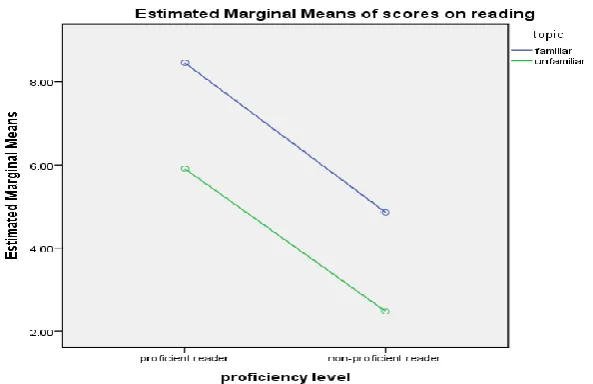
Figure 4.1. Proficient and non-proficient students’ scores in terms of familiar and unfamiliar topics in both classes
We found no interaction effect between our independent variables but significant main effects for both of them. However, we found larger effect size (Partial Eta Squared) for proficiency in comparison to topic familiarity in our Tests of Between-Subjects Effects and can see the same thing visually in Figure 4.1. All these findings bring us to the conclusion that we should accept our null hypothesis that topic familiarity cannot override high levels of reading proficiency.
V. DISCUSSION AND CONCLUSION
Our findings give support to the idea that as students get more proficient in their second language, their reliance on background knowledge diminishes although, with regard to many studies supporting the effect of background knowledge, it does not seem logical to say that this reliance becomes unnecessary altogether. Therefore, the findings of this study are in line with the findings of studies that have found substantial effects for the components of reading comprehension performance or language proficiency as a whole.
With respect to language proficiency the findings of this study support Hudson (1988), Carrell (1983) and Hammadou (1991), who argue that background knowledge does not help EFL learners’ reading comprehension performance too much at higher levels. This means that at higher levels of proficiency background knowledge cannot override linguistic proficiency. From the perspective of these researchers, the effect of background knowledge is more prominent at earlier stages of learning a second language and not as much significant at later stages. This finding is confirmed by Meyer and Freedle (1984) as well. These researchers believe that proficiency plays an important role in understanding both familiar and unfamiliar complex texts. On the flip side, McNamara (2001) states that language proficiency can even compensate for the lack of cohesion in the text implying that proficiency is more important than other elements. The findings of this study, however, cannot confirm Pulido’s (2004) claim that cultural familiarity does not help low proficiency students’ understanding of a text. Instead, the study has found a significant effect for topic familiarity which would be helpful to readers at all levels.
Vocabulary knowledge is considered to be the main component of reading comprehension ability (Chou, 2011; Hancock, 1998: Joshi & Aaron, 2000; Ma & Lin, 2015). This point is echoed by Laufer (1992) and Celce-Murcia et al., 2014 as well. The idea is that, comprehension happens when vocabulary of a text is understood. Insufficient vocabulary knowledge is believed to hinder comprehension of both the text and the questions that follow it (Chou, 2011; Garcia, 1991; Ma and Lin, 2015; Martin-Chang & Gould, 2008; Qian, 2002). The statements of all these researchers are in one way or the other in line with the findings of this study because as it was said, vocabulary is an essential component of reading comprehension ability.
APPENDIX A. EID AL FITR
Eid al-Fitr is a Muslim holiday that marks the end of Ramadan, the Islamic holy month of fasting. Eid is an Arabic word meaning "festivity", while Fiṭ r means "to break fast"; and so the holiday symbolizes the breaking of the fasting period. It is celebrated after the end of the Islamic month of Ramadan, on the first day of Shawwal.
Eid al-Fitr is sometimes also known as the "Smaller Eid" as compared to the Eid al Gorban that lasts three days following the Hajj (the pilgrimage to Mecca) and is casually referred to as the "Greater Eid"
Typically, on the day of the al eid Muslims generally greet each other and have a small breakfast before attending a special Eid prayer that is performed in congregation at mosques or open areas like fields, squares etc. Muslims are encouraged to dress in their best clothes (new if possible) for the occasion.
Answer the following questions. 1. When is Eid al Fitr celebrated? 2. What else is Eid al Fitr called?
3. Do Muslims fast on the day of Eid al Fitr? 4. Is Eid al Fitr more important than Eid al Gorban? 5. Why do Muslims pay Zakat al-Fitr?
6. What kind of clothes are Muslims encouraged to put on for Eid prayer? 7. Is Eid al Fitr prayer performed individually?
8. Which month comes after Ramadan? 9. Break fast in line 2 means:
a. sleep b. pray
c. have food or drink d. thank someone 10. Lasts in line 5 means:
a. starts b. continues c. ends d. is celebrated
APPENDIX B. EASTER DAY
Easter Day is the central religious feast in the Christian world. According to Christian scripture, Jesus rose from the death on the third day after his crucifixion. Some Christians celebrate this resurrection on Easter Day or Easter Sunday (also Resurrection Day or Resurrection Sunday). Easter is a moveable feast, meaning it is not fixed in relation to the civil calendar.
According to the traditions, Easter Sunday is celebrated by taking part in an Easter vigil, lighting a new fire outside the church early on Sunday morning. Another custom involves lighting the Paschal candle and decorating it with studs to celebrate Christ's wounds. Chanting of the Easter proclamation, reading the Old Testament, singing hymns and wishing happy Easter Day are other characteristics of the celebration.
Relatively newer elements such as the Easter Bunny and Easter egg hunts have become part of the holiday's modern celebrations, and those aspects are often celebrated by many Christians and non-Christians alike. The Easter Bunny, which is a counterpart to the Santa Claus of Christmas, brings gifts, a basket of colored eggs, to children on the night before the celebration. Easter eggs used to be painted chicken eggs, but a modern custom is to substitute chocolate eggs, or plastic eggs filled with confectionery such as jelly beans. These eggs are often hidden, allegedly by the Easter Bunny, for children to find on Easter morning.
Answer the following questions.
1. Is Easter Day celebrated on the same day each year? 2. Where does Easter story come from?
3. Where do Christians light fire during Easter vigil? 4. Were Easter Eggs in the past made of chocolate?
5. Have Easter Day traditions remained the same by the passage of time?
6. What aspects of Easter Day are often celebrated by Christians and non-Christians alike? 7. Are the New Easter Eggs painted chicken eggs?
8. What is Easter Bunny on Easter Day like compared to Christmas? 9. Resurrection in line 3 means:
a. festival b. reappearance c. event d. accident
10. Wounds in line 7 means: a. clothes
REFERENCES
[1] Abu Rabia, S. (2003). Cognitive and social factors affecting Arab students learning English as a third language in Israel.
Educational Psychology, 23(4), 347–360.
[2] Alptekin, C. (2006). Cultural familiarity in inferential and literal comprehension in L2 reading. System, 34, 494–508.
[3] Al-Shumaimeri, Y. A. N. (2006). The effects of content familiarity and language ability on reading comprehension performance of low- and high-ability Saudi tertiary students studying English as a foreign language. Journal of King Saud University, 18(2), 1–19.
[4] Anderson, R. C., & Pearson, P. D. (1984). A schema-theoretic view of basic processes in reading comprehension. In P. D. Pearson (Ed.), Handbook of reading research (pp. 255–292). New York, NY: Longman.
[5] August, D., Francis, D. J., Hsu, H. Y. A., & Snow, C. E. (2006). Assessing reading comprehension in bilinguals. The Elementary School Journal, 107(2), 221–238.
[6] Bartlett, F. C. (1932). Remembering. Cambridge: Cambridge University Press.
[7] Bernhardt, E. B. (1991a). Reading development in a second language: Theoretical, empirical, and classroom perspectives. Norwood, NJ: Ablex.
[8] Burgoyne, K., Whiteley, H. E., & Hutchinson, J. M. (2013). The role of background knowledge in text comprehension for children learning English as an additional language. Journal of Research in Reading, 36(2), 132–148.
[9] Carrell, P. L. (1983). Three components of background knowledge in reading comprehension. Language Learning, 33, 183– 207.
[10] Carrell, P. L., & Grabe, W. (2010). Reading. In N. Schmitt (Ed.), An introduction to applied linguistics (2nd ed.).London: Hodder Education.
[11] Celce-Murcia, M., Brinton, D. M., & Snow, M. (2014). Teaching English as a second or foreign language(4th ed.). Boston, MA: National Geographic Learning.
[12] Chou, P. T. (2011). The effects of vocabulary knowledge and background knowledge on reading comprehension of Taiwanese EFL students. Electronic Journal of Foreign Language Teaching, 8(1), 108–115.
[13] Dörnyei, Z. (2003). Attitudes, orientations, and motivations in language learning: Advances in theory, research and applicati ons.
Language Learning, 53, 3–32.
[14] Easter Day. (n.d.). Retrieved June 20, 2016 from http://www.myenglishpages.com/site_php_files/reading-easter-day.php. [15] Eid al-Fitr. (n.d.). Retrieved June 20, 2016 from http://www.myenglishpages.com/site_php_files/reading-eid-al-fitr.php. [16] Erten, I. H., & Razi, S. (2009). The effects of cultural familiarity on reading comprehension. Reading in a Foreign Language,
21(1), 60–77.
[17] Fisher, D. (n.d.). Vocabulary and background knowledge: Important factors in reading comprehension. Retrieved July 04, 2016 from http://flexliteracy.com/pdf/rar/FLEX-Vocabulary-and-Background-Knowledge.pdf.
[18] Fisher, D., & Frey, N. (2009). Background knowledge: The missing piece of the comprehension puzzle. Portsmouth, NH: Heinemann.
[19] Garcia, G. E. (1991). Factors influencing the English reading test performance of Spanish-speaking Hispanic children. Reading Research Quarterly, 26(4), 371–392.
[20] Grabe, W., & Stoller, L. F. (2002). Teaching and researching reading. Harlow: Pearson Education.
[21] Grabe, W. (2009). Reading in a second language: Moving from theory to practice. New York, NY: Cambridge University Press. [22] Hall, R., Greenberg, D., Laures-Gore, J., & Pae, H. K. (2014). The relationship between expressive vocabulary knowledge and
reading skills for adult struggling readers. Journal of Research in Reading, 37(1), 87–100.
[23] Hammadou, J. (1991). Interrelationships among prior knowledge, inference, and language proficiency in foreign language reading. Modern Language Journal, 75, 27–38.
[24] Hancock, O. H. (1998). Reading skills for college students (4th ed.). Upper Saddle Rivers, NJ: Prentice Hall.
[25] Haynes, M. (1984). Patterns and perils of guessing in second language reading. In J. Handscombe, R. Orem & B. Taylor (Eds.),
On TESOL 83: The question of control (pp. 163–176). Washington D.C.: TESOL.
[26] Horwitz, E. K. (1988). The beliefs about language learning of beginning university foreign language students. The Modern Language Journal, 72(3), 283–294.
[27] Hudson, T. (1988). The effects of induced schemata on the “Short Circuit” in L2 reading: Non-decoding factors in L2 reading performance. In P. L. Carrell, J. Devine & D. E. Eskey (Eds.), Interactive approaches to second language reading (2nd ed.) (pp.183–205). New York, NY: Cambridge University Press.
[28] Johnson, P. (1982). Effects on reading comprehension of building background knowledge. TESOL Quarterly, 16, 503–516. [29] Joshi, R. M., & Aaron, P. G. (2000). The component model of reading: Simple view of reading made a little more complex.
Reading Psychology, 21, 85–97.
[30] Kendeou, P., & Broek, P. V. D. (2007). The effects of prior knowledge and text structure on comprehension processes during reading of scientific texts. Memory and Cognition, 35(7), 1567–1577.
[31] Koda, K. (1994. Second language reading research: Problems and possibilities. Applied Psycholinguistics, 15, 1–28. [32] Koda, K. (2005). Insights into second language reading. New York, NY: Cambridge University Press.
[33] Laufer, B. (1992). How much lexis is necessary for reading comprehension? In H. Bejoint & P. Arnaud (Eds.), Vocabulary and Applied Linguistics (pp. 126–132). London: MacMilan.
[34] Levin, M. G., & Haus, G. J. (1985). The effect of background knowledge on the reading comprehension of second language learners. Foreign Language Annals, 18(5), 391–397.
[35] Ma, Y., & Lin, W. (2015). A study on the relationship between English reading comprehension and English vocabular y knowledge. Education Research International, 5(1), 1–14.
[36] Martin-Chang, S. Y., & Gould, O. N. (2008). Revisiting print exposure: Exploring differential links to vocabulary, comprehension and reading rate. Journal of Research in Reading, 31, 273–284.
[38] McNamara, D. S. (2001). Reading both high-coherence and low-coherence texts: Effects of text sequence and prior knowledge.
Canadian Journal of Experimental Psychology, 55, 51–62.
[39] Meyer, B. J. F., & Freedle, R. O. (1984). Effects of discourse type on recall. American Educational Research Journal, 21, 121– 143.
[40] Nassaji, H. (2002). Schema theory and knowledge-based processes in second language reading comprehension: A need for alternative perspectives. Language Learning, 52(2), 439–481.
[41] Nation, I. S. P. (1990). Teaching and learning vocabulary. Boston, MA: Heinle and Heinle.
[42] Oller, J. W. (1995). Adding abstract to formal and content schema: Results of recent work in Peircean semiotics. Applied Linguistics, 16, 273–306.
[43] Pallant, J. (2013). SPSS survival manual. Berkshire: Open University Press.
[44] Pulido, D. (2004). The effects of cultural familiarity on incidental vocabulary acquisition through reading. The Reading Matrix, 4 (2), 20–53.
[45] Qian, D. D. (2002). Investigating the relationship between vocabulary knowledge and academic reading performance: An assessment perspective. Language Learning 52(3), 513–536.
[46] Ricketts, J., Nation, K., & Bishop, D. V. M. (2007). Vocabulary is important for some, but not all reading skills. Scientific Studies of Reading. 11(3), 235–257.
[47] Ridgway, T. (1997). Threshold of the background knowledge effect in foreign language reading. Reading in a Foreign Language, 11(1), 151–167.
[48] Robertson, L. H. (2002). Parallel literacy classes and hidden strengths: Learning to read in English, Urdu and classical Arabic.
Reading Literacy and Language, 36(3), 119–126.
[49] Roller, C. M. (1990). The interaction between knowledge and structure variables in the processing of expository prose. Reading Research Quarterly, 25(2), 79–89.
[50] Shen, Z. (2004). Effects of previewing and providing background knowledge on EFL reading comprehension of American documentary narratives. TESL Reporter, 37(2), 50–63.
[51] Steffenson, M. S., Joag-dev, C., & Anderson, R. C. (1979). A cross-cultural perspective on reading comprehension. Reading Research Quarterly 1, 10–29.
[52] Tomlinson, B. (1998). Materials development in language teaching. Cambridge: Cambridge University Press. [53] Yule, G. (1996). Pragmatics. Oxford: Oxford University Press.
Soheil Mahmoudi is an MA graduate of ELT and an English language instructor at English Time Language School, Pendik Branch, Istanbul, Turkey. He teaches general English courses for different levels at this school. His areas of inter est are survey studies, methodology, linguistics, and sociolinguistics.