http://scienceasia.asia
_______________
2010 Mathematics Subject Classification: 17B10
Key words and phrases : Harish-Chandra module, generalized G-modules, infinite dimensional representation, cohomological induction.
© 2013 Science Asia 1 / 24
COHOMOLOGICAL INDUCTION ON GENERALIZED G-MODULES TO INFINITE
DIMENSIONAL REPRESENTATIONS
PROF. DR. FRANCISCO BULNES
Abstract. Extensions and globalizations of Harish-Chandra modules are used to obtain a representation theory that includes the cases of non-compact type of irreducible representations studied in the Vogan program. To it, is extended an infinitesimal character of anti-dominant weight λL ρ(u), of a representation Hcp,q(X,), with ,defined for X G/L. In this process, are obtained some
generalized versions of G modules to the use of differentiable cohomologies.
I.
INTRODUCTIONThe study of the classification problem of representations carried to determine that the problem could be solved if is classified all the irreducible unitary representations (open problem). Actually only have been classified in complete and satisfactory form the tempered representations and the discrete series or fundamental representations of Harish-Chandra, and have been obtained progresses in some irreducible unitary representations such as the characterized for the derived functor Extg*,K(F,V) 0,for all F, of finite dimension and all V , irreducible unitary. With respect to the tempered representations, the classification is completed thanks to the doctoral thesis work of Garnica [1], directed by the Vogan.
After Vogan and Salamanca-Riba [2], obtain progresses in the classification of a major class of irreducible unitary representations through of the minimal K -types method [3]. In this context, the classification of all the tempered representations is realized through of the generalization of the regular characters that parameterize a canonical representation determined in the Harish-Chandra class: parameterization that is obtained for the process of real parabolic induction or cohomological induction in each case.
this way, is obtained the complete Langlands classification of the tempered representations and with it a formula of corresponding characters to the Langlands decomposition in irreducible subrepresentations.
This paper haves the goal of extend and generalize in some sense the results that have been obtained in the parabolic and cohomological inductions using the concept of the generalized G -modules from the concept given by Harish-Chandra of G -module but adding the concept of generalized open orbit to the G -module.
II.
VOGAN PROGRAMIn the study realized by Vogan [4], is established the following problem of the representation theory (PTR). Given an irreducible representation (,V ), is possible to give a structure of Hilbert space on V, to have to , like an unitary representation.
Strictly speaking this bears the questions:
(i). Can we make that V , takes a bilinear Hermitian G -invariant form ,?
(ii). If said form exist, Is the form ,, positive define?
The goal of the Vogan program is to analyze some difficulties that arise when one tries to study accurately this program. The difficulties have their origin exactly in the flexibility of the definition of a representation (,V ), of G,a topological group.
Typically wants realize a representation of G,on a space of functions. If G,acts on the set X, then G,acts on functions on X, for
(g)f(x) f(g1x), x X y gG (1)
The difficulties arise when we try to decide exactly which space of functions on X, is necessary of consider. Since if G, is the Lie group acting smoothly on a manifold X, then one can consider the spaces C(X), Cc(X ), Cc (X)
or
) (X C .
irreducible representations contains at most a class of equivalence of irreducible unitary representations of G, this is;
, ~ ~
G
Gu (2)
with G~ , a class of infinitesimal equivalence of classes of admissible representations of G. This result in some way establishes a solution or general answer to the problem (PTR) of the Vogan program.
However, is required specifying the type of positive defined way that will guarantee the Hermitian structure of the representation algebra of VK,that induces to ,Κ , like a
Hermitian G -invariant form and thus endows to VK,like unitary representation in this class of infinitesimal equivalence, that is to say, the existence will have been guaranteed of at least an irreducible unitary representation in the class of unitary equivalence that is representation of G.
III.
DIFICULTIESThe existence in a G -invariant continuous Hermitian form ,, on V, implies the existence of ,Κ , on VK , but the reciprocal is not true. Since VK ,is dense in V , exists a
continuous extension at most of ,Κ, to V , but the extension cannot exist.
An important observation that one deduces from some concrete examples is that the Hermitian form can be defined only on "representations appropriately thin or small", at least it is what Vogan puts in evidence inside its program for each class of infinitesimal equivalence.
In the different spaces to consider C(X), Cc(X ), Cc (X)
ó C (X ), the space Cc (X)
offers as a suitable candidate and appropriately small and it can be endowed with a n invariant Hermitian form. The space is generally more "fat" like space to admit an invariant Hermitian form.
)} ( : ) ( , : ) ( {
* C V V C W B
V
), , (V C
(3)
where (), is the defined strong topology on neighborhood base in the origin consisting the groups W(B), defined by the spaces
*, } ) ( sup * { )
(B E e E
W eB
with B V,bounded.
Theorem. 3. 1. (Casselman, Wallach and Schmid) [5-7].
Suppose you that (,V), is an irreducible admissible representation of Lie groups G , on a Banach space V. We Define
. ) ' .( . . . . ) , ( ) ' .( . . . ) , ( , . . ) , ( , . . ) , ( V of dual inV ions hyperfunct of vectors V V de dual inV vector on distributi V inV vectors able differenti V inV vectors analitic V
Each one of these four representations is a soft representation of G , in the class of infinitesimal equivalence of ,and each one only depends on that equivalence class.
The inclusions ,
V V V V
V (4)
are continuous, with dense image. Anyone Hermitian form ,K,on VK ,is expanded uniquely to G -invariants continuous Hermitian forms ,, and ,,on V, and V .
The four representations
V V
V , , and V are called minimal soft distribution and maximal globalizations respectively.
theorem II. 1., they are the same one). The Hermitian form cannot be extended continually to the maximal distribution or globalization
V and V . Because could be necessary the use of representations of G,constructed on spaces of holomorphic sections of vector bundles and their corresponding generalizations. In this part is where later, inside of this work, will be induced and generalized the G -modules of Harish-Chandra [8, 9], being able to be related with the globalizations of Wong.
Now then, since through this way are obtaining unitary representations, is necessary specify a similar way or analogous to the followed to the obtaining of minimal and differentiable globalizations with the certainty of that the Hermitian forms can be defined on the representations.
IV.
MINIMAL AND MAXIMAL GLOBALIZATIONS
We consider a result of maximal globalizations of Harish-Chandra:
Teorema 4. 1. (Wong) [10]. We assume that the admissible representation V, is the maximal globalization of the (q,L K) module underlying [6]. Let the G invariant holomorphic vector bundle on X G /L,corresponding of (V X ). Then the operator , for the Dolbeault cohomology has closed range and such that every one of the spaces
), , (
,
X
H pq takes a soft representation of G, each one of these admissible representations is the maximal globalization of their underlying module of Harish-Chandra.
Proof: [11].
Def. 4. 1. Suppose G, is real and reductive. q, is a parabolic subalgebra of the complexified Lie algebra gC, and L, is the Levi factor of q. A (q,L) representation (,V), that is to say, admissible if the representation ,in L, is admissible. In this case the method of Harish-Chandra of V,is the (q,L K) module V LK, of vectors L K finites in V .
identify the unique classes of unitary representations corresponding to each one of the mentioned infinitesimal equivalence classes.
For it, is necessary develop a way to modify the Dolbeault cohomology to produce minimal globalizations in more grade that the maximal. Essentially we can follow the ideas of Serre, which are based on the realization of representations of minimal globalization obtained about generalized flag manifolds achieved first by Bratten. Of the duality used to define the maximal globalization the question it does arise, how can you identify the dual topological space of a cohomological space of Dolbeault on a complex neighborhood compact?
The question is interesting in the simplest case: Suppose X C,is open set and H (X),is the space of holomorphic functions X , in a topological vector space X , using the topology of uniform convergence of all the derivatives on compact sets.
For what would H(X),be natural alone to be questioned, what is the dual space?
This last question has a simple answer. Be Cc (X,densidades ),
the space of compactly supported distributions on X . We can think in this like the space of complex compactly supported 2-forms (or (1, 1)-forms) on X , with coefficients of generalized functions. For what, with more generality we write:
) , ( ) (
), , (
q p X
Ac pq Compactly supported forms on X with coefficients of generalized functions,
The differential operator of Dolbeault ,map (p, q)-forms to (p, q + 1)-forms and it preserves the support,
:Ac(1,0), (X) Ac(1,1), (X) Cc (X,densities ),
(5)
Then
, ) ( / ) ( )
(X A (1,1), X A 1,0 X
H c c (6)
Here the line __________ on 1,0( ),
X Ac
To open X , in C , the image of , is automatically closed, because the line ________ is not necessary. However this formulation has an immediate extension for any complex manifolds X (replacing 1 and 0 for the dimensions n, and n 1).
Let us enunciate the generalization of Serre [12]:
Theorem 4. 2. (Serre). Suppose that X , is a complex manifold of dimension n, , a vector holomorphic bundle on X , and ,is the canonical bundle of lines (of (n, 0)-forms have more than enough X ). We Define
) , (
,
0
X
A p = Space of the smooth valuates (0, p)-forms on X,
) , (
), , 0 (
X Ac p
= Space of valuates compactly supported (0, p)- forms with coefficients of generalized functions
Proof. [12].
We define the topological cohomology of Dolbeault de X , with values in ,as
, ) , ( /
) , ( ( ] [ker ) ,
( 0, 1,0
, 0
A X A X
X
Htopp p p (7)
This is a quotient of the usual Dolbeault cohomology and carries a locally convex topology also usual. Similarly we define
) 8 ( ,
) , ( /
) , ( ](
[ker ) ,
( (0, ), ( 1,0),
, 0
A X A X
X
Htopp p c p
the topological cohomology of Dolbeault with compact supports. Then a natural identification exists
) 9 ( *),
, ( )*
,
( 0,,
,
0
X H
X
Htopp Cntopp
Here *, is a vector holomorphic bundle dual of .
more, and the operators , automatically have closed range.
The central idea in this part of the program of Vogan is the desire to build representations of real reductive groups G , beginning with a measurable complex flag manifold X G /L, and using G equivariant holomorphic bundles of lines on X . Indeed, if we have
, /T K
X with r 0, in Hc0,r(X,),then ( , ),
, 0
X
Hc r in the irreducible G module on the corresponding coherent sheaf of O(), of global sections of the complex holomorphic
bundle , and the relationship among - cohomology and the sheaf is simple and is given by the space
) 10 ( )),
( , ( )) ( ,
( 0
X O H X O
For the infinite case, is necessary to use a finer structure of the flag manifolds like for example, the given by open orbits of flag manifolds and the continuous homomorphisms among said open orbits to induce a classification of the irreducible representations that reside in the space H 0(X ,O()), and that under the association of irreducible minimum
K types suggested by Vogan [3, 13], the widest class in classifiable irreducible unitary representations can be obtained by the theory of Langlands.
However we will establish a special formalization of the - cohomology to be able to use
G invariant holomorphic bundle of lines on X .
For compact G, the theorem of Borel-Weil says that all the irreducible representations of
,
G arise in this way as spaces of holomorphic sections of holomorphic bundles of lines.
Def. 4. 2. Suppose that X, is a complex manifold of dimension n, and , is a holomorphic vector bundle on X . The cohomology of (p, q)-Dolbeault compactly supported of X, with coefficients in , is for definition
) 11 ( ))),
( (
/(Im( )) ( )(
(ker( )* ,
( ( , ), ( , 1),
, 0
pq pq
c p
c X A A
H
If ,is of finite dimension then the cohomology Hcp,q(X ,), is a cohomology of Čech with compact supports of X,with coefficients in the sheaf ,
p
O of holomorphic p forms with values in .
) , (
,
, X
Hcptopq Hausdorff maximal Quotient of Hcp,q(X , ) Ker ()/Im( ), (12)
Then Htopp,q(X,), takes smooth representations of G (for translation of forms).
Then a clear consequence of the theorem of Serre; theorem 4. 2., and the theorem of Wong; theorem. 4. 1., using the definitions previous is the following corollary:
Corollary 4. 1 (Bratten) [14]. Suppose that X,is a complex manifold G / L, and assume that admissible representation V, is the minimal globalization of the (q,L K) module. Let
), , (
,
X
Acpq be the Dolbeault complex to with coefficients of generalized functions of compact support. Then the operator , has a closed range such that each one of the corresponding cohomological spaces Hcp,q(X, ), takes smooth representation of G (on the dual of a nuclear Fréchet space). Each one of these representations of G , is admissible and is a minimal globalization of their underlying module of Harish-Chandra.
Proof: [10, 14].
The fundamental relation of duality of minimal and maximal globalizations is given by the corollary. 4. 1., that makes allusion to the conjecture of Serre.
The theorem demonstrated by Bratten [14], is different: He defines a sheaf of germs of global sections A(X,), and demonstrates a parallel result for the cohomology of sheaves with compact support on X , with coefficients in A(X,).
When G, is of finite dimension, the two results are exactly the same one, being this easy to verify for that Dolbeault cohomology (with coefficients of generalized functions of compact support) and it calculates the cohomology of sheaves in this case.
The case of infinite dimension of V, comparing the corollary one enunciated previously with results of Bratten is more difficult of establish. The development of Vogan [10, 15], in all the exhibitions only speech of the Dolbeault cohomology and not of the cohomology of sheaves, foreseeing that the relationship between sheaves and the Dolbeault cohomology for bundles of infinite dimension is complicated and it bears bigger difficulties that those foreseen by the own theory of representations.
representations of infinite dimension [16, 17].
Equally to the Dolbeault cohomology with compact support. The weight L (u), that appears in the following corollary is therefore the infinitesimal character of the representationHc0,r(X ,), with ,having defined by X G/L.
Corollary 4. 2 (Vogan). Let Z K /L K, be a complex compact s dimensional submanifold of the complex n dimensional manifold X G/L . Let r ns,be the
co-dimension of Z , in X . Assume that V,is a (q,L) module of infinitesimal character
*, h
L and that V,is the minimal globalization of the (q,L K)module. Assume that ),
(u
L is weakly anti-dominant to u, this is, that L (u), is weakly dominant. Then:
(i). Hc0,q(X ,) 0, under q r.
(ii). If L Lm ax and V, is an irreducible representation of L,then ( , ), ,
0
X
Hc r is irreducible or cero.
(iii). If the module of Harish-Chandra of V, admits a Hermitian and invariant form, then the module of Harish-Chandra of Hc0,r(X ,), admits a Hermitian form.
(iv). If the module of Harish-Chandra of V, is unitary then the module of Harish-Chandra of
), , (
,
0
X
Hc r is unitary.
Proof. [10, 18] and of the corollary 4. 1.
V. u -COHOMOLOGY
Let g, be a reductive Lie algebra on C . Let h , be a cartan subalgebra of g, and let l, be the system of positive roots to (g,h).Let
, )
(
b h g
b
P
P (13)
Let q,be the subalgebra of b, enclosed b. Let l { (g g) q}, and corresponding P l,with
,
h g
l
l (14)
u g, (15)
Then q l u, and [l ,u] u. Let u- h
g, and q- l u-. Then.
-u l u
q By the theorem PBW (Poicaré-Bott-Weil) [19],
), ) ( ) ( ( ) ( )
(g U l uU g U g u
-U (16)
To U (g), enveloping algebra of Lie algebra g.
Be V,a g module with action Then
), , ( Hom ) ,
( V V
Ci u C iu (17) is a lmodule under the action (XYX((Y (adX(Y))) , X l,and Yu.Also
d
d(X X
The modules given for (17) are the complexes of the u cohomology that are useful to our goals.
VI. THE OPEN G(w)ORBITS:GENERALIZED G MODULES TO INFINITE DIMENSIONAL REPRESENTATIONS
The nature of the orbits that will be necessary to consider must be intimately related with the nature and shape of the components of the character , which is can be written as the decomposition
) 18 ( ,
hyperbolic elliptic
nil
elliptic
hyperbolic
) 19 ( )
( ) (
i s s
II II
G G G G
G
G G
e h
e n
The problem is to include the representation of L,whose characterhyperbolic , haves support on a hyperbolic set in G,[20, 21] which is an infinite dimension space and thus is an infinite dimensional representation.
The homogeneous spaces as G /L,are exactly the co-adjunct orbits of G, admitting totally complex polarizations, and these polarizations are exactly the complex structures of G /L [10]. As have been exposed in [2] and [18],the orbits method suggests that more unitary representations of interest of reductive groups can are obtained in three steps. The first step (which is poorly understudied) is joining representations to nilpotent co -adjunct orbits. The second step (which is the Vogan work [4]) is the cohomological induction which is applied to the homogeneous spaces G /L, to carry the “unitarization” from representations of L,to representations of G . The third step (work of Gelfand [22], Harish-Chandra [23] and Mackey [24]) is the parabolic induction of Levi subgroups of real parabolic subgroups.
Let q qw g, be denotes the parabolic sub-algebra represented for w,and let L,be the subgroup of isotropy of G,in w . Then L, include a fundamental subgroup of Cartan H,of
,
G then L ZG(G0)L0,and L0 L G0.
G modules of Fréchet are induced and irreducible G modules of infinite dimension are constructed whose differentiable cohomology is a cohomology of representations of infinite dimension applicable to the Langlands classification and some geometrical theorems as the theorem of Borel-Weil [16, 17, 19].
An extension of a G module is a open G orbit of a holomorphic bundle of flags on Fréchet spaces [15, 17].
One generalization of the extension of a G module H (G(w),q(E)) 0
q ,
, s q
is the
case when is of infinite dimension. For this case is necessary to build a version of extension of G module whose cohomology is the corresponding to a cohomology of representations of infinite dimension. s,is the complex dimension of a compact maximal submanifold Z(w),of G(w),such that
) 20 ( ,
/ )
(w K K L
Z
and E G(w), the homogeneous complex holomorphic vector bundle corresponding to the open G orbit G(w) Lˆ and maximum weigh .
If L T,the extension of the G module is reduce to set of global sections of the sheaf
), (
q
Ο of the complex holomorphic bundle of flag manifolds with maximum weigh . This is an irreducible G module of finite dimension with maximum weigh (Theorem of Borel-Bott-Weil) [25].
A version of extension of G module whose cohomology is that of representations of infinite dimension can be built starting from the induction of G modules on a differentiable cohomology defined as follows:
Def. 6. 2. A generalized open G orbit is the extension of G module (open L module on a differentiable cohomology) induced in the differentiable category given by the space
), ( ))
(
(G w Ind G w
I LG [15], (21) Def. 6. 3 (Bulnes) [9, 15]. A generalized G module is the induced G module by a
differentiable cohomology of representations of infinite dimension (E,), defined on generalized orbits of the complex homogeneous bundle
, /L G
where E , is a Fréchet space.
Using ucohomology, continuous cohomology and the generalization de la topology on complexes of fibered holomorphic bundles of Fréchet is having that:
Proposition 6. 1. (Bulnes) [4, 15, 17].
)), ( , / ( )) ( ,
(
q E
u I H G L O
Hct ct (23)
Proof. [9, 15].
Of these generalities in hand, we get immediately a description of the topological dual of Dolbeault cohomology.
V. RESULTS
Using the conjecture of Vogan on the possible extension of representations of L,to modules of Harish-Chandra to G,taking care that the co-border operators of the Dolbeault cohomology have all closed range, we apply this conjecture on the extension of the induced
G modules proposed to modules of Harish-Chandra of infinite dimension, obtaining the conjecture:
Conjeture. (Bulnes) [9]. Suppose that Hctq(g,L K; AL E*),is a (l,L K) module of finite longitude, E, their corresponding representation of L, and , the make holomorphic associated bundle to G/L.Then the co-border operators of the Dolbeault cohomology are all of closed range and to the case of infinite dimension the range of the co -border operators of the Dolbeault cohomology are closed provided certain intertwining operators applied to the corresponding induced G modules are modules of Harish-Chandra (which must satisfy the theorem of Vogan-Zuckerman on irreducible unitary representations of infinite dimension).
bundle module a radical nilpotent bundle of Borel subalgebras [2], [8], [11], and with pertinent generalizations of the G modules, is had a theorem of classification of representations of infinite dimension [8]:
Theorem. 7. 1 (Bulnes) [9, 15, 27]. Let , be denotes for Hctt (L(w),Oq(E)), a representation of infinite dimension of (q,L), and let E G(w), be the associated homogeneous vector bundle. Then the operator , to the complex de Dolbeault
, )*) (
), (
(G w q 1 L
A E u is of closed range.Then the cohomologies H (G(w),Oq(E)) 0,
q
, s q
are admissible G modules of Fréchet composition of series (these shape admissible representations of finite longitude). Their modules of Harish-Chandra underlying are given by functors of Zuckerman [11, 18] Ast(G,M ,b,) A(G,L,q,). E, have Infinitesimal Character L,,and trivial action u (To it the generalized G modules admit the infinitesimal G character u
,
G .
Proof. To that , be closed, is necessary that be regular in whole their domain (Wong’s
globalizations). Then , on H (G(w),Oq(E)),
q is a representative
K finite cohomology of strong harmonic 2
L form. By the intertwining operator 8, 15, 28, it is map fundamental series in harmonic forms of I(w),of ( / , )),
L
L G
Hq with
L , the bundle of
lines and ,is the unitary character of L G. Then , is regular in A(G,L,q,). Then by differentiable cohomology,
, 0 ) (F0
S (24)
), F ( F0 Q
with K type (,F0), in ( , ),
C
u
q
G L
C and S(F0) , represents the
class of cohomology non-vanishing on K L . Using results of u – cohomology (lemmas of Vogan [4, 27] and Kostant [19] of u – cohomology) to g modules. This class of
cohomology is the of the (l,L K) modules isomorphic to space H (G(w),E~),
q when
.
~
C
E But ,
C u
C and due to that the induced representations on generalized
G modules like the defined in the Def. 6. 1, and Def. 6. 2, can be identified under the Szegö intertwining operator [28, 29]
), , / ( )
( Ind
: 1
E E H G L E
q L
L
where
( / , ) Ind ( ~ ( 1u)*),
q G L q L G
H E E (26)
and Ind ( ~ ( 1 )*) ,
E
E q u
G L where )), ( ), ( (
E
E H G w Oq
q
(27)
Not one must lose sight that is wanted to carry on the classical representations
) (
Ind 1 L L
E , with discrete series , built up by the Vogan’s algorithm of minimal K types of Aq(), to the canonical tempered representations Ind ( ( )*),
1 u q G
L E where the
restriction fiber of E have Dolbeault operator L(w). In particular and using the
generalization of the Borel-Bott-Weil theorem (to L, locally compact),
, F ) ), /( ( ) ), /(
( 0, 2
,
0
u u u C
C H K K L
L K K
H q q (28)
We can to use these representations like complexes of Dolbeault to a globalization of Wong of type C (L(w), (*LL(w))*).
E If we induce certain representations
), /(
)
(w K K L
K of G(w), to L(w) G /L, of G(w) . But this is possible due to the construction of the generalized G modules. Then , on said complexes is close.
Then using like u dim C(K L)(x), with u ts, with t,and s, complex dimensions of
), )(
(K M x and (K L)(w), and the fact of that
, 0 )) ( ), ( ( ~ ~ E b o x M
H q (29)
, t p
and
, 0 )) ( ), ( ( E b o x L
H q (30)
, u p
we have the spectral succession of Leray of L(x) L(w), that collapse to
the vanishing of the group of cohomology ( ( ), ( )) 0,
E b
o x L
H q u,establish that
))), ( ), ( ( ( ), ( ( )) ( ), (
( ~ ~
E
E q b
b o o
o H L x H M x
x L
H s t s t (31)
and due to the development of the relative lemmas of Frèchet spaces is followed that (31) have structure of Frèchet space to the which the action of G , is a continuous representation (generalized G module).
We consider the following application.
Let G SU (2,2), be acting on the open orbit G(w) M . Then the holomorphic discrete series representations given by the representations Ind GL(q),are the corresponding to
the cohomology group ( / , ~( L/M ),
q
L G
H
M b
o with q 2,that is to say, are those which are realizable as holomorphic sections of certain homogeneous vector bundle over
M [30]. If
we consider to G,as the space of full flags in C4,we can use the pre-images of M , under natural projection having the the six open orbits G,G,G,G,G , and
,
G meaning that the Hermitian form has the indicated signatures (namely +, ++, ++ ,
and ++ for example to G,and analogous for the other orbits) when restricted to each part of the flag. For every one of this open orbits of SU (2,2),on G,and using an appropriate line bundle in every case, we can through of Penrose transform P,[29] we find the holomorphic discrete series as [27]
), , ( ) , (
:H 2 G 4 M 4
P (32)
where (M ,4), are the Zuckerman functor images. This six isomorphism are consequence of a calculation of direct images of the Penrose transform. We ask that if
), 2 , 2 (
SU can be represented on the corresponding L2 cohomology, that is to say, if is possible obtain the corresponding G modules of Harish-Chandra.
We take as example the open orbit G.Then using an intertwining operator (as the Szegö operator in (25)) inside the
end up pairing H 2(G,6), with 3( , ( ))
M
G G oq
H . Then the twistor transform T
(very linked to Penrose transform) as intertwining operator complies the relation (31) [31]:
) 33 ( ),
) ( , (
) , (
: 2 6 3
M
G G oq
H G
H
T
In the best of all possible worlds we would find a transform for each of the six open orbits and in this way obtain the complete discrete series.
Remember that in the more general case and the computation of Schmid´s thesis [5, 7], the cohomological space H 2(G,6), is a cohomological space of type H s(Q,oq(E)),in the
twistor transform where H s(Q,), indicates the expansion of cohomology class in infinite formal (topological) neighborhoods of Q,and the cohomological space of the right member of (33) in a more general context denotes a relative cohomology in the algebraic category.
Conclusions
Cohomologically should be induced with finer decompositions of an nilpotent algebra of u , obtaining spaces more classified "thin"; the corresponding admissible G modules of Fréchet. The obtained theorem can classify a great part of representations of infinite dimension although not their entirety due to the difficulty of obtaining a substantial algebra whose Dolbeault cohomology has an operator of closed range on the admissible
G modules that appear in the problem of representation of those (l,L K) modules for an algebra q.
However, choosing an appropriate infinitesimal G character, we could establish functors of Zuckerman corresponding to a algebra p u,
with u g/t,and canonical globalizations
,
g
X with g , g , g ,or g ; having the property of closed range.
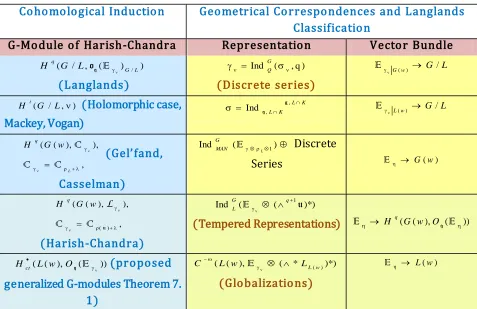
Table 1.
Cohomological Induction Geometrical Correspondences and Langlands
Classification
G-Module of Harish-Chandra Representation Vector Bundle
) ) ( , /
( G/L
q L G H E q o (Langlands) ) q , ( Ind G Q (Discrete series) L G w
G( ) /
E ) , / (G L
H i (Holomorphic case,
Mackey, Vogan) K L K L , ,
Ind q g EL(w) G/L
, ), ), ( ( L w G H q C C
C (Gel’fand,
Casselman) ) ( Ind 1 L G
MAN E Discrete
Series E G(w)
, ), ), ( ( u C C L w G H q (Harish-Chandra) )*) ( (
Ind 1u
q G
L E
(Tempered Representations) E H (G(w),Oq(E))
q )) ( ), ( ( E q O w L
Hct (proposed
generalized G-modules Theorem 7. 1) )*) * ( ), (
(L w LL(w)
C
E (Globalizations) ) (w L E Technical Notation
G Lie Group of finite dimension or infinite dimension
G
C Category of the continuous G modules
G
C Category of the differentiable G modules
) ; (G V
Hctq Space of differentiable cohomology of dimension q, with coefficients in V .
) ; (G V
Hctq Space of continuous cohomology of dimension q, with coefficients in V .
) , (G V
(E)
I Generalized G module or induced G module for the open G orbit ,
/ )
(w G L
G whose complex holomorphic bundle is E G /L.
) (G L E
o Sheaf of germs of holomorphic sections of the vector principal fibered bundle .
/L G GLE
b Borel subalgebra.
) /
(
, 0
L K K
C s Cocycle space of the ucohomology of the cohomological space given by the Borel-Weil theorem.
P Penrose transform.
o Sheaf of the D modules that are irreducible G modules of finite dimension with maximal weight .
q Parabolic subalgebra
)
Int(G Inner group.
)
Ad( G Adjunct group of group G .
)
ad(g Adjunct algebra of Lie algebra g.
T Torus of finite dimension of a Lie subgroup of a Lie group G .
F Irreducible G module of finite dimension of maximal weight .
))
( , / (G L o E
Hq Admissible G module whose sheaf of germs is the of the holomorphic sections of the complex vector holomorphic and homogeneous bundle E G /L.
) (w
G Open G orbit of the flag manifold W .
) (w
g Proper root space of g, of the associated adjunct maps to the functional .
g Lie algebra of the Lie group G .
h Cartan subalgebra if ht a. A Lie subalgebra of g.
) , (
Hom g,K V W Space of (g,K) invariant homomorphisms that go from module V, to the module W .
m – Corresponding algebra of the Lie subgroup M ,of the Lie Group G.
0}. ] , [ if only and if , ) Ad(
{ F
a g
m h g h h h
P Parabolic subgroup of G.
( ,o( )) Zuckerman functor of locating of the global sections that shape an irreducible
G module of finite dimension with maximal weight .
C
dim Complex dimension.
K L K L
, ,
Ind q g Induced representations of the polarization q, of g, for the method of the uni-potent representations of Vogan. These representations are (g,L K) modules.
T twistor transform
n Nilpotent algebra.
H Cartan subgroup of the Lie group.
l Levi algebra. Algebra used in the Levi decomposition of Lie algebra g, corresponding to
the Lie group G .
0
G Space which arise of the identification G0 0 (G0), that is to say, the space of points )}
( End Ad , ) ( Ad
R
G Component of real points of the real reductive Lie group G (open subgroup of G ).
C
G Analytic Lie group.
L Levi group.
Tensor product of modules belonging to an associative ring endowed of the tensor product to their elements.
) (
Cl Closure.
) ( 0
0
G Identity component of the Lie group G0 .
) (g
T Tensor algebra of the Lie algebra g.
MAN
0 Langlands decomposition endowed of homomorphism
, and space modulo the Hilbert space H .
) , (g a
W Weyl group of the homomorphisms on g, modulus a.
t Lie algebra corresponding to maximum torus in G .
] ,
[g g Bilateral ideal of antisymmetric elements.
) (g
Z Centre of Lie algebra g.
) (
Ind GP Induced representation , of the group P , to the group G .
M
0 – Connected component of the Lie subgroup
M , of the parabolic subgroup P , of the real reductive group G .
) (V
J Jacquet module of the module V .
p Minimal compact subalgebra of the decomposition g t p.
C
W Weyl group.
Ad Endomorphism of the Lie group G . Adjunct Map on the group G .
ad Endomorphism of the Lie algebra g. Adjunct map on the algebra g.
K Compact subgroup of the Lie group G .
G
0 Identity component of
G . Explicitly 0G 0 ANK ,or through continuous homomorphisms X(G), to know, 0G {g G (g)1, X(G)}.
REFERENCES
[1] E. Garnica-Vigil, “On the Classification of Tempered Representations for a Group in the Harish-Chandra Class,” PhD. Thesis, MIT (1992) June 1.
[2] S. A. Salamanca-Riba, D. Vogan, “On the classification of unitary representations of reductive Lie groups,” Annals of Mathematics, 148 (1998), 1067–1133
[3] S. A. Salamanca-Riba, “On the unitary dual of real reductive Lie groups and the Aq(λ) modules: The
strongly regular case,” Duke Math. J. Volume 96, Number 3 (1999), 521-546.
[4] D. Vogan, “Representations of Real Reductive Groups”, Birkhäuser , (Green Book), New 1981.
[5] W. Casselman and D. Wigner, “ Continuous Cohomology and a Conjecture of Serre's”, Invent. Math. 25 (1974), 199-211.
[6] N. Wallach, “On the Enright-Varadajan modules, a construction of the discrete series,” AnnSci. École Norm. Sup. (4) 9 (1976) 81-102.
[7] W. Schmid, “Homogeneous complex manifolds and representations of semisimple Lie groups and Lie algebras,” PhD. Thesis, University of California, 1967.
[8] Harish-Chandra, Harmonic analysis on real reductive groups III, Ann. Of Math. (2) 104 (1976) 117-201. [9] F. Bulnes, “Extension of G-Modules and Generalized G-Modules,” International Conference on Representation Theory of Reductive Lie Groups., IM/UNAM, Mexico, 2005.
[10] D. Vogan, “Unitary Representations and Complex Analysis,” Springer-Verlag Monograph, N. Y. USA, 2005. [11] H. Wong, “Dolbeault Cohomological Realization of Zuckerman Modules Associated with Finite Rank Representations,” J. Funct. Anal. 129, No. 2 (1993), p428-459.
[12] J-P. Serre, “Galois Cohomology,” Springer-Verlag Monographs in Mathematics, 1997.
[13] A. Knapp and D. Vogan, “Cohomological induction an Unitary Representations,” Princeton University Press, Princeton, N. J. 1995.
[14] T. Bratten, “Realizing Representations on Generalized Flag Manifolds,” Compositio math, 106 (1997), p283-319.
[15] F. Bulnes, “Some Relations Between the Cohomological Induction of Vogan -Zuckerman and Langlands Classification,” Faculty of Sciences, UNAM PhD. Dissertation, ed., F. Recillas. 2004.
[16] H. Cartan, S. Eilenberg, Homological Algebra, Princeton University Press, 1956.
[17] C. Chevalley and S. Eilenberg, “Cohomology Theory of Lie Groups and Lie Algebras,”Transactions of the
American Mathematical Society Vol. 63, No. 1 (Jan., 1948), pp. 85-124.
[18] D. Vogan, and G. Zuckerman, “Unitary Representations with Nonzero Cohomology,” Comp. Math. 53 (1984), 51-90.
[19] B. Konstant, “Lie Algebra Cohomoloy and Generalized Borel-Weil Theorem,” Ann. Of Math, 74 (1961), p729-387.
[20] W. Casselman, D. Milicic, “Asymptotic Behavior of Matrix Coefficients of Admissible Representations,” Duke Math Journal 49 (1982) pp869-930.
[21] V. Guillemin, S. Sternberg, Geometric Asymptotics, Math. Surveys Vol. 14, American Mathematical Society, 1978.
[22] I.M. Gel’fand, I. M. Graev and Piatetski-Shapiro, Representation theory and automorphic functions, Saunders Math. Books, 1969.
[23] Harish-Chandra, “Spherical Functions on a Semi-simple Lie Group I,” Amer. J. Math. 80 (1958) pp241-310.
[24] G. Mackey. The theory of Unitary Group Representations (Chicago Lectures in Mathematics) University Of Chicago Press (August 1, 1976) ISBN 0-226-50051-9
[25] J. Carmona, Sur le Classification des Modules Admissible Irréducibles, Lectures Notes in Math, 1020, Sprnger-Verlag, New York, 1983, pp11-34.
[26] F. Bulnes, u-Cohomology, generalizations and some ideas, International Conference on Representation Theory of Reductive Lie Groups., IM/UNAM, Mexico, 2005.
[27] A. Knap, Introduction to Representations in Analytic Cohomology, Amer. Math. Society (1) 154 (1992) pp1-19.
[28] A. Knapp, E. Stein, Intertwining operators for semisimple groups, Ann. Of Math. 93 (2) 1971, pp489-578. [29] F. Bulnes, Orbital Integral on Reductive Lie Groups and their Algebras, Intech, Rijeka Croatia, 2013. [30] F. Bulnes, “Doctoral course of mathematical electrodynamics,” Internal. Proc. Appledmath 2, SEPI -IPN, México, 2006, pp. 398-447.
[31] M. G. Eeastwood, The generalized twistor transform and unitary representations of SU(p, q), pre-print, Oxford University, 1983.
PRINCIPAL OF DEPARTMENT OF RESEARCH IN MATHEMATICS AND ENGINEERING, TECHNOLOGICAL INSTITUTE OF HIGH STUDIES OF CHALCO, FEDERAL HIGHWAY MEXICO -CUAUTLA TLAPALA “LA CANDELARIA”, CHALCO, STATE OF MEXICO P. C. 56641, MEXICO